Article
J. Braz. Chem. Soc., Vol. 26, No. 3, 506-512, 2015. Printed in Brazil - ©2015 Sociedade Brasileira de Química 0103 - 5053 $6.00+0.00
A
*e-mail: [email protected]
#Current address: Alberto Luiz Coimbra Institute for Graduate Studies and Research in Engineering (COPPE), Federal University of Rio de Janeiro, 21941-972 Rio de Janeiro-RJ, Brazil
The Performance of Crosslinking with Divinyl Sulfone as Controlled by the
Interplay Between the Chemical Modification and Conformation of Hyaluronic Acid
Andréa A. M. Shimojo, Aline M. B. Pires,# Rafael Lichy and Maria H. A. Santana*
Department of Engineering of Materials and of Bioprocesses, School of Chemical Engineering, University of Campinas (UNICAMP), 13083-970 Campinas-SP, Brazil
Hyaluronic acid (HA) microparticles crosslinked with divinyl sulfone (DVS) are primarily used in viscosupplementation to restore the viscoelastic properties of synovial fluid in the treatment of joint diseases. The crosslinking degree provides the swelling and rheological properties required for injectable application and biological stability. In this work, we studied the effects of alkaline medium on the crosslinking performance between HA and DVS. The crosslinking degree was evaluated based on the modification of the swelling and rheological properties of HA microparticles crosslinked at 1/1 HA/DVS mass ratio. Stable microparticles were obtained by shearing in the narrow pH range of 11.79 to 12.63. The microparticles exhibited gel-like dynamic mechanical behavior in the frequency range examined. Alkalinity increased the swelling and decreased the viscoelasticity of the HA microparticles. Ultimately, the interplay between the chemical modification and conformation of HA chains may control viscoelasticity and swelling at the levels required for specific applications.
Keywords: biomaterials, crosslinking, rheology, viscosity and viscoelasticity, swelling
Introduction
Crosslinking reactions involving hyaluronic acid (HA) have often been used to create a polymer network with high stiffness and low susceptibility to enzymatic degradation.1 Four functional groups of the HA molecules are susceptible to chemical modification: the carboxylate group, the acetamido group, the reducing end-group of the polymer and the hydroxyl groups. Furthermore, the glycosidic bonds can be broken by oxidation, producing shorter chains or oligosaccharides.2,3
It is not known which of the hydroxyl groups reacts; however, because of the better accessibility of reagents to primary alcohols, it is reasonable to assume that the reaction occurs mainly on the hydroxyl of C6 of the N -acetyl-glucosamine moiety of HA.4,5
HA crosslinking reactions typically use polyfunctional reagents such as divinyl sulfone (DVS), 1,4-butanediol diglycidyl ether (BDDE) and adipic acid dihydrazide (ADH). Moreover, aldehyde reagents can also crosslink HA by forming a protein bridge between hydroxyl groups.2
Crosslinking based on DVS begins with the formation of reactive alkoxy radicals induced by the alkaline medium, followed by the generation of sulfonyl-bis-ethyl crosslinks between hydroxyl groups, which give rise to an infinite network of HA chains (Figure 1).6 The first step of the reaction is the deprotonation of hydroxyl at alkaline medium. Each deprotonated OH or alkoxide ion will then react with the electron-deficient double bond in one vinyl sulfone group of DVS.7
is strongly dependent on type and concentration of crosslinkers and on the solvent composition. Hence, the physicochemical parameters, such as the molecular weight, swelling and rheological properties, of the polymer in solution are substantially affected by crosslinking.
HA-DVS microparticles, added to fluid non-crosslinked HA, are widely used as a viscosupplement to meet the requirements of viscoelasticity, biological stability and injectability in humans. Despite the extension of the application, studies relating the crosslinking degree to the swelling, rheological and injectability properties of HA hydrogels remain scarce.13-15
Balazs and Leschchiner16 described the effects of the extension of the crosslinking of HA-DVS on the swelling of HA-DVS gel particles, as controlled by factors such as the HA molecular weight, the HA/DVS mass ratio and the concentrations of HA, alkali and neutral salts. Alkali concentrations of 0.2 and 0.01 mol L-1 were studied for a HA/DVS ratio of 5/1. At this ratio, the swelling decreased with increasing pH, indicating a higher crosslinking degree. In previous work, we studied the influence of the size of HA microparticles at a 1/1 HA/DVS mass ratio on the swelling, rheological properties and extrusion force.14 The size range of 75-100 µm proved to offer the best balance between viscoelasticity and swelling properties. However, a mixture with fluid HA (non-crosslinked) was required to meet the requirements of injectability in vivo. In subsequent studies, we examined the crosslinking of HA microparticles sized to 75-100 µm as controlled by the HA/DVS mass ratio at pH 12.30.
This work extends our previous findings by investigating the influence of an alkaline reaction medium on the crosslinking degree of HA microparticles sized 75-100 µm and crosslinked with a 1/1 HA/DVS mass ratio. The effects on the swelling and rheological properties of HA microparticles were analyzed in terms of the interplay between HA conformation and the extension of the crosslinking reaction. The results showed alkaline control in the narrow pH range from 11.79 to 12.63, which can serve to fine-tune the HA-DVS crosslinking degree. These changes, combined with the HA/DVS ratio, may produce softer microparticles that do not require mixture with fluid non-crosslinked HA for injection in humans, or they may increase the crosslinking degree at lower concentrations of DVS.
Experimental
Materials
Hyaluronic acid with an average molecular weight of 3.5 × 10⁶ Da was obtained by bacterial fermentation using
Streptococcus equi subsp. zooepidemicus ATCC 39920 in the School of Chemical Engineering of the University of Campinas, according to the protocol described by Pires et al.17-19 Divinyl sulfone and phosphate buffered saline (PBS) were purchased from Sigma-Aldrich (St. Louis, MO, USA). All other reagents were purchased from Synth® (Diadema, SP, Brazil) unless otherwise specified.
Methods
Crosslinking and preparation of HA-DVS microparticles The HA hydrogels were prepared in the presence of NaOH concentrations of 0.05 to 1 mol L-1, based on previous studies by Balazs and Leshchiner.16 The lower limit was dictated by the reaction requirement of a pH higher than 9, and the upper limit was determined by HA degradation by alkaline hydrolysis. The crosslinking reaction was performed by adding DVS in a 3% (g per 100 g) solution of HA to an alkaline solution containing 3% (g per 100 g)NaCl. The HA/DVS mass ratio was 1/1. The reaction was performed at 25 ºC for 4 h. The product was washed for 2 days under reciprocal agitation at 200 rpm. After drainage of the wash solutions, the hydrogel was shaken at 200 rpm in a solution of 10 mmol L-1 PBS for an additional 24 h. HA-DVS microparticles were obtained by shearing of the plain crosslinked hydrogels in an Ultra-Turrax T-25 (IKA, Germany) at 24.000 rpm, according to the methodology described by Shimojo et al.14 The processing time was adjusted to obtain microparticles in the range of 75 to 100 µm (87.5 µm mean diameter).
Characterization of HA in alkaline medium
Characterization of HA-DVS microparticles
The chemical modifications of hyaluronic acid by DVS were previously identified by infrared spectrometry (Shimadzu IR Prestige-21 infrared spectrophotometer, Kyoto, Japan) through the characteristic peaks for DVS, which exhibits absorptions at 1310 cm-1 (S=O asymmetric stretching vibrations), 1130 cm-1 (S=O symmetric stretching vibrations) and 794 cm-1 (S−C stretching vibrations) and through the ether bond at 1255 cm-1 (C−O−C stretching vibrations).12,15
The HA-DVS microparticles were characterized based on their mean diameter, swelling and rheological properties. Particle size measurements were performed by laser scattering in a Horiba LA-900 particle analyzer (Horiba Instruments Incorporated, USA). The analysis was performed with the HA-DVS microparticles dispersed in water.
Swelling measurements were performed in PBS at 25 ºC for 72 h. According to Zawko et al.,21 the swelling ratio of HA hydrogels reaches the maximum attainable swelling in water. Nevertheless, the microparticle hydrogels prepared in this work were swelled in PBS to approximate in vivo
conditions.
The HA-DVS microparticles were weighed after swelling, and the weight of the dry gels was determined by drying the gel under vacuum (1 mm Hg) at 25 ºC for 3 days, according to the methods published by Shu et al.22 All measurements were performed in triplicate.
The equilibrium water content (EWC) was determined
according to Collins and Birkinshaw.23 EWC was
calculated at pH 7 in PBS at 25 °C. The fraction of free water in total water was calculated as the ratio of the endothermic peak area for water of the swollen HA-DVS microparticles to the melting endothermic heat of fusion (−334 J g-1) for pure water, as described by Ahmad and Huglin.24 The bound water was expressed as the difference between the total and free water. The endothermic peak maximum of the swollen HA-DVS microparticles ranges between 0.4 and 1.6 °C.
The state of water in the swollen HA-DVS microparticles was determined by differential scanning calorimetry (DSC) analysis using a TA Instruments DSC 2920 differential scanning calorimeter (TA Instruments, USA). The temperature was cooled to −40 ºC and then heated to 40 ºC at a heating rate of 5 ºC min-1 under 60 cm3 min-1 of nitrogen gas flow. From the area of the peaks normalized for sample mass, the endotherm associated with water loss was obtained and compared with the theoretical value for water, according to Collins and Birkinshaw.25
Rheological measurements were performed on a Rheometer Haake, model RheoStress 1 (Haake Inc.,
Germany), in both the steady and oscillatory regimes using a parallel plate geometry of 20 mm at 25 °C. Oscillatory measurements were performed in the linear region at a stress of 1.188 Pa in a frequency range of 0.1-10 Hz. Steady shear measurements were taken at shear rates of 0.1-50 s-1. The rheological parameter was calculated by equations 1, 2 and 3:
G’ = A ωB (1)
where G’ is the storage modulus; ω is the oscillation frequency in rad s-1; A is a constant; and the exponent B is the slope in a log-log plot of G’ versus ω.
tan δ = G”/G’ (2)
where tan δ is the phase angle; G’ is the storage modulus; and G” is the loss modulus.
η = Kγn–1 (3)
where η is the viscosity (Pa s); γ is the shear rate (s-1); K is the flow consistency index (Pa sn-1); and n is the flow behavior index (dimensionless).
Results and Discussion
Effects of alkaline medium on HA conformation
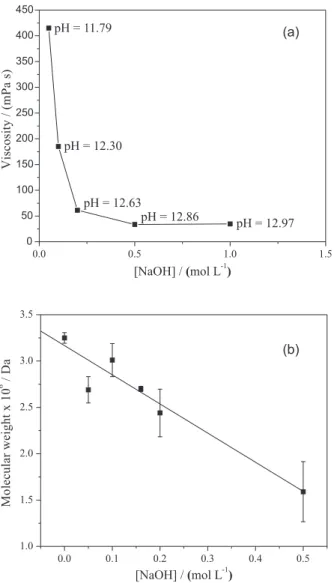
Figure 2 shows the behavior of the viscosity and molecular weight of HA after the addition of NaOH in the range of 0.05 to 1 mol L-1. Although the change in pH was moderate (11.79 to 12.97), there was a sharp decrease in viscosity in the pH range between 11.79 and 12.63 (Figure 2a). Slight changes in the molecular weight of HA were observed up to 0.2 mol L-1 (Figure 2b). However, for 0.5 mol L-1 NaOH, the decrease in the average molecular weight of 63% indicates breaking of the polymer chains. The average molecular weight of the solution of 1.0 mol L-1 NaOH was not measured to avoid damage to the chromatographic column.
random coil configuration, thereby reducing the viscosity of the medium.27
With respect to molecular weight, Cowman and Matsuoka28 showed that the addition of alkali changes the conformation of the molecule through the breaking of hydrogen bonds. The polymer molecules begin to untangle from each other and align themselves in the direction of flow, resulting in a drastic reduction in viscosity.
These findings explain the results obtained for the viscosity and molecular weight of HA in the presence of NaOH (Figure 2). They also predict significant effects on the crosslinking reaction with DVS because of the changes in the conformation of HA with the proximity of the chains that results from the contraction of untangled molecules with increasing pH. In addition, while the decrease in viscosity enhances the diffusion of DVS, the contraction of the HA molecule hinders the entrance of DVS into the internal sites of chemical reaction.
Effects of alkalinity on the crosslinking of HA
We previously used Fourier transformer infrared spectroscopy (FT-IR) to confirm the crosslinking of HA with DVS using a NaOH concentration of 0.1 mol L-1.14 In our study, we used a HA concentration of 3% (g per 100 g) and a pH range that slightly changes the molecular weight of HA and hinders the formation of pendant groups.6
HA is hydrated extensively by water because the water forms hydrogen bonds with the N-acetyl and carboxyl groups. The dipole attraction of the hydrogen bond to the carboxyl group results in HA affinity for retaining water.29
Chemically crosslinked HA hydrogels also exhibit the ability to absorb large amounts of water and saline solution.29
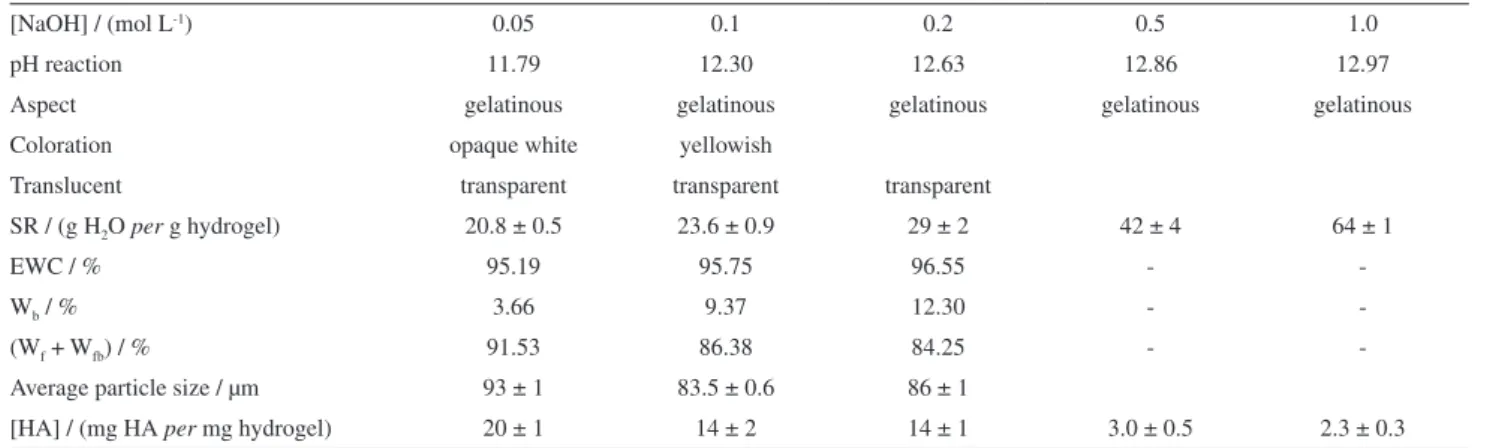
Table 1 shows the swelling ratio (SR) and EWC of HA microparticles as calculated according to Collins and Birkinshaw.25
The swelling ratio of HA-DVS microparticles increased with increasing concentration of NaOH from 0.05 to 0.2 mol L-1. This behavior indicates a decrease in the crosslinking degree with increasing pH due to the higher availability of functional groups that interact with water, thereby increasing the swelling degree. The HA-DVS microparticles crosslinked at pH 12.86 to 12.97 were not stable after disintegration in Ultra-Turrax at 10,000 rpm for 1-2 min. Although these microparticles also showed a gelatinous and transparent appearance after wash steps, they had a rather soft consistency.
The HA-DVS microparticles crosslinked at lower pH showed the lowest EWC and bound water content, indicating a more compact structure. In this case, the lower bound water content was also explained by the decreased ability to form hydrogen bonds with water molecules due to the higher degree of crosslinking.
Figure 3 shows the effects of alkalinity on the mechanical spectra and on the flow curves for the HA-DVS microparticles. The mechanical spectrum (Figure 3a) showed a pronounced increase in the dynamic elastic modulus (G’) with decreasing pH, suggesting a higher density of crosslinking. These results also agree with the overall result of the swelling ratio obtained.
The HA-DVS microparticles prepared in this work exhibited typical gel-type mechanical spectra, i.e., G’ higher than the dynamic viscous modulus (G”) throughout the studied range. Moreover, the curves were almost frequency independent. According to Xuejun et al.,30 similar behavior has been observed for many biological hydrogels. This behavior demonstrates an increased elasticity for the crosslinked HA hydrogel based on network stabilization through the strong covalent crosslinks, reducing the intrinsic mobility of the chains and increasing the relaxation
0.0 0.5 1.0 1.5
0 50 100 150 200 250 300 350 400 450
pH = 12.97 pH = 12.86
pH = 12.63 pH = 12.30
V is co si ty / (m P a s)
[NaOH] /(mol L-1)
pH = 11.79
0.0 0.1 0.2 0.3 0.4 0.5
1.0 1.5 2.0 2.5 3.0 3.5 M o le c u la r w e ig h t x 1 0 6 / D a
[NaOH] /(mol L-1)
(a)
(b)
time characteristic of motion. Consequently, the polymer chains cannot release stress during the period of oscillation and exhibit an elastic behavior.
The degree of frequency dependence can also be determined by the well-known power law parameters described by Ramkumar and Bhattacharya.31 In the power law relationship, G’ is the storage modulus; ω is the oscillation frequency in rad s-1; A is a constant; and the exponent B is the slope in a log-log plot of G’ versus ω. The B values define the strength and nature of the gels. It is known that B = 0 for a covalent gel, whereas B > 0 for physical gels, according to Khondkar et al.32
Table 2 shows the power law parameters and the values of tan δ (= G”/G’) calculated for the HA-DVS microparticles.
According to Ikeda and Nishinari,33 the mechanical spectrum of gels can be related to the gel strength.Weak gels are slightly different from conventional gels in two respects: the moduli have low frequency dependence, and the magnitude of G’ is often 10 times smaller than the magnitude of G”. In contrast, strong gels exhibit G’ higher than G”; however, the slope of the G’ lines is zero, while G” displays a minimum at intermediate frequencies.33,34 Table 1. Swelling properties of HA-DVS microparticles with varying NaOH concentrations. HA and NaCl concentrations: 3% (g per 100 g), 1/1 HA/DVS mass ratio, 25 °C in PBS
[NaOH] / (mol L-1) 0.05 0.1 0.2 0.5 1.0
pH reaction 11.79 12.30 12.63 12.86 12.97
Aspect gelatinous gelatinous gelatinous gelatinous gelatinous
Coloration opaque white yellowish
Translucent transparent transparent transparent
SR / (g H2O per g hydrogel) 20.8 ± 0.5 23.6 ± 0.9 29 ± 2 42 ± 4 64 ± 1
EWC / % 95.19 95.75 96.55 -
-Wb / % 3.66 9.37 12.30 -
-(Wf + Wfb) / % 91.53 86.38 84.25 -
-Average particle size / µm 93 ± 1 83.5 ± 0.6 86 ± 1
[HA] / (mg HA per mg hydrogel) 20 ± 1 14 ± 2 14 ± 1 3.0 ± 0.5 2.3 ± 0.3
aSR: swelling ratio; EWC: equilibrium water content; W
b: bound water; Wf: free water; Wfb: freezing bound water.
0.1 1 10
10 100 1000
G
'a
n
d
G
"
/
P
a
Frequency / Hz
0.1 1 10
1 10 100 1000
V
is
co
si
ty
/
(P
a
s)
Shear rate / s-1
(a)
(b)
Figure 3. (a) Mechanical spectrum and (b) flow curves of crosslinked HA-DVS microparticles at different NaOH concentrations (HA and NaCl concentrations: 3% (g per 100 g), HA/DVS mass ratio: 1/1): () 0.05, () 0.1 and () 0.2 mol L-1. G’ (closed symbol) and G” (open symbol) moduli.The measurements were performed using swollen HA-DVS microparticles equilibrated in PBS.
Table 2. Values of tan δ (at 4.6 Hz) and power law parameters A and B for the relationship G’ = A.ωB, determined from the mechanical spectra; and K and n values in the pseudoplastic domain of η versus γ determined from the flow curves for HA-DVS microparticles
[NaOH] /
(mol L-1) A / (Pa s) B (slope) tan δ K / (Pa s n-1) n
0.05 774.6 0.041 0.13 78 0.38
0.1 617.3 0.052 0.17 69 0.32
The tan δ values and slopes of the curves of G’ for HA-DVS microparticles prepared in this work showed an increase in the strength of the hydrogels with decreasing pH of the reaction mixture, suggesting greater entanglement of the chains or greater crosslinking density. These hydrogels were classified as covalent and weak hydrogels (B ca. 0 and tan δ > 0.1).
The values of the parameters K and n in the Ostwald de Waele power law (η = K.γn–1) are also shown in Table 2.35,36 A strong shear thinning is observed at higher shear rates (Figure 3b), with values of flow indexes (n) as low as 0.09-0.38, indicating non-Newtonian pseudoplastic behavior in the pH range studied.37
According to the reaction mechanism (Figure 1), increased pH was expected to increase the chemical modification of DVS and the degree of crosslinking due to the greater availability of the −OH groups. As a consequence, the G’ and G moduli would increase, while SR decreased.
However, the mechanical spectrum, flow curves and SR values showed the opposite behavior: a decrease in the moduli (G’ and G”) (Figure 3a) and increase in SR (Table 1) with increasing pH, suggesting a lower crosslinking degree. These results demonstrate our initial hypothesis regarding the interplay between chemical modification and conformation of HA on its crosslinking with DVS.
The dependence of the HA/DVS ratio also might be considered. Despite the higher availability of −OH groups, Balazs and Leshchiner16 did not obtain effective crosslinking in the presence of NaOH at concentrations lower than 0.2 mol L-1 for a 5/1 HA/DVS ratio.
Conclusions
The alkaline medium plays an important role with regard to the conformation of HA chains, which also influences the rheological properties and performance of chemical modification of DVS. Therefore, the pH works to fine-tune the crosslinking degree between DVS and HA. The optimal pH range for the crosslinking reaction is between 11.79 and 12.63; this range benefits the degree of crosslinking and reduces the viscosity of the medium with slight modification of the molecular weight of the HA.
Acknowledgements
This work was supported by the National Counsel of Technological and Scientific Development (CNPq). The authors would like to thank Professor Edvaldo Sabadini of the Department of Physical Chemistry, University of Campinas (UNICAMP) for the use of the rheometer and
Professor César Costapinto of Biotechnological Processes Department, School of Chemical Engineering, University of Campinas (UNICAMP) for the availability of the high pressure liquid chromatography (HPLC) system.
References
1. Gold, M.; J. Cosmet. Dermatol.2009, 8, 301.
2. Band, P. A. In The Chemistry Biology and Medical Applications
of Hyaluronan and Its Derivatives; Laurent, T. C., ed.; Portland
Press: London, UK, 1998, p. 33.
3. Collins, M. N.; Birkinshaw, C.; Carbohydr. Polym.2013, 92, 1262.
4. Salah, E.; Ahmed, R.; Hala, E.; Hala, B.; Indian J. Appl. Res. 2013, 3, 23.
5. Schanté, C. E.; Zuber, G.; Herlin, C.; Vandamme, T. F.;
Carbohydr. Polym.2011, 85, 469.
6. Campoccia, D.; Doherty, P.; Radice, M.; Brun, P.; Abatangelo, G.; Williams, D. F.; Biomaterials1998, 19, 2101.
7. Yu, Y.; Chau, Y.; Biomacromolecules2012, 13, 937.
8. Albrecht, K.; Moeller, M.; Groll, J.; Adv. Polim. Sci.2011, 234, 65.
9. Milas, M.; Rinaudo, M.; Roure, I.; Al-Assaf, S.; Phillips, G. O.; Williams, P. A.; Biopolymers2001, 59, 191.
10. Lai, J. Y.; Ma, D. H. K.; Cheng, H. Y.; Sun, C. C.; Huang, S. J.; Li, Y. T.; Hsiue, G. H.; J. Biomater. Sci. Polym. Ed.2010, 21, 359.
11. Lai, J. Y.; Materials2012, 5, 1986.
12. Lai, J. Y.; Carbohydr. Polym.2014, 101, 203.
13. Sadozai, K. K.; Gooding, T. B.; Bui, K.; Sherwood, S.; US pat.
20050136122 A1, 2005(CA 143:65577).
14. Shimojo, A. A. M.; Pires, A. M. B.; de la Torre, L. G.; Santana, M. H. A.; J. Appl. Polym. Sci. 2013, 128, 2180.
15. Shimojo, A. A. M.; Pires, A. M. B.; Lichy, R.; Rodrigues, A. A.; Santana, M. H. A.; J. Biomed. Mater. Res. Part A2014, 103, 730. 16. Balazs, E. A.; Leshchiner, A.; US. pat. 4582865, 1986
(CA 105:232207).
17. Pires, A. M. B.; Eguchi, S. Y.; Santana, M. H. A.; Appl. Biochem.
Biotechnol.2010, 162, 2125.
18. Pires, A.; Macedo, A. C.; Eguchi, S. Y.; Santana, M. H. A.;
Bioresour. Technol.2010, 101, 6506.
19. Pires, A. M. B.; Santana, M. H. A.; Appl. Biochem. Biotechnol. 2010, 162, 1751.
20. Balke, S.; Hamielec, A.; LeClair, B.; Pearce, S.; Ind. Eng. Chem.
Res. Dev.1969, 8, 54.
21. Zawko, S. A.; Suri, S.; Truong, Q.; Schmidt, C. E.; Acta
Biomater.2009, 5, 14.
22. Shu, X.; Liu, Y.; Palumbo, F. S.; Luo, Y.; Prestwich, G. D.;
Biomaterials2004, 25, 1339.
24. Ahmad, M. B.; Huglin, M. B.; Polym. Int.1994, 33, 273. 25. Collins, M. N.; Birkinshaw, C.; J. App. Polym. Sci.2007, 104,
3183.
26. Gatej, I.; Popa, M.; Rinaudo, M.; Biomacromolecules2005, 6, 61.
27. Ghosh, S.; Kobal, I.; Zanette, D.; Reed, W. F.; Macromolecules 1993, 26, 4685.
28. Cowman, M. K.; Matsuoka, S.; Carbohydr. Res.2005, 340, 791.
29. Kablik, J.; Monheit, G. D.; Yu, L.; Chang, G.; Gershkovich, J.;
Dermatol. Surg.2009, 35, 302.
30. Xuejun, X.; Netti, P.; Ambrosio, L.; Nicolais, L.; Sannino, A.;
J. Bioact. Compat. Pol.2004, 19, 5.
31. Ramkumar, D. H. S.; Bhattacharya. M.; J. Texture Stud.1996,
27, 517.
32. Khondkar, D.; Tester, R. F.; Hudson, N.; Karkalas, J.; Morrow, J.; Food Hydrocolloids2007, 21, 1296.
33. Ikeda, S.; Nishinari, K.; J. Agri. Food. Chem.2001, 49, 4436. 34. Clark, A. H.; Ross-Murphy, S. B.; Adv. Polym. Sci. 1987, 83,
57.
35. Ostwald, W.; Colloid Polym. Sci.1925, 36, 99. 36. De Waele, A.; Colloid Polym. Sci.1925, 36, 332.
37. Collins, M. N.; Birkinshaw, C.; J. Appl. Polym. Sci. 2013, 130, 145.
Submitted: June 18, 2014
Published online: January 20, 2015