ISSN 1517-7076 http://www.materia.coppe.ufrj.br/sarra/artigos/artigo10919 Revista Matéria, v. 12, n. 3, pp. 525 – 531, 2007
Corresponding Author: Gemelli, E. Received on: 13/04/07 Accepted on: 10/07/07
Oxidation kinetics of commercially pure titanium
Gemelli, E.; Camargo, N.H.A.;
Santa Catarina State University (UDESC), Center of Technological Science (CCT), Department of Mechanical Engineering (DEM), Campus Universitário, Bairro Bom retiro, P.O. Box 631, Zip code
89.223-100 – Joinville/SC - Brazil
e-mail: [email protected]; [email protected]
ABSTRACT
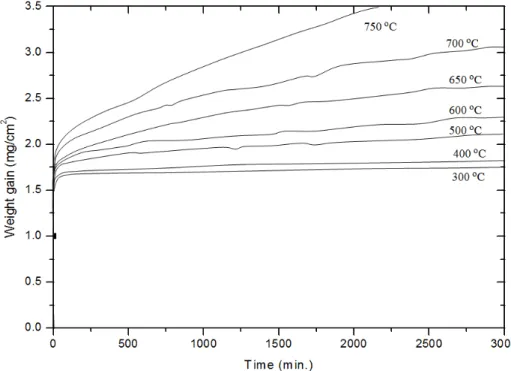
The aim of this work was to perform thermal characterization of commercially pure titanium in dry air to determine its oxidation kinetics and the structure of the oxide. The oxidation kinetics were determined thermogravimetrically under isothermal conditions in the temperature range 300 to 750 oC for 48 hours and the structure of the oxides was determined by differential thermal analyses and X-ray diffraction in the temperature range room temperature - 1000 oC. The oxidation rate of titanium increased with increase in temperature. It was high in the initial stages of oxidation and then decreased rapidly with time, especially up to 600 oC. The kinetic laws varied between inverse logarithmic at the lower temperatures (300 and 400 oC) and parabolic at the higher temperatures (650, 700 and 750 oC). Evidences from X-ray diffraction and differential thermal analyses data revealed that the passive oxide film formed at room temperature crystallized into anatase at about 276 oC. The crystallized oxide formed in the range 276 - 457 oC consisted of anatase, in the range 457 – 718 oC consisted of anatase and rutile sublayers, and at temperatures beyond 718 o
C consisted of a layer of pure rutile. Scanning electron microscopy observations reveled that the oxidized surfaces were crack-free and the surface roughness increased steadily with oxidation temperature.
Keywords: Titanium, oxidation kinetics, oxide film, structure.
Cinética de oxidação de um titânio puro comercial
RESUMOO objetivo deste trabalho foi de realizar uma caracterização térmica de um titânio puro comercial para estudar sua cinética de oxidação e seus produtos de corrosão formados em atmosfera de ar seco em função da temperatura. A cinética de oxidação foi determinada por termogravimetria em condições isotérmicas entre 300 e 750 oC por 48 horas e os óxidos formados foram caracterizados por análise térmica diferencial e difração de raios-X entre a temperatura ambiente até 1000 oC. A cinética de oxidação aumenta com a temperatura e é muito rápida nos primeiros instantes, diminuindo rapidamente com o tempo, especialmente até 600 oC. As leis cinéticas variaram entre a logarítmica inversa nas temperaturas mais baixas (300 e 400 oC) e a parabólica nas temperaturas mais altas (650, 700 e 750 oC). As análises por difração de raios-X e análise térmica diferencial mostraram que a cristalização do filme passivo de óxido, formado naturalmente à temperatura ambiente, ocorre aproximadamente a 276 oC. A estrutura do óxido é composta de anatásia cristalina entre 276 e 457 oC, anatásia e rutilo entre 457 e 718 oC, e somente rutilo acima de 718 oC. Observações por microscopia eletrônica de varredura revelaram que as superfícies oxidadas não apresentam fissuras e que suas rugosidades aumentam uniformemente com a temperatura de oxidação.
Palavras-chave: Titânio, cinética de oxidação, filme de óxido, estrutura.
1 INTRODUCTION
526 the implants. Among these techniques, the oxidation of titanium has been investigated recently [7]. The oxidation can be enhanced by thermal oxidation or by micro-arc oxidation, also known as plasma electrolysis
[5, 8]. This process is performed by applying a positive voltage to a titanium specimen immersed in an
electrolyte (anodic oxidation). When the applied voltage is increased to a certain point, a micro-arc occurs as a result of the dielectric breakdown of the TiO2 layer. At this moment, Ti ions in the implant and OH ions in the electrolyte move in opposite directions very quickly to form TiO2 again [7, 8]. Recent studies demonstrated that this treatment increases the thickness and roughness of the oxide layer, which leads to a beneficial effect on the biocompatibility of the titanium implants [7].
When the titanium is exposed to ambient air at room temperature, a passive oxide film is spontaneously formed on its surface. This passive film is amorphous, very thin (5-10 nm thickness [9]), and composed of three layers [10, 11]: the first layer adjacent to metallic titanium is TiO, the intermediary layer is Ti2O3, and the third layer, which is in contact with the environment, is anatase TiO2. At room temperature, anatase TiO2 is the most important layer in thickness and responsible for the integration between the implant and the human bone when the material is not submitted to a thermal treatment at high temperature. The surface oxide film on titanium formed in the air is so protective that the further oxidation of titanium is prevented in various circumstances and mediums [12]. Even during sterilization in autoclave under a saturated water vapor pressure at 120 oC for 1.8 ks, oxidation of titanium does not proceed [12].
Oxidation at high temperatures promotes the development of a crystalline oxide film. Increasing temperature induces the formation of a thicker oxide layer, which is accompanied with dissolution of oxygen beneath it [13]. Feng and al. [14] investigated the oxidation of a commercially pure titanium at 600 oC for 30 min. in air, in the oxygen and in the water vapor with 1.13-1.15 Pa. Surface composition and crystal structure analyses carried out by X-ray photoelectron spectroscopy (XPS) and by X-ray diffraction (XRD), respectively, indicated that titanium was oxidized in every medium, and formed films of rutile TiO2 instead of anatase TiO2 [14]. Nevertheless, thermal oxidation at 600 oC and 650 oC for 48 h at normal atmospheric condition revealed that the oxidized surfaces of the Ti-6Al-4V alloy principally consist of rutile but the anatase form of TiO2 was also detected at limited number of diffraction angles, especially after oxidation at 600 oC (13). However, at 650 oC rutile totally dominated the oxide structure [13].
Although some works have reported the structure of the oxide film in many temperatures, none of them have investigated the crystallization temperature of the passive oxide film and the stability domain of anatase and rutile as a function of temperature. In this paper, a systematic study has been carried out to evaluate the oxidation kinetics and the transition temperatures of each oxide phase formed on commercially pure titanium.
2 MATERIALS AND METHODS
Samples of commercially cast titanium were gradually polished up to 1 m alumina, cleaned in ethanol, and dried at room temperature. The average chemical composition, measured by X-Ray fluorescence spectroscopy (Shimadzu RF-5301), was found to be Ti – 0.078 wt.% Fe – 0.065 wt.% Mn – 0.026 wt.% Zn. Oxidation kinetics of this material were performed by thermogravimetry between 300 and 750 oC for 48 h in dry air with an accuracy of 10-6 g. Characterization of the oxide films was made by differential thermal analyses (DTA), X-ray diffraction (XRD), and scanning electron microscopy (SEM). Thermogravimetry (TG) and DTA tests were carried out on disks of 5 mm diameter and 2 mm thickness with a Netzsch equipment (Jupiter STA 449C). DTA was performed in dry air between room temperature and 1000 oC at a heating speed of 5 oC/min. Samples of 20 mm x 17 mm x 2 mm were oxidized in a furnace, at normal atmospheric conditions, for 48 h between 200 and 800 oC. After oxidation, a XRD-6000 Shimadzu X-ray diffractometer was used to identifier the oxides formed on the titanium. CuK radiation source was used and the incidence beam scan was 2o/min. Diffraction angle range was between 10o and 80o, with a step increment of 0.02o and a count time of 0.6 s.
3 RESULTS AND DISCUSSIONS
3.1 Oxidation Kinetics
527 3.2 Differential Thermal Analyses and X-ray Diffraction
Figure 2 shows the transformations of the oxide film during the heating. The peak at 73,5 oC is due to volatilization of ethanol molecules adsorbed on the surface of the passive film. At 276.1 oC the passive film converted to a crystalline film. The next transformation is observed at about 444-470 oC (peak at 457.2 o
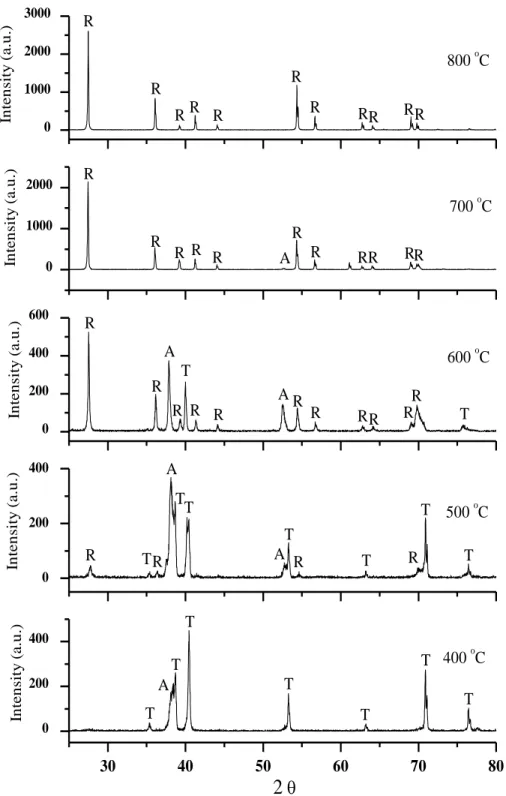
C). Evidences from XRD have shown a crystalline film of anatase between these two peaks (Figure 3). The major peak of anatase was found at 2 = 38.1o. Actually, between 276 and 500 oC there are a double peak composed of anatase (2 = 38.1o) and titanium (2 = 38.3o). A systematic investigation between 200 and 300 o
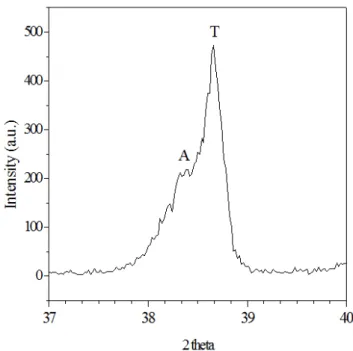
C confirmed that the transition between the passive film to a crystalline film of anatase might occur at approximately 275 oC. At this temperature the oxide film is very thin and the peaks observed by XRD are from titanium substrate. At 300 oC the anatase peak can be clearly detected by XRD (Figure 4). At approximately 444 oC (peak at 457 oC) rutile begins to nucleate and then the oxide film is constituted of anatase and rutile sublayers (Figure 2). The peak at 680-730 oC (718 oC ) indicates that anatase is no longer stable, converting to rutile, which is the only stable oxide above 718 oC. This results are also back up by XRD, which indicates that the oxide film formed at 500 and 600 oC is constituted of anatase and rutile, and at 700 and 800 oC rutile totally dominated the oxide structure (Figure 3). At 700 oC a slight peak of anatase was identified after 48 of oxidation showing that the reaction needs more time or higher temperatures to complete the transformation. The peak at 900 oC, which starts at about 885 oC, is due to the allotropic transformation of
Ti to Ti (Figure 2). Allotropic transformation of pure titanium is reported to be at 882,5oC as a result of a new atomic structure arrangement, from hexagonal ( phase) at room temperature to cubic ( phase) between 882,5oC and its melting point at 1670 oC [15].
528 Figure 2: TG and DTA curves of titanium.
529
30 40 50 60 70 80
0 200 400
400 oC R A A T T T T T T T
2
0 200 400
500 oC
R
R R A R T
T T T T T T 0 200 400 600
600 oC
T T R R R R R R R R R R A A 0 1000 2000 A R
700 oC
R R R R R R R R R 0 1000 2000 3000
800 oC
R R R R R R R R R R R R In te n sity ( a.u .) In te n sity ( a.u .) In te n sity ( a.u .) In te n sity ( a.u .) In te n sity ( a.u .)
530 Figure 4: XRD patterns showing the crystallization of the passive film of titanium surfaces oxidized 48 hours
at 300 oC in air (T = titanium, A = anatase).
SEM observations on top of the oxide films showed that the surfaces are crack-free and uniformly roughness, which increases with the oxidation temperature (Figure 5). The surface roughness, measured on the Ti-6Al-4V according to average roughness (Ra) values, which define the arithmetic mean of departure of a surface profile from a mean line, indicated that the roughness of oxidized surfaces at 600 and 650 oC for 48 h was 0,80 and 1,35 m, respectively [13]. Average roughness of untreated sample was 0.17 m before oxidation [13].
Figure 5: SEM micrographs of surface appearances of oxidized samples for 48 h in dry air at 300 oC (a), 500 oC (b) and 700 oC (c).
4 CONCLUSION
Commercially pure titanium was thermally characterized up to 1000 oC. Oxidation reaction is very fast in the early stages of the oxidation process leading to oxide layers composed of anatase and rutile structures of TiO2. After the initial period, the oxidation kinetics are very slow up to 650 oC due to the excellent thermal behavior of the scale. Crystallization of the passive film into anatase occurs at about 276 o
531 5 REFERENCES
[1] SUL, Y.T., JOHANSSON, C.B., JEONG, Y. ROSER, K., WENENBERG, A., ALBREKTSSON, T., “Oxidized implants and their influence on the bone response”, Journal of Materials Science: Materials in Medicine, v.12, pp.1025-31, 2001.
[2] SUL, Y.T., “The significance of the surface properties of oxidized titanium to the bone response: special emphasis on potential biochemical bonding of oxidized titanium implant”, Biomaterials, v. 24, pp. 3893-907, 2003.
[3] THOMSEN, P., LARSSON, C., ERICSON, L.E., SENNERBY, L., LAUSMA, J., KASEMO, B., “Structure of the interface between rabbit cortical bone and implants of gold, zirconium and titanium”, Journal of Materials Science: Materials in Medicine, v. 8, pp. 653-65, 1997.
[4] OKAZAKI, Y., GOTOH, E., “Comparison of metal release from various metallic biomaterials in vivo”, Biomaterials, v. 26, pp. 11-21, 2005.
[5] LI, D., FERGUSON, S.J., BEUTLER, T., COCHRAN, D.L., SITTING, C., HIRT, H.P., BUSER, D., “Biomechanical comparison of the sandblasted and acid-etched and the machined and acid-etched titanium surface for dental implants”, Journal of Biomedical and Material Research, v. 60, pp. 325-32, 2002.
[6] WENNERBERG, A., “The importance of surface roughness for implants incorporation”, International Journal of Machine and Tools Manufacturing, v. 38, pp. 657-62, 1998.
[7] LI, L.H., KONG, Y.M., KIM, H.W., KIM, Y.W., KIM, H.E., HEO, S.J., KOAK, J.Y., “Improved biological performance of Ti implants due to surface modification by micro-arc oxidation”, Biomaterials, v. 25, pp. 2867-2875, 2004.
[8] YEROKHIN, A.L., NIE, X., LEYLAND, A., MATTHEWS, A., “Influence of surface characteristics on bone integration of titanium implants”, Journal of Biomedical and Material Research, v. 122, pp. 73-93, 1999.
[9] FENG, B., WENG, J., YANG, B.C., CHEN, J.Y., ZHAO, J.Z., HE, L., QI, S.K., ZHANG, X.D., “Surface characterization of titanium and adsoption of bovine serum albumin”, Materials Characterization, v. 49, pp. 129-137, 2003.
[10] CHENG, X., ROSCAE, S.G., “Corrosion behavior of titanium in the presence of calcium phosphate and serum proteins”, Biomaterials, v. 26, pp. 7350-7356, 2005.
[11] POUILLEAU, J., DEVILLIERS, D., GARRIDO, F., DURAND-VIDAL, S., MAHE, E., “Structure and composition of passive titanium oxide films”, Materials Science and Engineering, v. B47, pp. 235-243, 1997.
[12] HIROMOTO, S., HANAWA, T., ASAMI, K., “Composition of surface oxide film of titanium with culturing murine fibroblasts L929”, Biomaterials, v. 25, pp. 979-986, 2004.
[13] GÜLERYÜZ, H., CIMENOGLU, H., “Effect of thermal oxidation on corrosion and corrosion-wear behaviour of a Ti-6Al-4V alloy”, Biomaterials, v. 25, pp. 3325-3333, 2004.
[14] FENG, B., CHEN, J.Y., QI, S.K., ZHAO, J.Z., HE, L., ZHANG, X.D., “Characterization of surface oxide films on titanium and bioactivity”, Jounal of Materials Science: Materials in Medicine, v. 13, pp. 457-464, 2002.