CLINICAL SCIENCE
The association of major depressive episode and
personality traits in patients with fibromyalgia
Danyella de Melo Santos,ILaı´s Verderame Lage,IIEleonora Kehl Jabur,IHelena Hideko Seguchi Kaziyama,III Dan V. Iosifescu,IVMara Cristina Souza de Lucia,VRene´rio Fra´guasI
IDepartment and Institute of Psychiatry, Hospital das Clinicas da Faculdade de Medicina da Universidade de Sa˜o Paulo - Sa˜o Paulo/SP, Brazil.IIDepartment Medical Clinic II, Rheumatology Service, Hospital das Clinicas da Faculdade de Medicina da Universidade de Sa˜o Paulo - Sa˜o Paulo/SP, Brazil.IIIDepartment of Neurology, Hospital das Clinicas da Faculdade de Medicina da Universidade de Sa˜o Paulo - Sa˜o Paulo/SP, Brazil.IVDepression Clinical and Research Program, Massachusetts General Hos-pital, Harvard University - Boston, Massachusetts, USA.VDivision of Psychology and Department of Neurology, Hospital das Clinicas da Faculdade de Medicina da Universidade de Sa˜o Paulo - Sa˜o Paulo/SP, Brazil.
INTRODUCTION:Personality traits have been associated with primary depression. However, it is not known whether this association takes place in the case of depression comorbid with fibromyalgia.
OBJECTIVE:The authors investigated the association between a current major depressive episode and temperament traits (e.g., harm avoidance).
METHOD: A sample of 69 adult female patients with fibromyalgia was assessed with the Temperament and Character Inventory. Psychiatric diagnoses were assessed with the Mini-International Neuropsychiatric Interview severity of depressive symptomatology with the Beck Depression Inventory, and anxiety symptomatology with the IDATE-state and pain intensity with a visual analog scale.
RESULTS:A current major depressive episode was diagnosed in 28 (40.5%) of the patients. They presented higher levels of harm avoidance and lower levels of cooperativeness and self-directedness compared with non-depressed patients, which is consistent with the Temperament and Character Inventory profile of subjects with primary depression. However, in contrast to previous results in primary depression, no association between a major depressive episode and self-transcendence was found.
CONCLUSIONS: The results highlight specific features of depression in fibromyalgia subjects and may prove important for enhancing the diagnosis and prognosis of depression in fibromyalgia patients.
KEYWORDS: Fibromyalgia; Personality; Depression; Temperament; Character.
Santos DM, Lage LV, Jabur EK, Kaziyama HHS, Iosifescu DV, Lucia MCS, et al. The association of major depressive episode and personality traits in patients with fibromyalgia. Clinics. 2011;66(6):973-978.
Received for publication onDecember 14, 2010;First review completed onJanuary 6, 2011;Accepted for publication onFebruary 28, 2011 E-mail: [email protected]
Tel.: 55 11 3069-7804
INTRODUCTION
Fibromyalgia (FMS) is a syndrome characterized by chronic widespread musculoskeletal pain and stiffness in association with fatigue and poor sleep. The classification of the American College of Rheumatology Criteria for FMS1 includes the presence of pain in all four body quadrants in combination with excess tenderness to manual palpation in at least 11 of 18 muscle–tendon sites, in the absence of clinically demonstrable peripheral nociceptive causes. Although some biological mechanisms have been identified, the etiology and pathogenesis of FMS remain unclear.2,3The prevalence of FMS in the general population is estimated to
be between 1.3% and 4.8%.4 Patients with FMS also frequently suffer from emotional distress and/or psychiatric disorders.5,6
Depression in a medical setting or comorbid with medical conditions has been reported to be frequent, difficult for general practitioners to recognize ,7–9 associated with
increased morbidity and to have different psychopatholo-gical presentation.10Of note, the prevalence of depression is
increased in fibromyalgia patients compared with medically healthy individuals.11,12Among patients with fibromyalgia, the current and 12-month prevalence of major depression (MDD) has been reported to be between 20% and 30%13,14in various studies, but also from 30% to 80% in others,15 compared with 4% to 6%, respectively, for current and 12-month prevalence of MDD in the general population.16,17 The prevalence of MDD appears to be higher in FMS patients than in rheumatoid arthritis patients, according to some18,19 but not all20 reports. An epidemiological study placed fibromyalgia as the second most common general
Copyrightß2011CLINICS– This is an Open Access article distributed under
medical condition associated with MDD, with an odds ratio (OR) of 3.4.21 In addition to this increased prevalence, depression in FMS has been reported to be associated with sexual dysfunction,22lower rates of physical therapy23and vitamin D deficiency.24 Considering the relevance of the association between personality and MDD in the general population, it is pertinent to investigate whether this association extends to patients with fibromyalgia or not. Studying the association between a specific personality trait (harm avoidance) and the depression comorbid with FMS may bring inputs about the nature of such depression and its potential response to treatment.
Several studies have reported a specific pattern of personality traits in MDD subjects (primary depression), as assessed using Cloninger’s Temperament and Character Inventory (TCI).25The TCI is based on a psychobiological model of personality and evaluates 7 traits referring to temperament and character. Temperament evaluation includes 4 dimensions: novelty seeking (NS), harm avoid-ance (HA), reward dependence (RD) and persistence (P). The assessment of the character includes the evaluation of self-transcendence (ST), self-directedness (SD) and coopera-tiveness (C). Prior studies have consistently reported that MDD was associated with higher HA, but not NS and RD dimensions.26,27HA scores appear to be directly correlated with the severity of depressive symptomatology. In addi-tion, other studies investigating the character personality traits (ST, SD and C) have suggested that MDD subjects tend to have higher scores of HA and ST and lower scores of SD and C compared with healthy volunteers.28–30
Altered personality traits have also been described in chronic pain patients by some but not all authors.31 A pattern close to that described in MDD (i.e., increased HA scores and decreased SD scores) has been reported in patients with non-specific musculoskeletal disorders,32 tension-type headache33 and migraine.33,34 Moreover, a correlation of HA, SD and C with depression severity has been reported in tension-type headache patients,33 and
some authors have suggested that the association of chronic pain with TCI dimensions is caused, at least in part, by the presence of comorbid depression.34 Two studies have previously reported35,36an association between higher HA
and higher Beck Depression Inventory scores in neurologi-cal and cardiac patients. The association between depres-sion and HA has physiological and clinical implications. Physiologically, HA has been associated with serotonergic dysfunction37and, clinically, HA independent of the other
dimensions has been related to an increased risk of developing depression38,39 and to the response to antide-pressant treatment.27
Three studies40–42 have previously investigated the association between depression and personality aspects in FMS patients. Johnson et al. (1997)40 evaluated the
self-esteem structure in 61 female FMS patients; they found that depressed FMS patients present a self-esteem structure with lower sense of self-esteem, lower self-assertiveness and less emotional candor, different from the non-depressed FMS patients. Nordahl and Stiles (2007)42reported a sociotropic
personality style similar to MDD only in FMS patients with current or lifetime history of MDD. In another study, Mazza et al. (2008),41using the Beck Depression Inventory and the TCI, reported a depressive state and trait correlation with HA and strong depressive state association with SD in FMS patients. None of the above-mentioned studies used an
instrument that captures parameters similar to those captured by the TCI; and, to our knowledge, no study has specifically investigated the association of TCI personality traits with a current major depressive episode (MDE) in FMS patients. Thus, our main hypothesis was that a current MDE in FMS patients is associated with harm avoidance (HA); secondarily, we investigated the association of current MDE with other TCI dimensions.
MATERIALS AND METHODS Patients
Patients included in this study were recruited between June 2006 and September 2008 from the Rheumatology and Neurology departments of the Hospital das Clinicas da Faculdade de Medicina da Universidade de Sao Paulo, Brazil. The neurology unit specializes in chronic pain patients, and the rheumatology unit specializes in the diagnosis and treatment of FMS. Patients were referred to a screening interview by their neurologist or rheumatolo-gist. Physicians were instructed to refer all female patients aged 18 years or older with FMS according to the American College of Rheumatology Criteria.1 Only females were included in the study because FMS is 10 times more prevalent in women.
The exclusion criteria included major medical conditions, debilitating neurological conditions, bipolar disorder, dys-thymic disorder, psychosis and other DSM-IV Axis I disorders, except anxiety and major depressive episode, because of the high prevalence of these diagnoses. Patients with inability to comprehend the instruments were also excluded.
During the study period, 279 patients were referred to the screening visit. Forty-nine patients refused to participate in the study or missed the scheduled appointment. Fifty-nine patients were excluded because of medical comorbidities, 29 due to psychiatric conditions and 73 because of inability to comprehend the instrument instructions. Sixty-nine patients were included in the study analysis.
Measures
A questionnaire was used to collect sociodemographic data including age, marital status, educational level, employment status and total family income. Recorded clinical character-istics included length of history of FMS symptomatology (years) and current psychopharmacological treatment (anti-depressant, benzodiazepine, antipsychotic).
Psychiatric disorders were diagnosed by a psychologist (D.M.S.) using the Brazilian version43 of the
Mini-International Neuropsychiatric Interview (M.I.N.I.).44 The M.I.N.I. is a structured interview designed to access the psychiatric diagnosis in accordance with the DSM-IV and ICD-10 criteria.44
The Beck Depression Inventory (BDI)45was used to assess
the severity of depression. BDI is a 21-item self-report questionnaire that has been widely used to evaluate medically ill depressed patients. The Brazilian version was validated by Gorenstein et al. (1996).46
The IDATE-state,47 a 20-item self-report questionnaire, was used to measure anxiety severity; we used the Brazilian version validated by Gorenstein et al. (1996).46
Comorbid medical conditions were evaluated with the Cumulative Illness Rating Scale (CIRS),48a questionnaire that
them into 13 organ systems: cardiac, hypertension, vascular, respiratory, EENT (eye, ear, nose, throat, larynx), upper gastrointestinal (GI), lower GI, hepatic, renal, other GU, musculoskeletal–integumentary, neurological, endocrine– metabolic. The interviewer (D.M.S.) asked the patient about the 13 organ systems and rated the severity of illnesses for each organ as none, mild, moderate, severe or extremely severe.
Pain severity was evaluated with a visual analog scale (VAS). The scale anchors were ‘‘no pain’’ and ‘‘pain as bad as it could be’’, and with a numeric range from 0 to 10 centimeters. Patients were questioned about pain intensity in the previous week.
Personality traits were assessed using the self-administrated Brazilian version of TCI49 consisting of 240 self-descriptive, true/false items, assessing 4 temperament dimensions (NS, HA, RD, P) and 3 character dimensions (SD, C, ST). NS includes 4 subdimensions: NS1, exploratory excitability versus stoic rigidity; NS2, impulsiveness versus reflection; NS3, extrava-gance versus reserve; NS4, disorderliness versus regimentation. HA consists of 4 subdimensions: HA1, anticipatory worry and pessimism versus uninhibited optimism; HA2, fear or uncer-tainty versus confidence; HA3, shyness with stranger versus gregariousness; HA4, fatigability versus vigor. The third dimension of temperament, RD, includes 2 subdimensions: RD1, sentimentality; and RD3, dependence versus indepen-dence. P expresses the preservation of a form of behavior as resistance to frustration. The first character dimension of SD has a further 5 subdimensions: SD1, responsibility versus blame; SD2, purposefulness versus lack of goal or direction; SD3, resourcefulness; SD4, acceptance versus self-striving; and SD5, congruent second nature. C includes 5 subdimensions: C1, social acceptance versus social intolerance; C2, empathy versus social disinterest; C3, helpfulness versus unhelpfulness; C4, compassion versus revengefulness; and C5, integrated con-science. ST includes 3 subdimensions: ST1, self-forgetfulness versus self-conscious experience; ST2, transpersonal identifica-tion versus self-isolaidentifica-tion; ST3, spiritual acceptance versus rational materialism.25,50
The research project was approved by the ethics committee of the HC-FMUSP, and all patients gave written informed consent.
Statistics
Comparisons between FMS patients with and without current MDE were performed with t-tests (for normally distributed variables), with Mann–Whitney U-tests (for variables without normal distribution) and with chi-square tests (for categorical variables). The TCI dimensions did not show normality; consequently, we used the Mann–Whitney U-test to investigate our main hypothesis (association of current MDE with HA) and our secondary hypotheses (association of current MDE with other TCI dimensions). We used Spearman’s correlation tests to investigate correla-tion between TCI dimensions and BDI and IDATE scores. All tests were performed with an alpha of 0.05, two-tailed.
RESULTS
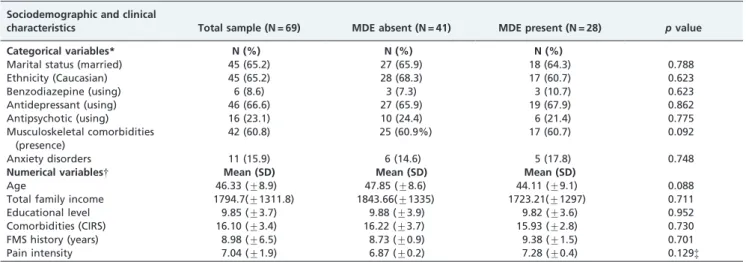
The 69 FMS patients included in this study had a mean age of 46.3 (¡8.9) years, 9.8 (¡3.7) years of schooling, 65.2%
were married and 65.2% were Caucasian. The mean length of FMS symptomatology was 8.9 (¡6.5) years, and the mean pain intensity on the VAS was 7 (¡1.9). Sixty-six percent of
the patients were using antidepressants, 8.6% were using benzodiazepine and 23.1% were using antipsychotics. Current MDE was diagnosed in 28 (40.5%) and anxiety disorder in 11 (15.9%) patients (Table 1).
We found no significant differences on sociodemographic or clinical characteristics between FMS patients with or without a diagnosis of MDE (Table 1).
Compared with non-depressed subjects, patients with MDE had higher HA scores on the main HA scale (p= 0.002)
and on 3 out of 4 HA subscales: HA1 (p , 0.001), HA3 (p= 0.040) and HA4 (p= 0.023) (Table 2). Patients with MDE
exhibited lower SD (p= 0.001) and lower C (p= 0.027)
compared with non-depressed patients. There were no significant differences on the other TCI scales (NS, P, RD and ST) between depressed and non-depressed FMS patients (Table 2).
Among MDE patients, the BDI was positively correlated with HA (r= 0.384) and ST (r= 0.466) scores. A negative
correlation was found between SD and BDI (r= –0.646). The
IDATE-state was negatively correlated with the SD (r=
–0.397) and C (r= –0.446) scales, and positively correlated
with HA (r= 0.367). There was no significant association
between pain intensity and TCI traits.
DISCUSSION
In this study of 69 FMS patients, we found that current MDE was associated with higher HA scores than in non-depressed subjects, and that HA scores were positively correlated with the severity of depressive symptoms (measured by the BDI). In addition, in a post hoc analysis (two-way ANOVA) using HA as the dependent variable and including anxiety disorders as a potential confounder, we found that MDE was associated with HA independently of anxiety disorders. High HA scores indicate a tendency to be cautious, pessimistic, insecure and fearful; these subjects present shyness in most social situations, feel chronically tired and fatigued.51In addition, MDE patients had lower SD and C scores than non-depressed FMS patients. Those with low SD scores are characterized by difficulties in accepting responsibility, lack of long-term goals, low self-esteem and are often dependent, whereas individuals with low C scores are characterized by social intolerance, social disinterest and always seeking their own profit.51 These results suggest that MDE in FMS patients resembles primary depression described in non-medically ill psychia-tric patients. However, besides the same three traits described above in our depressed FMS patients, previous studies with psychiatric patient samples have revealed that patients with primary MDD also have increased ST scores compared with healthy control subjects.28–30In our sample,
ST scores were no different in depressed compared with non-depressed FMS patients. It is possible that normal levels of ST may be a characteristic of MDE associated with FMS, in contrast to primary depression.
To our knowledge, two studies used the TCI in FMS patients,41,52and only one evaluated the association of TCI with depressive symptoms.41 In that study, Mazza et al.
(2009) investigated the effect of selective serotonin reuptake inhibitors (SSRI) on TCI dimensions over a period of 6 months in 60 FMS patients compared with 80 healthy control subjects.41 They reported a significant decrease in
of SD in FMS patients. Consistent with our results, Mazza et al. (2009) also did not find an association between ST and depression trait or state.
Regarding the investigation of other aspects of depression comorbid with FMS, we found 3 studies that compared depressed with non-depressed FMS patients. In their study, Nordahl and Stiles (2007)42compared 25 depressed with 19 non-depressed FMS patients and also with two other groups, one with 43 psychiatric outpatients with MDD and another with 41 healthy control subjects. They found that the cognitive personality style that is typical of MDD (higher levels of sociotropy and dysfunctional attitudes) was only present in FMS patients if they met the criteria for a concurrent or lifetime history of MDD. This is a finding in line with ours, reinforcing the relevance of depression for the dysfunctional aspects of FMS patients. Johnson et al. (1997)40 investigated the self-esteem structure in 61 female FMS patients compared with 40 healthy control subjects and 37 non-depressed patients with rheumatoid arthritis. Depressed FMS patients presented a self-esteem structure characterized by low basic self-esteem combined with a demanding need to earn self-esteem, which is a distinct pattern compared with non-depressed FMS patients, rheu-matoid arthritis patients and healthy control subjects. The authors proposed that depressed FMS patients represent a specific group of FMS patients.40 Okifuji et al. (2000)23 reported that depressed FMS patients reported more maladaptative thoughts and functional limitations than non-depressed FMS patients.
Studies32–34 that have investigated the association of chronic pain with TCI dimensions have reported that the TCI differences from healthy control subjects could not be explained totally by the pain condition and were explained, at least in part, by a greater presence of depressive and anxiety symptoms among FMS patients. In this particular, IDATE-state scores were positively correlated with HA and negatively correlated with SD and C. In addition, in the post hoc analysis using HA as the dependent variable, including MDE and anxiety disorders as independent variables, we found that anxiety disorders were associated with HA
Table 1 -Sociodemographic and clinical characteristics of female FMS patients with and without a current major depressive episode.
Sociodemographic and clinical
characteristics Total sample (N = 69) MDE absent (N = 41) MDE present (N = 28) pvalue
Categorical variables* N (%) N (%) N (%)
Marital status (married) 45 (65.2) 27 (65.9) 18 (64.3) 0.788
Ethnicity (Caucasian) 45 (65.2) 28 (68.3) 17 (60.7) 0.623
Benzodiazepine (using) 6 (8.6) 3 (7.3) 3 (10.7) 0.623
Antidepressant (using) 46 (66.6) 27 (65.9) 19 (67.9) 0.862
Antipsychotic (using) 16 (23.1) 10 (24.4) 6 (21.4) 0.775
Musculoskeletal comorbidities (presence)
42 (60.8) 25 (60.9%) 17 (60.7) 0.092
Anxiety disorders 11 (15.9) 6 (14.6) 5 (17.8) 0.748
Numerical variables{ Mean (SD) Mean (SD) Mean (SD)
Age 46.33 (¡8.9) 47.85 (¡8.6) 44.11 (¡9.1) 0.088
Total family income 1794.7(¡1311.8) 1843.66(¡1335) 1723.21(¡1297) 0.711
Educational level 9.85 (¡3.7) 9.88 (¡3.9) 9.82 (¡3.6) 0.952
Comorbidities (CIRS) 16.10 (¡3.4) 16.22 (¡3.7) 15.93 (¡2.8) 0.730
FMS history (years) 8.98 (¡6.5) 8.73 (¡0.9) 9.38 (¡1.5) 0.701
Pain intensity 7.04 (¡1.9) 6.87 (¡0.2) 7.28 (¡0.4) 0.129{
*Chi-square. {t-test. {Mann–Whitney.
CIRS = Cumulative Illness Rating Scale; MDE = major depressive episode.
Table 2 -Comparison between temperament and character inventory dimensions of female FMS patients with and without a current major depressive episode.
MDE absent (N = 41)
MDE present
(N = 28) pvalue
Novelty seeking 16.63¡5.24 15.18¡4.73 0.364
NS1 6.00¡2.10 4.68¡2.50 0.032
NS2 3.51¡2.17 3.61¡1.77 0.785
NS3 4.66¡2.33 4.36¡2.31 0.639
NS4 2.46¡1.91 2.54¡1.75 0.813
Harm avoidance 18.37¡6.85 23.79¡6.90 0.001*
HA1 4.59¡2.62 7.25¡2.61 0.000
HA2 5.54¡1.38 5.71¡1.38 0.481
HA3 3.95¡2.31 5.11¡2.33 0.040
HA4 4.29¡2.51 5.71¡2.46 0.023
Reward dependence
14.32¡3.62 13.39¡3.52 0.201
RD1 7.10¡1.73 7.43¡1.95 0.452
RD3 4.54¡2.32 3.18¡2.16 0.018
RD4 2.68¡1.39 2.79¡1.60 0.900
Persistence 5.34¡1.39 4.75¡1.94 0.167
Self-directedness
31.34¡6.86 25.39¡7.21 0.001*
SD1 6.00¡1.43 4.29¡2.09 0.001
SD2 5.80¡1.66 4.29¡1.98 0.000
SD3 3.29¡1.50 2.25¡1.43 0.004
SD4 7.61¡1.86 6.82¡2.14 0.099
SD5 8.63¡2.33 7.75¡2.34 0.095
Cooperativeness 33.66¡5.17 31.57¡4.04 0.027*
C1 6.24¡1.91 6.00¡1.81 0.474
C2 5.00¡1.30 4.54¡1.17 0.186
C3 6.12¡1.12 5.75¡1.08 0.128
C4 9.07¡1.21 8.75¡1.27 0.229
C5 7.02¡1.44 6.57¡1.23 0.111
Self-transcendence
18.46¡4.54 18.79¡7.07 0.717
ST1 6.29¡1.83 6.32¡2.68 0.629
ST2 4.73¡1.76 5.00¡2.14 0.577
ST3 7.46¡2.65 7.46¡3.61 0.644
The Mann–Whitney test was used to compare the temperament and character inventory dimensions between FMS patients with and without current MDE.
independently of MDE. The prevalence of 15.9% for anxiety disorders may be considered relatively low; however, it is in accordance with the reported prevalence rates of anxiety disorders (current and lifetime) among FMS patients ranging from 11% to 65%.5,12,53 Sixty-six percent of our patients were using antidepressants, 23.1% were using antipsychotics and 8.6% were using benzodiazepines, which could have been enough to treat some cases of anxiety disorder, but not depressive ones, and possibly, at least in part, explain the relatively low prevalence of anxiety disorders in our sample.
Two studies35,36 have investigated the association
between TCI and depression comorbid with other medical conditions (in one study, MDD comorbid with heart disease; in the other, MDD comorbid with Parkinson’s disease). In both studies, the depression was only associated with HA. Together with our findings, these data suggest that depression comorbid with medical conditions has some similarities when compared with primary depression. None of these studies reported a difference in ST comparing patients and control subjects. These results suggest that several forms of depression comorbid with chronic pain may be associated with normal ST levels.
Our findings of HA dysfunction in depression associated with FMS does not preclude the possibility that non-depressed FMS may also be associated with some degree of HA dysfunction, as has been proposed by some authors. Indeed, HA may be an essential trait in the perception of pain. Pud et al. (2006)54studied pain perception in healthy
volunteers and evaluated temperament traits with the Cloninger’s tridimensional personality theory. Their results showed that HA correlated with pain responsiveness, and a higher HA was likely to predict a heightened pain response. These data support the view that treating depression, and consequently reducing HA, may be relevant to regularize pain perceptions and achieve pain control in these patients. Some limitations of our study should be considered. Regarding the secondary hypotheses, while investigating the association of MDE with the various dimensions of the TCI, we performed multiple comparisons, increasing the probability of a type I error. We evaluated only current MDE and were not able to appraise a possible influence of previous episodes of MDD on TCI dimensions. Our sample comprised patients in a tertiary hospital; consequently, generalization of our results for less severely affected patients should be considered with prudence. We per-formed a cross-sectional evaluation, and it is difficult to determinate to what extent the evaluation of HA is biased by a depressive state. Studies have demonstrated that HA scores are higher during an episode of major depression compared with the periods before and after remission of the episode with successful treatment with antidepressants.26,55 However, patients with a diagnosis of MDD even before the first episode or in a remission state after an episode have higher HA scores than the general population. A recent study treating depression in FMS patients revealed that HA was state and trait dependent on depression.41 We compared the association between HA and MDE found in our FMS patients with literature data about the association of TCI with primary depression. The inclusion of a control group without fibromyalgia would offer more accurate information for this comparison. However, it should be remembered that our objective was to investigate the association of TCI and depression in FMS patients and not
a comparison of TCI between FMS patients and those without FMS. The TCI requires a minimum of schooling; for Brazilian samples, it has been reported that at least 4 years of instruction are necessary.49 Because of this, in our screening phase, 73 patients were excluded for inability to comprehend the TCI instructions. Consequently, it is difficult to infer whether the results of our study are applicable for patients with poor schooling.
In conclusion, although several studies have evaluated the coexistence of FMS and psychiatric disorders, data about the specific characteristics of comorbid depression are sparse. Our data support the view that patients with FMS are heterogeneous, particularly regarding the existence of a subgroup with comorbid depression. The association of depression with increased levels of HA and also with decreased levels of SD and C, found in our sample, suggests that depression in FMS patients may deserve special focus considering the clinical and psychophysiological implica-tions of TCI dimensions. New research should consider the relevance of depression and its association with TCI dimensions with respect to fibromyalgia treatment and prognosis.
REFERENCES
1. Wolfe F, Smythe HA, Yunus MB, Bennett RM, Bombardier C, Goldenberg DL, et al. The American College of Rheumatology 1990 Criteria for the Classification of Fibromyalgia. Report of the Multicenter Criteria Committee. Arthritis Rheum. 1990;33:160–72, doi: 10.1002/art. 1780330203.
2. Laske C, Stransky E, Eschweiler GW, Klein R, Wittorf A, Leyhe T, et al. Increased BDNF serum concentration in fibromyalgia with or without depression or antidepressants. J Psychiatric Res. 2007;41:600–5, doi: 10. 1016/j.jpsychires.2006.02.007.
3. Yunus MB. Towards a model of pathophysiology of fibromyalgia: aberrant central pain mechanisms with peripheral modulation. J Rheumatol. 1992;19:846–50.
4. Biewer W, Conrad I, Hauser W. [Fibromyalgia]. Schmerz (Berlin, Germany). 2004;18:118–24.
5. Epstein SA, Kay G, Clauw D, Heaton R, Klein D, Krupp L, et al. Psychiatric disorders in patients with fibromyalgia. A multicenter investigation. Psychosomatics. 1999;40:57–63.
6. Thieme K, Turk DC, Flor H. Comorbid depression and anxiety in fibromyalgia syndrome: relationship to somatic and psychosocial variables. Psychosom Med. 2004;66:837–44, doi: 10.1097/01.psy. 0000146329.63158.40.
7. Benute GR, Nomura RM, Reis JS, Fraguas R, Jr., Lucia MC, Zugaib M. Depression during pregnancy in women with a medical disorder: risk factors and perinatal outcomes. Clinics. 2009;65:1127–31, doi: 10.1590/ S1807-59322010001100013.
8. Henriques SG, Fraguas R, Iosifescu DV, Menezes PR, Lucia MC, Gattaz WF, et al. Recognition of depressive symptoms by physicians. Clinics. 2009;64:629–35, doi: 10.1590/S1807-59322009000700004.
9. Fraguas R, Jr., Henriques SG, Jr., De Lucia MS, Iosifescu DV, Schwartz FH, Menezes PR, et al. The detection of depression in medical setting: a study with PRIME-MD. J Affect Disord. 2006;91:11–17, doi: 10.1016/j.jad. 2005.12.003.
10. Yates WR, Mitchell J, John Rush A, Trivedi M, Wisniewski SR, Warden D, et al. Clinical features of depression in outpatients with and without co-occurring general medical conditions in STAR*D: confirmatory analysis. Prim Care Companion J Clin Psychiatry. 2007;9:7–15, doi: 10.4088/PCC. v09n0102.
11. Raphael KG, Janal MN, Nayak S, Schwartz JE, Gallagher RM. Psychiatric comorbidities in a community sample of women with fibromyalgia. Pain. 2006;124:117–25, doi: 10.1016/j.pain.2006.04.004.
12. Martinez JE, Ferraz MB, Fontana AM, Atra E. Psychological aspects of Brazilian women with fibromyalgia. J Psychosom Res. 1995;39:167–74, doi: 10.1016/0022-3999(94)00093-K.
13. Russell AS, Hui BK. The use of PRIME-MD questionnaire in a rheumatology clinic. Rheumatol Int. 2005;25:292–5, doi: 10.1007/ s00296-004-0548-8.
14. Kassam A, Patten SB. Major depression, fibromyalgia and labour force participation: a population-based cross-sectional study. BMC Musculoskelet Disord. 2006;7:4, doi: 10.1186/1471-2474-7-4.
16. Blazer DG, Kessler RC, McGonagle KA, Swartz MS. The prevalence and distribution of major depression in a national community sample: the National Comorbidity Survey. Am J Psychiatry. 1994;151:979–86. 17. Kessler RC, Berglund P, Demler O, Jin R, Koretz D, Merikangas KR, et al.
The epidemiology of major depressive disorder: results from the National Comorbidity Survey Replication (NCS-R). JAMA. 2003;289:3095–105, doi: 10.1001/jama.289.23.3095.
18. Hudson JI, Hudson MS, Pliner LF, Goldenberg DL, Pope HG, Jr. Fibromyalgia and major affective disorder: a controlled phenomenology and family history study. Am J Psychiatry. 1985;142:441–6.
19. Alfici S, Sigal M, Landau M. Primary fibromyalgia syndrome – a variant of depressive disorder? Psychother Psychosom. 1989;51:156–61, doi: 10. 1159/000288150.
20. Ahles TA, Khan SA, Yunus MB, Spiegel DA, Masi AT. Psychiatric status of patients with primary fibromyalgia, patients with rheumatoid arthritis, and subjects without pain: a blind comparison of DSM-III diagnoses. Am J Psychiatry. 1991;148:1721–6.
21. Patten SB, Beck CA, Kassam A, Williams JV, Barbui C, Metz LM. Long-term medical conditions and major depression: strength of association for specific conditions in the general population. Can J Psychiatry. 2005;50:195–202.
22. Kalichman L. Association between fibromyalgia and sexual dysfunction in women. Clin Rheumatol. 2009;28:365–9, doi: 10.1007/s10067-009-1093-3.
23. Okifuji A, Turk DC, Sherman JJ. Evaluation of the relationship between depression and fibromyalgia syndrome: why aren’t all patients depressed? J Rheumatol. 2000;27:212–19.
24. Armstrong DJ, Meenagh GK, Bickle I, Lee AS, Curran ES, Finch MB. Vitamin D deficiency is associated with anxiety and depression in fibromyalgia. Clin Rheumatol. 2007;26:551–4, doi: 10.1007/s10067-006-0348-5.
25. Cloninger CR, Svrakic DM, Przybeck TR. A psychobiological model of temperament and character. Arch Gen Psychiatry. 1993;50:975–90. 26. Chien AJ, Dunner DL. The Tridimensional Personality Questionnaire in
depression: state versus trait issues. J Psychiatr Res. 1996;30:21–7, doi: 10. 1016/0022-3956(95)00041-0.
27. Nelson EC, Cloninger CR. The tridimensional personality questionnaire as a predictor of response to nefazodone treatment of depression. J Affect Disord. 1995;35:51–7, doi: 10.1016/0165-0327(95)00038-O.
28. Hansenne M, Reggers J, Pinto E, Kjiri K, Ajamier A, Ansseau M. Temperament and character inventory (TCI) and depression. J Psychiatr Res. 1999;33:31–6, doi: 10.1016/S0022-3956(98)00036-3.
29. Richter J, Eisemann M, Richter G. Temperament and character during the course of unipolar depression among inpatients. Eur Arch Psychiatry Clin Neurosci. 2000;250:40–7, doi: 10.1007/PL00007538.
30. Smith DJ, Duffy L, Stewart ME, Muir WJ, Blackwood DH. High harm avoidance and low self-directedness in euthymic young adults with recurrent, early-onset depression. J Affect Disord. 2005;87:83–9, doi: 10. 1016/j.jad.2005.03.014.
31. Nylander PO, Schlette P, Brandstrom S, Nilsson M, Forsgren T, Forsgren L, et al. Migraine: temperament and character. J Psychiatr Res. 1996;30:359–68, doi: 10.1016/0022-3956(96)00009-X.
32. Malmgren-Olsson EB, Bergdahl J. Temperament and character person-ality dimensions in patients with nonspecific musculoskeletal disorders. Clin J Pain. 2006;22:625–31, doi: 10.1097/01.ajp.0000210907.65170.a3. 33. Boz C, Velioglu S, Ozmenoglu M, Sayar K, Alioglu Z, Yalman B, et al.
Temperament and character profiles of patients with tension-type headache and migraine. Psychiatry Clin Neurosci. 2004;58:536–43, doi: 10.1111/j.1440-1819.2004.01297.x.
34. Mongini F, Fassino S, Rota E, Deregibus A, Levi M, Monticone D, et al. The temperament and character inventory in women with migraine. J Headache Pain. 2005;6:247–9, doi: 10.1007/s10194-005-0198-6. 35. Borkowska A, Pulkowska J, Pulkowski G, Rybakowski F. [Association of
temperament, character and depressive symptoms with clinical features of the ischaemic heart disease]. Wiad Lek. 2007;60:209–14.
36. Jacobs H, Heberlein I, Vieregge A, Vieregge P. Personality traits in young patients with Parkinson’s disease. Acta Neurol Scand. 2001;103:82–7, doi: 10.1034/j.1600-0404.2001.103002082.x.
37. Svrakic DM, Draganic S, Hill K, Bayon C, Przybeck TR, Cloninger CR. Temperament, character, and personality disorders: etiologic, diagnostic, treatment issues. Acta Psychiatr Scand. 2002;106:189–95, doi: 10.1034/j. 1600-0447.2002.02196.x.
38. Matsudaira T, Kitamura T. Personality traits as risk factors of depression and anxiety among Japanese students. J Clin Psychol. 2006;62:97–109, doi: 10.1002/jclp.20215.
39. Cloninger CR, Svrakic DM, Przybeck TR. Can personality assessment predict future depression? A twelve-month follow-up of 631 subjects. J Affect Disord. 2006;92:35–44, doi: 10.1016/j.jad.2005.12.034.
40. Johnson M, Paananen ML, Rahinantti P, Hannonen P. Depressed fibromyalgia patients are equipped with an emphatic competence dependent self-esteem. Clin Rheumatol. 1997;16:578–84, doi: 10.1007/ BF02247798.
41. Mazza M, Mazza O, Pomponi M, Di Nicola M, Padua L, Vicini M, et al. What is the effect of selective serotonin reuptake inhibitors on temperament and character in patients with fibromyalgia? Compr Psychiatry. 2009;50:240–4, doi: 10.1016/j.comppsych.2008.08.004. 42. Nordahl HM, Stiles TC. Personality styles in patients with fibromyalgia,
major depression and healthy controls. Ann Gen Psychiatry. 2007;6:9, doi: 10.1186/1744-859X-6-9.
43. Amorim P. Mini International Neuropsychiatric Interview (MINI): valida-c¸a˜o de entrevista breve para diagno´stico de transtornos mentais. Rev Bras Psiquiatr. 2000;22:106–15, doi: 10.1590/S1516-44462000000300003. 44. Sheehan DV, Lecrubier Y, Sheehan KH, Amorim P, Janavs J, Weiller E,
et al. The Mini-International Neuropsychiatric Interview (M.I.N.I.): the development and validation of a structured diagnostic psychiatric interview for DSM-IV and ICD-10. J Clin Psychiatry. 1998;59 Suppl. 20:22–33; quiz 34–57.
45. Beck AT, Ward CH, Mendelson M, Mock J, Erbaugh J. An inventory for measuring depression. Arch Gen Psychiatry. 1961;4:561–71.
46. Gorenstein C, Andrade L. Validation of a Portuguese version of the Beck Depression Inventory and the State-Trait Anxiety Inventory in Brazilian subjects. Braz J Med Biol Res. 1996;2:453–7.
47. Spielberger CD, Vagg PR. Psychometric properties of the STAI: a reply to Ramanaiah, Franzen, and Schill. J Personality Assess. 1984;48:95–7, doi: 10.1207/s15327752jpa4801_16.
48. Linn BS, Linn MW, Gurel L. Cumulative illness rating scale. J Am Geriatrics Soc. 1968;16:622–6.
49. Fuentes D, Tavares H, Gorenstein C. Inventa´rio de Temperamento e de Ca´rater de Cloninger – validac¸a˜o da versa˜o em Portugueˆs. Rev Bras Psiquiatr. 1999;26:363–9.
50. Cloninger CR. Temperament and personality. Curr Opin Neurobiol. 1994;4:266–73, doi: 10.1016/0959-4388(94)90083-3.
51. Cloninger C. Personality and psychopathology. Washington, DC: American Psychiatric Press, Inc.; 1999.
52. Verdejo-Garcia A, Lopez-Torrecillas F, Calandre EP, Delgado-Rodriguez A, Bechara A. Executive function and decision-making in women with fibromyalgia. Arch Clin Neuropsychol. 2009;24:113-22, doi: 10.1093/ arclin/acp014.
53. Uguz F, Cicek E, Salli A, Karahan AY, Albayrak I, Kaya N, et al. Axis I and Axis II psychiatric disorders in patients with fibromyalgia. Gen Hosp Psychiatry. 32:105-7, doi: 10.1016/j.genhosppsych.2009.07.002. 54. Pud D, Eisenberg E, Sprecher E, Rogowski Z, Yarnitsky D. The
tridimensional personality theory and pain: harm avoidance and reward dependence traits correlate with pain perception in healthy volunteers. Eur J Pain. 2004;8:31–8, doi: 10.1016/S1090-3801(03)00065-X.