301
Luiz Alberto Dias Menezes Filho
(in memoriam)
Mario Luiz de Sá Carneiro Chaves
Professor Titular
Universidade Federal de Minas Gerais - UFMG Instituto de Geociências
Belo Horizonte - Minas Gerais – Brasil [email protected]
Coralie Heinis Dias
Doutoranda
Universidade Federal de Minas Gerais - UFMG Instituto de Geociências
Belo Horizonte - Minas Gerais – Brasil [email protected]
Daniel Atencio
Professor Associado
Universidade de São Paulo – USP Instituto de Geociência São Paulo – São Paulo – Brasil [email protected]
Recent mineral
discoveries in the Coronel
Murta,Taquaral, and Medina
pegmatite fields, northeastern
Minas Gerais, Brazil
Abstract
The occurrence of ive rare minerals in the Eastern Brazilian Pegmatite Province, northeastern Minas Gerais, is described and discussed: bergslagite [CaBe(AsO4)(OH)] from the Manoel Fonseca mine, Coronel Murta county; herderite [CaBe(PO4)F] from the Funil mine, Medina county; lithiophosphate [Li3PO4] from the Cachoeira mine, Araçuaí/Itinga counties; lithiotantite [Li(Ta,Nb)3O8] from the Murundu mine, Itinga county; and kosnarite [KZr2(PO4)3] from Mario Pinto mine, Itinga county. The host pegmatites of these minerals, with their respective main chemical and/or mineralogical features are also presented. As a consequence of such discoveries, Raman spectra for lithiotantite and lithiophosphate were made available, and crystal structure reinement for lithiotantite was performed.
Keywords: pegmatites, mineralogical discoveries, Minas Gerais State.
Geosciences
Geociências
http://dx.doi.org/10.1590/0370-44672015690087
1. Introduction
The Eastern Brazilian Pegmatite Province is very important for its pro-duction of industrial minerals (quartz, feldspar, mica and beryl), as well as for gemology and mineralogical collection purposes. Several pegmatite districts are known, and two of them (Pedra Azul and Araçuaí) are focused in this paper (Figure 1). Pegmatites from this province are char-acterized by the presence of rare minerals, some of them are Brazilian type minerals: 28 of the 67 minerals described for the irst time from Brazilian samples were originally found in this large region, i.e.
almost 42% of all Brazilian type minerals. Nevertheless, mineralogical studies about deposits from this wide region are still scarce. In recent years, the authors of the present work have been attempting to reverse the scenario of minor importance given to Brazilian minerals. A research line devoted to the identiication of possibly new mineral species, through detailed studies on the mineralogy of deposits con-sidered promising has enabled the inding of rare minerals.
The description of five of such findings with their mineralogical and
chemical characterization and geological context, represent the aim of this paper. All the minerals were also conirmed by X-ray diffractometry. For EMP analysis (Microscopy Center – UFMG), samples were mounted on polished sections and metalized with C. For bergslagite and herderite, the following standards were used: luorite – F, apatite – P2O5, FeAs2 – As2O5, and apatite – CaO; for kosnarite, the standards used were: MgO – MgO, magnetite – FeO, monazite – P2O5, Al2O3 – Al2O3, HfSiO4 – HfO2, ZrSiO4 – ZrO2, ZrSiO4 – SiO2, and sanidine – K2O.
2. Bergslagite [CaBe(AsO
4)(OH)] from the Manoel Fonseca mine (Olho d’Água farm, Coronel Murta county)
Originally described in Sweden (Langban mine, Bergslagen region)
by Hansen et al. (1984), this mineral was found later in Germany (Fuchs
(Mt. Cervandone), and Switzerland (Fallota, Fianel mine, and Cavradi gorge). It is monoclinic, isostructural with herderite [CaBe(PO4)F] and
hy-droxylherderite [CaBe(PO4)(OH)], and can be colorless, whitish or greyish, with a vitreous luster. The Manoel Fonseca mine (805130E / 8170236N
– Figure 2a) where it was found is lo-cated around 15 km north of Coronel Murta town, in the pegmatite ield of the same name.
Figure 1
Schematic geographic map showing the eight main pegmatite districts in the Eastern
Brazilian Pegmatite Province, emphasizing the focused ones in Northeastern Minas Gerais, the Coronel Murta, Taquaral and Medina fields. Towns: BH, Belo Horizonte (capital of the State); GV, Governador Valadares; DI, Diamantina; AR, Araçuaí.
Biotite schist and quartzite of the Macaúbas Group predominate in the region, in the vicinity of the contact with a relatively small peg-matoid granite stock. The pegmatite with about 8 m thick, and more than 100 m long is intruded in the schist, and is concordant with the wall rock foliation (approximate direction and dip, N65°E/40°NE). It is a zoned body, composed by lower and upper domains, separated by 1 m of schist. The upper domain (NE), from where the studied samples came, produced topaz, and is nowadays abandoned.
The lower domain (SW),
current-ly active, is 4 m thick. The wall zone extends to the contact with the coun-try rock, is ine-grained, and consists predominantly of pertitic microcline with intercalations of quartz (graphic texture), and small amounts of musco-vite and schorl. The intermediate zone is constituted by microcline (thicker grains), quartz, muscovite, albite, and schorl. The quartz core is discontinu-ous and can reach 1 m thickness or more; decimetric replacement bodies of albite occur around it, where mil-limetric crystals of apatite with a light green-bluish to brown color are abun-dant, together with milky herderite.
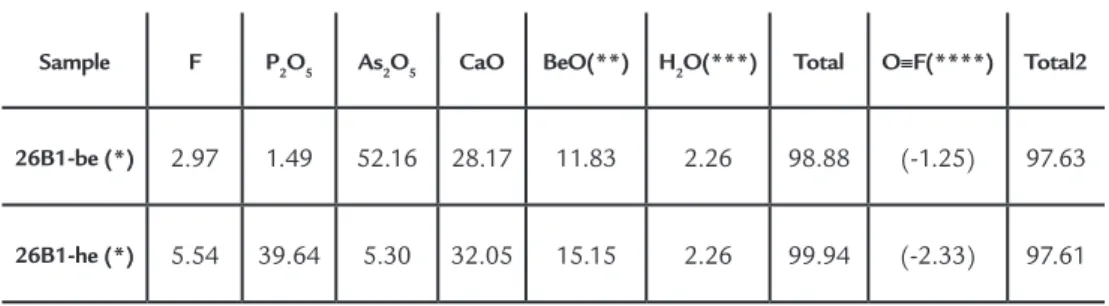
Two quartz crystals with about 15 cm length were collected at this pegma-tite; their faces are coated with several small white crystals, about 3 mm each (Figure 2b). Electron microprobe anal-yses have identiied a bergslagite core, bordered by a herderite layer about 0.1 mm thick (Table 1). Figure 2c shows a scanning electron microscopy image by backscattered electrons of one of those crystals. The empirical formulae are: bergslargite Ca1.06Be1.00(As0.96P0.04)
Σ1.00O4.00[(OH)0.53F0.33O0.14]Σ1.00, and
herd er it e C a0 . 95B e1 . 0 0( P0 . 9 2A s0 . 0 8)
Σ1.00O4.00[F0.48(OH)0.42]Σ0.90.
Figure 2
(a) Geology of the Coronel Murta pegmatite field, with its main pegmatites. MF: Manoel Fonseca mine (modified from Pedrosa-Soares, 1996).
(b) Bergslagite on quartz. (c) Backscattered electron image of the crystal analyzed
according Table 1, showing a bergslagite core (lighter phase) and a herderite rim.
(a) (b)
303
Table 1 Electron microprobe analyses of bergslagite (be) and her-drite (he) from the Manoel Fonseca
mine (wt %). (*) 20 spots average; (**) BeO content calculated for 1 Be apfu ; (***) H2O calculated for charge neutrality; (****) oxygen equivalent.
3. Herderite [CaBe(PO
4)F] from the Funil mine (Medina county)
Herderite was originally described by Haidinger (1828), at the Sauberg mine, Saxony, Germany; hydroxylherderite, CaBe(PO4)(OH), was found by Penield (1894) at the Paris county, Maine, USA. There are conlicting interpretations in the literature, and it is common to refer to any of those two minerals by the ge-neric name herderite. Over the past two decades, all attempts of conirmation of the existence of herderite had failed, and Back & Mandarino (2008) emphasized:
“Herderite (a doubtful species), sym-metry unknown, no chemical data with F>OH are known, may form a series with hydroxylherderite…”. The mineral is monoclinic, and can be colourless, pale yellow, beige, greenish-white or purplish, with a vitreous luster.
T he Fu n il m i ne (2382 2 2E / 8204543N) is located in the Medina peg-matite ield (Figure 3A), which is included in the Pedra Azul pegmatite district, ac-cording to Pedrosa-Soares et al. (2011). Pegmatite bodies from this district are internal to proximal (marginal) source granite; they are generally small to me-dium (up to 5 m thick) and homogeneous, biotite-rich and tourmaline-poor or -free; lithium minerals are also absent. Depos-its from that area aim the extraction of gemologic beryl and topaz; green and
yellow luorapatite is a common acces-sory mineral in the replacement bodies. This pegmatite is zoned, quite weathered, with thickness about 3 m and is directed to E-W. Near to the surface, the body is subvertical, while in greater depths it dips approximately 40ºS. The wall zone exhibits thinner grains, and the inter-mediate zone is composed by weathered microcline, with quartz grains and biotite sheets, both measuring few centimeters. Albite-rich zones wholly kaolinized, with several centimeters width, are considered to be guides for aquamarine search. The quartz core is discontinuous and has normally few decimeters of thickness.
The analyzed herderite samples came from a set of euhedral and cen-timetric crystals, with a greenish grey color, and were collected near the hang-ing wall, where, in the 1990’s important topaz indings occurred. Topaz is F-rich and tends to crystallize upwards in peg-matite bodies due to thermal – gravita-tional diffusion of volatile components (Pedrosa-Soares et al., 2011). Topaz materializes the higher luorine content concentrated in residual melts, and thus it coexists with F-enriched terms of herd-erite – hydroxylherdherd-erite series. In August 2009, a sample of herderite (Table 2) from the Funil mine was supposed to be
the irst one in the world with conirmed provenience; that mine would then be-come the mineral’s type locality, and that sample’s crystal structure would be stud-ied. However, at the same time Harlow & Hawthorne (2008) described and studied the crystal structure of herderite from Mogok, Myanmar (with 8.7%). Those authors mention, in that paper, another occurrence, from Yichung, China (7.25% F), found as an inclusion within a topaz crystal. Thus the studied specimen rep-resents the world’s third occurrence (7B1 grain from Table 2).
Another small group of crystals was discovered in 2011 (26A grains from Table 2), with the same aspects as the previous one, including faces coated with thin schorl crystals. The luorine content in those samples is even higher, according to chemical analyses on two different crystal fragments, one removed from the crystal rim and the other close to the core; no signiicant differences between them can be observed. The empirical formulae for herderite are: Ca0.95Be1.00(PO4)1.00[F0.56(OH)0.36]Σ0.92 (sample 7B1), and Ca0.96Be1.00(PO4)1.00 [F0.69(OH)0.23]Σ0.92 (sample 26A). Data for Medina herderite was published by RRUFF database R100064 (free access through www.rruff.info).
Table 2 Electron microprobe analyses of herderite from the Funil mine (wt.%). Samples: 7B1, 4 spots average; 26A, 40 spots average; (*) BeO content calculated for 1 Be apfu; (**) calculated for charge neutrality; (***) oxygen equivalent.
Sample F P2O5 CaO BeO(*) H2O(**) Total O≡F(***) Total2
7B1 6.59 44.09 33.19 15.55 2.02 101.44 (-2.77) 98.67
26A 8.16 43.97 33.38 15.52 1.29 102.32 (-3.44) 98.88
4. Lithiophosphate [Li
3PO
4] from the Cachoeira mine (Barreiro, Araçuaí/Itinga counties)
This mineral was irst described in the Voroya tundra, Kola peninsula, Rus-sia, in the 1950’s (Matias & Bondareva, 1957). Some other occurrences were later reported in Canada (Tanco mine,
Manitoba), USA (Foote mine, Cleveland, North Carolina and Tip Top mine, Custer, South Dakota) and Morroco (Mrirat pegmatite, Marrakesh). It is or-thorhombic, has a vitreous luster and can
be colourless or slightly rose-coloured. The Cachoeira mine is operated by the Brazilian Lithium Company (CBL) since 1990, aiming underground extrac-tion of spodumene as lithium ore, and
Sample F P2O5 As2O5 CaO BeO(**) H2O(***) Total O≡F(****) Total2
26B1-be (*) 2.97 1.49 52.16 28.17 11.83 2.26 98.88 (-1.25) 97.63
is considered the most important of this kind in the country. It is located at the margins of the Piauí river, which locally limits the border between Itinga and Araçuaí counties. Currently it is being operated in its western front, in the lat-ter county (mine ofice cenlat-ter: 189721E / 8142540N – Figure 3b).
According to Romeiro & Pedrosa-Soares (2005), the deposit is constituted
by a swarm of pegmatites, generally tabular and with lateral continuities up to hundreds meters. They are homoge-neous and have rare replacement bod-ies. Their minimum thickness ranges between 3 and 4 m, and the essential mineralogy is composed of microcline, spodumene, albite, quartz and mus-covite. Accessory minerals are monte-brasite, beryl and niobium-tantalates.
Spodumene crystals are light green, tabular along (110) and can reach up to 1.5 m in length, but their average size ranges, in general, between 10 and 20 cm. Most of the bodies are parallel to the foliation of the surrounding schist (N50°E/ 45ºNW), although one of the most important is discordant, directed to NE with subhorizontal to subvertical SE-dipping.
Figure 3
(a) Geology of the Medina pegmatite field. FU = Funil mine (modified from Pinto, 2008). (b) Geology of the Taquaral pegmatite field, highlighting the Cachoeira (MC), Murundu (MU) and Mario Pinto (MP) pegmatites (modified from Paes et al., 2008).
Even if the several pegmatite bodies that occur in that area have an apparently simple mineralogical behavior, a systematic study has been conducted in small replacement bodies (generally with a diameter of less than 5 cm) aiming the possible localization
of rare minerals. Such research led to the identiication of the lithiophos-phate species, in crystals with size and perfection undoubtedly never reported before (Figure 4a). The mineral oc-curs in cavities illed by albite, quartz, muscovite and cookeite, as millimetric
prismatic, striated crystals, isolated or in druses. All of those minerals are partially covered by submillimetric spheres of luorapatite.
Data for lithiophosphate from the Cachoeira mine is now available in the RRUFF database R100092.
Figure 4
(a)Photo of prismatic crystal of lithiophosphate in albite with cookeite from the Cachoeira mine. (b) Detailed image of perfect lithiotantite crystals from the Murundu pegmatite.
(a) (b)
5. Lithiotantite [Li(Ta,Nb)
3O
8] from the Murundu mine (Jenipapo, Itinga county)
Lithiotantite was irst described in the tantalum deposit of Ognevka, Ka-zakhstan, by Voloshin et al. (1983). A second occurrence at the Ungursai tanta-lum Deposit, Irtysh River, Kalba Range, Eastern Kazakhstan Province (Shyghys Qazaqstan Oblysy; Vostochno-Kazakh-stanskaya Oblast') was quoted by Pekov (1998). The third and fourth occurrences were described by Uher et al. (2008) at the Urubu mine, Itinga, Minas Gerais, and the
Manono granitic pegmatite, Democratic Republic of Congo, but its structure was still unknown by the time of the inding at the Murundu mine, which is the ifth one worldwide. Unlike the irst descrip-tion (transparent, colorless), the mineral is dark red (Figure 4b).It is monoclinic, in tabular and twinned crystals upon milky quartz, or associated with reddish brown prismatic tantalite, and black cassiterite.
The Murundu pegmatite has been
previously described by Cassedanne & Cassedanne (1980, 1985), concerning its main minerals and geological aspects, although its location was imprecise (now deined: 192974E / 8156119N – Figure 3b), besides it was erroneously designated as “Mulundu”. It is constituted by a large pegmatite body, subhorizontal, hosted in the Salinas schist, with well-deined inter-nal zoning and a thick quartz core. The pegmatite was operated at the surface until
305
the end of the 1980’s, mainly for industrialfeldspar, beryl and montebrasite. Cavities rich in well-formed quartz crystals and yellow muscovite were frequently found in the core and commercialized as collection pieces; several small pockets containing gemological elbaite (green and blue) and/
or cassiterite and/or columbite-tantalite were found in replacement bodies around the core.
Electron microprobe analyses of lithiotantite from Murundu pegmatite are presented in Table 3. The empiri-cal formula is: (Li0.96Mn0.02Fe0.01Na0.01)
Σ1.00(Ta2.18Nb0.79Sn0.03)Σ3.00O8.00. The crystal
structure refinement was obtained by Menezes Filho et al. (2012). As for lithio-phosphate, the University of Arizona has incorporated a new page about the Raman spectrum of this mineral in its RRUFF database R100165.
Table 3 Electron microprobe analyses of lithiotantite from the Murundu mine, 6 spots average (wt %; total iron as FeO; Li2O calculated).
Sample Ta2O5 Nb2O5 TiO2 Na2O MnO FeO SnO2 Li2O Total
14A 78.80 17.24 0.00 0.07 0.23 0.07 0.86 2.35 99.62
6. Kosnarite [KZr
2(PO
4)
3] from the Mario Pinto mine (Jenipapo, Itinga county)
Kosnarite was first described by Brownield et al. (1993), from samples of two very close North-American localities, Mount Mica quarry and Black Mountain pegmatite, Oxford county, Maine. Shortly afterwards, the mineral was identiied in Wyche Proof, Victoria, Australia (Birch et al., 1994). In both countries, studied speci-mens are extremely small, submillimetric, showing trigonal (pseudocubic) crystals; color ranges from pale blue to blue-green to nearly colorless, with a vitreous luster. Hyrsl et al. (2003) described kosnarite samples from the Limoeiro mine, Virgem da Lapa, and Frost et al. (2012) studied material from Jenipapo area (Taquaral
ield), in the same State. Kosnarite from the Jorge pegmatite, also in the Jenipapo area, is quoted in Mindat (http://www.mindat. org/locdetailed-205524.html). Kosnarite from Jenipapo is recorded in the RRUFF database (R060250). This occurrence is of great importance due to its superior size and high quality.
The Mario Pinto mine (193465E / 8154143N – Figure 3b) is also located in the Taquaral pegmatite ield, 2.5 km south of Murundu pegmatite. It is a zoned peg-matite hosted in biotite schist of the Sali-nas Formation, that strikes N40° and dips vertically. The workings have uncovered the pegmatite for an extension of about 30
x 10 m. The pegmatite is medium-grained size, composed essentially by muscovite and feldspar on both sides of an irregular quartz core, with small pockets in the vi-cinity, and some rose quartz crystals. The maximum thickness of the body varies around 15 m.
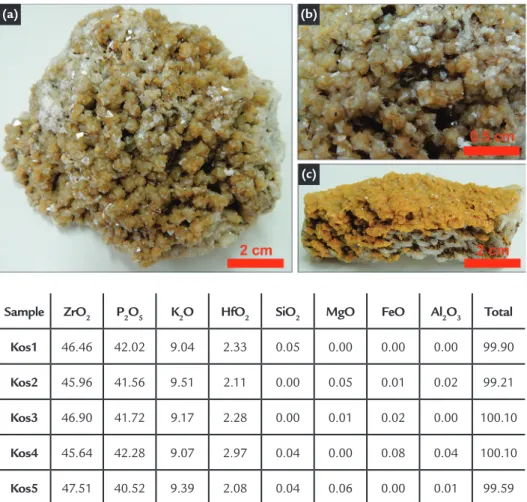
Kosnarite occurs as beautiful mil-limetric druses, beige or vivid to pale yellow, with pseudo-octahedral crystals up to 2 mm generally upon albite (cleave-landite), and associated or not with brown spherulites of zanazziite (Figures 5a, b, and c). Electron microprobe analyses of kosnarite from the Mario Pinto mine are presented in Table 4.
Figure 5 (a) Beige kosnarite druse from the Mario Pinto pegmatite. (b) Detailed aspect of the central part of the pseudo-octahedral crystals from “photo A”.
(c)Another sample, showing the rare vivid yellow color of the kosnarite aggregate on albite.
(a) (b)
(c)
Table 4 Electron microprobe analyses of kosnarite from the Mario Pinto mine (wt %; total iron as FeO).
Sample ZrO2 P2O5 K2O HfO2 SiO2 MgO FeO Al2O3 Total
Kos1 46.46 42.02 9.04 2.33 0.05 0.00 0.00 0.00 99.90
Kos2 45.96 41.56 9.51 2.11 0.00 0.05 0.01 0.02 99.21
Kos3 46.90 41.72 9.17 2.28 0.00 0.01 0.02 0.00 100.10
Kos4 45.64 42.28 9.07 2.97 0.04 0.00 0.08 0.04 100.10
7. Concluding remarks
The Eastern Brazilian Pegmatite Province can still be considered very poorly studied, besides the 28 new minerals found in it. As example, some mines or mining districts globally known, where many more minerals have already been described, can be cited: Khibiny alkaline massif, Kola peninsula, Russia – 116 species; Frank-lin zinc mine, New Jersey, USA – 71
species; Langban iron and manganese mine, Sweden – 71 species; Tsumeb lead and copper mine, Namibia – 71 species, Katanga mining district, Re-public of Congo – 65 species. Still in this regard, in a country with very little mining tradition as Italy, 312 miner-als have been described. However, the mineralogical research line being developed by this group of authors has
brought advances in this respect, result-ing in the recent indresult-ings of new pegma-tite minerals, such as carlosbarbosaite (Atencio et al., 2012), cesarferreiraite (Scholz et al., 2014) and correianevesite (Chukanov et al., 2014). Likewise, ind-ings reported in this paper (bergslagite, herderite, lithiophosphate, lithiotantite and kosnarite) also highlight this im-portant initiative.
8. References
ATENCIO, D. et alii. Carlosbarbosaite, ideally (UO2)2Nb2O6(OH)2.2H2O, a new hydrated uranyl niobate with tunnels from Jaguaraçu, Minas Gerais, Brazil: des-cription and crystal structure. Mineralogical Magazine, v. 76, p. 75-90, 2012. BACK, M.E., MANDARINO, J.A. Fleischer’s Glossary of Mineral Species 2008.
Tucson: Mineralogical Record Inc. 2008, 344 p.
BIRCH, W.D. et alii. Wycheprooite, a new hydrated sodium aluminium zirconium phosphate from Wiche Proof, Victoria, Australia, and a new occurrence of kosna-rite. Mineralogical Magazine, v. 58, p. 635-639, 1994.
BROWNFIELD, M.E. et alii. Kosnarite, KZr2(PO4)3, a new mineral from Mount Mica and Black Mountain, Oxford county, Maine. American Mineralogist, v. 78, p. 653-656, 1993.
CASSEDANNE, J., CASSEDANNE, J. Löllingite, scorodite, pharmacosidérite & au-tres minéraux de la pegmatite de Mulundu (MG). Anais da Academia Brasileira de Ciências, v. 52, p. 153-164, 1980.
CASSEDANNE, J., CASSEDANNE, J. Présence d’une moraesite a Ca-Mg dans le champ pegmatitique de Itinga-Taquaral. Anais da Academia Brasileira de Ciên-cias, v. 57, p. 319-323, 1985.
CHUKANOV, N.V. et alii. Correianevesite, Fe2+Mn 2
2+(PO
4)2.3H2O, a new
reddingite--group mineral from the Cigana mine, Conselheiro Pena, Minas Gerais, Brazil.
American Mineralogist, v. 99, p. 811-816, 2014.
FROST, C. et alii. Infrared and Raman spectroscopic characterization of the phospha-te mineral kosnariphospha-te KZr2(PO4)3 in comparison with other pegmatitic phosphates.
Transition Metal Chemistry, v. 37, p. 777-782, 2012.
HAIDINGER, W. On herderite, a new mineral species. The Philosophical Magazine,
v. 4, p. 1-3, 1828.
HANSEN, S. et alii. Bergslagite, a new mineral from Langban, Sweden. Neues Jahr-buch für Mineralogie, Monatshefte, v. 1984, p. 257-262, 1984.
HARLOW, G., HAWTHORNE, F.C. Herderite from Mogok, Myanmar, and com-parison with hydroxyl-herderite from Ehrenfriesdorf, Germany. American Mine-ralogist, v. 3, p. 1545-1549, 2008.
HYRSL, J. et alii. Die weltbesten Kosnarite aus Brasilien und das Amblygonit-Monte-brasit-Problem. Mineralien-Welt, v. 14, p. 60-63, 2003.
MATIAS, V.V., BONDAREVA, A.M. Lithiophosphate - a new mineral. Doklady Akademii Nauk SSSR, v. 112, p. 124-126, 1957.
MENEZES FILHO, L.A.D. et alii. Lithiotantite, ideally LiTa3O8. Acta Crystallogra-phica Section E, v. E68, p. 27-28, 2012.
PAES, V.J.C. et alii. Folha SE.24-V-A-IV Itaobim. Programa Geologia do Brasil, Car-ta Geológica – Escala 1:100.000. CPRM-Serviço Geológico do Brasil, Belo Hori-zonte, 2008, 1 map.
PEDROSA-SOARES, A.C. Folha SE.23-X-B-VI Araçuaí. Espinhaço Project, UFMG/ COMIG Agreement, Belo Horizonte, 1996, 1 map.
PEDROSA-SOARES, A.C. et alii. Late Neoproterozoic-Cambrian granitic magma-tism in the Araçuaí orogen (Brazil), the Eastern Brazilian Pegmatite Province and related deposits. Geological Society of London Special Publications, v. 350, p. 25-51, 2011.
Oce-307
anPictures. Moscow, 1998. 369 p.
PENFIELD, S.L. On the crystallization of herderite. American Journal of Science, v. 147, p. 329-339, 1894.
PINTO, C.P. Folha SE.24-V-A-II Jequitinhonha. Programa Geologia do Brasil, Carta Geológica – Escala 1:100.000. CPRM-Serviço Geológico do Brasil, Belo Horizon-te, 2008, 1 map.
ROMEIRO, J.C.P., PEDROSA-SOARES, A.C. Controle do minério de espodumênio em pegmatitos da mina da Cachoeira, Araçuaí, MG. Geonomos, v. 13, p. 75-81, 2005.
SCHOLZ, R. et alii. Césarferreiraite, Fe2+Fe 2
3+(AsO
4)2(OH2).8H2O, from Eduardo
mine, Conselheiro Pena, Minas Gerais, Brazil: second arsenate in the laueite mine-ral group. American Mineralogist, v. 99, p. 607-611, 2014.
UHER, P. et alii. Foordite-thoreaulite, Sn2+Nb 2O6–Sn
2+Ta
2O6: compositional
varia-tions and alteration products. European Journal of Mineralogy, v. 20, p. 501-516, 2008.
VOLOSHIN, A.V. et alii. Lithiotantite, Li(Ta,Nb)3O8, a new mineral from granite pegmatites of Eastern Kazakhstan. Mineralogiceskij Zhurnal, v. 5, p. 91-95, 1983.