Marcelo Henrique Farias de Medeiros Professor Doutor
Universidade Federal do Paraná – UFPR Departamento de Construção Civil Curitiba – Paraná – Brasil [email protected]
Eduardo Pereira Professor Doutor
Universidade Estadual de Ponta Grossa – UFPG Departamento de Engenharia Civil
Ponta Grossa – Paraná – Brasil [email protected]
Valdecir Angelo Quarcioni Pesquisador II
Instituto de Pesquisas Tecnológicas do Estado de São Paulo
Laboratório de Materiais de Construção Civil São Paulo – São Paulo – Brasil
Paulo Roberto do Lago Helene Professor Titular
Universidade de São Paulo – USP Escola Politécnica
Departamento de Construção Civil São Paulo – São Paulo – Brasil [email protected]
Surface treatment systems
for concrete in marine
environment: Effect of
concrete cover thickness
Abstract
There are some ways to extend the service life of a reinforced concrete struc-ture. This paper focuses on the extension of the service life by treating the surface of reinforced concrete, speciically on the effect of the concrete cover thickness on the surface treatment system eficacy. Thus, chloride migration tests were performed and diffusion chloride coeficients were calculated. The service life of each case (treated or non-treated concrete) was estimated using these data and Fick’s second law of diffu-sion. Results indicated that the thicker the concrete cover is, the greater the eficacy of the concrete surface treatment system will be. The dissemination of this information is important, since it is almost intuitive to think that the effect of a surface treatment system depends only on itself and this study shows the opposite.
Keywords: chloride, concrete, durability, surface protection, service life. http://dx.doi.org/10.1590/0370-44672014690092
Civil Engineering
Engenharia Civil
1. Introduction
When a structure has its construc-tion completed, the layman thinks its ma-terialization costs have ceased. However, under the action of usage, it will need to undergo maintenance to ensure the proper performance of its functions.
Under standard conditions, the reinforcing steel is physically protected by a barrier consisting of the concrete cover. This barrier limits the ingress of substances that can start the corrosion process and limits the access of water and oxygen. Having a good quality concrete, with high density and high electrical re-sistivity, it will be less susceptible to ionic
movements, and therefore, the corrosion process will slow down.
However, it is not only the con-crete cover variable that interferes in the depassivation time and kinetics of rein-forcement corrosion. Some studies such as Guimarães et al. (2003) and Meira et al. (2007) show the inluence of the
distance of the structure in relation to the sea, showing that the attack intensity is severely reduced when distance from the coastline increases. Medeiros et al. (2013)
studied an in situ reinforced concrete structure showing that the higher the concrete is, the lower the chloride
con-tamination degree will be and showed the inluence of the wetting and drying cycles which increase the speed of chloride con-tamination. These are important aspects, indicating that service-life models and building standards should consider these effects. However, many research works are needed to make possible the improve-ment and production of more realistic and accurate service life models.
REM: Int. Eng. J., Ouro Preto, 69(3), 281-292, jul. sep. | 2016
288
2. Experimental program
2.1 Concrete substrate
The concrete of the substrate was produced with a Brazilian Portland cement designated CPII E-32, which is equivalent to ASTM C 595 (Slag-modiied Portland cement). This cement has blast furnace slag addition and is one of the most widely used cements in the state of São Paulo, Brazil.
The mix proportioning of the con-crete was 1:1.80:2.70 and water/cement ratio equals 0.52, which corresponds to a compressive strength of 32 MPa (28 days, in saturated condition). The maximum size of coarse aggregate is 19 mm.
Curing occurred at 23oC and 100%
RH environment during 91 days, used to obtain a high degree of hydration. This was chosen because migration tests involve the exposure of the surfaces to moisture and this could cause additional hydration in untreated concrete but not in concrete with treated surface.
2.2 Surface Protection Systems
Five protection systems were used, all are commercial products speciied for surface treatment of reinforced con-crete structures exposed to chloride ions environments. Table 1 presents a
sum-mary of the studied surface protection products. The choice of these protection systems aims to compare some products of the three groups of surface protection systems: Pore liners (make the concrete
water-repellent), pore blockers (react with some of the soluble concrete con-stituents and form insoluble products) and coatings (form continuous ilm on the concrete surface).
Group Treatment system Identification Description manufature
Pore liners Single Water repellent Silane/siloxane – dispersed in water
Pore blocker Single Sodium silicate
Product based on sodium silicate
marketed for protection and waterproofing of
concrete
Coating
Single Acrylic Varnish Acrylic –
dispersed in solvent
Single Polyurethane Varnish polyurethane (Bicomponent)
Double system Double Water repellent + Acrylic
(silane/siloxane – dispersed in water) +
(Varnish acrylic – dispersed in base solvent)
The consumption of material indi-cated by the manufacturers was respected
in the implementation of all protection systems used in this work.
2.3 Chloride migration test (non-steady state condition)
The migration tests were conducted similarly to the ASTM C 1202/12 proce-dure, but with some modiications. The differences are the voltage applied, of 30 V (instead of 60 V), the 30-hour testing time (instead of 6 hours) and the measurement of the chloride penetration depth (instead of total charge passed).
After curing time, each cylindrical
specimen (100 mm in diameter and 200 mm in length) was cut into two 50-mm-wide slices from the central nucleus of the original specimen. Although most researchers adopt the use of a single central slice for the migration test, in this study they were drawn from two central slices based on a previous work (Medeiros et al. 2009 and Medeiros et al. 2012a), which
statistically proved that it is totally possible to use up to three 50-mm thick slices in a migration test without compromising the results. Six slices were used to represent each case studied.
After the drying procedure (7 days in laboratory environment – 25 oC and
R.U. 70±4%), the protection materials were applied on only one circular surface surfaces exposed to marine environments.
More speciically, to study the inluence of
concrete cover thickness on the potential protective systems of surface treatments
for concrete in an environment contami-nated with chloride ions.
Table 1
Description of the
of the specimens. Afterwards, the speci-mens were vacuum-saturated during 24 hours. This procedure consisted in condi-tioning specimens in vacuum desiccators and applying a vacuum pressure of 1 mmHg (133 MPa) during 3 hours. Then, the desiccator was illed with de-aerated water until all specimens were immersed, and the vacuum pressure was maintained for one additional hour. Afterwards, the vacuum pump was turned off, and the specimens were maintained immersed during 20 hours.
Seven days after the application of the surface treatment, the 50-mm-thick specimen was placed between two acrylic cells, each cell with 280 cm3 of solution
volume. One cell was illed with 0.3 N NaOH aqueous solution and the other with 3.0% NaCl aqueous solution. The cells were connected to a 30 V power source during 30 hours, in which the electrode immersed in NaOH aqueous solution was the anode and the electrode immersed in 3.0% NaCl aqueous solution was the cathode.
After 30 hours of the migration test, the concrete slices were fractured in the direction of the chloride lux and an aqueous solution of AgNO3 0.1 M was sprayed on the recently fractured surface. This procedure causes the formation of two well-deined regions (one white, one brown). The white region is formed due
to AgCl precipitation, and, therefore, represents the region containing chlorides. The brown region corresponds to the region free of chlorides. Importantly, the white region corresponds to the site with free chloride (water soluble chloride), and the measurement refers to the front of free chloride penetration excluding the combined chloride (Meck and Sirivivat-nanon 2003).
Luping and Nilsson (1992) estab-lished a mathematical model to deter-mine the chloride diffusion coeficient in non-steady-state conditions. The chloride diffusion coeficient calculation accord-ing to these authors is performed usaccord-ing Equation 1.
Where: R = gas constant (8.31 J / molK); T = temperature (298 K); z = is the ion
valence (for chloride = -1); F = Faraday
constant (96.5 J / Vmol); E = electric
ield (-600 V / m); xd = chloride
penetra-tion depth (m); t = test time (s), a and b = constants. When E = -600 V / m and
T = 298 K, a = 1.061 and b = 0.589.
This method is based on chloride migra-tion in non-steady-state condimigra-tions (ac-cording to Fick’s law). Ac(ac-cording to Luping and Nilsson (1992), with this procedure, the test time is a few hours for conven-tional concrete and about 2 days for high
performance concrete. In the experiment used here, the testing time was 30 hours. Andrade et al. (2000) compared different
methods for determining the diffusion coeficient in unsteady-state conditions and concluded that this procedure is the one with better reproducibility of results.
3. Results and discussion
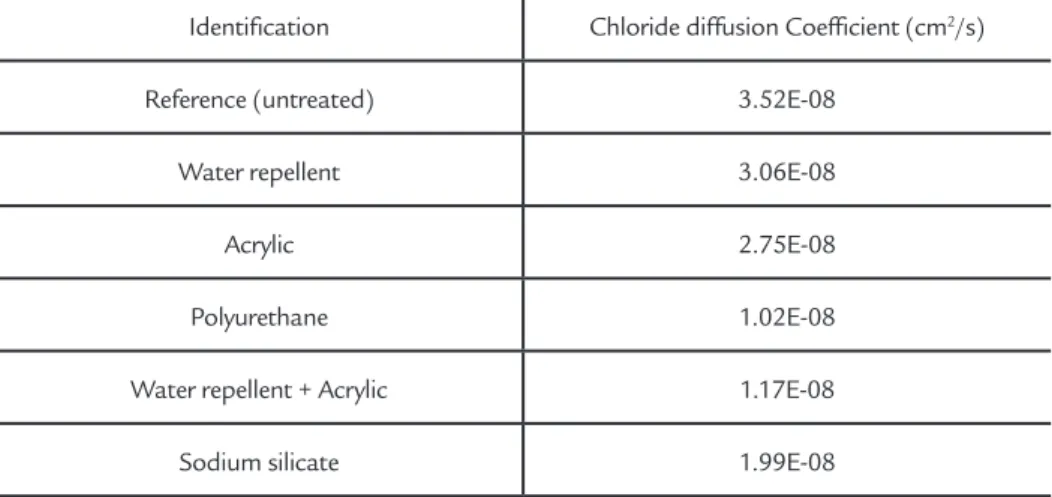
Table 2 presents chloride diffusion coeficient data measured with the
proce-dure formerly described for the reference concrete (without treatment) and for
concrete studied with different surface treatments.
Identification Chloride diffusion Coefficient (cm2/s)
Reference (untreated) 3.52E-08
Water repellent 3.06E-08
Acrylic 2.75E-08
Polyurethane 1.02E-08
Water repellent + Acrylic 1.17E-08
Sodium silicate 1.99E-08
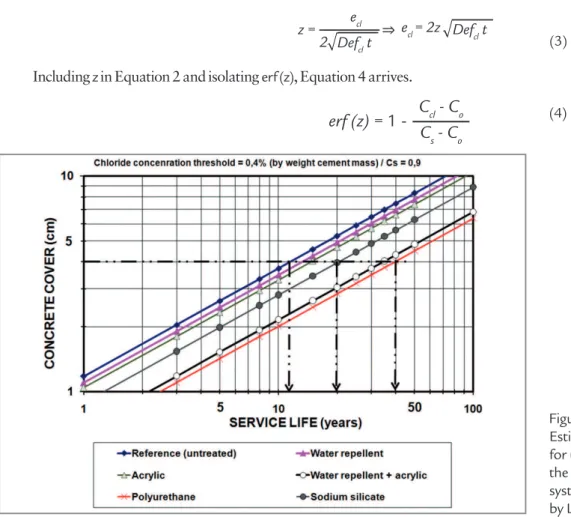
Using the chloride diffusion coeficient values determined by the method proposed by Luping and Nilsson (1992) and applying the
second Fick's law (non-steady-state conditions), it is possible to construct Figure 1, which relates the concrete cover with the service life in respect
to chloride attack.
In this way, equations 3 and 4, developed by the second Fick's law (Equation 2), were used.
Where: CCl = chloride content at
depth eCl, at time t (%); Cs =
chlo-ride content in the surface of the
concrete, admitted as constant (%);
C0 = initial chloride content in concrete; DefCl = effective chloride diffusion
co-eficient (cm2/s); t = time considered (s);
eCl = depth reached of chloride content
equals CCl (cm).
RT
x
d- ax
bd
D =
zFE
t
(1)
Table 2 Chloride diffusion coefficient measured in each case.
C
cl- C
oC
s- C
o= 1 - erf
e
cl2 Def
clt
REM: Int. Eng. J., Ouro Preto, 69(3), 281-292, jul. sep. | 2016
290
Including z in Equation 2 and isolating erf (z), Equation 4 arrives.
In the construction of Figure 1,
C0 = 0 was considered because there is
no chloride in the concrete at the time of molding the specimens.
Fixing a value for CS and
consid-ering CCl equal to the critical chloride
content limit for corrosion initiation in reinforcement, the Gauss error function [erf (z)] is found. Using tables
that relate erf (z) with z, the value of z
is obtained. By replacing the value of
z and the chloride diffusion coeficient
(obtained by the test) in Equation 3, an equation relating the depth at which the threshold value (for depassivation reinforcement) is reached with the time needed for the steel corrosion depas-sivation to be obtained. This was the reason for preparing Figure 1.
To construct this plot, a value equal to 0.9% of CS extracted from Helene (1993) was used, which speci-ies this reference value for concretes with compressive strength between 20 and 30 MPa, water/cement from 0.48 to 0.68 subjected to salt spray. This is the range at which the concrete substrate of this work its.
Moreover, it should be noted that, in the present study, the term service
life means the time required for the chloride content, on the surface of the reinforcement, to reach 0.4% (in respect to cement mass), which corre-sponds to the period called corrosion initiation. The value of 0.4% was cho-sen as it was the most internationally accepted as the chloride threshold for corrosion initiation, although this is-sue still needs to be well researched in order to reach a consensus.
It is important to highlight that the approach adopted in this paper for the solution of the second Fick's law, according to Andrade and Dal Molin (2003), is called "Error Function so-lution" which implies the following simpliications:
- It is assumed that the concrete material is homogeneous and isotropic;
- The only active transport mech-anism is diffusion;
- It is assumed that no interac-tions occur between the chlorides and the components of the concrete at the time of penetration;
- The medium is considered to be ininite;
- Both the chloride diffusion coeficient and the chloride content at
surface are constant over time;
- Chloride diffusion coefficient is completely independent of surface concentration.
It is known that there is a mistake in this methodology, since CS tends to
increase and chloride diffusion coefi-cient decreases over time. CS increases
due to the accumulation of chlorides in the concrete surface during the exposure time and the diffusion coef-icient decreases due to changes in the concrete microstructure.
As indicated by the arrows in Figure 1, for a given structure with a concrete cover thickness equal to 4 cm, the treatments resulted in increases in service life of 15%, 28%, 244%, 77% and 200% for water repellent, acrylic, polyurethane, sodium silicate and double system, respectively.
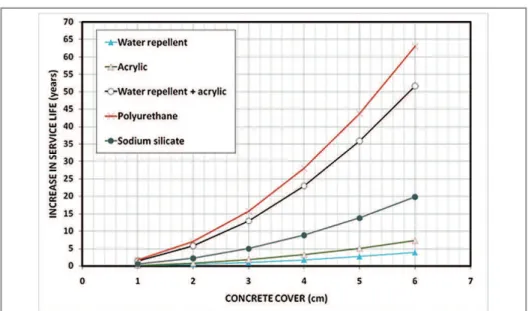
Figure 2 has an overview of the increase in service life (in years) as a function of the concrete cover. It is worth to note that the larger the concrete cover is, the larger the gain in years provided by the protection, i.e., the difference between the refer-ence series and the treated concrete is more evident.
C
cl- C
oC
s- C
oerf (z) =
1 -
(4)Figure 1
Estimated service life (years) for untreated concrete and with the various surface protections
systems of the study (diffusion coefficient by Luping; Nilsson method, 1992). (3)
ecl 2 Defcl t
z = ecl = 2z Defcl t
Figure 3 helps to understand this fact, showing relation between the number of years of service life at-tained with each protection system and the designed concrete coverage or the existing concrete cover, in the case of an old reinforced concrete structure to be protected.
A very useful way to think in terms of surface protection was pro-posed in Medeiros and Helene (2009)
and Medeiros et al. (2012b), in which
protection is converted to the equivalent concrete cover, which consists of how many inches of concrete cover thickness equal to one coat of a given protection system. The equivalent concrete covers for water repellent, acrylic, water repel-lent + acrylic, polyurethane and sodium silicate are 0.3 cm, 0.5 cm, 2.9 cm, 3.4 cm, and 1.3 cm, respectively.
It is important to emphasize that
the service life predictions presented in this work are only valid under the conditions listed below:
• The reinforced concrete struc -ture is at the beginning of its service life (starting from the initiation period);
• The fastest degradation agent is
chloride attack;
• No accidental external factors
have affected the properties of the concrete cover.
It is important to emphasize that there is a consideration that was made in this work and can be considered as a point of method failure. It is the fact that the concrete+surface protection was not considered as a two-layer system and thus has two different diffusion properties.
However, it is dificult to
con-sider the thickness of each layer exist-ing in cases where hydrophobic agents and silicates have been applied, since these treatments do not form a layer. These products penetrate the pores of the concrete and act by chemical reaction. Thus, it becomes dificult to treat the situation as two layers.
In the case of acrylic and
poly-urethane would be possible to mea-sure the layer using a meter-thick layer of paint, but it was thought better not to give different interpretation procedures for the treatments being tested in this work. For this reason, all cases in this study were considered as a single layer with a single chloride diffusion coeficient.
4. Conclusions
Figure 2 Concrete cover X service life for concrete treated with water repellent - Cs = 0.9% (diffusion coefficient by the Luping and Nilsson method, 1992).
Figure 3 Concrete cover X increase in service life for treated and untreated concrete - Cs = 0.9% (diffusion coefficient by the Luping and Nilsson method, 1992).
The results presented here show that the effect of raising the service
life of a surface protection for concrete exposed to marine environment is
REM: Int. Eng. J., Ouro Preto, 69(3), 281-292, jul. sep. | 2016
292
5. Acknowledgements
The authors thank the University of São Paulo (POLI-USP), the Federal University of Parana (UFPR), the
Insti-tute for Technological Research of São Paulo (IPT) and FAPESP (The State of São Paulo Research Foundation) for
making this study possible by inan-cially supporting it.
6. References
ANDRADE, C., CASTELLOTE, M., ALONSO, C., GONZÁLEZ, C. Non-steady--state chloride diffusion coeficients obtained from migration and natural diffusion tests – Part I: Comparison between several methods of calculation. Mater. Struct.,
33, p.21-28. 2000.
ANDRADE, J. J. O., DAL MOLIN, D. C. C. Considerações quanto aos modelos empregados para a previsão da vida útil das estruturas de concreto armado: des-passivação por íons cloreto. Revista Engenharia Civil, 18, p.31-44. 2003.
GUIMARÃES, A. T. C., CASTAGNO JÚNIOR, R., HELENE, P. Intensity of the attack of chloride-ions: considerations about the distance of concrete members re-lated to the coastline. Teoria e Prática na Engenharia Civil, 3, p.73-79. 2003.
HELENE, P. Contribuição ao estudo da corrosão em armaduras de concreto arma-do. São Paulo: Escola Politécnica, Universidade de São Paulo, São Paulo, Brazil.
1993. (Ph.D. Thesis).
LUPING, T., NILSSON, L. Rapid determination of the chloride diffusivity in concrete by applying an electrical ield. ACI Mater. J., v.89, n.1, p. 49-53. 1992.
MECK, E., SIRIVIVATNANON, V. Field indicator of chloride penetration depth.
Cem. Concr. Res., v.33, n.8, p. 1113-1117. 2003.
MEDEIROS, M., HELENE, P. Durabilidade e proteção do concreto armado. Revista
de Tecnologia da Construção, 151, p.50-54, 2009.
MEDEIROS, M.; HOPPE FILHO, J.; HELENE, P. Inluence of slice position on chlo-ride migration tests for concrete in marine conditions. Marine struct., v.22, n.2,
p.128-141, 2009.
MEDEIROS, M., H. F., HOPPE FILHO, J., BORBA, A. Y., HELENE, P. Ensaio de migração de cloretos para concreto: inluência do número de fatias extraídas.
REM. Revista Escola de Minas, 65, p.475-481, 2012a.
MEDEIROS, M. H. F., CASTRO-BORGES, P., ALEIXO, D. M., QUARCIONI, V. A., MARCONDES, C. G. N., HELENE, P. Reducing water and chloride penetra-tion through silicate treatments for concrete as a mean to control corrosion kinetics.
International Journal of Electrochemical Science, v.7, n.10, p. 9682-9696. 2012b.
MEDEIROS, M. H. F., GOBBI, A., RÉUS, G. C., HELENE, P. Reinforced concrete in marine environment: effect of wetting and drying cycles, height and positioning in relation to the sea shore. Constr. Build. Mater., 44, p.452-457, 2013.
MEIRA, G. R. ANDRADE, C. PADARATZ, I. J. ALONSO, C. BORBA JÚNIOR, J. C. Chloride penetration into concrete structures in the marine atmosphere zone – relationship between deposition of chlorides on the wet candle and chlorides ac-cumulated into concrete. Cem. Concr. Comp., v.29, n.9, p.667–676. 2007.
that the thicker the concrete cover of the reinforcement is, the higher the increase of service life offered by a particular protection system will be. This infor-mation is important for professionals involved in designs of new reinforced concrete structures as well as in repairs of existing structures, helping decision-making in the speciication of materials for surface protection.
The dissemination of this informa-tion is important, since it is almost intui-tive to think that the effect of a surface treatment system depends only on itself
and this study shows the opposite. There is an inluence of the concrete cover of the existing reinforced concrete struc-ture in the performance of the surface treatment system.
This study indicates a method for testing and analyzing reinforced concrete subjected to chloride envi-ronment based on a simple chloride migration test and the use of Fick's dif-fusion law. This may be an important tool for analyzing this type of material to deine the speciication of surface protection systems.
This paper shows the high capac-ity for increasing service life presented by surface protection systems; they can double or even triple the structure service life. However, it is important to emphasize that this increase is inherent to a regular maintenance program and schedule. This is essential due to the fact that the durability of protection systems is extremely lower than the durability of the concrete structure, and periodical maintenance is thus required to ensure their eficiency in protecting the con-crete substrate over time.