Abstract
This paper presents a potential condition to separate kaolinite through lotation when it is present in bauxite ore. This research anticipates a Brazilian industry require-ment, considering the tendency towards the need for aluminosilicates removal from bauxite ores, as has already occurred in China. Kaolinite is the most abundant alumi-nosilicate, and gibbsite is the main aluminum bearing mineral in Brazilian bauxite ores. The irst step was a fundamental study involving microlotation experiments with pure samples of kaolinite and gibbsite. Ammonium quaternary salts and amines were used as the collector and corn starch as the depressant.
In a fundamental study, the best conditions determined in the irst step were evaluated for the lotation of kaolinite from bauxite ore using laboratory scale ex-periments. Tests with AQ142/starch (pH 10) and CTAB (pH 7) led to satisfactory results. In general, the highest values of alumina/silica mass ratio were obtained with AQ142/starch and the highest values of mass recovery and metallurgical recovery were achieved with CTAB.
Keywords: froth lotation, lotation collectors, kaolinite, bauxite.
Otávia Martins Silva Rodrigues
Professora Doutora
Universidade Federal de Ouro Preto – UFOP Escola de Minas
Departamento de Engenharia de Minas Ouro Preto - Minas Gerais - Brasil [email protected]
Antônio Eduardo Clark Peres
Professor Doutor
Universidade Federal de Minas Gerais - UFMG Escola de Engenharia
Departamento de Engenharia Metalúrgica e de Materiais
Belo Horizonte – Minas Gerais - Brasil [email protected]
Andréia Bicalho Henriques
Professora Doutora
Universidade Federal de Minas Gerais – UFMG Escola de Engenharia
Departamento de Engenharia de Minas Belo Horizonte – Minas Gerais - Brasil [email protected]
Bárbara Gonçalves Amorim
Bolsista de Iniciação Científica e estudante de Engenharia de Minas
Universidade Federal de Minas Gerais – UFMG Escola de Engenharia
Departamento de Engenharia de Minas Belo Horizonte – Minas Gerais - Brasil [email protected]
Kaolinite removal
from bauxite by flotation
Mining
Mineração
http://dx.doi.org/10.1590/0370-44672014690093
1. Introduction
Chinese bauxite ores have required more elaborated beneiciation processes than the Brazilian bauxite ores. This fact is a consequence of the low alumina/silica (Al/Si) mass ratio in currently mined Chi-nese ores (Xu et al., 2004). Despite Brazil having some reserves with high-grade alumina, the tendency towards the short-age of rich reserves has been discussed (Rodrigues, 2009; Massola et al., 2009; Marino et al, 2012).
There are many studies addressing the concentration of Chinese bauxites (Hu
et al., 2003; Zhao et al., 2003; Yuehua et
al., 2004, Wang et al., 2004; Xu et al., 2004; Zhang et al., 2008; Zhang et al., 2008b). The main aluminium-bearing mineral in Chinese ores is diaspore. Brazilian bauxites differ from Chinese bauxites in that Brazilian ores have gibbsite as the main aluminium-bearing mineral. Also, the gangue minerals pres-ent in those two types of ore are differpres-ent. Iron and titanium oxides can be present in both types of deposits. Illite, pyrophyllite and kaolinite are the main silica bearing minerals in Chinese ores. Kaolinite and quartz are the main silica bearing
miner-als in Brazilian bauxites.
Brazil holds two types of deposits. The bauxite reserves in the north region present high-grade of Al2O3 and kaolinite is the main gangue mineral; the deposits from the central-south region contain not only kaolinite, but also quartz as a silicate gangue and lower Al2O3 content, if com-pared with those from the north region.
mass ratio, and, consequently renders unfeasible the utilization of the bauxite in the Bayer Process to produce alumina. Kaolinite in the Bayer Process is known as a reactive silica because it increases the consumption of NaOH and energy in the digestion stage without resulting in alumina formation.
Amines and ammonium quaternary salts are well-known potential collectors to loat aluminosilicates. Dodecylamine (DDA) is one of the most used collectors to loat aluminosilicates. Xia et al. (2009) afirmed that its adsorption onto kaolinite occurs by an electrostatic mechanism and, under acidic condition,
addition-ally by hydrogen bonding. Apart from
Xia et al. (2009) Rodrigues (2009) also
showed, in her microlotation study, that dodecylamine adsorbs onto the kaolinite surface enabling its lotation. Rodrigues (2009), also, tested, with success the etheramine Flotigam EDA, manufactured by Clariant.
Ammonium quartenary salts, for example cetyl trimethyl ammonium bromide, cetyl pyridine chloride, do-decyl trimethyl ammonium chloride and octadecyl dimethyl benzyl ammonium chloride have a good performance when used to loat aluminosilicates as shown by Zhong et al. (2008), Wang et al. (2003),
Zhao et al. (2007).
This article presents a study of ka-olinite lotation with Brazilian bauxite from the north region using amines and ammonium quaternary salts. Firstly, a fundamental stage was performed with tests in a Hallimond Tube. Then, the most selective conditions were evaluated in laboratory scale lotation. The results presented in this article are of great rel-evance for the reason that the lotation of Brazilian bauxite has not been effec-tively studied, since Brazil still has some reserves with high grade of alumina. In other words, this article anticipates a Brazilian demand.
2. Methodology
Microlotation tests were conducted in a Hallimond tube using pure mineral samples (kaolinite and gibbsite) to evaluate the performance of collectors and depres-sants in the system.
The samples were carefully ground, avoiding ines production and contamina-tion, using agate mortar and pestle. The particle size of the samples was adjusted between 75 µm and 212 µm.
The agitation in the Hallimond tube causes further comminution of the already ine kaolinite particles. Because of this, an extension was adapted to the apparatus to prevent entrainment. N2 was the gas used to produce the bubbles, at a low rate of 60 mL/min.
Throughout this study four amines and four ammonium quaternary salts were tested. This article just presents the results with the collectors that showed the highest selectivity at the microlota-tion stage. The best collectors were cetyl trimethyl ammonium bromide (CTAB)
and Tomamine Q-14-2 PG (AQ142). CTAB is a pure reagent (ammonium quaternary salt) produced by Aldrich Chemistry. AQ142 is a commercial am-monium quaternary salt produced by Pietsch Chemicals. Gelatinised corn starch was used as depressant.
The collectorsCollector perfor-mance was evaluated at three concen-trations: 1x10⁻⁴ mol/L, 5x10⁻⁵ mol/L,
and 1x10⁻⁵ mol/L. The collectors
con-ditioning time was one minute. The performances of corn starch and sodium hexametaphosphate were checked at a concentration range between 10 mg/L and 400 mg/L. The depressant condi-tioning time was 2 minutes. The froth collection time was determined after kinetic experiments, and was established at 5 min for the tests using CTAB, and at 2 min for the tests using AQ142. These experiments were done at pH values close to 4, 6, 8 and 10.
Bauxite ore was carefully prepared,
by comminution operations and size separations, specifically to minimise ines generation. After that stage the ore was deslimed. The inal size range of the bauxite sample was: -150 μm + 15 μm. The preparation of bauxite caused an increase in the alumina/silica mass ratio from 7.30 to 11.05.
Subsequently, laboratory scale lo-tation tests were conducted to verify the reproducibility of the results indicated in the microlotation stage.
Laboratory scale lotation tests were done in a Denver machine using a 900 mL cell. Each test was fed with 200 g of bauxite ore and 700 mL of water, the % solids of the pulp being 22%. The gas flow rate was 6 NL/ min. These experiments were done at pH values close to 7 and 10. Bench scale tests were conducted in two size ranges. Both stages, microlotation and laboratory scale, were conducted with distilled water.
3. Results and discussion
3.1 Microflotation experiments
Hu et al. (2003) showed that cetyl
trimethyl ammonium bromide (CTAB), in the concentration of 2x10⁻⁴ mol/L,
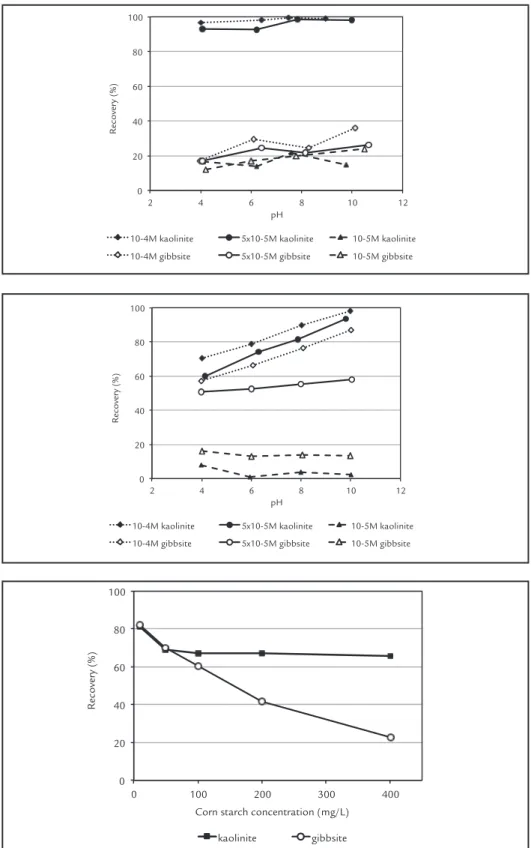
works as collector of kaolinite, espe-cially at pH 4, at which the recovery reaches 80%. The results obtained in this research are slightly better than those presented by Hu et al. (2003). Figure 1 shows the recovery of kaolin-ite and gibbskaolin-ite with CTAB. One can observe high lotability of kaolinite in the pH range between 4 and 10, except for the lowest concentration of CTAB tested. The same conclusion cannot be
extended to gibbsite. The highest recov-ery of gibbsite was 37%. These results indicate that kaolinite and gibbsite can possibly be separated by lotation using CTAB as a collector in absence of depressant.
Figure 2 presents the results of recovery of kaolinite and gibbsite, at the pH range between 4 and 10, with the ammonium quaternary salt Tomamine Q-14-2 PG (AQ142).
The presence of the collector AQ142, at concentrations of 1x10⁻⁴
mol/L and 5x10⁻⁵ mol/L, results in
val-ues of recovery for both minerals above 50%. One can observe that increase of pH results in an increase of recovery for both minerals. In conclusion, there is no selectivity window to separate the two minerals. Sodium hexametaphosphate (HX) and corn starch were tested to provide selectivity for the separation.
0 20 40 60 80 100
2 4 6 8 10 12
10-4M kaolinite 5x10⁻⁵M kaolinite 10-5M kaolinite
10-4M gibbsite 5x10⁻⁵M gibbsite 10-5M gibbsite
pH
Recovery (%)
Figure 1 Flotability of kaolinite and gibbsite as a function of pH and CTAB concentration.
Figure 2 Flotability of kaolinite and gibbsite as a function of pH and AQ142 concentration.
Figure 3 Floatability of kaolinite and gibbsite, as a function of starch concentration, with AQ142 (1x10⁻⁴ mol/L) at pH = 10.
3.2 Laboratory scale flotation tests
Figure 4 shows the best results for the laboratory scale lotation tests of bauxite sample. Laboratory scale tests reproduced the tendency shown in microlotation experiments.
The best result obtained with CTAB was achieved at neutral pH and collector concentration of 400 g/t (test B9); the Al/Si ratio changed from 11.06 to 26.56 and the metallurgical recovery achieved was 78%, the mass recovery being 72.1%.
In general, the combination of Tomamine AQ142 (AQ142) and corn starch provided good results in terms of selectivity of the laboratory scale lo-tation tests. Figure 4 indicates that the Al/Si ratio hit values between 24.2 and 25.9 (the initial Al/Si ratio was 11.06). The increase in starch concentration did not further improve the selectivity, but resulted in an increase of mass and metallurgical recovery (tests B13, B14 and B15). Using AQ142, the presence
of the depressant was crucial to ensure the selectivity in the stage of laboratory scale lotation tests.
In general, the highest values of the Al/Si ratio were obtained when the reagents used were the collector AQ142 and the depressant starch. However, values of mass recovery and metallurgical recovery obtained when AQ142 was used as collector were lower than those achieved when the collector used was CTAB. In both
0 20 40 60 80 100
2 4 6 8 10 12
10-4M kaolinite 5x10⁻⁵M kaolinite 10-5M kaolinite
10-4M gibbsite 5x10⁻⁵M gibbsite 10-5M gibbsite
pH
Recovery (%)
0 20 40 60 80 100
0 100 200 300 400
kaolinite gibbsite Corn starch concentration (mg/L)
Figure 4
Best results of laboratory scale flotation tests.
4. Conclusions
The microlotation stage indicated two conditions of selectivity to separate kaolinite and gibbsite by lotation: (i) use of CTAB, and (iii) combination of AQ142/starch.
Laboratory scale lotation tests performed with AQ142/starch and
CTAB led to satisfactory results. In general, the highest values of alumina/ silica mass ratio were obtained with AQ142/starch and the highest values of mass recovery and metallurgical recovery were achieved with CTAB. At pH 7 and high concentration, 400
g/t, CTAB yielded the highest Al/Si ratio, at reasonably high metallurgi-cal and mass recoveries of 78.0% and 72.1% respectively.
The use of the collector AQ142 is a novelty in this system.
5. Acknowledgements
The authors are grateful to CAPES PROEX, CNPq and FAPEMIG for the inancial support.
6. References
HU, Y., JIANG, H., WANG, G, D. Electrokinetic behavior and lotation of kaolinite in CTAB solution. Minerals Engineering, v. 16, p. 1221-1223, 2003.
MARINO, S., WANG, X., LIN, C., MILLER, J. The lotation of a gibbsite bauxite ore. In: INTERNATIONAL ALUMINA QUALITY WORKSHOP, 9., 2012, Per-th. Proceedings… Londres: International Aluminium Institute, 2012. p. 345-350. MASSOLA, C. P., CHAVES, A. P., LIMA, J. R. B., ANDRADE, C. F. Separation of
silica from bauxite via froth lotation. Minerals Engineering, v. 22, p. 315-318, 2009.
RODRIGUES, O. M. S. Study on kaolinite lotation. Belo Horizonte: Curso de Pós Graduação em Engenharia Metalúrgica, Materiais e de Minas, Universidade Fede-ral de Minas Gerais, 2009. 96 p. (Dissertação de Mestrado).
WANG, Y., HU, Y., LIU, X. Flotation de-silicating from diasporic-bauxite with cetyl cases the increase in concentration of
collector was inversely proportional to the recovery values.
For tests done with AQ142 and starch, the highest value of
metallurgi-cal recovery was 71.3%. In this test the mass recovery and the Al/Si ratio ob-tained were respectively, 24.2 and 64.1. The laboratory scale flotation tests were only conducted in a rougher
stage. Insertion of scavenger and clean-er stages could improve the results in terms of mass recovery, metallurgical recovery, and alumina/silica mass ratio in the concentrate.
Condition pH Depressant, [g/t] Collector, [g/t] B8
B9 B12 B13 B14 B15 B18
7 7 10 10 10 10 10
/ / / starch, 200 starch, 400 starch, 800 starch, 800
CTAB, 200 CTAB, 400 CTAB, 400 AQ142, 200 AQ142, 200 AQ142, 200 AQ142, 400 Mass ratio (Al/Si)
Metallurgical recovery (%)
Mass recovery (%)
Condition 0
10 20 30 40 50 60 70 80 90 100
B8 B9 B12 B13 B14 B15 B18
trimethylammonium bromide. Journal of Central South University Technology,
Changsha, v. 10, n. 4, p. 324-328, 2003.
WANG, Y., HU, Y., HE, P., GU, G. Reverse lotation for removal of silicates from diasporic-bauxite. Minerals Engineering, v. 17, p. 63-68, 2004.
YUEHUA, H., WEI, S., HAIPU, L., XU, Z. Role of macromolecules in kaolinite lo-tation. Minerals Engineering, n. 17, p. 1017-1022, 2004.
ZHAO, S. M., WANG, Y. H., BAO, S. X., XU, J. Flotation of aluminosilicates using N-(2-aminoethyl)-1-naphthaleneacetamide. Minerals Engineering, v.16, p. 1031-1033, 2003.
ZHAO, S., ZHONG, H., LIU, G. Effect of quaternary ammonium salts on lotation behavior of aluminosilicate minerals. Journal of Central South University Techno-logy, Changsha, n. 4, p. 500-503, 2007.
ZHANG, L. M., HU, Y. H., CAO, X. F., OUYANG, K. Study on mechanism of N,N--alkyl dodecylamine in lotation of kaolinite and diaspore. In: INTERNATIONAL MINERAL PROCESSING CONGRESS, 24. 2008, Beijing. Proceedings… 2008. p. 1580-1586.
ZHANG, L. X., CHEN, X. Q., LIU, X. Review of lotation desilication on diasporic bauxite. In: INTERNATIONAL MINERAL PROCESSING CONGRESS, 24. 2008b, Beijing. Proceedings… 2008. p. 1485-1490.
ZHONG, H., LIU, G., XIA, L., YIPING, L., HU, Y., ZHAO, S., YU, X. Flotation separation of diaspore from kaolinite, pyrophyllite and illite using three cationic collectors. Minerals Engineering, n. 21, p. 1055-1061, 2008.
XU, Z., PLITT, V., LIU, Q. Recent advances in reserve lotation of diasporic ores – A Chinese experience. Minerals Engineering, v. 17, p. 1007-1015, 2004.
XIA, L., ZHONG, H., LIU, G., LI, X. Electron bandstructure of kaolinite and its mechanism of lotation using dodecylamine as collector. Journal of Central South University Technology, Changsha, v. 16, p. 73-79, 2009.