Hamiltonian Dynamis of the Landau-Ginzburg
Model for the Phase Transition in (NH
4 )
2 BeF
4
A. Ribeiro Filho,R. C. de Miranda Filho,D. S. de Vasonelos and J. F. M. Roha
InstitutodeFsia,Universidade FederaldaBahia,
CampusUniversitario deOndina,
40210-340, Salvador,BA,Brazil
Reeived9May,2000
We present a Hamiltoniantreatment of the Landau-Ginzburg theory of phasetransitions in the
aseofinommensurateferroeletrisystemslike(NH
4 )
2 BeF
4
.Thisformulationhastheadvantage
oftreatingthesystemasanexampleofanonlineardynamialsystem.
I Introdution
Analytial peuliaritiesof thenonlinearproblemsthat
ariseintheinommensuratestruturesarenot,in
gen-eral, straightforward and require sometimes
alterna-tivemethods, whih an larify the behaviour, of the
main properties of dierent systems as improper
fer-roeletris, hiral smeti ferroeletri liquid rystals,
and other. The great interest has been to study the
distint phase transitions in inommensurate systems
without the use of any ansatz a priori. The problem
is not simple ashave been shown by well established
numerial works involving these strutures.
MMil-lan,Ishibashi,Dzyaloshinskiiandotherauthors[1℄have
used the known onstant-amplitude ansatz (ofthe
or-derparameter)orPMO-ansatz(phase-modulated-only
ansatz) or solitoni hypothesis, in order to study the
freeenergydensityofthesystem,andtowrite the
op-timized equations. Normally, it arises as a nonlinear
set of oupled Euler-Lagrange equations (in terms of
amplitudeandphaseoftheorder parameter),without
anyanalytialsolutions. MMillan'shypothesis,
insti-gatedthearisingofthedesommensurations array(or
phasesolitons) whih alloweda best understanding of
theinommensuratesystems.
Oneof the rst attempts to introdue an
alterna-tivetreatment in order to study thementioned
prob-lem was proposed by Ribeiro Filho et al [2℄, through
a Lagrangian treatment involving analogies between
the "time" evolution of the order parameter
ompo-nents, in the Landau-Ginzburg theory, of the
hi-ral smeti ferroeletri liquid rystal DOBAMBC
(1 n deyloxybenzylidene p0 amino 2
methylbutyinnamate) and the usual onguration
spae of a partile in a two-dimensional framework.
Another example of suh methods was introdued by
dertostudyinommensuratestruturesinthioureaand
other ferroeletris systems. In reent years several
works [4℄involvingaHamiltonian treatment, in order
to study the liquidrystal DOBAMBC, have roused
the interest of experimentalists and theoretiians. In
this work, it is presented a similar treatment for the
improperferroeletrisystem(NH
4 )
2 BeF
4
. Insetion
IIwedesribethementionedferroeletriandsome
as-petsof the anonialformalismapplied toit. In
se-tionIII,weperformsomeanalytialalulations
involv-ingthestabilityanalysisandthexedpointslinkedto
the problem. Finally, in the onluding setion, it is
disussedthemainresultsofthiswork.
II Theory
Inthissetionweintrodueanalternativeformulation
of the Landau-Ginzburg model of phase transitions[4℄
fortheaseoftheimproperferroeletri(NH
4 )
2 BeF
4 ,
whih belongs to the hemial family A
2 BX
4 [5℄. In
order to onstrut the dynamial theory, whih allow
to study the "time" evolutionof the order parameter
omponents, in the mentioned Landau-Ginzburg
the-ory, we onsider, at rst, the orrelation between the
ongurationspae (q
1 :::;q
n
),with thatoneof the
or-der parameter omponents (
1 ;:::;
n
). We an write
the expression of theHamiltonian density Hin terms
ofthefreeenergydensityf as
H= X
j :
j p
j
f (1)
wherep
j
istheanonialmomentumonjugatedto
j .
:
j =
H
pj ;
:
p
j =
H
j
,(j=1;:::;n)
Westudyherethesolutionsoftheseanonial
equa-tions rewriting them in a single equation, that is, we
ombinethevetorspand intoa2n-dimensional
ve-tor x=(p;). Itispossibletointerpretthequantities
( H
p
j ,
H
i
) as a 2n-dimensional vetor rH, and will
introduea2n2nmatrixJ:
J=
0 I
I 0
(2)
beingIthennidentitymatrix. Fromsuhpremisesit
ispossibleto rewritethe Hamilton'sequations unied
in the form J :
x
= -rH(x); where H is the
Hamil-tonian funtion and the state of the system is
deter-minedbythevetorx=(x
1 ;:::;x
2n
),sothatthesetof
thesevetorsonstitutesthephasespaeofthesystem,
M = fxg, whih, in the general ase, orresponds to
agiven manifold. In partiularase asM=R 2n
, we
dene the salar produt (x;y) = 2n
P
i=1 x
i y
i
. Using the
matrixJitispossibletodeneaPoissonbraket
stru-tureonthespaeF(M)ofsmoothfuntions (C 1
)on
M,thatis,
fQ(x);P(x)g= (rQ;JrP)= n
X
i=1
Q
p
i P
i Q
i P
p
i
(3)
d
whih satises the Jaobi identity: fQ;fP;R gg +
fP;fR ;Qgg+fR ;fQ;Pgg=0,as well asthe relation
fQ(x);P(x)g = fP(x);Q(x)g, and the Leibniz rule:
fQ;PR g = fQ;PgR+fQ;R gP. The two rst
rela-tionsalsodeneaLiealgebrastrutureonF(M). So,
the mentioned Hamilton's anonialequations anbe
written as,
:
x=fH;xg=X (4)
whihistheanonialformofthementionedequations
ofmotionofaHamiltoniansystem,whihis
harater-izedbyfM;f;g;H(x)g,thatis,bythephasespaeM,
the Poisson struture f;g and the Hamiltonian
fun-tion H(x). X is theso-alledHamiltonianvetoreld
assoiatedwiththeHamiltonianfuntion H(x)[6℄.
Ferroeletri materials besides exhibit a
sponta-neous eletri dipole momentum, an also be dened
as substanes in whih is haraterized a relation
be-tween the polarization and the eletri eld through
a hysteresisyle. Oneof the mostimportant rystal
familiesthat presentstheferroeletriityphenomenom
isharaterizedbythehemialformulaA
2 BX
4 ,ofthe
so-alled improper ferroeletis [5℄, whih an present
other order parameters besidesthe polarization. The
ferroeletri(NH
4 )
2 BeF
4
(Ammoniumuorberyllatte)
is an importantmemberof that moleular familyand
presents,likeotherinommensurateferroeletris,a
se-queneoftwophasetransitionsinvolvingthreedistint
phases: the paraeletri (or normal or prototype) or
hightemperaturephase(N),theinommensuratephase
(I), wherethetransitiontemperatureisT
i
= 90:0 o
C,
and, nally, theferroeletriommensurate phase(C)
whihbeginsattemperatureT
= 96:0 o
C. The
sym-thorrombiD 16
2h
Pmm,the(C)phaseisalso
orthor-rombi C 9
2
Pn2
1
a, and the intermediary (I) phase
is indetermined, with an inommensurate modulation
in the a-axis of the struture.[1℄ ;
[5℄ The polar axisin
the(C) phaseis parallel to theb-axis, and thelattie
parameterofthea-axisisdoubled[7℄. Experiments
us-ing magneti resonane have ontributed for the best
understandingofthemainphysial featuresofthe
dif-ferent phasesof this materialwhen areonsidered the
high andlowtemperatureregions in the(I) phase. It
has been established that in the region near the
nor-mal phase, the wave of inommensurate modulation
an be desribed asa"plane wave",and as the
tem-peratureleadsto T
,of thelok-in(inommensurate
-ommensurate)transition,theapproximated
ommen-surateregionsarepresent,butseparatedbystati
soli-toni lattiesso-alled disommensurationsor domain
walls[1℄ ;
[5℄wherethephaseofthemodulationwavevary
fasterthatoneintheaseofaplanewave. Inreferene
tothe (I)phaseitis worthto emphasizethat thesoft
modeondensationattemperatureT
i
,inthementioned
rystal,leadstothemodulationoftheparentlattiefor
aninommensuratestruturewhoseperiodiityisan
ir-rationalmultipleoftheperiodoftheprototypelattie.
The haraterization of this (I) phase annot be
ob-tained by one of the 230 spae groups but it an be
studiedbythesuperspaegroupformalism.[5℄
Considering the Landau-Ginzburg theory of phase
transitionsof the ferroeletri(NH
4 )
2 BeF
4
, it is
pos-sible to establish the freeenergy density potential for
thisrystalandisomorphous[8℄as
f(x)=f
h +f
nh +f
L
neous,inhomogeneous partsand theLifshitzinvariant
ofthementionedthermodynamialpotential,thatis,
f
h =
1
2 (
2
1 +
2
2 )+
1
4 (
2
1 +
2
2 )
2
+ 1
2
( )
2
1
2
2 (6)
f
nh =
1
2 [(
d
1
dx )
2
+( d
2
dx )
2
℄ (7)
and
f
L =Æ(
1 d
2
dx
2 d
1
dx
) (8)
where x is the oordinate and
j
(j =1;2) arethe
or-derparameteromponentswhihtransformin
aord-ing to atwo-dimensional irreduible representation in
X [k
o =(
a
;0;0)℄ point on the Brillouin zone
bound-ary,andtheoeÆient=
o (T T
o
)dependslinearly
ontemperatureand it isthe so-alledLandau
param-eter. The other parametersare: >jj , > 0and
Æ are onsidered temperature independent. The
Lif-shitzterm(8)isallowedbysymmetryanditsexistene
prohibits the seond-order transition diretly into the
ommensurate phase (C) from the normal phase (N).
Anotherimportantfeatureofthismaterialisthatwhen
temperaturedereases,theoeÆientofthequadrati
terms in
j
(j = 1;2) beomes zero for the ritial
wavenumber k
i =
jÆj
, at temperature T
i
, given by
i =
o (T
i T
o )=
Æ 2
, where aseond-order
normal-inommensuratetransition takes plae[8℄. Theaim of
this work is to disuss some qualitatively
fundamen-tal aspets of the physis of the mentioned
ferroele-tri,fromaHamiltonianapproahbaseduponasimple
one-dimensionalLandau-Ginzburgmodelgivenby(5).
In this equation the expression ( ) 1
measures
theanisotropyfatorofthethermodynamialpotential
f. It is worth to stress that just below the
temper-ature T
i
, the anisotropipart of (5) an be negleted
in referene to theisotropi oneand therefore the
so-lution of the problem is given by the sinusoidal
fun-tions
j
(j =1;2), as wewill showin thenextsetion.
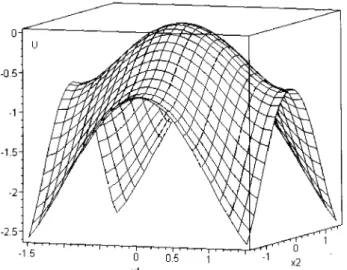
Fig. (1)showsthehomogeneouspartofthe
thermody-namial potential in termsof the order parameter
o ,
when itis onsidered theisotropi ase( =).
Us-ingsomenumerialvaluesquoted inliterature[8℄,itis
skethed inFigs. (2)and(3), for=0:8 and=0:2,
the homogeneouspart ofthe thermodynamial
poten-tial. Inthis asethe anisotropyis not quite large, so
thattheinommensuratephaseisstabledowntomore
large range of temperature. Figs. (4) and (5), where
we use =0:8 and = 0:4, indiate the asewhen
theanisotropyislargeenoughand,inonsequene,the
ontour lines deviate from the irular pattern more
learly thanin Fig. (3). Inthis ase thetemperature
rangeoftheinommensuratephaseisquitenarrow
be-ause, aswell established,the anisotropyenergy, that
favours the ommensurate phase, beomes prominent
partof thetotalenergyonloseandbelowT.
Figure1. ThermodynamialpotentialU fh versusorder
parameter(x
o
o
),for =0:8and= 1:6;=0:8.
Figure2. ThermodynamialpotentialU(x
1 ,x
2 ), x
1
1 e
x
2
2
,for = 1:6,=0:8and=0:2.
Figure 3. Contour lines ofthe homogeneous potential for
Figure 4. ThermodynamialpotentialU(x
1 ,x
2 ), x
1
1 e
x
2
2
,for= 1:6,=0:8and= 0:4.
Figure 5. Contour lines of the homogeneouspotential for
= 1:6,=0:8and= 0:4.
In order to make easy the omputations
involv-ing (1) it willbeonsidered the following analogiesin
(5): x like "time" t; f ! L (the Lagrangian), where
L = T V, being T and V the kineti and
poten-tial energies, respetively. Inthis mehanialanalogy
T !f
nh
andV =U+U
L
,withU !f
h andU
L !f
L
in thegeneralizedpotentialdepending on the
"veloi-ties" :
j
(j=1;2). Usingsuhdesignationsweareable
alulate theanonialmomentaby
p
j =
:
j +( 1)
j
Æ
j+1
(9)
with (j = 1;2;3 1) and through a usual Legendre
transformationweanwritethefollowingHamiltonian
H = 1
2 (p
2
1 +p
2
2 )+
1
2 (
2
1 +
2
2 )
1
4 (
2
1 +
2
2 )
2
1
2
( )
2
1
2
2 +(p
1
2 p
2
1
) (10)
where = Æ
2
and =
Æ
. When 6= ,
the anisotropi term makes the phase and the
ampli-tude, of the order parameter, be x-dependent, that is
j
(j=1;2)begintoinlude higherharmoniswherea
givenritialwavenumberk
i
isdetermined inorder to
minimize
F = 1
L Z
f(x)dx (11)
where L is the "length " of rystal. It is worth to
point out that the equation (10), with 6= , also
denesanonlinearHamiltonian system,whihis
non-integrable[6℄. WeanrewritetheHamiltonian(10)as
H =H
o 1
2
( )
2
1
2
2
(12)
sothat, if=,thesystemwithH =H
o
isintegrable
andisotropi,with
G=(p
1
2 p
2
1
) (13)
beingtheseondonstantofmotionbesidestheenergy.
ThismaybeveriedbydiretalulationofthePoisson
braketfH;Gg=0.
III Analytial Calulations
From the equation (11), and using the Hamiltonian
treatment, it ispossibleto get all resultsthat
hara-terizethe dierentphase transitionsin thementioned
ferroeletrirystal. The transition between (N) and
(I)phases analso be desribed byHamiltonian (10),
whih givesrise, as we haveshowed in thesetion II,
thefollowingsystemofordinarydierentialequations,
whihanberewriteinshort, :
X=F(X),withXbeing
theHamiltonianvetoreld, and
:
x
1 =F
1 (x
1 ;x
2 ;x
3 ;x
4 )=
1
x
3 +x
2
(14)
:
x
2 =F
2 (x
1 ;x
2 ;x
3 ;x
4 )=
1
x
4 x
1
(15)
:
x
3 =F
3 (x
1 ;x
2 ;x
3 ;x
4
)= x
1 +x
4 +x
1 x
2
2 +x
3
1
(16)
:
x
4 =F
4 (x
1 ;x
2 ;x
3 ;x
4
)= x
2 x
3 +x
2
1 x
2 +x
3
2
(17)
wherewesubstitute
1 byx
1 ;
2 byx
2 ;p
1 byx
3 andp
2
of a dynamialsystem, where thexed pointsan be
determined byonditionF(X) =0. Therstof these
pointsP
1
:(0;0;0;0)isquiteinterestingin ourpresent
disussionaswewillseehereafter. Afterperformingthe
stabilityanalysisaroundthispointitispossibleto
re-ognize several experimental features of thementioned
ferroeletri,aswehavepointedoutinthelastsetion.
Followingthe standardproedure [6℄of suh
anal-ysis in adynamialsystem, that is, using alinear
ap-proximationaroundtheequilibrium pointP
1 weget
:
X J
H (P
1
)X (18)
wheretheJaobianmatrix,J
H (P
1
),isgivenby
J
H (P
1 )=
0
B
B
0
1
0
0 0
1
0 0
0 0
1
C
C
A
(19)
Thefour eigenvaluesof theharateristiequation
areobtained,inthisapproximation,by
det(J
H (P
1
) I)= 4
+2 2
( 2
+ 1
)
+( 4
2 1
2
+ 2
2
)=0 (20)
andthesolutionsare
1
=
2 =[
1
(+Æ 2
1
)+2Æ 3
2
1
2
℄ 1
2
(21)
3
=
4 =[
1
(+Æ 2
1
) 2Æ 3
2
1
2
℄ 1
2
(22)
where = 0 orresponds to the strutural stability
breaking and we get the ritial temperature, T
i =
T
o +
Æ 2
o
. This temperature is therefore the
normal-inommensuratetransition temperature[8℄andforthis
ase,after somealgebrai alulations,theeigenvalues
are pure imaginary, that is, = i jÆj
and the
orre-spondingeigenvetorsare
x
oj =A
0
B
B
i
1
0
0 1
C
C
A
(23)
where x
oj
(oj = 1;2) orresponds to i in (23).
Fi-nally, we get: x
1
= Aos jÆj
x and x
2
= Asen jÆj
x,
that is, suh expressions show that the order
param-eter omponents
j
(j =1;2); of this ferroeletri
sys-tem, are modulatedwith the ritial wavelength k
i =
jÆj
. These resultsharaterizetheonset ofthe
inom-mensurate struture in this material and they are in
agreement with those ones obtained, traditionally, by
transition at T
i
betweenthe (N)and (I)phases. The
wavelength ofthe modulationis notasimplemultiple
ofthelattieperiodin thenormalphase.
From the set of equations (14)-(17) it is
sim-ple to nd the following nine xed points, with
o-ordinates P
i (x
1 ;x
2 ;x
3 ;x
4
), of the dynamial
sys-tem: P
1
(0;0;0;0); P
2
(0;n; Æn;0); P
3
(0; n;Æn;0);
P
4
(n;0;0;Æn); P
5
( n;0;0; Æn); P
6
(m;m; Æm;Æm);
P
7
(m; m;Æm;Æm); P
8
( m;m; Æm; Æm) and the
last point P
9
( m; m;Æm; Æm); where n = (
)
1
2
and m = (
+ )
1
2
. The analysis of the last eight
xedpoints(P
2 ;:::;P
9
)isquitesimilartothatone
em-ployed in P
1
(0;0;0;0) in spite of the algebrai work
be quite extended. Normally, we onsider again the
linearized system J
ij =
F
i
x
j = F
j
i
, so that J = [J
ij ℄
and using the equations (14)-(17) we nd: F 1
1 = 0;
F 2
1
= ; F 3
1 =
1
; F 4
1
= 0; F 1
2
= ; F
2
2 = 0;
F 3
2
= 0; F 4
2 =
1
; F 1
3
= +x
2
2 +3x
2
1 A
1 ;
F 2
3
= 2x
1 x
2 ; F
3
3
= 0; F 4
3
= ; F 1
4
= 2x
1 x
2 B;
F 2
4
= +x
2
1 +3x
2
2
A
2 ; F
3
4
= 0; F 4
4
= .
Thereforetheharateristiequationisgivenby
4
+[2 2
(A
1 +A
2 )
1
℄ 2
+ 4
+ 2
A
1 A
2
+ 1
2
(A
1 +A
2
)
2
B 2
=0 (24)
where
A
1
= +x
2
2 +3x
2
1
(25)
A
2
= +x
2
1 +3x
2
2
(26)
B =2x
1 x
2
(27)
andthemainalgebrairesultsofthesealulationshave
beensummarized anddisussedintheappendix.
IV Conlusions
In this work we expliit the possibility in using the
mathematial bakgroundofdynamialsystemsin
or-dertodisussthephasetransitionsprobleminthe
fer-roeletri rystal (NH
4 )
2 BeF
4
. This treatment an
be extended to other members of the hemial
fam-ily A
2 BX
4
. Forthis, itwasintrodued aHamiltonian
treatment,inadditionto themehanialanalogy,
on-sideringthementionedferroeletrimaterialasa
typi-alHamiltoniansystem.
Summarizing the disussion underlined in setion
IIIandappendixwehavefoundfourdistintvaluesfor
the Landau parameter:
o ", 0,
+
o and
o
. In the
neghbourhood (the left and rightsides) ofeah
dier-ent-value,thephasespaepresentsdierentfeatures.
In the ase =
o
", it is observed, to the rightside,
hy-a unique xed point, whih is ellipti. When = 0,
in both left and right sides, the xed points are
elip-ti. For > 0 there is only one ritial point while
for < 0 (whih is the more important ase for the
Landau-Ginzburg model) there are nine xed points.
In the ase of = +
o
impliates that in the points
P
1 ;:::;P
5
thereisnothange ofbehaviour. With
refer-ene to thepointsP
6 ;:::;P
9
,thehangeis identialto
thoseonein
o
"despiteallhyperbolipointsare
loal-ized in theleft sidewhile theelliptiones in theright
size. For
o
wenotethattherearenothangesforthe
pointsP
1 ;:::;P
5
,whileP
6 ;:::;P
9
arehyperboliinboth
sides(leftandright),butinthease<
o
the
eigen-valuesarereal,whilefor>
o
theyareomplex. So,
from theanalysisaboveonlytwo-values(
o "e
+
o )
separate hyperboli and ellipti points. It is worthto
emphasize that thetemperatureassoiated withthese
two -values are those obtained by other authors [8℄
andorrespondstothepreseneofthephasetransition
in thementionedferroeletrimaterial.
From the harateristi equation (20) and matrix
(23)itisshowedthearisingofaninommensurateplane
waveinvolvingtheorderparameteromponents
1 (or
x
1 ) and
2 (or x
2
) in terms of a ritial wavenumber
k
i
,whiletheritialtemperaturebetweenthe(N)and
(I) phases has been obtained, quikly, when we have
onsidered thestabilityanalysis,in thelinear
approxi-mation,aroundthepointP
1
(0;0;0;0). Usingthe
equa-tions (34),(35),(28) and(29), from theappendix, we
get
+
o = (
Æ 2
)(+)[+( 2
2
) 1
2
℄ 1
whihorrespondsto theritialtemperature
T +
o =T
o (
Æ 2
o
)(+)[+( 2
2
) 1
2
℄ 1
wheretheommensuratephasebeomesunstablewith
respet to spatially modulated solution. The
wave-length of the modulation wave, it is omputed from
themodulusoftheeigenvalues,in(31),thatis,
= jÆj
[2(
2
2
) 1
2
℄ 1
2
[+( 2
2
) 1
2
℄ 1
2
Itisinterestingtopointoutthatinspiteofthe
rit-ialtemperatureT +
o
hasbeenpreviouslyomputed[8℄,
meanwhile that expression does not represent in fat
the atual lok-in temperature T
whih takes plae,
in reality, at muh lowertemperaturethan T +
o
. With
refereneto(NH
4 )
2 BeF
4
itisworthto stressthat the
lok-inphasetransitiontemperature,an beobtained,
with more auray, from (11), when the free energy
densitypotentialmodelinludes otherphysial
ontri-butions likeexternal elds [9℄. Using suh
thermody-namialpotentialmodelsitisfoundarst-orderlok-in
In order to disuss our Hamiltonian treatment we
deide to use an established and simple model
be-ause, normally, the lok-in temperature alulation
is quite umbersome, when it is onsidered the
inu-ene of an external eletri eld on
inommensurate-ommensurate (lok-in) phase transition in this
ferro-eletri material, whih gives a good agreement with
experiment.
In summary, we have got new analytial results
as well as those ones obtained by other authors for
(NH
4 )
2 BeF
4
, usingasimpleandelegantHamiltonian
approah,showingtheeÆayofthisalternative
formu-lationforstudyingphasetransitionsandotherfeatures
ofimproperferroeletris. Thegreatadvantagesofthis
analytialapproah hasbeenthe straightforward way
ingettinginformationsaswellasmanyphysial
proper-tiesanbedisussedmorelearly. Inomparisonwith
thestandardformalismusedbydierentwriters[8℄we
anstressthatthisHamiltoniantreatmentismore
sim-pleandavoidsomehypothesisusedbythem.
Despite thesimpliity of thethermodynamial
po-tentialmodel,usedinthiswork,itshows,morelearly,
thepossibility in using theHamiltonian treatmentfor
theLandau-Ginzburgtheoryofphasetransitions. This
approah reates new possibilities in studying phase
transitions employing nonlinear dynamial tehniques
whihhavebeendisussedinotherbranhesofPhysis.
Anotheraspetalreadyunderlinedbefore[4℄isthat
us-ing the mathematial reourses of the nonlinear
dy-namis it is possible to study, more arefully, the
haoti strutures that are present, experimentally, in
the neighbourhood of the lok-in phase transition in
this material. Fromsuh evidenes it will be possible
to analyze the haotiity, in terms of Poinare maps,
theLiapunovexponent,powerspetrumandthe
orre-lationfuntion.
Inthisworkwehaveonentratedinstudyingsome
aspets of the ritial points present in (NH
4 )
2 BeF
4
andin disussingthebehaviouroftheLandau
param-eter,whihis dependentoftemperature.
Aknowledgements-Oneofus(A.R.F.)wouldlike
to thank the support of the Brazilian agenies CNPq
andCAPES.
Referenes
[1℄ W. L. MMillan, Phys. Rev. 14, 1496 (1976); I. E.
Dzyaloshinskii,Sov.Phys.JETP,20,3,665-671(1965);
E. M. do Nasimento, D. S. de Vasonelos, J. F. M.
RohaeA.RibeiroFilho,Rev.Bras.Ens.Fsia,20,1,
11-18(1998); Y. Ishibashi andH. Shiba,J.Phys.Jpn,
44,801(1978).
[2℄ A.RibeiroFilho,D.R.Tilley,andB.Zeks,Phys.Lett.
A100,247(1984).
[4℄ K.C.Mundim,P.Pitanga,andA.RibeiroFilho,Notas
de Fsia, CBPF-NF-045, 1-10 (1992); phys.stat. sol.
(b)179,53(1993);P.Pitanga,A.RibeiroFilho,andK.
C.Mundim,phys.stat.sol.(b)183,103(1994);P.
Pi-tanga, K.C.Mundim,andA.Ribeiro Filho,phys.stat.
sol.(b)197,517(1996).
[5℄ R.Lifshitz,Rev.Mod.Phys.69,4,1181-1218(1997);V.
C.Costa,D.S.deVasonelos, E.M.doNasimentoe
A.RibeiroFilho,Rev.Bras.Ens.Fsia,20,3,220-229
(1998).
[6℄ J. E. Mardsen, Letures onMehanis, London Math.
So. Let. Notes Ser. 174, Cambridge Univ. Press
(1992);A.M.O.deAlmeida,"Sistemas
Hamiltonianos-CaoseQuantiza~ao",Ed.Uniamp,(1995);A.M.
Per-emolov,"IntegrableSystemsofClassialMehanisand
Lie Algebras", vol. 1, Ed. Birkhauser (1990); N.
F-Ferrara e C.P.C. doPrado, "Caos uma Introdu~ao",
Ed.EdgardBluherLtda.(1994);R.C.MirandaFilho,
and R. F. S. Andrade, Phys. Lett. A 153, 2, 3, 101
(1991).
[7℄ J.Kobayashi,Y.Uesu,J.Ogawa,andY.Nishiara,Phys.
Rev.B,31,7,4569-4575 (1985).
[8℄ A. P. Levanyuk, and D. G. Sannikov, Sov. Phys. Sol.
State 18, 245 (1976); Y. Ishibashi, Ferroeletris 24,
119-126(1980);H.ShibaandY.Ishibashi,J.Phys.So.
Jap.44,5,1592-1599 (1978);Y.IshibashiandV.
Dvo-rak,J.Phys.So.Jap.44,32(1978).
[9℄ P. Prelovsek, A. Levstikand C. Filipi, Phys. Rev.B,
28, 9, 6610-6612 (1983); O. Hudak, J. Phys.C: Solid
StatePhys.,16,2641-2658 (1983).
Appendix
Thesolutionof (24) forthe xed points P
6 ;:::;P
9 ,
expliited in the text through its oordinates x
1 , x
2 ,
x
3 ,x
4
,showsthatx 2
1 =x
2
2 =m
2
=
+
.So,from(24)
wend:
A
1 =A
2
=A=( 2
1+ 1
)
Æ 2
(28)
B 2
=[(
+ )2℄
2
= 2
2
(29)
Substituting(28)and(29)in (24)wehave
2
=ZD 1
2
(30)
where
D=
2
2
2
+4b
2
+4
4
(31)
Z= b
2
2
(32)
b= 2
1+ 1
(33)
IntheaseD<0weseethat 2
andareomplex,
2
positive, impliates that D is negative for loalized
betweentherootsofequationD=0,thatis,
Do+
=2
2
2
[ b+(b 2
2
)℄ 1
2
(34)
Do
=2
2
2
[ b (b 2
2
)℄ 1
2
(35)
Z itwillbezerofortherootof(32),sothat
Zo
= 2b 1
2
(36)
whoseloationitwillbedisussedlater. From(28)and
(29)wehaveb>0,beause >jj, andb>. These
twolastonditionslinkedwith(34)and(35)showthat
Do <
Do+
< 0. So, the -valuesare loated
be-tween
Do
and
Do+
, and beomes D < 0. Suh
valuesbelongstotheexistene'sdomainofxedpoints
P
6 ;:::;P
9
,whiharerealfor<0aswehavepreviously
expliited. Itis possibleto verify that
Zo
belongs to
the interval (
Do ,
Do+
), that is, between (
D ,
Do+
), where
D =
1
2 (
Do+ +
Do
). Using(34)and
(35)wehave
Zo
Do =
2 2
b 2
2
[b(b 2
2
)+b 2
(b 2
2
) 1
2
℄ (37)
The two terms in the right side of (37) are positive
beause from(28) and (29), b > 0 and b > . So,
Zo >
Do
and, on the other hand, we see that
D =
2 2
2
b <
Zo
, and thus it shows that
Zo is
loatedto therightof
D
. It isalso possibleto verify
that
Zo
isloatedto theleftof
Do+
. From(34)and
(37)weget:
Do+
D =
2 2
2
a
1
(38)
Zo
D =
2 2
2
a
2
(39)
witha
1 =(b
2
2
) 1
2
anda
2
=(b 2
b 1
), beingboth
positive and a
1 > a
2
, so that
Do+ >
Zo
. So, the
eigenvaluesan beomputed noting the following
hy-pothesis: (I) when
Zo
<<
Do+
, wehave,in this
ase, Z < 0 and 2
= zid, where z = jZj and
d=jDj 1
2
,suhthatthefoureigenvaluesfoundare
on-jugate omplex, that is,
+1 =
2 and
+2 =
1 ,
with expressions
+1 = r
1
2
(os
+
2
+isin
+
2 );
+2 =
r 1
2
(os
+
2 +isin
+
2 );
1 =r
1
2
(os
2 +isin
2 )and
2
= r
1
2
(os
2
+isin
2
), where r = (z 2
+d 2
) 1
2
,
+
= tan 1
( d
2
)+ e = 2
+
, being valid:
Re(
+1
) = Re(
2
) < 0e Re(
+2
) = Re(
1 ) < 0;
(II) when
Do
< <
Zo
, the results are
equiva-lent, but in this ase Z = z, and not Z = z, and
+
= tan 1
( d
2
) and =
+
; (III) when it is
on-sidered the hypothesis D 0, then 2
sign of 2
, whih it will be determined by the
rela-tion between Z 2
and D as showed in (31) and (32),
that is, Z 2
D = (b 2 2 ) 2 2
0, and we an
say that the sign ( 2
) is equal to the sign (Z) and
2
6= 0, 8 < 0, so that 2
+
= 0 for = 0 and
2
=Z D
1
2
=2Z <0. ThenD 0if
Do or Do+ . When Do
=)<
Zo
()Z >0;
if
Do+
=)>
Zo
()Z <0. Insummary we
see that: (a)
Do
=)
+1
= (Z+D 1 2 ) 1 2 > 0; 1
= (Z D 1 2 ) 1 2 > 0; +2
= (Z+D 1 2 ) 1 2 < 0 and 2
= (Z D
1
2
) 1
2
< 0, all real; (b)
Do+
<0=)
+1 =i(
Z+D 1 2 ) 1 2 ; 1 =i( Z D 1 2 ) 1 2 ; +2 = i(
Z+D 1 2 ) 1 2 and 2 = i( Z D 1 2 ) 1 2 ; ()
=0=)
+1 = +2 =0; 1 = 2 =2i.
Thesolutionof (24)forthepointsP
2 , ...,P
5 ,in
a-ordingwiththevaluesofitsoordinates,arex 1 x 2 =0 and x 2 1 +x 2 2 = n 2 =
, so that substituting these
expressionsinequations(25)-(27)and,aftersome
alge-braimanipulationswendthefollowingharateristi
equation: 4 +2( 2 A 0 1 ) 2 +( 2 + 1 A 0 ) 2 2 02 2 =0 (40) when A 0 = b 0 Æ 2 ; b 0 = + 2 = 1 b ; 0 = 3 2 .
The equation (40) is equivalent to (24) when
substi-tute A !A 0
, ! 0
, sothat theequations (30){(32)
anberewrittenas:
2 =Z 0 D 0 1 2 (41) D 0 = 02 2 2 +4b 0 2 +4 4 (42) Z 0 = b 0 2 2 (43)
Althoughtheequations(41)-(43)besimilarto
(30)-(32),theeigenvaluesobtaineddonotpresentthesame
features. ForthepointsP
6 ;:::;P
9
,thepropertiesofthe
eigenvalues are strongly inuened by relations b > 0
and b> obtainedfrom (28)and(29). Inthease of
pointsP
2 ;:::;P
5
,despiteb 0
>0bevalid,meanwhilethe
relation b 0
> 0
isnotvalid. So,from(41)-(43)wehave
0 > b 0 and b 0
> 0. The rst of these two onditions
impliatesthattheequationD 0
=0doesnothavereal
roots(theargumentintherootof(34)isnegative).
Be-ing theoeÆient of 2
in (42)positive,then D 0
>0,
8. It is worthto pointout that 0 itis a
nees-saryandsuÆientonditionfortheexisteneofpoints
P
2 ;:::;P
5
(beausen=(
)
1
2
). TheminimumofD 0 is foundby: = 2b 0 2 02
<0 (44)
D 0 =4 4 02 b 02 02
>0 (45)
andZ 0
itwillbezerofor
Z 0 o = 2b 0 2 b 02
<0 (46)
and from (46), (44) and 0 > b 0 : Z 0 o > jj =) Z 0 o < and jZ 0 j D 0 1 2
. Therefore, the
eigenval-ues are given for = 0, as being:
+1 = +2 = 0; 1 = 2
= 2i and for < 0, the sign in front
of D 0
1
2
indiates the sign of 2
, by virtue of (45),
that is: +1 = (Z 0 +D 0 1 2 ) 1 2 ; 1 = i( Z 0 D 0 1 2 ) 1 2 ; +2 = (Z 0 +D 0 1 2 ) 1 2 and 2 = i( Z 0 D 0 1 2 ) 1 2 .
In the solution of (24) for the point P
1
(0;0;0;0)
we have: x
1 = x
2
= 0; A
1 = A 2 = = Æ 2 = b" Æ 2
= A", (b" = 1); B = 0 = " 2
2
,
(" = 0). Substituting, b ! 1 = b", ! " =0 e
A!A",intheequations(30)-(32)weget:
2
=Z"D" 1
2
(47)
D"= 4 2 +4 4 (48)
Z"=
2
2
(49)
andin this asethe onditions(b >0, b >) are not
valid. Inthis aseare valid: b"<0and b"<"=0.
Theeigenvalueswill havedistintfeaturesoftheother
two ases already disussed. When D"< 0: this
hy-pothesisoursfor>
Do"
,where
Do"
istherootof
equationD"=0,sothat
Do" = Æ 2
>0 (50)
Z"=2
Do"
(51)
andtheresultsareidentialtothoseones obtainedfor
D<0intheaseofpointsP
6 ;:::;P
9
. WhenD"0we
have D o " = Æ 2
andinthisasewegettherelations
Z" 2 D"= 2 2
0andjZ"jD" 1
2
. Forthe
omputa-tionofeigenvaluesweonsider,analogously,theases:
=0 and get
+1 = +2 = 0; 1 = 2 = 2i;
and for 6= 0 we have pure imaginary eigenvalues,
thatis,
+1 =i(
Z"+D" 1 2 ) 1 2 ; 1 =i( Z" D" 1 2 ) 1 2 ; +2 = i(