From the Coloproctology Discipline, Digestive Surgery Department, Hospital das Clínicas, Faculty of Medicine, University of São Paulo.
Received for publication on August 18, 2002.
CONVENTIONAL APPROACH X LAPAROSCOPIC
ABDOMINOPERINEAL RESECTION FOR RECTAL
CANCER TREATMENT AFTER NEOADJUVANT
CHEMORADIATION: RESULTS OF A PROSPECTIVE
RANDOMIZED TRIAL
Sergio Eduardo Alonso Araujo, Afonso Henrique da Silva e Sousa Jr., Fábio Guilherme Caserta Marysael de Campos, Angelita Habr-Gama, Rodrigo Blanco Dumarco , Pedro Paulo de Paris Caravatto, Sergio Carlos Nahas, José Hyppólito da Silva, Desidério Roberto Kiss and Joaquim José Gama-Rodrigues
ARAUJO SEA et al. - Conventional approach x laparoscopic abdominoperineal resection for rectal cancer treatment after neoadjuvant chemoradiation: results of a prospective randomized trial. Rev. Hosp. Clín. Fac. Med. S. Paulo 58(3):133-140, 2003.
OBJECTIVE: The aims of this study were to evaluate the safety and efficacy of laparoscopic abdominoperineal resection compared to conventional approach for surgical treatment of patients with distal rectal cancer presenting with incomplete response after chemoradiation.
METHOD: Twenty eight patients with distal rectal adenocarcinoma were randomized to undergo surgical treatment by laparoscopic abdominoperineal resection or conventional approach and evaluated prospectively. Thirteen underwent laparoscopic abdominoperineal resection and 15 conventional approach .
RESULTS: There was no significant difference (p<0,05) between the two studied groups regarding: gender, age, body mass index, patients with previous abdominal surgeries, intra and post operative complications, need for blood transfusion, hospital stay after surgery, length of resected segment and pathological staging. Mean operation time was 228 minutes for the laparoscopic abdominoperineal resection versus 284 minutes for the conventional approach (p=0.04). Mean anesthesia duration was shorter (p=0.03) for laparoscopic abdominoperineal resection when compared to conventional approach : 304 and 362 minutes, respectively. There was no need for conversion to open approach in this series. After a mean follow-up of 47.2 months and with the exclusion of two patients in the conventional abdominoperineal resection who presented with unsuspected synchronic metastasis during surgery, local recurrence was observed in two patients in the conventional group and in none in the laparoscopic group.
CONCLUSIONS: We conclude that laparoscopic abdominoperineal resection is feasible, similar to conventional approach concerning surgery duration, intra operative morbidity, blood requirements and post operative morbidity. Larger number of cases and an extended follow-up are required to adequate evaluation of oncological results for patients undergoing laparoscopic abdominoperineal resection after chemoradiation for radical treatment of distal rectal cancer.
DESCRIPTORS: Rectal cancer. Rectum. Laparoscopic resection. Abdominoperineal amputation.
It is undeniable that improvement of surgical techniques resulting from development of mechanical suture de-vices, better knowledge about dis-semination of rectal adenocarcinoma and, more recently, the issue of neoadjuvant treatment through chemo and radiotherapy lead to a consider-able increase of sphincter preserving
surgery desirable for cure and mainte-nance of transanal evacuation.
However, abdominoperineal resec-tion (APR), as described by Ernst W. Miles in 1908 1, is still the choice
treatment by means of chemoradia-tion2.
Increasing evidence concerning benefits originated from laparoscopic colorectal surgery such as less morbid-ity and pain, earlier recovery of bowel function, short hospital stay, and early return to work virtually consolidated this approach for treatment of benign colorectal diseases but doubts persist as to the cost-effectiveness relation in our environment due to high cost of equipments and instruments. Con-versely, neoplastic recurrence in inci-sion and trocar sites represents the main barrier to the application of laparoscopic approach for radical sur-gical treatment of colorectal cancer mainly because the cause of these complications still remains unknown.
APR represents the ideal surgery to be performed by laparoscopic ap-proach, since oncologic dissection is similar to that performed by open ac-cess 3, the lesion is placed below the
peritoneal reflection and the tumor manipulation occurs only during the perineal phase, preventing recurrence at trocar sites, there is no need for ab-dominal incision in order to remove the surgical specimen which makes this surgery truly laparoscopic, and at last, there is no anastomosis to be per-formed. As a result, several authors have admitted the application of the laparoscopic access in order to cure rectal cancer, whilst for colon cancer, prospective trials are still ongoing and being awaited.
The role of chemoradiation for distal rectal cancer is still under de-bate. Neoadjuvant chemoradiation im-pact has been observed. It leads to de-creased local recurrence rate, increases sphincter saving procedures and com-plete regression of some cancers can be observed. Low toxicity of therapeu-tic regimens has been observed 4,5.
We aim to evaluate, in a prospec-tive manner, safety and efficacy of laparoscopic abdominoperineal
resec-tion (L-APR) compared to conven-tional approach (C-RAA) for surgical treatment of patients with distal rectal cancer presenting with incomplete re-sponse after chemoradiation.
PATIENTS AND METHODS
Study protcolol was approved by the Ethics and Scientific Committee of our department and full infomed con-sent was obtained for all patients. Be-tween September 1997 and September 2000, 28 patients with distal rectal ad-enocarcinoma with pre-operative stag-ing favourable to radical resection by APR were included in this trial and evaluated prospectively. They were randomized to undergo surgical treat-ment by L-APR or C-APR. Thirteen underwent L-APR and 15 C-APR.
All patients underwent chemora-diation before surgery, as previously described4. Cancer persistence was
de-tected either microscopically or mac-roscopically during the follow-up. Pre-operative evaluation and post-opera-tive follow-up were standardized for the 2 groups of patients.
The following variables were pro-spectively collected for study in the 2 groups : gender, age, body mass index (BMI), history of previous abdominal surgery, duration of surgery (min), du-ration of anesthesia (min), intra and post operative complications, need for transfusion, length of post operative hospital stay, need for reoperation, number of dissected lymph nodes and length of the pathological specimen, pathological staging, length of follow-up, and local or distant cancer recur-rence.
Statistical analysis comparing the 2 groups (L-RAA and C-RAA) was per-formed using non-parametric Mann-Whitney test (for age, BMI, surgery time, anesthesia time, need for hemotransfusion, hospital stay, number of lymph nodes dissected and
follow-up), Student´s t-test (for length of resected surgical specimen and gen-der) and Fisher´s exact test (for patho-logical staging, number of blood units and intra and post operative compli-cations). A p value < 0,05 was consid-ered significant.
Patients underwent operation un-der general anesthesia, placed in the modified lithotomy position in Tren-delenburg with a square cushion be-neath the hips, shoulder pads and with 45º to 60º leg abduction. A nasogastric tube and urinary catheter were inserted and the anus was closed with a suture. Surgeon and camera assistant were po-sitioned at the right and the second as-sistant at the left side of the patient.
rec-Table 1 - Demographic data.
Laparoscopic Conventional
Abdominoperineal Abdominoperineal p Resection (n=13) Resection (n=15)
Male gender 9 1 0 0,89
Mean age 59,1 (31 – 75) 56,4 (24-78) 0,70
Mean BMI 23,5 (21,7 – 24,6) 25,6 (17,1 – 38,5) 0,47
Previous abdominal operation 4 (30%) 5 (33,3%) 0,31
tal fascia and therefore favouring to-tal mesorecto-tal excision as well as to keep intact parietal pelvic fascia pre-venting damage to autonomic nerves. Inferior mesenteric artery division and control was performed using an endo-scopic stapling device in one patient and double clipping for all others. In-ferior mesenteric vein was ligated sepa-rately through the progression of the dissection laterally in the mesocolon to the sigmoid. The descending sig-moid junction was transected with an endostapling device or at the end of the abdominal phase. The pneumoperi-toneum was re-estabilished and the dis-section of the rectum proceeded later-ally, anteriorly and posteriorly with the help of anterior traction of the sigmoid using a babcock clamp. The dissection continued distally to the closest point to the elevator ani muscles. The pneu-moperitoneum was ended and while the colostomy was being matured, the perineal phase of the resection was ini-tiated and accomplished in the usual fashion.
RESULTS
Of the 13 patients who underwent L-APR, 9 (60%) were men and among the 15 patients who underwent C-APR, 10 (66%) were men (p=0.89). The mean age was 59.1 for the laparoscopic group and 56.4 for the conventional group (p=0.7). The mean body mass index for the laparoscopic group was 23.5 and was 25.6 for the conventional group (p=0.47). Four (30%) patients of the laparoscopic group had previous abdominal surgeries in comparison to 5 (33.3%) in the conventional group (p=0.31). Demographic data are shown in table 1.
Mean operation time was 228 min-utes for the laparoscopic group versus 284 minutes for the conventional group (p=0.04). Mean anesthesia du-ration was shorter (p=0.03) for L-APR
when compared to C-APR: 304 and 362 minutes, respectively.
Intraoperative complications oc-curred in 2 (15,4%) patients in the laparoscopic group: 1 bladder lesion during perineal dissection and hypo-tension that responded to volume res-toration. In the conventional group, intraoperative complications occurred in 4 patients (26,7%) as follows: ure-thral lesion during perineal dissection in two cases, hypotension in 2 cases and an ureter lesion that was promptly handled. There was no significant dif-ference between the 2 groups (p=1,0).
Blood transfusion was needed in 3 (23.1%) patients in the L-APR group and in 10 (66.6%) patients in C-APR group. However, the difference was not significant (p=0.467 – Fig. 1). The
number of blood units used for the 2 groups was not significantly different. There was no need for conversion to open approach in this series.
Postoperative complications were observed in 9 (69%) patients in the L-APR group and in 7 (46.7%) of the C-APR group. There was no significant difference between these rates. Postop-erative complications are showed in table 2.
Hospital stay after surgery was larger for the L-APR patients (mean=10.5 days). However Mann-Whitney test demonstrated no signifi-cant difference between the 2 groups (p=0.42).
Regarding lymph nodes extent of disection, a mean of 5.5 lymph nodes were dissected by the pathologist
Table 2 - Post operative complications.
Laparoscopic Conventional Abdominoperineal Abdominoperineal Resection (n=13) Resection (n=15)
Dehiscence of perineal wound 4 3
Late bowel function recovery 1 3
Urinary retention 1 1
Perineal hernia 2 0
Pulmonary infection 1 0
Male gender 9 (69%) 7 (46,7%)
p = 0,47
Table 3 - Pathological data.
Laparoscopic Conventional
Abdominoperineal Abdominoperineal p Resection (n=13) Resection (n=15)
Mean extention of resected specimen 26cm 33cm 0,34
Mean number of disected lymph nodes 5,5 11,9 0,04
Astler-Coller A 4 1 0,25
B1 1 5
B2 5 3
C1 2 2
C2 1 3
D 0 0
sician in the L-APR group and 11,9 in the C-APR. Theses results show that the number of lymph nodes harvested in the laparoscopic group was smaller (p=0.04). The mean length of colorectal resected segment was 26cm in the L-APR and 33cm in the C-APR (p=0.349).
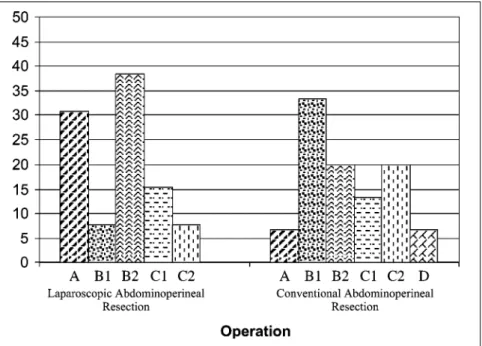
The distribution of the patients ac-cording to the pathological staging (Astler-Collins) was similar for the groups (p=0.25 – graphic 2). Data are shown in table 3.
After a mean follow-up of 47.2 months and with the exclusion of 2 patients in the conventional APR who presented with unsuspected synchro-nic metastasis during surgery, local re-currence was observed in 2 patients in the conventional group and in none in the laparoscopic group.
DISCUSSION
The perspective of performing L-APR which from the technical point of view constitutes truly laparoscopic operation – impelled colorectal geons to offer minimally invasive sur-gery to patients that will handle defi-nite colostomies.
It has been consistently demon-strated that L-APR represents feasible and safe operation with benefits al-ready observed by several authors. However, it is recognized that facing the excellent results which are ob-tained with the C-APR – especially when performed by surgeons skilled in
colorectal dissection and with large experience -, laparoscopic colorectal surgery for cancer was judged inad-equate or superfluous. Controversy was due to uncertainty of oncologic long term results; the enigma of trocar
site recurrence; the perception of a steep learning curve which demands significant dedication of the surgeon; the search for adequate animal models to practice; larger occurrence of com-plications during initial experience and finally, the elevated cost still as-sociated to the method.
Decanini and cols.6 in a study
per-formed in fresh corpses, demonstrated that the L-APR is feasible according to oncological principles. We understand that when sphincter ablation is indi-cated to reach cure of rectal cancer, to-tal mesorrecto-tal excision7 stands as a
main technical principle to be pursuited during abdominal phase as-sociated to preservation of radial
gin. Perineal phase is accomplished during L-APR exactly as during C-APR 8,9.
In order to reduce local recurrence rates and improve survival after rectal cancer diagnosis, several treatment modalities combining surgery, radio and chemotherapy were designed 2.
Neoadjuvant chemoradiation leads to cancer mortality decrease, improves ressecability through tumoral downstaging, increases sphincter pres-ervation and reduces local recurrence
5. In our hospital, a regimen of
5-fluoracil/leucovorin therapy associ-ated to external beam radiotherapy (5040 Cgy) has been used as first mo-dality treatment with intention to cure patients bearing distal rectal adenocar-cinoma stages I, II and III of the TNM classification since 1991 2.
After some progress in the learning curve in colorectal surgery and based on good results obtained with the laparoscopy approach for APR opera-tions 10, we decided to initiate a
pro-spective and randomized trial in order to assess results of safety and effi-ciency of L-APR in comparison to the conventional approach for patients who presented with incomplete re-sponse to chemoradiation.
Demographic data results of gen-der, age, BMI and history of previous abdominal operation are showed in ta-ble 1. It can be noted that in spite of the small number of patients, table randomization was successful in not selecting patients of the male gender, obese or with previous surgeries for the conventional approach. Under sev-eral aspects, APR stands as the ideal operation to be performed by video approach. Once the experience is achieved and newly developed equip-ment such as the harmonic scalpel is used, obesity, male gender and previ-ous abdominal surgery no longer rep-resent a contraindication to the laparoscopic approach.
Regarding the results of longer
sur-gical time and anesthesia duration as-sociated to the conventional approach, we understand there is a bias in this re-sult. Surgical team in charge of per-forming L-APR when sorted was often the same in opposition to the conven-tional group, where different surgical teams performed the operation. In ac-cordance with results observed by other authors, it is likely that operation and anesthesia time are similar be-tween the two study groups after ini-tial cases are performed 6,11-18 .
There are specific intraoperative complications of the laparoscopic ap-proach, such as injury of abdominal wall vessels, refractory hypercapnia, intra abdominal vessels injury, bowel perforation, and bladder and ureter le-sions mainly due to inadequate anatomic recognition. The majority of these complications can be prevented and occur during the initial phase of expertise. Intraoperative complications have occurred with similar frequency in the 2 studied groups, and could not be associated to the surgical access. Attentive surgical technique under good endoscopic view, motivation of the surgical team and the use of 30º telescopes may be related to less intraoperative morbidity.
Some authors attribute to the video approach, a potential to reduce bleed-ing and need for blood transfusion
11,13,15,18 if compared to the
conven-tional access. In APR, the perineal stage of the operation requires special attention to hemostasis. As this phase is conducted in the same way in both groups of study, we believe in the va-lidity of the results of homogeneity of blood requirements in L-APR and C-APR (Fig. 1).
In a previous report 10 focusing the
initial experience of this staff with L-APR we observed the need for conver-sion to the open approach in a female patient due to a large uterus. We be-lieve that this conversion is a phenom-enon that occurs early in the video
surgery experience either with cholecistectomy, antireflux surgery or colectomy. Familiarization with endo-scopic disection and a more experi-enced staff perhaps may be the main determinants of a decrease in conver-sion rate. Nevertheless, specific com-plications may be better managed by laparotomy, such as ureter lesions, posterior bladder lesions and some cases of intra abdominal bleeding. In these series, no conversions were needed which is comparable to other studies with reported conversion rates ranging from 0 to 40% 3,8,9,12,13.
Post operative morbidity was simi-lar in both groups and it does not seem to be associated to surgical access (Ta-ble 2). A perineal hernia represents a relatively rare phenomenon after the APR and has occurred early in this se-ries in 2 patients submitted to the L-APR. Both of them required re-opera-tion in order to correct the defect. Al-though it was initially associated to the video approach, this complication is not associated to the access. Closure of the pelvic peritoneum, which may be accomplished more frequently dur-ing conventional access, was attrib-uted by some surgeons as a protection factor against perineal hernias . How-ever, dehiscence of pelvic peritoneum closed under tension may lead to the herniation with increased risk of small bowel incarceration. As a result, in some cases of L-APR , we have started executing the reinforcement of the perineal closure applying bovine peri-cardium prosthesis. Since then, this complication no longer happened; however, we believe that this caution should be reserved to selected cases, in spite of an easy execution associ-ated to no complication in three cases. One of the most popular benefits as-sociated to video surgery was shorter hospital stay 6,12-18. In the present study
sub-mitted to L-APR although this result has not reached significance. We attrib-uted this result to 2 reasons: 1) small number of patients, and 2) that morbid-ity and disabilmorbid-ity for post operative APR patients results from the perineal wound. We observed in abdominal sur-geries performed by laparoscopy such as anterior resection for megacolon or diverticular diseases a faster recovery for patients submitted to video surgery. In the APR operation, however, morbid-ity is related to perineal dissection, making it more difficult to demonstrate shorter hospital stay .
Since the status of resected lymph nodes is related to prognosis after curative colorectal cancer surgery, it is not a surprise that this aspect consti-tutes an endpoint of criterial evalua-tion. Although widely mentioned in the past 6,13,17-19, the number of excised
lymph nodes does not suitably repre-sent extension of dissection, since the number of lymph nodes identified in the surgical specimen depends on the pathologist physician, who is process-ing the specimen and, per se , does not allude to the localization of these lymph nodes, whether if close to arte-rial ligation, in retroperitoneal position or simply epicolics. With respect to APR, several clinical trials involving a larger number of patients 6,8,11-18
dem-onstrated similarity in the extent of lymphadenectomy provided by the L-APR and C-L-APR. In our small series of cases, we observed a smaller mean number of disected lymph nodes in patients submitted to the laparoscopic approach (5,5 vs 11,9). We believe
that this evidence, although generated from a randomized trial, does not re-flect the reality and represents a bias resulting from the small number of evaluated patients. Also, this phenom-enon may reflect a differential re-sponse of tumoral regression with cause still unknown. In the group of patients submitted to the L-APR, no lymph nodes were detected at all in the surgical specimen in 4 cases against 2 cases in the conventional group. Perhaps differences in the pa-thology department staff involved in the specimen dissection or methodo-logical differences in order to identify lymph nodes may explain these results . On the other hand, the evaluation of the length of excised intestinal seg-ment, which was similar in both groups, indicates that the extent of the operations was equal.
Evaluating the risk most commonly related to local recurrence after cura-tive treatment of the rectal cancer, we may outline as variables of strong or independent correlation with this un-favourable course: advanced patho-logical staging, incomplete resection (compromised margins), no adjuvant perioperative treatment or little re-sponse to tumor neoadjuvant treat-ment, tumor aneuploidy, p53 hyper expression, among others 20-30.
Fleshman et al. 12, in a trial comparing
L-APR and C-APR with a total of 194 cases, did not observe differences be-tween the 2 groups concerning cancer neoplastic recurrence after mean follow up of 19 and 24 months, respectively. Milsom et al. 15 obtained similar
re-sults although they concluded that a longer follow-up time was required. In our study, excluding patients with liver metastasis, we detected local re-currence in 2 patients submitted to C-APR and in none in the laparoscopic group. Due to the small number of cases and to advanced pathological staging of these patients even after chemoradiation treatment, we believe that recurrence in this series can not be associated to surgical access. In order to verify this question, we are await-ing the ongoawait-ing results of larger number of patients as well as enlarge-ment of post operative follow-up.
We must have caution when consid-ering the strength of the evidences here, in spite of the randomization. The data were collected in a small scale 31 due
to a small number of cases. Since the majority of the available experiences are not controlled and similarly de-mand follow-up, we have decided to submit our data in order to enlarge sci-entific evidence and even to set up sys-tematic reviews and meta analysis.
CONCLUSIONS
We conclude that L-APR is feasible, similar to C-APR concerning surgery duration, intra operative morbidity, blood requirements and post operative morbidity. Larger number of cases and an extended follow-up are required to adequate evaluation of oncological re-sults for patients undergoing L-APR af-ter chemoradiation for radical treatment of distal rectal cancer.
RESUMO
ARAUJO SEA e col. - Amputação do reto convencional x laparoscópica no tratamento do câncer do reto distal após quimioirradiação
neoadjuvante – resultados de estu-do prospectivo e ranestu-domizaestu-do.
Rev. Hosp. Clín. Fac. Med. S. Pau-lo 58 (3):133-140, 2003.
OBJETIVO: Comparar os
con-vencional no tratamento cirúrgico de pacientes com câncer do reto distal que apresentaram resposta incompleta a quimioirradiação pré-operatória.
MÉTODO: Vinte e oito pacientes
com adenocarcinoma de reto distal fo-ram randomizados para se submeter à amputação do reto por via laparos-cópica ou à amputação do reto por via convencional. Treze pacientes subme-teram-se à amputação do reto por via laparoscópica e 15 à amputação do reto por via convencional .
RESULTADOS: Não houve
dife-rença significativa (p<0,05) no que se refere a: sexo, idade, índice de massa corpórea, história pessoal de operação abdominal, complicações intra e pós operatórias, necessidade de hemo-transfusão, tempo de internação hospi-talar após a operação, extensão da peça
ressecada e estadiamento anatomopa-tológico. O tempo operatório médio foi de 228 minutos para amputação do reto por via laparoscópica versus 284 minutos para amputação do reto por via convencional (p=0,04). A duração média de anestesia foi menor (p=0,03) para amputação do reto por via lapa-roscópica quando comparado com am-putação do reto por via convencional: 304 e 362 minutos respectivamente. Não foram realizadas conversões nos pacientes submetidos à amputação do reto por via laparoscópica . Após se-guimento médio de 47,2 meses e ex-cluindo-se dois pacientes do grupo amputação do reto por via convencio-nal que no intra-operatório apresenta-vam metástases sincrônicas, observou-se recidiva local em dois pacientes no grupo amputação do reto por via
con-vencional e em nenhum do grupo am-putação do reto por via laparoscópica.
CONCLUSÕES: Concluímos que
a amputação do reto por via laparos-cópica é exequível nos mesmos mol-des que a amputação do reto por via convencional no que se refere à dura-ção da operadura-ção, morbidade intra-ope-ratória, perda sangüínea e morbidade pós-operatória. Há necessidade de mai-or casuística e seguimento ainda não disponíveis para a adequada avaliação da radicalidade oncológica, ocorrência de recidiva e sobrevida para pacientes submetidos a tratamento cirúrgico do câncer do reto por amputação do reto por via laparoscópica .
DESCRITORES: Câncer do reto.
Ressecção. Laparoscopia. Amputação abdominoperineal.
REFERENCES
1. MILES EW - A method of performing abdominoperineal excision for carcinoma of the rectum and the terminal portion of the pelvic colon. Lancet 1908, 2:1812-13.
2. HABR-GAMA A, DE SOUZA PM, RIBEIRO U JR et al. - Low rectal cancer: impact of radiation and chemotherapy on surgical treatment. Dis Colon Rectum 1998; 41:1087-96.
3. DECANINI C, MILSOM JW, BÕHM B et al. - Laparoscopic oncologic abdominoperineal resection. Dis Colon Rectum 1994; 37:552-8.
4. NICCHOLLS RJ, RITHCIEJK, WASWORTH J et al. - Total excision or restorative resection for carcinoma of the middle third of the rectum. Br J Surg 1979; 66:625-7.
5. CAMPOS FG, HABR-GAMA A - Câncer do reto distal: radioterapia e quimioterapia: quando e como? In: HABR-GAMA A, GAMA-RODRIGUES J, CECCONELLO I et al. - Atualização em Cirurgia do Aparelho Digestivo e em Coloproctologia. São Paulo, Frôntis Editorial, 2001. p. 323-32.
6. DARZI A, LEWIS C, MENZIES-GOW N et al. - Laparoscopic abdominoperineal excision of the rectum. Surg Endosc 1995;9:414-7.
7. MCCALL JL - Total mesorectal excision: evaluating the evidence. Aust N Z J Surg 1997; 67:599-602.
8. CHINDASUB S, CHARNTARACHARMNONG C, NIMITVANIT C et al. - Laparoscopic abdominoperineal resection. J Laparoendosc Surg 1994;4:17-21
9. LROATULAM AJ, AGACHAN F, ALABAZ O et al. - Laparoscopic abdominoperineal resection for anorectal cancer. Am Surg 1998;64:12-8.
10. SOUSA JR AH, HABRGAMA A, CAMPOS FG et al. -Laparoscopic abdominoperineal resection of rectum. Analysis of 18 cases. Rev Hosp Clín Fac Med S Paulo, 1958; 53: 242-8 .
11. FLESHMAN JW, WEXNER SD, ANVARI M et al. - Laparoscopic versus abdominal perineal resection for cancer. Dis Colom Rectum 1999; 42(7): 930-9.
12. RAMOS JR, PETROSEMOLO RH, VALORY EA et al. -Abdominoperineal resection: laparoscopic versus conventional. Surg Laparosc Endosc, 1997; 7(2):148-152. 13. SEOW-CHOEN F, EU KW, HO YH, et al. - A preliminary
14. MILSOM JW, BOHM B, HAMMERHOFER KA et al. - A prospective randomised trial comparing laparoscopic versus conventional techniques in colorectal surgery: a preliminary report. J Am Coll Surg 1998; 187(1):46-54.
15. LARACH SW, SALORNON MC, WILLIAMSON PR et al. -Laparoscopic assisted abdominoperineal resection. Surg Lapa-rosc Endosc 1993; 3:115-8.
16. WU JS, BIRNBAUM EH, FLESHMAN JW - Early experience with laparoscopic abdominoperineal resection. Surg Endosc 1997; 11: 449-55.
17. FRANKLIN ME JR, ROSENTHAL D, NOREM RF - Prospective evaluation of laparoscopic colon resection versus open colon resection for adenocarcinoma :a multicenter study. Surg Endosc 1995; 9:81 1-6.
18. FLESHMAN JW, NELSON H, PETERS WR et al. - Clinical Outcomes of Surgical Therapy Study Group - Early results of laparoscopic surgery for colorectal cancer: retrospective analysis of 372 patients treated by Clinical Outcomes of Surgical Therapy (COST) Study Group. Dis Colon Rectum 1996; 39:S53-8.
19. GEIS WP, KIM C - Improved efficiency in laparoscopic abdominoperineal resection: the Kim-Geis approach. Int Surg 1994; 79:226-7.
20. SATO T, NISHIMURA G, FUSHIDA S et al. - Evaluation of p53, Ki-67 and DNA ploidy in both primary rectal carcinomas and locally recurrent tumors. Oncol Rep 1998; 5(5):1225-9. 21. DESAI GR, MYERSON RJ, HIGASHIKUBO R et al. - Carcinoma
of the rectum. Possible cellular predictors of metastatic potential and response to radiation therapy. Dis Colon Rectum 1996; 39(10):1090-6.
22. ADELL G, SUN XF, STAL O et al. - p53 status: an indicator for the effect of preoperative radiotherapy of rectalcancer. Radiother Oncol 1999; 51(2):169-74.
23. SCHWANDNER O, SCHIEDECK TH, BRUCH HP et al. - p53 and Bcl-2 as significant predictors of recurrence and survival in rectalcancer. Eur J Cancer 2000; 36(3):348-56. 24. NEHLS O, KLUMP B, HOLZMANN K et al. - Influence of p53
status on prognosis in preoperatively irradiated rectal carcinoma. Cancer. 1999 15; 85(12):2541-8.
25. LAMMERING G, TAHER MM, GRUENAGEL HH et al. -Alteration of DNA ploidy status and cell proliferation induced by preoperative radiotherapy is a prognostic factor in rectal cancer. Clin Cancer Res 2000; 6(8):3215-21.
26. MORAN MR, ROTHENBERGER DA, GALLO RA et al. -Multifactorial analysis of local recurrences in rectal cancer, including DNAploidy studies: a predictive model. World J Surg 1993; 17(6):801-5.
27. LIANG JT, CHENG YM, CHANG KJ et al. - Reappraisal of K-ras and p53 gene mutations in the recurrence of Dukes’ B2 rectal cancer after curative resection. Hepatogastroenterology 1999; 46(26):830-7.
28. CHANG KJ, ENKER WE, MELAMED M - Influence of tumor cell DNA ploidy on the natural history of rectal cancer. Am J Surg 1987; 153(2):184-8.
29. ROSEANO M, TUROLDO A, BALANI A et al. - DNA ploidy and cell kinetics in cancer of the rectum]. Ann Ital Chir 1994; 65(3):319-29. Italian.
30. WIGGENRAAD R, TAMMINGA R, BLOK P et al. - The prognostic significance of p53 expression for survival and local control in rectal carcinoma treated with surgery and postoperative radiotherapy. Int J Radiat Oncol Biol Phys 1998; 41(1):29-35.