Short Report
S
J. Braz. Chem. Soc., Vol. 25, No. 11, 2121-2124, 2014.Printed in Brazil - ©2014 Sociedade Brasileira de Química 0103 - 5053 $6.00+0.00 http://dx.doi.org/10.5935/0103-5053.20140181
*e-mail: [email protected]
Phenolic Compounds from
Clinopodium tomentosum
(Kunth) Govaerts (Lamiaceae)
Mariela Beatriz Vera Saltos,a Blanca Fabiola Naranjo Puente,b Nicola Malafrontec and
Alessandra Braca*,a
aDipartimento di Farmacia, Università di Pisa, via Bonanno 33, 56126 Pisa, Italy
bDepartamento de Ciencias de la Vida, Escuela Politecnica del Ejercito, Avenida El Progreso S/N,
Sangolqui, Ecuador
cDipartimento di Farmacia, Università di Salerno, via Giovanni Paolo II 132, 84084 Fisciano (SA), Italy
A investigação fitoquímica dos extratos das folhas de Clinopodium tomentosum (Kunth) Govaerts (Lamiaceae) permitiu o isolamento de um novo composto, denominado ácido 2-O-benzoil-3-O-cinamoil tartárico, juntamente com onze compostos conhecidos, dihidrodehidroconiferil álcool 9’-O-β-D-glucopiranósido, blumenol c glucósido, siringaresinol 4’-O-β-D-glucopiranósido, hesperitina, pinocembrin 7-O-rutinosído, ácido clinopódico E, ácido cafeico, ácido p-cumárico, ácido cafeico metil éster, ácido cafeico etil éster, ácido rosmarínico e ácido rosmarínico metil éster. Suas estruturas foram elucidadas com base em métodos espectroscópicos e de espectrometria de massas.
Phytochemical investigation of the leaf extracts of Clinopodium tomentosum (Kunth) Govaerts (Lamiaceae) allowed the isolation of one new compound, named 2-O-benzoyl-3-O-cinnamoyl tartaric acid, along with twelve known compounds, dihydrodehydroconiferyl alcohol 9’-O-β -D-glucopyranoside, blumenol c glucoside, syringaresinol 4’-O-β-D-glucopyranoside, hesperetin, pinocembrin 7-O-rutinoside, clinopodic acid E, caffeic acid, p-coumaric acid, caffeic acid methyl ester, caffeic acid ethyl ester, rosmarinic acid, and rosmarinic acid methyl ester. Their structural characterization was obtained on the basis of extensive spectroscopic analyses, including mono- and bidimensional nuclear magnetic resonance (1D and 2D NMR) experiments and high-resolution electrospray ionization mass spectrometry (HR-ESI-MS).
Keywords: Clinopodium tomentosum, Lamiaceae, phenolic compounds, spectroscopic analysis
Introduction
The genus Clinopodium (Lamiaceae) consists of flowering plants, wildly distributed in southern and southeastern Europe, North America and Mexico.1 It is
also found growing in Latin America between 3000 and 4000 m above sea level. Many species of the genus are used as medicinal plants. Clinopodium tomentosum (Kunth) Govaerts possesses small yellow-colored flowers, reaching a height of 30-80 cm, and in Ecuador is commonly known as “Santa Maria”. Local people use the aerial parts of the plant to prepare infusions for its relaxant effect and as anti-inflammatory agent. Previous phytochemical studies on
Clinopodium ssp. have revealed the presence of flavonoid glycosides, phenylpropanoids, caffeic acid oligomers, and saponins.2-5 Despite its use in the Ecuadorian traditional
medicine, to our knowledge, no data on the chemical composition or biological activity of the aerial parts of
C. tomentosum are available. Nevertheless, its essential oil composition was reported by Benzo et al. in 2007.6
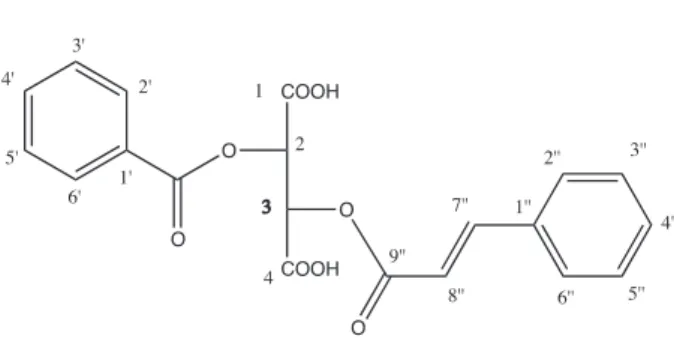
In this paper, we report the isolation and structural characterization by spectroscopic and spectrometric methods of one new compound, named 2-O-benzoyl-3-O -cinnamoyl tartaric acid (1) (Figure 1) along with twelve known compounds, from the aerial parts of the title plant.
Experimental
General experimental procedures
Phenolic Compounds from Clinopodium tomentosum (Kunth) Govaerts (Lamiaceae) J. Braz. Chem. Soc. 2122
DRX-600 spectrometer (Bruker, Karlsruhe, Germany) at 300 K. All the 2D NMR spectra were acquired in deuterated methanol (CD3OD) in the phase-sensitive
mode with the transmitter set at the solvent resonance and time proportional phase increment used to achieve frequency discrimination in the ϖ1 dimension. Standard
pulse sequences and phase cycling were used for double-quantum filtered correlation spectroscopy (DQF-COSY), total correlation spectroscopy (TOCSY), heteronuclear single quantum coherence (HSQC) and heteronuclear multiple-bond correlation (HMBC) experiments. NMR data were processed on a Silicon Graphics Indigo2 Workstation using UXNMR software. High-resolution electrospray ionization mass spectra (HR-ESI-MS) were acquired in the positive ion mode on a quadrupole time of flight (Q-TOF) Premier spectrometer equipped with a nanoelectrospray ion source (Waters, Milford, MA, USA). Electrospray mass spectra (ESI-MS) were obtained from an LCQ Advantage ThermoFinnigan spectrometer (ThermoFinnigan, San Jose, CA, USA), equipped with an Xcalibur software. Column chromatography (CC) was performed over Sephadex LH-20 (40-70 µm, Amersham Pharmacia Biotech AB, Uppsala, Sweden). High performance liquid chromatography (HPLC) separations were conducted on a Shimadzu LC-8A series pumping system equipped with a Shimadzu RID-10A refractive index detector on a C18 µ-Bondapak column (30 cm × 7.8 mm, 10 µm, Waters, flow rate 2.0 mL min-1).
Thin layer chromatography (TLC) analyses were carried out using glass-coated silica gel 60 F254 (0.20-mm
thickness) plates (Merck, Darmstadt, Germany).
Plant material
Aerial parts of C. tomentosum were collected in Tumbaco, Ecuador in September 2011. The plant was identified at the Herbarium of Jardin Botanico de Quito, Quito, Ecuador. A voucher specimen (N. 7305 Clinopodium tomentosum/1) was deposited at Herbarium Horti Botanici Pisani, Pisa, Italy.
Extraction and isolation
The dried and powdered aerial parts (560 g) of
C. tomentosum were in sequence extracted for 48 h with
n-hexane, CHCl3, CHCl3-MeOH (9:1) and MeOH, by
exhaustive maceration (3 × 2 L), to give 7.6, 18.0, 8.5 and 13.1 g of the respective residues. The CHCl3-MeOH
extract (2.5 g) was subjected to Sephadex LH-20 (CC, 3 × 70 cm, flow rate 1.5 mL min-1) eluting with MeOH to
give six major fractions (A-F) grouped by TLC, together with pure caffeic acid (50 mg, 370-420 mL) and hesperitin (40 mg, 560-1000 mL). Fractions C (328 mg), D (904 mg), and E (157.8 mg) were separately purified by reversed phase (RP)-HPLC with MeOH-H2O (2:3) as eluent to
afford blumenol c glucoside (5.3 mg, tR = 17 min) from
C, syringaresinol 4’-O-β-D-glucopyranoside (8.6 mg, tR = 17 min) and dihydrodehydroconiferyl alcohol
9’-O-β-D-glucopyranoside (10 mg, tR = 19 min) from
D, and p-coumaric acid (6 mg, tR = 16 min), caffeic acid
methyl ester (10 mg, tR = 24 min) and caffeic acid ethyl ester (7.7 mg, tR = 42 min) from E. The MeOH extract
was partitioned between n-BuOH and H2O to afford an n-BuOH residue (6.2 g). The n-BuOH fraction (6.2 g) was submitted to Sephadex LH-20 (CC, 5 × 70 cm, flow rate 1.5 mL min-1) using MeOH as eluent to obtain
seven major fractions (A-G) grouped by TLC, together with pure caffeic acid (14.2 mg, 260-270 mL) and clinopodic acid E (62.4 mg, 550-590 mL). Fractions D (135.5 mg) and E (243 mg) were separated by RP-HPLC with MeOH-H2O (2:3) as eluent to give compound 1
(5.7 mg, tR = 22 min) from fraction D, and rosmarinic
acid (20 mg, tR = 18 min) and rosmarinic acid methyl ester (7 mg, tR = 41 min) from fraction E, respectively.
Fraction C (443 mg) was previously submitted to partition between n-BuOH and H2O yielding a n-BuOH residue
(67.8 mg) which was subsequently subjected to RP-HPLC with MeOH-H2O (1:1) as eluent to yield pinocembrin
7-rutinoside (2 mg, tR = 15 min). Fraction F (330 mg) was purified by RP-HPLC with MeOH-H2O (1:1) as eluent to
give rosmarinic acid (10 mg, tR = 9 min) and hesperetin (5 mg, tR = 24 min).
2-O-Benzoyl-3-O-cinnamoyl tartaric acid (1)
Amorphous powder; [α]D
25 –70 (c 0.2, MeOH); UV
(MeOH) λmax/nm (log ε) 213 (4.20), 225 (3.82), 309 sh
(4.10); HR-ESI-MS m/z calcd. for C20H16O8Na [M+Na] +:
407.0743; found: 407.1691, 277.2327 [M+Na-130]+,
131.3031 [M+Na-130-146]+; ESI-MS m/z 383 [M–H]–; 1H NMR (600 MHz, CD
3OD) and 13C NMR (150 MHz,
Saltos et al. 2123 Vol. 25, No. 11, 2014
Results and Discussion
The chloroform-methanol and the methanol extracts of the aerial parts of C. tomentosum were subjected to Sephadex LH-20 column chromatography followed by reversed phase high performance liquid chromatography (RP-HPLC), to afford one new compound (1) (Figure 1) and twelve known compounds.
Compound 1 was isolated as amorphous solid. Its molecular formula was determined as C20H16O8 by
HR-ESI-MS (m/z 407.1691 [M+Na]+). Its HR-ESI-MS/MS
spectrum showed two main fragments at m/z 277.2327 [M+Na-130 (C9H6O)]+ (95%) and 131.3031 [M+Na-130
(C9H6O)-146 (C9H6O2)]
+ (28%) due to the loss of two
asymmetric ester moieties. The 1H and 13C NMR spectra
(Table 1) showed typical signals of a trans-double bond together with other five aromatic [dH 7.45 (overlapped,
3H, H-3’’/5’’ and H-4’’), 7.50 (t, 2H, J 7.5 Hz, H-3’/5’), 7.62 (overlapped, 1H, H-4’), 7.65 (overlapped, 2H, H-2’’/6’’), 8.17 (t, dd, 2H, J 7.5, 1.5 Hz, H-2’/6’)] and two hydroxymethine signals at dH 5.80 (d, 1H, J 2.7 Hz) and
5.82 (d, 1H, J 2.7 Hz). This information in conjunction with the remaining NMR signals and HR-ESI-MS/MS spectra indicated the presence of a tartaric acid esterified with one benzoyl and one cinnamoyl residues. All the 1H and 13C NMR signals were assigned with the aid of 2D NMR
spectra including 1D-TOCSY, DQF-COSY, HSQC, and
HMBC spectra. The downfield shift of H-2 and H-3 (d 5.80 and 5.82) and C-2 and C-3 (both 76.0 ppm) compared to tartaric acid confirmed that these positions were esterified.7
The configuration of C-2 and C-3 remained undetermined. On the basis of all these evidences the structure of 1 was determined as 2-O-benzoyl-3-O-cinnamoyl tartaric acid. Asymmetric esters of tartaric acid are found rarely in nature, being isolated mostly from Echinacea genus.7,8
The following known compounds were identified by spectral analysis and comparison with published spectroscopic data: hesperitin,9 dihydrodehydroconiferyl
alcohol 9’-O-β-D-glucopyranoside,10 blumenol c
glucoside,11 syringaresinol 4’-O-β-D-glucopiranoside,12
rosmarinic acid, rosmarinic acid methyl ester,13 pinocembrin
7-rutinoside,14 clinopodic acid E,4 caffeic acid, caffeic acid
methyl ester,15 caffeic acid ethyl ester,16and p-coumaric
acid.17
Supplementary Information
Supplementary data (1H NMR, HSQC, HMBC, and
MS for compound 1) are available free of charge at http://jbcs.sbq.org.br as PDF file.
References
1. Estrada-Reyes, R.; Martínez-Vázquez, M.; Gallegos-Solís, A.; Heinze, G.; Moreno, J.; J. Ethnopharmacol. 2010, 130, 1. 2. Opalchenova, G.; Obreshkova, D.; Drug Dev. Ind. Pharm. 1999,
25, 323.
3. Aoshima, H.; Miyase, T.; Warashima, T.; Chem. Pharm. Bull. 2012, 60, 499.
4. Murata, T.; Sasaki, K.; Sato, K.; Yoshizaki, F.; Yamada, H.; Mutoh, H.; Umehara, K.; Miyase, T.; Warashina, T.; Aoshima, H.; Tabata, H.; Matsubara, K.; J. Nat. Prod. 2009, 72, 1379.
5. Miyase, T.; Matsushima, Y.; Chem. Pharm. Bull. 1997, 45, 1493. 6. Benzo, M.; Gilardoni, G.; Gandini, C.; Caccialanza, G.; Vita
Finzi, P.; Vidari, G.; Abdo, S.; Layedra, P.; J. Chromatogr. A 2007, 1150, 131.
7. Soicke, H.; Al-Hassan, G.; Görler, K.; Planta Med. 1988, 54, 175.
8. Lu, Y.; Li, J. Y.; Li, M. L.; Hu, X.; Tan, J.; Liu, Z. H.; Nat. Prod. Commun. 2012, 7, 1353.
9. Wagner, H.; Chari, V. M.; Sonnenbichler, J.; Tetrahedron Lett. 1976, 21, 1799.
10. Abe, F.; Yamauchi, T.; Chem. Pharm. Bull. 1986, 34, 4340. 11. Pabst, A.; Barron, D.; Semon, E.; Schreier, P.; Phytochemistry
1992, 31, 1649.
12. Shahat, A. A.; Abdel-Azin, N. S.; Pieters, L.; Vlietinck, A. J.; Fitoterapia 2004, 75, 771.
Table 1. 1H NMR (600 MHz) and 13C NMR (150 MHz) data of compound 1 (CD3OD)a
Position dH (J / Hz) dC
1/4 – 173.0
2 5.80 d (2.7) 76.0
3 5.82 d (2.7) 76.0
Benzoyl 1’ – 128.5
2’/6’ 8.17 dd (7.5, 1.5) 133.6
3’/5’ 7.50 t (7.5) 129.1
4’ 7.62b 133.6
COO – 167.2
Cinnamoyl 1’ – 134.3
2’’/6’’ 7.65b 128.8
3’’/5’’ 7.45b 130.0
4’’ 7.45b 130.0
7’’ 7.80 d (16.0) 146.2
8’’ 6.71 d (16.0) 118.4
9’’ – 167.2
Phenolic Compounds from Clinopodium tomentosum (Kunth) Govaerts (Lamiaceae) J. Braz. Chem. Soc. 2124
13. Eicher, T.; Ott, M.; Speicher, A.; Synthesis 1996, 755. 14. Xu, X.; Xie, H.; Hao, J.; Jiang, Y.; Wei, X.; J. Agric. Food Chem.
2011, 59, 1205.
15. Saleem, M.; Kim, H. J.; Jin, C.; Lee, Y. S.; Arch. Pharmacal Res. 2004, 27, 300.
16. Sugiura, M.; Naito, Y.; Yamaura, Y.; Fukaya, C.; Yokohama, K.; Chem. Pharm. Bull. 1989, 37, 1039.
17. Ralph, J.; Hatfield, R. D.; Quideau, S.; Helm, R. F.; Grabber, J. H.; Jung, H.-J. G.; J. Am. Chem. Soc. 1994, 116, 9448.
Submitted: June 19, 2014