0103 - 5053 $6.00+0.00
Short Report
*e-mail: [email protected]
#Present Address: Laboratório de Síntese de Moléculas Bioativas, Universidade de São Paulo, São Paulo – SP, Brazil
Synthesis and Reactivity of
α
α
α
α
α
-Phenylseleno-
β
β
β
β
β
-substituted Styrenes. Preparation of (
Z
)-Allyl
Alcohols, (
E
)-
α
α
α
α
α
-Phenyl-
α
α
α
α
α
,
β
β
β
β
β
-unsaturated Aldehydes and
α
α
α
α
α
-Aryl Acetophenones
Eder J. Lenardão,*,a Rodrigo Cella,b,# Raquel G. Jacob,a Thiago B. da Silvaa and Gelson Perinc
a
Departamento de Química Analítica e Inorgânica, Universidade Federal de Pelotas, 96010-900 Pelotas-RS, Brazil b
Departamento de Química, Universidade Federal de Santa Maria, 97105-900 Santa Maria-RS, Brazil c
Departamento de Química Orgânica, Universidade Federal de Pelotas, 96010-900 Pelotas-RS, Brazil
Foi desenvolvido um método simples e eficiente para a síntese de β-estirenos α-fenilseleno-substituídos, através da reação do α-(fenilselenobenzil)fosfonato de dietila e NaH na presença de aldeídos. A reação destes produtos com n-BuLi e posterior captura do ânion com aldeídos ou DMF levou à formação, exclusivamente, de álcoois de configuração Z e aldeídos α,β-insaturados de configuração E, respectivamente. Além disto, a hidrólise dos selenetos na presença de TiCl4 levou à formação de α-arilacetofenonas em bons rendimentos.
A new and efficient method was developed to prepare α-phenylseleno-β-substituted styrenes by reaction of diethyl α-phenylseleno benzylphosphonate with NaH and aldehydes. Selenium-lithium exchange by reaction with n-BuLi yielded the vinyl lithium species, which were captured with several electrophiles, like aldehydes and DMF, affording exclusively (Z)-allyl alcohols, and (E)-α-phenyl-α-β-unsaturated aldehydes, respectively in good yields. The hydrolysis of the vinyl selenides in presence of TiCl4 allowed the corresponding α-aryl acetophenones.
Keywords: Horner-Wittig reactions, vinyl selenides, transmetallation, α-β-unsaturated aldehydes, Z-allyl alcohols
Introduction
Organoselenium compounds constitute useful intermediates in organic synthesis and much attention has been devoted to their preparation and synthetic utilization.1 Among the different classes of these
compounds, vinyl selenides constitute a very useful intermediate, because of the versatile reactivity of the selanyl group and the presence of carbon-carbon double
bond.2 Considerable efforts have been directed to
preparation of vinyl chalcogenides by the Wittig-type reaction, including the synthesis of vinyl selenides
di-and trisubstituted by Wittig3,4 and Horner-Wittig
reaction.5,6 An interesting aspect of this approach is the
possibility to synthesize vinyl selenides with homo-logation of the carbon skeleton.7
To the best of our knowledge, the only methods reported for the preparation of α-phenylseleno-β
-substituted styrenes involve the reaction of Z-α
-(phenylseleno)vinyl p-toluensulfonates with
Ph2Cu(CN)Li2 in presence of catalytic amounts of Pd(PPh3)2Cl2 (only three examples)8 and the
hydro-selenation of phenylacetylene using aluminum
phenylselenolate anion (one example),9 while the
Wittig-type reaction have not been considered as a general synthetic strategy to date.
Recently, we have described practical and utile methodologies for the preparation of vinyl sulfides,10
selenides,10,11 tellurides,10,12 ketene telluroacetals,13,14
ketene (Te,S)-acetals15 and α-phenyltelluro- and α
-phenylseleno acrylonitriles16 based on Wittig-type
reactions. Due to our continuous interest on the synthesis and reactivity of new vinyl chalcogenides,17
we report here the application of the Horner-Wittig
reaction to the synthesis of α-phenylseleno-β
Synthesis and Reactivity of α-Phenylseleno-β-substituted Styrenes J. Braz. Chem. Soc.
Results and Discussion
Phenylselenophosphonate 1 was selected as starting material for our new protocol to preparation of
α-phenylseleno-β-substituted styrenes and 8 was obtained in good yield by the reaction of diethyl benzylphosphonate 2 with LDA, followed by addition
of phenylselenenyl chloride 3 (Scheme 1).5 The
treatment of 1 with NaH would generated the
intermediate anion 4 which, upon reaction with
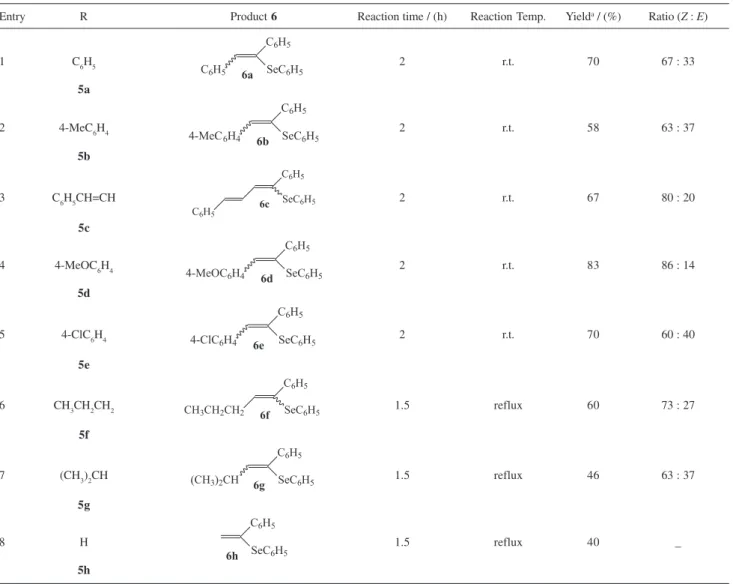
aldehydes 5, afforded the desired product 6a-h, as depicted in Scheme 1. When the reaction was performed using aromatic aldehydes (5a-e) and n-butyraldehyde (5f), the vinyl selenides 6a-e and 6f were obtained in moderate to good yields (entries 1-6, Table 1). However, with isobutyraldehyde (5g) and formaldehyde (5h), the yields obtained were lowers (entries 7-8, Table 1) and no reaction was observed with ketones (cyclohexanone, acetophenone and 3-pentanone). The lack of reactivity of ketones was previously reported when the Wittig reaction of selenophosphoranes with ketones was attempted.24
Alternatively, the vinyl selenides 6 can be obtained directly from 2, by reaction with LDA, phenylselenyl chloride 3 and then with the carbonyl compound 5, in a one-pot process (without isolation of intermediate 1), as
depicted in Scheme 1. However, it was observed that
the reaction gave the product in a lower overall yield. For example, benzaldehyde 5a reacts with 2 equiv. of phosphonate 2, providing 6a in 40% yield, while by using 1.0 equiv. of the phosphonate 2, the yield drops down to 28%, compared to the 70% yield using 1.0 equiv. of the
α-phenylselenophosphonate 1 (entry 1, Table 1). The method described here exhibits good generality and the yields are comparable with those described on literature,8,9 being successful with several aromatic and
aliphatic aldehydes, including cynamaldehyde 5c.
Moreover, the preparation of α-phenylseleno-β
-substituted styrenes with chain elongation is not possible by using these methods, which obviously limits their application in organic synthesis. It is noteworthy that by our method it was also possible to prepare the simplest vinyl selenide 6h, derived from formaldehyde, albeit in a modest 40% yield. Although most experiments were performed on a 1.0 mmol scale, these reactions can also be performed successfully on higher scale (up to 10 mmol) with comparable yields.
For all the substrates, the formation of a mixture of
Z and E isomers was observed. The stereochemistry of the obtained olefins, 6b-d and 6f-g, was assigned by
1H NMR. For example, for
1-phenyl-1-(phenylseleno)-1-pentene (6f), two triplets for the vinylic hydrogens, at δ 6.32 (Z isomer) and 6.13 (E isomer), with J 7.2 Hz, were observed, in a 73:27 ratio. Likewise, for 1-phenyl-1-(phenylseleno)-2-isopropylethene (6g), two doublets (J 10.0 Hz) were observed at δ 6.12 (Z isomer) and 5.96 (E isomer) in a 63:37 ratio. However, for 6a and 6e this ratio could not be determined directly by
1H NMR, because the vinylic hydrogen signals
overlapped with the aromatic one. Besides, the products were also not stable enough to perform GC analysis, even using different columns and conditions. To confirm the formation of the products as a Z + E mixture, a 77Se
NMR study was performed with 6a as a selected
example. The presence of isomers could be easily confirmed since two peaks were observed in the 77Se
NMR spectra at δ 400.2 and 522.4 ppm (60.5 MHz) in a 67:33 ratio. These results where also confirmed by
the analysis of their 13C NMR spectra and are
comparable with results previously described.15,16 The
isomeric ratio of 6e was determined by analogy with 6a, based on the assumption of that the Z-isomer was also formed preferentially, according to the analysis of its 13C NMR.
Selective Se/Li exchange and hydrolysis reaction of the vinyl selenides
The selenium moiety can be easily and selectively removed from vinyl selenides by treatment with different reagents.2 For example, they can be coupled with Grignard
reagents2,25 or organozinc halides26 by Ni-catalysis, and
transmetallated with organyl lithium species.27 In the
present work we decided to study the selective removal of the Se moiety from α-phenyl vinyl selenides 6. For this purpose, we treated some of the prepared products with n-BuLi at -78 °C and captured the intermediate vinyllithium with several electrophiles (Scheme 2).
The lithium-selenium exchange reaction on 6a (67:33;
Z:E ratio) with n-BuLi, followed by treatment with aqueous
ammonium chloride furnished exclusively E
-1,2-diphenylethene 8a in 70% yield, as detected by the 1H NMR
(200 MHz) analysis of their vinylic hydrogens (δ 7.08 ppm,
singlet, 2H). In addition to 8a, C6H5SeC4H9 and C6H5C≡CC6H5 (by-product of n-BuLi acting as base by removing the vinylic hydrogen of 6a) were isolated. The formation of 8a (E-isomer) and C6H5C≡CC6H5 are an indication that the α-phenyllithium anion suffers fast isomerization to the most stable one. The intermediate 7 was also converted to the corresponding allyl alcohols 8b and 8c by reaction with benzaldehyde and isobutyraldehyde, respectively. The products were obtained in 61% (8b) and 65% (8c) yield, and exclusively with Z-configuration (entries 2 and 3, Table 2).
By changing the electrophile by DMF, 6a was
converted to E-2,3-diphenyl-2-propenal(8d) in 63% yield (entry 4, Table 2). In this reaction, DMF was added at – 78 oC and the stirring was continued at this temperature
for 1 hour. It was observed the formation of a mixture of
E and Z isomers in a 71:29 ratio. The products were easily separable by column chromatography and the more polar
Table 1. Synthesis of α-phenylseleno-β-substituted styrenes 6 according to Scheme 1
Entry R Product 6 Reaction time / (h) Reaction Temp. Yielda / (%) Ratio (Z : E)
1 C6H5 2 r.t. 70 67 : 33
5a
2 4-MeC6H4 2 r.t. 58 63 : 37
5b
3 C6H5CH=CH 2 r.t. 67 80 : 20
5c
4 4-MeOC6H4 2 r.t. 83 86 : 14
5d
5 4-ClC6H4 2 r.t. 70 60 : 40
5e
6 CH3CH2CH2 1.5 reflux 60 73 : 27
5f
7 (CH3)2CH 1.5 reflux 46 63 : 37
5g
8 H 1.5 reflux 40 _
5h
Synthesis and Reactivity of α-Phenylseleno-β-substituted Styrenes J. Braz. Chem. Soc.
showed the Z-configuration by NOESY NMR (400 MHz). However, a very interesting feature was the fact that, warming up the solution slowly to room temperature and stirring to this temperature for 2h, followed by aqueous quenching, it was observed that, regardless of the geometry 6a, the product exhibited exclusively the most stable E -configuration, as confirmed by NOESY NMR (entry 5, Table 2). The presence of only one isomer was confirmed by analysis of the 13C NMR spectra, where single peaks
for all individual carbons were observed. The same behavior was observed when a Z+E mixture of 1-phenyl-1 - ( p h e n y l s e l e n o ) - 2 - ( 4 - m e t h y l p h e n y l ) ethene (6b) in a 63:37 ratio was used in the Se/Li exchange. By using the same procedure described above (2h at r.t.),
E-2-phenyl-3-(4-methylphenyl)-2-propenal (8e) was obtained exclusively in 68% yield (entry 6, Table 2). In this way, even starting from a Z+E mixture of vinyl selenides, only the most stable E olefin was formed under the reaction conditions.
The synthesis of ketones by the hydrolysis of vinyl selenides in presence of trifluoracetic acid, Lewis acid and HgCl2 is well documented.1,2 However, to our
knowledge no method was described for the preparation of aromatic ketones from vinyl selenides.
In the present work, we decided to study the hydrolysis4
of some vinyl selenides prepared. The reaction of the vinyl selenide 6a with TiCl4 (2 mmol) in acetic acid, furnished the corresponding aromatic ketone 9a in 73% yield, as depicted in Scheme 2 (entry 7, Table 2). The same reaction starting from 6d gave the corresponding ketone 9b in 65% yield (entry 8, Table 2). However, when 6a was treated with HgCl2 or K10/Fe(NO3)3 did not react at all and the use of CF3CO2H furnished the product, albeit in low yield (30%).
In conclusion, we have developed a new and simple methodology for the synthesis of α-phenylseleno-β -substituted styrenes 6. The prepared vinyl selenides were shown useful as precursors of functionalized trisubstituted olefins with high stereoselectivity affording exclusively Z
-Table 2. Products from the Se/Li exchange reaction and hydrolysis on vinyl selenides 6
Entry Vinyl Selenide 6 Electrophile Product 8 or 9 Yielda / (%) Ratio(E : Z)
1 H2O 70 100 : 0
2 C6H5CHO 61 0 : 100
3 (CH3)2CHCHO 65 0 : 100
4 DMF 63 71 : 29
5 DMF 55 100 : 0
6 DMF 68 100 : 0
7 _ 73 _
8 _ 65 _
allyl alcohols and E-α-phenyl-α,β-unsaturated aldehydes. We have also described the first synthesis of α-aryl acetophenones via acid hydrolysis of vinyl selenides.
Experimental
General
1H and 13C NMR spectra of CDCl
3 solutions were
recorded with a 200 MHz, 300 MHz or a 400 MHz spectrometer as noted. Chemical shifts are expressed as parts
per million (ppm) downfield from tetramethyl silane as an internal standard. For the 77Se NMR analysis (C
6H5Se)2
-CDCl3 (δ 463.0 ppm) was used as external reference. Mass spectra (EI) were obtained at 70 eV with a Hewlett Packard EM/CG HP-5988A spectrometer, infra-red spectra were acquired on a Perkin-Elmer 1310 Spectrometer and elemental analyses were performed with a Vario EL Elementar Analysis System. Merck’s silica gel (230-400 mesh) was used for flash chromatography. THF was distilled over sodium/benzo-phenone immediately before use.
Procedure for the synthesis of α-phenylseleno benzyl-phosphonate (1)
To a solution of LDA (10 mmol) in THF (10 mL) at -78 °C under nitrogen was added dropwise a solution of phosphonate 2 (1.140 g; 5 mmol) in THF (5 mL). After stirring for 20 min at this temperature, a solution of C6H5SeCl (0.960 g; 5 mmol) in THF (6 mL) was added. The temperature was raised to -20 °C and stirring was continued for 30 minutes; then, ethyl acetate (30 mL) was added and the mixture washed with water (3 × 20 mL). The organic layer was separated and dried with MgSO4 and the solvent removed under vacuum. The residue was purified by column chromatography (SiO2) using hexanes/ ethyl acetate (50:50) to afford 1, as a light yellow oil.
Yield: 1.440g (75%). 1H NMR (300 MHz, CDCl
3) δ 1.08
(t, J 7.0 Hz, 3H), 1.26 (t, J 7.0 Hz, 3H), 3.75-4.00 (m, 2H), 4.12 (q, J 7.7 Hz, 2H), 4.27 (d, J 18.0 Hz, 1H), 7.13-7.26 (m, 6H), 7.32 (d, J 7.7 Hz, 2H), 7.42 (d, J 7.8 Hz, 2H); 13C NMR (75 MHz, CDCl
3) δ 16.3, 16.4, 42.8 (d, J
147.7 Hz), 63.2, 63.3, 127.6, 128.3, 128.5, 129.0, 129.4, 129.5, 134.9, 136.3. MS m/z (rel. int.) 384 (M+ + 1, 8.8),
227 (13.4), 157 (7.0), 91 (56.6), 77 (100.0).
General procedure for the synthesis of α
-phenylseleno-β-organyl styrenes (6a-h)
To a solution of NaH (0.049g, 2.0 mmol) in THF (5 mL) at -30 °C under nitrogen was added, dropwise, a solution of selenophosphonate 1 (0.383g, 1 mmol) in THF (3 mL). The temperature was raised to 0 °C under stirring (30 minutes). Then, the aldehyde (1.1 mmol) was added and the stirring continued for 2 hours at room temperature or 1.5 hour at reflux temperature (see Table 1). The reaction mixture was treated with water (20 mL) and extracted with ethyl acetate (3 × 25 mL). The organic layer was dried over MgSO4 and the solvent removed under reduced pressure. The residue was purified by column chromatography (SiO2) using hexanes as eluent. Spectral data of 6a-h are listed below.
(Z+E)-1-Phenyl-1-(phenylseleno)-2-phenylethene (6a).8
The aforementioned procedure was used, employing benzaldehyde, 5a. Yield: 0.235g (70%); Z:E ratio = 67:33.
Z + E isomers: 1H NMR (200 MHz, CDCl
3) δ 6.81-7.40
(m, 12H), 7.48-7.61 (m, 4H); 13C NMR (50 MHz, CDCl 3) δ 126.6, 126.8, 127.6, 127.7, 127.8, 127.9, 127.95, 128.0, 128.4, 128.6(3C), 128.8, 129.1, 129.2, 129.3, 129.6, 130.4, 131.1, 132.4, 134.6, 134.7, 135.0, 135.7, 136.8, 137.6, 139.4, 142.0. MS m/z (rel. int.) 336 (M+, 9.1), 178 (45.9),
28 (100.0). Anal. Calc. for C20H16Se: C, 71.64; H, 4.81. Found: C, 71.77; H, 5.00.
Synthesis and Reactivity of α-Phenylseleno-β-substituted Styrenes J. Braz. Chem. Soc.
(Z+E)-1-Phenyl-1-(phenylseleno)-2-(4-methylphenyl) ethene (6b). The aforementioned procedure was used, employing 4-methylbenzaldehyde, 5b. Yield: 0.203g (58%); Z:E ratio = 63:37. Z + E isomers: 1H NMR (200
MHz, CDCl3) δ 2.19 (E) and 2.33 (Z) (2s, 3H), 6.83-6.97 (m, 2H), 7.00-7.04 (m, 2H), 7.13-7.24 (m, 7H), 7.48-7.52 (m, 4H); 13C NMR (50 MHz, CDCl
3) δ 21.1, 21.3, 126.4,
127.4, 127.6, 127.7, 127.9, 128.3, 128.6(2C), 128.7(3C), 129.0, 129.2, 129.3, 129.8, 130.6, 131.7, 132.2, 133.5, 133.9, 134.2, 134.4, 134.7, 135.2, 136.7, 137.5, 139.6, 142.2. MS m/z (rel. int.) 350 (M+, 5.0), 193 (15.8), 178
(13.2), 28 (100.0).
(Z+E)-1-Phenyl-1-(phenylseleno)-4-phenyl-1,3-butadiene (6c). The aforementioned procedure was used, employing cinnamaldehyde, 5c. Yield: 0.243g (67%); Z:E ratio = 80:20. Z + E isomers: 1H NMR (400 MHz, CDCl
3) δ 6.44
(E) (d, J 15.4 Hz, 0.2H), 6.65 (E) (d, J 11.0 Hz, 0.2H), 6.78 (E) (dd, J 15.4 and 11.0 Hz, 0.2H), 6.76 (Z) (d, J
15.6 Hz, 0.8H), 7.55 (Z) (dd, J 15.6 and 10.5 Hz, 0.8H), 7.00-7.62 (Z + E) (m, 15H + 0.8H vinylic Z); 13C NMR
(100 MHz, CDCl3) δ 125.5, 126.2, 126.4, 126.7, 127.5, 127.6, 127.8, 127.9, 128.0, 128.1, 128.2, 128.5, 128.6,128.7, 129.0, 129.1, 129.7, 130.7, 130.75, 131.4, 132.4, 133.1, 134.1, 134.2, 136.0, 136.8, 137.0, 141.2. MS m/z (rel. int.) 205 (M+ -C
6H5Se, 1.4) 77 (1.5), 28
(100.0). Anal. Calc. for C22H18Se: C, 73.13; H, 5.02. Found: C, 73.57; H, 5.03.
(Z+E)-1-Phenyl-1-(phenylseleno)-2-(4-metoxyphenyl) ethene (6d).18 The aforementioned procedure was used,
employing 4-methoxybenzaldehyde, 5d. Yield: 0.304g (83%); Z:E ratio = 86:14. Z + E isomers: 1H NMR (200
MHz, CDCl3) δ 3.60 (E) and 3.71 (Z) (2s, 3H), 6.59-7.60 (m, 15H); 13C NMR (50 MHz, CDCl
3) δ 54.9, 55.1, 113.4,
114.0, 126.2, 126.3, 126.5, 127.1, 127.3, 127.5, 127.6, 127.9, 128.1, 128.3, 128.4, 128.5, 128.6, 128.9, 129.3, 130.0, 130.1, 130.7, 131.8, 131.9, 134.1, 135.2, 137.5, 142.4, 159.1, 159.2. MS m/z (rel. int.) 366 (M+, 6.5) 209
(19.1), 28 (100.0).
(Z+E)-1-Phenyl-1-(phenylseleno)-2-(4-chlorophenyl) ethene (6e). The aforementioned procedure was used, employing 4-chlorobenzaldehyde, 5e. Yield: 0.259g (70%); Z:E ratio = 60:40. Z + E isomers: 1H NMR (200
MHz, CDCl3) δ 7.00-7.33 (m, 11H), 7.48-7.54 (m, 4H);
13C NMR (50 MHz, CDCl
3) δ 126.6, 126.7, 127.7, 127.9,
128.0, 128.1, 128.2, 128.4, 128.5, 128.7, 129.0, 129.1, 129.9, 130.1, 130.5, 130.9, 132.2, 133.1, 133.5, 134.8, 135.0, 135.2, 135.5, 135.9, 137.0, 138.9, 141.7, 146.6. MS m/z (rel. int.) 370 (M+, 6.2) 213 (16.3), 178 (24.0) 28
(100.0). Anal. Calc. for C20H15ClSe: C, 64.97; H, 4.09. Found: C, 64.95; H, 4.18.
(Z+E)-1-Phenyl-1-(phenylseleno)-1-pentene (6f). The aforementioned procedure was used, employing butyraldehyde, 5f. Yield: 0.181g (60%); Z:E ratio =
73:27. Z + E isomers: 1H NMR (200 MHz, CDCl
3) δ
0.84 (E) and 0.97 (Z) (2t, J 7.2 Hz, 3H), 1.38 (E) and 1.52 (Z) (2 sext, J 7.2 Hz, 2H), 2.05 (E) and 2.48 (Z) (2q, J 7.2 Hz, 2H), 6.13 (E) (t, J 7.2 Hz, 0.28H; vinylic), 6.32 (Z) (t, J 7.2 Hz, 0.72H; vinylic), (Z + E) 7.00-7.62
(m, 10H); 13C NMR (50 MHz, CDCl
3) δ 13.6, 13.8,
22.5, 22.7, 32.6, 35.1, 126.0, 127.0, 127.2, 127.6, 127.8, 127.9, 128.1, 128.8, 128.9, 129.1, 129.2, 130.9, 131.1, 131.3, 131.5, 132.8, 133.2, 137.1, 139.6, 141.9. MS
m/z (rel. int.) 302 (M+, 26.8), 145 (56.7), 91 (100.0),
77 (35.7). Anal. Calc. for C17H18Se: C, 67.77; H, 6.02. Found: C, 67.54; H, 5.95.
(Z+E)-1-Phenyl-1-(phenylseleno)-2-isopropylethene (6g). The aforementioned procedure was used, employing isobutyraldehyde, 5g. Yield: 0.139g (46%); Z:E ratio =
63:37. Z + E isomers: 1H NMR (200 MHz, CDCl
3) δ
0.95 (E) and 1.08 (Z) (2d, J 6.6 Hz, 6H), 2.30-2.57 (E) and 3.00-3.25 (Z) (2m, 1H), 5.96 (E) (d, J 10.0 Hz, 0.37H; vinylic), 6.12 (Z) (d, J 10.0 Hz, 0.63H; vinylic), (Z + E)
7.04-7.60 (m, 10H); 13C NMR (50 MHz, CDCl
3) δ
22.6(2C), 22.9(2C), 29.8, 32.6, 126.0, 127.0, 127.1, 127.2, 127.8, 127.9, 128.1, 128.8, 128.9, 130.0, 130.9, 131.4, 133.1, 139.8, 141.7, 144.3, 146.7. MS m/z (rel. int.) 302 (M+, 26.9), 145 (100.0), 117 (47.3), 91 (32.8).
Anal. Calc. for C17H18Se: C, 67.77; H, 6.02. Found: C, 67.45; H, 5.98.
1-Phenyl-1-phenylselenoethene (6h).9 The aforementioned
procedure was used, employing formaldehyde, 5h. Yield: 0.104g (40%). 1H NMR (200 MHz, CDCl
3) δ 5.37 (s, 1H),
5.88 (s, 1H), 7.17-7.35 (m, 6H), 7.47-7.62 (m, 4H); 13C NMR
(50 MHz, CDCl3) δ 117.8, 127.3, 127.6, 128.3, 128.5, 128.6, 129.1, 134.1, 140.0, 141.9. MS m/z (rel. int.) 178 (M+ 3,
-Se, 2.4), 157 (2.0), 105 (8.8), 77 (7.6), 28 (100.0).
General procedure for the Se/Li exchange preparation of
8a-e
To a solution of 6 (1 mmol) in THF (4 mL) at -78 °C under nitrogen was added, dropwise, a solution of n-BuLi (0.71 mL, 1.1 mmol, 1.54 mol L-1 solution in hexanes).
(30 mL) and washed with water (3 × 20 mL). The organic layer was separated and dried with MgSO4 and the solvent removed under reduced pressure. The residue was purified by column chromatography over silica gel using hexanes (for 8a) or a mixture of hexanes/ethyl acetate (for 8b-e) as eluent.
Trans-stilbene (8a).19 The same procedure as above was
followed using 6a and water (0.5 mL) as electrophile. Yield: 0.126g (70%). 1H NMR (200 MHz, CDCl
3) δ 7.08
(s, 2H), 7.13-7.36 (m, 6H), 7.46-7.50 (m, 4H); 13C NMR
(75 MHz, CDCl3) δ 126.3, 126.5, 127.6, 128.6, 137.3.
E-1,2,3-Triphenyl-2-propen-1-ol (8b).20 The same
procedure as above was followed using 6a and
benzaldehyde, 5a (0.159g, 1.5mmol) as electrophile. Yield: 0.175g (61%). 1H NMR (200 MHz, CDCl
3) δ 2.19
(br s, 1H), 6.16 (s, 1H); 6.99 (s, 1H), 7.20-7.43 (m, 15H);
13C NMR (50 MHz, CDCl
3) δ 71.1, 126.0, 127.0, 127.3,
127.4, 128.0, 128.2, 128.3, 128.4, 128.7, 131.8, 136.6, 139.3, 142.3, 142.6.
E-1-Isopropyl-2,3-diphenyl-2-propen-1-ol (8c).20 The
same procedure as above was followed using 6a and
isobutyraldehyde, 5g (0.108g, 1.5mmol) as electrophile. Yield: 0.164g (65%). 1H NMR (200 MHz, CDCl
3) δ 0.68
(d, J 6.8 Hz, 3H), 0.96 (d, J 6.6 Hz, 3H), 1.60-1.90 (m, 1H), 2.00 (br s, 1H); 4.42 (d, J 10.0 Hz, 1H), 6.79 (s, 1H), 7.28-7.36 (m, 8H), 7.60-7.65 (m, 2H); 13C NMR
(50 MHz, CDCl3) δ 18.9, 19.2, 31.6, 76.1, 126.9, 127.1, 127.9, 128.2, 128.5, 128.9, 133.2, 137.1, 141.0, 143.8.
(Z + E)-2,3-Diphenyl-2-propenal (8d).21 The same
procedure as above was followed using 6a and DMF
(0.1mL, 1.29 mmol) as electrophile. Yield: 0.131g (63%).
Zisomer: 1H NMR (200 MHz, CDCl
3) δ 7.38-7.44 (m,
10H), 7.86 (s, 1H), 10.1 (s, 1H); Z + Eisomer: 13C NMR
(50 MHz, CDCl3) δ 128.2, 128.4, 128.8, 129.3, 130.1, 130.7, 133.3, 134.0, 141.7, 150.0, 193.7.
E-2,3-Diphenyl-2-propenal (8d).21 The same procedure as
above was followed. However, the reaction was stirred at -78 °C for 20 min and was allowed to reach room temperature (20 min) and stirred for additional 2 h at this temperature. Yield:0.114g(55%).1H NMR (200 MHz, CDCl
3) δ
7.16-7.26 (m, 7H), 7.35-7.41 (m, 4H), 9.76 (s, 1H).
E-2-Phenyl-3-(4-methylphenyl)-2-propenal (8e).22 The
same procedure as above was followed using 6b. Yield:
0.151g (68%).1H NMR (300 MHz, CDCl
3) δ 2.30 (s, 3H),
7.02-7.11 (m, 4H), 7.17-7.20 (m, 2H), 7.35-7.44 (m, 4H),
9.74 (s, 1H); 13C NMR (75 MHz, CDCl
3) δ 21.4, 128.2,
128.8, 129.3, 130.8, 131.3, 133.6, 140.9, 141.0, 150.4, 193.9.
General procedure for hydrolysis of vinyl selenides 6a
and 6d. Preparation of 9a and 9b
To a two-necked 25 mL round-bottomed flask under atmosphere of nitrogen containing acetic acid (5 mL), TiCl4 (0.22 mL, 2 mmol) was added. After stirring the mixture for 5 minutes at room temperature, a solution of vinyl selenide (1mmol) in acetic acid (10 mL) was added. The reaction was stirred at this temperature for 20 minutes, then water (4.0 mL) was added and the stirring continued for 4 h at room temperature and for 16 h at 60 °C. The reaction mixture was treated with water and extracted with ethyl acetate (3 × 20 mL). The organic layer was dried over MgSO4 and the solvent removed under reduced pressure. The residue was purified by column chromatography using hexanes/ethyl acetate (98:2) as eluent.
2-Phenylacetophenone (9a).23 Yield: 0.143g (73%). 1H
NMR (200 MHz, CDCl3) δ 4.06 (s, 2H), 6.90-7.15 (m, 5H), 7.10-7.36 (m, 3H), 7.77-7.81 (m, 2H); 13C NMR (50
MHz, CDCl3) δ 45.5, 126.9, 128.6, 128.7, 129.4, 133.1, 134.5, 136.6, 197.6. IR (KBr) νmax/cm-1: 1684 (CO).
2-(4-Methoxyphenyl)acetophenone (9b).23 Yield: 0.147g
(65%). 1H NMR (200 MHz, CDCl
3) δ 3.74 (s, 3H), 4.10
(s, 2H), 6.72-6.77 (m, 2H), 7.06-7.11 (m, 2H), 7.34-7.46 (m, 3H), 7.90-7.94 (m, 2H). 13C NMR (75 MHz, CDCl
3) δ 46.8, 51.4, 125.9, 128.1, 128.3, 129.1, 129.5, 133.5, 134.8, 135.6, 198.5. IR (KBr) νmax/cm-1: 1575 (CO).
Acknowledgments
The authors thank FAPERGS and CNPq for financial support.
References
1. Sharpless, K. B.; Lauer, R. F.; J. Am. Chem. Soc. 1973, 95, 2697; Wessjohann, L. A.; Sinks, U.; J. Prakt. Chem. 1998, 340, 189; Wirth, T.; Tetrahedron 1999, 55, 1; Ponthieux, S.; Paulmier, C. In Topics in Current Chemistry. Organoselenium Chemistry: Modern Developments in Organic Synthesis; Wirth, T., ed.; Springer: Berlin, 2000, pp. 113-142.
Synthesis and Reactivity of α-Phenylseleno-β-substituted Styrenes J. Braz. Chem. Soc.
3. Petragnani, N.; Rodrigues, R.; Comasseto, J. V.; J. Organomet. Chem. 1976, 114, 281; Stefani, H. A.; Cavalheiro, M. M. C.; Comasseto, J. V.; Petragnani, N.; An. Acad. Bras. Cienc. 1989, 61, 37; Comasseto, J. V.; Brandt, C. A.; J. Chem. Res.-S 1982, 56; Minami, T.; Umezu, Y; Shikita, S.; Okada, Y.; Bull. Chem. Soc. Jpn. 1989, 62, 3724.
4. Comasseto, J. V.; Brandt, C. A.; Synthesis 1987, 811. 5. Comasseto, J. V.; Petragnani, N.; J. Organomet. Chem. 1978,
152, 295.
6. Coutrot, P.; Grison, C.; Youssefi-Tabrizi, M.; Synthesis 1987, 169.
7. For a review on the use of Wittig and Wittig-Horner reactions in preparation of vinyl chalcogenides, see: Silveira, C. C.; Perin, G.; Jacob, R. G.; Braga, A. L.; Phosphorus, Sulfur SiliconRelat. Elem. 2001, 172, 55.
8. Tingoli, M.; Tiecco, M.; Testaferri, L. Temperini, A.; Tetrahedron 1995, 51, 4691.
9. Dabdoub, M. J.; Cassol, T. M.; Batista, A. C. F.; Tetrahedron Lett. 1996, 37, 9005.
10. Silveira, C. C.; Begnini, M. L.; Boeck, P; Braga, A. L.; Synthesis
1997, 221.
11. Silveira, C. C.; Perin, G.; Braga, A. L.; J. Chem. Res.-S 1994, 492; Silveira, C. C.; Nunes, M. R. S.; Wendling, E.; Braga, A. L.; J. Organomet. Chem. 2001, 623, 131; Silveira, C. C.; Botega, C. S.; Rhoden, C. R. B.; Nunes, M. R. S.; Braga, A. L.; Lenardão, E. J.; Synth. Commun. 1998, 28, 3371.
12. Silveira, C. C.; Perin, G.; Braga, A. L.; Petragnani, N.; Synlett
1995, 58; Silveira, C. C.; Perin, G.; Boeck, P.; Braga, A. L. Petragnani, N.; J. Organomet. Chem. 1999, 584, 44. 13. Silveira, C. C.; Perin, G.; Braga, A. L.; Tetrahedron Lett. 1995,
36, 7361.
14. Silveira, C. C.; Cella, R.; Braga, A. L.; Jacob, R. G.; Lenardão, E. J.; Perin, G.; Tetrahedron 2005, 61, 7712.
15. Silveira, C. C.; Perin, G.; Braga, A. L.; Dabdoub, M. J.; Jacob, R. G.; Tetrahedron 1999, 55, 7421.
16. Silveira, C. C.; Perin, G.; Braga, A. L.; Dabdoub, M. J.; Jacob, R. G.; Tetrahedron 2001, 57, 5953.
17. Perin, G.; Jacob, R. G.; Botteselle, G. V.; Kublik, E. L.; Lenardão, E. J.; Cella, R.; Santos, P. C. S.; J. Braz. Chem. Soc.
2005, 16, 857; Perin, G.; Jacob, R. G.; Azambuja, F.; Botteselle, G. V.; Siqueira, G. M.; Freitag, R. A.; Lenardão, E. J.; Tetrahedron Lett. 2005, 46, 1679.
18. Shin, W.S.; Lee, K.; Oh, D.Y.; Bull. Korean Chem. Soc. 1996, 17, 981.
19. The Merck Index, 12th ed.; Merck: Whitehouse Station, NJ,
1996, p. 8972.
20. Arcadi, A.; Cacchi, S.; Marinelli, F.; Tetrahedron 1985, 41, 5121.
21. Nombel, P.; Lugan, N.; Donnadieu, B.; Lavigne, G.; Organometallics 1999, 18, 187; Eisch, J. J.; Aradi, A.; Lucarelli, M. A.; Qian, Y.; Tetrahedron 1998, 54, 1169.
22. Brenna, E.; Fuganti, C.; Serra, S.; J. Chem. Soc., Perkin Trans. I
1998, 901.
23. Katritzky, A. R.; Zhang, Y.; Singh, S. K.; Arkivoc 2002, 7, 146. 24. Petragnani, N.; Comasseto, J. V.; Rodrigues, R.; Brocksom, T.
J.; J. Organomet. Chem. 1977, 124, 1.
25. Gerard, J.; Hevesi, L.; Tetrahedron 2001, 57, 9109. 26. Huang, X.; Sun, M.; Synth. Commun. 1997, 27, 2725. 27. Denis, J. N.; Krief, A.; Tetrahedron Lett. 1982, 23, 3411.
Received: October 27, 2005