Heart Institute (InCor), Hospital das Clínicas, São Paulo University Medical School - São Paulo/SP, Brazil.
Email: [email protected]
Received for publication on January 16, 2006. Accepted for publication on May 30, 2006.
CLINICAL SCIENCES
STUDY OF THE TRACTION RESISTANCE OF MITRAL
VALVE CHORDAE TENDINEAE
Frederico Lafraia Lobo, Flávio Roberto Takeda, Carlos Manuel de Almeida Brandão, Domingo Marcolino Braile, Fabio Biscegli Jatene, Pablo Maria Alberto Pomerantzeff
Lobo FL, Takeda FR, Brandão CM de A, Braile DM, Fabio Biscegli Jatene, Pomerantzef PMA. Study of the traction resistance of mitral valve chordae tendineae. CLINICS. 2006;61(5):395-400.
OBJECTIVE: To determinate the extension and the resistance of the primary mitral valve chordae tendineae when submitted to traction. The importance of keeping the integrity of papillary muscle, chordae tendineae, and mitral valve cuspid when the replacement of this valve occurs is clear, but the knowledge of the maximum resistance that a primary tendinea chorda can withstand is not known.
METHODS: Eight hearts were dissected, and one hundred and thirty two primary human chordae tendineae were measured (length and thickness) and submitted to traction under controlled conditions so that the absolute resistance, resistance relative to thickness (relative resistance), and elongation could be measured.
RESULTS: The correlation between the elongation at the moment of rupture and the thickness was equal to 1.54 + 17.02 x thickness (P = 0.026); and to absolute resistance was equal to 0.95 + 1.42 x resistance (P < 0.001); and to the resistance relative to thickness (relative resistance) was equal to 1.95 + 0.08 x relative resistance (P = 0.009). The correlation between the absolute resistance and the thickness was equal to 0.26 + 14.53 x thickness (P < 0.001).
CONCLUSION: The resistance of primary mitral valve chordae tendineae is associated with its thickness and elongation at the moment of rupture, but is not associated with the length. The elongation at the moment of rupture shows a relationship with the resistance relative to thickness (relative resistance) and with the thickness of the primary chordae tendineae, but not with the length of the chordae tendineae.
KEYWORDS: Chordae Tendineae. Mitral Valve. Left Atrioventricular Apparatus. Elongation. Stretching Resistance.
INTRODUCTION
The left atrioventricular apparatus is located between the left atrium and the left ventricle, and consists of the following: mitral ring, anterior and posterior cusps, chor-dae tendineae, and papillary muscles.1 The transmitral
pres-sure exerted on mitral valve leaflets causes full clopres-sure dur-ingsystole,2 thus producing the strain in the chordae
tend-ineae, which are inserted in the different cusp areas. The force exerted by the cusps on the chordae tendineae is
di-rectly proportional to the transmitral pressure gradient and to the area covered by the cusps.3 These forces are
trans-mitted to the papillary muscles, which are located in the posterior wall of the left ventricle.
During systole, a change occurs in the mitral ring con-figuration, with its eccentric size reduction.4 Thus, the left
ventricle motion produces a displacement of the papillary muscle base. The subsequent contraction and motion of the papillary muscle, per se, affect the distances between por-tions of the papillary muscles and the mitral ring plane, which is a normal aspect of the movement.5
Since the publication of the study conducted by Lillehei et al6 in 1964, it has become known how important it is to
of the left ventricle when this valve is replaced. More re-cent studies7-14 have confirmed and justified this
preserva-tion of the left ventricular funcpreserva-tion, as proposed by Lillehei et al6.
Nevertheless, the maximum stretch that the chordae tendineae can sustain has not been quantified, despite a study carried out on porcine chordae tendineae15 in 2001.
Therefore, it is necessary to establish the individual maxi-mum resistance of the chordae tendineae to stretching, which will enable the prediction of resistance during the left ventricular systole.
OBJECTIVE
The objective of this study was to determine the elon-gation and stretching resistance of human mitral valve chor-dae tendineae, taking their thickness into account and es-tablishing the relative resistance of each primary chorda tendinea.
METHODS
Eight human hearts were obtained from the Forensic Department of Verification of Deaths of the the City of São Paulo from 8 corpses of individuals aged 29 to 83 years (mean age 57.7 years; standard deviation, 15.3 years and median age, 57.5 years). Five corpses (62.5%) were male. Six corpses (75%) were caucasian, and the other 2 (25%) were black. Four of the deceased (57.1%) were smokers, and 2 (28.6%) had systemic hypertension (SH). No valvulopathy or positive serology for HIV was found. The body mass index (BMI) of these corpses ranged from 15.6 kg/sq m to 29.8 kg/sq m (mean value of 22.9; standard de-viation, 4.9 and median, 23.8). The measurements were performed between 12 to 35 hours after death (mean, 18.3 hours, standard deviation, 7.5 hours, and median, 16.1 hours).
From these 8 hearts, 145 chordae tendineae were evalu-ated, with the results shown on Table 1. Once obtained, each heart was dissected in the Anatomic Surgery Labora-tory of the Heart Institute of the São Paulo University Medi-cal School, with the mitral valve system (papillary
mus-cle, chordae tendineae, and anterior and posterior cusps) being exposed (Figure 1).
After the dissection of the 8 mitral valve systems, the primary chordae tendineae were separated, but part of the papillary muscle and of the valve edges of each primary chorda tendinea were left connected to the chordae, thus providing 145 chordae tendineae. Each specimen was washed in running water and stored dry in plastic polyethylene bags, which, in turn, were sealed and stored in a container filled with water, covered, and kept in a freezer at - 6 ºC.
Once the individual chordae tendineae were frozen and stored in a thermal container, the material was transported to Braile Biomédica, located in the city of São José do Rio Preto/SP, so that stretching could be performed in the MTS Q Test/1L equipment (Figure 2). For the calculation of re-sistance relative to thickness (relative rere-sistance, kg/m2), a
Mitutoyo 0.01 mm micrometer was used to measure the thickness of each set of chordae tendineae and, indirectly, the transverse-section area of each chorda tendinea. Yhis was done by considering the chorda tendinea to be a per-fect cylinder.
At the time of stretching, each edge of the chorda tend-inea was fixed by metal claws designed for this purpose.
Figure 1 - Primary human tendinae chordae of mitral valve after dissected
Table 1 - Mean values, standard deviation, median, minimum, and maximum measurements performed on the chordae
tendineae
Variable N Mean value Standard deviation Median Minimum Maximum
Length (cm) 145 1.4 0.38 1.39 0.08 2.36
Thickness (cm) 145 0.05 0.02 0.05 0.02 0.11
Resistance (kg) 132 1 0.63 0.91 0.08 3.43
Relative resistance (kg/mm2) 132 4.9 4.31 3.3 0.58 27
The chordae tendineae were exposed between the two claws, and the papillary muscle and the cusp were fixed with part of the chorda tendinea to the claw. The described procedure made it possible to stretch only the chorda tend-inea, not the elements connected to it (papillary muscle and anterior or posterior cusps).
The resistance to stretch was assessed by the load (kg) applied at the time of rupture, and the resistance relative to the thickness of the chordae tendineae (relative resist-ance) was calculated as kg/m2. Elongation was represented
by the increase in the percent of the specimen length un-der stretch at the time of rupture. 16
For the purpose of determining correlations between elongation and other measurements (thickness, absolute re-sistance, relative rere-sistance, and length), linear regression models were built. The correlation between resistance, thickness, and length was also assessed.
At first, all the variables were analyzed in a descrip-tive manner. For the quantitadescrip-tive variables, this analysis was made through the observation of the minimum and maxi-mum values, and of the calculation of mean and standard deviation values. For the qualitative variables, the absolute and relative frequencies were calculated.
In order to evaluate the correlation between the two variables, Pearson’s correlation coefficient17 and the linear
regression model17 were used.
The significance level used for the tests was of 5%.
RESULTS
From the 145 chordae tendineae prepared for stretch-ing, 13 broke before stretching or were not fixed properly to the claws. Therefore, 132 chordae tendineae were satis-factorily stretched, of which 29 did not have data points for the variable, elongation at the time of the rupture (mm),
which is calculated by the stretching machine, coincident with strain peak described in the results as the resistance (kg), at the point at which the chordae tendineae were con-sidered ruptured; consequently 103 chordae tendineae were included in the results for the variable, elongation at the time of the rupture (mm).
The correlation between the elongation and thickness was equal to 1.54 + 17.02 x thickness (P = 0.026) as shown in Figure 3; the correlation between elongation and length was equal to 2.86 - 0.33 x length (P = 0.361); the correla-tion between elongacorrela-tion and absolute resistance was equiva-lent to 0.95 + 1.42 x resistance (P < 0.001); and the corre-lation between elongation and relative resistance was equal to 1.95 + 0.08 x relative resistance (P = 0.009) as shown in Figure 4. Therefore, we found positive and significant correlations between elongation and thickness, resistance, and relative resistance, but not between elongation and length.
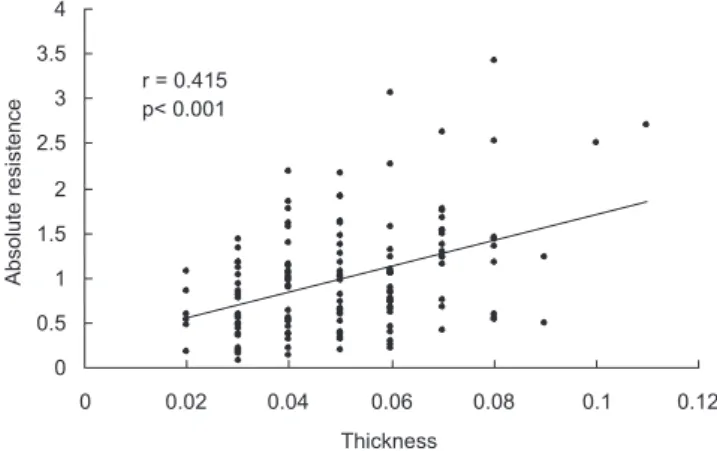
We found that the correlation between absolute resist-ance and thickness was equal to 0.26 + 14.53 x thickness (P < 0.001), which is positive and significant, as shown in
Figure 2 - Primary human tendinae chordae of mitral valve during traction
Figure 3 - Correlation between elongation and thickness
Figure 5, and that there was no significant correlation be-tween resistance and length (Table 2).
DISCUSSION
There are no studies in the medical literature worldwide addressing or testing the resistance of human primary chor-dae tendineae. The only studies with similar interest to ours deal with the force exerted by the papillary muscle,2,3,5,15 with
the importance of the position of the chordae tendineae in the proper hemodynamics of the left ventricle4,15 and with
the importance of preserving the left subvalvar system in val-vuloplasty and in the mitral valve replacement.6-14, 18
Echocardiographic examinations can yield the pressure exerted by the left ventricular chamber in each type of subvalvar system disease, such as rheumatic fever and myxomatous degeneration. As our investigation proceeds, we will be able to obtain the average resistance of the chor-dae tendineae in each of these diseases, and discuss the preservation or not of chordae tendineae in each condition
affecting the chordae tendineae.
The method employed in the dissection and traction of chordae tendineae was designed to avoid, to the maximum possible extent, the degeneration of the material under in-vestigation. Notwithstanding the precaution taken, we should reconsider, for the continuation of our study, the fol-lowing aspects of our method: should the chordae tendineae be preserved dry or in saline solution, should we preserve them until the time of stretching in regular freezers (tem-perature of approximately -6ºC) or in liquid nitrogen (low-est temperature of -196ºC), and should we store them in separate plastic polyethylene bags or in any other container type that is less reactive with the research material.
The purpose of this study was to start the investigation on the resistance of primary chordae tendineae; it was not designed to establish the final mean value of that resist-ance. This line of research will certainly continue, but us-ing other methods for the preservation of the chordae tend-ineae, eg. liquid nitrogen. There is also great interest in the future analysis of chordae tendineae from corpses with val-vular diseases of different etiologies.
CONCLUSION
The results presented show that the resistance of hu-man primary mitral valve chordae tendineae is related to their thickness and elongation at the time of rupture dur-ing stretchdur-ing, with no relation to their length. The thick-ness-related resistance shows a positive and significant cor-relation with elongation at the time of rupture.
ACKNOWLEDGMENTS
The authors wish to thank Rosangela Monteiro and Aristides T. Correa, from the Anatomic Surgery Labora-tory of the Heart Institute of Hospital das Clínicas - FMUSP [Medical School Hospital of the University of São Paulo], for their assistance in obtaining the hearts and having them dissected, and to Dr. Vladimir Ramirez and Solange de Oliveira Dourado, from Braile Biomédica, who helped per-form the stretching of the chordae tendineae.
Table 2 - Values of the correlation coefficient between
resistance, thickness, and length
Thickness Length
r 0.415 -0.163
p < 0.001 0.062
Figure 5 - Correlation between absolute resistance and thickness.
RESUMO
Lobo FL, Takeda FR, Brandão CM de A, Braile DM, Fabio Biscegli Jatene, Pomerantzef PMA. Estudo da resistência à tração das cordas da valva mitral. CLINICS. 2006;61(5):395-400.
OBJETIVO: Determinar o alongamento e a resistência à
da valva mitral, quando da substituição desta valva, mas não se tem conhecimento da resistência máxima que uma corda tendínea primaria pode sofrer resistência máxima que uma corda tendínea apresenta.
MÉTODO: Foram dissecados 8 corações que permitiram
a tração de cento e trinta e duas cordas tendíneas primárias humanas. Foram dissecados 8 corações que permitiram a tração de cento e trinta e duas cordas tendíneas primárias humanas, as quais foram medidas (comprimento e espessura) e submetidas a trações em condições controladas, e assim a resistência absoluta, a resistência relativa a espessura (resistência relativa) e o alongamento puderam ser medidos.
RESULTADOS: A correlação entre alongamento no
momento da ruptura e espessura foi igual a 1,54 + 17,02*espessura (p=0,026); e à resistência absoluta foi igual
a 0,95 + 1,42*resistência (p<0,001); e à resistência relativa à espessura foi igual a 1,95 + 0,08*resistência relativa (p=0,009). A correlação entre resistência absoluta e espessura foi igual a 0,26 + 14,53*espessura (p<0,001).
CONCLUSÃO: A resistência da corda tendínea primaria
humana da valva mitral está relacionada com sua espessura e com o alongamento no momento da ruptura à tração, não estando relacionada ao seu comprimento; e que o alongamento no momento da ruptura apresenta correlação com a resistência relativa à espessura e com a espessura da corda tendínea primaria humana, não estando relacionada com o comprimento da mesma.
UNITERMOS: Cordoalha. Corda Tendinea. Valva Mitral.
Aparelho atrio-ventricular. Resistência. Alongamento.
REFERENCES
1. Ranganathan N, Lam JH, Wigle ED, Silver MD. Morphology of the human mitral valve. II. The valve leaflets. Circulation. 1970;41:459-67.
2. Reul, H., N. Talukder, and E. W. Muller. Fluid mechanics of the natural mitral valve. J. Biomech. 1981;14:361-72.
3. Hashim SR, Fontaine A, He S, Levine RA, Yoganathan AP. A three-component force vector cell for in vitro quantification of the force exerted by the papillary muscle on the left ventricular wall. J. Biomech. 1997;30:1071-5.
4. Yellin EL, Yoran C, Sonnenblick EH, Gabbay S, Frater RW. Dynamic changes in the canine mitral regurgitant orifice area during ventricular ejection. Cir. Res. 1979;45:677-83.
5. Sanfilippo PF, Harrigan P, Popovic AD, Weyman AE, Levine RA. Papillary muscle traction in mitral valve prolapse: Quantitation by 2D echocardiography. J. Am. Coll. Cardiol. 1992;19:564-71.
6. Lillehei CW, Levy MJ, Bonnabeau RC Jr. Mitral valve replacement with preservation of papillary muscles and chordae tendineae. J. Thorac. Cardiovasc. Surg. 1964;47:532-43.
7. Dancini JL, Pomerantzeff PMA, Spina GS, Pardi MM, Giorgi MCP, Sampaio RO, et al. Valve replacement with chordal preservation and valvuloplasty for chronic mitral insufficiency. Arq. Bras. Cardiol. 2004;82:235-42.
8. David TE, Uden DE, Strauss HD. The importance of the mitral apparatus in left ventricular function after correction of mitral regurgitation. Circulation. 1983;68:76-82.
9. Miki S, Kusuhara K, Ueda Y, Komeda M, Okita Y, Tahata T. Mitral valve replacement with preservation of chordae tendineae and papillary muscles. Ann Thorac Surg. 1988;45:28-34.
11. Dottori V, Barberis L, Lijoi A, Giambuzzi M, Maccario M, Faveto C. Initial experience with mitral valve replacement with total preservation of both valve leaflets. Texas Heart Inst. J. 1994;21:215-9.
12. Mok CK, Cheung DLC, Chiu CSW, Aung-Khin M. An unusual lethal complication of preservation of chordae tendineae in mitral valve replacement. J Thorac Cardiovasc Surg. 1988;95:534.
13. Popovic Z, Barac I, Jovic M, Panic G, Miric M, Bojic M. Ventricular performance following valve replacement for chronic mitral regurgitation: importance of chordal preservation. J Cardiovasc Surg. 1999;40:183-190.
14. Straub U, Huwer H, Kalweit G, Volkmer I, Gams E. Improved regional left ventricular performance in mitral valve replacement with orthotopic refixation of the anterior mitral leaflet. J Heart Valve Dis. 1997;6:395-403.
15. Jesen MOJ, Fontaine AA, Yoganathan AP. Improved in vitro quantification of the force exerted by the papillary muscle on the left ventricular wall: three-dimensional force vector measurement system. Annals of Biomedical Engineering. 2001;29:406-13.
16. Vilar WD. Química e Tecnologia dos Poliuretanos. 2a ed. Rio de Janeiro: Vilar Consultoria; 1998. p. 9.4.
17. Rosner B. Fundamentals of Biostatistics. 2nd ed. Boston: PWS Publishers; 1986. p. 584.