Abstract— In the present work, the model reference
nonlinear controller (MRNC) based on pseudo dynamic model is designed to a continuous bioreactor which exhibits input multiplicities in dilution rate on productivity. i.e., two values of dilution rate will give the same value of productivity. The performance of MRNC and linear PI controller have been evaluated through simulation studies. The optimal parameters of MRNC have been obtained based on integral square error criterion (ISE) through simulations. As the MRNC provides always the two values of Dilution rate for control action and by selecting value nearer to the operating point, it is found to give stable and better response than linear PI controller. Linear PI controller results in wash out condition or switch over from initial lower input dilution rate to higher input dilution rate or vice versa. Thus, PDMRNC is found to overcome the control problems of PI controller due to the input multiplicities
Index Terms— Bioreactor, Input multiplicities, Instability, Nonlinear control.
Abbreviations
A. List of Symbols
D h-1 dilution rate e error
KI g/l substrate inhibition constant Km g/l substrate saturation constant Kc controller gain
P g/l product concentration Pm g/l product saturation constant Q g/l/h product cells produced per unit time S g/l substrate concentration
Sf g/l substrate feed concentration t h time
ts h settling time
X g/l biomass concentration Y g/lh measured value of productivity Yr reference value for Y
Manuscript received December 27, 2008October 9, 2008. G.Prabhaker Reddy is with the Dept. of Chemical Eng., University College of Technology, Osmania University, Hyderabad,-500007, India. ( Phone: 91-9866619899;Fax:91-4027098472; e-mail:
V.Ramesh Kumar is with the Dept. of Chemical Eng., University College of Technology, Osmania University,Hyderabad,-500007,India. (e-mail: [email protected])
B.Spandana is with the Dept. of Chemical Eng., University College of Technology, Osmania University,Hyderabad,-500007,India.
B. Greek Letters
α g/g product yield parameter β h-1 product yield parameter μ h-1 specific growth rate
μm h-1 maximum specific growth rate τI h integral time
τD h derivative time ξ damping coefficient ψ g/g cell mass yield
II. INTRODUCTION
Input multiplicities mean more than one value of an input variable (u) produce the same value of an output variable (y). The condition for the input multiplicities for single input and single output nonlinear systems is that the derivative of output with respect to the input must be zero (i.e., (dy/du)=0). In general input multiplicities occur due to the presence of competing effects in the nonlinear processes [1]-[4].
The nonlinear chemical processes such as the continuous stirred tank reactors (CSTRs) in series with the exothermic reaction(A→B),flash separation unit, the nonlinear processes with recycle structures such as heat exchanger network and the combine unit of reactor and distillation column are shown to exhibit input multiplicities[1],[4]. Also, a single exothermic CSTR with series reversible reaction scheme [1].
Control of nonlinear processes with input multiplicities by a conventional PI controller can give several problems including driving the process to a physical limit or to a lesser stable input steady state or to a lesser economical input steady state or yielding an unconstrained limit cycles[1],[2],[4].
In Reference [4], They have considered the nonlinear systems represented by the stable nonlinear gain followed by a unity gain linear system for the control studies of the processes with input multiplicities. Proportional-integral (PI) controller is considered. The hypothetical problems with input multiplicities with linear stable dynamic systems are chosen, they have shown that the input steady states having process gain of the same sign are compatible i.e., stable for the same set of controller parameters. They
Pseudo Dynamic Model Reference Nonlinear
Control of a Continuous Bioreactor with
Input Multiplicities
have shown the undesirable phenomenon of driving the system to the lesser stable input steady state in the presence of temporary disturbance and also closed loop system exhibits unconstrained limit cycle for certain disturbances.
In [5], They have demonstrated experimentally the superior performance nonlinear controller over conventional PI controller for bioreactor with input multiplicities.
In the present work, the design of model reference nonlinear controller for a continuous (MRNC) to a continuous bioreactor with input multiplicities to overcome the control problems of conventional PI controller due to input multiplicities.
III. .MODEL OF A CONTINUOUS BIOREACTOR A variety of fermentation can be described by the following unstructured model [6].
X μ DX dt
dX =− + (1)
ψ X μ ) X X ( D dt
dS = − −
f (2) X ) μ ( DP dt dP β α + + −
= (3)
The specific growth rate(μ) model is allowed to exhibit both substrate and product inhibition:
⎟⎟
⎠
⎞
⎜⎜
⎝
⎛
+
+
⎟⎟
⎠
⎞
⎜⎜
⎝
⎛
−
=
I 2 m m mK
S
S
K
S
P
P
1
μ
μ
(4)The productivity Q can be defined as the amount of product cells produced per unit time: Q=PD. The nominal model parameters [7] considered are α = 2.2 g/g, , β = 0.2 h-1, μm = 0.48 h-1 , P
m = 50 g/l ,Km = 1.2 g/l, KI = 22 g/l,
ψ= 0.4 g/g , Sf = 20 g/l. The Bioreactor system is
characterized by input multiplicities [5] in the dilution rate (D) on the productivity (i.e., two values of D giving an identical value for productivity). For example, Q = 3 g/l/h can be obtained under either D = 0.2278 l/h or D = 0.09386 l/h. At lower value of D, the steady-state gain is positive whereas at the larger value of D the gain is negative and thus it poses a control problem.
IV. DESIGN OF PSUEDO DYNAMIC MODEL REFERENCE NONLINEAR CONTROLLER FOR
CONTINUOUS BIOREACTOR WITH INPUT MULTIPLICITIES
The Design of Model Reference Nonlinear Controller based on pseudo dynamic model is briefly presented below. Since, the output variable (y) is to be controlled is Q (=DP). On differentiation, it gives,
dt (6)
dP D dt dD P dt
dQ = +
and the error is defined as ,
e = yr− y (7)
Where yr is the reference value of Q and y is the actual value of Q from the process. Here, reference value and the set point of Q are same. The pseudo dynamic model is assumed to be given by,
) 8 ( ) y y ( dt dy
τ
− = sWhere, ys is the expression for the steady state value of y given by the solution of corresponding steady state equations. Here, τ is an assumed time constant of the system. Differential of error gives
• • •
−
=
y
y
e
r (9)By substituting, •
y
from Eq. (8) into Eq. (9),]
/
)
y
y
[(
y
−
−
τ
=
••
s r
e
(10)On equating the equation (10) to
-kc [e + (1/ τI)
∫
t
edt
0] (11)
By combining Eqs (10) & (11) ys = y + τ[kc (e+ (1/τI)
∫
e dt
) +yr.
] (12) By substitution of the expression for ys from steady state equation, the control law is obtained as
b1D4+(b2-h1)D3+(b3-h2)D2–h3D-h4=0 (13)
Qs=Ys ; h1 = α2Sf ;
h2 = α{2Sf β-Qs [1/ ψ+ (Sfα/Pm)]};
h3 = (α/Pmψ) Qs2-Qs [(2αβSf/Pm) + (β/ψ )] +Sfβ2;
h4 = (β/Pm)[(Qs2/ψ) - βS
fQs] ; b1=α2a/μm, ;
b2= (2αβ/μm) a - (αQs/μm) b;
b3= (β2/μm )a – (Qsβ/μm) b + (Qs2/μm) c and
a = (Sf2/KI) +Sf +Km ; b = [1+2(Sf/KI)]/ψ ;c = 1/ ( ψ2KI)
In the design, the error dynamics is given by second order differential equation [i.e., Eqs (10) & (11)] . The controller parameters of MRNC are given by [8] as Kc = 10/ts and τI = 0.4tsξ2. Where, ξ and ts are the damping
coefficient and settling time of the error dynamics. These values are to be given by designer. The value of ts is to be
given from the knowledge of the open loop system dynamics. The value of ξ ranges from 1.0 to 2.0 for a second order error dynamics. The control law equation (13) gives two positive values of D. The value, which is nearer to the nominal steady state condition, is taken for implementation for the manipulation. Thus, the MRNC based on Pseudo dynamic model equation permits to select the lower or higher value of the manipulated variable.
V. SIMULATION RESULTS AND DISCUSSIONS The performances of MRNC and Conventional PI controller have been evaluated through simulations. Dynamic model of continuous bioreactor with parameters presented in section III are used for simulation studies. The control studies have been carried out for the productivity, Q=3.0g/lh. Which can be either obtained with dilution rate D=0.09386h-1 (lower input value) or
D=0.2278h-1 (higher input value) with feed substrate
concentration, Sf =20g/l. The regulatory results have been
presented below for both the input dilution rates for the step disturbance in feed substrate concentration.
A. At lower Dilution rate (D=0.09386h-1)
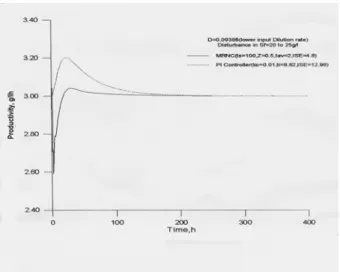
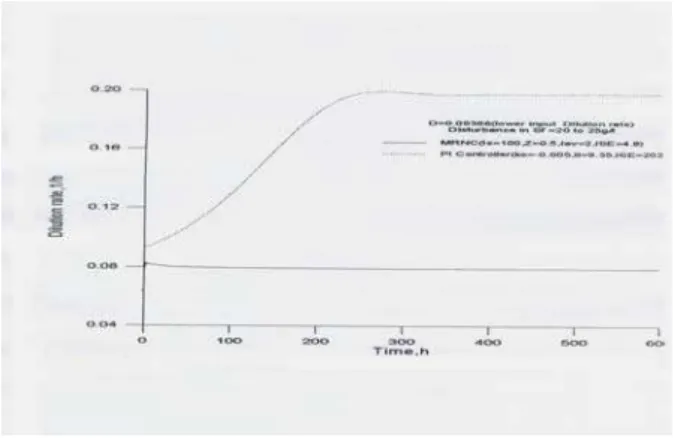
The regulatory responses of MRNC and Conventional PI controller are shown in Fig.1 for a disturbance in feed substrate concentration Sf from 20 to 25 g/l. The MRNC
controller gives better response with lower ISE=4.8, than PI controller with large ISE=12.96. The settling time of response with MRNC controller is also lower (100h) than PI controller (200h). The corresponding manipulation in dilution rate is shown in Fig.2.
.
Fig.1 Regulatory Responses of MRNC and PI controllers at lower dilution rate.
Fig. 2. Manipulation in Dilution rate for the responses shown in Fig.1
The responses of closed loop system when the controller settings meant for the larger value of D is used for the lower value of D are shown in Fig.3 for both the linear and the nonlinear controllers. The MRNC gives faster and stable response, whereas the linear controller first moves towards the unstable direction but soon changes to a stable condition. However the manipulated variable moves to a higher value. The corresponding manipulation variable is shown in Fig. 4
Fig. 4. Manipulation in Dilution rate for the responses shown in Fig.3
B. At higher Dilution rate (D=0.2278h-1)
The regulatory responses of MRNC and Conventional PI controller are shown in Fig.5 for a disturbance in feed substrate concentration Sf from 20 to 25 g/l. the MRNC
controller gives better response than PI controller. The corresponding manipulation in dilution rate is shown in Fig.6.
Fig.5 Regulatory Responses of MRNC and PI controllers at higher input dilution rate.
Fig. 6. Manipulation in Dilution rate for the responses shown in Fig.5
The response of closed loop system when the controller settings meant for the lower value of D is used for the larger value of D are shown in Fig. 7 for both the linear and the nonlinear controllers. The response of nonlinear controller is stable response but the linear controller leads
Fig.7 Regulatory Responses of MRNC and PI controllers when PI controller designed for lower input is applied for higher input Dilution rate.
Fig.8. Manipulation in Dilution rate for the responses shown in Fig.7
VI. CONCLUSION
Based on the simulations results, it is concluded that for a continuous bioreactor with input multiplicities in dilution rate, the performance of model reference nonlinear controller is much superior to that of PI controller at both dilution rates as MRNC gives stable and faster response and Conventional PI controller designed at higher dilution rate becomes unstable at lower dilution rate and vice versa. Model reference nonlinear controller based on pseudo dynamic permits the designer to select the value of input as smaller or larger of the input dilution rate.
ACKNOWLEDGMENT
G.PRABHAKER REDDY IS THANKFUL TO UGC AND MHRD, GOVT. OF INDIA FOR THE FINANCIAL SUPPORT UNDER
TEQIP TO PRESENT THIS WORK IN ICCA-2009 IN HONG
KONG.
REFERENCES
[1] L.B.Koppel “Input multiplicities in nonlinear multivariable control systems”, AIChE Journal,28, No.6, 1982,pp 935-944.
[2] L. B. Koppel “Input multiplicities in process control”, Chemical Engineering Education, 1983,pp 58-92.
[3] L.B Koppel , “ Conditions imposed by process static’s on multivariable process dynamics ”, AICHE Journal, 31,No.1, 1985.
[4] K.S.Dash and L.B.Koppel,“Sudden destabilization of controlled chemical processes”,Chem.Eng.Comm.84, 1989,pp129-157. [5] S.V Sunil Kumar, V.Ramesh Kumar and G.Prabhaker Reddy, “
Nonlinear Control of Bioreactors with input multiplicities- An Experimental work ” Bioprocess and Biosystems Engineering, ,
28, 2005, pp 45-53 .
[7] G.P.Reddy and M.Chidambaram, “ Nonlinear control of bioreactors with input multiplicities in dilution rate”, Bioprocess Engineering, 12,1995, pp 151-155.