w w w . a j e r . o r g
Page 139
American Journal of Engineering Research (AJER)
e-ISSN : 2320-0847 p-ISSN : 2320-0936
Volume-03, Issue-12, pp-139-149
www.ajer.org
Research Paper Open Access
Theoretical Study Of The Interaction Of Cavitation Bubbles With
The Interface “Liquid-Gas” Determining Optimum Modes Of
Ultrasonic Effect To Increase The Surface Of The Phase Contact
R.N.Golykh
1, V.A. Nesterov
1, A.V. Shalunova
1, E.V. Ilchenko
11
Biysk Technological Institute (branch) of Altai State Technical University named after I.I.Polzunov, Russia
ABSTRACT:
The article describes the model of the interaction of the cavitation area formed upon influence of ultrasonic vibrations with the interface of gas and liquid phases. In the system “liquid-gas” studied in the frameworks of the model liquid spreads on some solid surface in the form of the film and it is in contact with gas medium. It is shown, that the interaction of cavitation bubbles with the interface of liquid and gas leads to the generation capillary waves and consequently to the increase of the surface of phase contact. The model analysis allows determining the modes of ultrasonic effect, which are necessary for maximum enlargement of interphase boundary area. It leads in turn to the increase of the rate of physic-chemical processes based on the surface interaction of dissimilar substances (absorption of gas mixtures both for cleaning and for separation of specific-purpose components, drying, wet cleaning of gases from dispersed admixtures, etc.). As a result of model analysis we determined threshold vibration amplitudes of solid surface covered with the film of liquid phase, which excess resulted in stability failure of capillary waves and their decomposition to liquid drops. It was shown, that the most efficient frequency of ultrasonic effect was 60 kHz, at which phase contact surface increased in more than 3 times.KEYWORDS :
Absorption, capillary waves, cavitation, liquid, ultrasonicI.
INTRODUCTION
The rate of the most of physicochemical processes is limited by the interface of interacted substances or phases and also by the rate of agent introducing to this boundary. The most part of such processes occurs in two-phase system “liquid-gas”. For instance in the systems “liquid-gas” following process such as wet gas cleaning from different dispersed admixtures, absorption of gas mixtures both for their cleaning and for separation of specific-purpose components, drying of the materials and others can be realized. It is evident, that for maximum efficiency of mentioned above processes first of all it is necessary to provide large area of contact surface of liquid and gas phases. In existing chemical engineering apparatuses (absorbers, wet dust collectors, dryers) specific interface area (for the mass unit) required for the industrial realization of physic-chemical processes at the interface can be achieved by the following ways:
a. liquid is sprayed during gas phase in the form of small drops;
b. liquid spreads on the surface of the solids as a film (the thickness is no more than 5 mm) and contacts gas medium.
w w w . a j e r . o r g
Page 140
It is known, that the most advantageous method [1, 2] of creation of cavitation bubbles is the in-troduction ultrasonic vibrations into liquid phase with the frequency of 20…60 kHz. Ultrasonic influence can be carried out by excitation of mechanical vibrations of the solid surface, on which liquid film spreads. It is necessary to develop theoretical model allowing to determine optimum modes of ultra-sonic effect (amplitude and vibration frequency of the solid surface), which provides maximum interface area “liquid-gas”. There is a need to study in details the interaction of shock waves of cavitation bubbles with the surface of phase contact.For a long time the development of the theories of the interaction of shock waves of cavitation bubbles with the interface had some mathematical difficulties, as there was no correct solution of the equations of the hydrodynamics of supersonic liquid flow streaming cavitation bubble. At the beginning of 20th century foreign scientists (B.E. Nolting, E.A. Neppiras, H.G. Flynn, J.G. Kirkwood, H.A. Bethe) [3-5] gave basic theoretical descriptions of the growth and pulsation of the cavitation cavity (bubble). These descriptions are equations of radial vibrations of the bubble, which take into account possible factors influencing the dynamics of the cavitation cavity including compressibility of liquid and change of its wave properties at the supersonic flow. These equations are non-linear differential equations of second order relative to the radius of the bubble, which is a function on time. It was stated, that the bubble retained its spherical form during the cycle of expanding and collapsing, and it was assumed, that shock wave had spherically divergent character. Such assumption does not allow explaining experimentally observed the generation of capillary waves of small length (no more than 200 µm) at the interface “liquid-gas”.
However, as it was mentioned above in these processes, liquid spread on solid surface as a film. The thickness of the film does not exceed 5 mm [6], solid surface reflects shock waves. Reflecting phenomena break the sphericity of cavitation bubbles at their collapse [7]. This sphericity failure narrows the diagram of shock wave directivity, and this fact explains the generation of capillary waves of small length (no more than 200 µm). Stated factor should be taken into consideration at theoretical studies of the interaction of cavitation bubbles with the interface “liquid-gas”. Thus, the aim of the paper is to develop the mathematical model of the interaction of cavitation bubbles with the interface “liquid-gas” for the determination of the modes of ultrasonic effect providing maximum surface area of phase contact. The model includes following stages of the generation of capillary waves on the interface “liquid-gas” under the action of ultrasonic cavitation:
[1] expansion of cavitation bubble up to maximum radius, which is spherically symmetric due to the low speed of its walls (no more than 15 m/s);
[2] asymmetric collapse of the cavitation bubble from maximum radius to minimum size;
[3] generation and propagation of narrow directional shock wave in the thin liquid film at the collapse of the cavitation bubble;
[4] formation of capillary waves on interface “liquid-gas”. In this stage capillary waves profile is determined and square of the interface “liquid-gas” is calculated.
Further proposed model is described.
II.
MODEL
OF
INTERACTION
BETWEEN
CAVITATION
BUBBLES
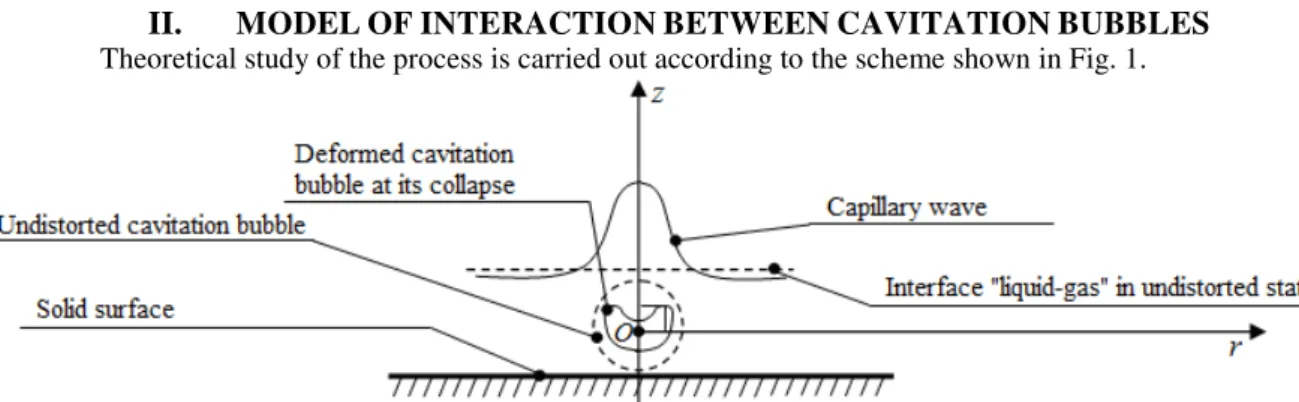
Theoretical study of the process is carried out according to the scheme shown in Fig. 1.Fig. 1. Scheme of theoretical study of the interaction between cavitation bubbles and interface “liquid-gas”
w w w . a j e r . o r g
Page 141
[1] expansion of the bubble is spherically symmetric, which is caused by low speed of walls motion, howeverthe bubble center vertically moves relative to the solid surface in the course of time;
[2] in initial time the center of the cavitation bubble is located near the solid surface, as such bubbles mostly influence on the formation of capillary wave.
Maximum radius of the bubble RMAX is defined on the base of Nolting-Neppiras equation [3]:
( )
ft Ahf p R R R p p R
t R
t R R t R
V π ρ π
σ µ
ρ 4 2 γ 4 sin2
2
3 2 2
0 3 0 0 0 2
2 2
+ −
+ + + ∂ ∂ − =
∂ ∂ +
∂ ∂
where R is the instantaneous radius of the cavitation bubble, m; R0 is the radius of cavitation nucleus, m; σ is the liquid surface tension, N/m; ρ is the density of liquid, kg/m3; p0 is the static pressure in liquid, Pa; f is the frequency of ultrasonic action, Hz; h is the thickness of liquid film, m; A is the amplitude of ultrasonic action, m; pV is the pressure of saturated vapor of liquid, Pa; t is the time, s; µ is the dynamic viscosity of liquid, Pa·s.
The distance between the center of the cavitation bubble (at the moment of maximum expansion) and the solid surface is defined from the equation given in Rozhdestvenskiy’s paper [8]:
0 3
2 6
2 2 2 2 2
2 =
∂ ∂ + ∂ ∂ + ∂ ∂ ∂ ∂
t R R t
b R b t R t b b
where b isthe distance between the center of the cavitation bubble and the solid surface, m.
Obtained values of maximum bubble radius and the distance between its center and the solid surface are used for theoretical studies of further stages of the capillary wave formation.
During the study of the stage of cavitation bubble collapse its form in the moment of the minimum size is determined.
The form of the cavitation bubble is defined from the integral equation (1) with boundary conditions (2, 3) on the wall of the cavitation bubble for liquid velocity potential and entry conditions (4, 5) on cavitation bubble wall:
( )
∫
∪∂
∂ ∂ − =
B A S
S
S E V
E ϕ
ϕ
n
r r
n r
0 0
2
0 (1)
γ
3 2
2
4 3 2
2
− =
+ + ∂ ∂
MAX
R V p
K V
V
t
ρ
ρ
π
σ
ϕ
n τ п (2)t
∂ ∂ =
∇ϕ r (3)
0
0 =
=
t
ϕ (4)
MAX t=0 =R
r (5)
where r0, r are the vectors of the coordinates of the points of the wall of the cavitation bubble or solid surface, m; φ is the fluid velocity potential on the wall of the cavitation bubble or solid surface, m2/s; Vnand Vτ are the normal and tangential components of fluid velocity, m/s;
( )
r0
r
E is the fundamental solution of Laplace’s equation; V is the volume of the cavitation bubble, m3; pn is the pressure of saturated vapor of fluid, ρ and σ are the density (kg/m3) and surface tension (N/m) of fluid, respectively; K is the mean curvature of the walls of the cavitation bubble, m-1; SAis the wall of the cavitation bubble; SBis the solid surface on which Vn is equal 0.
w w w . a j e r . o r g
Page 142
Fig. 2. Discretization of the cavitation bubble wall into ring boundary elementsIt is assumed, that in the frameworks of each ring element the velocity potential is constant. It allows solving boundary integral equation (1) as a system of linear equations (6). This system is obtained by using method of “images” (replacing solid surface by symmetrically placed cavitation bubble).
{ }
( ) ( ) ( ) ( ) ( ) ( ) ( ) ( ){ }
i i NN n N n n n N n N n n n N j i ij b V V V V V V V V
A 1...2
1 2 1 1 2 1 2 ... 1 , ... ... = − − = = (6)
where {Aij} is the matrix of linear system; ( )
i n
V
is normal velocity on i-th bubble wall boundary item with coordinates (ri; zi) and (ri+1; zi+1); {bi} is right part of system; N is count of boundary items;The coefficients of the system of linear equations (Aij and bi) are defined by the following obtained expressions:
(
)
(
)
(
)(
)
(
)
(
)
(
) (
)
− + − − − − − + − + − − − − + + + + = − − − − − − = = − − − − − − +∑∑
2 1 2 1 1 1 0 1 1 10 1 1 0 0
1 ) 1 , min( ) 1 ; 1 max( ) 1 , min( ) 1 ; 1 max( 2 1 , 2 2 2 1 , 2 2 1 , 2 2 1 2 4 j j j j j j j j i i i i q N j j j j j N j j N i i pN i z z r r r r q z z pb z z p r r qb z q r qb z q r J b ϕ ϕ ϕ ϕ (7) ( )( )
{
}
(
)
(
)
(
)
(
)
(
)
(
)(
)
− + − + − − − − × × − + − − − − = − − − − − − + + 0 1 1 0 0 1 1 0 0 1 1 0 2 2 1 2 1 , 2 2 1 , 2 2 1 1 2 2 1 , 2 2 1 pb z z p r r qb z q r qb z q r I qb z q r qb z q r I A i i i i j j j j pq ij j j j j pq ij qN j pNi δ δ δ δ
(8)
where I0, J, I are integrals over on each boundary item; b0 is starting distance (at maximum bubble expansion) between bubble center and solid surface, m.
w w w . a j e r . o r g
Page 143
=
1 1 0 0z
r
z
r
=
− − 1 1 N N N Nz
r
z
r
Integrals I0, J, I are defined as follows (9-11):
(
)
(
[
]
(
)
)
(
)
( )
( ) ( )(
)
(
)
(
)
( )
(
)
( )
( ) ( ) ϕ π π ϕ ϕ ϕ ϕ ϕ ϕ ϕ ϕ ϕ ϕ ϕ ϕ π ∂ − + + − − × × + − + − − − − − + + − + + − − − − × × − + − = − + = − = − + = − =∫
2 1 2 1 2 1 2 1 , 1 , 2 1 2 0 2 1 4 2 1 2 2 1 2 0 2 1 4 2 1 2 1 2 2 1 1 , 1 , 2 1 2 0 2 1 4 2 1 2 2 1 2 2 0 0 1 0 1 0 2 1 , 2 , , 2 , 4 , , 2 , 1 4 cos . . , , , l t l t l t l t z r l l l l t t l l l l l r r l r l l l l t l r r n z z n r r p v J l l r l l r l l r l l r l r l l r l r l l r l l r l r l l r n r r r (9)(
)
(
)
( )
( )
(
)
(
)
(
)
(
)
( )
( )
ϕw w w . a j e r . o r g
Page 144
where r1, r2, r0 are vectors of coordinates
=
=
=
0 0 0 2 2 2 1 1
1
;
;
z
r
z
r
z
r
r
r
r
; n is vector of normal
;
=
z r
n
n
n
= 0 0cos
z
r
ϕ
ϕ
l ;
(
)
+ + =
2 1
2 1 0
cos 2
1
z z
r
r ϕ
ϕ
l ;
(
) (
2 1)
22 1
2 r z z
r
l= − + − ;
l
1=
r
12+
z
12;l
0=
r
02+
z
02 .Obtained system of linear equations (6) is solved by iterative Seidel method.
Obtained forms of cavitation bubble walls (by equations (1-5) at the collapse in different moments of time are shown in Fig. 3. The initial moment of time (0 µs) is the moment of the maximum bubble expansion.
As it is shown in Fig. 3, cavitation bubble is a hemispherical radiator of shock wave.
At the study of the stages of generation and propagation of shock wave it allows approximating its pressure profile at different distances from the bubble by the following obtained expression (12).
( )
[
( )
( )
∂ ∂
+ ×
× +
=
+ + − + + −
∞
−∞ =
∑
∫ ∫
ψ
ψ
ω
ψ
π
ω
ψ ρ
ω η ω
π ω
π
1 2 2 0
cos 2
2
0 2
0 1 2
2 2
sin sin Re
2 ,
2 2 2 2 2 1
t z r
с
ra n J e
t p z
r a t
p
z r za c n z r t t c c in
n
c r
; (12)
where (r; z) are the coordinates of the points, m; ω is the circular vibration frequency of solid surface, s-1; t and
t1 are the moments of time, s; η is the viscosity of liquid, Pa·s; ρ and c is the velocity of sound in liquid, m/s;
( )
t1pc is the pressure in the nucleus of the cavitation bubble, Pa; a is the radius of the cavitation bubble at maximum pressure in the nucleus, m.
The function of shock wave pressure in the nucleus of the cavitation bubble pc
( )
t1 being a part of theexpression (12) is defined as:
( )
γ3
4 3
1
=
V R p t
p MAX
V c
π ;
pV is pressure of saturated liquid vapor; RMAX is bubble radius at maximum expansion; V is bubble volume at time t1; γ is a adiabatic index of gas.
Given profile of shock wave pressure is used further for the definition of capillary wave form and finally interphase boundary area.
The form of the capillary wave is defined from the expression (13):
( )
∫∫
∂ ∂∂ ∂ −
= t t t t z p t
r 0
2 0
1
2
1 ,
ρ
ξ (13)
where ξ
( )
r,t is the value of displacement of the interface “liquid-gas” along the axis z.Thus mathematical description presented above allows determining the profile of single capillary wave generated by separate bubble.
However at the realization of the technological process it is impossible to obtain separate bubble that is – interface “liquid-gas”; – wall of the cavitation bubble
a) 0 µs b) 0,38 µs c) 0,75 µs d) 1,13 µs e) 1, 24 µs f) 1,35 µs
w w w . a j e r . o r g
Page 145
why it is necessary to consider the interaction between the aggregate of cavitation bubbles and the interface generating set of capillary waves.The specific area of the interface “liquid-gas” per unit volume of liquid phase at the generation of the set of capillary waves is defined by the expression:
h r r r n
S 2 1 1
5 , 0
0
2
+ ∂
∂ ∂ +
= π
∫
λ ξwhere S is the specific area of the interface, m2/m3; λ is the length of the capillary wave (m) defined from the
condition , 0
2 = ∂ ∂
t r
λ
ξ .; n is the concentration of cavitation bubbles, m-3; < > is sign of averaging by liquid film
thickness; h is thickness of liquid film, m.
The term
∫
∂
∂ ∂ +
λ ξ
π 0,5
0
2
1
2 r
r r
n characterizes a shock wave energy being generated at bubble
collapse.
For the concentration of cavitation bubbles kinetic equation (14) obtained from Smolukhovskiy’s equation [9] for the processes of coalescence and breakage of disperse particles (liquid drops, gas and solid particles) is true [10]:
( )
20
1
n k iT
j n t n
B
− − = ∂
∂ (14)
where n is the calculating concentration of cavitation bubbles depending on time t, m-3, i is the average number of cavitation bubble pulsation before its collapse, kBis the constant of coalescence rate of the bubbles, m3/s, T0 is the period of ultrasonic vibrations, s, j is the mean amount of the nuclei generated at the breakage of the separate bubble.
By solving the equation (14) following analytic expression is obtained:
(
n n)
e nkBtn
n n n
∞
− ∞
∞
− + =
0 0
0 ; (15)
where n0 is the initial unknown concentration of cavitation bubbles, m-3, n∞ is the stationary concentration of
cavitation bubbles, m-3.
According to the expression (15) the concentration of the bubbles n in time, which equals tens periods of ultrasonic vibrations, achieves stable value and equals to n∞, which is defined by the expression (16):
0 1 T ik
j n
B − =
∞ ; (16)
Variable j being in expression for stable concentration (16) is calculated from experimental data given in Rozenberg’s book [3].
The constant of coalescence is defined as follows:
2
u
S
k
B=
effwhere Seff is square of effective bubbles collision’s cross-section which is proportional to RMAX2, m2; <u> is approach velocity of the cavitation bubbles, m/s.
w w w . a j e r . o r g
Page 146
( )
( )
( )
∂ ∂ − +
∂ ∂ − ∂
∂ +
+ ∂
∂ ∂ ∂ +
∂ ∂ =
∂
∂
∑
≠ =
t t R
t t R
t
t t R R R
t t R t
R
i i L i i
i L L i
ij i
j n j
j j L ij
i i
L L i i G i
r r v r
r v
d d
r v r
, 4
, 3
4 2 1
3 4 ,
3 4 3
4
3
, , 1
2
3 3 3
2 2 3 0
πη ρ
π
ρ π ρ
π ρ
π
; (17)
where i is the ordinal number of the bubble in zone of liquid phase; Riis the instantaneous radius of i-th bubble, m; c is the local velocity of sound in liquid phase, m/s;
p
wi is the gas pressure near the walls of i-th bubble, Pa;p is the instantaneous value of pressure of liquid phase without cavitation bubbles, Pa; ρLis the density of liquid phase, kg/m3; vL is the instantaneous vibrational speed of liquid phase without cavitation bubbles, m/s; R0i is the radius of i-th bubble nucleus, m; ρG is the equilibrium density of gas inside the bubble, kg/m3; t is the time, s;
η is the viscosity of liquid phase, Pa·s; ri is the coordinate vector of the center of i- bubble, м; dij = rj-ri is the vector of center line of i-th and j-th bubbles couple, m.
On the base of the results of equation solution (17) approach velocity of cavitation bubbles is defined by the following expression:
( )
( )
0 12 0
12 0
T T
u = d −d
.
Thus proposed model allows defining dependence surface area of interphase boundary on the modes of ultrasonic action (frequency and vibration amplitude of solid surface covered with liquid film, which borders on gas phase) and liquid properties.
III.
RESULTS
AND
DISCUSSION
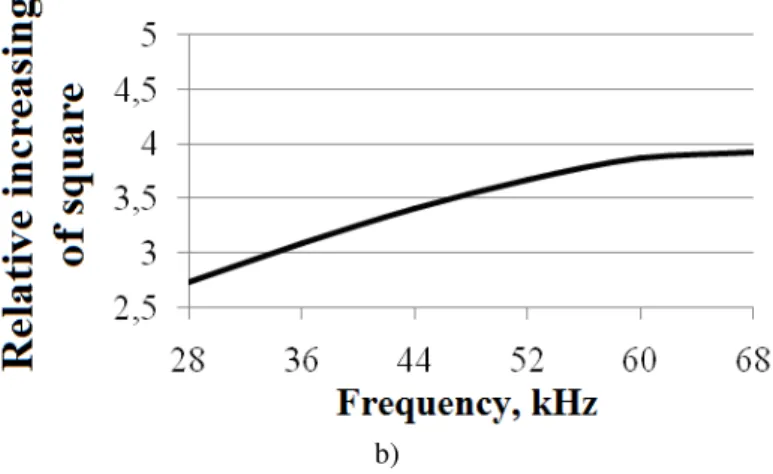
Obtained dependences of relative increase of the interface area on the modes of ultrasonic action are shown in Fig. 4.Relative increase K of interface area is the ratio of the interface area upon ultrasonic action (SUS) to the area without ultrasonic action (Swithout US):
US Without
US
S S K=
Fig. 4 shows the breakage of the graph corresponds to the fact, that capillary wave loses its stability and breaks into drops [11]. The dependence of frequency (Fig 4b) is built up at threshold amplitudes, when capillary wave remains stable.
w w w . a j e r . o r g
Page 147
b)Fig. 4. Dependences of specific area of the interface on the modes of ultrasonic action: (a) on amplitude at different frequencies; (b) on frequency at maximum amplitude
From presented dependences it is evident, that with the increase of amplitude interface area grows. If frequency rises, surface area grows (up to more than 3 times) due to the increase of cavitation bubble concentration [3]. However starting with the frequency of 60 kHz the growth of the area essentially becomes slower, and energy loss of the ultrasonic radiator increases quadratically. That is why; the application of frequencies of more than 60 kHz is unpractical. Fig. 5 shows the dependence of threshold vibration amplitude, at which capillary wave remains stable, on the frequency of action.
0
0,5
1
1,5
2
2,5
28 32 36 40 44 48 52 56 60
Frequency, kHz
T
h
re
sh
o
ld
a
m
p
li
tu
d
e,
µ
m
Fig. 5. Dependence of threshold amplitude, at which capillary wave remains stable, on the frequency of action
w w w . a j e r . o r g
Page 148
a)b)
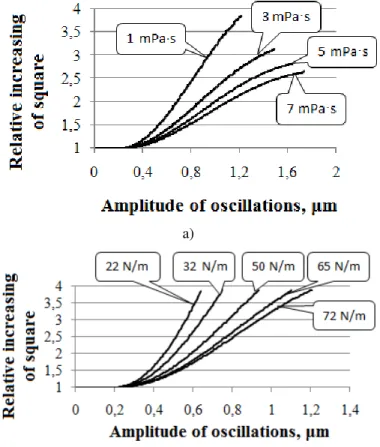
Fig. 6. Dependence of specific area of interphase boundary on amplitude at different properties of liquid (frequency of 60 kHz): viscosity (a) and surface tension (b)
Presented dependences (Fig. 6) can be used for the determination of the area change caused by change of the liquid type and change of its properties. In particular it is stated, that growth of viscosity leads to the decrease specific area of the interface. It is caused by the absorption of energy of shock waves in liquid phase due to forces of viscous friction. At that decrease of surface tension leads to the growth of the area, as surface energy of a liquid directly depends on its surface tension.
IV.
CONCLUSION
Thus model of the interaction of cavitation zone generated under the action of ultrasonic vibrations with interface of gas and liquid phases is developed. It is shown, that this interaction leads to the generation of capillary wave and consequently to the growth of surface of phase con-tact. Analysis of the model allows determining the modes of ultrasonic action, which are necessary for maximum increase of interphase boundary area. As a result of the analysis we determine threshold vibration amplitudes of solid surface covered with thin film of liquid phase, which excess leads to stability failure of capillary waves and their breakage into liquid drops. It is shown, that the most appropriate frequency of ultrasonic vibrations is 60 kHz, at which more than 3 times increase of contact surface. Obtained new scientific results have fundamental interest for the understanding of physical mechanism of the interaction of cavitation bubbles with the interface “liquid-gas”. They can be used for the practical realization of physic-chemical processes at the boundary “liquid-gas” (absorption, drying, evaporation, etc.). In particular ultrasonic action in the packed absorbers lets applying in more than 3 times less number of the nozzles at the same productivity of absorption.
V.
ACKNOWLEDGEMENTS
w w w . a j e r . o r g
Page 149
REFERENCES
[1] L.D. Rozenberg, Physical principles of ultrasonic technology (Moscow, RU: Science, 1969). In Russian.
[2] V.N. Khmelev, R.N. Golykh, S.S. Khmelev, R.V. Barsukov, Method for Calculation of Optimum Intensity of Cavitation Influence on Viscous and Fine-dispersed Liquid Media, Proc. 12th International Conference and Seminar on Micro / Nanotechnologies and Electron Devices, EDM'2011, Novosibirsk, RU, 2011, 245-250.
[3] L.D. Rozenberg, Powerful ultrasonic fields (Moscow, RU: Science, 1968). In Russian. [4] G. Flynn, Physics of acoustic cavitation in liquids (Physical acoustics,vol. 1, 1967. In Russian.
[5] V.K. Kedrinsky, Hydrodynamics of explosion. Experiment and models (Novosibrisk, RU: Publisher of SB RAS, 2000). In Russian. [6] Edited by G.M. Ostrovsky, New handbook for chemist and technologist. Part I (Saint Petersburg, RU: Publisher “Professional”,
2004). In Russian.
[7] H. Ishida, C. Nuntadusit, H. Kimoto, T. Nakagawa, T. Yamamoto, Cavitation bubble behaviour near solid boundaries, Proc. Fourth International Symposium on Cavitation, California Institute of Technology, US, 2001.
[8] V.V. Rozhdestvensky, Cavitation (Leningrad, RU: Shipbuilding, 1977). In Russian.
[9] C. Sheng, X. Shen, Modelling of acoustic agglomeration processes using the direct simulation Monte Carlo method,
Journal of Aerosol Science, 37, 1, 2006, 16-36.
[10] M.A. Margulis, I.M. Margulis, Dynamics of bubbles ensemble in cavitating liquid, Physical chemistry journal, vol. 81, 12, 2007, 2290-2295. In Russian.
![Fig. 4 shows the breakage of the graph corresponds to the fact, that capillary wave loses its stability and breaks into drops [11]](https://thumb-eu.123doks.com/thumbv2/123dok_br/18321205.349801/8.892.164.710.121.235/shows-breakage-graph-corresponds-capillary-loses-stability-breaks.webp)