The Ozone-Iodine-Chlorate Clock Reaction
Rafaela T. P. Sant’Anna, Emily V. Monteiro, Juliano R. T. Pereira, Roberto B. Faria*
Instituto de Quı´mica, Universidade Federal do Rio de Janeiro, Rio de Janeiro, RJ, Brazil
Abstract
This work presents a new clock reaction based on ozone, iodine, and chlorate that differs from the known chlorate-iodine clock reaction because it does not require UV light. The induction period for this new clock reaction depends inversely on the initial concentrations of ozone, chlorate, and perchloric acid but is independent of the initial iodine concentration. The proposed mechanism considers the reaction of ozone and iodide to form HOI, which is a key species for producing non-linear autocatalytic behavior. The novelty of this system lies in the presence of ozone, whose participation has never been observed in complex systems such as clock or oscillating reactions. Thus, the autocatalysis demonstrated in this new clock reaction should open the possibility for a new family of oscillating reactions.
Citation: Sant’Anna RTP, Monteiro EV, Pereira JRT, Faria RB (2013) The Ozone-Iodine-Chlorate Clock Reaction. PLoS ONE 8(12): e83706. doi:10.1371/ journal.pone.0083706
Editor:Spencer J. Williams, University of Melbourne, Australia
ReceivedSeptember 16, 2013;AcceptedNovember 6, 2013;PublishedDecember 26, 2013
Copyright:ß2013 Sant’Anna et al. This is an open-access article distributed under the terms of the Creative Commons Attribution License, which permits unrestricted use, distribution, and reproduction in any medium, provided the original author and source are credited.
Funding:This work was supported by Conselho Nacional de Desenvolvimento Cientı´fico e Tecnolo´gico, grant 303988/2009-6 (www.cnpq.br); Fundac¸a˜o Carlos Chagas Filho de Amparo a` Pesquisa do Estado do Rio de Janeiro, E-26/110-107/2007 (www.faperj.br); and Coordenac¸a˜o de Aperfeic¸oamento de Pessoal de Nı´vel Superior (www.capes.gov.br). The funders had no role in study design, data collection and analysis, decision to publish, or preparation of the manuscript. Competing Interests:The authors have declared that no competing interests exist.
* E-mail: [email protected]
Introduction
A clock reaction is a special chemical phenomenon of which the Landolt clock reaction is among the best examples [1,2]. Some of these reactions have captured the attention of a many students and others due to their sudden color changes that occur after a lag time or induction period. These clock reactions not only are beautiful but also belong to a class of nonlinear chemical phenomena including propagation of wave fronts, oscillating reactions and Turing structures, which are related to several natural processes and rhythms [3–6].
The definition of a clock reaction is a matter of dispute that remains unresolved. Some authors [7] consider the term ‘clock reaction’ appropriate only for reactions that present a stoichio-metric ratio such that the end of the induction period is marked by the exhaustion of one reagent. However, the paradigmatic Landolt reaction between sulfite and iodate has been shown [8] to depend not only on the depletion of sulfite but also on the autocatalytic production of iodide and H+
to show the abrupt formation of iodine. Thus, we may consider any reaction to have clock-type behavior if it presents an induction period followed by an abrupt change in the concentration of some species. For simplicity, our use of the term ‘clock reaction’ indicates a reaction that exhibits clock-type behavior.
The chlorate-iodine clock reaction [10] is among the last clock reactions to be discovered (the last one is based on molybdenum blue [9]). This reaction presents a rapid consumption of iodine after an induction period that is inversely proportional to the initial chlorate and H+
concentrations but is independent of the initial iodine concentration. Galajda et al. [11] demonstrated that this
reaction only occurs in the presence of the UV light from the deuterium lamp of a diode-array spectrophotometer, which breaks apart the iodine molecules, producing INradicals that react with
the chlorate.
In this work we show that addition of ozone to the chlorate-iodine system produces a clock reaction without requiring UV light.
Materials and Methods
The reaction was followed at the iodine absorbance band maximum (l= 460 nm, e= 740 L mol21 cm21) [12] using a
10-mm optical path quartz cuvette and an Agilent 8453 UV-Vis spectrophotometer with only the tungsten lamp turned on (the deuterium lamp was turned off) to avoid exposing the sample to UV light. Some experiments were repeated following the reaction using a conventional double-beam Cary 1E spectrophotometer with identical results. Each experimental curve represents a set of several curves obtained for each set of initial reagent concentra-tions as indicated in the legends.
The ozone solutions were prepared by feeding high-purity oxygen into a commercial ozone generator. The ozone was bubbled in 0.6 mol L21perchloric acid to reduce the rate of ozone
decomposition and obtain a concentration of approximately 3.061025mol L21. The ozone concentration was measured using
its absorbance at 260 nm (e= 3000 L mol21cm21) [13].
All reagents were used as received. The iodine was resublimed for some experiments, but the results were identical. All solutions were prepared using conductivity water (minimum 18 MV), and
all experiments were conducted at 2560.1uC.
A simulation of the proposed mechanism was developed via the numerical integration of the model presented in Table 1 using a semi-implicit Runge-Kutta method [14] codified in Turbo Pascal.
Results and Discussion
While repeating the Galajda et al. [11] experiments, we
attempted to place a quartz cuvette containing an aqueous iodine solution into a diode array spectrophotometer to illuminate it with
the UV light from the deuterium lamp. After a given irradiation time, we removed some of this solution from the diode array spectrophotometer and mixed it with the other reagent solutions in another cuvette inside a conventional double-beam spectropho-tometer. Surprisingly, the system clocked. Additional experiments indicated that the observed clock time was inversely proportional to the time that the iodine solution was exposed to UV light as depicted in Figure 1.
Considering that the lifetime of the INis small based on its
re-combination rate (2 IN(aq)RI2(aq);k= 86109L mol21s21[15]), these radicals could not survive long enough (at least 10 s) to remove the cuvette containing the iodine solution from the diode array spectrophotometer, pipette this solution and mix it with the other solutions. In another experiment, we placed pure water into a quartz cuvette in the diode array spectrophotometer and irradiated it for a given time (90 min, 120 min or 150 min). Then, we mixed this irradiated water with the iodine, chlorate and perchloric acid solutions and observed that this system also clocked. The clock time was also inversely proportional to the irradiation time (figure not shown).
Because UV light is not expected to have any effect on water, one can naturally suppose that UV light split the dissolved oxygen (O2+hnR 2 O) and formed ozone (O2+ORO3) that could
then participate in a sequence of reactions to produce the clock behavior. This interpretation was confirmed by preparing an ozone solution, mixing it with the other reagents and observing the clock behavior.
The addition of a hydrogen peroxide solution did not produce clock behavior, which suggests that we cannot assume any oxidizing species will produce this type of nonlinear behavior. The effect of adding HOCl or chlorite (which becomes HClO2) as
observed by Galajdaet al.[11] should be due to the participation
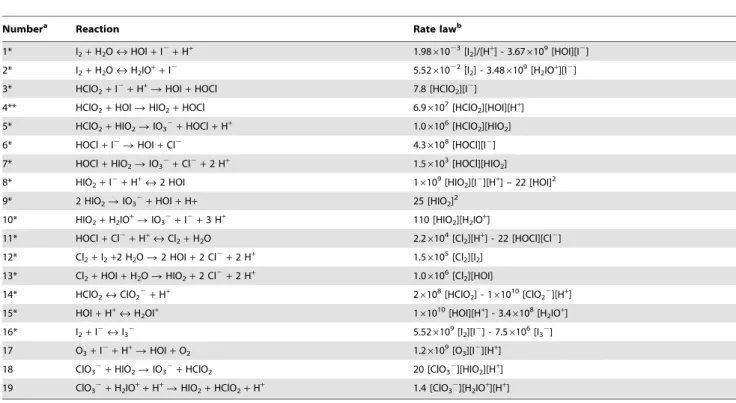
of these species in the autocatalytic sequence of reactions as shown by the proposed mechanism (Table 1).
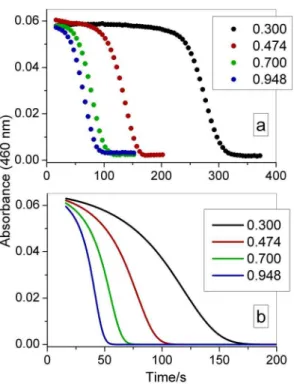
The effect of the initial ozone, chlorate, acid, and iodine concentrations on the induction period is demonstrated in Figures 2 to 5. All curves begin at 15 s, which is the time required to mix the reagents in the cuvette and put it in the cuvette holder inside the spectrophotometer. The reagents were added using a digital pipette in the following order: water, NaClO3, iodine,
Table 1.Mechanism for the ozone-iodine-chlorate clock reaction.
Numbera Reaction Rate lawb
1* I2+H2O«HOI+I2+H+
1.9861023[I2]/[H +
] - 3.676109[HOI][I2]
2* I2+H2O«H2IO +
+I2 5.52
61022[I
2] - 3.486109[H 2IO
+
][I2]
3* HClO2+I2+H+
RHOI+HOCl 7.8 [HClO2][I2]
4** HClO2+HOIRHIO2+HOCl 6.96107[HClO2][HOI][H
+
] 5* HClO2+HIO2RIO32+HOCl+H+
1.06106[HClO 2][HIO2]
6* HOCl+I2
RHOI+Cl2 4.3
6108[HOCl][I2]
7* HOCl+HIO2RIO32+Cl2+2 H+
1.56103[HOCl][HIO2]
8* HIO2+I2+H+
«2 HOI 16109[HIO
2][I2][H +
] – 22 [HOI]2
9* 2 HIO2RIO32+HOI+H+ 25 [HIO2]2
10* HIO2+H2IO+RIO32+I2+3 H+
110 [HIO2][H2IO+]
11* HOCl+Cl2+H+
«Cl2+H2O 2.26104[Cl
2][H +
] - 22 [HOCl][Cl2]
12* Cl2+I2+2 H2OR2 HOI+2 Cl2+2 H+
1.56105[Cl2][I2]
13* Cl2+HOI+H2ORHIO2+2 Cl2+2 H+
1.06106[Cl2][HOI]
14* HClO2«ClO22+H+
26108[HClO
2] - 161010[ClO 22][H
+
]
15* HOI+H+«H2OI+ 161010[HOI][H+] - 3.46108[H2IO+]
16* I2+I2«I32 5.526109[I2][I2] - 7.56106[I32]
17 O3+I2+H+
RHOI+O2 1.26109[O3][I2][H +
]
18 ClO32+HIO2RIO32+HClO2 20 [ClO32][HIO2][H
+
] 19 ClO32+H2IO++H+RHIO2+HClO2+H+ 1.4 [ClO32][H
2IO +
][H+
] a) * Reactions taken from Lengyelet al.[16]. ** Modified from the Lengyelet al.[16] model by including the [H+
] effect in the rate law. b) Rate constant units are s21, L mol21s21, L2mol22s21for the first-, second- and third-order processes, respectively.
doi:10.1371/journal.pone.0083706.t001
Figure 1. Effect of the iodine solution irradiation time on the clock time of the chlorate-iodine clock reaction.A 2.061024mol
L21iodine solution was irradiated using the deuterium lamp of a diode array spectrophotometer during the indicated time. The reaction was followed at 460 nm using a conventional double-beam spectropho-tometer. The initial concentrations after mixing the reactants in the cuvette were as follows: [NaClO3] = 0.0251 mol L21, [HClO4] = 0.948 mol
L21, and [I
2] = 7.361025mol L21. The reactants were added to the
solutions in the following order: NaClO3, irradiated iodine solution,
water, and HClO4.
doi:10.1371/journal.pone.0083706.g001
The Ozone-Iodine-Chlorate Clock Reaction
HClO4 and ozone. As indicated in these figures, increasing the
initial concentrations of these species reduces the induction period, except iodine which does not change the clock time but increases the initial absorbance.
The observed clock behavior can be understood by considering that ozone reacts with iodide to form HOI, which is a key species in producing the nonlinear autocatalytic behavior as previously demonstrated [16]. The full mechanism presented in Table 1 contains a core of reactions (Reactions 1 to 16) proposed by Lengyelet al.[16] between chlorine and iodine with species that
provide the autocatalytic path necessary for the clock behavior. Although this mechanism core only qualitatively reproduces the chlorite-iodide clock behavior [17], it remains the best available model for this system. To this core group of reactions we added Reaction (17) between ozone and iodide [13], and added Reactions (18) and (19) to introduce the chlorate, as we made in our first model of the chlorate-iodine clock reaction [10], but with slightly different rate constants. To obtain qualitative agreement as demonstrated in Figure 4 for the acid concentration effect, we included one additional H+
in the rate laws for Reactions (4) and
(19). In Reaction (4), this additional H+
accounts for the shifts in the [ClO22]/[HClO2] and [HOI]/[H2OI
+
] ratios that should be affected by changes in [H+
] as indicated by Jowsaet al.[17]. The
same can be said for Reaction (19), which can be affected by the protonation of chlorate or some reaction intermediate. Other modifications of the manner in which H+
participates in other reactions could improve the agreement in the acid concentration effect (Figure 4), but we decided to minimize these modifications, Figure 2. Effect of the ozone concentration on the clock time.
The initial concentrations after mixing the reactants in the cuvette were as follows: [O3] as indicated in the figure (mol L21), [NaClO3] = 0.0251
mol L21, [HClO
4] = 0.474 mol L21, and [I2] = 8.861025mol L21.
Exper-imental data (symbols); modeling results (continuous line). doi:10.1371/journal.pone.0083706.g002
Figure 3. Effect of the chlorate concentration on the clock time.
The initial concentrations after mixing the reactants in the cuvette were as follows: [NaClO3] as indicated in the figure (mol L21),
[O3] = 3.061026mol L21, [HClO4] = 0,474 mol L21, [I2] = 8.861025mol
L21. Experimental data (symbols); modeling results (continuous line).
doi:10.1371/journal.pone.0083706.g003
Figure 4. Effect of the acid concentration on the clock time.The initial concentrations after mixing the reactants in the cuvette were as follows: [HClO4] as indicated in the figures (mol L21),
[ O3] = 2 . 061 026 m o l L21, [ N a C l O
3] = 0 . 0 2 5 1 m o l L21,
[I2] = 8.861025mol L21. (a) experimental data (symbols); (b) modeling
results (continuous line).
doi:10.1371/journal.pone.0083706.g004
Figure 5. Effect of the iodine concentration on the clock time.
Initial concentrations after mixing the reactants in the cuvette: [I2] as
indicated in the figure (mol L21), [NaClO
3] = 0.0251 mol L21,
[HClO4] = 0.474 mol L21, [O3] = 4.061026mol L21. Experimental data
(symbols); modeling results (continuous line). doi:10.1371/journal.pone.0083706.g005
The Ozone-Iodine-Chlorate Clock Reaction
following only the suggestions made by Jowsa et al. [17]. As
indicated in Figures 2 to 5, the proposed mechanism can reproduce the behavior observed in the experiments, demonstrat-ing good agreement with the chlorate and iodine effect. For the ozone effect (Figure 2), the model produces good agreement for [O3]0= 46102
6
mol L21, but for other ozone concentrations, the
agreement is only qualitative. For the acid concentration effect (Figure 4), the model produces a shorter clock time than the experimental value, but is still in good qualitative agreement.
Additional experiments have indicated that mixing ozone and iodine solutions decreased only the I32bands at 350 and 288 nm,
indicating the oxidation of iodide (Reaction 17) followed by a shift in Reaction (16) to the left, allowing one to conclude that the ozone does not react directly with the iodine. Because the reaction between ozone and iodide has a high rate constant, we did not include the reactions between ozone and other low-concentration species in the model.
In conclusion, without UV light, the addition of ozone to the chlorate-iodine system initiates an autocatalytic sequence of reactions that results in the rapid consumption of iodine after an induction period. However, if UV light is present, its effect over
the iodine molecules cannot be ignored, especially in systems containing oxychlorine species, as observed in the photoinduced reactions between ClO2Nand I2[18] and between ClO32and I2
[10,11].
To our knowledge, this is the first time that the participation of ozone in a system to produce complex nonlinear behavior has been demonstrated. This research can serve as the first step to discover oscillating reactions or other nonlinear dynamic behavior involving ozone.
Acknowledgments
R.T.P.S. thanks Coordenac¸a˜o de Aperfeic¸oamento de Pessoal de Nı´vel Superior-CAPES for scholarship. E.V.M. and J.R.T.P. thank PIBIC-CNPq for scholarship. We thank Dr. Istvan Lengyel for the use of the Turbo Pascal code employed in the simulations.
Author Contributions
Conceived and designed the experiments: RTPS EVM JRTP RBF. Performed the experiments: RTPS EVM JRTP RBF. Analyzed the data: RTPS EVM JRTP RBF. Wrote the paper: RTPS EVM JRTP RBF.
References
1. Landolt H (1886) Ueber die Zeitdauer der Reaction zwischen Jodsa¨ure und schwefliger Sa¨ure. Ber. Dtsch. Chem. Ges. 19: 1317–1365.
2. Shakhashiri BZ (1985) Clock Reactions in Chemical Demonstrations. A Handbook for Teachers of Chemistry. Vol. 2, Madison: The University of Wisconsin Press, pp. 3–89.
3. Epstein IR, Pojman JA (1998) An Introduction to Nonlinear Chemical Dynamics: Oscillations, Waves, Patterns, and Chaos. New York: Oxford University Press.
4. Chance B, Pye EK, Ghosh AK, Hess B (1973) Biological and Biochemical Oscillators. New York: Academic Press.
5. Goldbeter A (1997) Biochemical Oscillations and Cellular Rhythms. Cambridge: University Press.
6. Danino T, Mondrago´n-Palomino O, Tsimring L, Hasty J (2010) A synchronized quorum of genetic clocks. Nature 463: 326–330.
7. Lente G, Bazsa G, Fa´bia´n I (2007) What is and what isn’t a clock reaction? New J. Chem. 31: 1707.
8. Edblom EC, Orba´n M, Epstein IR (1986) A New Iodate Oscillator: The Landolt Reaction with Ferrocyanide in a CSTR. J. Am. Chem. Soc. 108: 2826–2830. 9. Neuenschwander U, Negron A, Jensen KF (2013) A Clock Reaction Based on
Molybdenum Blue. J. Phys. Chem. A 117: 4343–4351.
10. Oliveira AP, Faria RB (2005) The Chlorate-Iodine Clock Reaction. J. Am. Chem. Soc. 127: 18022–18023.
11. Galajda M, Lente G, Fa´bia´n I (2007) Photochemically Induced Autocatalysis in the Chlorate Ion-Iodine System. J. Am. Chem. Soc. 129: 7738–7739. 12. Ra´bai G, Beck MT (1987) Kinetics and Mechanism of the Autocatalytic
Reaction between Iodine and Chlorite Ion. Inorg. Chem. 26: 1195–1199. 13. Liu Q, Schurter LM, Muller CE, Aloisio S, Francisco JS, et al. (2001) Kinetics
and Mechanisms of Aqueous Ozone Reactions with Bromide, Sulfite, Hydrogen Sulfite, Iodide, and Nitrite Ions. Inorg. Chem. 40: 4436–4442.
14. Kaps P, Rentrop P (1979) Generalized Runge-Kutta methods of order four with stepsize control for stiff ordinary differential equations. Numer. Math. 33: 55–68. 15. de Violet PF, Bonneau R, Joussot-Dubien J (1973) E´ tude en spectroscopie par impulsion laser de l’iode dissous dans des solvants polaires, mise en e´vidence des complexes par transfert de charge du type atome d’iode-solvant. J. Chim. Phys. 70: 1404–1409.
16. Lengyel I, Li J, Kustin K, Epstein IR (1996) Rate Constants for Reactions between Iodine- and Chlorine-Containing Species: A Detailed Mechanism of the Chlorine Dioxide/Chlorite-Iodide Reaction. J. Am. Chem. Soc. 118: 3708– 3719.
17. Jowza M, Sattar S, Olsen RJ (2005) Modeling Chlorite-Iodide Reaction Dynamics Using a Chlorine Dioxide-Iodide Reaction Mechanism. J. Phys. Chem. A 109: 1873–1878.
18. Ra´bai G, Kova´cs KM (2001) Photoinduced Reaction between Chlorine Dioxide and Iodine in Acidic Aqueous Solution. J. Phys. Chem. A 105: 6167–6170.
The Ozone-Iodine-Chlorate Clock Reaction