thermocellum
Family 35 Carbohydrate Binding Module
(
Ct
CBM35) for Gluco- and Galacto- Substituted Mannans
and Its Calcium Induced Stability
Arabinda Ghosh1, Ana Sofia Luı´s2, Joana L. A. Bra´s2, Neeta Pathaw3, Nikhil K. Chrungoo3, Carlos M. G. A. Fontes2, Arun Goyal1*
1Department of Biotechnology, Indian Institute of Technology Guwahati, Guwahati, Assam, India,2CIISA-Faculdade de Medicina Veterinaria, Avenida da Universidade Te´cnica, Lisbon, Portugal,3North Eastern Hill University, Shillong, Meghalaya, India
Abstract
This study investigated the role of CBM35 fromClostridium thermocellum(CtCBM35) in polysaccharide recognition.CtCBM35 was cloned into pET28a (+) vector with an engineered His6 tag and expressed in Escherichia coli BL21 (DE3) cells. A homogenous 15 kDa protein was purified by immobilized metal ion chromatography (IMAC). Ligand binding analysis of CtCBM35 was carried out by affinity electrophoresis using various soluble ligands.CtCBM35 showed a manno-configured ligand specific binding displaying significant association with konjac glucomannan (Ka= 14.36104 M21), carob
galactomannan (Ka= 12.46104M21) and negligible association (Ka= 12mM21) with insoluble mannan. Binding ofCtCBM35
with polysaccharides which was calcium dependent exhibited two fold higher association in presence of 10 mM Ca2+ion
with konjac glucomannan (Ka= 416104M21) and carob galactomannan (Ka= 306104M21). The polysaccharide binding was
further investigated by fluorescence spectrophotometric studies. On binding with carob galactomannan and konjac glucomannan the conformation ofCtCBM35 changed significantly with regular 21 nm peak shifts towards lower quantum yield. The degree of association (Ka) with konjac glucomannan and carob galactomannan, 14.36104M21and 11.46104M21, respectively, corroborated the findings from affinity electrophoresis. The association ofCtCBM35with konjac glucomannan led to higher free energy of binding (DG)225 kJ mole21as compared to carob galactomannan (DG)
222 kJ mole21. On binding CtCBM35 with konjac glucomannan and carob galactomannan the hydrodynamic radius (RH) as analysed by dynamic light scattering (DLS) study, increased to 8 nm and 6 nm, respectively, from 4.25 nm in absence of ligand. The presence of 10 mM Ca2+ions imparted stiffer orientation ofCtCBM35 particles with increased R
Hof 4.52 nm. Due to such stiffer orientationCtCBM35 became more thermostable and its melting temperature was shifted to 70uC from initial 50uC.
Citation:Ghosh A, Luı´s AS, Bra´s JLA, Pathaw N, Chrungoo NK, et al. (2013) Deciphering Ligand Specificity of aClostridium thermocellumFamily 35 Carbohydrate Binding Module (CtCBM35) for Gluco- and Galacto- Substituted Mannans and Its Calcium Induced Stability. PLoS ONE 8(12): e80415. doi:10.1371/ journal.pone.0080415
Editor:Michael Massiah, George Washington University, United States of America
ReceivedMay 9, 2013;AcceptedOctober 2, 2013;PublishedDecember 6, 2013
Copyright:ß2013 Ghosh et al. This is an open-access article distributed under the terms of the Creative Commons Attribution License, which permits unrestricted use, distribution, and reproduction in any medium, provided the original author and source are credited.
Funding:Mr. Arabinda Ghosh is supported by a scholarship from University Grants Commission (UGC), New Delhi, India. The funders had no role in study design, data collection and analysis, decision to publish, or preparation of the manuscript.
Competing Interests:The authors have declared that no competing interests exist. * E-mail: [email protected]
Introduction
Hydrolytic enzymes and their enhanced polysaccharide speci-ficity often improve by appended non catalytic carbohydrate binding module either at their N or C terminal ends. A major portion of plant carbohydrate reservoir is composed of hemicel-luloses such as the polymer and oligomer of xylose, mannose, arabinose etc. apart from celluloses. Polysaccharide recognition, binding and enhanced catalysis of hydrolytic enzymes truly facilitates by non catalytic modular carbohydrate binding mod-ules. Carbohydrate binding modules (CBMs) are classified into 67 distinguished families based on sequence similarity (http://www. cazy.org/Carbohydrate-Binding-Module). CBMs are found in the protein both as appended with hydrolytic enzymes such as cellulase, mannanase, xylanase, as non hydrolytic functions, as scaffoldings and as peptide with non catalytic functions with variety of hydrolytic enzyme complex (cellulosome) [1]. Family 35
monosaccharide a variety of diverted binding may be observed. Thus the polysaccharide specificity varies due to chain substitution and orientation of monosaccharides [7]. In earlier study, it was attributed to role of divalent cations in alteration of the domain conformation of CBMs that enhance the higher polysaccharide specificity and thermostability [8]. Thermostability one of the major concern of most of the enzyme stability and activity during industrial process and thus this binding module may restore the potentialities of the hydrolytic enzymes. Moreover, carbohydrate binding modules are used in various analytical processes. Thermostable CBMs were explored to separate cello- and xylo-oligosaccharides based on their affinity towards these carbohy-drates [9]. CBM microarray technique is more pronounced that replaced the conventional DNA microarray. This method is simple, effective and an alternative to various conventional microarray technologies [10]. Moreover, substantial rise in effective enzyme catalysis process may induce by this carbohydrate binding module will meet the requirement for carbohydrate fermentation to most demanding biofuel [11].
Our work is focused on the functional and conformational properties of CBM35 from Clostridium thermocellum ATCC 27405 (CtCBM35) upon polysaccharide and cation binding. CtCBM35 usually display the specificity towards manno-configured polysac-charides. Mannose has single stereochemical difference from glucose (at 29-OH site) in the manno-configured polysaccharides which made it less rigid structural conformation. CtBM35 has varying degree of affinity for lesser and higher galactose and glucose substituted polysaccharides. The affinity electrophoresis, fluorescence measurements and dynamic light scattering were employed to analyze both qualitative and quantitative binding of
CtBM35 with manno-configured polysaccharides. The structural variations ofCtBM35 due to Ca2+
ion binding and the alterations of domain conformations were described in this work.
Materials and Methods
Gene amplification and cloning ofCtCBM35
The open reading frame (ORF) of CtCBM35 was amplified from the genomic DNA of Clostridium thermocellum ATCC 27405 using a forward primer containingNheI restriction site: CAC GC-TAGCGCATATTCCCTTCCTG and a reverse primer with
XhoI restriction site: CACCTCGAG
TTAAAGTTCATCCAAG-CTG. The PCR conditions were followed as Mg2+
ions (2.5 mM), dNTPs (2 mM), primers (1.5mM), 1.0ml of Taq DNA polymerase (1ml of 1Unitml21) and 1ml of genomic DNA ofC. thermocellum. The PCR amplification cycles used were: denaturation at 94uC for 4 min followed by 30 cycles of denaturation at 94uC for 30 s, annealing at 55uC for 60 s and extension at 72uC for 2 min and final extension at 72uC for 10 min. The amplified products were run on 0.8% agarose gel and further purified by gel extraction (Qiagen kit.) The amplified products were then digested withNhe
I-XhoI restriction enzymes and cloned into NheI/XhoI restricted pET-28a (+) expression vectors containing kanamycin as resistant marker respectively which resulted in cloned plasmids (pCBM35). Thereafter,E. coliDH5acells were transformed with above cloned plasmids. The transformed cells were grown on LB [12] agar plates supplemented with kanamycin (50mg ml21) at 37uC for growth of recombinant clones. Positive clones were selected by restriction digestion analysis of the resulting cloned plasmids.
Protein expression and purification
E. coli BL-21(DE3) (Novagen) cells were used for expressing
CtCBM35 as described elsewhere [12]. E. coli BL-21 (DE3) cells were transformed with pCBM35. The cells were grown similarly
as described in Section 2.1, with incubation at 37uC and shaking at 180 rpm till mid-exponential phase (A600nm<0.6). The cells were
induced with 1.0 mM isopropyl-1-thio-b-D-galactopyranoside (IPTG) for hyper-expression of recombinant protein at optimized expression conditions of 24uC at 180 rpm for 16 h. The cells were harvested at 9,000gand the resulting pellet was resuspended in Sodium phosphate buffer (50 mM, pH 7.0). Then the cells were sonicated (Vibra cell, Sonics) on ice for 16 min (9 s on/off pulse) with further centrifugation (19,000 g, 30 min, 4uC) to get the crude cell free protein in the supernatant. Hybrid protein containing CtCBM35 appended by His6 tag were purified in a
single step by immobilized metal ion affinity chromatography (IMAC) using Ni-Sepharose columns (HiTrap Chelating, GE Healthcare) as recommended by the manufacturer. The purity and molecular mass of recombinant proteins were verified by SDS-PAGE [13].
Binding assay of family 35 Carbohydrate Binding Module (CtCBM35)
The polysaccharide binding capability of the non-catalytic modules was determined by visualizing the adsorption to soluble polysaccharides using gel retardation in native polyacrylamide gel electrophoresis containing the polysaccharides as described earlier by Takeo, (1990) [14]. PurifiedCtCBM35 (18mg) was assayed with soluble polysaccharides such as carob galactomannan, konjac glucomannan, carboxymethyl cellulose, rye arabinoxylan, birch-wood xylan, oatspelt xylan and glucouronoxylan. The polysac-charide samples were prepared subsequently by diluting in filtered water from (0.5%, w v21) polysaccharide stock. Native polyacryl-amide gels (7.5%) were prepared containing varying polysaccha-ride concentrations ranging from 0.0 to 1.5 (%, w v21). Bovine serum albumin (BSA) sample (1.0 mg ml21) was run in native gel for non-specific binding interaction. Binding study ofCtCBM35 with carob galactomannan and konjac glucomannan was carried out in absence and presence of Ca2+
ions. 10 mM Ca2+ ion was incorporated in 7.5% native polyacrylamide gel beforeCtCBM35 electrophoresis. In absence of Ca2+ ions 7.5% native gels were prepared as control and the relative mobilities ofCtCBM35 were calculated.
Binding analysis ofCtCBM35 with insoluble polysaccharides
The quantitative and qualitative assessment of CtCBM35 binding was carried out with insoluble mannan, avicel and wheat arabinoxylan. Thirty microgram ofCtCBM35 in 50 mM sodium phosphate buffer, pH 7.0, was mixed with 1 mg of mannan in a final reaction volume of 200mL. The reaction mixture was incubated for 2 h at 4uC with gentle shaking. After that the insoluble ligand was precipitated by centrifugation at 13000gfor 5 min. The supernatant, containing the unbound proteins, was removed and the pellet was washed three times with 200ml of 50 mM sodium phosphate buffer pH 7.0. The bound protein from the washed pellet was eluted by boiling the polysaccharides in 200ml of 10% (w v21) SDS containing 10% (v v21) b -mercaptoethanol for 10 min. The pellets of bound protein and the supernatant of unbound protein were analysed by 12% SDS-PAGE. A Bovine Serum Albumin (1 mg ml21) control was set in
bound protein was estimated by subtracting the free protein from the initial protein concentration. The adsorption parameters were calculated to determine the binding. If we consider [B] the bound protein concentration, [F] the unbound fraction of protein, [N] the number of binding site concentration and Ka is the association constant then at equilibrium adsorption were calculated as described earlier by Gilkeset al(1992) [16].
Polysaccharide binding study ofCtCBM35 by fluorescence spectroscopy
On binding to polysaccharides, carbohydrate binding modules undergo conformational changes and behave differently than in its unbound native form [17]. To compare the results with affinity electrophoresis, 160mM of CtCBM35 was incubated with polysaccharidesviz., carob galactomannan and konjac glucoman-nan of varying concentrations. Polysaccharide concentrations (0.01%, 0.04%, 0.06%, 0.08%, 0.15% and 0.2%, w v21) from 0.5% (w v21) stock solution in 100ml reaction mixture were prepared in 50 mM sodium phosphate buffer, pH 7.0. The samples were incubated at 4uC for 2 h. The fluorescence measurements were carried out using a fluorimeter (Fluoromax 3, Horiba Scientific, USA). Emission and excitation slits were kept at 3.00 and 1.00, respectively, with 0.5 s integration time. Three scans were taken per sample along with a control to reduce the noise created by buffer and polysaccharide. All the samples were excited at lmax= 295 nm with observance of emission spectra between lmax= 320–400 nm. The emission spectra of all the solutions were corrected against buffer and polysaccharide solution without CtCBM35 before setting the interaction study. Relative fluorescence intensities (Fo/F, where Fo is initial fluorescence
intensity of CtCBM35 and F is final fluorescence intensity of polysaccharide CtCBM35 conjugate) were plotted against poly-saccharide concentration. The association constants Ka(M21) of
CtCBM35 complex with carob galactomannan and konjac glucomannan were derived using modified Stern Volmer equation [18] as follows
log F0{F
F
~logKazn|log½Polysaccharide
Study of size ofCtCBM35 on binding with polysaccharide and Ca2+by dynamic light scattering
Polysaccharide binding greatly influences the protein confor-mational changes. These changes may lead to more dispersion in the dynamic environment leading to higher hydrodynamic area. The binding of polysaccharide with CtCBM35 was studied by dynamic light scattering (DLS). In a dynamic environment, the particles of ligand and protein molecules diffuse randomly. DLS essentially measures fluctuation in scattered light intensity due to diffusion of particles, the diffusion coefficient of the particles can be determined. The diffusion coefficient D is then related to the radius R of the particles by means of the Stokes-Einstein Equation [19]:
D~ kT
6pRg
where, k = Boltzmann-constant, T = temperature andg= viscosity. The hydrodynamic diameters (RH) ofCtCBM35 in presence of
0.1% (w/v) polysaccharides such as carob galactomannan and konjac glucomannan were measured by Zetasizer Nano ZS
(Malvern, UK) spectrophotometer. Refractive index and viscosity of 50 mM sodium phosphate buffer were adjusted to 1.3206 and 8.94561023g (cm s)21, respectively by using SEDNTERP tool package (http://www.jphilo.mailway.com). The hydrodynamic radius ofCtCBM35 was also studied in presence and absence of 10 mM Ca2+
ions.CtCBM35 was incubated at 25uC for 2 h and the extra unbound Ca2+
was removed by dialysis against water. The hydrodynamic radius of bound CtCBM35 with Ca2+ conjugate was measured and compared against Ca2+ free
CtCBM35. The instrument was set to measure the absorbance at a fixed angle (h= 90u). All the measurements were derived by deconvolution of intensity and sample autocorrelation function. Deconvolution of measured intensity was obtained using non negative least square analysis (NNLS) [19,20] algorithm e.g. CONTIN [21], Regularization and Multiple Narrow Mode algorithms [22,23]. These algorithms of fitting the data were included as inbuilt functions of Zetasizer Nano software package.
Protein melting and molecular dynamics study of CtCBM35 in presence of Ca2+ ion
Binding assays with soluble polysaccharides showed that an increase in enzyme affinity could be attributed to the presence of family 35 carbohydrate binding module. To investigate whether the presence of Ca2+ion may enhance the stability ofCtCBM35, the stabilizing effect was studied by UV spectroscopy. Protein melting curves were generated for recombinantCtCBM35 (pH 7.0, sodium phosphate buffer) by measuring in UV-absorption spectrophotom-eter (Varian, Cary 100) at 280 nm following the method of Dvortsovet al.(2009) [24]. The temperature was varied from 40– 100uC using the peltier temperature controller (Cary 100-Bio, Varian) and the solutions were kept at the particular temperature
Figure 1. Denaturing SDS-PAGE (12%) of recombinant
CtCBM35 purified by IMAC.
Figure 2. Affinity electrophoresis of CtCBM35 using 7.5% native PAGE in presence of varying concentrations of (A) carob galactomannan (B) konjac glucomannan (C) 10 mM Ca2+incorporated with carob galactomannan (D) 10 mM Ca2+incorporated with konjac glucomannan (E) A non linear regression plot of inverse relative migration ofCtCBM35 (1/r) against polysaccharide concentration (%, w v21), (
N
) carob galactomannan (in red), (m) konjac glucomannan (in green) and (N
) in presence of 10 mM Ca2+ ion with carob galactomannan (in light blue), (m) in presence of 10 mM Ca2+ion with konjac glucomannan (in dark blue).doi:10.1371/journal.pone.0080415.g002
Table 1.Association constants (Ka) and free energy of binding ofCtCBM35 from affinity electrophoresis and relative fluorescence intensities.
Polysaccharide
Kafrom AE (104M21)
Kafrom AE (10 mM Ca2+) (104M21)
Kafrom fluorescence
(104M21) Binding site (n)
Gibb’s free energy (DG) (kJ mole21)
Carob galactomannan 12.4 30 11.4 0.79 222.0
Konjac glucomannan 14.3 41 14.3 0.80 225.0
AE: Affinity Electrophoresis.
for sufficient time (10 min) to attain equilibrium.CtCBM35 was incubated with 10 mM CaCl2at 25uC for 2 h and dialyzed against
water to remove additional Ca2+ ion.
To investigate the role of Ca2+ ion in altering protein conformations a model of CtCBM35 fromClostridium thermocellum
was generated in presence of Ca2+ ion based on the crystal structure of closest homolog of CBM35 fromAmycolaptosis orientalis
(PDB ID: 2VZPA) by Modeller9v8 program. The homolog was identified using Blast PDB (http://www.ncbi.nlm.nih.gov/blast/ Blast.cgi). The structure was energy minimized with
GRO-MACS4.0.7 package (http://www.gromacs.org/) using steepest descent algorithm with GROMOS96 43a1 force field and simple point charge (SPC) water model [25–27]. Molecular dynamics (MD) simulation on the energy minimizedCtCBM35 model was carried out with the periodic boundary conditions applied in three dimensions to analyse the stability of the protein model. The net charge of system was neutralized by the addition of eleven sodium ions by replacing water molecules that are at least 3.50 A˚ from the protein surface [28]. The stable model was further visualized and analyzed in PyMOL tool.
Results
Cloning, expression and purification ofCtCBM35
The ORF region encoding CtCBM35 was amplified by polymerase chain reaction and successfully ligated to pET28a (+) expression vector and transformedE. coliDH5acells. The colonies appeared in the LB plates supplemented with 50mg ml21 kanamycin were screened for positive clones by digestion with
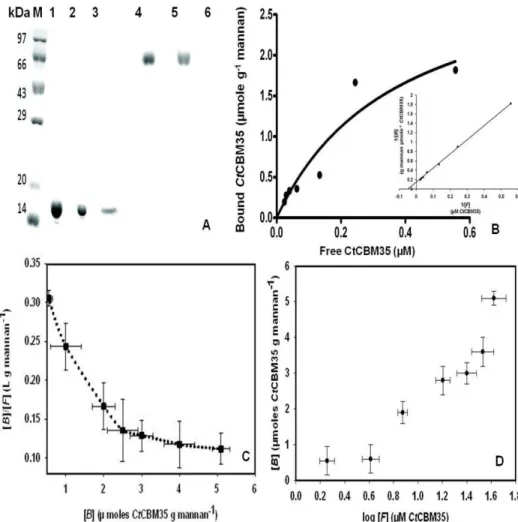
NheI andXhoI restriction enzymes. Few positive clones with an insert of 420 bp and a vector fragment of 5.4 kb were obtained in Figure 3. Qualitative binding ofCtCBM35 with insoluble mannan (A) using 12% SDS-PAGE.Lane 1: High range unstained molecular weight marker (200 kDa - 10 kDa), lane 2: PurifiedCtCBM35, lane 3: unboundCtCBM35, lane 4: boundCtCBM35, lane 5: Bovine serum albumin (BSA) as control, lane 6: unbound BSA, lane 7: bound BSA. (B) Adsorption ofCtCBM35 to insoluble mannan. The main panel shows the equilibrium adsorption isotherm ([B] versus [F]) for CtCBM35. Adsorption assay was done at 4uC, as described under methods section. Initial protein concentrations ofCtCBM35 were 0.2–19mM. In the small panel showing a linear regression plot of 1/[B] versus 1/[F] concentrations to derive the
association constant (Ka). (C) Scatchard plot of [B]/[F] vs [B]. The curved line was fitted to data points forCtCBM35 by least square regression analysis.
(D) a semi-logarithmic plot ([B] vs log [F]) for adsorption data ofCtCBM35. In both the plots the standard errors in two dimensions are indicated by vertical and horizontal bars.
doi:10.1371/journal.pone.0080415.g003
Table 2.Binding parameters ofCtCBM35 on binding with insoluble mannan derived from adsorption isotherm analysis.
Polysaccharide Kr(l g21)* Ka(mM21) No(mmole g21)*
Mannan 0.4960.02 12 0.0460.002
1% agarose gel electrophoresis. The transformed E. coli BL21 (DE3) cells by recombinant plasmids of positive clones after IPTG induction were screened for expression. The expression of
CtCBM35 (15 kDa protein) band was observed on 12% SDS-PAGE by comparing with long range (10–200 kDa) prestained molecular weight marker (Fermentas). The recombinant
CtCBM35 was purified by Ni2+-NTA (Immobilized metal ion chromatography) and the elution was accomplished with 300 mM Imidazole. A purified homogenous single band 15 kDa of
CtCBM35 appeared on 12% SDS-PAGE (Figure 1).
Binding assay ofCtCBM35 with soluble polysaccharides
To investigate the ligand binding specificity ofCtCBM35 the protein was expressed and purified to electrophoretic homogene-ity. The affinity of CtCBM35 for carob galactomannan, konjac glucomannan, rye-arabinoxylan, oat spelt xylan and lichenan was
determined by affinity electrophoresis [14]. The relative mobilities ofCtCBM35 in presence of various soluble polysaccharides were calculated against a reference with no ligand in the affinity gel (Figure 2A & 2B). A non linear regression plot was generated between relative migration ofCtCBM35 against varying concen-trations of ligand to calculate the association constant (Ka) (Figure 2E). TheCtCBM35 displayed higher binding affinity with konjac glucomannan as compared to carob galactomannan. The association constants (Ka) were found to be 14.36104M21with
konjac glucomannan and 12.46104M21with carob
galactoman-nan. No association of CtCBM35 was seen with carboxymethyl cellulose, rye arabinoxylan, birchwood xylan, oatspelt xylan, glucouronoxylan (Table 1). To assess the Ca2+
induced affinity binding of CtCBM35 with polysaccharides at their varying concentrations a similar approach was carried out by affinity electrophoresis as described earlier (Takeo et al., 1990) [14]. In Figure 4. Tryptoptophan fluorescence emission spectrum of CtCBM35 in presence of (A) carob galactomannan (%, w/v), represented in lines: (red) without polysaccharide, (in green) 0.01, (light blue) 0.04, (dark green) 0.06, (dark red) 0.08. (B) konjac glucomannan (red) without polysaccharide, (yellow) 0.01, (deep blue) 0.04, (light blue) 0.06, (dark green) 0.08, (dark red) 0.1.(C) Hill plot of log [(Fo2F)/F] vs log [carob galactomannan] (D) Hill plot oflogF0{F
F
vs log [konjac glucomannan] used to derive association constant (Ka).
presence of 10 mM Ca2+ion the affinity of CtCBM35 for carob galactomannan was increased to approximately 2.5 folds and the association constant (Ka) was obtained as 306104M21and with konjac glucomannan 416104M21(Table 1) (Figure 2C, 2D and 2E).
Binding analysis ofCtCBM35 with insoluble polysaccharides
The quantitative and qualitative binding of CtCBM35 with insoluble polysaccharides was assessed by adsorption isotherm analysis.CtCBM35 displayed low binding with insoluble mannan as analysed by SDS-PAGE when compared with the protein in free (unbound to mannan) form and the total purified protein (Figure 3A).CtCBM35 displayed no binding with avicel and wheat arabinoxylan. The saturation of insoluble mannan binding by
CtCBM35 was achieved approached but not to the highest protein concentration used (Figure 3B). The failure to reach saturation was detected when the same data was plotted in a semi logarithmic
graph between ([B] vs log [F]). Scatchard plot of CtCBM35 (Figure 3C and Figure 3D) indicated the complex binding with insoluble mannan. In this quantitative binding assessment at equilibrium the association constant (Ka) of CtCBM35 with insoluble mannan was 12mM21(Table 2). The relative equilib-rium association constantKrand the concentration of binding sites
in mannan surface [No] were calculated from a non linear
regression plot between bound CtCBM35 versus freeCtCBM35. The data were analyzed by GraphPad (Prism 2.0.1) software using non-linear regression analysis based on one binding site equation. The estimated values of relative equilibrium constant Kr and
concentration of binding sites [No] were 0.4960.2 l g2 1
and 0.0460.002mmole g21, respectively (Table 2). This result sug-gested thatCtCBM35 bind to insoluble mannan less effectively as the protein binding site on the polysaccharide was less. This may be due to binding of protein to the non reducing end of the polysaccharide.
Figure 5. Dynamic light scattering ofCtCBM35 in conjugation with 0.1% (w/v) (A) carob galactomannan, (B) konjac glucomannan and (C) 10 mM Ca2+ion.
Polysaccharide binding study ofCtCBM35 by fluorescence spectroscopy
Among the three aromatic amino acids tryptophan shows highest quantum yield and better stability facilitates its presence to utilize as a probe for fluorescence detection during polysaccharide binding with protein [17]. In presence of polysaccharides such as carob galactomannan and konjac glucomannan with their varying concentration from 0.01%–0.08% (w/v) significant blue shifts were observed. Binding of carob galactomannan and konjac glucomannan withCtCBM35 displayed 21 nm peak shifts towards shorter wavelength of tryptophan emission spectra from lmax
350 nm to 329 nm (Figure 4A and Figure 4B). The association constant (Ka) ofCtCBM35 with carob galactomannan and konjac
glucomannan were derived from Hill plot (Figure 4C and Figure 4D). From Hill plot and relative fluorescence intensities the values of Ka with carob galactomannan was found to be 11.46104 M21 and with konjac glucomannan 14.36104 M21 (Table 1). It was found that theKavalues approximately similar as derived earlier from affinity electrophoresis. Therefore, the fluorescence studies of polysaccharide binding of CtCBM35 confirmed the results of affinity electrophoresis. The number of binding site concentrations (n) were derived from Stern Volmer equation and with carob galactomannan n = 0.79 and whereas with konjac glucomannan n = 0.80 (Table 1). It means both the polysaccharide has single binding site for CtCBM35. Since
CtCBM35 displayed significant affinities for mannose derived polysaccharide in combination of galactose and glucose in their side and main chains, form the derived affinity constants the Gibb’s free energy of binding were calculated using the equation:
DG~{RTlnKa
where, DG = Gibb’s free energy, R = gas constant (Joule K21 mole21), T = Temperature in Kelvin, Ka= association constant (M21). The free energy binding of CtCBM35 with carob galactomannan was222.0 kJ mole21and with konjac glucoman-nan225.0 kJ mole21(Table 1). The higher binding affinity and free energy of binding suggested that likely due to the simple molecular architecture of konjac glucomannan made an easy
platform forCtCBM35 than carob galactomannan, although both the polysaccharides have similar number of binding sites.
Study of size ofCtCBM35 on binding with polysaccharide and Ca2+by DLS
Polysaccharides binding greatly influence the alterations in the dynamic environment of a protein. As measured from dynamic light scattering (DLS) the hydrodynamic radius (RH) ofCtCBM35
was found to be 4.25 nm which was in the acceptable range as this value is higher than theoretical RH, 2 nm for a 15 kDa protein.
The RHaugmentation ofCtCBM35 was seen in presence of 0.1%
(w v21) carob galactomannan from 4.25 nm to 6 nm (Figure 5 A). In contrast, konjac glucomannan binding (0.1%, w v21) exhibited much broader RHof 8 nm (Figure 5 B). The augmentation of size
was due to strong binding with konjac glucomannan leading to a stiffer structure and low random diffusion of the particles of protein and polysaccharides in the dynamic environment. Random diffusion of the particles measured in terms of random diffusion coefficient and is inversely proportional to RH. In
presence of 10 mM Ca2+
ion, the hydrodynamic radius of
CtCBM35 was changed remarkably from 4.25 nm in absence of Ca2+
ion to 4.52 nm (Figure 5 C). In this case Ca2+
ion might bind with the amino acid residues ofCtCBM35 and imparted a stiffer orientation than the usual. Therefore, random diffusion of the system reduced and as a result the dynamic radius ofCt CBM35-Ca2+
complex was increased.
Protein melting and molecular dynamics study of CtCBM35 in presence of Ca2+ ion
Melting ofCtCBM35 was studied in presence of additive Ca2+ ion to investigate the protein stability which perhaps, play a major role in polysaccharide recognition at higher temperature and improve the catalytic properties of catalytic modules. The melting ofCtCBM35 atlmax280 nm showed an unfolded peak at 50uC (Figure 6). In the presence of 10 mM CaCl2 as additive, the
melting point ofCtCBM35 was shifted towards higher temperature at 70uC and the low melting peak at 50uC disappeared completely (Figure 6). Thus, Ca2+ion played a key role in providing better stability ofCtCBM35 at higher melting temperature as compared to lack of additive. This analysis was further analyzed using PyMOL tool from the generated model ofCtCBM35. There was one Ca2+ ion binding pocket interacting with 7 amino acid residues viz. Glu 9, Glu 11, Ser 34, Gly 37, Asp 129. It was observed that negatively charged residues were predominant except Ser and Gly which interacted strongly with positively charged Ca2+
ions. These amino acid residues made coordinate bonds with Ca2+
ion and their orientation was changed remarkably. The comparative study of two CtCBM35 models with unbound and bound Ca2+
ion (Figure 7 A and 7 B) displayed orientation of amino acid residues within the binding pocket. When both the models were superimposed (Figure 7 C), it was observed that the residues changed their orientations at their similar positions with Ca2+
ion bound state than the unbound structure. The bound state residues have less root mean square deviation (RMSD) value of 1.08 A˚ as compared to unbound state of 1.8 A˚ . This reduced RMSD value due to the stiffer binding with Ca2+
ion prevented less free movement at their bound state [29].
Discussion
The cloned family 35 Carbohydrate binding module (CtCBM35) from Clostridium thermocellum preferred binding with manno-configured polysaccharides.CtCBM35 discriminated dur-ing carbohydrate selection showdur-ing its affinity only with manno-Figure 6. Protein melting curve ofCtCBM35 (—) in absence of
10 mM Ca2+ion, (— —) in presence of 10 mM Ca2+ion.
configured ligands among the manno and xylo-configured polysaccharides. Instead of b-1,4-mannose chain affinity the variance of ligand selection within the manno-configured polysac-charides was often observed. CtCBM35 has higher affinity with konjac glucomannan than carob galactomannan. Rationale behind this selective affinity was due to the galactose unit in carob galactomannan likely interferes with theCtCBM35 binding. Carob galactomannan is composed of a 1,4-b-linked D-mannan backbone to which single D-galactosyl units are attached to C-6 of D-mannosyl residues. Whereas glucomannan is a linear polysac-charide comprising 1,4-b-linked D-glucosyl and D-mannosyl
residues. Therefore, CtCBM35 was more glucomannan specific than galactomannan. This finding gained a new insight into the CBM35 family when compared with other mannan specific CBM35 fromClostridium thermocellumandCellvibrio japonicas[30,31] which were exo and endo acting to D-mannan chain of galactomannan only. However, the binding of CtCBM35 with insoluble polysaccharides was quite insignificant. Low affinity against insoluble mannan was due to the inability of trans (as a discrete fold) form of CtCBM35 to disrupt the inter chain interactions in mannan. This in contrast to some CBMs has the ability to disintegrate the surface of crystalline insoluble Figure 7. Amino acid residues ofCtCBM35 in the modeled structure (A) without Ca2+ ion (B) with Ca2+ ion (C) superimposed structure of both (A) and (B) showing the Ca2+ion binding pocket to compare the altered positions of the amino acid residues in absence and presence of Ca2+ion.
polysaccharides that potentiates higher binding to some soluble fractions of insoluble polysaccharides [32,33]. Polysaccharide specificity by CBM35 family is probably due to the conserved hydrophobic aromatic residues that play a major role in polysaccharide binding [30]. Tryptophan being one of such residues has indole ring with intrinsic fluorescence property with higher quantum yield, displays fluorescence emission at 320 nm to 400 nm [17]. Polysaccharide binding changes the microenviron-ment of tryptophan due to conformational changes in protein. Usually in CBMs, the aromatic residues responsible for polysac-charide binding are lying in the hydrophobic core. Due to polysaccharide binding and direct interaction with tryptophan, the fluorescence emission is gradually decreased. The higher affinity of
CtCBM35 for konjac glucomannan masks the available trypto-phan for fluorescence emission as compared to carob galacto-mannan. Thus, gradual fall in peak intensities were coupled with peak shifts (,21 nm) due to altered conformation of native CtCBM35. In dynamic light scattering, the larger particle size of
CtCBM35 is due to the polysaccharide binding. The cationic interaction of aromatic residues with carob galactomannan and konjac glucomannan insistsCtCBM35 domain alteration to more compact form reducing the random diffusion of the particles between polysaccharide and amino acid residues. Due to simpler structure of konjac glucomannan, the interaction with aromatic residues in the binding pocket ofCtCBM35 uphold strong binding as compared to carob galactomannan with substituted galactose side chain. The structure ofCtCBM35 gains its particle size in the conjunction with polysaccharide and the Brownian motion of light
measured between the larger particles and ends up in a larger hydrodynamic area. Melting of a protein module is a cooperative process [34–36]. CBM acts as an independent subunit from the catalytic module at higher temperature. But divalent cation like Ca2+
ion makes polar contact with the amino acid residues away from the polysaccharide binding sites. This imparts stiffer orientation of the residues dragging more towards the ion and holding into a proper position of the residues even at varying physical parameters such as higher temperature, pH change etc with reduced RMSD value. Ca2+
ion attacks on the negatively charged amino acid side chains and do not allow their mobility at harsh environmental conditions due to which the protein folding remain intact [29]. Thus a recombinant thermostable glucoman-nan and galactomanglucoman-nan specific CBM35 fromClostridium thermo-cellum may be useful to enhance the activity by appended to a mannanase for higher degree of hydrolysis of complex manno-configured polysaccharides into simple sugars. Moreover, these findings might lead to comprehend both glucomannan and galactomanan specific CBM35 fromClostridium thermocellumwhich may play a potential role in biofuel production in conjunction with mannanase from mannan rich polysaccharides in future.
Author Contributions
Conceived and designed the experiments: AGh AG NP NKC ASL JB CF. Performed the experiments: AGh AG NP NKC ASL JB CF. Analyzed the data: AGh AG NP NKC CF. Contributed reagents/materials/analysis tools: AG NKC CF. Wrote the paper: AGh AG.
References
1. Cai S, Zheng X, Dong X (2011) CBM3d, a novel subfamily of family 3 carbohydrate-binding modules identified in cel48a exoglucanase of Cellulosilyti-cum ruminicola. J Bacteriol 193(19): 5199–5206.
2. Taylor EJ, Goyal A, Guerreiro CIPD, Prates JAM, Money VA, et al. (2005) How family 26 glycoside hydrolases orchestrate catalysis on different polysaccharides structure and activity of a Clostridium thermocellum lichenase. J Biol Chem 280(38): 32761–3276.
3. Sunna A (2010) Modular organisation and functional analysis of dissected modularb-mannanase CsMan26 fromCaldicellulosiruptorRt8B.4. Appl Microbiol Biotechnol 86(1): 189–200.
4. Bolam DN, Xie H, Pell G, Hogg D, Galbraith G, et al. (2004)64 modules represent a new family of carbohydrate-binding modules that display novel properties. J Biol Chem 279: 22953–22963.
5. Valenzuela SV, Diaz P, Pastor FI (2012) Modular glucuronoxylan-specific xylanase with a family CBM35 carbohydrate-binding module. Appl Environ Microbiol 78(11): 3923–31.
6. Tunnicliffe RB, Bolam DN, Pell G, Gilbert HJ, Williamson MP (2005) Structure of a mannan-specific family 35 carbohydrate-binding module: evidence for significant conformational changes upon ligand binding. J Mol Biol 347: 287– 296.
7. Mizutani K, Fernandes VO, Karita S, Luı´s AS, Sakka, et al. (2012) Influence of a mannan binding family 32 carbohydrate binding module on the activity of the appended mannanase. Appl Environ Microbiol 78(14): 4781–4787
8. Hachem MA, Karlsson EN, Simpson PJ, Linse S, Sellers P, et al. (2002) Calcium binding and thermostability of carbohydrate binding module cbm4-2 of xyn10a fromRhodothermus marinus. Biochemistry 41: 5720–5729.
9. Johansson R, Gunnarsson LC, Ohlin M, Ohlson S (2006) Thermostable carbohydrate-binding modules in affinity chromatography. J Mol Recognit 19(4): 275–281.
10. Ofir K, Berdichevsky Y, Benhar I, Azriel-Rosenfeld R, Lamed R, et al. (2005) Versatile protein microarray based on carbohydrate-binding modules. Proteo-mics 5(7): 1806–1814.
11. Jorgensen H, Sanadi AR, Felby C, Lange NE, Fischer M, et al. (2010) Production of ethanol and feed by high dry matter hydrolysis and fermentation of palm kernel press cake. Appl Biochem Biotechnol 161(1–8): 318–332. 12. Sambrook JF, Russell DW (1989) Molecular cloning: A laboratory manual. 3rd
ed. Cold Spring Harbor Laboratory Press. 213 p.
13. Laemmli UK (1970) Cleavage of structural proteins during the assembly of the head of Bacteriophage T4. Nature 227: 680–685.
14. Takeo K (1984) Affinity electrophoresis: Principles and applications. Electro-phoresis 5: 187–195.
15. Bradford MM (1976) Rapid and sensitive method for the quantitation of microgram quantities of protein utilizing the principle of protein-dye binding. Anal Biochem 72: 248–254
16. Gilkes NR, Eric JS, Henrissat B, Tekant B, Miller RC Jr, et al. (1992) The adsorption of a bacterial cellulase to crystalline cellulose. J Biol Chem 267(10): 6743–6749.
17. Royer CA (2006) Probing protein folding and conformational transitions with fluorescence. Chem Rev 106:1769–1784.
18. Belatik A, Hotchandani S, Carpentier R, Tajmir-Riahi HA (2012) Locating the binding sites of pb (ii) ion with human and bovine serum albumins. Plos One 7(5): 1–9.
19. Morrison JD, Corcoran JD, Lewis KE (1992) The determination of particle size distributions in small-angle scattering using the maximum-entropy method. Appl Crystallogr 25: 504–513.
20. Provencher SW (1979) Inverse problems in polymer characterization: Direct analysis of polydispersity with photon correlation spectroscopy. Macromol Chem 180: 201–209.
21. Ostrowsky N, Sornette D, Parker P, Pike ER (1981) Exponential sampling method for light scattering polydispersity analysis. Optica Acta 28(8): 1059– 1070.
22. Provencher SW (1982) Contin: a general purpose constrained regularization program for inverting noisy linear algebraic and integral equations. Comput Phys Commun 27(3): 213–227.
23. Shiba K, Niidome T, Katoh E, Xiang H (2010) Polydispersity as a parameter for indicating the thermal stability of proteins by dynamic light scattering. Analyt Sci 26: 659–663.
24. Dvortsov IA, Lunina NA, Chekanovskaya LA, Schwarz WH, Zverlov VV, et al. (2009) Carbohydrate-binding properties of a separately folding protein module fromb-1,3-glucanase Lic16A ofClostridium thermocellum. Microbiology 155: 2442– 2449.
25. Berendsen HJC, Van der Spoel D, Drunen RV (1995) GROMACS: a message passing parallel molecular dynamics implementation. Comput Phys Commun 91: 43–56.
26. Van der Spoel D, Lindahl E, Hess B, Groenhof G, Mark AE, et al. (2005) GROMACS: fast, flexible, and free. J Comput Chem 26:1701–1718. 27. Hess B, Kutzner C, Van der Spoel D, Lindahl E (2008) GROMACS 4:
algorithms for highly efficient, load-balanced and scalable molecular simulation. J Chem. Theory Comput 4: 435–447.
28. Saravanan P, Avinash H, Dubey VK, Patra S (2012) Targeting essential cell wall lipase Rv3802c for potential therapeutics against tuberculosis. J Molr Graph Mod 38: 235–242.
29. Noorbatcha IA, Sultan AM, Azura A, Salleh HM (2012) Molecular dynamics study of the effect of calcium ions on the thermostability of Bacillus Amyloliquefaciensphytase. Aust J Basic App Sci 6(1): 109–116.
significant conformational changes upon ligand binding. J Mol Bio 347(2): 287– 296.
31. Correia MAS, Abbott DW, Gloster TM, Fernandes VO (2010) Signature active site architectures illuminate the molecular basis for ligand specificity in family 35 carbohydrate binding module. Biochemistry 49: 6193–6205.
32. Din N, Damude HG, Gilkes NR, Miller Jr RC, Warren RA, et al. (1994) C1-Cx revisited: intramolecular synergism in a cellulose. PNAS 91(24): 11383–11387.
33. Din N, Gilkes NR, Tekant B, Miller Jr RC, Anthony RJ, et al. (1991) Non– hydrolytic disruption of cellulose fibres by the binding domain of a bacterial cellulase. Nat Biotechnol 9: 1096–1099.
34. Branden K, Tooze J (1999) Introduction to Protein Structure, 2nd edn. New York: Garland Publishing.
35. Dobson CM, Evans PA, Radsford SE (1994). Understanding protein folding: the lysozyme story so far. Trends Biochem Sci 19:31–37.