ISSN 0104-6632 Printed in Brazil
www.abeq.org.br/bjche
Vol. 33, No. 04, pp. 1073 - 1081, October - December, 2016 dx.doi.org/10.1590/0104-6632.20160334s20150340
Brazilian Journal
of Chemical
Engineering
SOLUBILITY OF A NEW ANTIRETROVIRAL
DRUG (CRS 74) IN AQUEOUS ETHANOL
MIXTURES
S. P. Lacerda, J. J. Letourneau, F. Espitalier
*and M. I. Ré
Université de Toulouse, Mines-Albi, UMR-CNRS 5302, Centre RAPSODEE, Campus Jarlard, F-81013 Albi CT cedex 09, France.
Phone: + (33) 5 6349 3151; Fax: + (33) 5 6349 3025 E-mail: [email protected]
(Submitted: May 28, 2015 ; Revised: July 24, 2015 ; Accepted: July 27, 2015)
Abstract - This study concerns a new antiretroviral drug named CRS 74, which has a limited bioavailability because of its low aqueous solubility and dissolution rate. To improve these properties, CRS 74 can be recrystallized by using Liquid Anti-Solvent (LAS) crystallization. Ethanol is chosen as the solvent under study for the molecule and water as the anti-solvent. Since solubility data is limited, it is necessary to collect experimental data for the molecule in relation to ethanol and water-ethanol mixtures at different temperatures in order to select suitable mixture compositions and temperature for LAS process design. In this work, the CRS 74 solubility measured in the temperature range 288.15 - 303.15 K in pure ethanol and in 95% water - 5% w/w ethanol mixtures, and the CRS 74 solubility measured at 303.15 K in water-ethanol mixtures containing from 30 to 70% w/w ethanol are presented. Measurements were performed using the shake-flask method for generating the saturated solutions followed by compositional analysis by HPLC of the solution. The experimental data showed that the solubility of CRS 74 in binary hydroalcoholic mixtures increases upon increasing the temperature and mass fraction of ethanol. In order to better understand the behavior of the system and to estimate supersaturation conditions for a larger range of CRS 74 crystallization conditions, two models have been chosen to describe the experimental data: UNIQUAC and Jouyban-Acree models. The modeling of experimental solid-liquid equilibrium data proved that both models could correlate satisfactorily the solubility of the studied drug. This study provided valuable data for the recrystallization of CRS 74 by using the Liquid Anti-Solvent (LAS) crystallization process.
Keywords:Antiretroviral drug; Solubility; UNIQUAC; Aqueous ethanol mixture.
INTRODUCTION
This study concerns a new compound, (2S, 3S, 5S)-2, -5 bis- [N-[N-[[N- methyl- N-[(2-isopropyl- 4- thiazolyl) methyl] amino] carbonyl] vanilyl] amino- 1,6- diphenyl- 3- hydroxyhexane, named CRS 74. This molecule has the activity of inhibiting human immu-nodeficiency virus (HIV) protease, an essential en-zyme involved in the HIV replication process. Con-sequently, this new compound can be used for the treatment of HIV infections, alone or in combination
with other anti-HIV medicines.
CRS 74 has a high biological activity as disclosed in PCT document WO 2005/111006 and US 7763733 (Bockelmann et al., 2005; Bockelmann et al., 2010) but its bioavailability is limited because of its low aqueous solubility and dissolution rate. Such proper-ties imply difficulproper-ties not only in the design of phar-maceutical formulations, but may also result in biovariability.
admin-1074 S. P. Lacerda, J. J. Letourneau, F. Espitalier and M. I. Ré
Brazilian Journal of Chemical Engineering
istrated orally. Solid forms that have been investi-gated for drug dissolution enhancement include salts, polymorphs and amorphous, among others. Amor-phous formulations can achieve improved solubility, but the system is at serious risk of crystallizing to the thermodynamically stable form, even in the solid state(Yu, 2001; Rodríguez-Spong et al., 2004). Such transformations can compromise the performance of the formulation.
To save time and resources in product devel-opment, relatively simple approaches should be tried first like crystallization. Micro/nanonization during crystallization (Rasenack and Müller, 2002; Rase-nack and Müller, 2004; Badawi et al., 2011; Viçosa
et al., 2012), surface modification (Han et al., 2011) and crystal structure modification (Eerdenbrugh et al., 2009) may improve the dissolution rate of poorly water-soluble APIs (Active Pharmaceutical Ingredients).
The Liquid Anti-Solvent (LAS) crystallization process is an attractive method for CRS74 recrys-tallization, aiming at controlling its dissolution kinet-ics. It requires mild conditions (ambient temperature and atmospheric pressure) with no requirement for expensive equipment. In the LAS process, crystal-lization of the solute is achieved by decreasing the solubility of the solid in the system. This is done by addition of a non-solvent component for the solute, called the anti-solvent and miscible with the solvent.
The LAS crystallization process for production of ultra-fine particles has been widely researched over the last few decades(Thorat and Dalvi, 2012). One goal in this crystallization operation is the control of product properties, e.g., particle size and particle size distribution(Zhao et al., 2007; Zhang et al., 2009), purity, residual solvent content, crystallinity, poly-morphic form (Balani et al., 2010) and dissolution rates in specific media during in vitro-tests (Viçosa et al., 2012; Plakkot et al., 2011) to a certain extent. The product properties can be manipulated by chang-ing the process parameters and formulation.
The solvent selection is one of the essential pa-rameters to envisage any crystallization process.
Therefore, the knowledge of the solubility of a target component in different solvents is required. In this work, the solubility of CRS 74 in pure ethanol and ethanol-water binary mixtures was measured in the temperature range of 288.15 K to 303.15 K at atmos-pheric pressure.
Although experimental data on solubility are es-sential to provide information about a system and help to understand its behaviour, correlations and prediction models are also required for the correct design of crystallization processes. Solid-liquid equi-libria of ternary mixtures containing ethanol (sol-vent), water (anti-solvent) and the new antiretroviral drug were studied and the obtained solubility data were represented using two models: the UNIQUAC-based model (Walas, 1985) and the Jouyban-Acree model (Jouyban-Gharamaleki and Acree, 1998).
EXPERIMENTAL SECTION Materials
The molecular formula of the active pharmaceuti-cal ingredient (CRS 74) is C46H66N8O5S2 and its mo-lar weight 875.2 g/mol. Its chemical structure is pre-sented in Figure 1. It was provided with 99% purity as a courtesy from Cristalia Ltda (Itapira, SP, Brazil). Ethanol (EtOH) (from Fluka Analytical, Sigma–Al-drich, France) and acetonitrile (ACN) high perfor-mance liquid chromatography (HPLC) grade (from Scharlau Chemie, Barcelona, Spain) were used as solvents with purity higher than 99%.
Methods
Solubility Measurements
The solubility of CRS 74 was determined by equilibrating an excess of CRS 74 in 5 g of water, ethanol and different ethanol/water combinations at a given temperature (from 298.15 to 303.15 K) in a temperature-controlled bath for 72 hours.
According to this method, the solid drug was added in excess to a certain medium, the flasks were sealed, and shaken at a predetermined time, 24, 48 and 72 hours. The saturation was confirmed by ob-servation of the presence of un-dissolved material and measurements of dissolved drug concentration. The concentration was determined by removing the solid phase by filtration (0.22 µm pore size, Pall 4506, France) and injection of the filtered solution onto the HPLC system with analysis at a wavelength of 210 nm. The HPLC system consisted of an Agilent Chromatograph (Model1100 series) equipped with a UV-vis detector and a HPLC column ProntoSIL 300-5-ODSH 5 µm, 250x4 mm ID. The flow rate of the mobile phase (acetonitrile/water in the ratio of 70:30) was 1.0 mL/min.
Differential Scanning Calorimetric (DSC) Analysis DSC measurement was carried out using a DSC-Q200 thermal analyzer (TA Instruments, France) in a temperature range of 293 to 483 K at a heating rate of 10 °C/min under nitrogen atmosphere (50 mL min-1) in order to determine the onset of the melting point and the fusion enthalpy with about 3 mg of solid. The molecule was characterized by a melting point of 461.75 K and a melting enthalpy of 86.6 J/g.
Modelling
Two models were chosen to describe experi-mental data: the UNIQUAC model (UNIversal QUASI Chemical) (Walas, 1985) and the Jouyban-Acree model (Jouyban-Gharamaleki and Jouyban-Acree, 1998). The first model is based on the calculation of activity coefficients and the second is based on the mathe-matical representation of the solubility of drugs in mixed solvents with respect to solvent composition and temperature.
UNIQUAC Model
In the UNIQUAC model, the activity coefficient is calculated by assuming a combinatorial contribu-tion, essentially due to the differences in size and shape of the molecules, and a residual contribution essentially due to energetic interactions. The expres-sion for the activity coefficient of the component i,
i
γ , is described by a combinatorial and a residual contribution:
( )
( ) ( )
ln γi =ln γiC +ln γiR (1)
The combinatorial term γiC is given by:
( )
ln ln ln
2
C i i
i i
i i
i
i j j j
i
z q x
l x l
x
φ θ
γ
φ
φ
⎛ ⎞ ⎛ ⎞
= ⎜ ⎟+ ⎜ ⎟
⎝ ⎠ ⎝ ⎠
+ −
∑
(2)
where xi is the mole fraction of component i; z is the coordination number which is usually set to 10. The bulk factors li are given by:
(
) (
1)
2
i i i i
z
l = r −q − r − (3)
i
θ and φi are the molecular surface area and mo-lecular volume of each component i, given by:
i i i
j j j
x r x r
φ =
∑
(4)i i i
j j j
x q x q
θ =
∑
(5)For pure components, ri and qi are calculated as the sum of the group-volume and group-area parame-ters, Rk and Qk:
=
∑
ki k i k
r υ R (6)
=
∑
ki k i k
q υ Q (7)
where υik (an integer) is the number of groups of type k in the molecule i.
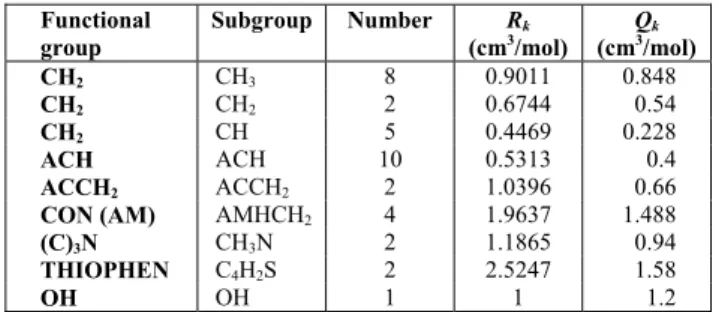
The active molecule was decomposed into func-tional groups similarly to the group contribution UNIFAC method. The first parameters, volume and surface parameters (Rkand Qk), were estimated from the volume and surface area parameters of CRS 74 functional groups. The functional groups and sub-groups are reported in Table 1. The thiazole heter-ocycle (C3HNS) was replaced by the thiophene one (C4H2S). The volume and surface area parameters ri
and qi of the three components (water, ethanol and
1076 S. P. Lacerda, J. J. Letourneau, F. Espitalier and M. I. Ré
Brazilian Journal of Chemical Engineering
Table 1: UNIFAC Group Volume and Surface-Area parameters for groups of CRS 74.
Functional group
Subgroup Number Rk
(cm3/mol) (cmQ3/mol) k
CH2 CH3 8 0.9011 0.848
CH2 CH2 2 0.6744 0.54
CH2 CH 5 0.4469 0.228
ACH ACH 10 0.5313 0.4
ACCH2 ACCH2 2 1.0396 0.66
CON (AM) AMHCH2 4 1.9637 1.488
(C)3N CH3N 2 1.1865 0.94
THIOPHEN C4H2S 2 2.5247 1.58
OH OH 1 1 1.2
Table 2: UNIFAC Group Volume and Surface-Area, Rk and Qk parameters for CRS 74.
Molecule i Water (DIPPR) Ethanol
(DIPPR)
CRS 74
ri(cm3/mol) 0.9200 2.1055 34.4615 qi(cm3/mol) 1.4000 1.9720 26.5160
The expression of the residual term is given by:
( )
(
)
ln iR i 1 i ij j ij
j j k kj
q ln θ τ
γ θ τ
θ τ
⎛ ⎞
= ⎜ − ⎟−
⎝
∑
⎠∑
(8)In Equation (8), the parameters τij are calculated from UNIQUAC binary interaction parameters uij as follows:
−
⎛ ⎞
= ⎜− ⎟
⎝ ⎠
ij ii ij
u u exp
RT
τ (9)
For a ternary system, twelve parameters are necessary: six parameters concerning the geometry of the molecules plus six binary interaction parame-ters. The binary interaction parameters (uij) water/ CRS 74 and ethanol/CRS 74 were identified from solubility measurements. Binary interaction parame-ters water/ethanol are available in DIPPR (Data Compilation Tables of Properties of Pure Com-pounds) and reported in Table 3.
The binary interaction parameters of the UNIQUAC model were identified in two steps. Initially, solubility data for the binary ethanol/CRS 74 as a function of temperature were considered to estimate the two binary interaction parameters ethanol/CRS 74 from the activity coefficient of the solute calculated by Equation (10).
The temperature dependent experimental activity coefficient of the solute CRS 74, γCRS74 solute, can be
estimated from the melting enthalpy, Δhm, its melt-ing temperature Tm and the mole fraction at
satura-tion, xCRS74 solute, at a given solution temperature T:
(
74 74)
1 1
ln CRS solute CRS solute m
m
h x
R T T
γ = −Δ ⎛⎜ − ⎞⎟
⎝ ⎠ (10)
Table 3: Binary interaction parameters for the UNIQUAC model.
Binary Systems i-j uij (cal/mol)
Water-CRS 74 1-3 3-1
-546.14 23 809.35 Ethanol-CRS 74 2-3
3-2
-494.45 1 999.09 Water-Ethanol
(database Simulis) 1-2 2-1
-96.4730 + 0.6843 * T(K) 31.6290 + 0.4759 * T(K)
In a second stage, the binary interaction parameters of water/CRS 74 were calculated from experimental data for the ternary water/ethanol/CRS 74 with a mass ratio ethanol/(ethanol-water) of 5% and variable temperature. A ternary mixture was chosen because the solubility data in water as a function of temperature are not available.
In both cases, the objective function C of the curve fitting method used to estimate the binary interaction parameters was the weighted root mean square error, given by:
( )
(
)
( )
(
)
2 74 74
2 74 74
2 exp i
i
exp cal
n CRS solute CRS solute i
i exp cal
exp
i CRS solute CRS solute
T C
n T
γ γ
γ γ
− =
+
∑
(11)in which nexp is the number of measurements; each one corresponds to an experiment done at a tem-perature . ((expi)74 )
i CRS solute
T γ is estimated by Equation (10) and γCRScal 74 solute
( )
Ti is calculated with the UNIQUAC model in which the unknown parameters are obtained at the minimum of .CJouyban-Acree Model
The Jouyban-Acree model is represented by Equation (12):
( )
( )
( )
(
)
* * *
, 1 1, 2 2,
2 1 2
1 2
0
ln m T ln T ln T
i i
i
w z w z w
z z
J z z
T =
= +
⎡ ⎤
+⎢ − ⎥
⎣
∑
⎦w th th o so re m − an an H m tr so te Jo co d co u v ln w co C T p o co li tu w (T ta
where w*m T, i he solvent m he mass fract
f a solute; w
olubility of t espectively. model and ar
* 1ln( (1, )T )
z w
− −
nd z z1 2
(
z1T −
nalysis (Jouy Combinati Hoff model e mixed solven raining proc olubility data emperatures ouyban, 201 onstants are ata, then th ompositions sing simple ersion could
( )
*, 1
n wm T =z
⎡ + ⎢⎣
where the A1, onstants.
RE CRS 74 Sol Temperature First, the d erimentally f 288.15 to 3
From data oncluded tha ibrium after 2 ure ± 0.5 K.
w was taken Table 4 and ained (≤ 4.2%
is the solute mixtures at tem
tions of solv
* 1,T
w and w*2,
the solute in The terms re computed
* 2ln( (2, )T )
z w
−
)
2 2z
− using yban-Gharam ion of the Jo enables pred nts at differ cess by usin
a points, e.g (Jouyban e
13). In the tr e computed he solubility and temper e algebraic d be represent
1 1 1 2 1 2 0 i B A T z z J T = ⎛ + ⎞+ ⎜ ⎟ ⎝ ⎠
∑
, A2, B1, B2
ESULTS AND lubility in e
drug solubili measured w 303.15 K.
a obtained at the
liquid-24 h of stirri Thereafter t n as the ave Figure 2). T %) is in par
e mass fractio mperature T; vents 1 and 2
,T denote th
the mono-so
i
J are co d by regress against z z1 2 T
a no-interce maleki and H ouyban-Acre diction of dru
rent tempera ng a minimu g., at the low
et al., 2012 raining proc using meas y values at
ratures coul operations. ted as
(
)
2 2 2 1 2 i i B z A TJ z z
⎛ + ⎜ + ⎝ ⎤ − ⎥⎦
2 and Ji term
D DISCUSS Pure Ethan
ity in pure e within the tem
from 24 to -solid system ing at a cont the saturation erage of the The standard rt due to eva
on solubility ; z1 and z2
2 in the absen e mass fract olvents 1 and onstants of
sing ln (w( ,*m T
, z z1 2
(
z1 zT −
ept least squ Hanaee, 1997 e and the Va ug solubility atures after um number west and high
2; Sardari a cess, the mo sured solubi other solv d be predic The combin
2⎞
⎟ ⎠
(1
ms are the mo
SION nol: Effect
ethanol was mperature ran
72 h, it w m reached eq
trolled tempe n mass fract
three readin d deviation aporation los y in are nce tion d 2, the )) T
)
2 , z uare ). an’t y in the of hest and odel lity vent cted ned 13) odel of ex-nge was qui- era-tion ngs ob-sses of to dil Ta CR eth T 28 29 29 30 *m an Fig CR mo exp tem sol 10 at CR no Et ver HP mi exp ran sho per solvent after systematic e lution and ca able 4: Exp RS 74 exp hanol as a fu(K) Experimen data w* 103 8.15 68.1 3.15 74.8 8.15 80.9 3.15 92.6 meanmass fraction
activity coefficie
gure 2: Ex RS 74 solub odel and dash
pressed in m mperatures.
The results lubility in pu -3 g/g
solution a 303.15 K.
RS 74 Exper ol Mixture thanol: Effec The results ry poor solu PLC analysis ixture contai
perimentally nge of 288.1 ow the CRS rature. It ca
r sampling a errors linked alibration cur perimental a pressed in
unction of te
ntal Experimenta data SD** 103 4.2 2.9 2.3 1.9 n of solute, ** Stan ent of solute equa
perimental bilities (solid
hed line for t mass fractio
revealed tha ure ethanol i at 288.15 K t
rimental Sol Containing ct of Temper
revealed tha ubility in pu s). So, the d ining 95% w y measured 15 to 303.15
74 mass frac an be seen t
and, in part, c to analytical rve.
and ideal s mass fract emperature.
al wideal***
103
Calc da UNI
0.13 6 0.22 7 0.38 8 0.62 9 ndard deviation, al to 1 (Equation
(symbols) a d line for th the Jouyban on in ethano
at this molecu increasing fr
to 92.6 ± 1.9
lubility in A g 95% Wa
rature at this molecu ure water (no drug solubili water and 5%
within the 5 K. Table 5
ction as a fu that the solu
closely relate l methods, lik
solubilities tion in pu . culated ata by IQUAC w* 103 Calculat data by Jouyban Acree Model w* 103 65.8 67.7 74.0 74.8 82.6 82.3 91.7 90.3 *** calculated w (10).
and calculate he UNIQUA
-Acree mode ol at differe
ule exhibited om 68.1 ± 4 9 10-3 g/gsolut
Aqueous Eth ater and 5%
ule exhibited ot detected b ity in a bina % ethanol w e temperatu and Figure unction of tem ubility in th
10 m te T C w te 2 2 2 3 *m F C an ex co at C n M et p o tu th ca (Y fo co an li 078 mixed aqueo emperature in
Table 5: Exp CRS 74 expr water - 5% (
emperature. T (K) Experim data w* 103 288.15 0.004 293.15 0.003 298.15 0.004 303.15 0.004 mean mass fracti
Figure 3: E CRS 74 solub
nd dashed xpressed as ontaining 95 t different tem
CRS 74 Expe nol Mixture Mixture Com
The solub thanol mixtu lotted in Fig f CRS 74 i ures with the hat the addit
an dramatic Yalkowsky a or more tha ombinations n anti-solve ization studie
ous system n the studied
perimental a ressed as ma (w/w) ethano . mental a Experime data SD** 103 40 0.0002 36 0.0001 40 0.0001 41 0.0001 ion of solute, ** St
xperimental bilities (solid line for th mass fractio 5% (w/w) w
mperatures.
erimental So at 303.15 mposition
bility of CR ures at 303.1 gure 4. On th
ncreases in e ethanol pr tion of an o cally change
and Rosema an 40% eth s containing ent are favo
es.
was not af d range.
and calculate ass fraction ol mixture a
ental Calculat data by UNIQU w* 103 2 0.0006 1 0.0006 1 0.0007 1 0.0008 tandard deviation (symbols) d line for UN
he Jouyban-on in ethanol ater and 5%
olubility in A K: Effect
RS 74 in d 5 K is listed he one hand the aqueou roportion. It organic co-so e the solub an, 1981) as hanol. On th
more than urable for f
S. P. Lacerda, J.
Brazilian Jou
ffected by
ed solubility in 95% (w/ as a function
ted UAC Calculate data by Jouyba Acree Mo w* 103 6 0.0030 6 0.0035 7 0.0041 8 0.0047 n and calcula NIQUAC mo -Acree mod l-water mixt % (w/w) etha
Aqueous Eth of the Bina
different wat d in Table 6 a d, the solubil s ethanol m is well-kno olvent to wa bility of dru
observed h he other ha 60% water further cryst
J. Letourneau, F
urnal of Chemica
the y of w/w) n of ed an-del ated odel del) ture anol ha-ary ter-and lity mix-own ater ugs here and, r as tal-Ta fra 9 5 8 1 8 2 7 2 7 3 6 4 5 5 4 6 3 7 Fig CR an exp mi Co Jo act for me bin sys an
. Espitalier and M
al Engineering
able 6: Solu action in eth
Solvent
Water 95% (w/w) water 5% (w/w) ethanol 85% (w/w)) water 15% (w/w) ethano 80% (w/w) water 20% (w/w) ethano 75% (w/w) water 25% (w/w) ethano 70% (w/w) water 30% (w/w) ethano 60% (w/w) water 40% (w/w) ethano 50% (w/w) water 50% (w/w) ethano 40% (w/w) water 60% (w/w) ethano 30% (w/w) water 70% (w/w) ethano
Ethanol
gure 4: Ex RS 74 solubi d dashed l pressed as m ixtures at 303 orrelation of uyban-Acre UNIQUAC tivity coeffic r the two sys ean square nary system
stem water/e d 0.058.
M. I. Ré
bility of CR hanol/water
Mean m fractio
solu
w± SD
not detec HPLC an - l 0.004±0 r - ol 0.010±0 - ol 0.020±0 - ol 0.030±0 - ol 0.070±0 - ol 2.290±0 - ol 12.300±1 - ol 60.960±5 - ol 87.890±4 92.600±1 perimental ilities (solid l line for the mass fraction
3.15 K. f Solubility ee Models
model. The e cients (γCRSexp stems are rep
error C (se ethanol/CR ethanol/CRS
RS 74 expre mixtures at
mass on of ute
D 103
Calcula data b UNIQU
w* 1
cted by nalysis - 0.0001 0.00 0.0004 0.00 0.0020 0.02 0.0020 0.08 0.0030 0.23 0.0900 1.65 1.4100 9.51 5.2400 37.8 4.0000 82.99 1.9000 91.74
(symbols) a line for UNI e Jouyban-A n in different
Data by UN
experimental
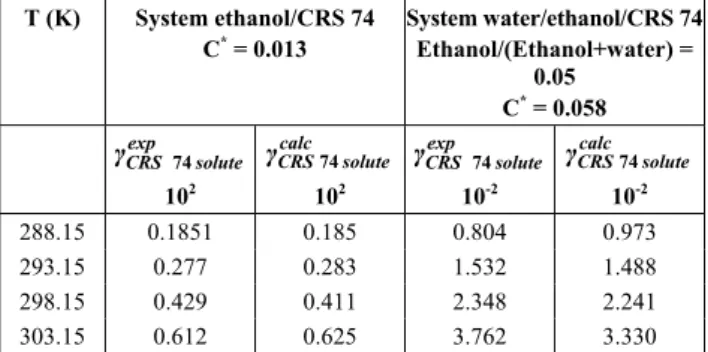
74 solute and
ported in Tab ee Equation RS 74 and fo 74 are resp
essed as ma t 303.15 K.
ated by UAC 103 Calculate data by Jouyban Acree Mod
w* 103
- 1 0.005 9 0.007 7 0.015 0 0.041 0 0.134 8 1.515 1 12.342 5 52.106 97 103.071 42 90.329 and calculate IQUAC mod Acree mode ethanol-wat NIQUAC an
l and calculat
74
calc CRS solute
γ
ble 7. The ro (11)) for th for the terna
ectively 0.01 ass ed -del ed del el) ter nd ed
e )
Table 7: Experimental and calculated activity co-efficients with UNIQUAC model for ethanol/CRS 74 and ethanol/water/CRS 74.
T (K) System ethanol/CRS 74
C* = 0.013
System water/ethanol/CRS 74 Ethanol/(Ethanol+water) =
0.05 C* = 0.058
74 exp CRS solute
γ
102
74 calc CRS solute
γ
102
74 exp CRS solute
γ
10-2
74 calc CRS solute
γ
10-2
288.15 0.1851 0.185 0.804 0.973
293.15 0.277 0.283 1.532 1.488
298.15 0.429 0.411 2.348 2.241
303.15 0.612 0.625 3.762 3.330
*objective function calculated with Equation (11)
Jouyban-Acree Model
The model parameter values were assessed by non-linear curve fitting based on the least mean square method. The trained form of the Jouyban−Acree model for prediction of CRS 74 solubility in ethanol and water mixtures at specific temperature T is given in Equation (14):
( )
(
)
(
)
*
, 1
2
1 2
1 2
2
1 2
1675.976
ln 10.032
2248.868 2.775
3132.043 5395.102 7114.846
m T
w z
T
z
T
z z z z
z z T
⎛ ⎞
= ⎜ + ⎟
⎝ ⎠
⎛ ⎞
+ ⎜ − ⎟
⎝ ⎠
+ −
⎡ ⎤
+ ⎢ ⎥
− −
⎣ ⎦
(14)
where w*m T, denotes the solute solubility in the bi-nary solvent mixtures at temperature T (K) expressed in g/kg. This trained form of the model may be used to explore the predictability of the Jouyban−Acree model for the solubility of the tested drug in ethanol + water mixtures at various temperatures and solvent compositions. In addition, it may be used to predict the aqueous solubility of CRS 74 at various tempera-tures by considering z1=0.0 and z2 =1.0.
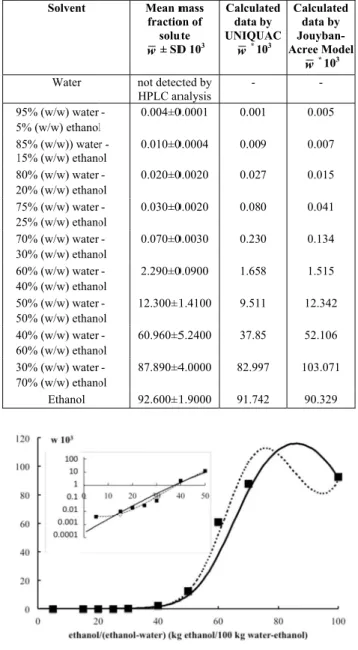
Table 4 and Figure 2 and Table 5 and Figure 3 give respectively the solubilities calculated in pure etha-nol and in 5% ethaetha-nol - 95% water mixture as a function of temperature with the two models. In pure ethanol, the calculated concentrations are in good agreement with experimental values. In 5% ethanol - 95% water mixture, the UNIQUAC model understi-mates the solubility of the active molecule. The Jouyban-Acree model seems to provide more accu-rate predictions.
Figure 4 and Table 6 present the calculated solu-bility at 303.15 K as a function of the ethanol mass proportion in the mixture ethanol-water with the two models. The data calculated with UNIQUAC model showed good agreement with experimental results. The two models revealed a maximum solubility of CRS 74 for an ethanol mass fraction in the mixture ethanol-water between 0.70 and 1. The maximum solubility for alcohol-water mixtures was predicted by the models but still not confirmed experimentally. A maximum solubility for a solute in a mixed solvent system has been observed experimentally for other systems (water/acetone/ketoprofen(Espitalier et al., 1995); water/ethanol/paracetamol and water/dioxane/ phenacetin(Ruckestein et al., 2003); water/ethanol/ hydrocortisone (Ali et al., 2009) and n-heptane/ ethanol/eflucimide (Teychene and Biscans, 2011)). Different studies with the Hidelbrand solubility approach have shown that the location and the height of the peaks could be linked with the polarity of the solute (Jouyban-Gharamaleki, 2000; Peña et al., 2006). Hydroxyl and amine groups of the solute give a polar character to this molecule that could explain the maximum of solubility calculated for a high ratio of ethanol in the mixture.
Indeed, the Jouyban-Acree model predicts a local minimum for the mixture 95% ethanol-5% water. To the best of our knowledge, this behaviour has not yet been described in the literature and should be treated with caution.
CONCLUSIONS
CRS 74 is soluble in ethanol (92.6 mg/gsolution at 303.15 K). To the best of our knowledge, there are no other published data on the solubility of the new antiretroviral molecule (CRS 74) in pure ethanol and in ethanol-water mixtures.
1080 S. P. Lacerda, J. J. Letourneau, F. Espitalier and M. I. Ré
Brazilian Journal of Chemical Engineering
ACKNOWLEDGMENTS
The authors would like to thank Cristalia Ltda (Itapira, SP, Brazil) for providing the drug CRS 74.
REFERENCES
Ali, H. S. M., York, P., Blagden, N., Preparation of hydrocortisone nanosuspension through a bottom-up nanoprecipitation technique using microfluidic reactors. Int. J. Pharm., 375, 107-13 (2009). Badawi, A. A., El-Nabarawi, M. A., El-Setouhy, D.
A., Alsammit, S. A., Formulation and stability testing of itraconazole crystalline nanoparticles. AAPS, 12, 3 (2011).
Balani, P. N., Wong, S. Y., Ng, W. K., Widjaja, E., Tan, R. B. H., Chan, S. Y., Influence of polymer content on stabilizing milled amorphous salbuta-mol sulphate. Int. J. Pharm., 391, 125-136 (2010). Bockelmann, M. A., Rosatto, S. S., Fuzeto, C. R.,
Vernucci, T. B., Barel, D. C., Oliveira, K. M. G., Freitas, M. P., Ritonavir analogous compound useful as retroviral protease inhibitor, preparation of the ritonavir analogous compound and pharma-ceutical composition for the ritonavir analogous compound. European Patent, WO 2005/111006, November (2005).
Bockelmann, M. A., Rosatto, S. S., Fuzeto, C. R., Vernucci, T. B., Barel, D. C., Oliveira, K. M. G., Freitas, M. P., Ritonavir analogous compound useful as retroviral protease inhibitor, preparation of the ritonavir analogous compound and pharma-ceutical composition for the ritonavir analogous compound. United States Patent 7763733, July (2010).
Eerdenbrugh, B. V., Speybroeck, M. V., Mols, R., Houthoofd, K., Martens, J. A., Froyen, L., Hum-beeck, J. V., Augustijns, P., Mooter, G. V. D., Itraconazole/TPGS/Aerosil®200 solid dispersions characterization, physical stability and in vivo performance. Eur. J. of Pharm. Sci., 38, 270-278 (2009).
Espitalier, F., Biscans, B., Laguerie, C., Physico-chemical data on ketoprofen in solutions. J. Chem. Eng. Data, 40, 1222-1224 (1995).
Han, X., Ghoroi, C., To, D., Chen, Y., Davé, R., Simultaneous micronization and surface modi-fication for improvement of flow and dissolution of drug particles. Int. J. Pharm., 415(1-2), 185-95 (2011).
Jouyban-Gharamaleki, A., Romero, S., Bustamante, P., Clark, B. J., Multiple solubility maxima of ox-olinic acid in mixed solvents and a new extension
of Hildebrand solubility approach. Chem. Pharm. Bul., 48, 175-8 (2000).
Jouyban-Gharamaleki, A. and Acree, Jr. W. E., Com-parison of models for describing multiple peaks in solubility profiles. Int. J. Pharm., 167, 177-182 (1998).
Jouyban-Gharamaleki, A. and Hanaee, J., A novel method for improvement of predictability of the CNIBS/R-K equation. Int. J. Pharm., 154, 245-247 (1997).
Lee, P. S., Han, J. Y., Song, T. W., Sung, J. H., Kwon, O. S., Song, S., Chung, Y. B., Physicochemical characteristics and bioavailability of a novel in-testinal metabolite of ginseng saponin (IH901) complexed with beta-cyclodextrin. Int. J. Pharm., 316, 29-36 (2006).
Peña, M. A., Reíllo, A., Escalera, B., Bustamante, P., Solubility parameter of drugs for predicting the solubility profile type within a wide polarity range in solvent mixtures. Int. J. Pharm., 321, 155-61 (2006).
Plakkot, S., Matas, M., York, P., Saunders, M., Sulaiman, B., Comminution of ibuprofen to pro-duce nano-particles for rapid dissolution. Int. J. Pharm., 415, 307-314 (2011).
Rasenack, N., Müller, B. W., Dissolution rate en-hancement by in situ micronization of poorly water-soluble drugs. Pharm. Res., 19, 12 (2002). Rasenack, N., Müller, B. W., Micron-size drug
parti-cles: Common and novel micronization tech-niques. Pharm. Dev. Technol., 9(1), 1-13 (2004). Rodríguez-Spong, B., Price, C. P., Jayasankar, A.,
Matzger, A. J., Rodríguez-Hornedo, N., General principles of polymorphism: A supramolecular perspective. Adv. Drug Deliv. Rev., 56, 241-274 (2004).
Ruckenstein, E., Shulgin, I., Solubility of drugs in aqueous solutions Part 2: Binary nonideal mixed solvent. Int. J. Pharm., 260, 283-291 (2003). Sardari, F. and Jouyban, A., Solubility of nifedipine
in ethanol + water and propylene glycol + water mixtures at (293.2 to 313.2) K. Ind. Eng. Chem. Res., 52, 14353-14358 (2013).
Smith, A. J., Kavuru, P., Wojtas, L., Zaworotkov, M. J., Shytle, R. D., Cocrystals of quercetin with improved solubility and oral bioavailability. Mol. Pharm., 8, 1867-76 (2011).
Teychene, S., Biscans, B., A Multiscale approach for the characterization and crystallization of eflu-cimibe polymorphs: From molecules to particles. KONA Powder and Particle Journal, 29, 266-282 (2011).
poorly water soluble drugs in aqueous suspen-sions: Recent developments and future perspec-tive. Chem. Eng. J., 181, 1-34 (2012).
Viçosa, A., Letourneau, J.-J., Espitalier, F., Ré, M. I., An innovative antisolvent precipitation process as a promising technique to prepare ultrafine ri-fampicin particles. J. Cryst. Growth, 342, 80-87 (2012).
Walas, S. M., Phase Equilibria in Chemical Engi-neering. Butterworth Publishers, Boston (1985). Yalkowsky, S. H., Roseman, T. J., Solubilization of
Drugs by Cosolvents. In: Yalkowsky (Ed.), Tech-niques of Solubilization of Drugs, pp. 91-134,
Marcel Dekker Inc., New York (1981).
Yu, L., Amorphous pharmaceutical solids: Prepara-tion, characterization and stabilization. Adv. Drug Deliv. Rev., 48, 27-42 (2001).
Zhang, H. X., Wang, J. X., Zhang, Z. B., Le, Y., Shen, Z. G., Chen, J. F., Micronization of atorvas-tatin calcium by antisolvent precipitation process. Int. J. Pharm., 374, 106-113 (2009).