Article
Printed in Brazil - ©2012 Sociedade Brasileira de Química0103 - 5053 $6.00+0.00
A
*e-mail: [email protected]
Ultrasound-Assisted Surfactant-Enhanced Emulsification Microextraction
Combined with HPLC for the Determination of Estrogens in Water
Yan Zou,a Yanhua Li,b Hua Jin,b Deqing Zou,a Mousheng Liua and Yaling Yang*,a
aFaculty of Life Science and Technology, Kunming University of Science and Technology,
650500 Kunming, P. R. China
bFirst People’s Hospital of Yunnan Province, 650032 Kunming, P. R. China
Desenvolveu-se um procedimento de microextração por emulsificação assistida por ultrassom e aperfeiçoada por surfactante (UASEME) combinado com cromatografia líquida de alta eficiência
com detector de arranjo de diodos para a determinação de 17β-estradiol (βE2), estrona (E1) e
dietilestilbestrol (DES) em água. Ultrassom foi aplicado para auxiliar a emulsificação e Triton X-100 foi usado como dispersor e emulsificante. Tetracloreto de carbono foi usado como solvente extrator. Empregando otimização global, o procedimento foi caracterizado por um intervalo linear
aceitável de 10 a 1000 ng mL-1 para βE2, E1 e DES (r > 0,997), exatidão e precisão validadas (RSD
0,85-1,28% (n = 5)) e alta sensibilidade com limites de detecção de 0,200, 0,100 e 0,125 ng mL-1
para βE2, E1 e DES, respectivamente. O procedimento foi aplicado para a análise de amostras
típicas de água, com fatores de enriquecimento de 85,29, 173,45 e 97,05 para βE2, E1 e DES,
respectivamente, e boas recuperações (≥ 89,82%). De maneira geral, o procedimento desenvolvido
foi simples e confiável, com potencial de aplicação em larga escala para análises da água.
An ultrasound-assisted surfactant-enhanced emulsification microextraction (UASEME) combined with high performance liquid chromatography-diode array detector procedure was
developed for the determination of 17β-estradiol (βE2), estrone (E1) and diethylstilbestrol
(DES) in water. Ultrasound was applied to assist emulsification, and Triton X-100 was adopted as the disperser and emulsifier. Carbon tetrachloride was applied as the extraction solvent. Global optimization was used and the developed procedure was characterized by an acceptable
linear range of 10 to 1000 ng mL-1 for βE2, E1 and DES (r > 0.997), a validated accuracy and
precision (RSD 0.85-1.28% (n = 5)), and high sensitivity with limits of detection of 0.200, 0.100
and 0.125 ng mL-1 for βE2, E1 and DES, respectively. Furthermore, we applied this procedure to
analyze typical water samples, with enrichment factors of 85.29, 173.45 and 97.05 for βE2, E1
and DES, respectively, and good recoveries (≥ 89.82%). Altogether, the proposed procedure was
simple and reliable, with potential application in large-scale water analysis.
Keywords: ultrasound-assisted surfactant-enhanced emulsification microextraction, HPLC,
Triton X-100, estrogen, water samples
Introduction
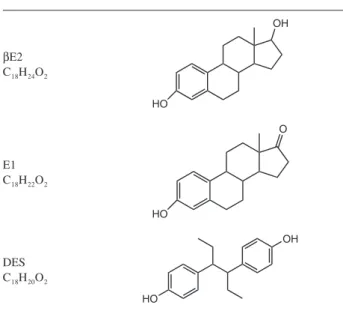
βE2, E1 and DES (shown in Table 1) are three environmental endogenous estrogens which can promote the growth and development of female genitalia. They are generated by ovarian follicles, and enter the environment mainly from the excreta of human, poultry and livestock.1
Agricultural waste has been recognized as an additional source of estrogens in water.2 Estrogens have also been
used in cosmetics to make the skin more elastic, white and
glossy. However, estrogens were banned from cosmetics in the European Union due to their carcinogenicity.3
The environmental levels of estrogens may be having widespread adverse effects on the reproductive health of humans and wildlife.4 Therefore, it is important to establish
a sensitive and reliable method for the determination of estrogen residues in water.
Currently, many widely used methods for the analysis of estrogens are based on chromatographic techniques such as liquid chromatography (LC),5-8 gas chromatography
(GC)9 and chemiluminescence’s enzyme immunoassay
suitable derivatization reagent prior to analysis. However, derivatization reactions are very time-consuming.11,12
The low concentration of estrogens in environmental water makes them difficult to be directly determined by chromatographic methods.13,14 Hence, some sample
preconcentration techniques are needed to extract the traces of estrogens from the aqueous medium before analysis. The traditional sample preparation methods include solid phase extraction (SPE)15 and solid-phase microextraction (SPME).16
SPE and SPME need a small quantity of solvent and time, but columns are too expensive. Based on liquid-liquid extraction, several new types of preconcentration techniques have been developed. These include hollow-fiber microporous membrane liquid-liquid extraction (HF-MMLLE),17 stir bar
sorptive extraction (SBSE),18 cloud point extraction (CPE)19
and dispersive liquid-liquid microextraction solidification of a floating organic drop (DLLME-SFO).20 DLLME is
based on a ternary solvent system. The appropriate mixture of extraction solvent and disperser solvent is quickly added into the target aqueous solution, resulting in the formation of a homogeneous solution which can increase the contact surface between phases and obtain high enrichment factors. Recently, a series of improved DLLME methods have been developed. Ultrasound was used in DLLME to enhance the extraction efficiency of dimethachlon in our previous study.21 In classical DLLME, organic solvents such as
acetone,22 ethanol,23 methanol,24 and acetonitrile25 are usually
used as disperser solvents. However, some surfactants have also been used as disperser solvent in surfactant-assisted dispersive liquid-liquid microextraction (SA-DLLME)26
and ultrasound-assisted surfactant-enhanced emulsification microextraction (UASEME).27-29
Surfactants are amphiphilic molecules. They have hydrophilic and hydrophobic groups.30 Surfactant could
be used as an emulsifier to enhance the dispersion of water-immiscible organic solvent in aqueous phase. Ultrasound radiations could accelerate the formation of fine droplets of extraction solvent, and decrease the extraction time. Then, the two phases could be separated completely by the demulsification of electrolyte and centrifugation. Triton X-100 is a typical nonionic surfactant containing an average of 9.5 oxyethylene units per molecule.31
Triton X-100 has been widely applied in heavy-duty industrial cleaning and as agrochemical.32 It is also an
effective and economic emulsifier, wetting agent, phase dispersant33 and solubilizer.34
The aim of this work was to develop a method of UASEME for the determination of estrogens in water samples. Ultrasound was used to assist emulsification, and Triton X-100 was used as disperser solvent and emulsifier. Parameters affecting the extraction efficiency including the type and volume of dispersant and extraction solvent, ultrasonication time and temperature, sample pH, ionic strength and centrifuging time were optimized.
Experimental
Reagents
βE2, E1 and DES (analytical standards) were all purchased from Sigma. (Sigma, St. Louis, MO, USA) Standard stock solutions of βE2, E1 and DES were prepared in methanol at a concentration of 500 µg mL-1.
Working solutions were prepared by dilution of the stock solutions on the day of use. The surfactants including sodium dodecylsulphate (SDS), cetyltrimethyl ammonium bromide (CTAB), Tween 20 and Triton X-100 (Amresco, USA) were prepared in aqueous solutions. Acetonitrile was chromatographic grade (Tedia Company, Fairfield, OH, USA). Methanol, ethanol, acetone, carbon tetrachloride, chloroform, dichloromethane, ethyl acetate and n-butanol were analytical grade (Zhiyuan Chemical Reagent Co., Tianjing, China).
Instrumentation
The HPLC equipment consisted of four Agilent 1200 series LC-20AT pumps, a SPD-M20A DAD detector and an automatic injector. The separations were performed on an Agilent TC-C18 column (150 mm × 4.6 mm, i.d, 5 µm). Acetonitrile and water were used as mobile phase with the gradient program as follows: 0-4.5 min, 35:65; 6.0-20 min, 55:45, acetonitrile:water, v/v. The flow rate of
Table 1. Chemical structures of three estrogens
βE2 C18H24O2
OH
HO
E1 C18H22O2
HO
O
DES C18H20O2
OH
mobile phase was 1.0 mL min-1. The injection volume was
20 µL, and the DAD detector was set at 210 nm, which is the absorption maximum of all analytes. The column temperature was 25 oC. An Agilent chemstation for LC
was utilized to control the system, and for the acquisition and analysis of the chromatographic data. An ultrasonic water bath with temperature control (Shanghai Kudos Ultrasound Instrument Co., Ltd., Shanghai, China) was used to emulsify the solutions. A centrifuge with calibrated centrifugal tubes (Shanghai Medical Instruments (Group) Ltd., Corp. Surgical Instruments Factory, Shanghai, China) was used for phase separation.
UASEME procedure
A 10 mL aliquot of the water sample was placed in a screw cap glass centrifuge tube with conical bottom. An amount of 50 µL of CCl4 as extraction solvent, and 0.3 mL Triton X-100 (0.8×10⁻⁵ mol L-1) as disperser solvent and
emulsifier, were added to the sample solution. The final concentration of Triton X-100 in the sample solution was 2.4×10⁻⁶ mol L-1. The tube was capped and placed in an
ultrasonic water bath for ultrasonication performed at 35 kHz of ultrasound frequency and 25 oC for 5 min. The
emulsion was then detached by centrifugation for 5 min at 4000 rpm. After phase separation, the organic phase was deposited at the bottom of the tube and the denser phase was removed to another tube with a conical bottom using a syringe. The denser phase was then dried with nitrogen, dissolved in 0.5 mL acetonitrile, and 20.0 µL was injected into the HPLC for analysis.
Results and Discussion
Optimization of UASEME
In this work, the influence of different experimental parameters, including the type and concentration of disperser solvent, the type and volume of the extraction solvent, ultrasonication time, ionic strength, sample pH and centrifuging time, on the performance of UASEME, were investigated. A quantity of 10.0 mL of deionized water spiked with 100 ng mL-1 of each of the three estrogens was
used to study the extraction performance under different experimental conditions. All experiments were performed in quintuplicate, and mean values were used for optimization.
Effect of extraction solvent
The extraction solvent not only affects the emulsification, but also the extraction efficiency, and hence, selecting an appropriate extraction solvent is quite important
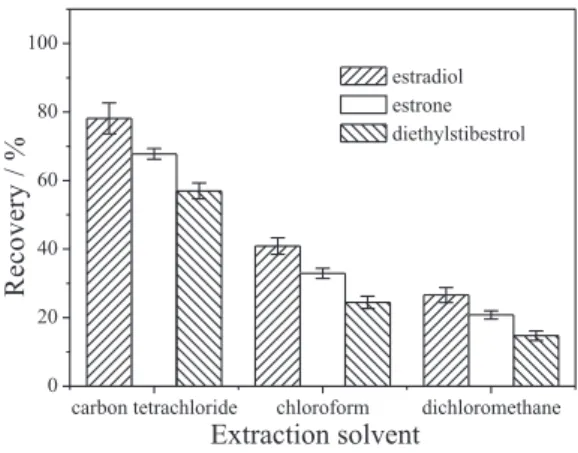
to UASEME. The extraction solvent should have hydrophobicity and good extraction capability for the target analytes, as well as being able to form a stable cloudy system in the presence of Triton X-100 and ultrasound. Based on these aspects, carbon tetrachloride, chloroform, dichloromethane, ethyl acetate and n-butanol were tested in this work. Figure 1 shows the effect of the extraction solvent on the extraction efficiency of the target analytes. When ethyl acetate and n-butanol were used as extraction solvents, no emulsification was observed in the system. Relatively high extraction efficiency was obtained when carbon tetrachloride was used as extraction solvent. The reason for this might be that the polarity of carbon tetrachloride is more similar to the target estrogens than chloroform and dichloromethane. Therefore, carbon tetrachloride was selected as the optimum extraction solvent.
Effect of disperser solvent
In DLLME, the disperser solvent must be miscible in both the extraction solvent and water.32 Several traditional
disperser solvents were studied including methanol, ethanol, acetonitrile and acetone. The surfactant can also serve as the disperser solvent and accelerate the emulsification of carbon tetrachloride in water under the energy provided by ultrasound. Different surfactants including SDS, CTAB, Tween 20 and Triton X-100 were investigated. When SDS, CTAB and Tween 20 were used as disperser solvents, the extraction efficiencies were very low. As shown in Figure 2, the highest extraction efficiency was observed when Triton X-100 was used as disperser solvent, and thus, Triton X-100 was selected as the optimum disperser solvent.
Effect of extraction solvent volume
The extraction solvent volume is a crucial factor during the DLLME process.35 The effect of different volumes of
Figure 1. Effect of extraction solvents. Extraction conditions: sample volume, 10.0 mL spiked with 100 ng mL-1 of each estrogen; sample pH, 7;
the concentration of Triton X-100, 4.0×10⁻⁷ mol L-1; extraction solvent
carbon tetrachloride between 20 to 150 µL was studied. As Figure 3 shows, the peak recoveries of the three estrogens were increased when the volume of carbon tetrachloride was increased from 20 to 50 µL, and then decreased with further volume increases to 150 µL. The reason for this might be that carbon tetrachloride could not be well emulsified in aqueous solution when its volume was larger than 50 µL. Therefore, 50 µL of carbon tetrachloride was used in further experiments.
Effect of the concentration of surfactant
The concentration of Triton X-100 can influence the dispersion and sedimentation of carbon tetrachloride. Triton X-100 can also play an important role in the emulsification and mass-transfer process. If the concentration of Triton X-100 is too low, the tiny droplets of carbon tetrachloride might not be formed effectively. Meanwhile, too high concentration of Triton X-100 could prevent the analytes from transferring to the droplets of carbon tetrachloride.36
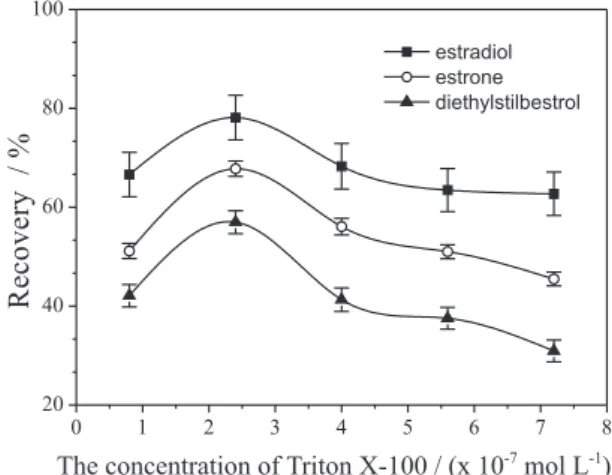
Thus, different concentrations of Triton X-100 ranging from 0.8 to 7.2×10⁻⁷ mol L-1 were investigated. Figure 4 indicates
that the extraction efficiency increased with increasing concentration of Triton X-100 up to 2.4×10⁻⁷ mol L-1.
The solution would remain cloudy after centrifugation when the concentration of Triton X-100 was higher than 2.4×10⁻⁷ mol L-1. The reason for this might be that some
analytes were incorporated into the micelles, resulting in an increasing solubility in the aqueous solution. Therefore, 2.4×10⁻⁷ mol L-1 Triton X-100 was selected in
this experiment.
Effect of ultrasonication
Ultrasound can improve the interactive rate between the extraction solvent and aqueous phase so that the extraction solvent can be well dispersed in the aqueous solution, and a stable and homogeneous ternary emulsion is formed.37 Mohammadi et al.38 have used ultrasound
to assist with emulsification microextraction of trace amounts of Co and Mn ions in water. The ultrasonication times in the range of 0-15min were evaluated at 25 °C. Figure 5 shows that peak areas increased till 5 min and remained almost constant for longer times. So, 5 min was chosen as ultrasonication time in further experiments. The ultrasonication temperature range from 25 to 55 °C was also investigated. Increasing temperature had no effect on the extraction efficiency. As a result, 25 °C was chosen as the ultrasonication temperature.
Effect of ionic strength
Normally, the solubility of analytes in water could be decreased with the addition of salt due to the salting-out effect.39 An appropriate ionic strength could prevent the
foam formation and accelerate phase separation. However, the viscous solution might prevent the extraction solvent
Figure 2. Effect of disperser solvents. Extraction conditions: sample
volume, 10.0 mL spiked with 100 ng mL-1 of each estrogen; sample pH, 7;
disperser solvent volume, 0.5 mL; CCl4 volume, 50 µL; centrifuging
time, 5 min.
Figure 4. Effect of the concentration of Triton X-100. Extraction conditions: sample volume, 10.0 mL spiked with 100 ng mL-1 of each
estrogen; sample pH, 7; CCl4 volume, 50 µL; centrifuging time, 5 min.
Figure 3. Effect of CCl4 volume. Extraction conditions: sample volume,
10.0 mL spiked with 100 ng mL-1 of each estrogen; sample pH, 7;
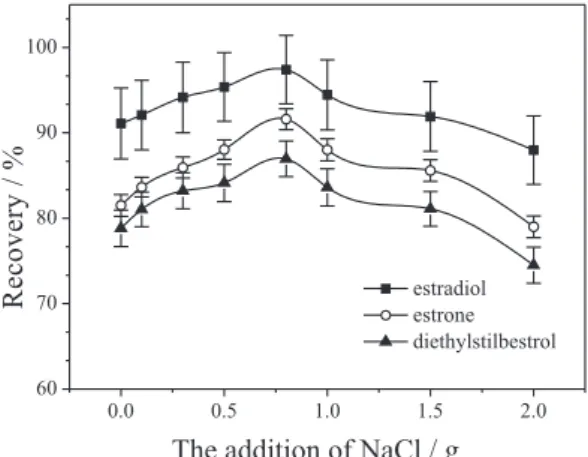
from dispersing in aqueous phase with an increase of ionic strength. Consequently, the effect of emulsification would be dramatically reduced.40 Figure 6 shows the analytes
peak areas versus the addition of NaCl in the range from 0 to 2.0 g. The best extraction efficiency was obtained with the addition of 0.8 g of NaCl. Therefore, 0.8 g NaCl was added to all samples in further experiments.
Effect of sample pH
The solubility of target analytes in water and organic phase can be affected by the sample pH.25 Sample pH was
investigated in the range from 2.0 to 12.0, with the best extraction efficiency of the target analytes obtained at pH 7.0 as shown in Figure 7. For this reason, the sample pH was chosen at 7.0 in further experiments.
Effect of centrifuging time
Centrifugation can accelerate the disruption of the emulsion and the sedimentation of carbon tetrachloride.
If the centrifuging time is not enough, the carbon tetrachloride would not be completely deposited at the bottom of the tube. The centrifuging time was evaluated in the range between 0 and 20 min at 4000 rpm. As shown in Figure 8, 5 min was the optimum centrifuging time, and therefore chosen as the centrifuging time for further experiments.
Analytical performance
The chromatograms of the three estrogens in standard aqueous solution obtained by direct HPLC-DAD (A) and by UASEME-HPLC-DAD (B) are shown in Figure 9. Comparing A and B, the peak heights of βE2, E1 and DES were clearly enhanced in B. In order to investigate the applicability of UASEME for the determination of the estrogens in water samples, several factors including linear range, enrichment factors, regression equations, correlation coefficients and detection limits were
Figure 5. Effect of ultrasonication time. Extraction conditions: sample
volume, 10.0 mL spiked with 100 ng mL-1 of each estrogen; sample pH, 7;
concentration of Triton X-100, 2.4×10⁻⁷ mol L-1; CCl
4 volume, 50 µL;
ultrasonic frequency, 35 kHz; centrifuging time, 5 min.
Figure 6. Effect of NaCl. Extraction conditions: sample volume, 10.0 mL
spiked with 100 ng mL-1 of each estrogens; sample pH, 7; concentration
of Triton X-100, 2.4×10⁻⁷ mol L-1; CCl
4 volume, 50 µL; ultrasonication
time, 5 min; centrifuging time, 5 min.
Figure 7. Effect of sample pH. Extraction conditions: sample volume,
10.0 mL spiked with 100 ng mL-1 of each estrogens; concentration of
Triton X-100, 2.4×10⁻⁷ mol L-1; CCl
4 volume, 50 µL; addition of NaCl,
0.8 g; ultrasonication time, 5 min; centrifuging time, 5 min.
Figure 8. Effect of centrifuging time. Extraction conditions: sample
volume, 10.0 mL spiked with 100 ng mL-1 of each estrogen; sample pH, 7;
concentration of Triton X-100, 2.4×10⁻⁷ mol L-1; CCl
4 volume, 50 µL;
evaluated under the optimum conditions. Results are summarized in Table 2.
Analysis of water samples
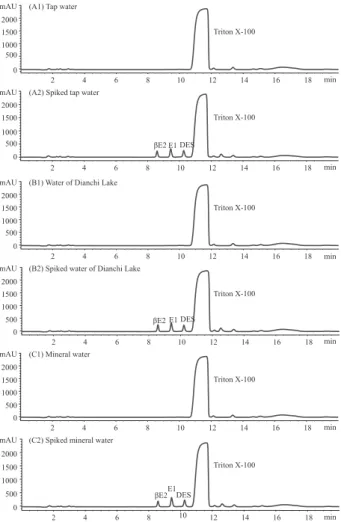
To demonstrate the capability of the proposed UASEME procedure, it was applied to analyze the levels of the three estrogens in lake, tap and mineral water under the optimized conditions. Results are shown in Figure 10. None of the target estrogens were detected in any of the water samples. In order to validate the accuracy of this method, the extraction recoveries of the three estrogens at three different levels (50.0, 500.0 and 1000.0 ng mL-1)
were spiked into actual water samples. Table 3 shows that the recoveries for the analytes were 89.82-104.48% with RSD lower than 6.50%. These excellent results demonstrate that the UASEME-HPLC-DAD procedure is precise and sensitive for trace analysis of βE2, E1 and DES in water samples.
Comparison of UASEME with conventional methods
The extraction efficiency of UASEME was compared with other reported techniques such as SPE, SPME, SBSE, CPE and DLLME-SFO. The LOD, RSD, linearity, and extraction time are listed in Table 4. It is observed that the extraction time of UASEME was greatly shortened. The range of LODs given in Table 4 for SBSE, CPE and DLLME-SFO were higher than with UASEME.
Figure 9. Typical chromatograms of analysis of βE2, E1 and DES in water samples by direct HPLC-DAD (A) and UASEME-HPLC-DAD (B). Concentrations of βE2, E1 and DES were 100 ng mL−1.
Table 3. Analytical results for estrogens in water samples
Sample Estrogen Spiked / (ng mL-1)
Found / (ng mL-1)
Recovery / %
RSD / % (n = 5)
Tap water βE2 0 NDa
50 52 104.48 5.26
500 502 100.31 1.26
1000 1003 100.31 1.54
E1 0 NDa
50 45 90.56 1.72
500 500 100.09 1.45
1000 936 93.63 1.44
DES 0 NDa
50 47 94.66 4.69
500 502 100.48 1.49
1000 1030 103.05 3.27
Water of Dianchi Lake
βE2 0 NDa
50 48 96.41 2.74
500 505 101.08 1.64
1000 974 97.42 1.43
E1 0 NDa
50 49 98.18 3.34
500 498 99.62 1.08
1000 965 96.52 2.48
DES 0 NDa
0.05 49 97.33 6.26
0.5 506 101.14 1.50
1 1023 102.31 2.09
Mineral water
βE2 0 NDa
50 47 93.75 4.51
500 449 89.82 1.24
1000 952 95.24 2.71
E1 0 NDa
50 51 101.99 3.34
500 491 98.12 1.36
1000 953 95.26 2.06
DES 0 NDa
50 49 97.74 6.50
500 505 101.04 1.21
1000 1013 101.27 1.40
anot detected. Table 2. Performance characteristics of the developed procedure
Analyte LRa / (ng mL-1) Regression equation r LOD / (ng mL-1) RSD / % (n = 5) Enrichment factorb
βE2 10-1000 Y = 225.57x + 159.36 0.9988 0.200 1.27 85.29
E1 10-1000 Y = 262.37x + 135.12 0.9975 0.100 0.85 173.45
DES 10-1000 Y = 325.22x + 183.64 0.9982 0.125 1.28 97.05
Conclusions
In this work, ultrasound was applied to assist emulsification, and Triton X-100 was adopted as disperser solvent and emulsifier in ultrasound-assisted surfactant-enhanced emulsification microextraction (UASEME). The developed procedure presented quantitative recoveries and
enrichment factors, good repeatability, short extraction time and good linearity. Therefore, the UASEME-HPLC-DAD procedure is a simple and reliable microextraction method which can be successfully applied for the determination of estrogen residues in water.
Acknowledgments
The work was greatly supported by the Medical Neurobiology Key Laboratory of Kunming University of Science and Technology, Basic and Applied Research Project in Yunnan province (2008ZC082M) and the Analysis and Testing Foundation of Kunming University of Science and Technology (N. 2010121). The authors are thankful to Daniel Michael Paddon for helping with English language.
References
1. Wei, H. B.; Lin, J. M.; Wu, D. N.; Zhao, L. X.; Li, Z. J.; Ying, X. T.; Chinese J. Anal. Chem. 2007, 35, 320.
2. Gadd, J. B.; Tremblay, L. A.; Northcott, G. L.; Environ. Pollut.
2010, 158, 730.
3. Wang, C.; Ma, Q.; Wang, X.; Wu, T.; Bai, H.; Hao, N.; Wang, J. B.; Chinese J. Anal. Chem. 2007, 35, 1257.
4. Daston, G. P.; Gooch, J. W.; Breslin, W. J.; Shuey, D. L.; Nikiforov, A. I.; Fico, T. A.; Gorsuch, J. W.; Reprod. Toxicol.
1997, 11, 465.
5. Lopez de Alda, M. J.; Díaz-Cruz, S.; Petrovic, M.; Barceló, D.; J. Chromatogr., A 2003, 1000, 503.
6. Havlíková, L.; Nováková, L.; Matysová, L.; Šícha, J.; Solich, P.; J. Chromatogr., A 2006, 1119, 216.
7. Yoon, Y.; Westerhoff, P.; Snyder, S. A.; Esparza, M.; Water Res.
2003, 37, 3530.
8. Watabe, Y.; Kubo, T.; Nishikawa, T.; Fujita, T.; Kaya, K.; Hosoya, K.; J. Chromatogr., A 2006, 1120, 252.
9. Zhou, Y. Q.; Wang, Z. J.; Jia, N.; J. Environ. Sci. 2007, 19, 879.
10. Tanaka, T.; Takeda, H.; Ueki, F.; Obata, K.; Tajima, H.; Takeyama, H.; Goda, Y.; Fujimoto, S.; Matsunaga, T.; J. Biotechnol. 2004, 108, 153.
Figure 10. Typical chromatograms of analysis of βE2, E1 and DES in three real water samples by UASEME-HPLC-DAD. Chromatograms A1, B1 and C1 were of tap, Dianchi Lake and mineral water samples. Chromatograms A2, B2, and C2 were of tap, Dianchi lake and mineral water samples spiked with βE2, E1 and DES at concentrations of 50 ng mL−1 of each one.
Table 4. Comparison of the developed propcedure with other sample preparation techniques for the determination of estrogens in water
Procedure LRa / (ng mL-1) LOD / (ng mL-1) RSD / % Extraction time Reference
SPE-LC/MS/MS 0.015-1.5 0.001-0.03 < 17 - 15
SPME-GC/MS/MS 0.005-0.5 0.0002-0.003 < 12 > 2 h 16
SBSE-HPLC/DAD 0.5-300 0.04-0.11 < 9.5 = 43 min 18
CPE-HPLC/UV 1-192 0.23-5.0 < 12 = 65 min 19
DLLME-SFO-HPLC/UV 5-1000 0.8-3.1 < 14 > 30 min 20
UASEME-LC/DAD 10-1000 0.1-0.2 < 1.28 < 15 min This work
11. Mol, H. G. J.; Sunarto, S.; Steijger, O. M.; J. Chromatogr., A
2000, 879, 97.
12. Zhang, K.; Zuo, Y. G.; Anal. Chim. Acta 2005, 554, 190. 13. Chang, H.; Wan, Y.; Wu, S. M.; Fan, Z. L.; Hu, J. Y.; Water Res.
2011, 45, 732.
14. Lei, B. L.; Huang, S. B.; Zhou, Y. Q.; Wang, D. H.; Wang, Z. J.; Chemosphere 2009, 76, 36.
15. Pedrouzo, M.; Borrull, F.; Pocurull, E.; Maria Marcé, R.; Talanta
2009, 78, 1327.
16. Carpinteiro, J.; Quintana, J. B.; Rodríguez, I.; Carro, A. M.; Lorenzo, R. A.; Cela, R.; J. Chromatogr., A 2004, 1056, 179. 17. Zorita, S.; Hallgren, P.; Mathiasson, L.; J. Chromatogr., A 2008,
1192, 1.
18. Hu, Y. L.; Zheng, Y. J.; Zhu, F.; Li, G. K.; J. Chromatogr., A
2007, 1148, 16.
19. Wang, L.; Cai, Y. Q.; He, B.; Yuan, C. G.; Shen, D. Z.; Shao, J.; Jiang, G. B.; Talanta 2006, 70, 47.
20. Chang, C. C.; Huang, S. D.; Anal. Chim. Acta 2010, 662, 39.
21. Ruan, S. C.; Yang, Y. L.; Huang, H. T.; Chin. J. Anal. Lab. 2010, 29, 111.
22. Pena, M. T.; Casais, M. C.; Mejuto, M. C.; Cela, R.; J. Chromatogr., A 2009, 1216, 6356.
23. Sereshti, H.; Karimi, M.; Samadi, S.; J. Chromatogr., A 2009, 1216, 198.
24. Zarei, A. R.; Gholamian, F.; Anal. Biochem. 2011, 412, 224. 25. Zhao, E. C.; Zhao, W. T.; Han, L. J.; Jiang, S. R.; Zhou, Z. Q.;
J. Chromatogr., A 2007, 1175, 137.
26. Moradi, M.; Yamini, Y.; Esrafili, A.; Seidi, S.; Talanta 2010,
82, 1864.
27. Wu, Q. H.; Chang, Q. Y.; Wu, C. X.; Rao, H.; Zeng, X.; Wang, C.; Wang, Z.; J. Chromatogr., A2010, 1217, 1773.
28. Wu, C. X.; Liu, N.; Wu, Q. H.; Wang, C.; Wang, Z.; Anal. Chim. Acta 2010, 679, 56.
29. Cheng, J.; Matsadiq, G.; Liu, L.; Zhou, Y. W.; Chen, G.; J. Chromatogr., A 2011, 1218, 2476.
30. John, V. T.; Simmons, B.; McPherson, G. L.; Bose, A.; Curr. Opin. Colloid Interface Sci. 2002, 7, 288.
31. Zdziennicka, A.; J. Colloid Interface Sci. 2009, 336, 423. 32. Ji, G. L.; Zhang, H. B.; Huang, F.; Huang, X. R.; J. Environ.
Sci. 2009, 21, 1486.
33. Alpatova, A. L.; Shan, W. Q.; Babica, P.; Upham, B. L.; Rogensues, A. R.; Masten, S. J.; Drown, E.; Mohanty, A. K.; Alocilja, E. C.; Tarabara, V. V.; Water Res. 2010, 44, 505.
34. Dias, N.; Mortara, R. A.; Lima, N.; Toxicol. in Vitro 2003, 17, 357.
35. Herrera-Herrera, A. V.; Asensio-Ramos, M.; Hernández-Borges, J.; Rodríguez-Delgado, M. Á.; TrAC, Trends Anal. Chem. 2010,
29, 728.
36. Mohammad, R.; Yaghoub, A.; Mohammad-Reza, M. H.; Elham, A.; Fardin, A.; Sana, B.; J. Chromatogr., A 2006, 1116, 1.
37. Zgoła-Grześkowiak, A.; J. Chromatogr., A 2010, 1217, 1761. 38. Mohammadi, S. Z.; Afzali, D.;Baghelani, Y. M.; Karimzadeh, L.;
J. Braz. Chem. Soc. 2011, 22, 104.
39. Huang, K. J.; Wei, C. Y.; Liu, W. L.; Xie, W. Z.; Zhang, J. F.; Wang, W.; J. Chromatogr., A 2009, 1216, 6636.
40. Vakili-Nezhaad, G. R.; Mohsen-Nia, M.; Taghikhani, V.; Behpoor, M.; Aghahosseini, M.; J. Chem. Thermodyn. 2004, 36, 341.
Submitted: October 2, 2011