Brazilian Journal of Physics, vol. 36, no. 2A, June, 2006 415
Intersubband Excitations at Finite Temperatures and
their Roles in Different Quasi-One-Dimensional Systems
Marcos R. S. Tavares∗ and Guo-Qiang Hai†
∗Instituto de F´ısica Te´orica. Universidade Estadual Paulista. S˜ao Paulo, SP, 01405-900, Brazil
†Instituto de F´ısica de S˜ao Carlos, Universidade de S˜ao Paulo, S˜ao Carlos, SP, 13560-970, Brazil
Received on 4 April, 2005
We theoretically study many-body excitations in three different quasi-one-dimensional (Q1D) electron sys-tems: (i) those formed on the surface of liquid Helium; (ii) in two coupled semiconductor quantum wires; and (iii) Q1D electrons embedded in polar semiconductor-based quantum wires. Our results show intersubband coupling between higher subbands and the two lowest subbands affecting even the lower energy intersubband plasmons on the liquid Helium surface. Concerning the second system, we show a pronounced extra peak ap-pearing in the intersubband impurity spectral function for temperatures as high as 20 K. We finally show coupled intersubbandplasmon-phononmodes surviving for temperatures up to 300 K.
Keywords: Intersubband excitations; Many-body excitations; Quasi-one-dimensional (Q1D) electron systems
I. INTRODUCTION
Since the seminal work by Go˜niet al., [1] where fundamen-tal many-body excitations in GaAs/AlGaAs semiconductor-based quantum wires were experimentally probed, collective (plasmons) and single-particle (particle-hole) excitations in Q1D electron systems have been extensively studied. [2,3] Those experimental results were concerned to the inelas-tic light (Raman) scattering in Q1D electron systems and have been interpreted within the random-phase approxima-tion (RPA) in the framework of the Fermi liquid (FL) theory. Also, Q1D electron gas confined on the surface of liquid he-lium has also been realized in laboratory by bending the liquid helium surface. [4] In some sense, this Q1D system is simi-lar to those in semiconductor quantum wires, nanotubes and metallic chains where many-body effects can be studied.
Several papers have also been published concerning col-lective excitations in coupled double semiconductor quantum wires. In particular, a new kind of tunneling spectroscopy in these systems was able to check out the Luttinger liquid (LL) behaviour of the electrons in extremely clean limit at very low temperatures. [5] But, so far, it is still a puzzle in clarifying the conditions under which the 1D electron system embedded in semiconductor quantum wires behaves as a LL. We men-tion that effects of the intersubband (or interwire) excitamen-tions are believed to be enough to disable the LL behaviour, pro-vided the system looses its strict one-dimensional character. [6]
This paper will be focussing on the intersubband many-particle excitations occurring in different kinds of electronic Q1D systems that were mentioned above. Concerning to those formed on the surface of liquid Helium our results show that there is only one observable intrasubband plasmon mode, but many intersubband modes. All observable intersubband modes are related to the first and second subbands. Moreover, we show that strong Landau damping occurs when the plas-mon energy approaches the energy difference between two subbands, leading to gaps in the plasmon spectra. [7]
Our results also indicate room temperature effects regard-ing coupled intersubband plasmon-phonon modes in a polar
semiconductor based multisubband quantum wires. We show intersubband plasmon-phonon modes being observed for tem-peratures up to 300 K. [8]
We finally study the impurity induced optical properties in Q1D electron systems embedded in two coupled semiconduc-tor quantum wires at finite temperature. Our results indicate that the intersubband (or inter-wire tunneling) induced single-particle excitations lead to a nonmonotonic impurity spectral function. [6]
This paper is organized as follows. In Sec. II we show our working formulae. Sec. III shows the numerical results. We summarize our results in Sec. IV.
II. THEORETICAL FORMULATION
A. Spectral weight function
A safer manner to analyze many-particle excitations at fi-nite temperatures in multisubband systems is to look directly at the so-called spectral weight function [9]
S(q,ω) =−
∑
αβIm£ε
b(ω)χαβ(q,ω)¤, (1)
whereα ≡ (i,i′) and β ≡ (j,j′) are the coupled in-dices with the subband inin-dices i,i′,j, and j’. In Eq. (1), the frequency-dependent dielectric function εb =1+
h
(ωT O)2−(ωLO)2
i
/hω2
−(ωLO)2+iωη
i
models the po-larization of the background polar semiconductor, with ωLOandωT Obeing the longitudinal-optical (LO) and the transverse-optical (TO) phonon frequencies, respectively.
The density-density correlation function χαβ(q,ω) in Eq. (1) is obtained through the generalized random-phase-approximation (RPA) equation
∑
ll′416 Marcos R. S. Tavares and Guo-Qiang Hai
which involves the electronic dielectric functionεαβ(q,ω)and the 1D multisubband irreducible polarizabilityΠβ(q,ω). [10] For Q1D electrons confined on the surface of liquid Helium, Maxwell-Boltzmann statistics is used instead of Fermi-Dirac in calculatingΠβ(q,ω). [7]
The electronic dielectric function in Eq. (2) is written as a summation of the two contributions: the electron-phonon in-teraction (first term) and the electron-electron inin-teraction (sec-ond term). It has the following form
εαβ(q,ω) =εb(ω)δαβ−Vαβ(q)•Πβ(q,ω), (3)
whereVαβ(q)is the Coulomb electron-electron (e-e) bare in-teraction in the 1D geometry. [10] Notice that, by setting εb=1 in Eq. (3),i.e. without electron-phonon interaction, the dielectric function of the Q1D electron gas within the RPA is recovered.
When the confinement potential in they-direction is sym-metric, e-e Coulomb interactionVαβ(q) =0 wheni+i’+j+j’is an odd number. As a consequence, the spectral weight func-tion can be treated separately into two parts: [8]
S(q,ω) =Seven(q,ω) +Sodd(q,ω). (4)
By carefully studying this function, one is able to map the ω−qplane and plot the dispersion relation of collective and single-particle excitations. By showing all excitation modes through the peaks in S(q,ω), one provides a very efficient guide of what should be observable in the experiments.
B. Impurity spectral function
Here, two parallel wires (with square-well type confine-ment potential) in the x-direction are considered with zero thickness in thez-direction. In they-direction, the two wires are of 30 nm and 20 nm widths, respectively, separated by a 3-nm AlGaAs barrier of 300 meV height. The energy gap be-tween the first and the second subbands isω12=5.36 meV. We consider the impurity localized at the center of the barrier. Such a system is also similar to a type-II quantum wire het-erostructures, where valence holes are localized between two parallel 1D electron gases.
We model this system by an Anderson impurity localized below the continuum of the two subbands in the coupled quan-tum wires filled with electrons. We devoted special attention to the interwire element of the impurity spectral function
A12(ω) =−2Im
Z
dtexp(iωt)g12(t), (5)
whereg12(t)is the finite temperature impurity Greens func-tion involving electronic transifunc-tions between the wires.
The tunneling between the wires is responsible for the ex-istence ofg12(t). [6]
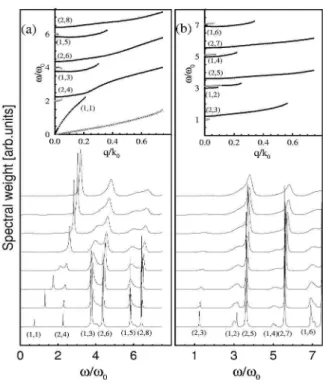
FIG. 1: The spectral weight (a)Seven(q,ω)and (b)Sodd(q,ω)of a Q1D channel formed over the liquid Helium atT= 0.4 K for differ-ent wave-vectors corresponding to those in the inset. The electron density isNe= 104cm−1. The insets give the full dispersion relation
of the plasmon modes (n,m).The open-dots indicate the small peaks due to single-particle excitations.
III. NUMERICAL RESULTS
In Fig. 1, we plot the spectral weight function S(q,ω) for differentqvalues in a quantum wire channel formed on the surface of liquid Helium with an electron densityNe= 104cm−1and temperatureT=0.4K. Theqvalues correspond to those in the inset. Fig. 1(a) and 1(b) show the dispersion re-lations of the plasmon modes(n,m)which have been obtained from the peaks inSeven(q,ω)andSodd(q,ω), respectively. We also see small peaks in the full spectra due to single-particle excitations (SPEs) indicated by the open-dots in the insets. The lowest branch (open-dots) represents the intrasubband SPEs. With increasing q, the spectral weight of the intra-subband (interintra-subband) plasmon modes increases (decreases). We also observe the Landau damping induced gaps appearing aroundω=nω0at smallqwhere the SPEs are strong. Here, ω0is the characteristic frequency describing the quantum wire confinement. We observe that the Landau damping becomes stronger when the plasmon mode(n,m)approaches to the fre-quencyω= (n+1)ω0, where the SPEs are stronger. [7]
Brazilian Journal of Physics, vol. 36, no. 2A, June, 2006 417
FIG. 2: The coupled plasmon-phonon dispersion relations in polar semiconductor based quantum wires atT = 50 K obtained from the peaks of (a)Seven(q,ω)and (b)Sodd(q,ω). The electron density is
Ne= 106cm−1. Thin solid lines show the dispersion relations
with-out electron-phonon interaction. The horizontal dashed lines indi-cate the frequencies of TO and LO phonons, ωT O=4.75ω0 and
ωLO=5.17ω0, respectively. The inset shows the vicinity ofωLO.
plasmon-phonon modes (open-dot curves) in polar semicon-ductor based quantum wires. They are taken from the peaks in (a)Seven(q,ω)and (b)Sodd(q,ω)for different wave-vectorsq. The temperatureT=50 K and the electron densityNe=106 cm−1. The colors indicate the intensity of the spectral weight calculated for allω−qplane. They go from navy-blue (zero intensity) to red, which indicates a variation of 10 times in the spectral intensity. For Ne=106cm−1, two subbands are oc-cupied with the lowest having the most electron density. This helps us to identify the most weighted peaks indicated in Fig. 1. Extra coupled modes labelled as(n,m)′ are better seen in the inset. They show up in the vicinity ofωLOas a result of the electron-phonon interaction. Notice also that the branches above (below)ωLO shift to higher (lower) frequencies when the electron-phonon interaction is considered. The presence of bulk LO-phonons in the system is responsible for such a shift. The upper panels in Fig.2 detail the vicinity of ωLO. The intensity scales in the upper panel are changed accord-ing to the change in theω-axis scale. In this region, only the modes related to electrons in the first subband are of notice-able intensities. But we show the less weighted extra mode (2,8)′appearing in Fig.2(a), while the mode (2,7)is seen in Fig. 2(b). We mention that these modes are being seen at T =50K due to their strong phononlike character.
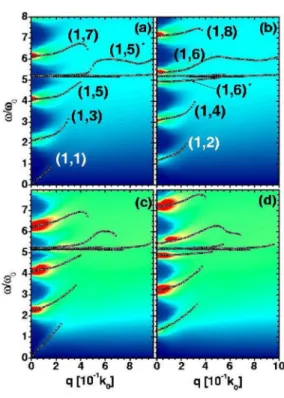
FIG. 3: Coupled intersubband plasmon-phonon modes(1,n) ob-tained by mapping the spectral weight function (a and c)Seven(q,ω)
and (b and d)Sodd(q,ω)atT= 300 K. The electron density in (a) and (b) isNe=106cm−1, whileNe=2.2x106cm−1in (c) and (d).
For the sake of completeness, we compare, in Fig. 3, the dispersion relations at T =300K for two different electron densities. We show in Figs. 3(a) and 3(b) the intersubband coupled modes (1,n)forNe=106cm−1, while Figs. 3(c) and 3(d) show the same forNe=2.2×106cm−1. Spectral weight intensities decrease as the wave-vectorq increases, but they are still clearly noticeable atT=300K (red regions) for both densities.
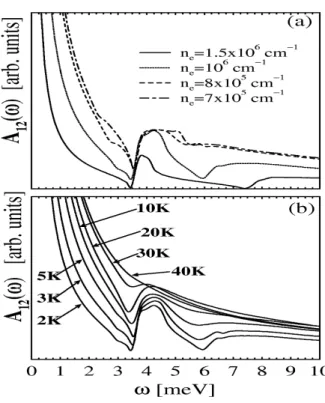
In Fig. 4(a), we showA12(ω)in coupled asymmetric quan-tum wires atT =2K for different charge densitiesNe. The figure shows the effects due to interwire SPEs. These ef-fects lead to a non-monotonic impurity spectral function. AsNedecreases, the narrower wire becomes less populated and the shoulders in the figures get affected. In Fig. 4(b), we show the temperature evolution ofA12(ω)forNe=106cm−1. Al-though the temperature suppresses the interwire excitations, their effects are observable up toT =30K.
IV. CONCLUSIONS
sta-418 Marcos R. S. Tavares and Guo-Qiang Hai
FIG. 4: (a) Interwire spectral functionA12(ω)atT=2 K for differentNein coupled asymmetric quantum wires. As the density decreases, the
narrower wire becomes less populated and the shoulders in the figure get affected. (b) Here we show the temperature evolution ofA12(ω)for
Ne=106cm−1. Interwire SPEs are observable in our calculation up toT= 30 K.
tistics. We found strong intersubband plasmon modes related to the first two subbands. The SPEs in the system are responsi-ble for strong Landau damping at frequenciesω=nω0where gaps appear in the plasmon spectra. We also have mapped out the ω−q plane concerning coupled intersubband plasmon-phonon modes at room temperatures in a multisubband Q1D quantum wires based on polar semiconductors. We remark-ably found coupled intersubband plasmon-phonon modes re-lated to the first subband surviving up to temperatures as high
as 300 K. We finally studied the non-diagonal (interwire) el-ement of the spectral function matrix of a localized impurity in a coupled double quantum wires. We show that the tun-neling between the two asymmetric wires induces interwire (or intersubband) particle-hole excitation effects leading to a pronounced peak in the impurity spectral function up to 20 K.
This work was supported by FAPESP and CNPq.
[1] A. Go˜ni, A. Pinczuk, J.S. Weiner, J.M. Calleja, B.S. Dennis, L.N. Pfeiffer, and K.W. West, Phys. Rev. Lett.67, 3298 (1991). [2] B.Y.-K. Hu and S. Das Sarma Phys. Rev. B48, 5469 (1993). [3] J. Voit, Rep. Prog. Phys.58, 977 (1995).
[4] Yu. Z. Kovdrya and V.A. Nikolaenko, Fizika Nizkikh Temper-ature18, 1278 (1992).
[5] E.H. Hwang and S. Das Sarma, Phys. Rev. B58R1738 (1998); M.R.S. Tavares and G.-Q. Hai , Phys. Rev. B61, 7564 (2000); and O.M. Auslaenderet al., Science295, 825 (2002).
[6] M.R.S. Tavares, G.-Q Hai, and G.E. Marques, Physica E21, 479 (2004).
[7] M.R.S. Tavares, G.-Q. Hai, F.M. Peeters, and N. Studart, Phys. Rev. B68, 140504(R) (2003).
[8] M.R.S. Tavares, Phys. Rev. B71,to appear (2005).
[9] For a rewiew, see G. D. Mahan,Many particle Physics(Plenum, New York, 1981), second edition.