616
DIFFERENCES BETWEEN VOCAL PARAMETERS
OF COCHLEAR IMPLANTED CHILDREN AND CHILDREN
WHO USE INDIVIDUAL SOUND AMPLIFICATION DEVICE
Diferenças entre parâmetros vocais em crianças usuárias
de implante coclear e em crianças usuárias de aparelho
de ampliicação sonora individual
Lourdes Bernadete Rocha de Souza (1)
(1) Phonoaudiologist, Associate Professor III from the
Depart-ment of Phonoaudiology at Federal University of Rio Grande do Norte-UFRN, Natal, RN, Brazil, Post doctorate in Phonoaudiology by USP-Bauru.
Conlict of interest: non-existent
requires of the motor information of the pathways for articulation and sensory information.
Sensory information is obtained through auditory feedback, which also interferes with the correction and improvement of muscle control of the organs involved in vocal production3.
Due to the lack of kinesthetic feedback presented by these children, the vowels tend to be produced with a lower distinction. This lack of distinction is acoustically revealed, among other things, increasing the frequency of the irst formant (F1) and a decrease in the frequency of the second formant (F2)4.
There are compromised characteristics in relation to vocal aspects found in children with deicits in hearing. Resonance can present nasality because the language generally presents posteri-orized due to laryngeal tension, affecting the quality
INTRODUCTION
Normal hearing provides appropriate feedback for the control of voice and speech. Children depend on the feedback provided by audition to control the duration, the fundamental frequency (f0) and formants in the production of vowels. In subjects with severe and profound hearing impairment, there is the increase in average f0 due to the absence of auditory feedback1,2.
The production of voice and speech involve numerous regulatory processes. The stabilization of these processes has its onset in childhood and
ABSTRACT
Purpose: to conduct a comparative study of the vocal parameters in the fundamental frequency, irst formant and second formantof the voice of children with cochlear implants, the voice of children using personal sound ampliication device and normal hearing children. Method: the sample of 18 children (12 girls and 6 boys) aged from 5 to 7 years old (average age 6,3 years).The recording of the samples was performed in the voice laboratory at the speech pathology clinic of the University of Rio Grande do Norte, Natal, using the PRAAT software. The analyzed parameters were fundamental frequency and second formantfrequency of sustained vowel [a] emission and of irst formant and second formant frequencies of vowel [a], for syllables [ka] and [pa]. Results: except for the irst formant of the vowel [a] of the syllable [pa] that showed a statistically signiicant difference among cochlear implant users and normal hearing groups, the other parameters showed statistically signiicant difference among the three groups. Conclusion: children users of cochlear implants present acoustic values close to those of normal hearing children, these values being more adequate than those presented by the children using individual sound ampliication devices.
children with cochlear implants (cochlear implant group-CIG) and 06 children who used hearing aid (hearing aid users group-HAUG), of both genders. The implanted children in this study received a cochlear implant before the age of 4 years old.
Thus, we established the following criteria for inclusion and exclusion:
Children with cochlear implants
• Children with congenital sensor neural hearing loss, severe and/or profound bilateral, lack of intellectual or emotional impairment, partici-pation in (re) habilitation program.
Children using hearing aids
• Children with congenital sensor neural hearing
loss, severe and/or profound bilateral, lack of intellectual or emotional impairment, partici-pation in (re) habilitation program.
Normal hearing children
• Children without hearing problems, no voice disorders, absence of intellectual or emotional impairment.
A recording of the speech sample was performed in the voice laboratory from the Phonoaudiology Clinic from the Federal University of Rio Grande do Norte, in Natal, place with environmental noise under 50 dB and analyzed using the PRAAT software program8 with sampling rate 20050Hz, 16 bit, mono channel, installed on CCE notebook, processor I 3 and 3 GB. The samples of sustained vowel were edited and being deleted the beginning and end of each emission. The procedure for recording was the same for all participants. The children were sitting with the microphone positioned 10 cm from the lips and were asked to produce a sustained vowel /a/ and the words macaco (monkey) and papai (dad).
It was performed acoustic analysis of the vowel [a] and syllables [ka] and [pa] from the words macaco (monkey) and papai (dad), respectively. The analyzed parameters in the emission of vocal [a] and the sustained vowel [a] of the syllables [ka] and [pa] were the f frequency of formants F1 of resonance. The poor monitoring of the speech
results in alteration of f0 intensity and voice duration5. In recent years technology has made it possible for deaf people to enter the world of sound and improve their communicative competence through the cochlear implant that electrically stimulates the auditory nerve improving auditory feedback in these individuals. The cochlear implant systems have become increasingly successful in providing basic skills for the recognition of speech sounds.
Study by Seifert et al5 investigated the f 0 of the sustained vowel [a] performed by 20 children with pre-lingual deafness, implanted before and after 4 years old. The results showed that children implanted before 4 years old showed improvement in voice control faster than children implanted later and better acoustic control over their speech, enabling normalized degrees of f0 as well as better articulation skills.
Dehqan and Scherer2 compared the voice of a group of children with profound hearing loss who were hearing aid users and a group of children with normal hearing, through the analysis of the sustained vowel [a]. The results showed that children with profound hearing loss showed increase of the fundamental frequency in relation to the group of children with normal hearing.
It is mentioned in the literature that some param-eters of the voice of children with deafness differ considerably from the parameters of voice from normal hearing children. On the other hand, there are data in the literature arguing that the voice of children with cochlear implants, after adequate auditory feedback presents the acoustic character-istics closes to normal6,7.
618
Souza LBRDescriptive analysis was performed and the results shown in tables.
To make a comparison between the 3 groups was used the analysis of variance and Tukey test, adopting signiicance level of 5%.
parents signed an informed consent form
autho-rizing their children to participate in the study.
The results of the analysis of the group of children with cochlear implants were compared with the results of children who used hearing aids and with the group of children with normal hearing.
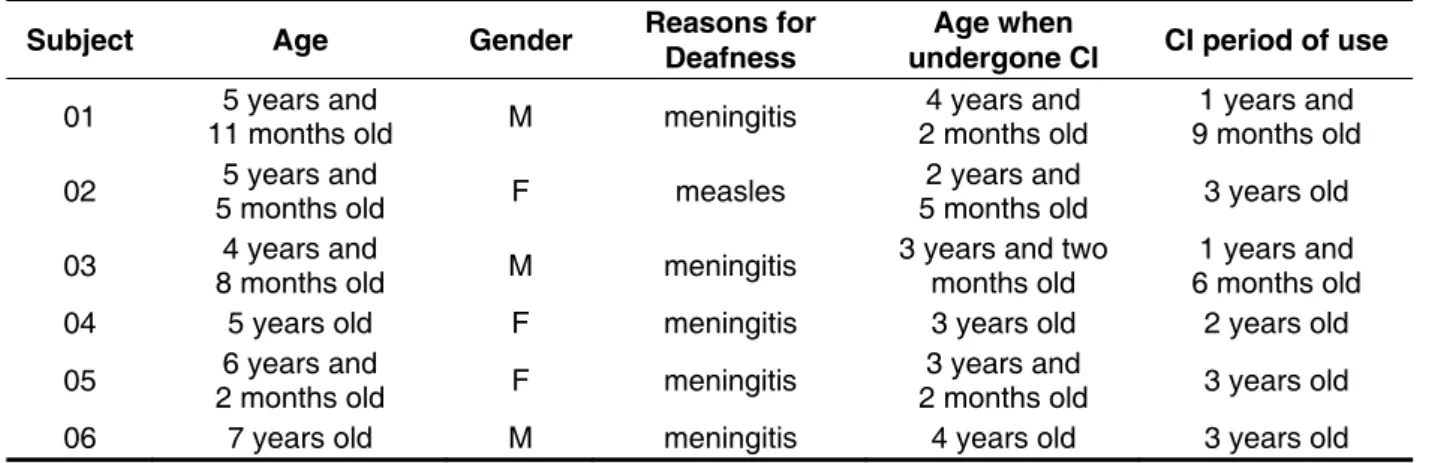
Table 1 – Demographic characteristics of children with cochlear implant
Subject Age Gender Reasons for Deafness
Age when
undergone CI CI period of use
01 11 months old 5 years and M meningitis 2 months old 4 years and 9 months old 1 years and
02 5 months old 5 years and F measles 5 months old 2 years and 3 years old
03 8 months old 4 years and M meningitis 3 years and two months old 6 months old 1 years and
04 5 years old F meningitis 3 years old 2 years old
05 2 months old 6 years and F meningitis 2 months old 3 years and 3 years old
06 7 years old M meningitis 4 years old 3 years old
RESULTS
Data were tabulated and the results analyzed by comparing the values obtained in the three groups.
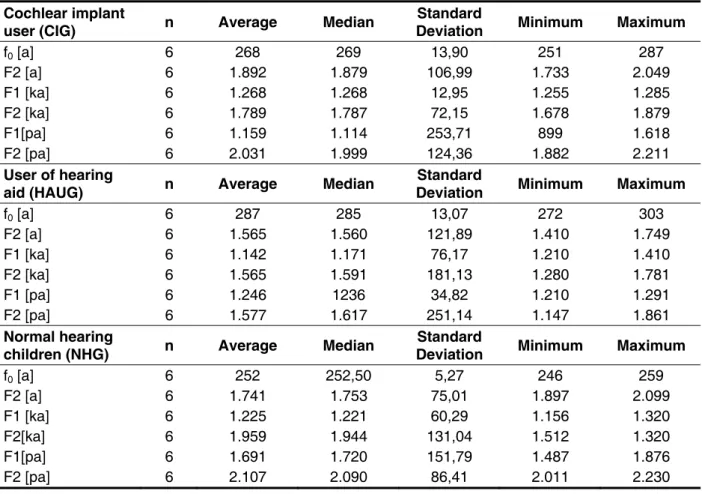
Table 2 presents the results of the descriptive analysis of the evaluated parameters of the three groups.
Table 3 presents the results of analysis of variance of the analyzed parameters among the three groups.
The difference between the values of the variable F1 of the vowel [a] of the syllable [pa] was the only result that the NHG and CIG groups showed a statistically signiicant value.
Voice of cochlear implant users
619
Cochlear implant
user (CIG) n Average Median
Standard
Deviation Minimum Maximum
f0 [a] 6 268 269 13,90 251 287
F2 [a] 6 1.892 1.879 106,99 1.733 2.049
F1 [ka] 6 1.268 1.268 12,95 1.255 1.285
F2 [ka] 6 1.789 1.787 72,15 1.678 1.879
F1[pa] 6 1.159 1.114 253,71 899 1.618
F2 [pa] 6 2.031 1.999 124,36 1.882 2.211
User of hearing
aid (HAUG) n Average Median
Standard
Deviation Minimum Maximum
f0 [a] 6 287 285 13,07 272 303
F2 [a] 6 1.565 1.560 121,89 1.410 1.749
F1 [ka] 6 1.142 1.171 76,17 1.210 1.410
F2 [ka] 6 1.565 1.591 181,13 1.280 1.781
F1 [pa] 6 1.246 1236 34,82 1.210 1.291
F2 [pa] 6 1.577 1.617 251,14 1.147 1.861
Normal hearing
children (NHG) n Average Median
Standard
Deviation Minimum Maximum
f0 [a] 6 252 252,50 5,27 246 259
F2 [a] 6 1.741 1.753 75,01 1.897 2.099
F1 [ka] 6 1.225 1.221 60,29 1.156 1.320
F2[ka] 6 1.959 1.944 131,04 1.512 1.320
F1[pa] 6 1.691 1.720 151,79 1.487 1.876
F2 [pa] 6 2.107 2.090 86,41 2.011 2.230
Table 2 – Demonstrates the result of descriptive analysis of data objectives by the three groups
Analysis of Variance (p) Tukey’s test
( multiple comparisons - p<0,05)
f0 [a] <0,001* CIG ≠ HAUG; NHG ≠ HAUG
F2 [a] <0,001* CIG ≠ HAUG; NHG ≠ HAUG
F1 [ka] 0,005* GIC ≠ HAUG
F2 [ka] 0,001* CIG ≠ HAUG; NHG ≠ HAUG
F1[pa] <0,001* CIG ≠ GON; NHG ≠ HAUG
F2 [pa] <0,001* CIG ≠ HAUG; NHG ≠ HAUG
Table 3 – Demonstrates the result of the analysis of variance and Tukey test
620
Souza LBRnormal hearing. It is believed that this difference is related to the reduction of mouth opening in children of the CIG, favoring decreasing the frequency of the irst formant F1, demonstrating that the quality of a vowel can be described from the point of view of perception via the phonetic or from the point of view of acoustic analysis by the frequency of its formants8.
We can point out, according to the results, that children of the CIG showed better results for the other analyzed parameters that children from HAUG, when compared to the NHG. Children belonging to HAUG showed average values of F2 of the vowel [a] lower than the average values given by the subjects of the CIG in articulating words (macaco – Monkey and papai – Dad). The children who used hearing aids, by the lack of adequate auditory feedback, often have pharyngeal constriction and a dorsal tongue more posterior, which contributes to an increase in the space of the anterior oral cavity, reducing the values of F2.
Acoustic analysis of this study contributed to the understanding of motor adjustments developed by HAUG and the CIG, demonstrating that cochlear implant users are beneited by auditory feedback, had the opportunity to better coordinate articulatory adjustments, revealing better control in the source mechanism and ilter.
CONCLUSION
Although cochlear implants do not restore the experience of perception of sound in the same way it is perceived by the normal hearing people, it provides to the user a better auditory feedback providing opportunities in their communicative competence.
We concluded that children of this study, cochlear implant users, showed values of acoustic parameters closer to the values obtained by normal hearing children, these values being more suitable than the values presented by children using hearing aids.
when compared to the CIG, with this group values closer to the values obtained by NHG (252Hz). The highest value of the f0 of HAUG can be attributed to lack of auditory feedback, the poor laryngeal control involving laryngeal elevation, inability to control the tension of the vocal cords and subglottic pressure2.
It is believed that the values of f0 of the CIG closer to the NHG and the difference was statisti-cally signiicant compared to HAUG (Table 3) are related to the gain control of the hearing (auditory feedback) and, consequently, greater ield of motor adjustments made by the CIG in this study, as well as the neuromuscular skills involved in speech and maturity of these controls9.
The frequency of the second formant F2 is related to the anterior-posterior displacement of the tongue. The value of F2 indicates greater anterior posture of the tongue, while the lower value of F2 indicates posterior position of the tongue10. By analyzing the values of F2 of the sustained vowel /a/, there was an increase in this value in the CIG when compared to HAUG demonstrating these values with the presence of a posterior pharyngeal constriction and tongue in HAUG, indicating lower value of F2.
The larger value of F2 in CIG demonstrated in this group a better adjustment control of the vocal tract, agreeing with Garcia9 when argues that these articulatory changes are related not only to the auditory feedback, as well as the adaptation of neuromuscular skills involved in speech production.
During the speech chained the parameters F1 and F2 of the syllables [ka] and [pa] demonstrated that the CIG was more stable with values closer to the NHG. Hocevar-Boltezar et al11 argues that children with pre-lingual deafness who received a cochlear implant before 4 years old can show improvement in speech between 6 to 10 months after the use of this device.
5 . Seifert E, Oswald A, Bruns AU, Vischer MB, Kompis B, Haeusler R. Changes of voice and articulation in children with cochlear implants. Int J Pediatr Otorhinolaryngol. 2002.66(2):115-23. 6. Campisi P, Low A; Papsin MDR, Mount MLT, Cohen-Kerem R, Harrison R. Acoustic analysis of the voice in pediatric cochlear implant recipients: a longitudinal study. The Laryngoscope.2005.115:1046-50.
7. Baudonck N, D’Haeseleer E, Dhooge I, Van Lierde K. objective vocal quality in children using cochlear implants: a multiparameter approach. J Pediatr Otorhinolaryngol. 2010: 1310-5.
8. PRAAT .Programa computadorizado gratuito de análise-acústica fala. Disponível em: http//. www. praat.org. Acesso em 22 de jun.2006.
9. Garcia JV, Vila Rovira JM, Sanvicen LG. The inluence of the auditory prosthesis type on deaf children’s voice quality. Int J Pediatr Otorhinolaryngol.2010. 74: 843-8.
10. Cukier S, Camargo Z. abordagem da qualidade vocal em um falante com deiciência auditiva: REFERENCES
1. Lejska M. Voice ield measurements – a new method of examination: the inluence of hearing on the human voice. J Voice.2004;18(2):209-15. 2. Dehqan A, Scherer RC. objective voice analysis of boys with profound hearing loss.J Voice. 2011; 25(2):61-5.
3. Poissant SF, Kimberly A, Peters K, Robb MP.Acoustic and perceptual praisal of speech production in pediatric cochlear implant users. Int J Pediatr. Otorhinolaryngol.2006;70(7):1195-203. 4. Mahmoudi Z, Rahati S, Ghasemi MM, Asadpour V, TayaranI H, Rajati M. Classiication of voice disorder in children with cochlear implantation and hearing aid using multiple classiier fusion. 2011. Disponível em:http//.www.biomedical-engineering-online.com/ content/10/1/3. Acesso em 15 de mai.2011
RESUMO
Objetivo: realizar um estudo comparativo entre os parâmetros vocais freqüência fundamental, fre -quência do primeiro formante e fre-quência do segundo formante da voz de crianças usuárias de implante coclear, da voz de crianças usuárias de aparelho de ampliicação sonora individual e da voz de crianças ouvintes normais. Método: a amostra foi composta por 18 crianças (12 meninas e 6 meninos), numa faixa etária entre 5 e 7 anos (média de idade 6,3 anos). A gravação das amostras foi realizada no laboratório de voz da Clínica de Fonoaudiologia da Universidade Federal do Rio Grande do Norte, em Natal. A análise acústica foi realizada utilizando-se o programa PRAAT. Os parâmetros analisados foram frequência fundamental e frequência do segundo formante da emissão da vocal [a] sustentada e frequência dos primeiro e segundo formante da vogal [a] das silabas [ka] e [pa]. Resultados: com exceção do primeiro formante da vogal [a] da silaba [pa] que apresentou diferença estatisticamente signiicante entre os valores dos grupos de usuários de implante coclear e do grupo de ouvintes normais, os demais parâmetros apresentaram diferença estatisticamente signiicante entre os três grupos. Conclusão: as crianças usuárias de implante coclear apresentaram valores acústicos próximos aos apresentados pelas crianças ouvintes normais, sendo esses valores mais adequados do que os apresentados pelas crianças usuárias de aparelho de ampliicação sonora indivdual.