Arq Bras Cardiol volume 74, (nº 2), 2000
Bacal et al. Methotrexate in patients with persistent rejection after transplantation
1 4 5
Instituto do Coração do Hospital das Clínicas – FMUSP
Mailing address: Fernando Bacal – Incor – Av. Dr. Enéas C. Aguiar, 44 05403-000 – São Paulo, SP - Brazil
Objective – To evaluate the use of methotrexate for
the treatment of recurrent rejection in heart transplant recipients.
Methods – We studied 6 patients submitted to heart
transplantation that showed rejection grade ≥3A (ISHLT) in two consecutives endomyocardial biopsy specimens. The dose was 11.26±3.75mg/week. The evaluated data were: ventricular function, endomyocardial biopsy, white cell count and number of rejection episodes before and after methotrexate administration.
Results – There was a reduction in the number of
rejection episodes (5.17±1.47 before methotrexate; 2.33±1.75 after 6 months and 3.17±2.99 after 12 months of treatment, p=0.0193). The ventricular function was nor-mal with ejection fraction of 76.5±4.80 before and 75.6±4.59 after methotrexate (p=0.4859). One patient did not finish the treatment because he showed signs of rejection associated with severe pericardial effusion. Five patients had a reduction in the white cell count (8,108±23.72 before and 5650±1350 after methotrexate, p=0.0961). One pulmonary infection with complete resolution after antibiotic treatment was observed.
Conclusion – Methotrexate in low doses is an
effecti-ve adjunct therapy in the treatment of recurrent rejection after heart transplantation.
Key words: heart transplantation, methotrexate, rejection
Arq Bras Cardiol, volume 74 (nº 2), 145-148, 2000
Fernando Bacal, Viviane Cordeiro Veiga, Alfredo Inácio Fiorelli, Giovanni Bellotti, Edimar Alcides Bocchi, N oedir Antonio Groppo Stolf, José Antonio Franchini Ramires
São Paulo, SP - Brazil
Treatment of Persistent Rejection with Methotrexate in Stable
Patients Submitted to Heart Transplantation
Original Article
The first heart transplant in Brazil was performed by Zerbini in 1968. Currently heart transplantation represents a well-established therapeutic option for end-stage heart fai-lure that does not respond to medical treatment 1.
During the last decade, cyclosporine and other immu-nosuppressant drugs produced better survival rates and quality of life for heart transplant recipients by reducing the frequency and intensity of rejection episodes 2.
Despite the advances in immunosupressant therapy, acute graft rejection is still a major cause of morbidity and mortality in heart transplantation recipients. Acute rejecti-on accounts for 20% and 25% of deaths in the early and late phases after transplantation, respectively 3-10.
Methotrexate, a folic acid analog, was initially used for the treatment of some malignancies, severe psoriasis, and rheumatoid arthritis, and is now being used as an adjuvant immunosuppressant drug in cases of persistent rejection re-sistant to ordinary treatment 3,8,11-13.
The objective of our study was to evaluate the use of low-dose methotrexate in out patients with persistent rejec-tion grade ≥3A (International Society of Heart and Lung Transplantation) 14.
Methods
We studied six patients, five man (83.3%) and one woman (16.7%), mean age 35±19.5 years, who undewent or-thotopic heart transplantation in or Hospital and were follo-wed by the same medical and multidisciplinary team. The diagnoses before heart transplantation were dilated cardio-myopathy (66.6%), ischemic heart disease (16.7%), and Chagas’ disease (16.7%). For baseline characteristics of these patients refer to table I.
1 4 6
Bacal et al.
Methotrexate in patients with persistent rejection after transplantation
Arq Bras Cardiol volume 74, (nº 2), 2000
Persistent rejection was defined as stability or worse-ning of rejection graduation (≥3A) in two consecutive biop-sies 7 to 10 days apart. Patients received two courses of pulse therapy with oral prednisone 1mg/kg per day during four days, followed by 0.2mg/kg reduction every four days until the previous maintenance corticosteroid dose was achieved. If no improvement could be demonstrated, patients were selected to receive low-dose methotrexate in addition to the routine three-drug regimen. The immuno-suppressant drug regimen is further described in table II. Routine posttransplantation evaluation for rejection com-prises three endomyocardial biopsies performed in weeks 1, 2 and 4 after transplantation. Beginning in week 4 (one month after transplantation) recipients underwent gallium-67 isotope scintigraphy every two weeks up to the third month and thereafter monthly up to the sixth month. If clini-cal presentation or gallium scintigraphy were suggestive of rejection, patients then undewent endomyocardial biopsy for diagnostic confirmation. Treatment was only initiated after positive diagnostic findings.
The mean administered dose of methotrexate was 11.26±3.75mg/week for 96±14 days, initiated 554±822 days after transplantation.
The analyzed parameters were: ventricular function, endomyocardial biopsy, white blood cell count, and rejec-tion episodes before and after methotrexate administrarejec-tion. Statistical analysis was performed through paired Stu-dent’s t test with a significance level of p<0.05.
Results
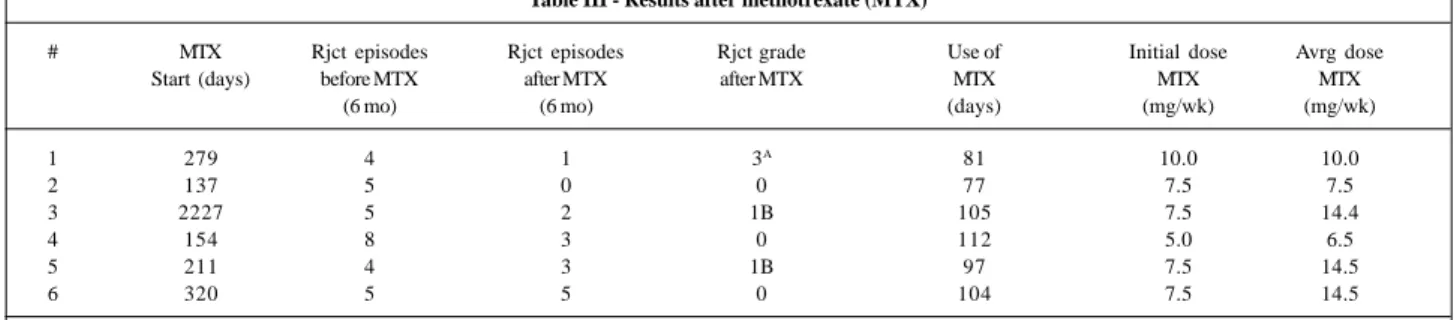
As shown in table III, methotrexate was administered 554±822 days after transplantation, with a starting dose of 7.5±1.58mg/week, an average dose of 11.26±3.75mg, for 96±14 days. Patients had an average of 5.17±1.47 episodes
of rejection before methotrexate, 2.33±1.75 episodes after six months, and 3.17±2.99 episodes after 12 months of treatment (p<0.0193) (fig. 1). Three patients (50%) had no re-jection after methotrexate interruption, 2 patients (33.33%) had rejection grade 1A and one patient was refractory to treatment persisting in rejection grade 3A.
Left ventricular function remained within normal limits. Left ventricular ejection fraction was 76.5±4.8% before and 75.6±4.59 after treatment with methotrexate (p<0.4859) (fig. 2).
One patient did not complete the treatment because he had severe pericardial effusion on echocardiogram associa-ted with signs of fatigue. The patient was admitassocia-ted to the hospital and responded well to intravenous corticosteroid pulse therapy. In five patients a reduction occurred in white cell blood count from 8,108±2,372 before to 5,650±1,350 after treatment with methotrexate (p<0.0961) (fig. 3). We obser-ved one episode of infection with white blood cell count elevation and signs of pulmonary infection. The patient’s status improved after the administration of antibiotics in ad-dition to methotrexate.
Survival rates were 100% in the first year and 83.33% by the end of the fifth year. One patient died 44 months after transplantation due to acute rejection. Survivors remained clinically stable.
Discussion
The folic acid analog methotrexate, initially used for the treatment of some malignancies, severe psoriasis, and rheumatoid arthritis, has been used as adjuvant medication to the routine three-drug immunosuppressant therapy (cy-closporine, azathioprine, prednisone) in cases of persistent rejection 3,8,10,12,13.
The use of methotrexate was proposed in 1988 by Constanzo-Nordin et al, when they reported improvement in 9 out of 10 episodes of persistent rejection after methotre-xate administration 7,11,12.
Methotrexate’s beneficial effects are due to its action in cellular and humoral immune response 4,9,13, reducing B
lym-phocyte ability to secrete antibodies in response to specific and nonspecific stimulation. In addition, methotrexate inter-feres with cytokine production through interleukin secretion and reduces purine synthesis causing diminution in lym-phocyte proliferation 11,13,15,16.
Only one patient in the study did not reach the end of the proposed treatment because of fatigue, leg edema and severe pericardial effusion demonstrated by chest radio-gram and echocardioradio-gram. He was admitted to the hospital to receive corticoid pulse therapy.
Patients in this study were clinically and hemodynami-cally stable, and it is known that such patients have lower mortality. However, the question of whether or not to treat rejections in cases like these remains unsolved. There are cli-nical reports describing patients treated without pulse the-rapy for rejection grade 2 and also reports from groups that defend control of rejection at any price considering the
re-Table I - Patients identification
# Sex Etiology Age Tx date Bx
pre-treatment
1 F Dilated 59 28/12/96 3A
2 M Dilated 9 16/9/93 3A
3 M Dilated 37 26/6/85 3A
4 M Chagas 16 22/3/93 3A
5 M Ischemic 52 15/4/91 3A
6 M Dilated 37 19/8/90 3A
Table II – Immunosuppressant therapy
# Azathioprine Prednisone Cyclosporine level (ng/ml) (mg/kg/day) (mg/kg/day) (mg/kg/day) cyclosporine
1 2.86 0.28 4.3 178
2 0.89 0.16 5.6 256
3 1.25 0.16 4.0 170
4 1.85 0.27 6.5 111
5 2.35 0.17 4.0 123
Arq Bras Cardiol volume 74, (nº 2), 2000
Bacal et al. Methotrexate in patients with persistent rejection after transplantation
1 4 7
duction of future complications, including graft vascular complications 17-22.
Our group of patients had a particularly high inciden-ce of rejection, especially considering the period of treat-ment initiation (after six months). In this period moderate rejection is rarely seen. However, it is well established that, even with the therapeutic arsenal currently available, a few
Table III - Results after methotrexate (MTX)
# MTX Rjct episodes Rjct episodes Rjct grade Use of Initial dose Avrg dose
Start (days) before MTX after MTX after MTX MTX MTX MTX
(6 mo) (6 mo) (days) (mg/wk) (mg/wk)
1 279 4 1 3A 81 10.0 10.0
2 137 5 0 0 77 7.5 7.5
3 2227 5 2 1B 105 7.5 14.4
4 154 8 3 0 112 5.0 6.5
5 211 4 3 1B 97 7.5 14.5
6 320 5 5 0 104 7.5 14.5
MTX- methotrexate; Rjct- rejection; Gr- rejection grade; wk- week; Avrg- average.
patients will still experience rejection. Factors that might contribute for these findings are donor versus recipient histocompatibility, recipient of the female sex, drug interac-tions modifying serum levels of cyclosporine, sensitized re-cipients, and other causes yet to be understood 6,7,12.
Infections are relatively common during methotrexate therapy. Constanzo-Nordin et al reported the case of a patient who died of Pseudomonas sp pneumonia after one intravenous dose of methotrexate (150mg). Possibly, the administered drug might predispose a patient to this compli-cation 3,4,12. In our group of patients, one subject had one
episode of upper respiratory tract infection and received an-tibiotics with prompt resolution.
The initial dosage of methotrexate used in our study was smaller than the usual dose reported in the literature; nevertheless, it resulted in similar success rate, obtaining a reduction in moderate rejection episodes.
Some studies have reported severe leukopenia that pro-bably interfered with the morbidity and mortality in their patients 4,11,12. In our study, we found a reduction in white blood
cell counts in five patients, but in none was there a need to in-terrupt the treatment. The synergistic myelosuppressor effect of azathioprine plus methotrexate might limit the use of this association: however, in clinical practice, several groups have maintained an azathioprine regimen, performing weekly blood cell counts, and suspending methotrexate administration if leukocyte count fell below 4,000 cells/mm3. Using lower doses
of methotrexate we found a mild reduction in white blood cell count, but it was no limitation for the treatment of our patients. In conclusion, methotrexate is a safe and effective adjuvant immunosuppressant therapy, promoting reducti-on in rejectireducti-on episodes, with mild side effects and is capa-ble of preserving myocardial function.
Limitations of this study: Although the treatment was administered to a preselected group of patients, this was not a randomized clinical trial for it lacked a control group of patients using corticoid pulse therapy, and therefore we could not compare the efficacy and safety of each regimen. The number of patients in our study was small be-cause persistent rejection is less frequently seen with the currently available three-drug immunosuppressant regi-men. Most cases of rejection subside after the first course of corticoid pulse therapy.
Fig. 1 – Episodes of rejection before and after methotrexate administration.
Fig. 2 – Left ventricle ejection fraction before and after methotrexate.
Fig. 3 – White blood cell count before and after methotrexate.
Pre-MTX Post-MTX
Pre-MTX Post-MTX
1 4 8
Bacal et al.
Methotrexate in patients with persistent rejection after transplantation
Arq Bras Cardiol volume 74, (nº 2), 2000
1. Zerbini EJ. Transplante cardíaco. 25 anos de Transplante Cardíaco no Brasil 1993: 13-15.
2. Robbins RC, Barlow CW, Oyer PE, et al. Thirty years of cardiac transplantation at Stanford university. J Thorac Cardiovasc Surg 1999; 117: 939-51. 3. Bouchart F, Gundry SR, Van Schaack-Gonzales J, et al. Methotrexate as
rescue/ad-junctive immunotherapy in infant and adult heart transplantation. J Heart Lung Transplant 1993; 12: 427-33.
4. Bourge RC, Kirklin JK, White-Williams C, et al. Methotrexate pulse therapy in the treatment of recurrent acute heart rejection. J Heart Lung Transplant 1992; 11: 1116-24.
5. Forni A, Faggian B, Chiominto B, Mazzucco A. Combined chronic administra-tion of methotrexate and cyclosporine a following cardiac ongoing rejecadministra-tion. Transplant Proc 1998; 30: 1140-2.
6. Chan GL, Weinstein SS, Vijayanagar RR. Treatment of recalcitrant cardiac allo-graft rejection with methotrexate. Cardiac Transplant Team Clin Transplant 1995; 9: 106-14.
7. Hosenpud JD, Hershberger RE, Ratkovec RR, et al. Methotrexate for the treat-ment of patients with multiple episodes of acute cardiac allograft rejection. J Heart Lung Transplant 1992; 11: 739-45.
8. Taylor OD, Olsen SL, Ensley D, et al. Methotrexate for rejection prophylaxis af-ter heart transplantation. J Heart Lung Transplant 1995; 14: 950-4. 9. Olsen SL, O’Connell JB, Bristow MR, et al. Methotrexate as an adjunct in the
treat-ment of persistent mild cardiac allograft rejection. Transplantation 1990; 50: 773-5. 10. Ross HJ, Gullestad L, Pak J, Slauson S, Valantine HA, Hunt SA. Methotrexate or total lymphoid radiation for treatment of persistent or recurrent allograft cellular rejection: a comparative study. J Heart Lung Transplantation 1997; 16: 178-89. 11. Chinnock R, Emery J, Larsen R, et al. Methotrexate therapy for complex graft rejection in pediatric heart transplant recipients. J Heart Lung Transplant 1995; 14: 726-33.
References
12. Costanzo-Nordin MR, Grusk BB, Silver MA, et al. Reversal of recalcitrant cardiac allograft rejection with methotrexate. Circulation 1988; 78(suppIII): III-47-57. 13. Shaddy RE, Bullock EA, Tani LY, et al. Methotrexate therapy in pediatric heart transplantation as treatment of recurrent mild to moderate acute cellular rejection. J Heart Lung Transplant 1994; 13: 1009-13.
14. Billingham ME, Cary NRB, Hammond ME. A working formulation for the stan-dardization of nomenclature in the diagnosis of heart and lung rejection: heart rejection study group. J Heart Lung Transplant 1990; 9: 587-92.
15. Rosenthal GJ, Weigand GW, Germolec DR. Supression of B cell function by me-thotrexate and trimetrexate: evidence of inhibition of purine biosynthesis as a major mechanism of action. J Immunol 1988; 141: 410-6.
16. Segal R, Mozes E, Yaron M. The effects of methotrexate on the production and ac-tivity of IL-1. Arthritis Rheum 1989; 32: 370-7.
17. Costanzo MR, Koch DM, Fisher SG, Heroux AL, Kao WG, Johnson MR. Effects os methotrexate on acute rejection and cardiac allograft vasculopathy in heart transplant recipients. J Heart Lung Transplant 1997; 16: 169-78.
18. Hosenpud JD, Bennett LE, Keck BM, Fiol B, Novick RJ. The registry of the Inter-national Society for Heart and Lung Transplantation: fourteenth official report – 1997. J Heart Lung Transplant 1997; 16: 691-712.
19. Weis M, von Scheidt W. Cardiac allograft vasculopathy: a review. Circulation 1997; 96: 2069-77.
20. Baan CC, Holweg CT, Niesters HG, et al. The nature of acute rejection is asso-ciated with development of graft vascular disease after clinical heart transplanta-tion. J Heart Lung Transplant 1998; 17: 363-73.
21. Orbaek Andersen H. Heart allograft vascular disease: an obliterative vascular di-sease in transplanted hearts. Atherosclerosis 1999; 142: 243-63.