rev bras hematol hemoter. 2014;36(6):448–449
Revista
Brasileira
de
Hematologia
e
Hemoterapia
Brazilian
Journal
of
Hematology
and
Hemotherapy
w w w . r b h h . o r g
Letter
to
the
Editor
Prevalence
of
anemia
in
2673
of
6-
and
7-year-old
schoolchildren
from
São
José
dos
Campos,
State
of
São
Paulo
DearEditor,
Anemia hasa great impacton cognitive development and
physicalgrowth inpreschool-agedchildren.1 InBrazil,
ane-miaratesinchildrenvaryaccordingtoregion,agegroupand
sample.2–4
Thepresentstudymeasuredtheprevalenceofanemiaina
representativesampleof2673schoolchildrenenrolledinthe
firstandsecondgrades(6and7yearsold)of40schoolsinthe
cityofSãoJosé dosCampos,StateofSãoPaulo.Thestudy
used data from the Pincel Mágico program5 which counts
on the support ofthe Health and EducationDepartments.
Theprogramaimstoidentifysigns,pathologicaltendencies
orestablisheddiseasesaswell astopromotebetterhealth
conditionsintheschoolenvironment.Themethodsofthis
program,includingprocedures,sampledesign,blood
collec-tionandethicalaspects,havebeendescribedpreviously.5The
WorldHealthOrganization(WHO)criteriawereusedtodefine
anemia(hemoglobin<11.5g/dL)andassesstheseverity.6The
studywasapprovedbytheResearchEthicsCommitteeofthe
UniversidadePaulista(UNIP)(#402630).
Table2–Hemoglobin(Hb),hematocrit(%)andmeancorpuscularvolume(MCV)levelsinmildandmoderateanemia groupsaccordingtogenderandage.
Female(6years) Male(6years) Female(7years) Male(7years)
Mildanemia
n 17 15 11 13
Hb(g/dL) Median(range)
11.2 (11.0–11.4)
11.2 (11.0–11.4)
11.3 (11.0–11.4)
11.2 (11.0–11.4) Ht(%)
Median(range)
34.1 (32.7–38.0)
34.7 (32.0–37.9)
34.6 (31.6–38.3)
34.6 (32.2–38.1) MCV(fL)
Median(range)
79.6 (76.6–89.6)
79.0 (73.9–87.2)
79.4 (67.5–87.1)
78.6 (73.8–90.0)
Moderateanemia
n 16 10 15 15
Hb(g/dL) Median(range)
10.7 (9.1–10.9)
10.7 (9.7–10.9)
10.7 (10.1–10.9)
10.7 (9.7–10.9) Ht(%)
Median(range)
33.4 (26.0–37.1)
33.2 (32.3–34.3)
33.0 (31.1–38.0)
33.0 (32.0–35.9) MCV(fL)
Median(range)
77.9 (62.6–84.4)
77.1 (63.5–80.7)
73.1 (66.4–81.6)
76.6 (58.2–87.9)
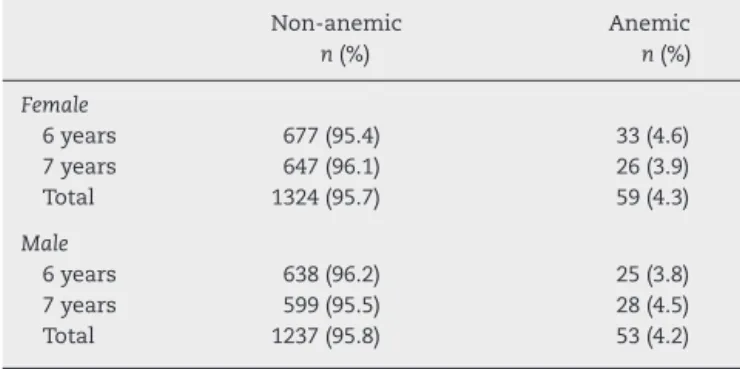
Table1–Distributionofcasesaccordingtogenderand ageinnon-anemicandanemicgroups.
Non-anemic
n(%)
Anemic
n(%)
Female
6years 677(95.4) 33(4.6)
7years 647(96.1) 26(3.9)
Total 1324(95.7) 59(4.3)
Male
6years 638(96.2) 25(3.8)
7years 599(95.5) 28(4.5)
Total 1237(95.8) 53(4.2)
Thetotalprevalenceofanemiainthis samplewas4.2% withsimilar valuesbeingfoundbetween6-yearold and 7-year-oldchildren(Table1).Withregardtotheanemicgroup,
mildandmoderateclassificationsofanemiaweredistributed
equallybetweenmalesandfemalesinbothagegroups.
More-over, themedianvaluesofmean corpuscularvolume were
revbrashematolhemoter.2014;36(6):448–449
449
Althoughbasedoncross-sectionaldata, ourresults
sug-gestlower prevalence ofanemiain this agerange. Similar
datawere foundbyMartins etal.5Incontrast,Costaetal.2
demonstratedthat6-and7-year-oldchildrenattending
pub-licpreschoolsinIlhabela,StateofSãoPaulohadestimatesof
prevalenceof23.4%and24.3%,respectively.Inaddition,Brito
etal.3showedthat36% ofchildrenwithagesrangingfrom
seventonineyearshadanemiainthecityofJequiá
(northeast-ernregionofBrazil).Moreover,inapopulation-basedstudy
designedtomeasuretheprevalenceofanemiainahealthy
populationofchildrenfrom theStateofRioGrandedoSul
(southernBrazil)theprevalenceofanemiaamongover6-year
oldswas31%.4
Reports have found many risk factors for anemia in
preschool-agedchildrenincludingsocioeconomiclevel,
nutri-tion, healthcare and biological factors; iron deficiency is
consideredanimportantcauseofanemiainpreschool-aged
children.7Weobservedahigherproportionofmicrocytic
ane-miawiththesefindingssuggestingapossibleassociationwith
irondeficiency.Thisissuerequiresfurtherinvestigation.
Conflicts
of
interest
Theauthorsdeclarenoconflictsofinterest.
r
e
f
e
r
e
n
c
e
s
1.LozoffB,CorapciF,BurdenMJ,KacirotiN,Ângulo-BarrosoR, SazawalS,etal.Preschool-agedchildrenwithirondeficiency anemiashowalteredaffectandbehavior.JNutr.
2007;137(3):683–9.
2.CostaJT,BraccoMM,GomesPAP,GurgelRQ.Prevalenceof anemiaamongpreschoolersandresponsetoiron supplementation.JPediatr(RioJ).2011;87(1):76–9.
3.BritoLL,BarretoML,SilvaRC,AssisAM,ReisMG,ParragaI, etal.Fatoresderiscoparaanemiapordeficiênciadeferroem crianc¸aseadolescentesparasitadosporhelmintosintestinais. RevPanamSaludPublica/PanAmJPublicHealth.
2003;14(6):422–31.
4.SillaLM,ZelmanowiczA,MitoI,MichalowskiM,HellwingT, ShillingMA,etal.Highprevalenceofanemiainchildrenand adultwomeninanurbanpopulationinsouthernBrazil.PLOS ONE.2013;8(7):e68805.
5.MartinsVL,MelioneLP,Bismarck-NasrEM,OliveiraMG. ProgramaPincelMágico:avaliac¸ãodascondic¸õesdesaúdede escolaresdosprimeirosesegundoanosdoensino
fundamental.RevPaulPediatr.2012;30(4):486–92.
6.WorldHealthOrganization.Haemoglobinconcentrationsfor thediagnosisofanaemiaandassessmentofseverity.WHO; 2011[WHO/NMH/NHD/MNM/11.1].
7.KonstantynerT,OliveiraTCR,TaddeiJAAC.Riskfactorsfor anemiaamongBrazilianinfantsfromthe2006National DemographicHealthSurvey.Anemia.2012;2012:850681.
CláudiaAlvesdaSilvaa,AdrianoMoraesdaSilvaa,
FernandoCallerab,∗
aUniversidadePaulista(UNIP),SãoJosédosCampos,SP,Brazil bCentrodeHematologiadoVale,SãoJosédosCampos,SP,Brazil
∗Correspondingauthorat:CentrodeHematologiadoVale,Rua
EuclidesMiragaia,700,sala75,Centro,12245-820SãoJosédos
Campos,SP,Brazil.
E-mail address: [email protected]
(F.Callera).
1516-8484/©2014Associac¸ãoBrasileiradeHematologia,
HemoterapiaeTerapiaCelular.PublishedbyElsevierEditora
Ltda.Allrightsreserved.
http://dx.doi.org/10.1016/j.bjhh.2014.07.015
Received9May2014
Accepted8June2014