Repositório ISCTE-IUL
Deposited in Repositório ISCTE-IUL:
2018-12-04Deposited version:
Post-printPeer-review status of attached file:
Peer-reviewedCitation for published item:
Souto, N. & Dinis, R. (2018). Efficient MIMO detection for high-order QAM constellations in time dispersive channels. In 2018 IEEE International Conference on Communications, ICC 2018. Kansas City: IEEE.
Further information on publisher's website:
10.1109/ICC.2018.8423046Publisher's copyright statement:
This is the peer reviewed version of the following article: Souto, N. & Dinis, R. (2018). Efficient MIMO detection for high-order QAM constellations in time dispersive channels. In 2018 IEEE International Conference on Communications, ICC 2018. Kansas City: IEEE., which has been published in final form at https://dx.doi.org/10.1109/ICC.2018.8423046. This article may be used for non-commercial purposes in accordance with the Publisher's Terms and Conditions for self-archiving.
Use policy
Creative Commons CC BY 4.0
The full-text may be used and/or reproduced, and given to third parties in any format or medium, without prior permission or charge, for personal research or study, educational, or not-for-profit purposes provided that:
• a full bibliographic reference is made to the original source • a link is made to the metadata record in the Repository • the full-text is not changed in any way
The full-text must not be sold in any format or medium without the formal permission of the copyright holders.
Serviços de Informação e Documentação, Instituto Universitário de Lisboa (ISCTE-IUL) Av. das Forças Armadas, Edifício II, 1649-026 Lisboa Portugal
Phone: +(351) 217 903 024 | e-mail: [email protected] https://repositorio.iscte-iul.pt
Efficient MIMO Detection for High-Order QAM
Constellations in Time Dispersive Channels
Nuno Souto
1and Rui Dinis
21 ISCTE-University Institute of Lisbon / Instituto de Telecomunicações, 1649-026 Lisboa, Portugal [email protected]
2 FCT - Universidade Nova de Lisboa/ Instituto de Telecomunicações, 2829-516 Caparica, Portugal, [email protected]
Abstract— In this paper, we apply a generalized form of the alternating direction method of multipliers (ADMM) and derive a multiple-input multiple-output (MIMO) detection algorithm for single carrier transmissions in time dispersive channels. The proposed algorithm supports different penalty parameters for each individual subcarrier and antenna and also includes a relaxation coefficient in the iterations. Besides evaluating the impact of these parameters, a method is presented for the automatic selection of the penalty. It is shown through simulations that very competitive performances can be obtained with the proposed approach for systems with high-order modulation combined with large antenna settings.
Keywords—Nonconvex optimization, ADMM, MIMO detection, single carrier with frequency domain equalization, time dispersive channels.
I. INTRODUCTION
Multiple-input multiple-output (MIMO) schemes have been one of the main research topics in the area of wireless communications due to the theoretical spectral efficiency gains that can be achieved [1] and are one of the key technologies for fifth generation (5G) networks and beyond. As the maximum-likelihood detection (MLD) for a MIMO transmission is non-deterministic polynomial time-hard (NP-hard) problem [2], various low complexity suboptimal receivers have been proposed in the literature (an extensive survey is presented in [1]). Still, many of these detectors assume flat fading channels which make them adequate mostly for orthogonal frequency-division multiplexing (OFDM) schemes [3] or single carrier (SC) MIMO transmissions in narrowband channels [4]. For a SC transmission in a time dispersive channel which, is typical in broadband wireless systems, the receiver also has to deal with the high levels of intersymbol interference (ISI) present in the received signals. Therefore, several solutions have been proposed for joint MIMO detection and ISI suppression [5]-[9]. Many of the proposed receivers are based on nonlinear schemes and comprise frequency domain processing [6]-[9]. These schemes avoid a high decoding complexity associated to a full-time domain implementation (like in [5]) in large problem sizes. Furthermore, they are able to reduce the performance gap to
the matched filter bound (MFB) when compared with frequency domain linear equalizers such as zero-forcing (ZF) and minimum mean squared error (MMSE). Amongst the available solutions, one of the most appealing ones is the iterative block decision feedback (IB-DFE) equalizer [7], due to its excellent performances. However, this receiver requires a full matrix inversion for each subcarrier and iteration which can still lead to significant receiver complexity especially in large problem settings.
The alternating direction method of the multipliers (ADMM) is a well-known approach within the field of convex optimization due to its simplicity, operator splitting capabilities and convergence guarantees under mild conditions [10]. Besides its broad application in convex problems, there has been a recent interest in its use as a heuristic for solving nonconvex problems as well [10]-[15], often with excellent performance. In line with these approaches, in [16] we derived an ADMM based algorithm for the nonconvex problem of MIMO detection and equalization in time dispersive channels where its ability to achieve very promising results was observed. However, an important aspect that affects the operation of ADMM is the choice of the penalty parameter ρ. In the case of convex problems this parameter has an impact on the convergence speed to the guaranteed global optimum. For nonconvex problems, such as MIMO detection and equalization, the penalty parameter also influences the quality of the solution [10],[16]. It is important to note that optimal parameter selection is still an active area of research even for convex problems [17] . In order to support a finer and more flexible tuning of the detector, in this paper we extend the work in [16] and derive a generalized frequency domain based ADMM (GFD-ADMM) detector for arbitrary signal constellations where different penalty parameters can be applied to each individual subcarrier and antenna. The application of a generalized form of ADMM not only allows us to decompose the detection problem into a sequence of simpler subproblems with closed-form solutions but also enables us to have control over a wider set of parameters for improving the performance of the receiver. In this extended formulation, we also include a relaxation parameter which is a technique which can improve the convergence properties of
the algorithm. We also evaluate the impact of different strategies for penalty parameter selection in different scenarios and compare the proposed receiver against the matched filter bound and other existing methods, in particularly the IB-DFE.
The remainder of this paper is organized as follows. Section II describes the MIMO system model. Section III formulates the detection problem, derives the GFD-ADMM algorithm with the inclusion of relaxation and multiple penalty parameters and presents an algorithm for penalty selection. Numerical results are presented and discussed in Section IV followed by conclusions drawn in Section V.
II. SYSTEM MODEL
In the following we will consider a MIMO system with Mtx
transmitter antennas and Nrx. receiver antennas. It is assumed that an N-sized block transmission during which the channel remains constant is employed, combined with a cyclic prefix (CP) whose length is longer than the channel memory. The received signal samples in the time domain (after dropping the CP) can be represented using
=
y Ωs n, (1) where s is the NMtx1 vector with the transmitted symbols selected from a M-sized complex valued set and nNNrx1
is the noise vector whose elements are independently drawn from a zero-mean circularly symmetric Gaussian distribution with covariance 2 2
rx
N N
I ( In symbolizes the n×n identity matrix). Ω is the NMrxNMtxchannel matrix defined as
0 1 1 0 1 1 1 0 1 0 L L L L L Ω 0 Ω Ω Ω Ω 0 Ω Ω 0 Ω Ω 0 0 0 Ω Ω , (2) where 1,1 1, ,1 , tx rx rx tx l l M l l l N N M h h h h Ω , (3)
, 0,..., 1 l j i l L h represents the time domain complex samples of
the channel impulse response between transmit antenna i and receive antenna j and L is the length of the channel memory. Note that model (1) can represent a point-to-point MIMO transmission as well as a MIMO multiple access scenario where several geographically distributed users simultaneously transmit to a serving base station. Due to the block circulant structure of Ω we can apply the well-known decomposition of circulant matrices into the product of a complex conjugate transpose of a discrete Fourier transform (DFT) matrix, a diagonal matrix and a DFT matrix and write
rx
tx
H
N M
Ω F I H F I , (4)
where (.)H denotes the conjugate transpose, AB corresponds to the Kronecker product between matrices A and B and F represents the normalized N×N DFT matrix
1 1 2 2 1 2 4 1 1 2 1 1 1 1 1 1 1 1 1 1 N N N N N N N F , (5)
with ω being a Nth primitive root of unity, exp( 2 / )j N . Matrix H is block diagonal and can be expressed as
0 1 1 0 0 0 0 0 0 N H H H H (6) with 1 1 1,1 1, 0 0 1 1 ,1 , 0 0 tx rx rx tx L L n kn n kn M n n k L L n kn n kn N N M n n h h h h
H . (7)This allows us to write the received signal in the frequency domain using
Nrx
Y F I y HS N , (8)
where S
FIMtx
s and N
FINrx
n . In the following it assumed that the receiver has perfect knowledge about H (perfect channel state information).III. GENERALIZED FREQUENCY DOMAIN ADMM
A. Algorithm Description
In order to obtain a reduced complexity detector with most of the decoding steps performed in the frequency domain we start by formulating the maximum likelihood detection (MLD) problem taking into account the frequency domain representation (8), which leads to
2 2 min s Y HS (9) subject to sNMtx (10)
Mtx
S F I s , (11) where ||.||2 represents the 2-norm of a vector. Due to the discrete constraint set used in (10), the resulting optimization problem is nonconvex. In order to apply ADMM we start by resorting to the indicator function INMtx( )z defined as 0 if
tx
NM
z and +∞ otherwise, which allows us to rewrite the MLD problem as 2 2 , min I NMtx( ) S z Y HS z (12)
subject to S FIMtx z (13)
Noting that our formulation is defined over complex valued variables, we can write the augmented Lagrangian using
2 2 ( , , ) NMtx( ) L S z U Y HS I z
tx
tx
H H M M S F I z U Ρ S F I z U U U, (14)where UNMtx1 is the scaled dual variable and 1
diag( ,...,
N M tx) Ρ , where ρi are the penalty parameters.
Note that we are applying a generalized version of the ADMM where we can employ a different penalty parameter for each individual equality constraint in (13). The application of ADMM allows us to decompose the MLD problem into a series of simpler subproblems corresponding to the independent minimization of the Augmented Lagrangian over variables S and z and its maximization over the dual variable U using gradient ascent [10]. The resulting algorithm will then consist on the following iterative steps
1 min ( , , ) t L t t S S S z U (15) 1 min ( 1, , ) t L t t z z S z U (16)
1 1 1 tx t t t t M U U S F I z . (17)Regarding the S-minimization step (15), it is simple to find a
closed-form expression using H ( , , ) 0
t t
L
S S z U which,
combined with the diagonal block structure of H, results in
1
1 t H H t t k k k k k k k k k S H H Ρ H Y Ρ Z U (18) with k=0,1,…N-1. Vectors t 1 k S , t k Z , t kU and diagonal matrix
k
Ρ are Mtx-sized slices of S , t1 Z , t U and t Ρ with the kth subcarrier respective components.
Concerning the z-update in (16), it can be obtained through the projection operation onto NMtx [10], defined as
NMtx , according to
1 1 NMtx tx t H t t M z F I S U . (19)This projection, can be implemented through an element wise rounding to the closest element in .
B. Relaxation
A modification that can applied to the algorithm consists in the use of a technique called relaxation where St1 is replaced
by 1
1
tx
t t t t
M
S FI z in the z and U update
expressions. This leads to
1 1 1 NMtx tx t H t t t t t M z F I S U z (20)
1 1 1 1 tx t t t t t t t M U U S F I z z , (21)where tis the relaxation parameter which can take values in
the interval (0, 2] [10]. When t 1, (20) and (21) reduce to
Algorithm 1: GFD-ADMM algorithm for MIMO detection in time dispersive channels
1: Input: U0, z , H, Y, 0 Ρ,
, Q, N 2: sˆz0. 3: Z0
F I Mtx
z0. 4: fbest f
Z . 0 5: for t=0,1,…Q-1 do 6: for k=0,1,…,N-1 do 7: t 1
H
1
H
t t
. k k k k k k k k k S H H Ρ H Y Ρ Z U 8: end for 9: 1 N Mtx
tx
1
1
t H t t t t t M z F I S U z . 10: t 1
Mtx
t 1 Z F I z . 11: If f
t 1 fbest Z then 12: sˆzt1. 13: fbest f
t 1 Z . 14: end if 15: Ut1UttSt1
1 t
ZtZ . t1 16: end for 17: Output: ˆs .the original update expressions (19) and (17). The sequence of steps comprising the GFD-ADMM detector are detailed in Algorithm 1 where Q is the number of iterations, ˆs is the estimate of the transmitted symbols and f S
is the original objective function in the MLD problem formulation, defined as
22
=
f S Y HS . (22)
Note that the only step performed in the time domain is the rounding operation applied in the z update (20).
C. Penalty Parameter Selection
Although the penalty parameter selection is still a topic of research even for convex problems, it was found in [17] an expression for the penalty parameter that minimizes the convergence factor for constrained quadratic programs. While our MLD formulation also involves a quadratic objective function, the discrete constraint set (10) makes the problem nonconvex and consequently it does not fit the problem class addressed in [17]. Nonetheless, we propose the use of a computation method inspired by the approach which is
detailed in Algorithm 2. In the algorithm,
H
k k
H H
represents the set of distinct eigenvalues of H k k
H H . Line 5 has the purpose of dealing with ill-conditioned channel matrices which could result in extremely high values for the penalty parameter. This method generates a single penalty value for all subcarriers and antennas.
Algorithm 2: Computation of penalty matrix Ρ 1: Input: H 2: max , 0 min 3: for k=0,1,…,N-1 do 4: max, max
H k k k H H5: min, min
: log10
max,
3
H
k k k k
H H
6: max max
max,k,max
7: min min
min,k,min
8: end for 9: 24 3 min max 4 M 10: Ρ
IMtx 11: Output: P. D. ComplexityIn the proposed algorithm, the multiplications of vectors by matrices
F I Mtx
and
tx
H M
F I correspond to Mtx DFT
and Mtx inverse DFT operations, which have a complexity order of O N
log2N if a fast Fourier transform algorithm is
applied [18]. Besides to the DFT computations, the step with the heaviest contribution to the overall complexity is the S-update (18) which involves N matrix inversions. However, assuming a constant P for every iteration, the matrix inverses only have to be computed once and the complexity order
contribution is
3 2
tx tx
O NM NQM . As a result, the total
complexity order per data symbol becomes
3 2
2
log
tx tx tx
O M Q N M QM . For comparison, the
complexity order of the frequency domain linear MMSE is
3 2
2
log
tx tx tx
O M N M M while for the IB-DFE is
3 2
2
log
tx tx tx
O M Q N QM QM which is higher than the
GFD-ADMM due to the need to recompute the inverse of a
rx tx
M M matrix for each subcarrier in every iteration.
IV. NUMERICAL RESULTS
In this section we present several performance results using the proposed GFD-ADMM with different parameter selection strategies. The results were obtained through Monte Carlo simulations for an uncoded SC transmission with N=256, a block duration of 67μs and a CP with 16.7μs. The channel model selected for each pair of transmit and receive antennas was the extended typical urban model [19] which is representative of a typical severely time-dispersive channel with rich multipath propagation. All the coefficients of the channel impulse responses,
, 1,...,0,..., 1; 1,...,tx rx
i M j N l
j i l L
h , are drawn as
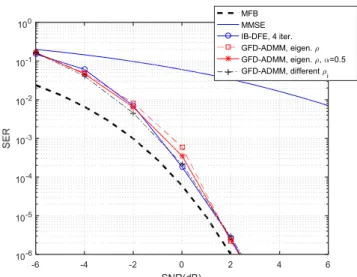
Fig. 1. SER performance of a 16x16 MIMO system with QPSK and Q=50.
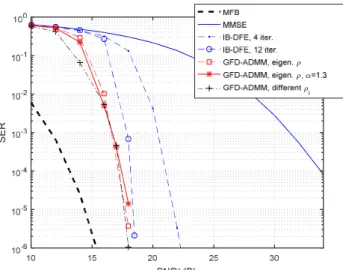
Fig. 2. SER performance of a 16x16 MIMO system with 16-QAM and Q=50.
independent and identically distributed, zero-mean, complex Gaussian random variables.
Fig. 1 shows the symbol error rate (SER) as a function of the signal-to-noise ratio (SNR) for a 16×16 MIMO system using QPSK. For comparison, we also include performance curves of the MFB (single user transmission without ISI and employing a channel matched filter [20]), linear MMSE and IB-DFE with 4 iterations. The GFD-ADMM results were
obtained with Q=50 iterations, initialized with
0 N Mtx MMSE z s and 0 0 mmse u s z , where sMMSErepresents the MMSE estimate. Two different types of penalty parameter selection methods were tested. One is based on the application of algorithm 2 (using the eigenvalues of the channel matrices) and the other employs two possible different values for each subcarrier and antenna according to
2 2 2 11, :, mod( 1, ) 1 0.8 13, elsewhere k tx rx i i M N H , (23)where i=1,..,N.Mtx and mod( , )a b is the modulo operation (remainder after division of a by b). It is visible in the results
-6 -4 -2 0 2 4 6 SNR(dB) 10-6 10-5 10-4 10-3 10-2 10-1 100 MFB MMSE IB-DFE, 4 iter. GFD-ADMM, eigen. GFD-ADMM, eigen. , =0.5 GFD-ADMM, different i 0 2 4 6 8 10 12 14 16 Es/N0(dB) 10-6 10-5 10-4 10-3 10-2 10-1 100 MFB MMSE IB-DFE, 4 iter. IB-DFE, 12 iter. GFD-ADMM, eigen. , GFD-ADMM, eigen. , =0.6 GFD-ADMM, different i
Fig. 3. SER performance of a 16x16 MIMO system with 64-QAM, Q=50 and MMSE initialization.
that, except for the MMSE, all the other cases achieve performances close to the MFB. We can also see that while the use of a single penalty parameter already achieves excellent performance, the inclusion of the relaxation parameter can provide small improvements, especially in the low SNR regime. In this regime, the SER can be further reduced when different penalty parameters are applied, as can be observed in the figure.
Fig. 2 illustrates the simulation results achieved for a 16×16 MIMO system with 16-QAM. In this scenario the GFD-ADMM curve with different penalty parameters was obtained with the following selection function
2 2 2 11, :, mod( 1, ) 1 4.5 9, elsewhere k tx rx i i M N H (24) where i=1,..,N.Mtx. In this scenario the GFD-ADMM is also able to perform close to the MFB and clearly outperforms the IB-DFE, even when this applies 12 iterations. Regarding the different parameter selection strategies, it is possible to see that the inclusion of a relaxation parameter can benefit the receiver but only for high SNRs. For lower SNRs the performance can even suffer a small degradation. As for the use of different penalties, it is clear that it is the strategy that achieves the best performance.
Fig. 3 shows the performance of a 16×16 MIMO system using 64-QAM. For this scenario, the GFD-ADMM curve with different penalty parameters was obtained employing
2 2 2 7, :, mod( 1, ) 1 32 4, elsewhere k tx rx i i M N H (25) with i=1,..,N.Mtx. The results show that the IB-DFE requires at least 12 costly iterations in order to perform close to the GFD-ADMM, and this only happens for high SNRs. As for the comparison between the different GFD-ADMM curves, it is visible that although the three receivers show similar performances, the GFD-ADMM with different penalty parameters is able to achieve the best performance in low and
high SNR regimes. In this scenario the relaxation parameter does not seem to improve the behavior of the receiver.
V. ACKNOWLEDGMENT
This work was partially supported by the FCT - Fundação para a Ciência e Tecnologia and Instituto de Telecomunicações under project UID/EEA/50008/2013.
VI. CONCLUSIONS
In this paper we proposed a generalized ADMM detection algorithm for SC transmissions in time dispersive MIMO channels. The proposed algorithm is an extension of a previous ADMM based detector which includes a relaxation parameter and different penalty parameters for individual subcarriers and antennas, thus supporting a finer and more flexible tuning for improved performance. A method for selecting the penalty parameter according the modulation and state of the channel was also presented. It was shown that the use of different penalty parameters can have an advantageous impact on the performance of the proposed receiver which can outperform other existing solutions like the IB-DFE.
REFERENCES
[1] S. Yang, L. Hanzo, “Fifty Years of MIMO Detection: The Road to Large-Scale MIMOs,” IEEE Commun. Surveys Tut., vol. 17, no. 4, pp. 1941–1988, 4th Quart. 2015.
[2] S. Verdú, “Computational complexity of optimum multiuser detection,” Algorithmica, vol. 4, no. 1-4, pp. 303–312, Jun. 1989.
[3] G. L. Stuber, J. R. Barry, S. W. McLaughlin, Y. Li, M. A. Ingram, and T. G. Pratt, “Broadband MIMO-OFDM wireless communications,” Proc. IEEE, vol. 92, no. 2, pp. 271–294, Feb. 2004.
[4] G. J. Foschini, “Layered space-time architecture for wireless communication in a fading environment when using multi-element antennas,” Bell Labs Technical Journal, vol. 1, no. 2, pp. 41–59, Autumn 1996.
[5] N. Al-Dhahir and A. H. Sayed, “The finite-length input multi-output MMSE-DFE,” IEEE Trans. Signal Process., vol. 48, no. 10, pp. 2921–2936, Oct. 2000.
[6] R. Kalbasi, D. Falconer, A. Banihashemi, and R. Dinis, “A comparison of frequency domain block MIMO transmission systems,” IEEE Trans. Veh. Technol., vol. 58, pp. 165–175, Jan. 2009.
[7] R.Dinis, R. Kalbasi, D. Falconer and A. Banihashemi, “Iterative Layered Space-Time Receivers for Single-Carrier Transmission Over Severe Time-Dispersive Channels,” IEEE Commun. Letters, vol. 8, no. 9, pp. 579–581, Sep. 2004
[8] N. Benvenuto, R. Dinis, D. Falconer, and S. Tomasin, "Single Carrier Modulation With Nonlinear Frequency Domain Equalization: An Idea Whose Time Has Come—Again," Proc. IEEE, vol. 98, no. 1, pp. 69 - 96, Jan. 2010.
[9] G.M. Guvensen, A.O. Yilmaz, "A General Framework for Optimum Iterative Blockwise Equalization of Single Carrier MIMO Systems and Asymptotic Performance Analysis," IEEE Trans. Commun., vol. 61, no. 2, pp. 609-619, Feb. 2013.
[10] S. Boyd, N. Parikh, E. Chu, B. Peleato, and J. Eckstein, “Distributed optimization and statistical learning via the alternating direction method of multipliers,” Found. Trends Mach. Learn., vol. 3, no. 1, pp. 1–122, 2011.
[11] N. Derbinsky, J. Bento, V. Elser, and J. S. Yedidia, “An improved three-weight message-passing algorithm,” arXiv:1305.1961, May 2013. [12] S. Magnusson, P. C. Weeraddana, M. G. Rabbat and C. Fischione, "On
the Convergence of Alternating Direction Lagrangian Methods for Nonconvex Structured Optimization Problems," IEEE Trans. Control of Network Systems, vol. 3, no. 3, pp. 296-309, Sept. 2016.
S
E
[13] R. Takapoui, N. Moehle, S. Boyd, and A. Bemporad, “A Simple Effective Heuristic for Embedded Mixed-Integer Quadratic Programming,” in Proc. American Contr. Conf., Boston, MA, USA, pp. 5620-5625, July 2016.
[14] S. Diamond, R. Takapoui and S. Boyd, “A General System for Heuristic Solution of Convex Problems over Nonconvex Sets,” arXiv preprint, arXiv:1601.07277, Jan. 2016.
[15] K. Huang and N. D. Sidiropoulos, “Consensus-ADMM for General Quadratically Constrained Quadratic Programming,” IEEE Trans. Signal Process., vol. 64, no. 20, pp. 5297–5310, Oct. 2016.
[16] N. Souto and R. Dinis, “MIMO Detection and Equalization for Single Carrier Systems using the Alternating Direction Method of Multipliers,” IEEE Signal Process. Lett., vol. 23, no. 12, pp. 1751–1755, Dec. 2016. [17] E. Ghadimi, A. Teixeira, I. Shames, and M. Johansson, “Optimal
parameter selection for the alternating direction method of multipliers (ADMM): Quadratic problems,” IEEE Trans. Autom. Control, vol. 60, no. 3, pp. 644–658, Mar. 2015.
[18] S. G. Johnson and M. Frigo, “A modified split-radix FFT with fewer arithmetic operations,” IEEE Trans. Signal Process., vol. 55, no. 1, pp. 111–119, Jan. 2007.
[19] "Evolved Universal Terrestrial Radio Access (E-UTRA); Base Station (BS) radio transmission and reception, " 3GPP TS 36.104 v12.11.0, March 2016.
[20] N. Souto, R.Dinis, and J .C. Silva " Analytical Matched Filter Bound for 𝑀-QAM Hierarchical Constellations with Diversity Reception in Multipath Rayleigh Fading Channels," IEEE Trans. Commun., vol. 58, no. 3, pp. 737-741, March 2010.