AR
TIGO ORIGINAL / ORIGINAL AR
TICLE
INTRODUCTION
Helicobacter pylori (H. pylori) infection is the
main etiological cause of chronic gastritis, peptic ulcer disease(19) and its recurrence(17). The eradication of H. pylori infection has been considered primary
prophylaxis of gastric cancer, and responsible for gas-tric cancer reduced incidence and mortality(14); thus, diagnosis of H. pylori infection is highly important for
the correct management of these disorders(17). Among the noninvasive tests for H. pylori
infec-tion diagnosis, urea breath test using urea labeled with carbon-13, non-radioactive isotope, was origi-nally described by Graham et al. in 1987(10), showing excellent correlation with culture and histological analysis. Marshall and Surveyor in the next year(20) reported also a simple breath test with urea labeled with carbon-14, presenting a signiicant difference between individuals that were H. pylori positive in
relation to the controls. The principle of urea labeled breath test is the production of urease by H. pylori
LOW DOSE CAPSULE BASED
13
C-UREA
BREATH TEST COMPARED WITH THE
CONVENTIONAL
13
C-UREA BREATH TEST
AND INVASIVE TESTS
Rejane
MATTAR
1, Cibele Aparecida
VILLARES
1,
Priscila Faria França
MAROSTEGAM
2, Cleuber Esteves
CHAVES
2,
Vanusa Barbosa
PINTO
2and Flair José
CARRILHO
1ABSTRACT - Context- One of the limitations of 13C-urea breath test for Helicobacter pylori infection diagnosis in Brazil is the substrate
acquisition in capsule presentation. Objectives- The purpose of this study was to evaluate a capsule-based 13C-urea, manipulated by
the Pharmacy Division, for the clinical practice. Methods- Fifty patients underwent the conventional and the capsule breath test.
Samples were collected at the baseline and after 10, 20 and 30 minutes of 13C-urea ingestion. Urease and histology were used as gold
standard in 83 patients. Results- In a total of 50 patients, 17 were positive with the conventional 13C-urea (75 mg) breath test at 10,
20 and 30 minutes. When these patients repeated breath test with capsule (50 mg), 17 were positive at 20 minutes and 15 at 10 and 30 minutes. The relative sensitivity of 13C-urea with capsule was 100% at 20 minutes and 88.24% at 10 and at 30 minutes. The relative
speciicity was 100% at all time intervals. Among 83 patients that underwent capsule breath test and endoscopy the capsule breath test presented 100% of sensitivity and speciicity. Conclusion- Capsule based breath test with 50 mg 13C-urea at twenty minutes was
found highly sensitive and speciic for the clinical setting. HEADINGS- Helicobacter pylori. Breath Test. Urea, analysis.
Declared conflict of interest of all authors: none
1 Divisão de Gastroenterologia e Hepatologia; 2 Divisão de Farmácia. Hospital das Clinicas da Faculdade de Medicina de São Paulo – FMUSP, São Paulo, SP, Brasil. Correspondence: Rejane Mattar. Av. Dr. Enéas de Carvalho Aguiar 255, 9º andar sala 9159, CEP: 05403-000 - São Paulo, SP, Brasil. E-mail: [email protected] in the acidic environment of the stomach that hy-drolyses urea in carbon labeled bicarbonate that is absorbed and, released as carbon dioxide (13CO
2 or 14CO
2) in the exhaled breath(24). We had previously validated 14C-urea breath test with 100% sensitivity and speciicity(21); nonetheless, due to its restrictions to pregnant woman and children, the conventional 13C-urea breath test(30) was further introduced for the clinical practice.
The accuracy of 13C-urea breath test is very high with sensitivity of 88% to 95% and speciicity of 95 to 100%, being an acceptable non-invasive test to diagnose H. pylori infection for initial diagnosis and
eradication control after treatment(17). In Brazil, the conventional test with 13C-urea in powder dissolved in orange juice has been widely performed in children with doses of 50 mg and 75 mg in patients with less than 30 kg and more than 30 kg, respectively(3, 15, 16, 29), and in adults(30). However, the conventional test with liquid 13C-urea in orange juice may suffer the inluence of urease-producing oral lora, increasing 13CO
excre-tion in earlier sample collecexcre-tions with false-positive results, also a higher dose is necessary(7, 25, 27).
Capsule based 13C-urea breath test has been reported with lower dose than the conventional test with high sensitivity and speciicity, avoiding bacterial oral lora interference, and in a shorter time(7, 25, 27, 28). One of the limitations for 13C-urea breath test to be incorporated into daily gastroenterology practice in Brazil is the substrate (13C-urea) acquisition in capsule presentation(6). Thus, the purpose of this study was to evaluate the usefulness of a capsule-based 13C-urea, manipulated by the Pharmacy Division of a Tertiary Care Hospital for the clinical practice.
METHODS
Subjects
This study was approved by the local Ethics Committee. The inclusion criteria were patients who had not taken an-tibacterial therapy for at least one month and proton pump inhibitors for less than 15 days prior the urea breath test. Pa-tients that underwent H. pylori infection eradication regimen
for more than one month and those of initial H. pylori
infec-tion diagnosis were included in the study. In the irst phase of the study ifty patients (mean age of 42.52±11.81 years; thirty-ive were women) who underwent 13C-urea breath test were invited to participate, and gave written informed con-sent. The purpose of the irst phase was to establish the best point time collection of capsule based breath test.
In the second phase of the study after the time point col-lection was set, 13C-urea breath test was validated using urease and histology for H. pylori status determination. Cases were
considered positive when urease and histology were positive. For this analysis 83 patients (mean age of 56.13±12.89 years; 45 were women) that underwent upper gastrointestinal en-doscopy and capsule based 13C-urea breath test entered the study. Cases that had discordant results between histology and urease tests were excluded. One patient with bleeding gastric ulcer that was H. pylori negative by urease and
his-tology and H. pylori positive by urea breath test (21.3 dob)
was excluded.
Conventional 13C-urea breath
The procedure was performed according to technique previously described(30). Briely, patients had to fast at least 4-hour before the test and not to smoke or drink sparkling water on the day of the test. Breath sample was collected in aluminized bag as the baseline value, followed by ingestion of 75 mg of 13C-urea (Euriso-top®, France) dissolved in 200 mL of orange juice (pH = 3.0; powdered orange juice in packets prepared with water immediately before use, Dia Brasil Sociedade Ltda., Brazil). Breath samples were col-lected after 10, 20 and 30 minutes of 13C-urea ingestion, and analyzed by infrared spectroscopy (IRIS Doc, Wagner Analysen, Germany). A DOB (Delta over baseline-value) ≥4.0‰ was considered positive for H. pylori infection
accord-ing to the manufacturer instruction and previous reports in Brazil(3, 15, 16, 29, 30).
Capsule based urea breath test
Capsules were prepared by the Pharmacy Division of Hospital das Clínicas da FMUSP. The formulation consisted of 50 mg of 13C-urea (Euriso-top®, France) and 170 mg of citric acid that were mixed by trituration, reducing all to a ine and uniform powder and illed in hard gelatin capsule size 4, using capsule hand-illing machine (Capsutec, Brazil) (9). All batches of 50 mg of 13C-urea capsules were tested for weight variation. Each capsule weight was between 90 per cent and 110 per cent of the average and with the relative standard deviation less than or equal to 5.0%(1). The capsules were packaged into pouch unit-dose and kept in cardboard boxes with capsules of silica gel(32). The expiration date of the capsules prepared was 30 days. Not exceeding the period of one week, the patients repeated breath test, ingesting capsules of 50 mg of 13C-urea with 200 mL of orange juice. Breath samples were collected at basal, and after 10, 20 and 30 minutes of capsule ingestion and analyzed by infrared spectroscopy (IRIS Doc, Wagner Analysen, Germany). A DOB (Delta over baseline-value) ≥4.0‰ was considered positive for H. pylori infection.
Urease test
The biopsy samples taken from the antrum and corpus of the stomach were inserted into the homemade urease test tubes according to the previously described technique. The urease test tube was examined over the next 24 hours(22).
Histology
Gastric biopsy samples from the antrum and corpus were ixed in 10% formalin and stained with hematoxylin and eosin (H&E) and Giemsa for H. pylori identiication, as was
previously described(23).
Statistical Analyses
The sample size of 42 patients was calculated through a test between a null hypothesis given by Kappa statistic equal to 0.4 (fair) and an alternative hypothesis with Kappa statis-tic equal to 0.8 (substantial) for a prevalence of 53% of H. pylori in the studied population(18), considering a statistical signiicance of 5% and a power of 80%.
Kappa Index measure of agreement(31) was performed with SPSS software version 15.0 for Windows (Chicago, Il-linois, USA). The diagnostic performance of capsule based breath test was estimated with the software R version 2.15.2 (R Core Team, R Foundation for Statistical Computing Vi-enna, Austria, http://www.R-project.org). Relative sensitivity and relative speciicity were determined based on subjects with positive conventional urea breath test and subjects with negative conventional urea breath test, as the true-positives and the true-negatives, respectively(11). Breath 13CO
2 values were compared between patients H. pylori positive with
those H. pylori negative by Mann-Whitney on non-normal
distributions, or by Student’s t-test on normal distribution.
The analysis of capsule based breath test in relation to the
H. pylori status (urease and histology) was performed by
value and negative predictive value were estimated, using urease and histology as gold standard. A value of P<0.05
was considered signiicant.
RESULTS
In a total of 50 patients, 17 were positive with the conven-tional 13C-urea (75 mg) breath test at 10, 20 and 30 minutes. When these patients repeated the 13C-urea breath test with 50 mg capsules, 17 were positive at 20 minutes (Kappa Index 1.0 = almost perfect; P<0.05) and 15 at 10 and 30 minutes
(Kappa Index 0.90 = almost perfect; P<0.05) (Figure 1).
The relative sensitivity of 13C-urea with 50 mg capsules was 100% (95%CI: 77.92%-100%) at 20 minutes and 88.24% (95%CI: 64.16%-97.75%) at 10 and at 30 minutes. The rela-tive speciicity was 100% (95%CI: 87.31%-100%) at all time intervals.
Breath 13CO
2 values were signiicantly higher (P<0.05) in those patients H. pylori positive than in those H. pylori
negative. There was a striking difference of the mean 13CO 2 excretion between H. pylori positive and H. pylori negative
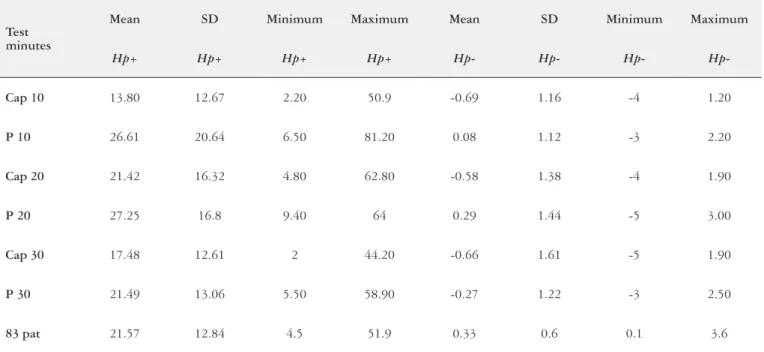
groups (Table 1), only at 10 (DOB = 2.20‰ and DOB = 2.80‰) and 30 (DOB = 2‰ and DOB = 3.10‰) minutes, four
H. pylori positive patients presented DOB values lower than
TABLE 1. Mean, standard deviation, minimum and maximum values of conventional and capsule based breath test at 10, 20 and 30 minutes of the positive and negative H. pylori subjects, and of the 83 patients that underwent breath test with 50 mg capsule at 20 minutes for breath test validation against gold standard
Test minutes
Mean SD Minimum Maximum Mean SD Minimum Maximum
Hp+ Hp+ Hp+ Hp+ Hp- Hp- Hp- Hp
-Cap 10 13.80 12.67 2.20 50.9 -0.69 1.16 -4 1.20
P 10 26.61 20.64 6.50 81.20 0.08 1.12 -3 2.20
Cap 20 21.42 16.32 4.80 62.80 -0.58 1.38 -4 1.90
P 20 27.25 16.8 9.40 64 0.29 1.44 -5 3.00
Cap 30 17.48 12.61 2 44.20 -0.66 1.61 -5 1.90
P 30 21.49 13.06 5.50 58.90 -0.27 1.22 -3 2.50
83 pat 21.57 12.84 4.5 51.9 0.33 0.6 0.1 3.6
Hp:Helicobacter pylori; SD: standard deviation; Cap: capsule based breath test; P: conventional breath test; pat, patients.
FIGURE 1. Comparison of the breath test results obtained with 50 mg 13C-urea capsules (C) and with the conventional 75 mg 13C-urea (P) at 10,
the cutoff of 4‰ with capsule based breath test (Figure 1). For 50 mg 13C-urea using capsule, cutoff value of DOB≥2‰ gave 100% relative sensitivity and speciicity at 10, 20 and 30 minutes. However, at 20 minutes these patients had positive breath test; hence, this time point collection was considered the most reliable for 50 mg capsule based breath test.
When capsule based breath test was validated against a gold standard (urease and histology), 32 patients that were H. pylori positive had positive urea breath test and 51 patients
that were H. pylori negative had negative breath test; thus,
the sensitivity (95%CI: 86.96%-100%) and speciicity (95%CI: 91.42%-100%) were 100%. The demographic and endoscopic indings of these 83 patients are presented in Table 2, 52 (62.7%) patients had peptic ulcer, 28 (33.7%) had gastritis, 2 (2.4%) had atrophic gastritis and 1 (1.2%) had normal en-doscopy. The statistical analysis of the endoscopic indings in relation to the H. pylori status, gender and ethnicity was
not signiicant. The mean13CO
2 excretion of H. pylori positive patients was DOB = 21.57±12.84‰, and of H. pylori
nega-tive patients was DOB = 0.33±0.6‰ (Table 1), the difference between these two groups was signiicant (P<0.05).
the capsule may help acidifying the stomach milieu, inducing
H. pylori for the urease synthesis(13). There is no interference of the oral lora, as the capsule is swallowed and disintegrated directly in the stomach. Capsules prevented the urea to be released before reaching the stomach, requiring a lower dose of 13C-urea(7, 13, 25, 27).
In this report, we showed that 13C-urea breath test per-formed with formulated 50 mg hard gelatin capsule with citric acid and taken with orange juice (pH = 3.0) had almost perfect agreement (Kappa Index measure of agreement = 1;
P<0.05) with the conventional 13C-urea breath test in powder
dissolved in orange juice. The conventional breath test with 75 mg of 13C-urea in 200 mL orange juice and considering a cutoff value of DOB≥4‰ was previously validated with 100% sensitivity and speciicity(4), and performed in other publications in Brazil(3, 15, 16, 29, 30).
Considering a cutoff value of DOB≥4‰ at 20 minute time collection or a cutoff value of DOB≥2‰ at 10, 20 and 30 minutes, the capsule (50 mg) urea breath test had 100% relative sensitivity and relative speciicity. A cutoff value of DOB≥4‰ at 20 minute time collection was chosen for the
TABLE 2. Demographic and endoscopic indings of the 83 patients that performed 13C-urea breath test with 50 mg capsule at 20 min time point
collection (%)
Endoscopy Normal Gastritis Peptic ulcer Atrophic
gastritis Total
H. pylori neg. 1 (2) 13 (25.5) 35 (68.6) 2 (3.9) 51 (61.4)
H. pylori pos. 15 (46.9) 17 (53.1) 32 (38.6)
White 1 (1.4) 25 (36.2) 41 (59.4) 2 (2.9) 69 (83.1)
Brown 1 (12.5) 7 (87.5) 8 (9.6)
Black 1 (25) 3 (75) 4 (4.8)
Japanese-Brazilian 1 (50) 1 (50) 2 (2.4)
Men 13 (34.2) 25 (65.8) 38 (45.8)
Women 1 (2.2) 15 (33.3) 27 (60) 2 (4.4) 45 (54.2)
Four patients that were H. pylori positive and were taking
omeprazole until the day of the urea breath test gave positive results as follows: DOB = 7.6‰, 8.1‰, 24.1‰ and 37.7‰.
DISCUSSION
According to the Maastricht IV Consensus report(17) urea breath test and stool antigen testing are acceptable non-invasive tests for H. pylori infection diagnosis with 88%-95%
sensitivity and 95%-100% speciicity. In Brazil, commercial capsule of 13C-urea is not available, hindering the incorpora-tion of this test to the daily gastroenterology practice(6). The Pharmacy Division of our Institution may formulate capsule of 13C-urea, and provide for the patients of our Hospital to undergo urea breath test.
The comparison of capsule based breath test with the conventional test showed that citric acid used as excipient of
clinical setting, as was previously demonstrated that a change in the cutoff value within 2 and 5 would have little effect on the clinical accuracy of the test, as positive and negative results tend to group outside this range(12).
In this study powdered orange juice (pH = 3.0) was taken with the capsule to increase sensitivity of the test, although citric acid as excipient of the capsule formulation may provide an acidic microenvironment. The activity of bacterial urease and the 13CO
(89.1%-100%) and speciicity (100%) with low concentra-tions of 10 to 25 mg 13C-urea solution(8). Conversely, exam performed with 25 mg 13C-urea solution in orange juice had lower sensitivity and speciicity, and was not recommended for the clinical setting in our country(5).
Previously was shown that even after 7-day treatment with omeprazole, no patients had false negative results with the tablet based breath test (two tablets of 50 mg 13C-urea and 463 mg citric acid)(13). In this report four patients that did not stop taking omeprazole also had positive breath test. This is an important inding, as some patients with continuous proton pump inhibitor therapy may not discontinue medica-tion with risk of gastrointestinal bleeding(2). Although the recommendation is to avoid all proton pump inhibitors and H2-receptor antagonists, among omeprazole, lansoprazole and pantoprazole, the latter did not interfere in the accuracy of 13C-urea breath test. In addition, H
2-receptor antagonists, that increase intragastric pH, have no inhibitory effect on H. pylori density, different from proton pump inhibitors that
decreases the density of H. pylori on the stomach surface(12). Thus, the false negative effect of H2-receptor antagonists and proton pump inhibitors on capsule 13C-urea breath test and the real necessity of discontinuing these medications should be further evaluated. Although the effects of increasing gas-tric pH by H2-receptor antagonists and sodium bicarbonate solution and of density of H. pylori were already explored
during 13C-urea breath test in solution by Graham et al.(12)
that concluded H2-receptor antagonists differ from proton pump inhibitors as high intragastric pH may cause a reduc-tion in urease activity, unrelated to a reduced bacterial load and reversed by citric acid.
When capsule based breath test was validated against a gold standard (urease and histology), the sensitivity and the speciicity were high and comparable to previous reports with 13C-urea in capsule presentation that showed sensitivity of 95%-100% and speciicity of 92-100%(7, 13, 25, 27, 28).
In conclusion, capsule based breath test with 50 mg 13C-urea at 20 minutes was found suitable for the clinical
setting with 100% sensitivity and speciicity.
ACKNOWLEDGMENT
The authors thank Marcio Augusto Diniz from the Labo-ratory of Epidemiology and Statistics of the Department of Gastroenterology, School of Medicine - University of São Paulo for the statistical analysis, Joyce Matie Kinoshita da Silva-Etto for technical support, Maria de Fátima Silva Mi-yamoto for the manipulation, and the Division of Pathology, Gastrointestinal Endoscopy and Center of diagnosis in Gas-troenterology - CDG of Hospital das Clínicas da FMUSP for the histological analysis and endoscopies procedures, respectively. This study was supported by Fundação Facul-dade de Medicina and Hospital das Clínicas da FaculFacul-dade de Medicina da Universidade de São Paulo.
Mattar R, Villares CA, Marostegam PFF, Chaves CE, Pinto VB, Carrilho FJ. Teste respiratório com 13C-uréia em cápsula de baixa dose em comparação
com o teste respiratório com 13C-uréia convencional e testes invasivos. Arq Gastroenterol. 2014,51(2):133-8.
RESUMO – Contexto - Uma das limitações para o teste respiratório com 13C-uréia ser incorporado na prática clínica no Brasil para diagnóstico de
infecção pelo Helicobacter pylori (H. pylori) é a aquisição do substrato em apresentação de cápsula. Objetivos - O objetivo deste estudo foi avaliar a utilidade de 13C-uréia em cápsula, manipulada pela Divisão de Farmácia de um Hospital terciário para a prática clínica. Métodos - Cinquenta
pacientes foram submetidos ao teste respiratório convencional com 75mg de 13C-uréia e ao teste com cápsula de 50 mg de 13C-uréia. Amostras de
ar expirado foram coletadas no basal e após 10, 20 e 30 minutos da ingestão de 13C-uréia para deinição do melhor tempo de coleta. A urease e a
histologia foram usadas como padrão ouro em 83 pacientes que se submeteram ao teste respiratório com único ponto de coleta. Resultados- Num total de 50 pacientes, 17 foram positivos com teste respiratório convencional com 75 mg de 13C-uréia aos 10, 20 e 30 minutos. Quando esses
paci-entes repetiram o teste respiratório com 13C-uréia em cápsulas de 50 mg, 17 foram positivos aos 20 minutos (Índice Kappa 1,0; P<0,05) e 15 aos 10
e 30 minutos (Índice Kappa 0,90; P<0,05). A sensibilidade relativa da 13C-uréia em cápsulas de 50 mg foi 100% aos 20 minutos e 88,24% aos 10 e
30 minutos. A especiicidade relativa foi de 100% em todos os intervalos de tempo. Entre 83 pacientes que se submeteram ao teste respiratório com cápsula e endoscopia, aqueles que eram H. pylori positivos tiveram teste respiratório positivo e aqueles H. pylori negativo tiveram teste respiratório negativo, mostrando sensibilidade e especiicidade de 100%. Conclusão- O teste respiratório com cápsula de 50 mg de 13C-uréia aos 20 minutos foi
REFERENCES
1. Brasil. Agência Nacional de Vigilância Sanitária. Farmacopeia Brasileira. 5 ed. Brasília: Anvisa, 2010. p. 546.
2. Brooks J, Warburton R, Beales ILP. Prevention of upper gastrointestinal hae-morrhage: current controversies and clinical guidance. Ther Adv Chronic Dis. 2013;4:206-22.
3. Cardinali LC, Rocha GA, Rocha AMC, Moura SB, Soares TF, Esteves AMB, Nogueira AMMF, Cabral MMDA, Carvalho AST, Bitencourt P, Ferreira A, Queiroz DMM. Evaluation of [13C] urea breath test and Helicobacter pylori stool antigen test for diagnosis of H. pylori Infection in children from a developing country. J Clin Microbiol. 2003;41:3334-5.
4. Coelho LGV, Reber M, Passos MCF, Aguiar ROA, Casaes PE, Bueno ML, et al. Application of isotope-selective non-dispersive infrared spectrometry for the evaluation of 13C-urea breath test: comparison with three concordant methods.
Braz J Med Biol Res. 1999; 32:1493-7.
5. Coelho LGV, Silva jr AE, Coelho MCF, Penna FGC, Ferreira ROA, Santa-Ce-cilia EV. Does low dose 13C-urea breath test maintain a satisfactory accuracy in
diagnosing Helicobacter pylori infection? Arq Gastroenterol. 2011;48:104-8. 6. Coelho LG, Maguinilk I, Zaterka S, Parente JM, Passos MCF, Moraes-Filho
JPP. 3rd Brazilian consensus on Helicobacter pylori. Arq Gastroenterol. 2013.50: 81-96.
7. Gatta L, Vakil N, Ricci C, Osborn JF, Tampieri A, Perna F, et al. A rapid, low-dose, 13C-urea tablet for the detection of Helicobacter pylori infection before and
after treatment. Aliment Pharmacol Ther. 2003;17:793-8.
8. Gatta L, Ricci C, Tampieri A, Osborn J, Perna F, Bernabucci V, Vaira D. Accu-racy of breath tests using low doses of 13C-urea to diagnose Helicobacter pylori
infection: a randomised controlled trial. Gut. 2006;55:457-62.
9. Gennaro AR. Remington: the science and practice of pharmacy. 20th ed.
Phila-delphia: Lippincott, Williams & Wilkins, Inc., 2003. p. 2210.
10. Graham DY, Evans DJ, Alpert LC, Klein PD, Evans DG, Opekun AR, Boutton TW. Campilobacter pylori detected noninvasively by the 13C-urea breath test.
Lancet. 1987;329:1174-7.
11. Graham DY, Malaty HM, Cole RA, Martin RF, Kein PD. Simpliied 13C-urea
breath test for detection of Helicobacter pylori infection. Am J Gastroenterol. 2001;96:1741-5.
12. Graham DY, Opekun AR, Jogi M, Yamaoka Y, Lu H, Reddy R, et al. False negative urea breath tests with H2-receptor antagonists: interactions between
Helicobacter pylori density and pH. Helicobacter. 2004;9:17-27.
13. Hamlet A, Stage L, Lönroth H, Cahlin C, Nyström C, Pettersson A. A novel tab-let-based 13C urea breath test for Helicobacter pylori with enhanced performance
during acid suppression therapy. Scand J Gastroenterol. 1999;34:367-74. 14. Kato M, Asaka M. Recent Development of Gastric Cancer Prevention. Jpn J
Clin Oncol. 2012;42:987-94.
15. Kawakami E, Machado RS, Reber M, Patrício FRS. 13C-Urea breath test with
infrared spectroscopy for diagnosing Helicobacter pylori infection in children and adolescents. J Pediatr Gastroenterol Nutr. 2002;35:39-43.
16. Machado RS, Patrício FRS, Kawakami E. 13C-Urea breath test to diagnose
Helicobacter pylori infection in children aged up to 6 years. Helicobacter.2004;9: 39-45.
17. Malfertheiner P, Megraud F, O’Morain CA, Atherton J, Axon ATR, Bazzoli F, Gensini GF, Gisbert JP, Graham DY, Rokkas T, El-Omar EM, Kuipers EJ, The
European Helicobacter Study Group (EHSG). Management of Helicobacter pylori
infection – the Maastricht IV/ Florence Consensus Report. Gut. 2012;61:646-64. 18. Marques SB, Mattar R, Artifon ELA, Sakai P, Carrilho FJ. High prevalence of duodenal ulcer in a tertiary care hospital in the city of São Paulo, SP, Brazil. Arq Gastroenterol. 2011;48:171-4.
19. Marshall BJ, Warren JR. Unidentiied curved bacilli in the stomach of patients with gastritis and peptic ulceration. Lancet. 1984;323:1311-5.
20. Marshall BJ, Surveyor I. Carbon-14 urea breath test for the diagnosis of Campy-lobacter pylori associated gastritis. J Nucl Med. 1988;29:11-6.
21. Mattar R, Silva FM, Alexandrino AM, Laudanna AA. Validation of 14C-urea
breath test for diagnosis of Helicobacter pylori. Rev Inst Med Trop S Paulo.
1999;41:3-7.
22. Mattar R, Santos AF, Eisig JN, Rodrigues TN, Silva FM, Lupinacci RM, et al. No correlation of babA2 with vacA and cagA genotypes of Helicobacter pylori
and grading of gastritis from peptic ulcer disease patients in Brazil. Helicobacter. 2005;10:601-8.
23. Mattar R, Marques SB, Santos AF, Monteiro MS, Iriya K, Carrilho FJ. A possible role of IL-1RN gene polymorphism in the outcome of gastrointestinal diseases associated with H. pylori infection. Clin Exp Gastroenterol. 2013;6:35-41.
24. Moulton-Barrett R, Triadailopoulos G, Michener R, Gologorsky D. Serum
13C-bicarbonate in the assessment of gastric Helicobacter pylori urease activity.
Am J Gastroenterol. 1993;88:369-74.
25. Ohara S, Kato M, Saito M, Fukuda S, Kato C, Hamada S, Nagashima R, Obara
K, Suzuki M, Honda H, Asaka M,Toyota T. Comparison between a new 13C-urea
breath test, using a ilm-coated tablet, and the conventional 13C-urea breath test
for the detection of Helicobacter pylori infection. J Gastroenterol. 2004;39:621-8.
26. Pantolickova D, Scott DR, Sachs G, Dorta G, Blum AL. 13C urea breath test
(UBT) in the diagnosis of Helicobacter pylori: why does it work better with acid test meals?Gut. 2003;52:933-7.
27. Peng NJ, Lai KH, Liu RS, Lee SC, Tsay DG, Lo CC, et al. Capsule 13C-urea breath
test for the diagnosis of Helicobacter pylori infection. World J Gastroenterol.
2005;11:1361-4.
28. Porter V, Zahid A, Mackie B, McNamara DA. Results of a prospective comparison pilot validation study of a low-dose tablet formulation 13C urea and citric acid
breath test employing a novel automated nondispersive isotope selective infrared spectroscopy analyser for the diagnosis of Helicobacter pylori infection. Eur J Gastroenterol Hepatol. 2009;21:1321-2.
29. Rodrigues MN, Queiroz DMM, Braga ABC, Rocha AMC, Eulailo EC, Braga LLBC. History of breastfeeding and Helicobacter pylori infection in children:
results of a community-based study from northeastern Brazil. Trans R Soc Trop Med Hyg. 2006;100:470-5.
30. Silva JMK, Villares CA, Monteiro MS, Colaúto C, Santos AF, Mattar R. Vali-dation of a rapid stool antigen test for diagnosis of Helicobacter pylori infection.
Rev Inst Med Trop S Paulo. 2010;52:125-8.
31. Sim J, Wright CC. The Kappa statistic in reliability studies: use, interpretation, and sample size requirements. Phys Ther. 2005; 85(3):257-68.
32. United States Pharmacopeia. 23th ed. Rockville: The United States Pharmacopeial
Convention, Inc., 2005. p. 3187.