Rev. Col. Bras. Cir. 2016; 43(4): 292-294
DOI: 10.1590/0100-69912016004007
Bronchial fistula closure with negative pressure wound therapy:
a feasible and cost-effective treatment
Fechamento de fístula brônquica com uso da terapia por pressão negativa: um
tratamento viável e custo-efetivo
RodRigo BaRBoza NuNes1, BRuNo FRaNcisco MülleR Neto1, FedeRico eNRique gaRcia cipRiaNo2, pedRo soleR coltRo1, JayMe adRiaNo
FaRiNa JúNioR1.
INTRODUCTION
B
ronchial fistula can occur as a complication of pulmo-nary infectious diseases, after thoracic trauma, conse-quent to invasive thoracic procedures and most common-ly as a complication of pulmonary surgical procedures1. Studies show variable incidence of this complication sec-ondary to thoracic surgery, occurring in frequency rang-ing from 4.5% to 20% of patients after pneumonectomy and about 1% after lobectomy. Mortality rates vary from 18% to 67%1.Patients with this condition usually require a long period of hospitalization, often being colonized by hospital germs, presenting empyema relapses, possible evolution to sepsis, need of broad-spectrum antibiotics, as well as various surgical approaches.
Negative pressure therapy has been used as an important alternative adjuvant in the treatment of complex wounds of various etiologies, with much evidence of its benefits in the literature2,3. There are even some successful treatment reports of patients with BF who used NPT4. The purpose of this study is to demonstrate the application of NPT as a therapeutic
resource for BF and comparatively analyze the overall treatment cost.
TECHNICAL REPORT
A patient with BF communicating with tho-racostomy was treated with NPT at the Hospital das Clínicas of the Faculdade de Medicina de Ribeirão Preto, Universidade de São Paulo (HCFMRP-USP). Previously, this patient had undergone several surgeries to treat com-plications such as empyema and to attempt BF closure, without success.
In 2008, this male, 50-year-old patient was diagnosed with pulmonary cystic bronchiectasis in the lower right lobe, being treated by lobectomy of this seg-ment by the Thoracic Surgery team. After the initial pro-cedure, the patient developed several complications and required 13 other surgeries between 2008 and 2013. In October 11, 2013, the Plastic Surgery team introduced the NPT in the pleurostomy wound (Figures 1A and 1B) in a way that a piece of the polyurethane foam (Fig-ure 1C) was adapted to be introduced into the pleural cavity, the other part remaining on the chest skin for
1 - Division of Plastic Surgery, Clinics Hospital, Ribeirão Preto Medical School, University of Sao Paulo. 2 - Division of Thoracic and Cardiovascular Surgery, Clinics Hospital, Ribeirão Preto Medical School, University of Sao Paulo.
Technical Note
A B S T R A C T
Treatment of bronchial fistula (BF) after pulmonary lobectomy is a challenge. Often, patients require long hospital stay, have recurrent em-pyema and pneumonia, are susceptible to sepsis, often need broad-spectrum antibiotics, as well as various surgical approaches. With the advent and growing evidence of the benefits of negative pressure therapy (NPT), its use in some patients with BF has been reported with encouraging results concerning its feasibility and cost-effectiveness. The aim of this study was to demonstrate the application of NPT as a resource for BF treatment and comparatively analyze the overall cost of treatment.
293
Rev. Col. Bras. Cir. 2016; 43(4): 292-294
Nunes
Bronchial fistula closure with negative pressure wound therapy: a feasible and cost-effective treatment
bonding with the suction tube (Figure 1D). The thoracic cavity and the remaining lung parenchyma can be seen in the CT scan image in Figure 2A. In total, there were six exchanges of the dressing, guided by the evolution of the wound, every 5 days on average, until November 13, 2013, when we discontinued NPT after evidence of BF occlusion.
The study also compared surgical hospital costs with hospital procedures and costs involved after the NPT start. These data were obtained from the Cost Section of the HCFMRP-USP Technical Advisory. The calculation of the costs of surgical and anesthetic procedures and hos-pital admissions was based on the average hourly values per procedure and average daily values , respectively, for the year 2014.
With the use of NPT, there was contraction of the pleurostomy cavity and occlusion of the bronchial tree fistula in the period of 1 month. This result was doc-umented by the control tomography (Figure 2).
Hospital costs with surgery and anesthesia in the 13 procedures performed to treat complica-tions prior to NPT use were R$ 28,825.35. Moreover, to calculate the total expenditure, we must add the
hospitalization costs. The patient remained about eight months hospitalized to treat complications, totaling R$ 141,199.12. Therefore, spending on surgical proce-dures, anesthesia and hospitalization for the treatment of this patient’s complications prior to NPT use totaled R$ 170,024.47.
After the introduction of NPT, expenses in-cluding surgery, anesthesia, hospitalization and dress-ings were R$ 26,162.70. Thus, the costs of NPT use for the treatment of this patient’s bronchial fistula was 6.5 times lower than in the previously used conventional treatment.
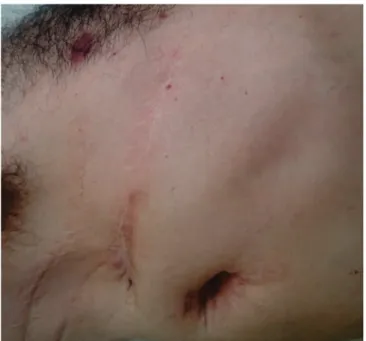
We discharged the patient at the end of treat-ment. During the following 22 months after the end of NPT, the patient had no complications, either pulmonary or related to the surgical procedures, and required no new admissions. The wounds remain healed (Figure 3), with significant improvement in quality of life.
DISCUSSION
The scientific literature has pointed out sev-eral NPT advantages on various types of wounds, in-cluding in the thoracic cavity. The use of NPT helps in the treatment of postoperative complications that are difficult to resolve, such as bronchial fistula and empyema6.
There are few reports about the auxiliary role of NPT in BF closure. An article suggests that the use of NPT promotes the closing of small caliber BF (diameter below 8mm)7. However, the application of NPT must be performed by experienced staff, as it can present serious Figure 1. Application of NPT. (A): Wound of thoracostomy and chest
drainage. Tweezers partially introduced in the pleurostomy cavity. (B) Tweezers introduced at the site of thoracostomy showing the depth of the pleural cavity. (C) Cut of the polyu-rethane foam to be introduced into the pleural cavity. (D): Foam partially inserted into the pleural cavity and the dres-sing with the NPT operating under continuous regimen of 125mmHg.
294
Rev. Col. Bras. Cir. 2016; 43(4): 292-294
Nunes
Bronchial fistula closure with negative pressure wound therapy: a feasible and cost-effective treatment
risks. There are reports of life-threatening complications such as right ventricular or aortic rupture8. In our pa-tient, the lung and chest wall architectures were already changed, with fibrosis and retractions resulting from the numerous performed procedures. The application of NPT did not bring any harm to the patient.
We found no reports in the literature compar-ing the costs of the therapies used in the management of bronchial fistula, but some authors suggest applying NPT early in lung complications such as empyema and for chest wound closure4. In this patient, we showed that the cost of treating the fistula bronchial after the introduction of NPT was 6.5 times lower than the cost of the conven-tional, previously undergone treatments.
Finally, we can conclude that NPT is a viable and cost-effective option for the closure of bronchial fistula after pulmonary lobectomy.
Figure 3. Anterolateral aspect of the patient’s right chest, 22 months after the end of NPT, with healed wounds.
REFERENCES
1. Sarkar P, Chandak T, Shah R, Talwar A. Diagnosis and
management bronchopleural fistula. Indian J Chest Dis Allied Sci. 2010;52(2):97-104.
2. Farina JA Jr, de Almeida CE, Marques EG, Jorge JL, Lima
RV. Negative pressure wound therapy in grade IIIB tibial fractures: fewer infections and fewer flap procedures [letter]? Clin Orthop Relat Res. 2015;473(11):3682-3.
3. Coltro PS, Ferreira MC, Batista BP, Nakamoto HA, Milcheski
DA, Tuma Júnior P. Role of plastic surgery on the treatment complex wounds. Rev Col Bras Cir. 2011;38(6):381-6.
4. Morodomi Y, Takenoyama M, Yamaguchi M, Inamasu
E, Yoshida T, Kawano D, et al. Application of continu-ous negative pressure irrigation and negative pressure fixation to treat a bronchopleural fistula with thoracic empyema. J Am Coll Surg. 2014;218(5):e87-90.
5. Sziklavari Z, Grosser C, Neu R, Schemm R, Kortner A,
Szöke T, et al. Complex pleural empyema can be safe-ly treated with vacuum-assisted closure. J Cardiotho-rac Surg. 2011;6:130.
6. Omran N, Habal P, Mandak J, Chek JL.
Broncho-pleu-ral fistula following vacuum-assisted closure therapy. J Card Surg 2013;28(4):397-8.
7. Rocco G, Cecere C, La Rocca A, Martucci N, Salvi R,
Passera E, et al. Caveats in using vacuum-assisted clo-sure for post-pneumonectomy empyema. Eur J Car-diothorac Surg. 2012;41(5):1069-71.
Received in: 29/02/2016
Accepted for publication: 09/06/2016 Conflict of interest: none.
Source of funding: none.
Mailing address:
Jayme Adriano Farina Junior E-mail: [email protected] R E S U M O
O tratamento de fístula brônquica (FB) após lobectomia pulmonar é um desafio. Muitas vezes, o paciente demanda longo tempo de internação, apresenta recidivas de empiema e pneumonia, pode evoluir para sepse, frequentemente necessita de antibioticoterapia de amplo espectro, bem como de várias abordagens cirúrgicas. Com o advento e acúmulo de evidências dos benefícios da terapia por pressão negativa (TPN), seu uso em alguns pacientes com FB tem sido relatado com resultados animadores relativos à sua viabilidade e ao seu custo-efetividade. O objetivo deste estudo foi demonstrar a aplicação de TPN como recurso para tratamento da FB e analisar comparativamente o custo global do seu tratamento.