Antonio Gil Vicente de Brum*
Universidade Federal do ABC, Santo André/SP – Brazil [email protected]
Annibal Hetem Jr.
Universidade Federal do ABC, Santo André/SP – Brazil [email protected]
Israel da Silveira Rêgo
Universidade Federal do ABC, Santo André/SP – Brazil [email protected]
Cayo Prado Fernandes Francisco
Universidade Federal do ABC, Santo André/SP – Brazil [email protected]
Andre Fenili
Universidade Federal do ABC, Santo André/SP – Brazil [email protected]
Fernando Madeira
Universidade Federal do ABC, Santo André/SP – Brazil [email protected]
Flavio Caldas da Cruz
Universidade Estadual de Campinas, Campinas/ SP – Brazil
Marcelo Assain Universidade Federal do Rio de Janeiro,
Rio de Janeiro/RJ – Brazil [email protected]
*author for correspondence
Preliminary development plan of
the ALR, the laser rangeinder for
the ASTER deep space mission to
the 2001 SN263 asteroid
Abstract: The Brazilian deep space mission ASTER, as temporarily named, plans to send a small spacecraft to encounter and investigate the triple asteroid 2001-SN263. The launch is scheduled (initially) to occur in 2015, arriving in 2018. The main motivation of the mission is the development of technology and expertise to leverage the national space sector. Within the scientiic goals, the investigation of the still unknown asteroid 2001-SN263. The main project guideline is to aggregate the widest possible Brazilian involvement in the platform, the development and operation of subsystems, integration, payload, as well as in the tracking, navigation, guidance and control of the probe. To meet this guideline, among others, the decision for the development of a laser altimeter in Brazil to ly in the mission was taken. This effort is currently coordinated by a group of researchers from the aerospace engineering personnel of UFABC. This article presents the preliminary development plan for the design of this instrument, which was called ALR (ASTER Laser Rangeinder).
Keywords: Deep space mission, Laser altimeter, Laser rangeinder, ASTER, ALR.
THE FIRST BRAZILIAN MISSION TO DEEP SPACE: ASTER
The Brazilian space mission ASTER, as it was temporarily
named, plans to send a small spacecraft to ind, orbit and
investigate the still unknown triple asteroid system 2001-SN263 for approximately six months. Launch is initially
scheduled for 2015 (irst launch window), arriving in
2018.
The mission will be conducted from the low-cost
Finnish-Russian platform MetNet, with initial liquid mass of 152 kg and total mass directed to a 30 kg payload and nominal power of 2.0-2.1 kW. Such restrictions demand reduced
dimensions, masses and consumption in the project of
scientiic instruments.
The main motivation of this mission is the development of technology and expertise in order to leverage the national space sector. Thus, the main guideline is to aggregate the widest Brazilian involvement in the platform, the
development and operation of subsystems, integration,
payload, as well as in tracking, navigation, guidance and
control of the probe.
In terms of scientiic goals, the investigation should bring
some indications on the formation of this triple system
and each of its main three asteroids will be separately investigated as to dynamic and orbital properties, shape, size, volume, mass distribution, mineral composition, topography and surface texture, gravitational ield and
rotation speed. Received: 04/0811
In order to fulill these goals, different scientiic
instruments are planned to compose the payload of the mission. Among them, there are a multispectral camera
(wide and narrow-band), a laser altimeter, and an infrared spectrometer. The scientiic data will be sent to Earth via
telemetry. The references Sukhanov et al. (2010), Araujo et al. (2010) e Winter et al. (2010) provide more details on the ASTER mission and the target system.
To meet the project guidelines, the laser altimeter was developed in Brazil, and the engineering coordination of
this initiative was a responsibility of the research group
of Navigation, Instrumentation and Aerospace Systems
(NISA, in Portuguese), comprised of professors of the
Aerospace Engineering course at Universidade Federal do ABC. This article presents the preliminary plan to develop this equipment, which is called ALR (ASTER
Laser Rangeinder).
ALR – THE LASER ALTIMETER FOR THE ASTER MISSION
Concept
The instrument will measure the length of time for a
laser pulse to leave the instrument, relect on the surface
of the target asteroid and return to the instrument. Thus,
the distance and relative velocity between the spacecraft and the asteroid system can be precisely measured. A topographic proile of the target corresponding to the course of the beam over the surface will be produced. By interpolation, a model of the global shape of the asteroid will be obtained. From measurements of amplitude and shape of the returning pulse, the relectivity of the surface,
its inclinations and roughness (within the area illuminated
by the laser pulse = footprint) will be modeled. The characteristics of the equipment are deined and presented this study, in order to enable the described investigation.
Functions
The ALR will contribute with the geodesic and geophysical
characterization of the asteroids that are part of the triple
system. The data in the equipment will be combined with
data from the imaging cameras to gather up topographic features of the targets.
The instrument will also be useful for the navigation in the approximation stages – distance of about 30 km from the center of gravity (CG) of the system – and closest to
each of the asteroids (decision of reaching distances <30
km), thus providing precise information concerning the
distance of the spacecraft to the target, and the relative
velocity between them. Also, ALR will be used to calibrate
the infrared spectrometer.
Due to the high number of functions and the importance
of each of them, the laser altimeter is essential for the mission.
Scientiic Objectives of ALR
• A model of the shape of the main asteroids in the system should be obtained with ≤10 m precision,
in terms of spatial resolution (surface) and height (topography), in relation with the CG of the asteroid,
in illuminated regions or those with no illumination.
• The mass of the asteroids should be deined (level of precision to be determined).
• Gravitational terms J1 and J2, which describe how the mass of the asteroid is distributed, should be determined (level of precision to be determined).
Using the data obtained by ALR
• Obtaining the topographic proiles of the asteroids;
• Obtaining a model of the global shape of the asteroids;
• Supporting the study of geodesic parameters of the asteroids (coordinate system, rotation, etc.);
• Supporting the deinition of the orbit and the modelling of gravitational data;
• Supporting spacecraft maneuvers;
• Measuring surface roughness and albedo (at laser frequency);
• Supporting autonomous navigation (as a sensor) at
the approximation stage.
The importance to develop ALR in Brazil
The development plan that better meets the technological objectives of the mission and of Brazil, according to the
National Plan of Space Activities of the Brazilian Space
Agency – PNAE/AEB (PNAE for the decade 2005-2014; www.aeb.org.br) , should prioritize the construction and qualiication for the space of scientiic equipment and
instruments, together with the academy, research institutes and national companies, thus strengthening the national space sector as to the development of new essential
ABOUT THE DEVELOPMENT OF ALR
Team
Team of Science
Marcelo Assain – Observatório do Valongo/UFRJ (Coordinator of Science/ALR)
Roberto Vieira Martins – Observatório Nacional, RJ Julio Inacio B. Camargo – Observatório Nacional, RJ
Team of Engineering (UFABC)
Antonio Gil Vicente de Brum (ALR coordinator of
Engineering) Annibal Hetem Jr. Cayo Prado F. Francisco Fernando Madeira
Israel da Silveira Rêgo
André Fenili
Laser/detector development
Flávio C. Cruz – IFGW/UNICAMP e company BR Labs (based in Campinas)
Other partners
Álvaro Alberto Cuccolo – OMNISYS Engineering/ UFABC
Requirements related to the operation
From initialization, the equipment should operate
continuously throughout the whole period of the mission investigation (T≤1 year).
The equipment should initialize its operation less than 50
km from the target. In this irst moment, it may be useful
for the spacecraft navigation providing precise information concerning distance and relative velocity in the maneuvers
to establish the encounter with the triple system.
After the encounter is established (rendezvous), an initial investigation of the system will take place. In this phase,
the equipment can be useful to verify the spacecraft pointing (coarse attitude) and the distance to the asteroids, that should be measured with ±10 m precision.
According to the results of the preliminary investigation,
the signal to start the maneuvers and obtain a position that is closer to the system will be given. In this case, the new distance between the spacecraft and the CG of the system will be deined by the mission management after more
data on the formation and dynamics of the system are
obtained. For now, there are few details about the orbits in this system. Table 1 gathers the available information.
According to Winter et al. (2010), the mass of asteroid 1 is much greater than the mass of the other asteroids (M1=1.149x10¹³ kg; M
2=8.0%M1; M3=.6%M1), the mean
orbital radius of asteroid 2 around asteroid 1 is ±17 km, which shows that the encounter to a distance much shorter than 30 km cannot occur, unless the satellite asteroids have coplanar
orbits. The maximum approximation of the spacecraft in
this safer perspective should remain, however, from 20 to
30 km. In this position, ALR can be used to investigate
the dynamic characteristics of the system, as well as those related to shape, dimension and topography of the asteroids, with distance measurements with <10 m error.
After this investigation, a new approximation can be
conducted. The type of approximation will depend on the decision of the mission management. Both the
establishment of a closer position, within the rendezvous
with the system, and the one obtained from the establishment of an orbit around one of the asteroids are
considered at the moment.
The irst asteroid to be investigated at a higher resolution will possibly be the biggest one (asteroid 1). Studies conducted by Araujo et al. (2010) point to the
possibility to establish an orbit around this asteroid with radius between 10 and 13 km. Orbits around asteroid 2 (intermediate mass) with radius of approximately
5 km are also under analysis. In these cases, ALR will
be used to map the topographic characteristics of these
asteroids with 1 m resolution. Also, at the end of the
Table 1. Orbital and Physical Data.
*Still not determined; 1Nolan et al. (2008); 2calculations for density = 1.0 g/cm3, estimated density: 1.3 ± 0.6 g/cm3
(Becker et al., 2008); Orbital data a, e, I refer to values of semi-major axis, eccentricity and inclination of the elliptical
orbit, respectively. 1 AU (astronomical unit) = mean distance Earth-Sun ≅ 150 x 106 km.
SOURCE: Winter et al. (2010).
Asteroid Orbit a1 e1 I1 Period1 Radius1 Mass2
A1 Sun 1.99 AU 0.478 6.69o ~2.8 years 1.4 km M
1= 1.15x10 13 kg
A2 A1 17 km * * ~147 hours 0.5 km M2≅ 7.9x10⁻² M
1
A3 A1 4 km * * ~46 hours 0.2 km M3≅ 5.7x10⁻³ M
mission, a closer approximation and possible contact
with one of the asteroids may occur. Since the mission
will not have other devices available to measure the
distance to the surface of the target, it is recommended
that the operational range of the ALR be expanded to the maximum possible proximity (<50 m). In order to meet these objectives, the equipment should be able to operate
at a range that varies from 50 km to less than 50 m, with 10 m and 1 m precision, respectively.
In terms of footprint (area that is illuminated by the laser beam over the surface of the target, and depends on the beam divergence and the distance to the target), at initialization and irst trigger of ALR (from 40 to 50 km away from the target), beam divergence should
provide a return signal of the pulse that was sent, in
order to conirm the spacecraft pointing and the proper
functioning of the equipment. Within the limits of
operation of the equipment (approximately 40 km), the irst values concerning the distance to the asteroids can be determined, thus conirming the relative positioning of the spacecraft. The irst scientiic use of ALR should be about 20 and 30 km away from the main target, asteroid 1. In this case, the beam divergence, α
(half-cone angle), should be small, and the power should be enough to obtain a return signal that is related to a 10 to 20 m footprint (radius of the illuminated area). This is suficient to conduct the scientiic analyses related to this approximation stage. For the stage of closest approximation to asteroid 1, about 10 km far, the ray of the footprint should be from 5 to 10 m, which implies a beam divergence angle between 0.028° and 0.057°,
in which α=atan (d/D), with d=footprint radius and
D=distance to the target; 0.028°=500 µrad. It is also recommended to observe that subsequent studies on the dynamics of the bodies in the triple system should conirm the values of the cited characteristics, related to the transmitter optics. The footprint should also be planned in order to enable the best possible mapping of the target surface. The distance between successive
measurements, as a function of the shootings frequency and of the spacecraft-target relative motion (including the target rotation can not exceed a maximum value
that would make it impracticable to obtain an improved
surface model in terms of horizontal resolution. The distance considered as ideal is the one which results in approximate continuous measurements of the terrain topography.
Design guidelines
1. Reduced coniguration (mass, dimensions, power, resource consumption).
2. Modular approach to develop the system.
Thus, the development of modules in Brazil (and their
parts) may be conducted as a result of a partnership between the academy and institutions of the national aerospace sector. The initiative is coordinated by the aerospace engineering team of UFABC.
Modular division
There are three modules to be developed: transmitter,
receptor and electronics. The design regarding the parts and the whole system aims to simplify all the items related to the instrument operation. Thus, the design of
the LIDAR, which lew with the Hayabusa mission, was the basis for the division proposed here and for the ALR
design in general (Tsuno et al., 2006; Hashimoto, Kubota
e Mizuno, 2003).
Concept of the joint operation
The laser electronics controls the laser operation and directs pumping diodes inside the laser head, in which
the laser beam is generated. The laser beam is collimated and expanded by the beam expander; then, it leaves the
instrument through the exit optics of the transmitter, and goes towards the surface of the target asteroid. The
signal relected by the target is received by the reception telescope (receptor) and focused on the detector plan. The rangeinder has algorithms implemented in the
receptor electronics to analyze the return signal.
DESIGN GENERAL CHARACTERISTICS
• Integrated design aiming to minimize the size and
weight of the instrument.
• Minimizing telemetry, commands and functions.
• Using simple and independent optics: transmitter and
receptor.
The classic Cassegrain telescope, with optical
deposition and a light material mirror, but also hard and resistant (silicon carbide or aluminum).
Obs.: The possibility of integrated optics is investigated (receptor and transmitter).
Telemetry and simple commands: on, off, operation start, end of operation, gain adjustments, etc.
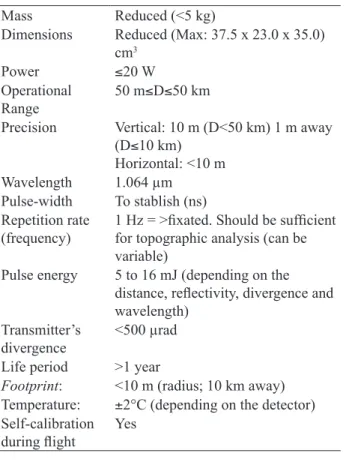
The desired characteristics for the instrument translated in
terms of design parameters are presented in Table 2.
Brief description of the parts
A preliminary version of ALR and its most important
elements is demonstrated in Fig. 1. The most important
parts are the transmitter, the receptor and the control unit. The latter is part of the electronics set of the equipment
(which includes power sources, not shown here). In Fig. 1, the electric connections are represented by full lines, and optical paths are represented by dotted lines.
Generally, ALR will use the time gap between transmission
and reception of a laser pulse to calculate the distance
between the spacecraft and the asteroid. A new aspect related to the existing equipment is the possibility to use
integrated optical transmission and reception. In this case, the function of the optics interchange, from transmitter to
receptor, by means of an electro-optical key. However, the
choice for independent optics is still more likely.
Transmitter and receptor
The transmitter will be operated by shooting commands programmed in the control unit of the equipment. Operation can also be externally commanded, via telemetry.
Triggering the transmitter or not will depend on the signal
sent by the Attitude and Orbit Control Subsystem (AOCS), which can conirm the correct spacecraft pointing. In
operation, ALR will send the collected information to
a data processing and storage unit. Such data should be used on board (by AOCS, as information concerning
Figure 1. Preliminary block diagram of the ASTER Laser Rangeinder program. Here is the version of the study with uniied optics. Independent optics is still the irst option.
Info: Time gap
Receptor Interval timer
Stop Control
Unit
External commands
Gap
Start
Shoot Transmitter
electro-optical key
Primary Secondary
Mass Reduced (<5 kg)
Dimensions Reduced (Max: 37.5 x 23.0 x 35.0) cm3
Power ≤20 W
Operational
Range
50 m≤D≤50 km
Precision Vertical: 10 m (D<50 km) 1 m away (D≤10 km)
Horizontal: <10 m
Wavelength 1.064 µm Pulse-width To stablish (ns) Repetition rate
(frequency) 1 Hz = >ixated. Should be suficient for topographic analysis (can be variable)
Pulse energy 5 to 16 mJ (depending on the
distance, relectivity, divergence and wavelength)
Transmitter’s divergence
<500 µrad
Life period >1 year
Footprint: <10 m (radius; 10 km away) Temperature: ±2°C (depending on the detector)
Self-calibration during light Yes
navigation and support to the operation of other scientiic instruments) and/or sent to telemetry.
The laser transmitter consists of a Nd: YAG laser, diode-pumped, with a Q-switch, operating at 1.064 µm. The
technology of this laser is mature and can produce high energy pulses that meet the criteria of low power consumption and reduced size. The operation in the close infrared gives this
laser a wide variety of eficient optics and detectors that are commercially available, which positively inluences
the decision to use it. The optical diode-pumped laser assures the long-life low power consumption of typically 50,000 hours or up to 18 million 10 pps shooting. A unit
of laser diode operating at 808 nm will basically consist of its current source and thermoelectric coolers to stabilize the emission wavelength. Pumping geometry will be linear, including the diode laser attached to the Nd: YAG crystal, two infrared mirrors and a LiNbO3 electro-optic modulator
for the Q-switch. The laser source operating in Q-switching
mode should be able to produce minimum energy pulses of 10 mJ to 1.064 µm, lasting up to 15 ns with repetition rates
varying from 1 to 10 pps, thus producing laser pulses with 1
MW of optic power. The energy of the laser pulse should be high, because, according to Reddy et al. (2008), the
2001-SN263 is a C-type asteroid, which means its albedo should be relatively low at 1.064 µm. Besides, the repetition rate inluences the horizontal resolution along the beam path over the asteroid surface. However, the commitment between the horizontal resolution, energy consumption and dissipation of heat was used to establish a value for
the repetition rate of the order of 1 pps. Beam divergence
and its pattern are mainly determined by the geometry of
the optical cavity and have an impact on the size of the footprint over the asteroid terrain.
The operation of the receptor will be controlled by a
temporal gate, which is also internally programmed in the control unit of ALR. Generally, the gate only triggers the receptor within the time gap in which the return pulse is expected. Thus, the time to gather random noise decreases, and the relation signal/noise is maximized.
A start signal is sent to the counting clock when the transmitter generates the exit pulse. When the echo or
return pulse is received by the receptor, a stop signal is sent
to the counting clock. The returning signal is received and sent to the processing unit. The results reveal the distance to the surface, as well as additional data concerning
inclination, roughness and albedo, which are stored to be possibly used by AOCS or by other instruments in the spacecraft, and/or to be sent out by telemetry. The registers
in the clock are then formatted for the next reading.
As to the optics of the instrument, in the version with
independent optics, the transmitter optics is simpliied
and has functions such as collimation and expansion
of the exit beam according to the speciication of the mission (divergence <500 µrad). A Galilean telescope with proper ilters and lens can be used for this purpose. Another possibility that is considered for this moment is uniied optics, which consists of coaxial and relection
arrangement with a Schmidt-Cassegrain telescope. A typical diameter for this telescope is around 10 to 12 cm.
Both internal mirrors will be made of a hard and resistant material, such as silicon carbide (SiC) or aluminum, the latter being much lighter (however, other properties are not so favorable and need to be investigated, such as high thermal conductivity). The choice for aluminum requires
a nonthermal design, like the one used in the laser
rangeinder that lew in the NEAR-Shoemaker mission (Cole, 1998). With the coaxial coniguration, transmitter and receptor share the same primary optical elements;
however, an electro-optical key is necessary, with only one
Pockels cell combined with a polarizer. Thus, a selection may be imposed on the state of polarization of the exit and echo pulses. Since the interval between the transmission
and reception of the laser pulse can range from 0.3 ms and
66 µs during the phases of the missions, fast commutation will not be required, which makes this technically viable.
Electronics
According to the guidelines of the mission, it is necessary
to optimize resources. In order to meet this objective, the same electronic unit should control both the transmitter and the receptor (integrated electronics). The transmitter
electronics includes feeding, triggering and shooting of
the laser source, besides the electronics that is dedicated
to controlling the operation. The receptor electronics is in charge of its operation, which includes the photo detector
element (PD) and the preampliier, besides the control of the receptor (integrated with the transmitter). This item also detects the pulse relected by the target (sent by the transmitter), treats the signal, obtains the shape of the
received pulse wave, processes this signal, storages and
sends data (to other equipment on board or to Earth, via telemetry (use of memory), among others).
Internal algorithms
After being implemented in electronic units, they irst treat the signal, obtain the shape of the wave, analyze the pulse, detect the border, calculate the distance, etc.
be conducted in real time to use on board (other devices/ instruments), or to send to Earth.
Housing
Metal box and ixation of the equipment inside it. The
design directions for this element are:
- Reduced dimensions (reference: 37.5 x 23.0 x 35.0 cm3);
- Fixation with external vibration damping;
- Armoring/isolation (thermal and others);
- Interfaces of internal/external communication (input/
output of energy and data);
- Internal/external power sources (total low consumption: ≤20 W);
- Heat sinks and thermal control (initial temperature: ±2º C).
Integration and tests
The integration and validation of the instrument should be conducted under contract by the aerospace company with
proper structure and experience in this type of activity. The
participation of the Engineering team of UFABC will be
in the contract, since it aims to develop the expertise in the
ield. For this stage, the company OMNISYS Engenharia (São Bernardo do Campo/SP) was contacted.
CONCLUSIONS AND FINAL COMMENTS
The items to develop ALR for the ASTER mission
were deined and presented. The subdivision of this development in parts (modules) and the characteristics of
each item and of the whole instrument were previously
described, in order to meet the needs and the technological and scientiic objectives of the mission.
The schedule for the modular development implies the
existence of a speciic timeline for each of the parts described. The parallel development of the parts should be inside this scenario, minimizing time and optimizing resources. However, the high level of integration and simpliication required by the design can only be achieved with more interchange of information
among the developing teams. So, the development is
centralized in the Engineering group of UFABC.
Each item has its own costs spreadsheet. The total
estimated cost is compounded by the sum of costs of the
parts previously listed. The total estimated cost of the mission is initially of US$ 35 million. The development
will be performed in stages (A, B, C, D). Stage A consists
of the creation of the development plan. In the other stages, the models are created and tested. The creation
of a “spider” (the setting of unqualiied elements or modules on a plate that is different from the inal version; it is used to test the module’s functionality), an engineering model, a qualiication model, a prototype and a light model. If possible, the intention is to use the qualiication model as a light model. In this case, there
is one less model to make, causing the costs to reduce.
At the moment, the “spider” is being created.
The ASTER Project has been recently included in the
activities of the National Institute for Space Research
(INPE). At the moment, the management of the mission
wants to include the Project as a strategic activity, aligned with Plano Nacional de Atividades Espaciais (PNAE), to allocate resources related to developments in the space
sector. Also, other inancing programs (Research and Projects Financing – FINEP and São Paulo Research Foundation etc.) are considered. The use of regular research scholarships is also included (scientiic initiation,
internships, masters, doctorate, technical development
etc.), since the development of expertise in the sector is
one of the purposes of the mission.
The development model used to create ALR, based on the establishment of multiple partnerships, with personal and institutional qualiication, should lead
the way to projects concerning the development of the national aerospace sector. This approach to the
development of aerospace instrumentation has been used successfully abroad. In Brazil, however, it is new and should contribute much to future developments in
the sector.
REFERENCES
Araujo, R. A. N. de, Winter, O. C., Prado, A. F. B. de A., Sukhanov A., 2010, “O Sistema Triplo de Asteróides 2001SN263: Dinâmica Orbital e Regiões de Estabilidade”. Trabalho apresentado no XV Colóquio Brasileiro de Dinâmica Orbital, Hotel Alpina, Teresópolis, RJ, Brasil.
Becker, T., Howell, E.S., Nolan, M.C., Magri, C., 2008,
“Physical Modeling of Triple Near-Earth Asteroid
153591(2001 SN263)”. American Astronomical Society, DPS meeting #40, #28.06; Bulletin of the American
Astronomical Society, Vol. 40. p.437.
Cole, T. D., 1998, “NEAR Laser Rangeinder: A tool for
the mapping and topologic study of Asteroid 433 Eros”.
Hashimoto, T., Kubota, T., Mizuno, T., 2003, “Light
weight sensors for the autonomous asteroid landing of MUSES-C mission”. Acta Astronautica, Vo. 52, No. 2-6, pp. 381-388.
Nolan, M. C., Howell, E. S., Benner, L. A. M., Ostro, S.
J., Giorgini, J. D., Magri, C., Margot, J., Shepard, M., 2008, “Planetary Radar Imaging of Binary Asteroids”. Presentation in the Binary Asteroid Dynamics
Workshop”, Observatory Meudon, Paris, France, from
http://www.asu.cas.cz/~asteroid/paris/add-ons.htm
Reddy, V., Gaffey, M. J., Schaal, M. Takir, D., 2008,
“Physical Characterization of First Triplet Near-Earth Asteroid (153591) 2001 SN263”. Asteroids, Comets, Meteors 2008 held July 14-18, 2008. In Baltimore,
Maryland. LPI Contribution No. 1405, paper id. 8244.
Sukhanov A.A.; Velho, H. F. de C.; Macau, E. E.; Winter, O. C., 2010, “The Aster project: Flight to a near-Earth
asteroid.” Cosmic Research, Vol. 48, No. 5, pp.443-450. doi:10.1134/S0010952510050114.
Tsuno, K., Okumura, E., Katsuyama, Y., Mizuno, T., Hashimoto, T., Nakayama, M., Hashimoto, H., 2006, “Lidar on board asteroid explorer Hayabusa”. Proc. 6th
Internat. Conf. On Space Optics, ESTEC, Noordwijk, The Netherlands (ESA SP-621, June 2006).
Winter, O. C., Araujo, R. A. N. de, Prado, A. F. B. de A., Sukhanov A., 2010, “A Study of the Orbital Dynamics of
the Asteroid 2001 SN263”. Proceedings of the 9th Brazilian Conference on Dynamics Control and their Applications.