*e-mail: [email protected]
Microstructure and Mechanical Properties
of WC-Co Reinforced With NbC
Wilson Acchara*, Cordt Zollfrankb, Peter Greilb
aDepartment of Physics, Federal University of Rio Grande do Norte,
59072-970 Natal - RN, Brazil
bDepartment of Materials Science (III), Glass and Ceramics,
University of Erlangen-Nürnberg, D-91058 Erlangen, Germany
Received: November 19, 2003; Revised: March 21, 2004
Cemented carbides such as tungsten carbide-cobalt WC-Co composites have been widely used as cutting tool materials. Several reports have shown the influence of different factors such as grain size, type and amount of binder phase and the addition of hard particles on the properties of WC-Co. The purpose of this work was to investigate the effect of niobium carbide on the microstructure and mechanical properties of WC-Co. Specimens of WC-Co reinforced with NbC were mixed and sub-sequently hot-pressed in a inert atmosphere. The WC-Co-NbC composite material exhibited high hardness values (18.9 GPa), flexural strength (2100 MPa) and fracture toughness (11.2 MPa.m1/2 ).
TEM analysis has shown a bimodal grain size distribution of WC.
Keywords: tungsten carbide, hardness, fracture toughness, niobium carbide, microstructure
1. Introduction
Cemented carbides such as WC-Co and WC-Co-TiC are
the most widely used material for metalworking1. As a
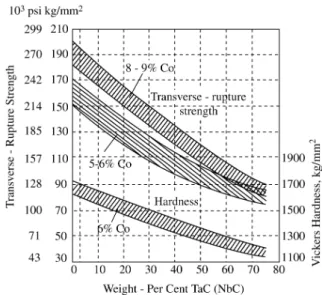
con-sequence, a considerable amount of research effort has been spent to develop alternatives cemented carbide systems in order to improve the microstructure and mechanical proper-ties of these materials. Figure 1 shows the influence of
TaC(NbC) addition on the mechanical performance of WC2.
The hardness decreases only slightly with increasing TaC(NbC) content, but the decrease in transverse-rupture strength is remarkably high for TaC(NbC) contents exceed-ing 20 wt.(%). Recent studies have shown an increase in hard-ness and fracture toughhard-ness of WC through the use of
differ-ent binding phases and the synthesis of nanocomposites3,6.
The addition of some hard refractory particles such as TiC,
VC and Mo2C has produced a pinning effect, reducing the
grain growth of the WC-Co matrix3,7,8, which contributes to
the final properties of the composite material. Literature data about the use of NbC in WC is still scant. Brazil holds the main world niobium reserves, making the study on possible application of niobium very strategic.
On the other hand, WC and NbC have also been reported
as reinforcement in alumina matrix, due its high hardness
and elastic modulus9,10. Hot-pressed alumina reinforced with
NbC has caused an increase of the hardness and fracture
toughness from 16.5 GPa and 2.9 MPa.m1/2 to 19.0 GPa and
4.2 MPa.m1/2, respectively.
The objective of this work was to study the influence of NbC on the microstructure and mechanical properties of hot-pressed WC-Co composite material.
2. Experimental Procedure
The starting powders used in this work consisted of WC
(Wolfram Bergbau, Austria), with D50 = 1 µm and 10 wt. (%)
of cobalt powder as binder phase. Niobium carbide (Herman
Starck Berlin) with D50 = 2.3 µm was used as reinforcing
Table 1. Mechanical properties and crystalline phases of WC-Co-NbC sintered specimens.
Properties WC-Co WC-Co-NbC
Theoretical Density (%) 99.0 98.5
Flexural Strength (MPa) 2000 ± 220 2100 ± 200
Crystalline Phases WC, Co WC, Co
performed using a SiLi-detector (type 7370, ISIS 30, Link, Oxford) attached to the TEM. Hardness and fracture tough-ness were determined using a Vickers hardtough-ness testing
ma-chine by using the method of Shetty et al.11. The analysis
of crystalline phases was determined by X-ray diffraction.
3. Results and Discussion
The X-ray powder diffraction pattern of pure and rein-forced WC-Co solely showed the presence of WC and Co phases (Table 1). No peaks of NbC or other crystalline re-action product phases were identified. The addition of NbC to WC-Co system seems to promote the formation of a car-bide phase that contains both W and Nb, possibly (W,Nb)C. The atomic radii of W (140 pm) and Nb (146 pm) are nearly the same. Thus, the NbC may be dissolved within the WC-phase due to substitution of W by Nb. There is no (W-Nb)C phase diagram published in the literature. There are well known phase diagrams that show the mutual solubility of
(Nb,gU), (V,Nb), (bTi,Nb), (Ti,V), (Ti,W) and (Cr,W)12 and
Nb-W13.
Similar behavior was also observed in alumina
rein-forced with (Ti,W) carbides14.The results indicated the
for-mation of a solid solution of (Ti-W)C, which corresponds
to the Ti-W binary phase diagram14. Hot-pressing resulted
in dense materials, with fraction densities in the range from 98.5 to 99.0% theoretical density (Table 1). Similar densi-ties have been reported for hot-pressed alumina-NbC
com-posites15.
Figure 2 shows the mechanical properties of WC-Co and WC-Co-NbC composites investigated in this work. For
comparison, the hardness and fracture toughness of Al2O3
and WC-Co reinforced with hard particles are also presented in Fig. 2. The mechanical properties of WC-Co-NbC mate-rial are comparable to those of the reinforced matemate-rials available in the literature. The introduction of NbC into WC-Co cemented carbide resulted in a slight decrease of
fracture toughness from 12 to 11.2 MPa.m1/2. The addition
of NbC to the WC-Co composite caused practically no effect on the hardness values as compared to pure WC-Co. The Hv-values of the WC-Co-NbC material remained al-most the same as that for the WC-Co copmosite (19 GPa). The addition of different types of reinforcing elements did not influence considerably the fracture toughness values
of WC-Co. KIC values vary from 10.2 to 12 MPa.m1/2.
Fig-ure 2 shows that the hardness is improved when WC is incorporated in alumina. The alumina-WC composite material exhibits a hardness value of 21 GPa, slightly
higher than WC-Co reinforced material15.
Introduction of TiC and TiC+Mo2C into WC-Co
ce-mented carbide results in a drastic decrease in the hard-ness from 19 to 14 GPa. Substitution of TiC by NbC im-proves the hardness of WC-Co material. Further increase in hardness is observed when VC is added to the system. The hardness of a WC-composite material depends strongly on the processing method and the grain size of
the raw materials3,6,7. This dependence can explain the
variation in hardness values of the different WC-Co com-posites, presented in Fig. 2.
Figure 1. Mechanical properties of WC-Co with TaC-NbC11. Figure 2. Comparison of hardness and fracture toughness values
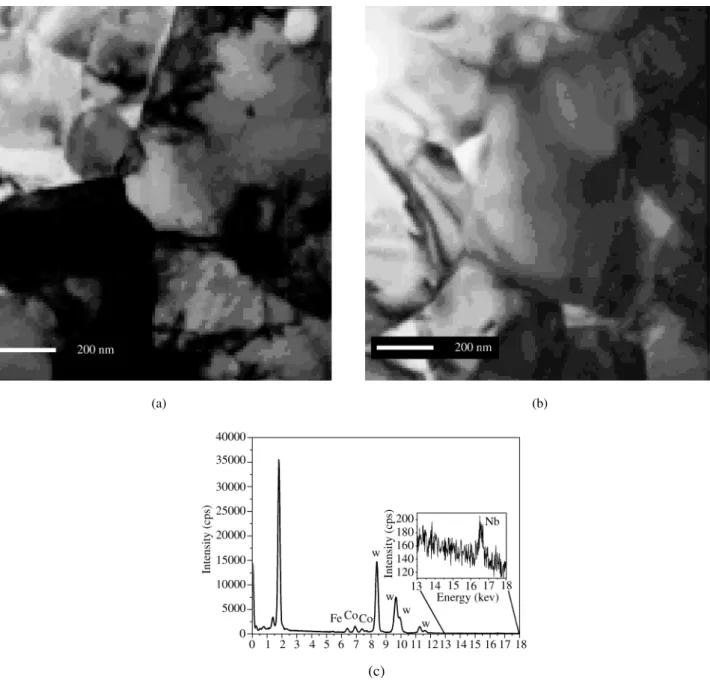
TEM investigation was used to observe the morpho-logical aspects and the microstructure of WC-Co-NbC composites. The composite ceramic material exhibited a heterogeneous microstructure with a bimodal WC-grain size distribution (Figs. 3a and 3b). The microstructure
consisted of large (1µm) and fine (100-200 nm) grains
of WC. The WC-particles were analyzed by EDS (Fig. 3c). The main elements found in the spectra were W, Co and Fe, whereas Nb was only hardly detectable (see inset in Fig. 3c). The results obtained by EDS indicate that the
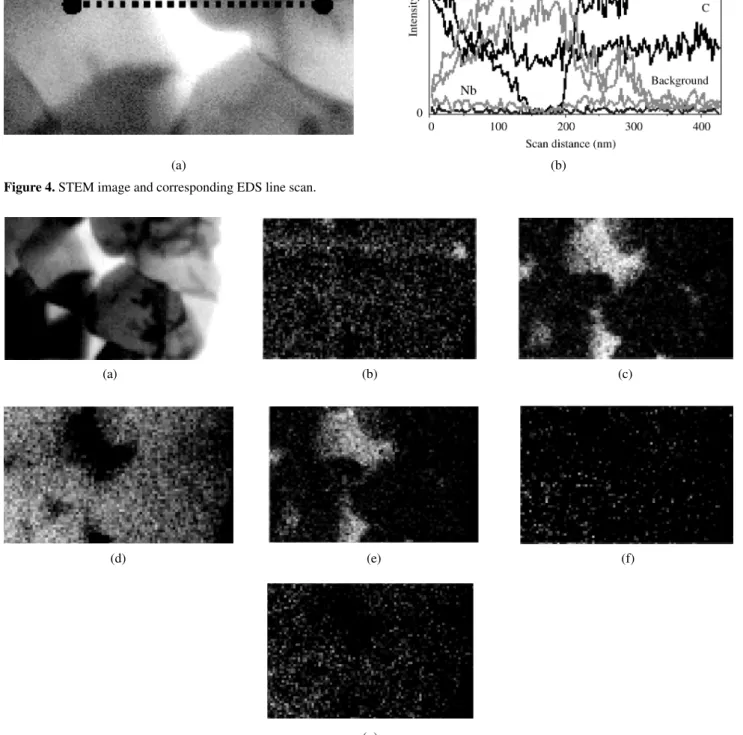
particles formed were principally composed of WC. A typical STEM image and a EDS line scan with element distribution of W, Co, Nb, C, and Fe is given in Fig. 4. The results suggest that the dark phase consisted prima-rily of tungsten and carbon (WC) and the bright phase of Co and Fe, respectively. The presence of niobium was not detected, possibly due the small amount of this element in the analyzed region.
Figure 5 shows EDS maps of the spatial distribution of the elements within the analyzed region. The region
in-(a) (b)
(c)
Figure 4. STEM image and corresponding EDS line scan.
Figure 5. STEM image and EDS maps of W, Co, Nb, C and Fe.
vestigated was the same of Fig. 4. The observed data con-firm that the dark grains correspond to W and very small amounts of Nb and the bright region basically to Co and
Fe. The Nb appears to be equally distributed over the analyzed region suggesting the formation of (W,Nb)C. The results obtained in this work indicated that the
WC-Co-(a) (b)
(a) (b) (c)
(d) (e) (f)
NbC ceramic composites show a good potential to be de-veloped. Further investigation is still under way to study the dependence of higher niobium carbide content on the microstructure and mechanical performance of NbC-rein-forced WC-Co.
4. Conclusions
Dense specimens of WC-Co-NbC were fabricated by hot-pressing. No NbC or other new Nb-phases were detected by X-ray diffraction. The addition of NbC to the WC-Co system seems to promote the formation of a carbide phase that consisted of tungsten and niobium (W,Nb)C.
Incorporation of 2 wt. (%) NbC into WC-Co cemented carbide produced a composite material with mechanical properties comparable to the other cemented carbides sys-tems, suggesting that the composite can be a good candi-date to metalworking. TEM micrographs have shown a microstructure consisting of large and fine grains of tung-sten carbide.
Acknowledgment
Part of this work was carried out at the Central Facility for High-Resolution Electron Microscopy of the University of Erlangen-Nürnberg, Germany.
References
1. Bradt, G. Mater.Technology v. 14, n. 1, p. 17-24, 1999.
2. Kopf, P.S.; Kieffer,R.; Cemented Carbides, The Macmillan
Company, p. 188-198, 1960.
3. Schubert, W.D.; Bock, A.; Lux, B. Int.J.of Refractory &
Hard Mater v. 13, p. 281-296, 1995.
4. Bhaumik, S.K.; Balasubramaniam, R.; Upadhyaya, G.S.;
Vaidya, M.L.; J.Mater.Sci.Lett, v. 11, p. 1457-59, 1992.
5. Zhu, Y.T.; Manthiran, A. J.Amer. Ceram.Soc., v. 77, n. 10,
p. 2777-78, 1994
6. Leiderman, M.; Botstein, O. A Rosen, Proceeding of the
4th European Conference on Advanced Materials and
Process, Italy, September 1995.
7. Bhaumik, S.K.; Upadhyaya, G.S.; Vaidya, M.L.
Mater.Sci.Tech, v. 7, p. 723-27, 1991.
8. Sepulveda, R.; Arenas, F. Inter. J. Refract.&Hard Mater.
v. 19, p. 389-396, 2001.
9. Acchar, W.; Martinelli, A.E.; Vieira, F.A.; Cairo, C.A. Mat.
Sci. Eng. v. 284, p. 84-87, 2000.
10. Pasotti, M.R.; Bressiani, A.H.; Bressiani, J.C. Inter. J.
Refrac.&Hard Mater. v. 16, p. 423-27, 1998.
11. Shetty, D.K.; Wrigth, I.G.; Mincer, P.N.; Clauer, A.H. J.
Mater. Sci, v. 20, p. 1873-82, 1985.
12. Murray, J.L. Bull.Alloy Phase Diagram v. 2 n. 2, 1981.
13. Metals Handbook, ed. 5, v. 8, p. 284, 1973.
14. Acchar, W.; Fonseca, J.L. Mater. Sci. Eng A., v. 371,
p. 382-387, 2004.
15. Acchar, W.; Greil, P.; Martinelli, A.E.; Cairo, C.A.;
Bressiani, A.H.; Bressiani, J.C. J. Europ. Ceram. Soc,
v. 20, p. 1765-69, 2000.
16. Weon-Pil Tai, Watanab, T. J. Am. Ceram. Soc, v. 81,