ISSN 0104-6632 Printed in Brazil
www.abeq.org.br/bjche
Vol. 33, No. 04, pp. 1031 - 1040, October - December, 2016 dx.doi.org/10.1590/0104-6632.20160334s20150265
Brazilian Journal
of Chemical
Engineering
SYNERGIC EXTRACTION OF PANTOTHENIC
ACID WITH TWO DIFFERENT EXTRACTANTS
A.-I. Galaction
1, M. Po
ş
taru
1, A.-S. Bompa
2, D. Ca
ş
caval
2* 1Department of Biomedical Science, Faculty of Medical Bioengineering, “Grigore T. Popa” University of Medicine and Pharmacy, M. Kogălniceanu 9-13, 700454 Iasi, Romania. 2
Department of Biochemical Engineering, Faculty of Chemical Engineering and Environmental Protection, “Gheorghe Asachi” Technical University, D. Mangeron 73, 700050 Iasi, Romania.
E-mail: [email protected]
(Submitted: April 27, 2015 ; Revised: June 12, 2015 ; Accepted: June 23, 2015)
Abstract - The influences of extractants concentrations and solvent polarity on the efficiency of pantothenic acid separation by synergic extraction with tri-n-octylamine (TOA) and di(2-ethylhexyl) phosphoric acid (D2EHPA) mixture have been analyzed. The results indicated the formation of an interfacial compound which includes one molecule of pantothenic acid and one of D2EHPA, its hydrophobicity being increased by solvation with additional TOA molecules. For solvents with lower dielectric constants, n-heptane and n-butyl acetate, the number of amine molecules participating in the interfacial complex formation was controlled by solvent polarity and D2EHPA concentration, decreasing with the increase of these two parameters. For dichloromethane, the chemical structure of the extracted compound remained the same regardless of D2EHPA concentration. The most important synergic effect corresponded to the extractant mixture dissolved in n-heptane, at low D2EHPA concentration in the organic phase (5 g/l).
Keywords: Pantothenic acid; Tri-n-octylamine; Di(2-ethylhexyl) phosphoric acid; Synergic extraction; Synergistic coefficient; Distribution coefficient.
INTRODUCTION
The phenomenon of synergism was first noted in biological systems as the combined actions of two or more bioactive compounds. Translated to the extrac-tion process, it appears when the efficiency of reac-tive extraction using a mixture of extractants is supe-rior to the sum of the efficiencies of each individual extractant (Schugerl, 1994; Matsumoto et al., 2001). In the extraction systems, the synergic effect can be quantitatively described by means of the synergistic coefficient, CS, usually calculated as a function of the
distribution coefficients or extraction yields (Matsu-moto et al., 2001; Keshav et al., 2009; Caşcaval et al., 2012). Therefore, in the case of reactive extraction with the extractants A and B, the synergistic coeffi-cient represents the ratio between the distribution coefficients corresponding to the extractants mixture and the sum of the distribution coefficients obtained
separately for each extractant (Matsumoto et al.,
2001; Keshav et al., 2009; Caşcaval et al., 2012):
AB S
A B
D C
D D =
+ (1)
The synergism is obtained if the synergistic co-efficient is greater than 1; if less than 1, the effect is
called “negative synergism” (Matsumoto et al.,
2001).
or-ş ş
ganic phase. In this case, the synergism is the result
of two simultaneous phenomena (Matsumoto et al.,
2001; Caşcaval et al., 2012):
the modification of the individual extraction
capacity of each extractant
the modification of the chemical structure of
the extracted compound compared to the extraction with the individual extractant.
Consequently, it could be assumed that one tractant reacts with the solute, forming a solute - ex-tractant complex soluble in the organic phase, while the other one increases the complex hydrophobicity by solvation. The synergic effect is amplified by in-creasing the difference between the polarities of the extractants (Keshav et al., 2009).
The previous studies on the synergic extraction of carboxylic acids used mainly two neutral extractants, namely a mixture of butylphosphate and tri-n-octylamine (Matsumoto et al., 2001; Keshav et al., 2009), or mixtures of amine extractants (Hong and
Hong, 1999; Hong and Hong, 2000; Keshav et al.,
2009). However, the use of a mixture of an amine extractant and an acidic one of the organophosphoric acid type induced an important synergic effect in the extraction of carboxylic acids (Caşcaval et al., 2012). Pantothenic acid, also known as vitamin B5, is the amide of pantoic acid with β-alanine (Figure 1). This compound is a water-soluble vitamin involved in the conversion of carbohydrates into glucose needed to produce energy, synthesis of coenzyme A, synthesis and metabolism of proteins, carbohydrates and fats (Coates et al., 2005).
Figure 1: The chemical structure of pantothenic acid.
In the human body, pantothenic acid plays a ma-jor role in the health of the digestive, nervous, circu-latory, and skeletal systems, skin and hair, and syn-thesis of hormones (insulin, adrenaline). It is also a booster for the imune system.
Generally, pantothenic acid is obtained by extrac-tion from natural sources (bread yeast, mushrooms, cereals, eggs, peanuts, soybeans, lentil, liver of vari-ous animals or birds, etc.) or chemical synthesis (Gonthier et al., 1998; Kroschwitz and Kirk-Othmer, 2001, Kivrk, 2015). Its biosynthesis by microorgan-isms (Brucella abortus, Azotobacter vinelandii, Esch-erichia coli, Fusarium oxysporum) represents an at-tractive alternative, mainly due to the reduction of
the required process steps and consumption of
mate-rials and energy (Weetall, 1980; Martinez-Toledo et
al., 1996; Drauz et al., 2012).
The separation of pantothenic acid from extracts, synthesis or biosynthesis media has been carried out by crystallization, ion exchange, and chromatography
(Zhdanovich et al., 1970; Hudson and Allen, 1984;
Moiseenok et al., 1987; Drauz et al., 2012). These methods offer rather low efficiency and require ex-pensive materials and energy costs.
Because pantothenic acid contains both basic and acidic groups, its reactive extraction with extractants of the organophosphoric acid and amine types has been studied and found to be possible (Poştaru et al., 2015). Therefore, based on our previous results on pantothenic acid reactive extraction with tri-n-octyla-mine (TOA) and, separately, di(2-ethylhexyl) phos-phoric acid (D2EHPA), the separation of this acid using the mixture of the two extractants has now been investigated. Beside the use of an Amberlite LA-2 and D2EHPA mixture for extraction of folic acid (Caşcaval et al., 2012), the proposed combination of extractants is original, any information concerning its application for synergic extraction of other car-boxylic acids not being reported in literature. In this paper, the influences of the extractants ratio in the mixture, pH-value, and solvent polarity on the mag-nitude of the synergic effect are discussed.
MATERIALS AND METHOD
The experiments were carried out using an extrac-tion column with vibratory mixing, which offers high interfacial area and the possibility to reach rapidly the equilibrium state. The laboratory equipment, de-scribed in detail in previous papers (Caşcaval et al., 2011; Kloetzer et al., 2013), consists of a glass col-umn with internal diameter of 36 mm and height of 250 mm, provided with a thermostatic jacket where the thermal agent (water and ethylene glycol mix-ture) is circulated at 25 °C. The phases were mixed by means of a perforated disk with 45 mm diameter and 20% free section. The vibrations had the fre-quency of 50 s-1 and 5 mm amplitude. The perforated disk position was maintained at the initial contact interface between the aqueous and organic phases. The extraction time was 1 min. The resultant emulsion was broken in a centrifugal separator at 8000 rpm.
2012)), n-butyl acetate (dielectric constant of 5.01 at
25 °C(Haynes, 2012)), and dichloromethane
(dielec-tric constant 9.08 at 25 °C (Haynes, 2012)). The considered extractants were TOA and D2EHPA. They were used individually and in mixtures, being dissolved in the mentioned solvents. Their con-centrations in the organic phase varied between 5 and 60 g/l (0.014 - 0.0.17 M TOA, 0.015-0.18 M D2EHPA). The volumetric ratio of the aqueous and organic phases was 1 (20 ml of each phase).
The pH value of the initial aqueous solution was varied between 1 and 7. The pH adjustment was made with a solution of 3% sulfuric acid or 3% so-dium hydroxide, depending on the prescribed pH-value. The pH-values were determined using a Con-sort C836 digital pH-meter and were recorded throughout each experiment. Any pH change was recorded during the extraction experiments.
The synergic extraction process was analyzed by means of the distribution coefficients and synergistic coefficient. For calculating these parameters, the pan-tothenic acid concentration in the initial aqueous solution and in the raffinate were measured. For de-termining the acid concentration in the solvent phase the mass balance was used. For dosing pantothenic acid, HPLC with a concentration gradient was used (Dionex Ultimate 3000, Acclaim PolarAdvantage column type II (PA2), with a diameter of 4.6 mm, length of 150 mm, particle diameter of 5 µm). The equipment was provided with a UV-VIS diode array detector DAD-3000. The injection volume was 20 µl. The mobile phase consisted of acetonitrile (A) and phosphate buffer (pH 3.2, phosphoric acid) (B). The gradient was 0-35% A in the first 14 minutes, at a flow rate of 1 ml min-1. Analyses were carried out at the temperature of 25 °C.
Each experiment has been repeated for two or three times for identical conditions, the average value of the considered parameters being used. The
maxi-mum experimental error was of ±4.44%.
RESULTS AND DISCUSSION
As previously stated, pantothenic acid can be re-actively extracted with both TOA and D2EHPA (Poştaru et al., 2015). The extraction with TOA (E) is possible due to the carboxylic group in the acid struc-ture, the process occurring by interfacial interactions between solute and extractant of the hydrogen bond-ing type if pantothenic acid is undissociated in the aqueous phase, or of the ionic type if the acid is par-tially dissociated (Poştaru et al., 2015):
(a q) ( )o . m o( ) HA +mE ←⎯⎯⎯⎯→ HA E
(HA symbolizes pantothenic acid).
Depending on the solvent polarity, the acidic or amine adducts could be formed at the interface. However, for pantothenic acid it was observed that the formation of acidic adducts is hindered, due both to the steric hindrance induced by the voluminous molecule of pantothenic acid and to its initial con-centration, which is lower compared to that of TOA (Poştaru et al., 2015). In this case, the interfacial compound could be of the ammonium salt type, re-sulting from neutralization of the solute carboxylic group with one extractant molecule, or of amine type adducts for m ≥ 2. The formation of these molecular associations was more pronounced in solvents with low dielectric constant, the values of m varying as follows: m=4 for n-heptane, m=2 for n-butyl acetate, and m=1 for dichloromethane (Poştaru et al., 2015).
Therefore, at equilibrium, the distribution coeffi-cient of pantothenic acid between the aqueous and organic phases corresponding to the reactive extrac-tion with TOA is:
( )
( )
. m o
TOA
aq
HA E D
HA
⎡ ⎤
⎣ ⎦
=
⎡ ⎤
⎣ ⎦
(2)
where DTOA is the distribution coefficient for reactive
extraction with TOA.
The variation of this distribution coefficient with the pH of aqueous phase is plotted in Figure 2.
In all cases, from Figure 2 it can be observed that the distribution coefficient initially increases slowly with the increase of pH from 1 to 2, decreasing strongly for higher pH-values. This variation is the result of carboxylic group dissociation, which be-comes unable to react with the amine extractant for pH-values over 3 (pKa = 4.41 at 25 °C (Haynes, 2012)). At the same time, the chemical stability of pantothenic acid is significantly affected in the pH-domains below 3 and over 7 (Poştaru et al., 2015), leading to an apparent lower extraction yield of pan-tothenic acid for pH=1 compared to that reached for pH=2. The reduction of solvent polarity exhibits a negative effect on the distribution coefficients, de-creasing from 14 for dichloromethane to 1.9 for n-heptane at pH=2 (Figure 2).
ş ş
1 2 3 4 5 6 7
0 4 8 12 16
Dichloromethane n-Butyl acetate n-Heptane
pH D
TOA
Figure 2: Influence of pH-value of the aqueous
phase and solvent polarity on the pantothenic acid distribution coefficient for reactive extraction with TOA (TOA concentration = 40 g/l).
0 10 20 30 40 50 60
0 5 10 15 20
Dichloromethane n-Butyl acetate n-Heptane D
TOA
C
TOA, g/l
Figure 3: Influence of extractant concentration on
the pantothenic acid distribution coefficient for reac-tive extraction with TOA (pH = 2).
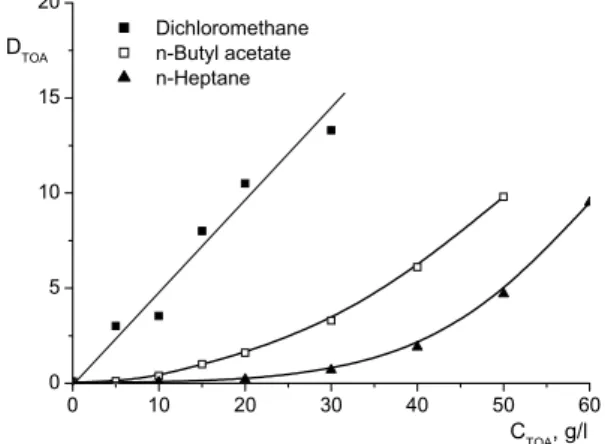
For dichloromethane, the linear dependence be-tween DTOA and extractant concentration can be seen.
For Figure 3 the solvents with lower dielectric con-stant, this dependence becomes of the polynomial type, being second-order for n-butyl acetate and fourth-order for n-heptane. These results confirm the extraction mechanisms related to each studied sol-vent, respectively the number of extractant molecule which react with pantothenic acid.
Because pantothenic acid contains one amide group which could exhibits a basic character of the carbonyl group, it can react with acidic extractants, including D2EHPA (HP). Consequently, the reactive extraction occurs by means of an interfacial reaction of the ion-exchange type, which requires the solute to be in the protonated form in the aqueous phase (at carbonyl oxygen) (Poştaru et al., 2015):
( ) ( ) ( ) ( )
2 aq o . n o aq
H A+ +n HP ← ⎯⎯⎯⎯→ HA HP +H+
For the same reason as discussed above, the for-mation of the adducts containing many molecules of pantothenic acid is also hindered in the extraction with D2EHPA, the number of extractant molecules participating in the interfacial reaction being n=2 for n-heptane and n-butyl acetate, and n=1 for dichloro-methane (Poştaru et al., 2015).
The distribution coefficient related to this extrac-tion mechanism is defined by the following relaextrac-tion- relation-ship:
[
]
[
( )]
) ( 2.
aq o n EHPA
D
HA HP HA
D = (3)
DD2EHPA representing the distribution coefficient for
reactive extraction with D2EHPA.
The influence of the pH-value of the aqueous so-lution on the distribution coefficient DD2EHPA is
indi-cated in Figure 4. Therefore, the distribution coeffi-cient is enhanced by increasing the pH-value up to 3, reaches its maximum at pH=3, then decreases. This dependence is the consequence of the phenomena occurring in the acidic domain of pH. Thus, the
reac-tive extraction of pantothenic acid with D2EHPA is
possible if its active amide group is in the cationic form at a very low pH-value. However, at strongly acidic pH, D2EHPA is also protonated and becomes unable to react with the acid. Due to these two oppo-site phenomena, the optimum pH-value for the ex-traction with D2EHPA was found to be pH=3 (Figure 4). The further increase of the pH-value leads to the dissociation of the carboxylic group, this process re-ducing further the solubility of pantothenic acid in the organic phase and, implicitly, the distribution coefficient.
1 2 3 4 5 6 7
0 2 4 6 8
Dichloromethane n-Butyl acetate n-Heptane
pH D
D2EHPA
Figure 4: Influence of pH-value of the aqueous
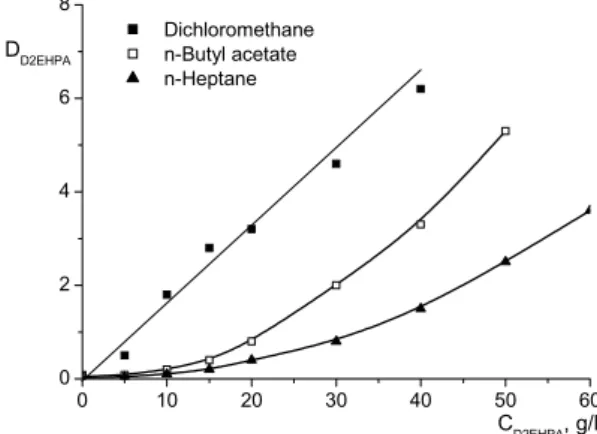
Compared to the reactive extraction with TOA, from Figure 4 it can be observed that the efficiency of pantothenic acid extraction with D2EHPA is infe-rior, regardless of the solvent polarity.
The mechanisms considered for reactive extrac-tion with D2EHPA in the three solvents are con-firmed by Figure 5, because it indicates a linear pro-portionality between the distribution coefficient and extractant concentration for dichloromethane, and a polynomial dependence of second- order for the other two solvents.
0 10 20 30 40 50 60
0 2 4 6 8
Dichloromethane n-Butyl acetate n-Heptane
DD2EHPA
CD2EHPA, g/l
Figure 5: Influence of extractant concentration on
the pantothenic acid distribution coefficient for reac-tive extraction with D2EHPA (pH = 3).
For verifying the potential synergic effect of the extractant mixture, the variation of the synergistic coefficient with the concentrations of TOA and D2EHPA was analyzed. According to expression (1), the synergistic coefficient for the studied extraction system is defined as:
EHPA D TOA
EHPA D TOA S
D
D
D
C
2 2
+
=
+(4)
the synergism appearing for CS > 1 (DTOA+D2EHPA -
distribution coefficient for reactive extraction with TOA and D2EHPA mixture).
Figures 6 and 7 indicate that the values of the synergistic coefficient are higher for the solvent with lower polarity, namely n-heptane. For a constant
concentration of D2EHPA in the organic phase, CS
increases with the increase of TOA concentration (Figure 6).
Depending on the solvent polarity and D2EHPA amount in the solvent phase, the synergic effect is observed for TOA concentrations over 20 - 40 g/l. Thus, by increasing the concentration of D2EHPA from 5 to 40 g/l, the minimum concentration value of TOA corresponding to synergism increases from 20
to 30 g/l for the solvents with lower polarity, namely n-butyl acetate and n-heptane, and from 20 to 40 g/l for dichloromethane.
The results plotted in Figure 6 suggest that TOA contributes to the formation of amine adducts by solvating the complex produced by interfacial reac-tion between pantothenic acid and D2EHPA. This statement is in concordance both with the mecha-nism of reactive extraction of pantothenic acid with TOA, and with the superior values of CS obtained for
n-heptane, because the low polarity of the organic phase allows structuring of the aminic associations (Schugerl, 1994).
0 10 20 30 40 50 60
1 2 3 4 5
C
D2EHPA = 5 g/l
Dichloromethane n-Butyl acetate n-Heptane
CS
CTOA, g/l
0 10 20 30 40 50 60
1 2 3 4
C
D2EHPA = 20 g/l
Dichloromethane n-Butyl acetate n-Heptane
CS
CTOA, g/l
0 10 20 30 40 50 60
1 2 3
CD2EHPA = 40 g/l Dichloromethane
n-Butyl acetate n-Heptane
CS
CTOA, g/l
Figure 6: Influence of TOA concentration on the
ş ş
Regardless of the solvent polarity or D2EHPA con-centration, for TOA concentrations over 50 g/L, the enhancement of the synergistic coefficient is attenu-ated or it decreases slowly. This diminution of the synergic effect magnitude could be attributed to the chemical reaction in the solvent phase between the two extractants. The phenomenon is more obvious for dichloromethane, because this reaction becomes more important both at higher TOA concentration and with the increase of solvent polarity, due to the prevention of amine associations.
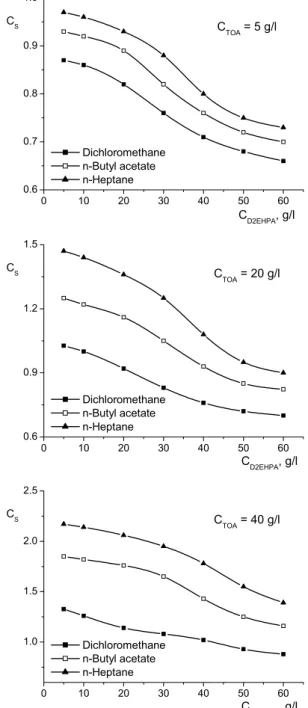
At constant TOA amount in the solvent phase, the increase of D2EHPA concentration leads to a con-trary variation of the synergistic coefficient (Figure 7). As mentioned above, the increase of D2EHPA concentration prevents the formation of amine ad-ducts and, consequently, affects the hydrophobicity of the interfacial complex with pantothenic acid. For these reasons, the diminution of CS is more important
for dichloromethane. This effect is additionally
con-firmed by the recorded values of CS for 5 g/l TOA,
which are lower than 1 for the entire considered do-main of D2EHPA concentration (negative synergism (Matsumoto et al., 2001)).
The increase of TOA concentration in the organic phase together with the decrease of solvent dielectric constant counteracts the negative influence on syner-gism due to increased D2EHPA concentration. There-fore, for 20 g/L TOA, the synergic effect was ob-served for D2EHPA concentrations up to 30 g/L for n-butyl acetate and up to 50 g/L for n-heptane, while for dichloromethane only for D2EHPA concentration below 10 g/L. At higher concentration of aminic extractant (40 g/l), for the two solvents with lower polarities synergism was observed for the entire in-vestigated domain of organophosphoric extractant. At this concentration of TOA, the domain of D2EHPA concentration corresponding to the values of CS over 1 is also extended in the case of
dichloro-methane, the superior limit becoming 40 g/l.
For modeling the synergism and establishing the chemical structure of the extracted compound formed by reaction between pantothenic acid, TOA, and D2EHPA, the results of the individual extraction with the two extractants at pH = 2 and the above discussed phenomena were taken into account. In these circumstances, the following interfacial mecha-nism of the synergic extraction of pantothenic acid was proposed:
(aq) ( )o ( )o . . n o( ) HA +n E +HP ←⎯⎯⎯⎯→ HA HP E
0 10 20 30 40 50 60
0.6 0.7 0.8 0.9 1.0
CTOA = 5 g/l
Dichloromethane n-Butyl acetate n-Heptane C
S
CD2EHPA, g/l
0 10 20 30 40 50 60
0.6 0.9 1.2 1.5
C
TOA = 20 g/l
Dichloromethane n-Butyl acetate n-Heptane C
S
CD2EHPA, g/l
0 10 20 30 40 50 60
1.0 1.5 2.0 2.5
C
TOA = 40 g/l
Dichloromethane n-Butyl acetate n-Heptane C
S
CD2EHPA, g/l
Figure 7: Influence of D2EHPA concentration on the
synergistic coefficient (pH = 2).
For calculating the number of TOA molecules participating in the formation of the interfacial amine adduct, the following relationship for the synergic extraction constant is considered (the components concentrations are given in mol/L):
( )
( ) ( ) ( )
. . n o
E n
aq o o
HA HP E K
HA HP E
⎡ ⎤
⎣ ⎦
=
⎡ ⎤ ⎡⋅ ⎤ ⎡⋅ ⎤
⎣ ⎦ ⎣ ⎦ ⎣ ⎦
(5)
where KE is the synergic extraction constant
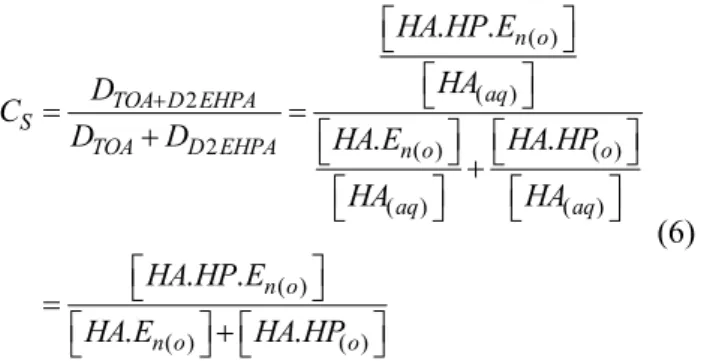
The synergistic coefficient could be expressed as a function of the concentrations of the extraction system components in the equilibrium state:
( )
( ) 2
2 ( ) ( )
( ) ( ) ( ) ( ) ( ) . . . . . . . . n o aq TOA D EHPA
S
TOA D EHPA n o o
aq aq
n o
n o o
HA HP E
HA D
C
D D HA E HA HP
HA HA
HA HP E
HA E HA HP + ⎡ ⎤ ⎣ ⎦ ⎡ ⎤ ⎣ ⎦ = = + ⎡⎣ ⎤ ⎡⎦ ⎣ ⎤⎦ + ⎡ ⎤ ⎡ ⎤ ⎣ ⎦ ⎣ ⎦ ⎡ ⎤ ⎣ ⎦ = ⎡ ⎤ ⎡+ ⎤ ⎣ ⎦ ⎣ ⎦ (6)
The concentration of interfacial amine complex formed during the extraction process is:
(
)
( ) ( ) ( )
. . n o S . n o . o
HA HP E C HA E HA HP
⎡ ⎤= ⋅ ⎡ ⎤ ⎡+ ⎤
⎣ ⎦ ⎣ ⎦ ⎣ ⎦ (7)
By combining Equations (5), (6), and (7), the syn-ergic extraction constant can be expressed as:
(
)
(
)
( ) ( ) ( ) ( ) ( ) 2 ( ) ( ) . .S n o o
E n
aq o o S TOA LD EHPA
n o o
C HA E HA HP K
HA HP E
C D D
HP E ⎡ ⎤ ⎡ ⎤ ⋅ ⎣ ⎦ ⎣+ ⎦ = ⎡ ⎤ ⎡⋅ ⎤ ⎡⋅ ⎤ ⎣ ⎦ ⎣ ⎦ ⎣ ⎦ ⋅ + = ⎡ ⎤ ⎡⋅ ⎤ ⎣ ⎦ ⎣ ⎦ (8)
Consequently, the synergistic coefficient can be calculated as:
( ) ( )
2
n E o o S
TOA D EHPA
K HP E
C
D D
⎡ ⎤ ⎡ ⎤
⋅⎣ ⎦ ⎣⋅ ⎦
=
+ (9)
The correlation (9) represents, in logarithmic form, the equation of a straight line:
(
2)
( ) ( )
ln S TOA D EHPA ln E ln o
o
C D D
K n E
HP ⋅ + ⎡ ⎤ = + ⋅ ⎣ ⎦ ⎡ ⎤ ⎣ ⎦ (10)
From the slope of the straight line given by Equation (10) it is possible to determine the number of amine extractant molecules, n, which participate to the formation of the interfacial adduct, and from its intercept the value of the synergic extraction constant, KE. Because the initial concentrations of
both extractants are considerably higher than that of
pantothenic acid, their equilibrium concentrations are assumed to be equal to the initial ones. Moreover, the calculations were considered for an optimum pH-value of 2, pantothenic acid being non-dissociated in the aqueous phase.
The straight lines obtained for three given values of D2EHPA concentration and different TOA concentrations are plotted in Figure 8 for all screened solvents. According to Figure 8, the number of amine molecules included in the interfacial adducts depends on the solvent polarity and organophosphoric extractant concentration (Table 1).
-4.5 -4.0 -3.5 -3.0 -2.5 -2.0 -1.5 0 2 4 6 8 10 Dichloromethane n-Butyl acetate n-Heptane
CD2EHPA = 5 g/l
ln[E(o)]
ln {C S (D TO A +D D2EHP A )/[ H P(O ) ]}
-4.5 -4.0 -3.5 -3.0 -2.5 -2.0 -1.5
0 1 2 3 4 5 6 7 Dichloromethane n-Butyl acetate n-Heptane
CD2EHPA = 20 g/l
ln[E(o)]
ln{C S (D TO A +D D 2 EH PA )/[H P(O ) ]}
-4.5 -4.0 -3.5 -3.0 -2.5 -2.0 -1.5
-1 0 1 2 3 4 5 6 Dichloromethane n-Butyl acetate n-Heptane
CD2EHPA = 40 g/l
ln[E(o)]
ln{C S (D TO A +D D2 EHP A )/[H P(O ) ]}
Figure 8: Graphical representation of the straight
A.-I. Galaction, M. Poştaru, A.-S. Bompa, D. Caşcaval
Table 1: Number of aminic extractant molecules included in the extracted compound.
D2EHPA
concentration Solvent
Number of TOA molecules (n)
5 g/L
n-Heptane 4.11 (≈ 4)
n-Butyl acetate 1.91 (≈ 2) Dichloromethane 1.06 (≈ 1)
20 g/L
n-Heptane 1.91 (≈ 2)
n-Butyl acetate 2.05 (≈ 2) Dichloromethane 0.92 (≈ 1)
40 g/L
n-Heptane 2.09 (≈ 2)
n-Butyl acetate 1.08 (≈ 1) Dichloromethane 1.11 (≈ 1)
The n values underline the dependence of the in-terfacial complex structure on the solvent polarity and D2EHPA concentration. Thus, for dichloro-methane, due to its high polarity, the chemical struc-ture of the extracted compound remains HA.HP.E, regardless of the concentration of organophosphoric extractant in the organic phase. For the other two solvents with lower dielectric constants, the increase of D2EHPA concentration leads to the decrease of the number of TOA molecules participating in the
reaction with pantothenic acid, the magnitude of this effect depending on the solvent polarity. Therefore, for n-butyl acetate, the chemical structure of the
interfacial product is HA.HP.E2 for D2EHPA
concen-tration up to 20 g/l, becoming HA.HP.E for 40 g/l D2EHPA. In the case of n-heptane, at 5 g/l D2EHPA,
the extracted compound has the structure HA.HP.E4,
being modified into HA.HP.E2 for higher
concentra-tions of organophosphoric extractant.
The above results confirm the negative influences of the increase of D2EHPA concentration and solvent polarity on the number of TOA molecules partici-pating in the solvation of the interfacial complex. Implicitly, these factors control the extraction effi-ciency and the magnitude of the synergic effect.
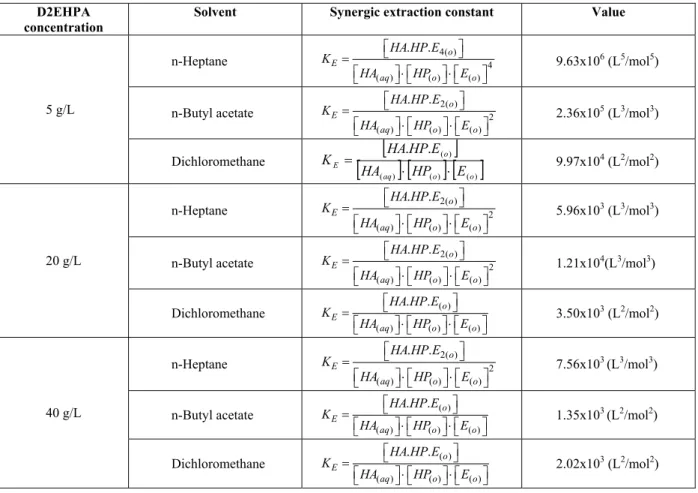
The values of the synergic extraction constant are given in Table 2 and are also dependent on the con-centration of D2EHPA and organic phase polarity. Similarly to the synergic effect, KE is affected by
increasing the D2EHPA concentration and solvent polarity, this variation emphasizing the direct rela-tion between the complex hydrophobicity, number of TOA molecules included in its chemical structure, and the performance of synergic extraction.
Table 2: Expressions and values of synergic extraction constants for the studied extraction systems.
D2EHPA concentration
Solvent Synergic extraction constant Value
5 g/L
n-Heptane 4( ) 4
( ) ( ) ( )
. . o
E
aq o o
HA HP E K
HA HP E
⎡ ⎤
⎣ ⎦
=
⎡ ⎤ ⎡⋅ ⎤ ⎡⋅ ⎤
⎣ ⎦ ⎣ ⎦ ⎣ ⎦
9.63x10⁶ (L5/mol5)
n-Butyl acetate 2( ) 2
( ) ( ) ( )
. . o
E
aq o o
HA HP E K
HA HP E
⎡ ⎤
⎣ ⎦
=
⎡ ⎤ ⎡⋅ ⎤ ⎡⋅ ⎤
⎣ ⎦ ⎣ ⎦ ⎣ ⎦
2.36x10⁵ (L3/mol3)
Dichloromethane
[
[
] [
] [ ]
]
) ( ) ( ) ( ) ( . . o o aq o E E HP HA E HP HA K ⋅ ⋅
= 9.97x10⁴ (L2/mol2)
20 g/L
n-Heptane 2( ) 2
( ) ( ) ( )
. . o
E
aq o o
HA HP E K
HA HP E
⎡ ⎤
⎣ ⎦
=
⎡ ⎤ ⎡⋅ ⎤ ⎡⋅ ⎤
⎣ ⎦ ⎣ ⎦ ⎣ ⎦
5.96x10³ (L3/mol3)
n-Butyl acetate 2( ) 2
( ) ( ) ( )
. . o
E
aq o o
HA HP E K
HA HP E
⎡ ⎤
⎣ ⎦
=
⎡ ⎤ ⎡⋅ ⎤ ⎡⋅ ⎤
⎣ ⎦ ⎣ ⎦ ⎣ ⎦
1.21x10⁴(L3/mol3)
Dichloromethane ( )
( ) ( ) ( )
. . o
E
aq o o
HA HP E K
HA HP E
⎡ ⎤
⎣ ⎦
=
⎡ ⎤ ⎡⋅ ⎤ ⎡⋅ ⎤
⎣ ⎦ ⎣ ⎦ ⎣ ⎦ 3.50x10
3
(L2/mol2)
40 g/L
n-Heptane 2( ) 2
( ) ( ) ( )
. . o
E
aq o o
HA HP E K
HA HP E
⎡ ⎤
⎣ ⎦
=
⎡ ⎤ ⎡⋅ ⎤ ⎡⋅ ⎤
⎣ ⎦ ⎣ ⎦ ⎣ ⎦
7.56x10³ (L3/mol3)
n-Butyl acetate ( )
( ) ( ) ( )
. . o
E
aq o o
HA HP E K
HA HP E
⎡ ⎤
⎣ ⎦
=
⎡ ⎤ ⎡⋅ ⎤ ⎡⋅ ⎤
⎣ ⎦ ⎣ ⎦ ⎣ ⎦ 1.35x10
3
(L2/mol2)
Dichloromethane ( )
( ) ( ) ( )
. . o
E
aq o o
HA HP E K
HA HP E
⎡ ⎤
⎣ ⎦
=
⎡ ⎤ ⎡⋅ ⎤ ⎡⋅ ⎤
⎣ ⎦ ⎣ ⎦ ⎣ ⎦ 2.02x10
3
For the experimental conditions under study, by comparing the information from Table 2 with those previously discussed, it can be affirmed that the most efficient system for synergic reactive extraction of pantothenic acid is that having the extractants mix-ture dissolved in n-heptane, and a concentration of D2EHPA of 5 g/L. In the case of similar extraction mechanism, namely for n-heptane and n-butyl ace-tate at 20 g/L D2EHPA, or n-butyl aceace-tate and di-chloromethane at 40 g/l D2EHPA, the higher solvent polarity exhibits a positive influence on the value of the synergic extraction constant.
Using the values of the synergic extraction con-stant and the number of TOA molecules, the syner-gistic coefficient was calculated for each extraction system by means of Equation (9). It was observed that the calculated values of CS offer a good
concord-ance with the experimental ones, the average devia-tion being 6.48%. The most important deviadevia-tions, maximum 15.77%, are recorded for dichloromethane and D2EHPA concentrations over 40 - 50 g/l, proba-bly due to the chemical reactions between the ex-tractants in organic phase.
CONCLUSIONS
The study of separation of pantothenic acid by re-active extraction with the mixture of TOA and D2EHPA dissolved in three solvents with different polarities indicated the possibility of obtaining a synergic effect. Thus, by maintaining a constant value of D2EHPA concentration and increasing the con-centration of TOA, the synergistic coefficient could become higher than 1, its highest values being reached for n-heptane.
The extractants roles in promoting the synergic effect are different: the organophosphoric extractant reacts with pantothenic acid and forms an interfacial compound soluble in the organic phase, while the amine extractant increases the hydrophobicity of this compound by solvation. Except for the solvent with the highest dielectric constant among those studied, namely dichloromethane, the chemical structure of the amine adduct depends on the concentration of D2EHPA and solvent polarity. Thus, for n-heptane and n-butyl acetate, the number of amine molecules included in the interfacial complex is reduced upon increasing D2EHPA concentration from 4 to 2 and, respectively, from 2 to 1. The same influence of or-ganophosphoric extractant concentration was found for the synergic extraction constant.
The most important synergic effect is obtained for the extractant mixture dissolved in n-heptane when the organic phase contains 5 g/L D2EHPA.
ACKNOWLEDGEMENTS
This work was supported by the Grant POSDRU/ 159/1.5/S/136893 under the frame of European So-cial Fund, Human Resources Development Opera-tional Programme 2007-2013.
REFERENCES
Caşcaval, D., Galaction, A. I. and Kloetzer, L., Syn-ergic extraction of folic acid with di(2-ethylhexyl) phosphoric acid and amberlite LA-2. Sep. Sci. Technol., 47, 834 (2012).
Caşcaval, D., Kloetzer, L. and Galaction, A. I., Influ-ence of organic phase polarity on interfacial mech-anism and efficiency of reactive extraction of acetic acid with tri-n-octylamine. J. Chem. Eng. Data, 56, 2521 (2011).
Coates, P. M., Blackman, M. R., Cragg, G. M., Lev-ine, M., Moss, J. and White, J. D., Encyclopedia of Dietary Supplements. Marcel Dekker, New York (2005).
Drauz, K., Groger, H. and May, O., Enzyme Cataly-sis in Organic SyntheCataly-sis. 3rd Ed., Wiley-VCH, Weinheim (2012).
Gonthier, A., Fayol, J., Viollet, J. and Hartmann, D. J., Determination of pantothenic acid in foods: In-fluence of the extraction method. Food Chem., 63, 287 (1998).
Haynes, W. M., CRC Handbook of Chemistry and Physics. 93rd Ed., CRC Press, Boca (2012-2013). Hong, Y. K. and Hong, W. H., Extraction of succinic acid with 1-octanol/n-heptan solutions of mixed tertiary amines. Bioproc. Biosyst. Eng., 23, 535 (2000).
Hong, Y. K. and Hong, W. H., Reactive extraction of lactic acid with mixed tertiary amine extractants. Biotechnol. Techniq., 13, 915 (1999).
Hudson, T. J. and Allen, R. J., Determination of pan-tothenic acid in multivitamin pharmaceutical preparations by reverse-phase high-performance liquid chromatography. J. Pharm. Sci., 73, 113 (1984).
A.-I. Galaction, M. Poştaru, A.-S. Bompa, D. Caşcaval
Fluid Phase Equilibr., 275, 21 (2009).
Kivrak, I., Chemical Constituents: Water-soluble vitamins, free amino acids and sugar profile from Ganoderma adspersum. Nat. Prod. Res., 29, 518 (2015).
Kloetzer, L., Caşcaval, D. and Galaction, A. I., Influ-ence of solvent polarity on interfacial mechanism and efficiency of succinic acid reactive extraction with tri-n-octylamine. Chem. Eng. Commun., 200, 701 (2013).
Kroschwitz, J. I. and Kirk-Othmer, M., Encyclopedia of Chemical Technology. 4th Ed., John Wiley & Sons, Inc., London (2001).
Martinez-Toledo, M. V., Rodelas, B., Salmeron, V., Pozo, C. and Gonzales-Lopez, J., Production of pantothenic acid and thiamine by azotobacter vinelandii in a chemically defined medium and a dialysed soil medium. Biol. Fertil. Soils, 22, 131 (1996).
Matsumoto, M., Otono, T. and Kondo, K., Synergis-tic extraction of organic acids with tri-n-octyla-mine and tri-n-butylphosphate. Sep. Purif. Tech-nol., 24, 337 (2001).
Moiseenok, A. G., Gurinovich, V. A. and Lysenkova, V. A., Separation of pantothenic acid derivatives as precursors for the biosynthesis of the acetyla-tion coenzyme by chromatography on DEAE-cel-lulose. Chem. Nat. Comp., 23, 216 (1987).
Poştaru, M., Bompa, A. S., Galaction, A. I., Blaga,
A. C. and Caşcaval, D., Comparative study on
pantothenic acid separation by reactive extraction with tri-n-octylamine and di-(2-ethylhexyl) phos-phoric acid. Chem. Biochem. Eng. Quart., In Press (2015).
Poştaru, M., Kloetzer, L., Blaga, A. C., Turnea, M.,
Caşcaval, D. and Galaction, A. I., Study on the
chemical inactivation of pantothenic acid (vita-min B5). Rom. Biotechnol. Lett., In Press (2015). Schugerl, K., Solvent Extraction in Biotechnology.
Springer-Verlag, Berlin (1994).
Weetall, H. H., Enzyme Engineering. Plenum Press, New York (1980).