DOI: http://dx.doi.org/10.5007/1980-0037.2013v15n2p174
original article
RBCDH
Licence Creative Commom CC
1 Universidade Estadual do Norte do Paraná. Centro de Ciência da Saúde. Jacarezinho, PR. Brasil. 2 Universidade Federal do Paraná. Departamento de Educação Física. Curitiba, PR. Brasil.
Received: 19 April 2012 Accepted: 26 September 2012
Correlation between physical activity
measured by accelerometry and BMI in
adolescents
Prática de atividade física mensurada por acelerometria
associada ao IMC em adolescentes
Antonio Stabelini Neto1 Géssika Castilho1 Jéssica Sartini Sena1 Wagner de Campos2
Abstract– he aim of this study was to investigate the correlation between physical activity measured by accelerometry and excess weight in schoolchildren. hree hundred and ninety one school-age adolescents (10 to 18 years old) participated in the study. he cut-of points used to estimate time spent in physical activity were: moderate ≥3.0 METs and vigorous ≥6.0 METs. Student’s t-test and Pearson product-moment correlation coef-icient were used to verify statistical diferences and correlations between physical activity and body mass index (BMI). Statistical signiicance was set at p<0.05. Male schoolchildren spent more time in moderate (96.1 ± 39.6 min.day-1) and vigorous (9.7 ± 8.8 min.day-1) physical activity than their female peers (moderate: 73.7 ± 37.7 min.day-1; vigorous: 6.1 ± 6.8 min.day-1). For both sexes, younger schoolchildren (10 to 14 years old) were more physically active than older ones (14 to 18 years old). Time spent in moderate-vigorous physical activity was inversely related to BMI. hese indings suggest that regular physical activity (RPA) is related to body weight reduction in schoolchildren. herefore, RPA can be used as an obesity prevention strategy in elementary school.
Key words: Excess weight; Lifestyle; Schoolchildren.
he increasing prevalence of overweight and obesity among children and adolescents has been observed in many countries all around the world, becoming a serious public health problem. Excess weight is associated with several risk factors to non-transferable chronic degenerative diseases,
including diabetes, hypertension and atherosclerosis1.
In view of this, taking physical activity as a tool for obesity prevention and health promotion, the World Health Organization has recently launched
Global Recommendations on Physical Activity for Health2, which
recom-mends that adults should engage in moderate-intensity physical activity for at least 150 minutes a week, equivalent to 30 minutes a day for ive days a week. For children and adolescents the recommendation is that they should engage in moderate-vigorous physical activity for at least 60 minutes a day.
Nevertheless, what we have seen is a gradual increase in rates of sed-entarism in several countries, including Brazil. Currently, available data suggest that 31% of the world’s population do not meet the minimum
recommended amount of physical activity3.
Studies conducted among young individuals in disparate countries show a similar pattern: boys are more physically active than girls in all age groups and physical activity, particularly of vigorous intensity, declines
signiicantly with advancing age in both sexes4-6.
One of the diiculties in deining the exactly behavior of physical ac-tivity, in large part, is due to the diiculty in accurately measure levels of physical activity in the general population, since most studies have used reminders or self-administered physical activity diaries. hese methods, although they are valid and widespread, present limitations on the indi-viduals’ ability to efectively recall the type, intensity, frequency and
dura-tion of physical activities7. Moreover, among younger individuals, another
intervening factor has to be consider with respect to the use of subjective methods, because young people’s habitual activities, most of the time, are done in the form of short-term intermittent activities, besides they have diiculty in perceiving intensity levels of physical activity8. In Brazil, due
to the high cost and the time taken for data collection, there is no informa-tion available in the literature on levels of physical activity from objective measurements on representative samples of schoolchildren.
In view of these aspects, this study aimed to compare physical activity measured by accelerometry between both sexes and diferent age groups of schoolchildren aged between 10 and 18 years, as well as to analyze the correlation between physical activity and values of body mass index (BMI).
METHODOLOGICAL PROCEDURES
Physical activity by accelerometry in adolescents Stabelini Neto et al.
Jacarezinho is located in the northern region of the state of Paraná, known as “Mesoregion of Pioneer Northern Paraná”, with average human development index (HDI) of 0.782, similar to those HDI observed in other mesoregions of Paraná, except the large Curitiba and the metropolitan region of Curitiba. According to the census conducted in 2010 by Instituto Brasileiro de Geograia e Estatística, the city of Jacarezinho has 38,580 inhabitants.
According to information provided by Núcleo Regional de Educação de Jacarezinho, PR, in the 2010 school year there were 5242 enrolled children from the 5th grade to 3rd grade of high school. In view of this, the sample
size was calculated according to the following criteria: a) the total number of schoolchildren, b) conidence interval of 95%, c) sample error of 5%, and prevalence of 20%9.
he minimum sample size calculated based on information from Sec-retaria Municipal de Educação and Núcleo Regional de Ensino was 235 schoolchildren. To estimate the design efect we used the value of 1.5 as a
correction to the sample by conglomerates design9. In addition, we added
another 5% of individuals to avoid problems due to loss of data and defect in the physical activity measuring equipment. he considered sample size was 370 schoolchildren. At the end of data collection, 391 adolescents had valid information and took part in this study.
Under the authorization of Núcleo Regional de Educação all the 18 schools were invited to participate of the study. Classrooms were randomly selected from the list containing the number of rooms from 5th to 8th grade
and 1st to 3rd years of high school provided by each school, participating
in evaluations always two classes of each grade, totaling 14 classes. Before evaluations, schoolchildren who agreed to participate in the study received a “term of free and informed consent”, which was completed and signed by their parents or guardians, authorizing the use of their data. his study was approved by the Research with Humans Ethics Committee of Universidade
Estadual de Maringá (UEM), Opinion No 668/2010, which is in accordance
with the Declaration of Helsinki and the Resolution 196/96-CNS/MS. Physical activity was objectively measured, using a Actigraph multi-axial accelerometer (GT3X; Pensacola, Florida, USA), designed to measure and record body accelerations in the vertical plane at a magnitude from 0.05 to 2.0G and a frequency of responses from 0.25 to 2.50 Hz. Accelerations in counts, which represent the amount and magnitude of accelerations, are iltered and counts are summed over a pre-determined time interval or epoch. Accelerometers were programmed to record data at 60-second (1 minute) epoch intervals. Participants were instructed to set the equipment in their hip, using an elastic band at the height of the anterior iliac spine, on the opposite side of the dominant arm for seven consecutive days. he accelerometer should be removed only for bathing (or other activities in a liquid environment) and to sleep.
hufe 1903 sotware, in which null values of counts/min for 30 continuous minutes were excluded from the analysis, assuming that the device was not in use at this time.
Subjects who did not have at least 4 full days of data, i.e. ≥ 10 hours per day record, with at least a valid day on the weekend, were excluded
from analyses10. he accelerometer has proven validity and reliability for
measuring physical activity in adolescents during activities both in labora-tory and outdoor11-13.
Counts obtained in diferent activities were converted into metabolic equivalents (METs), using the equation developed and validated by
Freed-son et al.14 for children and adolescents aged from 6 to 18 years: METs =
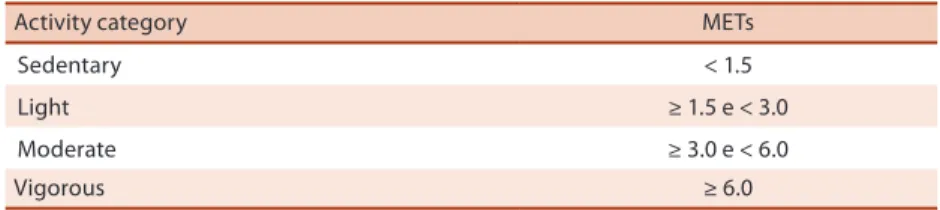
2.757 + (0.0015 x counts/min) – (0.08957 x age) – (0.000038 x counts/min x age). he cut-of points adopted for diferent physical activity intensity levels are shown in Table 1. hese cut-of points have been used in previous
studies conducted with samples of children and adolescents4,14-16.
Table 1. Cut-of points in counts/min for diferent physical activity intensity levels.
Activity category METs
Sedentary < 1.5
Light ≥ 1.5 e < 3.0
Moderate ≥ 3.0 e < 6.0
Vigorous ≥ 6.0
For measuring the height of schoolchildren we used a WCS portable vertical stadiometer, scaled in 0.1 cm. During evaluation subjects were barefoot and posted in anatomical position on the base of the stadiometer, forming a right angle with the vertical edge of the device. Subjects’ body mass should be distributed on both feet, and their head positioned in the Frankfurt plane. Arms freely loose along their trunk and palms facing their thighs. Subjects should keep their heels together, touching the vertical edge of the stadiometer. he device cursor was placed at the highest point of
their head during inspiratory apnea at the time of the measuring17.
For body mass assessment we used a Plena portable digital scale with a 100g resolution. During evaluation subjects were barefoot and wearing only light clothes, standing on the center of the scale platform and with their back to the scale, in anatomic position, and their body weight evenly distributed on both feet17.
Body mass index (BMI) was calculated using the formula BMI = body
mass / height2, in order to determine schoolchildren’s nutritional status
according to BMI percentiles: normal weight (BMI <85th percentile);
over-weight (BMI ≥ 85th and < 95th percentile); obesity (BMI ≥ 95th percentile).
Subjects were classiied using reference tables developed according to sex
and age group by the National Center for Health Statistics18 for individuals
Physical activity by accelerometry in adolescents Stabelini Neto et al.
Data were tabulated and stored in a database developed on Access 2007. Data were analyzed using SPSS for Windows version 15.0, with a signiicance level set at p<0.05 for all analyses. We used descriptive sta-tistics (mean and standard deviation) for sample characterization. hen, for comparing rates of physical activity between sexes and age groups we used the Student’s t test for independent samples. To verify the normal-ity of data we used the Kolmogorov-Smirnov test. Correlations between physical activity and BMI were determined using Pearson correlation coeicients.
RESULTS
Information about characteristics of the sample according to sex and age group are showed in Table 2. Boys were signiicantly taller and with lower BMI than girls in the group aged from 14 to 18 years.
Table 2.Participant’s characteristics according to sex and age group.
10 < 14 years n=211
14 < 18 years n=180
Total n=391
Sex n Mean SD Mean SD Mean SD
Age (years) Male 194 12.5 0.8 15.8* 1.4 13.3 1.7
Female 197 12.3 0.9 15.6* 1.1 13.1 1.7
Height (cm) Male 194
154.0 8.6 171.6*┼ 7.3 158.3 11.2
Female 197 153.6 7.7 161.7* 6.0 155.8 8.1
Body Mass (kg) Male 194 47.1 12.2 59.0* 9.2 50.0 12.6
Female 197 47.7 11.6 58.6* 10.9 50.6 12.3
BMI (Kg/m2) Male 194 19.6 3.9 20.0 2.6 19.7 3.6
Female 197 20.2 4.2 22.3*┼ 3.8 20.7 4.2
* Signiicant diference between age groups p<0.05; ┼ Signiicant diference between sexes.
Data regarding the time spent in diferent physical activity intensity levels showed that boys are more physically active than girls with respect to the time spent in moderate-vigorous physical activity and counts/min in both age groups (Table 3). No signiicant diferences were observed be-tween sexes in daily time recorded (time per day using the accelerometer) and light-intensity physical activity.
Both sexes had signiicantly reduction in minutes/day engaged in physi-cal activity of light, moderate and vigorous intensity, and in the mean of counts/min in the group aged from 14 to 18 years compared with the one aged from 10 to 14 years.
female: 10.7%). When compared between age groups, among schoolchildren aged from 10 to 14 years, 15.7% and 10.2% were overweight and obese, respectively. Among schoolchildren aged from 14 to 18 years, 18.7% were overweight and 6.7% obese (data not shown).
Table 3.Physical activity according to sex and age group.
10 < 14 years n=211
14 < 18 years n=180
Total n=391
Sex n Mean SD Mean SD Mean SD
Time recorded (minutes/day)
Male 194 837.8 181.1 789.6 100.6 827.0 167.2
Female 197 888.5 168.2 820.2 149.0 873.4 166.1
LPA (minutes/day)
Male 194 295.9 60.4 251.3* 86.2 285.9 69.0
Female 197 291.9 56.8 247.4* 80.1 281.7 65.3
MPA (minutes/day)
Male 194 106.1 35.1 61.3* 35.3 96.1 39.6
Female 197 82.0┼ 36.5 44.4*┼ 24.9 73.7┼ 37.7
VPA (minutes/day)
Male 194 11.2 9.3 4.6* 3.9 9.7 8.8
Female 197 7.3┼ 7.3 1.9*┼ 2.8 6.1┼ 6.8
MVPA (minutes/ day)
Male 194 117.2 38.8 66.0* 38.1 105.8 44.0
Female 197 89.3┼ 40.7 46.4*┼ 25.9 79.8┼ 41.8
Physical activity (counts/min)
Male 194 497.1 174.0 403.2* 157.4 476.15 174.0
Female 197 388.6┼ 150.0 319.1*┼ 150.0 373.32┼ 152.2
* Signiicant diference between age groups p<0.05; ┼ Signiicant diference between sexes. LPA: light physical activity; MPA: moderate physical activity; VPA: vigorous physical activity; MVPA: moderate-vigorous physical activity.
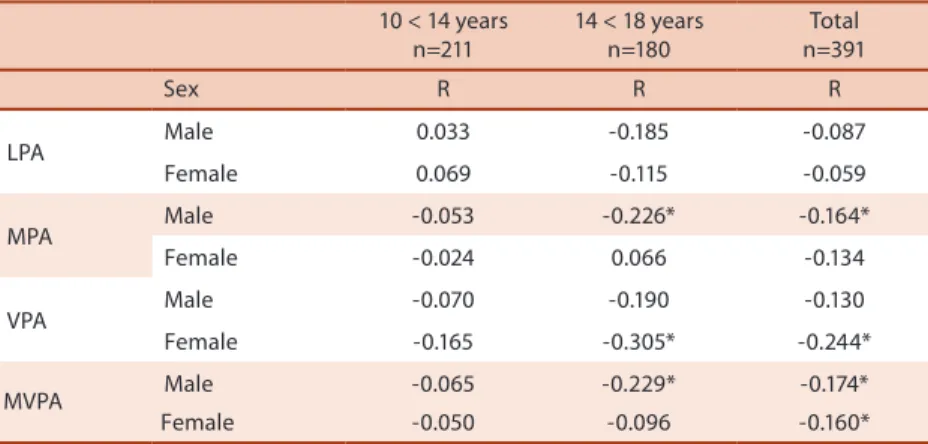
Correlation coeicients between physical activity intensity levels and BMI are showed in Table 4. We observed a signiicant inverse correlation between time spent in moderate-vigorous physical activity and BMI.
Table 4.Correlation coeicients between physical activity and body mass index.
10 < 14 years n=211
14 < 18 years n=180
Total n=391
Sex R R R
LPA Male 0.033 -0.185 -0.087
Female 0.069 -0.115 -0.059
MPA Male -0.053 -0.226* -0.164*
Female -0.024 0.066 -0.134
VPA Male -0.070 -0.190 -0.130
Female -0.165 -0.305* -0.244*
MVPA Male -0.065 -0.229* -0.174*
Female -0.050 -0.096 -0.160*
Physical activity by accelerometry in adolescents Stabelini Neto et al.
DISCUSSION
his is the irst study in Brazil, with a school-based sample, that objec-tively assessed physical activity in schoolchildren. his study’s indings go against previous evidences that boys are more physically active than girls and that physical activity is lower in older adolescents compared with their younger peers. So, even this sample being from of a speciic region of Brazil, this study’s indings regarding physical activity behavior proved to be consistent when compared with other studies’ indings in several states and countries4,19-21.
From 1986 to 2002 Samdal et al.5 assessed secular trends in adolescents’
physical activity behavior and showed that in all countries (Austria, Fin-land, Hungary, Norway, Scotland and Sweden) boys reported more time
spent in moderate-vigorous activities than girls. Likewise, Hallal et al.22
found a prevalence rate of sedentarism of 49% in males and 67% in females.
Kimm et al.6 objectively measured physical activity in adolescents and
reported a 21% reduction in the level of physical activity from 11 to 14
years old. Likewise, Narder et al.4 longitudinally assessed physical
activ-ity by accelerometry in 1032 American adolescents, using as a criterion to determine physical activity intensity levels the same cut-of points used in this study (≥ 60 minutes/day of MVPA). Ater the monitoring, authors observed a signiicant linear reduction of time engaged in MVPA from 9 to 15 years old. his reduction was of 38 minutes/day, per year, on weekdays and 41minutes/day, per year, in weekends.
When authors analyzed the proportion of adolescents who met the recommended 60minutes/day of MVPA, they observed that at the age of 9 years old virtually all subjects met that recommendation. However, with the reduction of time spent in MVPA with advancing age in both sexes, girls with 13.1 and boys with 14.7 years old fail to meet the recommended
physical activity levels4. hese results are similar to our indings, in which
the proportion of schoolchildren who meet the recommended 60 minutes/ day of MVPA drops to approximately 25% in the group aged from 14 to 18 years.
he fact that males, from very young, are more physically active than females, still generates curiosity in the scientiic community, since there is still no universally accepted biological plausibility to explain this phe-nomenon. Social factors seem to have an undoubted impact in this context, because boys, from very young, are encouraged by parents and teachers to practice sports, while girls are motivated to low-intensity activities or even sedentary ones.
hus, in view of this reality, as scientiic as empirical, physical educa-tion teachers should encourage their students to engage in regular physi-cal activity as a means of promoting health. Another point of consensus among several studies19-21 is that adolescents, with advancing age, regardless
labor market.
Regarding to correlations between time spent in diferent physical activity intensity levels and BMI values we observed signiicant inverse correlations between time engaged in moderate-vigorous physical activity and BMI. he same did not occur with light-intensity activities.
Silva et al.23 assessed correlations between physical activity, BMI and
sedentary behaviors in 5208 adolescents from the state of Santa Catarina and showed that the chance of having excess weight was 74% higher among low-active boys when compared with the active ones.
In a longitudinal study conducted by Moore et al.24, children with a
habitual high level of physical activity had consistently smaller gains in BMI. In another study conducted with adolescents from 34 countries, the chance of overweight decreased as physical activity increased (trend observed in 29 of the 34 countries) and excess weight was less prevalent
when the time spent watching TV decreased25. Likewise, Hancox et al.26
showed that the greater the number of hours watching TV, the higher the BMI of adolescents.
In contrast, the study conducted by Guedes et al.19 showed that
insui-cient physical activity was not associated with excess weight assessed by BMI. It is known that excess weight is a combined result of excessive food
intake and low physical activity energy expenditure. Levin et al.27 reported
that adolescents with higher BMI are less engaged in physical activity than adolescents with lower BMI values. hus, as adolescents with normal weight and low physical activity level may develop overweight, those who are already obese have more diiculty to engage in regular physical activity programs due to their excessive weight.
Disagreement among studies on correlations between physical activity and BMI is oten due to the method used to assess physical activity, since most subjective methods do not provide accurate information about the time spent in diferent physical activity intensity levels. In this sense, what should be highlighted in the assessment of physical activity in young people is the importance of using speciic cut-of points for each age to determine physical activity intensity levels, because it takes into account diferences in energy savings and resting metabolic rate related to each age, which al-lows us to estimate accurately the young people participation in physical activity of light, moderate and vigorous intensity.
Physical activity by accelerometry in adolescents Stabelini Neto et al.
CONCLUSION
Corroborating other reports in the literature, this study showed that boys are more physically active than girls. Moreover, in both sexes, younger subjects (10 to 14 years old) spend more time per day engaged in moderate-vigorous physical activity than their peers in the group aged from 14 to 18 years. Furthermore, results of this study reinforce previous evidence that moderate-vigorous physical activity is inversely related to excess weight in schoolchildren. Finally, prevention strategies should be developed to increase regular physical activity in the pediatric population, especially in female schoolchildren aged from 14 to 18 years, for individuals to maintain a physically active lifestyle for all life.
REFERENCES
1. Pinhas H, Dolan L M, Daniels SR, Standiford D, Khoury PR, Zeitler P. Increased incidence of non-insulin dependent diabetes mellitus among children and adoles-cents. J Pediatr 1996;128:608-15.
2. Word Health Organization. Global Recommendations on Physical Activity for Health. Geneva: WHO, 2010.
3. Hallal PC, Andersen LB, Bull FC, Guthold R, Haskell W, Ekelund U. Physical Ac-tivity Series Working Group. Global physical acAc-tivity levels: surveillance progress, pitfalls, and prospects. Lancet 2012; 6736(12):1-11.
4. Narder PR, Bradley RH, Houts RM, McRitchie SL, O’Brien M. Moderate-to-Vigorous physical activity from ages 9 to 15 years. JAMA 2008;300(3):295-305.
5. Samdal O, Tynja J, Roberts C, Sallis JF,Villberg J, Wold B. Trends in vigorous physi-cal activity and TV watching of adolescents from 1986 to 2002 in seven European Countries. Eur J Public Health 2006;28:1-7.
6. Kimm SYS, Glynn NW, Kryska AM. Longitudinal changes in physical activity in a biracial cohort during adolescence. Med Sci Sports Exerc 2000;32:1445-54.
7. Duncan GE, Sydeman SJ, Perri MG, Limacher MC, Martin AD. Can sedentary adults accurately recall the intensity their physical activity? Prev Med 2001;33(1):18-26.
8. Corder K, Ekelund U, Steele R M, Warehan N J, Brage S. Assessment of physical activity in youth. J Appl Physiol 2008;105:977-87.9. Luiz RR, Magnanini MMF. A lógica da determinação do tamanho da amostra em investigações epidemiológicas. Cad Saúde Pública 2000;8(2):9-28.
9. Trost SG, Pate RR, Freedson PS, Sallis JF, Taylor WC. Using objective physical activity measures with youth: How many days of monitoring are needed? Med Sci Sports Exerc 2000;32(2):426-31.
10. Puyau MR, Apolph AL, Vohra FA, Butte NF. Validation and calibration of physical activity monitors in children. Obesity Res 2002;10:150-7.
11. Trost S, Ward D, Moorehead S, Watson P, Riner W, Burke J. Validity of the computer and science and applications (CSA) activity monitor in children. Med Sci Sports Exerc 1998;30:629-33.
12. Melanson EL, Freedson P. Validity of the Computer Science and Applications, Inc, (CSA) activity monitor. Med Sci Sports Exerc 1995;27(6):1-7.
13. Freedson P, Sirard SJ, Debold E. Calibration of the Computer Science and Applica-tions, Inc (CSA) accelerometer. Med Sci Sports Exerc 1997; 29(Suppl):S45.15. Trost SG, Way R, Okely AD. Predictive Validity of hree ActiGraph Energy Expenditure Equations for Children. Med Sci Sports Exerc 2006;38(2):380-7
Corresponding author
Antonio Stabelini Neto
Universidade Estadual do Norte do Paraná Campus Jacarezinho. Centro de Ciências da Saúde
Alameda Padre Magno, 841. CEP: 86.400-000 Jacarezinho, Paraná, Brasil. E-mail: [email protected]
16. Centers for Disease Control and Prevention and National Center for Health Statis-tics/CDC. CDC growth charts: United States. 2000; Available from: <http://www. cdc.gov/growthcharts> [2009 mai 25].
17. Guedes DP, Guedes JERP, Barbosa DS, Oliveira JA ,Stanganelli LCR. Fatores de risco cardiovasculares em adolescentes: Indicadores biológicos e comportamentais. Arq Bras Cardiol 2006; 86:439-50.
18. Trost SG, Pate RR, Sallis JF, Freedson PS, Taylor WC, Dowda M, et al. Age and gender diferences in objectively measured physical activity in youth. Med Sci Sports Exerc 2002; 34(2):350-5.
19. Guedes DP, Guedes JERP, Barbosa DS, Oloveira JA. Níveis de prática de Atividade Física habitual em adolescentes. Rev Bras Med Esporte 2001;7(6):187-99.
20. Hallal PC, Bertoldi AD, Gonçalves H, Victora CG. Prevalência de sedentarismo e fatores associados em adolescentes de 10-12 anos de idade. Cad Saúde Pública 2006;22(6):1277-87.
21. Silva KS, Nahas MV, Hoefelmann LP, Lopes AS, Oliveira ES. Associações entre atividade física, índice de massa corporal e comportamentos sedentários em ado-lescentes. Rev bras epidemiol 2008;11(1):159-68.
22. Moore LL, Di Gao AS, Bradlee ML, Cupples LA, Ramamurtias AS, Proctor MH. Does early physical activity predict body fat change throughout childhood? Prev Med 2003;37:10-7.
23. Janssen I, Katzmarzyk PT, Boyce WF, Vereecken C, Mulvihillo C, Roberts C. Comparison of Overweight and Obesity Prevalence in School-aged Youth from 34 countries and their relationships with Physical Activity and Dietary Patterns. Obes Rev 2005;6:123-32.
24. Hancox RJ, Milene BJ, Poulton R. Association between child and adolescent television viewing and adult health: a longitudinal birth cohort study. Lancet. 2004;364(9430):257-62.