UNIVERSIDADE DE LISBOA
FACULDADE DE CIÊNCIAS
DEPARTAMENTO DE BIOLOGIA ANIMAL
NON-VIRAL GENE DELIVERY TO MESENCHYMAL STEM CELLS
Irina Sofia Mendes Pinheiro
Mestrado em Biologia Evolutiva e do Desenvolvimento
UNIVERSIDADE DE LISBOA
FACULDADE DE CIÊNCIAS
DEPARTAMENTO DE BIOLOGIA ANIMAL
NON-VIRAL GENE DELIVERY TO MESENCHYMAL STEM CELLS
Irina Sofia Mendes Pinheiro
Dissertação orientada por:
Doutora Teresa Catarina Páscoa Madeira
(Instituto Superior Técnico, Universidade de Lisboa)
Doutora Maria Gabriela Gomes de Figueiredo Rodrigues
(Faculdade de Ciências da Universidade de Lisboa)
Mestrado em Biologia Evolutiva e do Desenvolvimento
Table of contents
List of abbreviations
i
Acknowledgements
ii
Abstract
iii
Keywords
iii
Resumo
iv
Palavras-chave
vii
1. Introduction
1
1.1. Stem cells1
1.2. MSC source, isolation and characterization
2
1.3. Isolation and Characterization in vitro
2
1.4. Immunophenotype
3
1.5. Immunological characteristics
3
1.6. MSC for clinical use
4
1.6.1. Regenerative medicine/ Tissue engineering
4
1.6.2. Gene therapy
4
1.7. Gene deliver to MSC
5
2. Aim of studies
8
3. Materials and methods
9
3.1. Plasmid construction
9
3.2. DNA isolation
10
3.2.1. Transformation of E. coli
10
3.2.2. Plasmid Bank
10
3.2.3. High copy plasmid purification (Midi)
10
3.3. BM-MSCs isolation
11
3.5. Gene Transfection
12
3.5.1. Microporation
12
3.5.1.1. Proliferation kinetics
12
3.5.2. Magnetofection and Lipofection
13
3.6. Cell viability and Flow cytometry analysis
14
3.7. Adipogenic and osteogenic differentiation
15
3.8. Immunophenotyping of BM-MSC
15
3.9. Confocal microscopy
16
4. Results
17
4.1. Microporation
17
4.1.1. Optimization of microporation transfection conditions
17
4.1.2. Long term analysis of transfected cells
18
4.1.3. Microporation effect on cell division kinetics
20
4.2. Magnetofection
21
4.2.1. Effect of PolyMAG on transfection efficiency
21
4.2.2. Effect of magnetic lipolex preparation on cell transfection
22
4.2.3. Effect of magnetic poliplex preparation on cell transfection24
4.2.4. Effect of DNA amount on magnetofection using lipoplexes and poliplexes25
4.2.5. Long-term assessment of transfection efficiency27
4.2.6. Intracellular trafficking of magnetic lipoplexes after magnetofection28
4.3. Maintenance of multiple Stem cell traits after transfection
30
5. Discussion
34
6. Conclusions and future work
40
i
List of abbreviations
ALP Alkaline Phosphatase
Amp Ampicillin
BDNF Brain-derived neurotrophic factor
BM Bone Marrow
BMP-2 Bone morphogenic protein
CMV Cytomegalovirus
ESC Embryonic stem cells FBS Fetal bovine serum
G2 Generation 2
GFP Enhancedgreen fluorescent protein GvHD Graft vs host disease
hADSC Human adipose tissue derived stem cells hMSC Human mesenchymal stem cells HSC Hematopoietic stem cells
hUCB-MSC Human umbilical cord blood derived mesenchymal stem cells
IV Intravenous
Kan Kanamycin
LP Lipoplexes
M Microporated
MD Microporated with DNA mESC Mouse embryonic stem cells MHC Major histocompatibility complex MLP Magnetic lipoplexes
MP Magnetic particles
MPL Magnetic poliplexes
Ms Milliseconds
MSC Mesenchymal stem cells
NHEK Normal human epidermal keratinocytes NIH/3T3 Mouse fibroblast cells
NM Non-microporated
O.D. Optical density
P Parental generation
PBS Phosphate buffered saline
pDNA Plasmid DNA
PL Poliplexes
PEI Polyethylenimine
PFA Paraformaldehyde
RB Resuspension buffer REVs Episomally replicating viruses
V Voltage
ii
Acknowledgements
“Aspira ao conhecimento. Se empobreceres, ele será a tua riqueza; se enriqueceres, será o teu adorno.”
Provérbio Árabe
I want to express my truly gratitude to everyone which follow me during the Master Thesis year, especially to:
Professor Joaquim Cabral for giving me the wonderful opportunity to develop my Master Thesis at Institute for Biotechnology and Bioengineering (IBB), Instituto Superior Técnico (IST). Cláudia Lobato da Silva for awaken my scientific interest in this area and for receiving me at IST.
Catarina Madeira, for your supervision, unconditional support and encouragement trough this amazing experience. I feel extremely grateful and lucky to have had you as my supervisor, I couldn´t have done it without your help. Thank you for everything!
My colleagues at Stem Cell Bioengineering Group for your help and support.
Dr. Fábio Fernandes for your collaboration and assistance with the confocal microscopy at Centro de Química-Física Molecular (CQFM), Instituto Superior Técnico (IST).
My friends, particularly from BioEngineering Research Group (BERG) at IST, for all your friendship and companionship. Thank you all for the good moments!
My family, specially my parents and sister for your patient and unconditional love. Thank you for always encourage me to pursue my dreams.
iii
Abstract
Human mesenchymal stem cells (hMSC) are multipotent stem cells, capable of differentiation in vivo and ex-vivo into multiple cell lineages. Additionally, their immunomodulatory properties and trophic activity have made them extremely attractive for tissue engineering and gene therapy. Viral vectors have been used to efficiently genetically modify MSC, but due to safety concerns, non-viral vectors have been presented as a suitable alternative. However, non-viral methods are less efficient to deliver DNA, especially to hard-to-transfect cells as MSC. In this study, gene delivery to human Bone Marrow (BM) MSC was optimized by two novel non-viral techniques: microporation and magnetofection. Microporation is an electroporation based method recently developed to overcome high cell mortality obtained with conventional electroporation. Conversely, magnetofection has proven to be useful in scaffold construction and to improve liposomes effectiveness.
High transgene expression (50%) and low cell mortality (90% of cell recovery and 99% of cell viability) was obtained with microporation, when using 150,000 cells and 1μg of plasmid DNA (pDNA) encoding for a reporter protein. Moreover, it was shown that BM-MSC proliferation kinetics was mainly affected by the presence of pDNA rather than due to microporation process. On the contrary, magnetofection achieved high viability (80%) but only 27% of transfection and 40% of cell recovery, when using 15,000 cells/μg DNA. Lower efficiencies were mainly explained by the agglomeration observed in confocal microscopy, between lipoplexes and magnetic particles, which most likely prevented pDNA entry into the cell. Finally, none of the methods affected BM-MSC immunophenotype characteristics and differentiation potential.
Taken together, present data suggest that microporation is an easy and highly efficient promising tool for BM-MSC transfection, while magnetofection potential use on 3D tissue construction demands further prevention of particle agglomeration. Each method, with their particular advantage, has undoubtedly a potential use for clinical applications and genetic engineering.
Keywords: Cationic liposomes; magnetofection; mesenchymal stem cells; microporation; non-viral gene delivery; plasmid DNA.
iv
Resumo
As células estaminais são células indiferenciadas, capazes de se auto-renovar e de se diferenciar, sob determinadas condições, em células provenientes de linhagens múltiplas. Existem dois tipos principais de células estaminais: embrionárias e adultas. Apesar das células estaminais embrionárias possuirem um maior espectro de diferenciação, problemas éticos relacionados com o manuseamento destas tem substituido o seu uso pelas células adultas.
As células estaminais mesenquimais (mesenchymal stem cells- MSC) constituem uma população de células estaminais adultas, que apesar de raras, são facilmente isoladas e cultivadas a partir de diversos tecidos, em particular da medula óssea (bone marrow- BM), possuindo uma elevada capacidade de expansão ex-vivo. Em cultura, estas são células aderentes e fusiformes e identificadas através da presença de marcadores de superfície específicos, tais como CD105, CD73, CD44, CD90, CD71 e Stro-1.
As MSC tem vindo a ser alvo de grande interesse cientifico, nos últimos anos, devido às suas características particulares. Em primeiro lugar, são capazes de diferenciar-se numa vasta gama de linhagens celulares: condrócitos (células da cartilagem), osteócitos (células de osso, tendão ou ligamentos), adipócitos (células de gordura) e miócitos (células de músculo). Para além disso, possuem capacidades imunomodulátorias, reduzindo as probabilidades de rejeição em transplantes alogénicos e secretam substâncias bioactivas (actividade trófica) tais como citocinas e factores de crescimento que inibem mecanismos de respostas imunes e promovem o enxerto conjunto com células estaminais hematopoiéticas (hematopoietic stem cells- HSC). Alguns autores sugerem ainda que estas células possuem capacidades migratórias para tecidos danificados ou cancerígenos, após administração intravenosa. Deste modo, as MSC constituem uma excelente e potential ferramenta em áreas como a medicina regenerativa e terapia génica. Recentemente, surgiram diversos estudos que reportam o efeito benéfico das MSC na cura de doenças como a do enxerto contra hospedeiro (graft vs host disease- GvHD) e osteogenesis imperfecta, em crianças, onde se observou uma melhoria na formação e crescimento ósseo após infusão com MSC. As MSC têm sido também transfectadas eficientemente com genes terapêuticos, nomeadamente com BMP-2 (codificante para uma proteína morfogénica óssea) de modo a promover a formação de osso, com interferão-beta para facilitar a entrega da respectíva proteína e como terapia coadjuvante na cura de doenças como o Parkinson ou no tratamento de danos na espinal medula. Consequentemente, é
v imperativo um conhecimento mais aprofundado das características das MSC assim como da tecnologia necessária à sua manipulação.
Nos últimos anos, o uso de metodologias baseadas em vectores virais provou ser uma forma eficiente de transfectar células estaminais. Contudo, estes vectores podem ser patogénicos, podendo despoletar uma resposta imune e inflamatória, assim como induzir mutagénese das células transfectadas. Por outro lado, a entrega de genes através de métodos não virais, incluindo electroporação, lipossomas catiónicos e polímeros biodegradáveis, oferecem uma série de vantagens, tais como uma elevada capacidade de empacotamento, baixa imunogenicidade e, uma maior biosegurança. Estes métodos são geralmente usados para expressão transiente do gene, o que pode ser benéfico em células com um período de vida limitado ou na transfecção de células com genes suicidas de modo a destruir células cancerígenas. Adicionalmente, o facto de as MSC serem dificeis de transfectar torna necessário o desenvolvimento de novas metodologias seguras, que ofereçam uma elevada eficiência de transfecção, sem comprometer a viabilidade celular.
O objectivo principal deste estudo foi a optimização de duas técnicas não virais, recentemente desenvolvidas, para transfectar MSC da medula óssea: microporação e magnetofecção.
A microporação é um método de electroporação desenvolvido para evitar a elevada mortalidade das células, geralmente causadas por esta. Esta técnica faz uso de uma micropipeta e de um eléctrodo capilar em vez de uma cuvete, eliminando os efeitos negativos causados pela electroporação convencional, como a subida de temperatura, variação de pH e libertação de iões metálicos. Elevados valores de transfecção foram recentemente obtidos com microporação em células estaminais do cordão umbilical e do tecido adiposo (65-83%), mas não há registos de estudos com MSC. No âmbito deste estudo, foram transfectados por microporação, dois plasmídeos de diferentes tamanhos (pVAX e pCEP4), ambos contendo um gene que codifica para uma proteína repórter fluorescente verde (green fluorescent protein-GFP) ou amarela (yellow fluorescent protein– YFP), variando os seguintes parâmetros: voltagem (V), duração do pulso (milisegundos-ms) e número de pulsos. As maiores percentagens de transfecção de MSC (50%) e menor mortalidade celular (90% de recuperação celular e 99% de viabilidade celular) foram obtidas com 1000V, 40ms e 1 pulso, usando 150.000 células e 1 µg do plasmídeo menor (pVAX). Adicionalmente, a expressão do gene manteve-se durante os primeiros 7 dias após transfeccção nos 50%, desaparecendo ao fim de 23 dias. Porém a presença de DNA plasmídico (DNAp), mostrou ser a principal responsável pela
vi diminuição do crescimento celular, em vez do processo de microporação por si só. Estes resultados reforçam a ideia sugerida por outros autores de que o DNAp pode sobrecarregar as células metabolicamente, provocando danos às mesmas.
No caso da magnetofecção, o DNA plasmídico forma complexos com partículas magnéticas, que posteriormente são inseridos na célula através do uso de um campo magnético. Esta técnica tem vindo a ser usada com êxito na construcção de matrizes 3D e na melhoria da eficiência de lipossomas catiónicos. Recentemente, foram disponibilizados dois tipos de reagentes de partículas magnéticas: PolyMAG, concebido para ser adicionado apenas ao DNA e CombiMAG desenvolvido para ser usado com outro tipo de reagente de transfecção. Neste contexto, foram usadas diferentes quantidades de PolyMAG para transfectar BM-MSC. No entanto, a baixa expressão transgénica obtida com este reagente levou à substituição pelo CombiMAG. Como tal, usaram-se diferentes quantidades de CombiMAG com dois tipos de reagentes de transfecção, separadamente: lipossomas catiónicos (Lipofectamina™ 2000) e outro com polímeros biodegradáveis (X-fect™). A quantidade de DNAp foi também optimizada para ambos os reagentes usados e a entrada deste para o interior da célula foi observada utilizando microscopia confocal. Os melhores resultados de magnetofecção foram obtidos com 15000 células, 2 µl de lipofectamina, 2 µg de DNAp e usando 0.5 µl de CombiMAG: 80% de viabilidade celular, 27% de transfecção e 40% de recuperação celular. Ao contrário da microporação, a manutenção do transgene na célula observou-se apenas por 7 dias, possivelmente devido ao baixo valor inicial de transfecção.
Finalmente, nenhuma das técnicas não virais afectou a manutenção das características imunofenotípicas das BM-MSC, verificadas através da marcação com anticorpos específicos para este tipo de células (CD73 e CD105), e da capacidade de diferenciação em osteoblastos e adipócitos.
Comparando as duas técnicas usadas neste trabalho, a microporação provou ser um método mais eficiente e seguro na transfeccção de BM-MSC, sendo necessária uma menor quantidade de pDNA (1 µg). A baixa eficiência observada com magnetofeccção pode ser explicada pela aglomeração observada em microscopia confocal entre lipoplexos (complexo de lipossomas e DNA) e partículas magnéticas, que consequentemente poderá ter evitado a entrada de DNAp na célula e originado as baixas eficiências observadas, tornando necessária a prevenção futura desta mesma aglomeração, nomeadamente através do uso de um tampão salino.
vii Como trabalho futuro, seria interessante avaliar também o número de cópias do plasmídeo nas células através de RT-PCR, a citotoxicidade dos reagentes e partículas recorrendo a testes específicos para detectar necrose (detecção da actividade lactato desidrogenase) e apoptose celular (quantificação de nucleossomas no citoplasma), e substituir o uso de lipossomas catiónicos por um péptido Tat, que por sua vez demonstrou elevadas eficiências em estudos recentes de magnetofecção.
Os resultados obtidos sugerem que, em conjunto, a elevada eficiência e fácil uso da microporação na transfecção de BM-MSC, assim como o uso potential da magnetofecção na construção de matrizes 3D, constituiem uma possível feramenta para uso clínico e engenharia genética.
Palavras-chave: Células estaminais mesenquimais; DNA plasmídico; entrega de genes
1
1. Introduction
1.1. Stem cells
Stem cells are clonogenic undifferentiated immature progenitor cells, capable of self-renewal and multilineage differentiation. In addition, they can divide essentially without limit to maintain or repair their host tissue. Unlike other cell types, stem cells are unspecialized cells that under certain physiologic or experimental conditions can be induced to become tissue- or organ-specific with special functions [1].
Stem cells can be classified into three main groups according with their ability to differentiate: Totipotent cells, found in early embryos (1-3 days from oocyte fertilization), can originate all the embryonic tissues and placenta; Pluripotent, embryonic cells from blastocysts (days 4-14 after oocyte fertilization), can only differentiate into embryonic tissues belonging to the inner cell mass (ectoderm, mesoderm, and endoderm); Multipotent, derived from fetal tissue, cord blood and adult stem cells, can give rise only to tissues belonging to one embryonic germ layer (ectoderm or mesoderm or endoderm) [2].
Because of these particular attributes, there is widespread interest in stem cells and regenerative medicine and their potential to treat and cure human diseases. Human embryonic and adult stem cells offer advantages and disadvantages regarding their potential use for cell therapy [3]. Embryonic stem cells (ESC) are pluripotent, easy to isolate and grow relatively easy in culture. However, their generation and manipulation are beset by moral and etical concerns as well as their potential to form teratomas when explanted to ectopic sites [4]. On the other hand, even though adult stem cells are more difficult to expand, limited by number and differentiated cell types, they offer a potential advantage for regenerative therapy as a patient's own cells could be expanded in culture, differentiated into a specific cell type, and then reintroduced into the patient, without the risk of tissue rejection [5].
A good example of a tissue-derived adult stem cell is found in the bone marrow (BM). BM is a mesoderm-derived tissue that contains two kinds of stem cells: haematopoietic stem cells (HSC) and mesenchymal stem cells (MSC). HSC can give rise to all types of blood cells and are the best-characterized somatic stem cells so far, but in vitro expansion has been unsuccessful, limiting the future therapeutic potential of these cells [6]. Conversely, MSC’s particular characteristics have encouraged scientific research over the years.
2
1.2. MSC source, isolation and characterization
Even though MSC are tipically isolated from BM, where they are relatively rare (1/105 mononuclear cells)[7], they can be present in many other tissues and organs, like umbilical cord blood, fat tissue [8], liver, brain, pancreas [9], lung [10] and amniotic fluid [11].
MSC are defined as adherent, fibroblastoid-like cells that can be induced, in vivo and in
vitro, to differentiate into mesodermal cell lineages like chondrocytes (cartilage), osteoblasts
(bone), adipocytes (fat tissue) [12] myotubes (muscle) and non-mesodermal cells such as neurons [13]. Moreover, MSC are easy to isolate and culture, demonstrating high ex-vivo expansive potential without losing their normal karyotype and telomerase activity [14]. In addition, their immunomodulatory properties, ability to migrate into injured organs [15-16] and cancers [17], supports their potential use in transplantation, tissue engineering and gene therapy applications.
1.3. Isolation and Characterization in vitro
MSC are generally obtained ex-vivo from normal donor’s bone marrow aspirates, for purposes of allogenic marrow transplantation, or tissue disaggregation into single cell components and further resuspension in culture medium. After plating low-density mononuclear cells in a basal medium supplemented with fetal bovine serum, MSC are selected by washing out non-adherent cells. Culture conditions that do not allow leukocyte survival are used for further expansion [18]. These plastic adherent populations are functionally heterogeneous, containing an assortment of uncommitted and lineage restricted precursors exhibiting divergent stemness [19]. A homogeneous, adherent cell population is generally achieved after 3-5 weeks of culture and keeps proliferating for up to 40 doublings , after which cells start to suffer apoptosis and differentiation potential is progressively lost due to senescence [20].
3
1.4. Immunophenotype
Phenotypic characterization of MSC is still controversial, as there are still no specific markers for these cells. However, MSC may be commonly identified by the lack of expression of hematopoietic (CD45, CD34, CD14 or CD11) and endothelial (CD31/PECAM-1) markers, as well as by the expression of surface receptors CD105, CD73, CD44, CD90, CD71, STRO-1 [21]. MSC can also express vascular (CD106/VCAM-1), activated leukocyte (CD166/ALCAM) and intercellular (ICAM-1) adhesion molecules, chemokines, cytokine and grow factor receptors [22]. However, some authors verified that differences in cell surface expression markers may be influenced by many factors, such as method for isolation and culture, tissue source and senescence caused by extensive expansion [20, 23].
1.5. Immunological characteristics
MSC possess two important immunomodulatory properties, reducing the probabilities of rejection after an allogeneic transplant. First, they express the major histocompatibility complex (MHC) class I, but lack CD40, CD80, CD86 and MHC class II expression [24]. Second, MSC secrete large amounts of bioactive factors (e.g. cytokines, growth factors), that inhibit T-cell proliferation and recognition (by inhibiting TNF-α and INF-γ production thus increasing IL-10 levels) in an MHC independent manner [25], as well as NK cells, B-cell proliferation, differentiation and chemotaxis, dendritic cells maturation and function [26-27].
In vivo administration of human MSC (hMSC) has shown to lower the risk of
graft-versus-host disease (GvHD) by promoting hematopoietic engraftment [28]. Furthermore, in mice, experimental induced encephalomyelitis symptoms were significantly improved by systemic MSC administration [29].
Nevertheless, the use of MSC as an immunomodulatory tool still has safety concerns. For instance, in mice, MSC immunosuppressive properties are associated with uncontrolled growth of tumors [30].
4
1.6. MSC for clinical use
1.6.1. Regenerative medicine/ Tissue engineering
MSC are an attractive tool for therapeutic application in clinical study, given their differentiation potential, immunological characteristics and ability to migrate to sites of injured tissue. When compared with in vitro characterization, there is less information on the in vivo behavior of MSC although their infusion has shown their engraftment in several tissues and regenerative potential, both in humans and animal models like mice.
In children with osteogenesis imperfecta, after MSC infusion, an improvement in growth velocity and bone mineral density was observed [31]. Additionally, intracoronary infusion of autologous BM-MSC has been proven to improve left ventricular perfusion and heart contractile function [32]. However, the levels of MSC engraftment in damaged tissues are often very low, suggesting that the observed improvement is due to the release of soluble factors that influence the tissue microenvironment [31]. Furthermore, MSC are capable of homing to injured tissues after intravenous (IV) administration and play an important role in HSC grafting and homing by secreting cytokines and other biofactors [28, 33].
1.6.2. Gene therapy
MSC may be genetically modified with genes coding for proteins that are missing in genetic or acquired diseases or to produce specific proteins and transcription factors. Thus, many studies have documented the use of engineered MSC, for instances, to promote bone formation, using bone morphogenic protein (BMP-2); to deliver interferon-β to tumors in mice; to provide dopamine to Parkinson’s patients and insulin to diabetics; to enhance angiogenesis in ischemic heart models, and to repair spinal cord injury, using brain-derived neurotrophic factor (BDNF)[34].
5
1.7. Gene deliver to MSC
In recent years, efforts have been made to improve the efficacy of MSC engineering, in order to provide opportunities for therapeutic use and tissue regeneration. Viral vectors are widely used to efficiently transfect BM-MSC, infecting diving and nondividing cells. Viruses like retrovirus and lentivirus can be used for stable gene transfer and persistent expression by integration into the host genomic DNA. On the other hand adenovirus are non-integrating vectors, allowing only transient expression of the transgene [35]. Although viral systems have been proved to be very efficient, they present many disadvantages, such as pathogenicity, trigger of the immune response, lack of response to the viral vector in an already immunized patient and limited packaging capacity of some virus. Moreover, random integration of viral genes can cause cell mutagenesis, like tumor suppressor genes inactivation and upregulation of protooncogenes transcription [35-37]. Despite showing lower transfection efficiencies, interest in gene delivery by non-viral methods is increasing in order to overcome the safety concerns related to viral carriers. Non-viral vectors are easier to handle, more cost-efficient, less toxic, biosafe, easier to scale-up and to quality control, have a large packaging capacity, a lower immunogenicity and a larger range of putative tissues and cells as targets, because there is no host cell specificity [36]. Unlike retrovirus and lentivirus, non-viral gene transfer methods are applicable not only for stable integration, but generally for transient gene expression [38]. Transiently maintained plasmids could be a desirable feature for gene therapy strategies, where a short duration of transgene expression is necessary, like for instances, in cells with a limited lifespan (e.g. dendritic percursors cells), for protection against toxic effects of chemotherapy in patients with malignant diseases or in the destruction of cancer cells, using suicide gene transfer. However, the use of nonviral gene transfer systems is still limited, because MSCs are very difficult to transfect and most available plasmid vectors lack mitotic stability in proliferating cells, being rapidly lost, which accounts for the inefficiency in gene transference into the nucleus [36].
Various types of non-viral methods, like gene gun, electroporation, microporation, biodegradable polymers, liposomes and magnetic particles, have been developed over the years, to transfect cells in a safe and efficient way.
Particle-mediated transfection or gene gun consists in cell injection with DNA coated with an elemental particle of a heavy metal, using a pistol, and has been used effectively only on superficial tissues (e.g. skin), due to the damage it can cause to cells [39]. Electroporation relies on the application of a brief external electric pulse that causes the increase in the
6 permeability of the cell membrane so that DNA can enter the cell through electrophoretic and electro-osmotic forces. Both stable and transient gene expression can be achieved using this technique [40]. Nevertheless, the high quantity of required genetic material and cells, as well as the cell damage and high mortality, limits the efficiency of electroporation [41].To overcome these disadvantages, a novel electroporation technology called microporation has been developed, which provides high-efficiency transfection results with minimal cell damage. Microporation uses a pipette tip as an electroporation space and a capillary type electrode instead of a cuvette, which eliminate the harmful effects of cuvette-based electroporation method such as pH variation, temperature rising, turbulence, and metal ion generation [42]. This technique also allows DNA to be directly delivered to the nucleus and bypass endosomes / lysosomes (avoiding DNA degradation), as well as detection of gene expression within 4 hr after transfection. Moreover, some authors have recently shown that microporation has proven to be a reproducible, easy and efficient way to transfect a wide range of cells, such as mouse and human pancreatic islets [43], human-adipose tissue-derived stem cells (hADSCs) [44] and human umbilical cord blood derived MSC (hUCB-MSC)[45], with several macromolecules (e.g. RNA, DNA, siRNA) without compromising cell function and survival.
Biodegradable polymers are mainly used for the controlled release of DNA in cells or tissues in order to enhance, increase and sustain gene expression [37]. However, they are usually unstable and have a tendency to aggregate [35]. X-fect™ is a new transfection reagent developed by Clontech, which can be combined with plasmid DNA (pDNA), forming poliplexes (PL), creating biodegradable nanoparticles that might provide superior transfection results in a wide variety of mammalian cell types, without the high cytotoxicity of competing transfection reagents.
Cationic liposomes have been widely used as a transfection reagent and represent a safe method to introduce genes, drugs and other biomolecules into cells. The lipids form positively charged complexes with DNA, named lipoplexes (LP) that will bind to the negatively charged cell membrane and enter the cell by endocytosis [46]. Liposomes can be composed of various types of lipids and when antibodies are attached at their surface (immunoliposomes), they are able to specifically deliver large-size molecules [35-36]. Still, their finite lifetime due to degradation in lysosomal compartments, low ability to pass the nuclear membrane [47] and consequent low transfection efficiency, have encouraged some investigators to combine these liposomes with other non-viral methods. Indeed, it has been reported that when combined with polymers or magnetic particles, the transfection efficiency of cationic liposomes has been improved [48-49].
7 Magnetic nanoparticles have been used in a wide number of medical and biological applications: drug delivery, magnetic resonance imaging, cell migration processes, molecular and cell sorting, and recently gene delivery [47]. Magnetofection is a newly developed system for gene transfer that makes use of magnetic force to introduce pDNA/magnetic bead complexes into the cells. Magnetic particles can be combined with cationic lipids to enhance cell transfection. Indeed, the type of polycationic surface has a strong influence on the achievable reporter gene expression [47, 49-50]. The use of these combined techniques can enhance the delivery of gene vectors to target cells in a short period of time, increasing the transfection efficiency, with extremely low vector doses [47, 49, 51-52]. Furthermore, magnetofection have been used to fabricate 3D tissue-like structures, being a promising tool for tissue engineering [49]. Currently, Chemicell offers two kinds of magnetic reagents: PolyMAG and CombiMAG. Both reagents are generally applicable for adherent cells, and have been reported to provide efficient transfection in numerous cell types, including primary cells [51, 53]. While PolyMAG is designed to be mixed only with DNA, CombiMAG can be combined with polycationic (METAFECTENE™), lipidic transfection reagents (FuGENE™ and Lipofectamine™) and also with adenoviral and retroviral vectors. Even though it has been reported that magnetoparticles do not exert any toxic effects on cell growth, proliferation, self-renewal and differentiation potential (eg: mouse ESCs), [47, 49, 51, 54] this is yet not fully certain. In addition, it has been speculated that particle size as well as an excessive and rapid uptake of magnetic cationic lipids can interfere with DNA trafficking into the nucleus, reducing transfection efficiency [47, 55-56].
Overall, non-viral methods have definitely overcome some of the major problems related with the use of viral vectors. However, it is still difficult to safely transfect stem cells, especially hard-to-transfect cells like MSC, with high efficiency without impairing their normal activity, properties and viability. Thus, is extremely important to optimize these transfection methods so they could be widely applied as a common therapeutic strategy.
To achieve this, two recently developed non-viral based techniques, microporation and magnetofection, were optimized in this work to transfect BM-MSC, using plasmids containing a reporter gene (GFP or YFP). Furthermore, stem cell potential was investigated by evaluating immunophenotype characteristics, proliferation and differentiation potential and pDNA trafficking. The results strongly support the use of microporation as a reliable and efficient way to genetically modify BM-MSC as well as emphasize the need for the development of new approaches to overcome some of the drawbacks that magnetofection presented.
8
2. Aim of studies
This study was accomplished at Stem Cell Bioengineering Laboratory in Institute for Biotechnology and Bioengineering at Instituto Superior Técnico.
This work focused on the evaluation and optimization of two novel techniques for non-viral gene deliver to BM-MSC:
Microporation - with which the effect of the plasmid size, pulse intensity (voltage-V), duration (milliseconds-ms) and number of pulses on transfection efficiency were assessed.
Magnetofection - which efficiency was investigated by altering magnetic particles and plasmid DNA amount and also by using two different methods of DNA-complexes preparation. Moreover, intracellular location of pDNA was determined by confocal microscopy.
The cytotoxicity due to the presence of plasmid or due to the transfection method, the reporter protein expression over time, the maintenance of MSC differentiation potential and the immunophenotypic characteristics were assessed, after transfecting MSC for each of those non-viral methods.
This study will certainly provide useful insights into the MSC engineering field, either for basic research or future clinical applications, in particular when the transient expression of a transgene is necessary.
9
3. Materials and methods
3.1. Plasmid construction
The eukaryotic expression plasmid, pCEP4-YFP was prepared at IBB/IST, through an enzymatic restriction reaction of pCEP4 (10.2 kb, Invitrogen) with the enzymes HindIII and NotI and further insertion of YFP (0.72 kb) reporter gene (obtained from pYFP, Clontech) by T4 DNA ligase. The construction was confirmed by Agarose gel electrophoresis (Fig. 1).
pVAX-GFP and PVAX-YFP (3.697 kb) plasmids were obtained by modification of the commercial plasmid pVAX1lacZ (6.050 kb, Invitrogen), by replacement of the β-galactosidase reporter gene with the enhanced Green Fluorescent Protein (GFP) and enhanced Yellow Fluorescent Protein (YFP), respectively. The details of the construction are described elsewhere [57]. YFP gene was previously removed from pYFP (Clontech) and inserted into pVAX using Hind III and Apa I restriction enzymes and T4 Ligase, respectively.
pcDNA3.1 (5.6 kb, Invitrogen) was used without a reporter gene in confocal imaging experiments.
Figure 1: Agarose gel assay of pCEP4-YFP construction
pCEP4-YFP construction was confirmed by Agarose gel
electrophoresis, after single enzymatic restriction with
Hind III (one band ≈ 10.9 kb) and double enzymatic restriction with Hind III and Not I (two bands: pCEP4 ≈ 10.2 kb, YFP ≈ 0.72 kb). M represents HypperLadder III (NZYTech).
10 The plasmids contain the human cytomegalovirus (CMV) immediate-early promoter, a ColE1 type origin of replication and resistance genes for bacterial selection, kanamycin (Kan) for pVAX and ampicillin (Amp) for pCEP4 and pcDNA3.1, respectively.
3.2. DNA isolation
3.2.1. Transformation of E.coli
E.coli competent cells XL10 Gold (100 μl) were transformed with 1 μg of plasmid pCEP4-YFP using a heat shock protocol. Briefly, the plasmid was added to the cells, incubated for 10 min on ice, followed by incubation at 42°C for 1 min and on ice for 2 min. Nine hundred microliters of LB was then added to the cells suspension, incubated for 1 h at 37°C followed by centrifugation. The pellet was ressuspended in 100 μl of LB and plated overnight in LB Agar plates with Amp (100 μg/ml). Some of the colonies were then harvested and grown overnight in falcons containing 5 ml LB and Ampicilin at a final concentration of 100 μg/ml. Afterwards, the plasmid was purified using a miniprep kit (Promega). Plasmid integrity and cloning confirmation was assessed by Agarose gel electrophoresis, after double enzimatic restriction.
3.2.2. Plasmid Bank
Colonies with the desired construction (pCEP4-YFP; pVAX-YFP/GFP) were harvested from LB agar plates and inoculated in 5 ml LB falcons with antibiotics at 100 μg/ml and allowed to grow overnight at 250 rpm and 37°C. An appropriated volume of the resulting cell suspension was inoculated into fresh LB with antibiotics to start the growth at an optical density (O.D.) of 0.1. When O.D. reached 0.8 (after ≈ 4 h), 800 μl of this suspension was added to criovials with 200 μl of sterile glycerol. The vials were stored at -80°C.
3.2.3. High copy plasmid purification (Midi)
E.coli containing the appropriate plasmid constructions (pCEP4-YFP; pVAX-YFP/GFP or pCDNA3.1), were cultured overnight in 2 L shake-flasks with 250 ml of LB and antibiotics (Kanamycin (at 50 g/mL) for pVAX-YFP/GFP and Amp (at 100g/mL) for the remaining plasmids). Plasmid DNA was purified according to the Endotoxin-free Plasmid DNA Purification Kit protocol (Macherey-Nagel). Plasmid concentrations were estimated spectrophotometrically at 260 nm using a NanoDrop equipment (Digital Bio).
11
3.3. BM-MSC isolation
Mesenchymal stem cells were isolated from bone marrow aspirates, obtained after informed consent, at Instituto Português de Oncologia de Lisboa Francisco Gentil, from volunteer adult donors, as described previously [58].
3.4. BM-MSC culture
Cryopreserved human bone marrow-derived mesenchymal stem cells (hBM-MSC) were thawed by rapidly immersing the cryovials in a 37°C water bath with gentle shaking and resuspended in 6 ml of Iscove´s modified Dulbecco´s medium (IMDM, Gibco) containing 20% of fetal bovine serum (FBS). The mixture was centrifuged (1250 rpm for 7 min) and the pellet was resuspended in 1 ml of Dulbecco's modified Eagle's medium (DMEM 1g/L Glucose, Gibco), supplemented with 1% (v/v) penicillin (10,000 U/mL)/streptomycin (10,000 g/mL) and 0.1% (v/v) Fungizone (Gibco). Viability of the cells was assessed by Trypan blue assay (Gibco). Afterwards, cells were seeded (3000 to 6000 cell/cm2) in 75 cm2 T - flasks (FALCON®) and incubated at 37°C in a 5% CO2 humidified atmosphere, with a change of culture medium every
2 days. BM-MSCs were allowed to grow until ≈ 70-80% of confluence in the plates after which cultures were washed with Phosphate buffered saline (PBS) solution (Gibco), harvested with 4 ml of Accutase (Sigma) and centrifuged. The pellet was then resuspended in PBS to assess cell number and viability as described below in more detail.
12
3.5. Gene Transfection
3.5.1. Microporation
Cells (1.5x10⁷ cell/ml) were resuspended in resuspension buffer (RB; provided by the equipment supplier (Digital Bio)) and incubated with a specific amount of plasmid DNA (pCEP4-YFP or pVAX-(pCEP4-YFP) followed by microporation using a Microporator MP100 (Digital Bio/(Neon) Invitrogen). DNA amount is referred when appropriate and used within 150,000 cells/10 l of RB. Microporation was performed using different programs: 1000 V, 30 ms, 1 pulse; 1000 V, 40 ms, 1 pulse; 1300 V, 20 ms, 1 pulse. After microporation, the cell suspension (10 l) was plated separately into two or three wells of a 24-well culture plate in pre-warmed culture medium, without antibiotics, for 24h at 37°C in a 5% CO2 humidified atmosphere, after which the
medium was replaced by complete medium. To perform the gene expression assay over time, cells were maintained under those conditions for 10-23 days, with medium replacement every 2 days, and harvested on days 1, 4, 7, 10, 14 and 23 after transfection to be further analyzed. Cells passages 4 to 8 were used for the experiments and non-microporated cells served as controls.
3.5.1.1. Proliferation kinetics
For the proliferation kinetics assay, cells were stained with PKH67 (Sigma) as described previously [58].Cells were then microporated with 1 μg of pVAX-GFP, as described before (Methods Microporation) at 1000 V; 40 ms; 1pulse and cultured in 12 well plates for 10 days. Cells were analyzed by flow cytometry (FACSCalibur Becton Dickinson) and cell viability was assessed on days 1, 3, 7 and 10 after transfection.
The decrease in fluorescence over time
was used to calculate the number of divisions or generations within a specific subset,
using a proliferation wizard module of the ModFit Software (Becton Dickinson) in the
flow cytometry equipment.
Non-microporated (NM) and microporated (M) cells without DNA were used as controls.13
3.5.2.
Magnetofection and Lipofection
Cells at passage 4 to 9 were plated in 24 well plates and cultured until they reached ≈ 80% of confluence. After this, MagnetofectionTM technique (Chemicell) using two kinds of magnetic reagents, PolyMAG and CombiMAG, was performed, according to manufacturer’s protocol.
For transfection using PolyMAG reagent, different quantities of pVAX-GFP (0.5, 1 and 2 µg) and PolyMAG (0.5, 1 and 2 µl) were mixed with 200 µl of OptimemI (Gibco) without serum or antibiotics and incubated for 15 min at 37°C. Complexes were then added to the cells in 24-well plates, containing 400 µl of medium without serum and antibiotics. The culture plate was placed on the MagnetoFactor plate device for 20 min at 37°C. Afterwards, the medium was subsequently changed to DMEM 10% FBS with antibiotics and incubated under standard culture conditions for 24h.Non-transfected cells alone and with varying amounts of PolyMAG were used as controls in subsequent analysis.
For transfection using the CombiMAG reagent, two strategies were used. In “A method”, a DNA solution was mixed separately with two types of transfection reagents: a lipid cationic reagent, Lipofectamine™ 2000, forming LP and a biodegradable polymer, X-fect™ (Clontech), giving rise to PL. These complexes were then incubated for 10 min, followed by mixing with CombiMAG and further incubation for 10 min.
In the second strategy (“B method”) DNA solution was first mixed with the appropriate amount of CombiMAG, incubated for 10 min and then mixed with the transfection reagents individually, followed by incubation of 10 min.
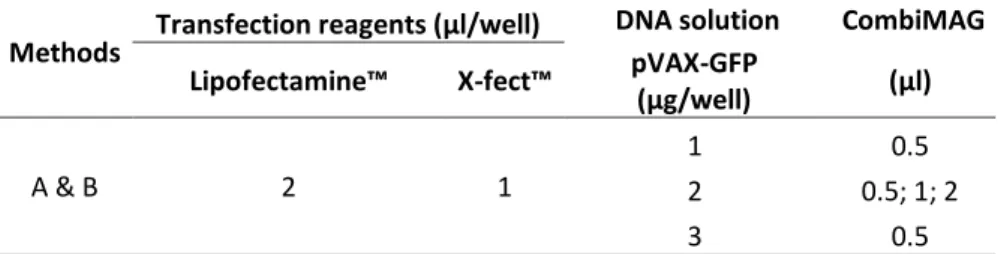
The DNA and reagents amounts used in all experiments are shown in Table 1.
Table 1: DNA, transfection reagents (Lipofectamine and X-fect) and CombiMAG amounts used in transfection experiments, for both methods A and B.
Methods Transfection reagents (μl/well) DNA solution
CombiMAG Lipofectamine™ X-fect™ pVAX-GFP
(μg/well) (μl)
A & B 2 1
1 0.5
2 0.5; 1; 2
14 The magnetic lipoplexes and poliplexes were added to cells previously cultured on 24-well plates with of Optimem I without FBS and antibiotics and incubated for 15 min. The cell culture plate was placed upon the MagnetoFACTOR plate and incubated for 30 min. Finally, the magnetic plate was removed and medium was replaced by DMEM 10% FBS with antibiotics after 24h of culture under standard conditions, after which the cell viability and transgene expression were assessed.
The amount of transfection reagents and DNA that were used in each experiment are described where appropriate and the following controls were used: non-transfected cells, cells incubated with different amounts of CombiMAG and transfected cells with LP or PL.
3.6. Cell viability and Flow cytometry analysis
Twenty four hours after transfection, cells in each well were washed with PBS and detached using accutase enzymatic reaction (250 μl for 24-well plates and 350 μl for 12-well plates). After adding IMDM 20% FBS with antibiotics (500 μl for 24-well plates and 700 μl for 12-well plates), centrifugation at 1250 rpm for 7 min was performed. The pellet was resuspended in 100 μl of PBS and cell number was assessed by direct cell counting in a hemocytometer and cell viability was determined by staining the cells with Trypan blue (Gibco).
To assess percentages of cell viability, recovery and yield, the following formulas were used:
CAt corresponds to the number of viable transfected cells and CAc is the number of viable non-transfected cells (control).
15 After counting, cells were then fixed with 500 μl of 2% paraformaldehyde (PFA) kept at 4°C (in a maximum of 3 days) and analyzed by flow cytometry to assess the percentage of YFP or GFP positive cells (YFP+ or GFP+, respectively).
3.7. Adipogenic and osteogenic differentiation
Two differentiation media, adipogenic and osteogenic (both from Gibco), were added to cultured cells at ≈90%-100% of confluence, for approximately 14 days, with change of medium each 2-3 days. Cells were then washed with PBS, fixed with 2% PFA for 30 min at room temperature and washed again with distilled water.
Osteocytes were detected by Alkaline Phosphatase (ALP) staining, where cells were incubated for 45 min, in the dark, with a solution of 1:3 Naphtol AS-MX phosphate (Sigma) and Fast Violet (Sigma), washed 3 times in distilled water and observed with an optical microscope. Lipid deposits in mature adipocytes were identified by incubation with 0.3% Oil Red-O solution for 1 h. The excess of staining solution was removed washing twice with distilled water and cells were observed under optical microscope.
3.8. Immunophenotyping of BM-MSC
For detection of typical MSC surface marker proteins, cells were harvested 24 h after transfection, resuspended in 100 μl of PBS and incubated with 10 μl of anti-human antibodies (BD Pharmigen™), CD73-PE, CD105-PE and isotype control γ1-PE (Biolegend) for 15 min in the dark. Cells were then centrifugated at 1000 rpm for 5 min, fixed with 500 µl of 2% PFA and analysed by flow cytometry.
16
3.9. Confocal microscopy
Intracellular monitoring of plasmid DNA (pcDNA 3.1) was assessed using a confocal and multiphoton system (Leica TCS SP5). Confocal microscopy measurements were performed at Centro de Química-Física Molecular at Instituto Superior Técnico. The plasmid was first labeled with a fluorescein dye (excitation wavelength= 492 nm; emission wavelength= 518 nm), according to Label IT® Traker TM Kit protocol (Mirus Bio). Cells were cultured in 8 well 15 μ-slide collagen IV chambers, until they reached ≈70-80% confluence. Then, cell nucleus and plasma membrane were stained with 1,5 μM of Hoechst dye 33342 (Invitrogen) and 5 μg/ml of Alexa Fluor 594 (Invitrogen) respectively, for 10 min at 37°C. Alexa Fluor 594 binds selectively to N-acetylglucosamine and N-acetylneuraminic acid residues, staining the plasma membranes, while Hoechst 33342 is selective for DNA and UV excitable, emitting blue fluorescence when bound to DNA. Subsequently, cells were transfected by magnetofection using the pre-established conditions per well: 1 μg of labeled DNA, 1 μl of Lipofectamine TM 2000 and 0.25 μl of CombiMAG. Transfected cells with lipoplexes were used as control. Stained cells were monitored ≈ 4 h after transfection at different time points. The imaging parameters were: 512x512 pixels; 200 Hz with a pinhole of 11.44 μm. To visualize the membranes and the DNA an Argon Laser at 40% and an excitation wavelength range of 496-514 nm was used. The emission was monitored at 525-568 nm (green) and 642-741 nm (red). To visualize the cell nucleus (blue channel) a Multiphoton Ti/Saphire laser (Power= 100%, 1555 W) with a wavelength of 749 nm was used and the emission was detected in the wavelength range of 380-473 nm.
17
4. Results
4.1. Microporation
4.1.1. Optimization of microporation transfection conditions
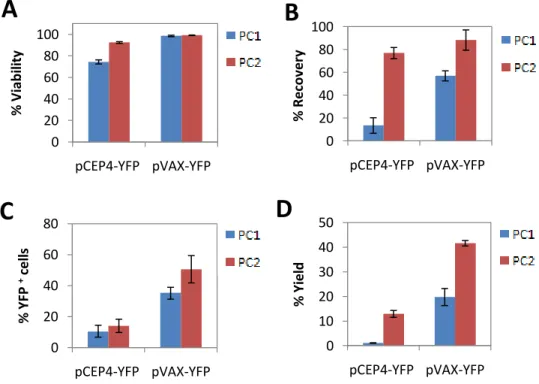
To first determine the appropriate microporation conditions to achieve higher transfection efficiency, 150,000 cells were microporated, with 1μg of pDNA. Two preoptimized pulsing conditions were used: 1300 V/20 ms/1 pulse (PC1) and 1000V/40ms/1 pulse (PC2) with two different plasmids: pCEP4-YFP (10.9 kb) or pVAX-YFP (3.7 kb). Cells were then analyzed, 24h after transfection, for cell viability (Fig. 2A) and recovery (Fig. 2B). Yield of transfection and percentage of YFP positive (YFP+) cells was assessed by flow cytometry (Fig. 2 C and D). With both plasmids using PC2, high cell viability (>90%) and recovery (≈80-90%) were obtained, while using PC1 only with pVAX-YFP higher viability values were achieved. The highest levels of YFP+ cells and yield were obtained with the smaller plasmid (pVAX-YFP) at PC2 condition.
Figure 2: Transfection efficiencies of BM-MSC using two different plasmids and two pulsing conditions.
BM-MSC were transfected with 1 µg of pCEP4-YFP or pVAX-YFP using two different voltages and different pulse duration: 1300 V/20 ms (PC1) and 1000 V/40 ms (PC2). Cells were analyzed 24 h after microporation by Trypan Blue exclusion test, for (A) cell viability, and (B) recovery. (C) YFP expression and (D) transfection yield were assessed by flow cytometry analysis. Non-transfected cells were used as controls (not shown). Control viability ≈ 95%. Results are expressed as the mean + SEM; n=3.
0 20 40 60 80 100 pCEP4-YFP pVAX-YFP % V ia b ili ty
A
0 20 40 60 80 100 pCEP4-YFP pVAX-YFP % R e co ve ryB
0 20 40 60 80 pCEP4-YFP pVAX-YFP % YFP +cel lsC
0 10 20 30 40 50 pCEP4-YFP pVAX-YFP % Yi e ldD
18 Even though the best transfection efficiencies were obtained with the smaller plasmid, 1 µg of PCEP4-YFP harbors a smaller number of plasmids in comparison with pVAX-YFP, because of the plasmid size difference. As a result, it is probable that a higher number of pVAX-YFP enters into the nucleus and consequently a higher amount of pVAX-YFP is expressed after each microporation.
Given this, we investigated if an increase on pCEP4-YFP concentration is correlated with an increase in transfection efficiency (Fig. 3). Therefore, cells were microporated using the best pulsing condition, PC2, varying the amount of pCEP4-YFP (1, 2 and 3 µg). The increase in DNA amount caused a slightly rise of YFP+ cells (from 5 to 11%) and a significant decrease on cell viability (from 90 to 50%). Therefore, higher amounts of pCEP4-YFP did not seem to improve significantly cell transfection and studies were continued using pVAX-YFP or -GFP and PC2.
Figure 3: Transfection efficiencies of BM-MSC using different amounts of reporter DNA
BM-MSC were transfected with different amounts of pCEP4-YFP (1, 2 or 3 µg), using 1000 V/40 ms. Viability and recovery were determined 24 h after microporation. Transient YFP expression (YFP+ cells) was assessed by flow cytometry. Non-microporated cells and microporated without DNA using PC2 condition served as controls (not shown). Controls viability ≈ 92%. Results are expressed as the mean + SEM; n=2.
4.1.2. Long term analysis of transfected cells
To assess cell proliferative capacity, maintenance and plasmid stability over time, cells were microporated with 1µg of pVAX-YFP, using PC2 optimized condition. After being cultured for 10 days in 12 well plates, cells reached total confluence and were transferred to 6 well plates, where they continued growing for more 13 days. Cells were analyzed at different points after transfection by Trypan Blue method and flow cytometry.
0 20 40 60 80 100 1 2 3 C e lls (% ) DNA amount (μg) Viability Recovery YFP+ cells
19 Long term analysis showed an initial lower cell number of transfected cells compared with controls (microporated and non-microporated cells) (Fig. 4A). However, all cells exhibited similar grow rates. These results indicate that the entering of DNA into the cell might interfere with cell growth and division. YFP expression was detected by flow cytometry during 23 days after transfection, being maintained at high levels (≈50%) for the first 7 days (Fig.4B).
These results indicate that microporation is an efficient method to transiently transfect BM-MSC.
Figure 4: Long term analysis of microporated BM-MSC along 10 and 23 days
BM-MSC were microporated with 1μg of pVAX-YFP, using PC2 program (1000 V/40 ms). (A) Transfected cells and controls (microporated without DNA and non-microporated cells) were counted at different time points after transfection. (B) YFP expression and Mean fluorescent intensity were assessed by flow cytometry, at different time points after transfection. M represent microporated cells (without DNA), while NM and MD represents non-microporated and non-microporated cells with DNA, respectively. Results are expressed as the mean + SEM; n=3.
0E+00 2E+04 4E+04 6E+04 8E+04 1E+05 1E+05 1 3 7 10 C e ll n u m b e r
Period after transfection (days)
A
NM M MD 0 500 1000 1500 2000 2500 3000 3500 0 10 20 30 40 50 60 1 4 7 10 14 23 M e an Fl u or e scent In te n si ty (M FI , a .u .) % YFP +cel ls DaysB
YFP+ cells MFI20 4.1.3. Microporation effect on cell division kinetics
To analyze the effect of microporation on BM-MSC proliferation rate, cells were first labeled with PKH67 and then transfected with 1 μg of pVAX-GFP at 1000 V for 20ms and cultured for 10 days. Non-microporated and microporated cells without and with DNA were compared in terms of their cell division kinetics by flow cytometry.
After approximately 3 days of culture most of non-microporated and microporated (without DNA) cells had undergone cell division until almost no nondivinding (in Fig.5A and B – Parental generation (P)) cells remained in culture from 7 to 10 days. These results suggest that microporation itself has no effect on cell division. Conversely, MSC transfection showed a delay on the initiation of cellular division, with 55% of nondividing cells between day 3 and 7 (Fig. 5C). By day 10, some cells (20%) remained at Generation 2 (G2) while others reached generations 3 (20%), 4 (25%), 5 (10%), 6 (10%) and 7 (5%).
Figure 5: Divisional kinetics of microporated BM-MSC along 10 days
BM-MSC were labeled with PKH67 and data was acquired by flow cytometry, at different time points. Each bar represents the percentage of cells in each doubling generation, along 10 days. (A) Non-microporated cells. (B) Microporated cells, without DNA. (C)Microporated cells with GFP. Microporation conditions were: 1 µg pVAX-GFP; 1000 V; 40 ms; 1 pulse. Results are expressed as the mean + SEM; n=2.
0 20 40 60 80 100 P G2 G3 G4 G5 G6 G7 G8 G9 G10 C el ls (% ) Generations
A
day 1 day 3 day 7 day 10 0 20 40 60 80 100 P G2 G3 G4 G5 G6 G7 G8 G9 G10 C e lls (% ) GenerationsB
day 1 day 3 day 7 day 10 0 20 40 60 80 100 P G2 G3 G4 G5 G6 G7 G8 G9 G10 C e lls (% ) GenerationsC
day 1 day 3 day 7 day 1021
4.2. Magnetofection
4.2.1. Effect of PolyMAG on transfection efficiency
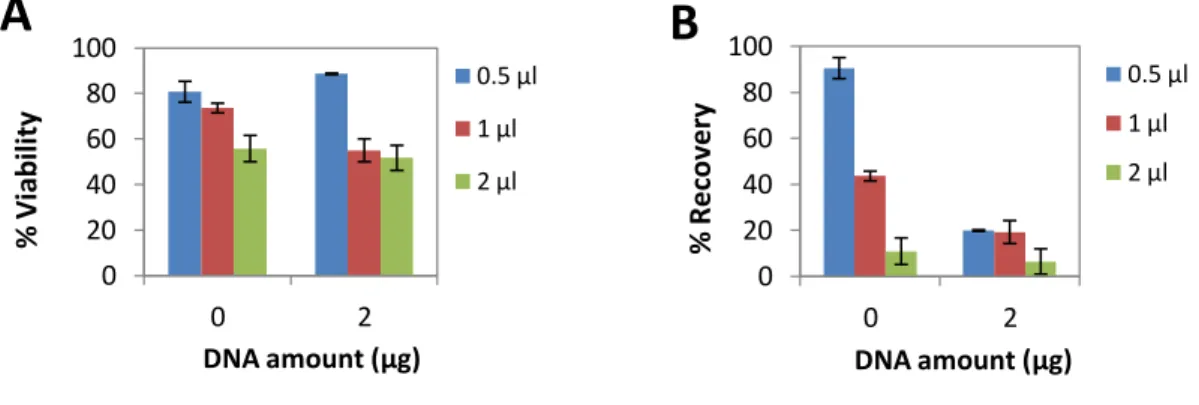
PolyMAG is a magnetofection reagent used to efficiently deliver DNA. To test BM-MSC transfection efficiency by PolyMAG, cells were incubated with different amounts of this reagent and varying amounts of pVAX-GFP, for 24 h. Transfected cells with 0.5 and 1 μg of pDNA showed no visible GFP expression under fluorescence microscopy (results not shown). Thus, viability assays were only performed with 2 μg of DNA, with which only few cells (≈ 1-2%) were expressing GFP. Both viability and recovery decreased significantly with higher amounts (1 and 2 μl) of PolyMAG alone (Fig.6A and B). The presence of pDNA did not seem to significantly affect cell viability. However, even when using 0.5 μl of PolyMAG cell recovery decreased almost 70%, when compared with the control. The use of PolyMAG was discarded in further experiments as GFP expression levels and cell recovery were too low to be considered.
Figure 6: Effect of PolyMAG on BM-MSC
BM-MSC were transfected with different amounts of pVAX-GFP (0.5, 1 and 2 μg) and PolyMAG (0.5; 1 or 2 μl). Non-transfected cells with different amounts of PolyMAG (0.5, 1 or 2 μl) and cells alone served as controls. Cells were analyzed 24 h after microporation for (A) cell viability and (B) recovery. Control (cells) viability ≈ 90%. Results are expressed as the mean + SEM; n=2.
0 20 40 60 80 100 0 2 % V ia b ilit y DNA amount (μg)
A
0.5 μl 1 μl 2 μl 0 20 40 60 80 100 0 2 % R e co ve ry DNA amount (μg)B
0.5 μl 1 μl 2 μl22 4.2.2. Effect of magnetic lipolex preparation on cell transfection
Previous studies have shown that mixing cationic liposomes with magnetic particles, improve cell transfection [49]. In this study, another magnetofection reagent, CombiMAG, was combined in various amounts (from 0.5 to 2μl) with lipofectamine™2000using two different methods for its preparation: A and B (previously described at Methods).
Cell viability, recovery, transfection efficiency and cell number were examined 24 h post transfection (Fig.7). With “A method” cell viability decreased, as the amount of CombiMAG increased from 0.5 to 2μl, being maintained for “B method” (Fig.7 A). Percentages of cell recovery were similar with both methods, for 1 and 2μl of CombiMAG, while for 0.5μl, “A method” demonstrated lower recovery levels when compared with “B method” (Fig.7 B).
Percentages of GFP+ cells and yield were higher for A method, ≈ 10-15% and ≈3-4%, respectively (Fig.7 C and D). Overall, even though magnetic lipoplex preparation, using the lowest amount of CombiMAG and strategy A, demonstrated high cell survival and transgene expression rate, cell recovery was low (≈40%). This might suggest that DNA input can be a metabolic burden to the cell.
The respective lipoplex formulation without magnetic particles, were simultaneously analized and lower transfection efficiencies were obtained (GFP+ cells ≈ 6%; Yield ≈ 5%; data not shown).
Furthermore, cell number analysis is shown on Fig.7 E (only results using 0.5 μl of CombiMAG are shown). The use of LP and magnetic particles (MP) alone and together (A, B methods) showed a decrease on cell number compared with the control (cells). Overall, cell survival was more affected by B strategy.
Magnetic lipoplexes (MLP) preparation by A method, using 0.5 μl of CombiMAG were defined as standard optimized condition for further assays.
23
Figure 7: Transfection efficiencies of BM-MSC using two different methods for LP preparation and different CombiMAG amounts.
BM-MSC were transfected with 2 μg of pVAX-GFP, using two different methods for magnetic lipoplex preparation (A or B method) and CombiMAG at different doses (0.5, 1 or 2μl). Cells alone and incubated with CombiMAG (MP) were used as controls. Cells were analyzed 24h after transfection for (A) cell viability (B) recovery and (E) cell number (using 0.5 μl CombiMAG). (C) GFP expression and (D) transfection yield were assessed by flow cytometry analysis. Non-transfected cells viability ≈ 94%; LP viability ≈ 90%, LP recovery ≈ 60%. Results are expressed as the mean + SEM; n=3. 0 20 40 60 80 100 0.5 1 2 % V iab ili ty CombiMAG ammount (μl)
A
A Method B Method MP 0 20 40 60 80 100 0.5 1 2 % R e co ve ry CombiMAG ammount (μl)B
A Method B Method MP 0 5 10 15 20 0.5 1 2 % G FP +ce lls CombiMAG ammount (μl)C
A Method B Method 0 5 10 15 20 0.5 1 2 % Y ie ld CombiMAG ammount (μl)D
A Method B Method 0.0E+00 1.0E+04 2.0E+04 3.0E+04 4.0E+04 5.0E+04 A method B method MP LP Cells C e ll n u m b e rE
24 4.2.3. Effect of magnetic poliplex preparation on cell transfection
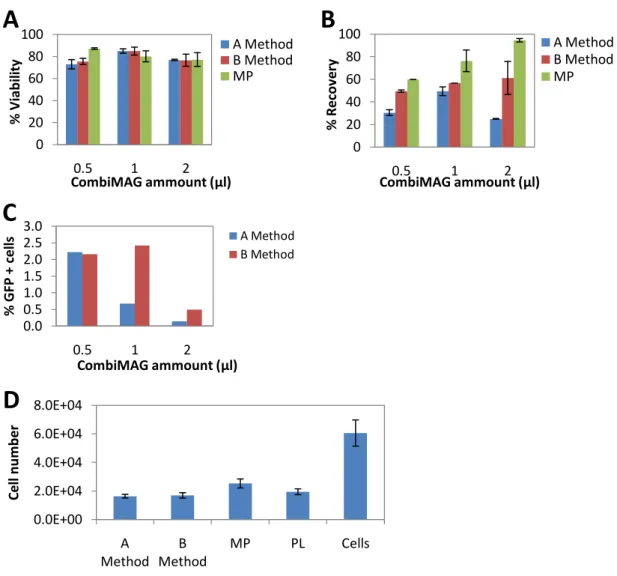
The same methods (A and B) used for LP preparation were tested using a biodegradable polymer based reagent (X-fect™) instead of a lipidic one. Same experimental conditions were used (0.5-2 μl of CombiMAG and 2 μg of DNA). Although both methods revealed similar cell viabilities (Fig. 8A), cell recovery was generally lower when using A method (Fig. 8B). The use of magnetic poliplexes (MPL) achieved extremely low levels (maximum 2.5%) of GFP expression (Fig. 8C), when compared with the use of PL (≈11%; results not shown). Furthermore, cell number was affected by both methods, by PL and MP, decreasing significantly when compared with the control (Fig. 8D).
Figure 8: Transfection efficiencies of BM-MSC using two different methods for PL preparation and different CombiMAG amounts
BM-MSC were transfected with 2 μg of pVAX-GFP, using two different methods for magnetic poliplex preparation (“A” or “B method”) and CombiMAG at different doses (0.5, 1 or 2 μl). Cells alone and incubated with CombiMAG (MP) were used as controls and samples were analyzed 24 h after transfection, for (A) cell viability (B) recovery and
(E) cell number (using 1 μl CombiMAG). (C) GFP expression was assessed by flow cytometry analysis.
Non-transfected cells viability ≈ 95%; PL viability ≈ 85%, PL recovery ≈ 65%. Results are expressed as the mean + SEM; n=3. 0 20 40 60 80 100 0.5 1 2 % V ia b ili ty CombiMAG ammount (μl)
A
A Method B Method MP 0 20 40 60 80 100 0.5 1 2 % R e co ve ry CombiMAG ammount (μl)B
A Method B Method MP 0.0 0.5 1.0 1.5 2.0 2.5 3.0 0.5 1 2 % GF P + cel ls CombiMAG ammount (μl)C
A Method B Method 0.0E+00 2.0E+04 4.0E+04 6.0E+04 8.0E+04 A Method B Method MP PL Cells C el l nu m berD
25 4.2.4. Effect of DNA amount on magnetofection using lipoplexes and poliplexes
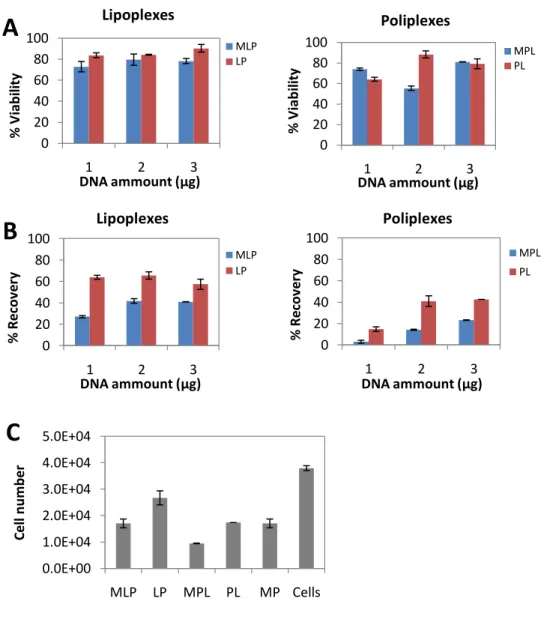
Pre-optimized conditions (0.5 μl of CombiMAG; A method) were used to determine the appropriate amount of DNA to achieve efficient cell transfection. Magnetic lipoplexes yielded ≈ 80% of cell viability and 30-40% of cell recovery, while MPL achieved lower cell survival rate with 2 μg of DNA and lower (3-20%) cell recoveries (Fig. 9A and B). As previously observed, cell number was lower when using MLP and MPL, as well as controls LP, PL and MP, when compared with cells alone (Fig. 9C). Between the two DNA-transfection reagent complexes, PL is shown to be the most harmful for cells, while the presence of magnetic particles together with these reagents, decreases even more the cell number.
Figure 9: Effect of lipoplexes, poliplexes and pDNA amount on BM-MSC
BM-MSC were transfected with pVAX-GFP at different doses (1, 2 or 3 μg), using 0.5 μl of CombiMAG and A method for magnetic lipoplex (MLP) and poliplex (MPL) preparation. Cells, cells incubated with CombiMAG (MP) and transfected cells with poliplexes (PL) or lipoplexes (LP) were used as controls and samples were analyzed 24h after transfection for (A) cell viability (B) recovery and (C) cell number (using 2μg of pVAX-GFP). Results are expressed as the mean + SEM; n=2.
0 20 40 60 80 100 1 2 3 % V ia b ili ty DNA ammount (μg)
A
MLP LP 0 20 40 60 80 100 1 2 3 % V ia b ili ty DNA ammount (μg) MPL PL 0 20 40 60 80 100 1 2 3 % R e co ve ry DNA ammount (μg)B
MLP LP 0 20 40 60 80 100 1 2 3 % R e co ve ry DNA ammount (μg) MPL PL 0.0E+00 1.0E+04 2.0E+04 3.0E+04 4.0E+04 5.0E+04 MLP LP MPL PL MP Cells C e ll n u m b e rC
Lipoplexes Poliplexes Lipoplexes Poliplexes26 The best results of GFP expression and yield were achieved with MLP using 2 μg of DNA (Fig. 10A and B). Interestingly, magnetic particles have in fact increased the plasmid delivery of lipoplexes because a 10% increase of GFP+ cells was observed when using MLP, compared to LP (Fig. 10A). On the other hand, the use of magnetic particles did not increased the transfection of PL (Fig. 10A) and extremely low yields were obtained in both cases (Fig. 10B)
Figure 10: Transfection efficiencies of BM-MSC using lipoplexes or poliplexes with different amounts of pDNA
BM-MSC were transfected with pVAX-GFP at different doses (1, 2 or 3 μg), using 0.5 μl of CombiMAG and A method for magnetic lipoplex (MLP) and poliplex (MPL) preparation. Cells, cells incubated with CombiMAG (MP) and transfected cells with poliplexes (PL) or lipoplexes (LP) were used as controls and samples were analyzed 24 h after transfection for (A) GFP expression and (B) transfection yield by flow cytometry analysis. Results are expressed as the mean + SEM; n=2.
0 5 10 15 20 25 30 1 2 3 % GF P + cel ls DNA ammount (μg)