J. Nano- Electron. Phys.
2 (2010) No1, P. 38-41 (Sumy State University) 2010 SumDU
38 PACS number: 07.75. + h
INFLUENCE OF THE ION SOURCE OPERATING CONDITIONS ON THE CHARACTERISTICS OF A PRISM MASS SPECTROMETER
WITH INHOMOGENEOUS MAGNETIC FIELD
A.S. Kuzema1, A.D. Pogrebnjak2, P.A. Kuzema3
1 Sumy National Agrarian University,
160, Kirov Str., 40021, Sumy, Ukraine E-mail: [email protected]
2 Sumy State University,
2, Rimsky-Korsakov Str., 40007, Sumy, Ukraine
3 Chuiko Institute of Surface Chemistry of NAS of Ukraine,
17, General Naumov Str., 03164, Kyiv, Ukraine
Influence of the magnetic field focusing the electron beam in the ion source of the mass spectrometer on the analytical characteristics of the device is studied. The range of the current values of the ion source focusing electromagnet, which provide the optimal performance of the mass spectrometer, is determined.
Keywords: MASS ANALYZER, ION SOURCE, MAGNETIC FIELD, ELECTRON
BEAM, RESOLUTION.
(Received 05 November 2009, in final form 30 March 2010)
Use of prism inhomogeneous magnetic fields in mass spectrometry allows to improve the principal characteristics of devices and mechanisms, where such fields function as the mass and energy charged-particle beam analyzers [1-3]. Slit ion sources with the electron-impact ionization of the sample and magne-tic focusing of the electron beam [4] are applied in the most mass spectrome-ters assigned for the analysis of the gas mixtures. Presence of the magnetic field in the ion source region influences the mass spectrometer sensitivity and causes the discriminatory effects, when the ion composition in the beam does not correspond to the molecular composition of the sample. As a result, it seems to be appropriate to determine the ion source operating conditions, which provide the most reasonable range of the analytical device parameters. Investigations were performed using mass spectrometer with the ion-opti-cal system composed of the mass analyzer with the magnetic field r–1, which has the rectilinear boundaries, and the single axisymmetric electrostatic lens, which provides the directional ion focusing. At relatively small dimensions such an ion-optical system gives large mass dispersion and spatial focusing of the ion beam. Indeed, in this case the mass spectrometer dispersion is determined by the expression [3]:
Dm (rm 2
m)/4 + (Lm" m)/2,
where rm is the radius of the central ion trajectory; m is the rotation angle
of the ions in the mass analyzer magnetic field; Lm is the length of the
INFLUENCE OF THE ION SOURCE OPERATING CONDITIONS ON … 39
At the chosen geometry of the ion-optical system (rm 0,1 m, m 270 , Lm" 0,18 m) the device dispersion is equal to 1 m or 10 mm per 1% of the
change in the ion mass. This significantly influences the increase in the de-vice resolution and sensitivity. Since in the mass spectrometer the electrical directional ion focusing instead of the magnetic one is used, the mechanical adjustment of the device is not required. Inaccuracy in the installation of the ion source and ion collector with respect to the boundaries of the mass analyzer magnetic field is removed by the change in the voltage on the mid-dle electrode of electrostatic lens placed between the ion source and the mass analyzer. Adjustment of the mass spectrometer is mainly reduced to the per-formance optimization of the ion source and the corresponding potential of the middle electrode of electrostatic lens. To provide the best performance of the ion source, the focusing electromagnet with adjustable magnetic induc-tion in the bore within the range 0,01-0,06 T is applied in the device.
Presence of the magnetic field in the ion source region influences the focusing properties of the ion gun. Therefore to study the effect of this field on the ion discrimination and the analytical device parameters, the mercury and air gases were injected into the ion source region. The mass spectro-meter adjustment was realized for the accelerating voltage of 2,3 kV by the mercury isotopes. Resolution was measured on the level of 10% of the line intensities 201 a.m.u. and 202 a.m.u. The ion discrimination was estimated using the nitrogen line intensity (28 a.m.u.)-to-mercury isotope line intensity (202 a.m.u.) ratio. Device sensitivity was determined by the ratio of the total ion current of the mercury isotopes and nitrogen to the pressure in the analyzer. In Fig. 1 we present the dependences of the ion discrimination (curve 1), sensitivity (curve 2) and device resolution (curve 3) on the value of the focusing electromagnet current and show the range of rational values of the mentioned parameters. As it was expected, the curves have complex behavior since the magnetic field of the ion source influences the electron and ion trajectories. At the magnetic induction of 0,018 T (that corresponds to the focusing electromagnet current of 0,27 A) the resolution and sensitivity of the mass spectrometer are the maximum ones. With the increase in the magnetic induction the ionization efficiency of molecules decreases and the ion beam width in the ion gun increases due to the deviation of the light masses. Therefore the device sensitivity and resolution decrease at the large values of the magnetic field in the ion source. It is seen from Fig. 1 that the mass spectrometer is not free of ion discrimination at great sensitivity and resolution. So, the range of rational values of the focusing electromagnet current varies from 0,1 A to 0,3 A that corresponds to the change of the magnetic induction in the bore from 0,01 T to 0,02 T.
40 A.S. KUZEMA, A.D. POGREBNJAK, P.A. KUZEMA
than 700 (curves 2 and 3), and therefore the device can be used not only for the chemical, but also for the structural analysis of the matter composition.
Fig. 1– The range of rational values of the mass spectrometer parameters: I+ is the
ion current of mercury isotopes and nitrogen; If is the focusing electromagnet cur-rent; m/ m is the resolution
Fig. 2– Resolution of the mass spectrometer for different line intensities. The ion
energy, eV: 103 (1); 1,5 103 (2) and 3 103 (3)
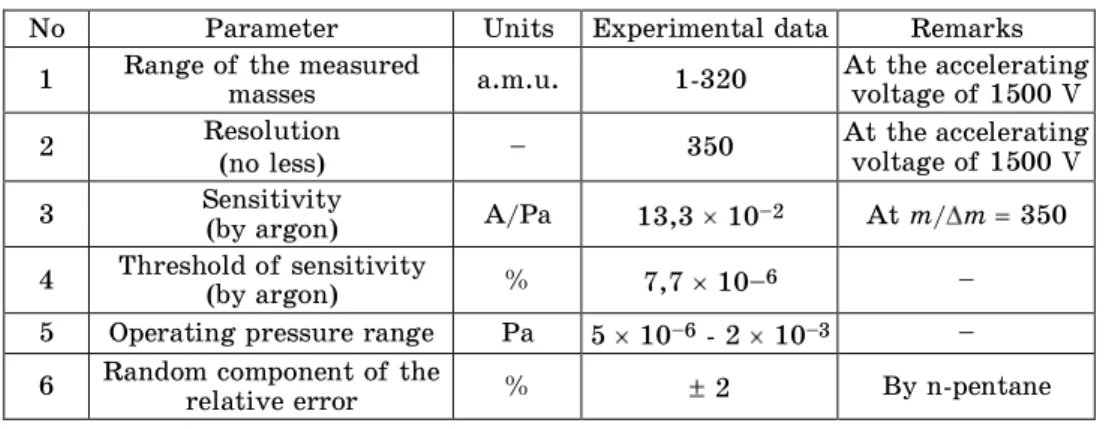
It is possible to judge the analytical possibilities of a mass spectrometer with inhomogeneous magnetic field by its principal technical characteristics obtained in the laboratory tests of the device and presented in Table 1.
Table 1– Principal characteristics of a prism mass spectrometer
No Parameter Units Experimental data Remarks
1 Range of the measured
masses a.m.u. 1-320
At the accelerating voltage of 1500 V
2 Resolution
(no less) – 350
At the accelerating voltage of 1500 V
3 Sensitivity (by argon) A/Pa 13,3 10–2 At m/ m 350
4 Threshold of sensitivity (by argon) % 7,7 10–6 –
5 Operating pressure range Pa 5 10–6 - 2 10–3 –
6 Random component of the
relative error % 2 By n-pentane
If, A
I
+
10
–
1,
A
/P
INFLUENCE OF THE ION SOURCE OPERATING CONDITIONS ON … 41
Thus, at relatively small dimensions of the mass analyzer (radius of the central ion trajectory is rm 100 mm) the prism mass spectrometer surpasses
the devices of the same class by analytical parameters. Besides, it is simple in adjustment and operation.
REFERENCES
1. N.A. Shehovtsov, Magnitnye mass-spektrometry (M.: Atomizdat: 1971).
2. V.M. Kel’man, I.V. Rodnikova, L.N. Sekunova, Staticheskie mass-spektrometry (Alma-Ata: Nauka: 1985).
3. A.S. Kuzema, O.R. Savin, I.Ya. Chertkov, Analiziruyuschie sistemy magnitnyh mass-spektrometrov (K.: Nauk. dumka: 1987).
4. A.A. Sysoev, M.S. Chupahin, Vvedenie v mass-spektrometriyu (M.: Atomizdat: 1977). 5. A.T. Lebedev, Mass-spektrometriya v organicheskoy himii (M.: BINOM: 2003). 6. E. De Hoffmann, V. Stroobant, Mass spectrometry: principles and applications