Vol-7, Issue-3, 2016, pp1025-1036
http://www.bipublication.com
Research Article
Allergenic study and epitope analysis of Indo-American hybrid Tomatoes
Majeed Jamakhani and S. S. Lele
Institute of Chemical Technology, Mumbai, India.
[Received-25/08/2016, Accepted-05/09/2016, Published-11/09/2016]
ABSTRACT:
Food allergies have high negative impact on nutritional balance of human body. Allergic response is seen high to vegetables such as tomatoes, capsicum and spinach, next to fish, eggs and nuts. Allergen molecules and epitope regions of Indo- American hybrid variety tomatoes is not well studied. The present work shows the presence of putative allergen molecules in two Indio-American hybrid tomatoes, which are identified in 7 patient sera by SDS - Immunoblotting method and further identification of epitopes, putative peptides and cross reactivity of these putative allergens by Immunoinformatics tools. Linear B-cell epitopes predicted by 3 combined immunoinformatics tools viz. DNASTAR protean, ABC pred and IEDB Bipred. Cross reactivity of these allergens determined by sequence alignment method against the allergen online database and Allermatch databases, which shows significant cross reactivity to Capsicum annum, Hevea brasiliensi, archis hypogaea, pollen, actinidia chinesis and prunus avium.
KEYWORDS:Food allergy; Bioinformatics; I-Tasser; Immunoblotting; Epitope mapping.
I.INTRODUCTION
Food allergy statistic across most of countries shows that fish, eggs, fruits and nuts are the most common allergic foods. A study of prevalence of sensitization to foods in Europe, which included 4522 individuals living in 13 countries were tested for IgE against 24 foods. The survey reported that comparative prevalence of sensitization to food allergens showed vegetables, fruits and nuts have more prevalence in maximum number of countries than allergy to eggs, milk and sea foods. Allergic reaction to nuts is reported to be 7% whereas fish and eggs allergy prevalence is 0.2 and 0.4% respectively. Food allergy by tomato showed significant allergic prevalence of 3.3% next to apple and wheat which is one of the most commonly consumed vegetables across the globe.[1] Prevalence of clinical oral food
challenge (OFC proven) for food allergy test
that of 7 % in emerging societies of Asia such as China and India.[2] However, due to
urbanization, there is increased consumption of processed food and stressful life style has resulted in reduced immunity and more and more children are exhibiting food allergies.
[3,4]
Plants protect themselves by exhibiting hypersensitive reaction to many plant pathogens like Virus, Bacteria and fungi. The molecules involved in such protection mechanism are Protein molecules also called pathogen related proteins or stress inducible proteins. PR proteins first detected in Tobacco mosaic virus and further identified in many plant.[5–11] Pathogenesis related
reactions [14] Thaumatin like proteins are not
only present in plants but also identified in animals[15] and fungi.[16,17] However in atopic
individuals’ pollen and food TLPs are considered as inhalant and ingestant allergens respectively.[18] So far, out of 15
allergen TLPs only 7 TLPs have been crystallized and their 3D structures were elucidated.[19]
It has been observed that 39.2% of children are mono sensitized to grass pollen, had tomato-specific IgE antibodies.[20] Ortolani et
al further confirmed that association between tomato oral allergy syndrome (OAS) and
grass pollen allergy is statistically
significant. [21] It has also been reported that sometimes anaphylaxis arises within few
hours as soon as tomato consumed. [22]
Several allergens in tomato have been described to date like Sol l 1, Sol l 2, Sol l 3, Sol l chitinase, Sol l Glucanase, Sol l peroxidase and Sola TLP (NP 24), but the clinical relevance of each of these allergens is not clear. One of the salt-induced TLPs is Protein NP24 (24 kDa with 247 amino acids) that is found in tomato tissues[23]
was first isolated, purified and crystallized from tomato fruits[24] and also described
there are two isoforms (I and II).[20]
Isoform-I is expressed mainly in the outer pericarp of healthy tomato fruits and is low in green tomatoes which subsequently increases during ripening, On the other hand, Isoform-II is relatively high in green tomatoes and it further increases as the fruit turns pink and subsequently decreases as the fruit turns red. Fully ripened tomato will have mainly isoform I and the half ripened fruit will have both isoforms in significant quantity.
Among many fruits studied by Krebitz, only hybrid form TLPs are shown hypertensive reaction with IgE. [25–27] However, allergens
in Indo-American hybrid tomatoes and the allergen epitope identification are not well studied so far.
Concern novel bioinformatics approach and its contribution in food allergy, many tools helps in the identification of cross reactivity and epitope regions present in allergen
molecules which eventually reduces the time and cost of allergen diagnosis processes[28]
From the above discussion, it may be observed that vegetable allergies, especially tomato allergies are much more prevalent than what one would expect less. Most people are allergic to only nuts, eggs and fish is a myth. Hence the present work was undertaken to identify putative allergen
molecules in Indo-American hybrid
tomatoes by SDS method, IgE antibody – antigen reaction and after that cross reactivity and epitope identification by immunoinformatics tools. Main paragraph text follows directly on here.
II. Experimental section 1. Reagents and Materials
Two Indo American Hybrid tomatoes namely Rashmi and Abhinav varieties were procured from local Maharashtra region. Reagents used for extraction are Liquid nitrogen, Phenol saturated with Tris-HCL pH 7.9 (Sigma), Sucrose, EDTA (Ethylene di amine tetra acetic acid), Potassium
chloride, β-mercaptoethanol and
phenylmethylsulfonyl fluoride (PMSF). For precipitation solution ammonium acetate in cold methanol is used and for solubilisation
Urea, thiourea, CHAPS, DTT and
pharmalytes is used. For Immunobloting pre stained protein ladder purchased from genetix biotech, antihuman IgE AP conjugated secondary antibody, purchased from Sigma and NBT BCIP substrate solution used as substrate for AP, also purchased from Sigma were used.
2. Protein Extraction
500 mM EDTA, 1mM (PMSF), 2% _-mercaptoethanol) in a ratio 1:5 (w/v). The supernatant was added with an equal volume of Tris phenol vortexing (30min) after centrifugation at 12000rpm/min for 30min
(4℃). Then collected the phenol phase
supernatant, mixed with 5 volumes of 0.1mol/L ammonium acetate in cold ethanol left overnight at - 20℃, centrifuged the tube
at 12000g for 30min, washing the precipitate with 0.1mol/L ammonium acetate in cold ethanol three times and in cold acetone once and stored at - 20℃ until use. Protein amount was determined using the Bradford assay by dissolving obtained precipitate in 2mL lysis buffer. Further Concentration of protein was estimated by Bradford Assay.
Figure 1. Tomato protein extraction scheme
A powerful technique SDS-PAGE was used to separate proteins on basis of molecular size from Tomato extracts (Laemmli, 1970). Separation of proteins from extracted parts of tomatoes peel, pulp and seed from Abhinav and Rashmi tomatoes was done by 15% SDS-PAGE.
Staking gel and Running gel composition is
given in Table 1.Entire gel and
electrophoresis system is run for one hour at 100V in running buffer. Gel has been carefully taken out and stained with silver staining by performing repeated steps of washing, pre-treatment, Impregnation and developing to visualize the bands.
Immunobloting:
Seven patients were taken in to study with the positive history of tomato allergy. Serum was extracted from patient blood and stored at -70°C until use.
Separated proteins in gel were transferred on to the nitrocellulose membrane and membrane was incubated with blocking buffer (1x TBS, 0.1% tween-20 with non-fat dry milk) for 1 hour. Further washing the membrane and incubating with patient sera (1:10 dilution in dilution buffer) with gentle agitation overnight at 4°C. Washing the membrane again and incubated with the secondary antibody alkaline phosphatase conjugated antihuman IgE (1:1500 dilution) for 1 hour. After washing proteins were detected by using premixed BCIP/NBT solution as a substrate. Study was approved by Local Ethical committee.
4. Retrieving protein sequences of putative allergens and Prediction of cross reactivity
Observed putative allergens by experimental analysis, corresponding sequences retrieved from uniprot knowledge database with their unique uniprot IDs Q93YG7, Q547Q0, P93224 and P12670 respectively in FASTA format. Cross reactivity of proteins is the overall similarity in 3 dimensional structures between any 2 antigens which are present in 2 different species, because of their
similarity antibodies are evoked by antigens and cause same hypersensitivity reactions. Cross reactivity of putative allergens was determined by aligning their protein sequences against the allergen databases like FARRP database and Allermatch database. Three methods are generally applied against both databases FASTA, 80 mer and 8 mer/ 6 mer methods. Sequence comparison was done by setting the default values. All these methods with percent identity of the amino acid sequence between aligned similar proteins gives a comparison that they are clinically cross-reactive or they share IgE binding properties.
5. Prediction of 3 dimensional confirmation of Protein Q93YG7 by DNASTAR NOVAFOLD I-TASSER algorithm
Prediction of 3 dimensional structure from protein sequence by in-silico was done by using many methods such as Homology method, Threading method, Ab initio method, De nova method etc. Homology method uses template (Protein structure which is identical to unknown protein sequence) to predict 3- dimensional structure of unknown target sequence, but it requires high sequence similarity between known and unknown protein sequences.
For lower sequence similarity as of our
predicted sequences, we are using
DNASTAR’s Novafold to predict structure based on I-Tasser algorithm developed by Prof. Y Zhang and ab initio method.
For an unknown sequence submitted by user, firstly I-Tasser identified template by threading through PDB library by LOMETS. LOMETS combine multiple threading methods because of different sensitivity and scoring system of different methods.
In next step structure assembly Monte Carlo simulation is done, in which identified by threading template parts are directly used to assemble structure, whereas unaligned loop or turn regions are built by ab initio method.
Conformational decoy generated are
lowest energy state of structure. In next step atomic model is refined by REMO and FG-MD models which improves the torsion, orientation and hydrogen network and quality of protein model is estimated by C- value (confidence score) and RMSD value. Then at last Protein function is determined by using COFACTOR.
6. Prediction and characterization of antigenic determinants of protein Q93YG7 and NP 24
Antigenic determinants are the part of antigen which is identified by the antibody, B cells or T cells and bind to it and produces hypersensitivity reactions. Prediction of Linear B cell with accuracy is a challenging process to design immunotherapy. To identify B cell epitope regions in predicted allergens we are using combinatorial immunoinformatics tools such as IEDB Bepipred, DNASTAR protean and ABC pred tools.
To identify B cell epitope by Bepipred prediction method, it predicts the location of B cell epitopes by combination of Hidden markov model and Parker and Levitt propensity scale methods, where residues with above the threshold are considered to be epitope regions.
In DNASTAR protean system protein sequence or structure undergone biophysical,
solvent accessibility and antigenicity
algorithm test which are considered as the parameters for prediction of B cell epitopes. B cell epitopes are predicted based on higher values of hydrophilicity, flexibility, solvent surface accessibility and antigenic index. ABC pred uses recurrent neural network to predict B cell epitopes, Top rank gives the best epitope.
Algpred is server which is used for the prediction of antigenic determinant which binds to IgE. In this approach protein is
predicted as an allergen by applying consecutive steps.
Initially scanning for similar sequences by using BLAST program and then preparing data set aligned through the Allergen Representative Peptides. Further motif groups are identified by MEME (Multiple Em for Motif Elicitation) and approximated for statistical analysis. Phylogenetic tree shows how closely allergenic protein sequences are related based on evolutionary conservation, phylogenetic analysis is done by using Molecular Evolutionary Genetics Analysis open source tool.
III. RESULTS
1. Putative allergenic proteins in hybrid variety
Protein estimation of Indo American hybrid tomato peel, pulp and seed parts were done by using Bradford assay. Fig 2 shows the protein concentrations of Abhinav and Rashmi variety tomatoes in mg/g of sample. Extracted proteins were dissolved in IEF
buffer and approximately 40µL of each
sample was loaded on to the SDS PAGE for proteins separation. Separated protein bands with molecular weight are shown in Fig 3 with standard protein ladder of molecular weight 60 -180 KDa.
After transferring the Gel on to the nitrocellulose membrane and incubated with patient sera, many IgE bound bands are highlighted in peel and seed regions but no bands were observed for pulp for both Abhinav and Rashmi varieties.
IgE binding patterns of Abhinav and Rashmi proteins are shown in Fig 4 for all the patient sera with control band for Immunobloting with healthy patient sera.
Figure 2. Estimation of protein concentration by Bradford assay. Numbers at the end of each horizontal bar indicates concentration of protein in mg/g
Figure 3. Result of 15% SDS-PAGE separation of proteins from Indo-America hybrid tomatoes
Figure 4. IgE Immunobloting of 7 patient serum samples with each part of Indo – American hybrid tomatoes (Peel, Pulp and Seeds). Control band is blotting result of Normal patient sera. Binding patterns for Peel at 9KDa, 14 KDa, 26 KDa and 51 KDa, for pulp at 26 KDa, for seeds at 26 KDa and 51 KDa are shown as dots in figure.
2. Understanding the cross reactivity of putative allergens
homologous known allergen sequences showed the significant cross reactivity. By this he suggested that alignment of query with greater than 50% identity with allergen sequences are cross reactive in full length alignment. In 80 mer sliding window method, similarity search will be performed for every 80 amino acids segment of the query sequence. The cut-off value of greater than 35%, which is recommended by FAO/WHO 2001 expert panel, indicates the possible cross reactivity of allergens. However, in the 8-mer/ 6-mer methods, exact match indicates the cross reactivity. Like these 3 methods both FARRP & Allermatch gives the cross reactivity information.
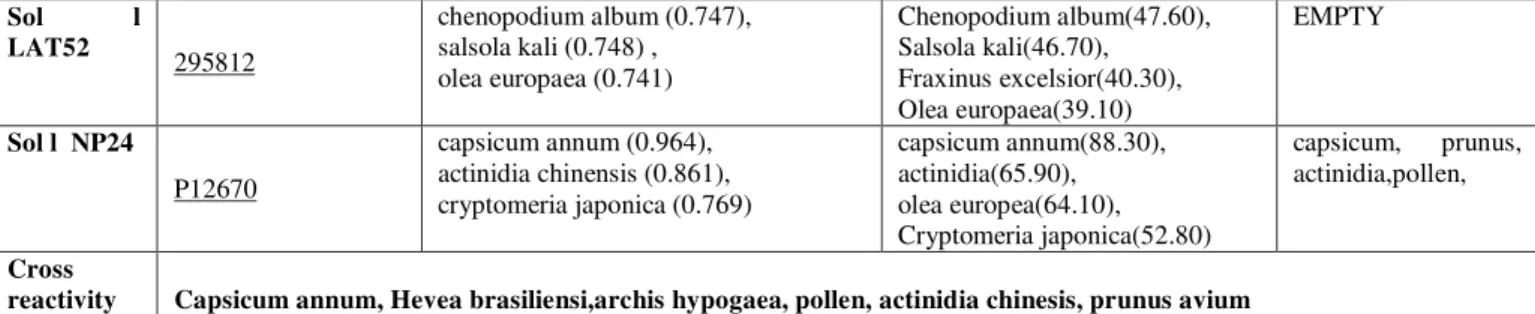
Table 2 displays the results of Cross reactivity best scores by aligning tomato allergens against allergen online and Allermatch databases. In a full length alignment method allergic Capsicum annum, Hevea brasiliensi, archis hypogaea, pollen, actinidia chinesis, prunus avium showed significant identity to tomato allergens that is above 65 %, whereas allergic pollen like Japanese cedar, dermatophagoides farinae and white cedar showed identity near to 50%. In a full length alignment method interestingly food alignment window against Allermatch database for tomato allergens showed more than 50 % identity to food TLPs Capsicum, Kiwi fruit, Banana, Apple, White cedar and Cupressus sempervirens. In 80 slide window result for allergens from tomato, number of 80 mer sequence found was 168 among that 29 sequences showed matching of 80 amino acid stretch with that of the allergens deposited in databases. In the 8 mer method result for allergens from tomato, the total number of 8 mers was 240, of which Number of sequences with at least one 8mer match corresponding to the deposited allergens was 15. In 80 slide window and exact match method result for tomato allergens showed similar result as of full length.
*** Uniprot ID / Gen
Bank ID
Best scores (in bracket)
FASTA 80 Mer 8 mer (Exact match
for all) Sol l1
Q93YG7
lycopersicon esculentum (1.00), solanum tubeosum (0.977), capsicum annum (0.969), arachis hypogaea (0.969), hevea brasiliensis (0.961)
Solanum lycopersicum (100), solanum tubesum(95.40), capsicum annum (91.60) , archis hypogacea (84.70), Hevea brasiliensi (87.60)
Hevea
brasiliensi,pollen
Sol l2
Q547Q0
lycopersicon esculentum (1.00), triticum aestivum (0.426) , der f 3 mite allergen (0.563) , dermatophagoides farinae (0.593)
solanum lycopersicum (99.10) solanum
Q8RVW4
lycopersicon esculentum (0.996), der f 3 (0.605) ,
dermatophagoides farinaetriticum aestivum (0.244)
empty solanum
Sol l3
P93224
lycopersicon esculentum (0.904), arachis hypogae (0.865), prunus avium (0.845), havea brasiliensis ( 0.831)
solanum lycopersicum (74.60), Lens culinaris (63.40), Arachis hypogaea (61.50), Fragaria x ananassa (47.30), actinidia (46.20)
solanum, archis hypogacea, Hevea brasiliensi, prunus
Sol l4
K4CWC5
solanum lycopersicon (0.938) , pollen (fagus) (0.824), prunus (0.780)
solanum lycopersicum (81.30), prunus (50.30),
fragaria(49.31), actinidia (48.70)
soanum, prunus,actinidia
K4CWC4
solanum lycopersicon (0.938) , pollen (fagus) (0.836) ,c herry (0.824), prunus (0.786)
solanum lycopersicum (81.30), prunus (50.3),
actinidia (48)
soanum, prunus,actinidia
Sol l6
K4BBD9 pollen CJP-8 (0.636) cryptomeria japonica , nLTP (0.536)
Apium graveolens Rapaceum
Group (63.20) EMPTY
Sol l7
XP_004229753.1
Arachis hypogae (0.755), nsLTP( 0.839) ,
actinidia (53.80), arachis hypogea (50.0),
Sol l
LAT52 295812
chenopodium album (0.747), salsola kali (0.748) , olea europaea (0.741)
Chenopodium album(47.60), Salsola kali(46.70),
Fraxinus excelsior(40.30), Olea europaea(39.10)
EMPTY
Sol l NP24
P12670
capsicum annum (0.964), actinidia chinensis (0.861), cryptomeria japonica (0.769)
capsicum annum(88.30), actinidia(65.90), olea europea(64.10), Cryptomeria japonica(52.80)
capsicum, prunus, actinidia,pollen,
Cross reactivity Result
Capsicum annum, Hevea brasiliensi,archis hypogaea, pollen, actinidia chinesis, prunus avium
Table 2. Cross reactivity of Identified putative allergens in Indo- American Hybrid tomatoes including other IUIS allergens identified by FARRP and Allermatch Databases (Only best results shown in Table)
3. Computational modelling of Protein Q93YG7 by I-TASSER algorithm
Protein Q93YG7 doesn’t have any X-ray crystallography or NMR detected 3 – dimensional structure. Also model built on Swiss-model webserver and modbase server uses very less 77% similarity sequence 3nul as template to model the protein. Here in our study we built model by I-TASSER algorithm by using template 4espA which has 88% identity and by abinitio method for more accurate 3-dimensional structure. Identified putative allergen sequence retrieved from NCBI with sequence ID Q93YG7 and modelled with I-TASSER Threading and ab initio methods. As shown in Figure 5, in I-TASSER protein fragments from threading are used as templates and template with higher z-score, more coverage and higher identity are considered as best template to build the model. Eight different threaded algorithms are used to normalize the z-score, with higher z-score 10, coverage 0.99 and % identity 0.88 user specified 4espA selected as template and modelled. Generated model quality analysed by higher TM-score, Lowest RMSD and highest C- score. Among the top 5 models generated model 1 with TM score- 0.93±0.06, RMSD- 1.6±1.4Å and C score – 1.53 is considered as best model and used for epitope prediction. Figure 5 also shows the predicted binding site of amino acids position which includes 3,7,10,13,31,33,122,125,129,131 regions.
4. Recognition and assessing antigenic determinants of Q93YG7, Q547Q0 and P12670
Many algorithms have developed to predict B cell epitope by computational biology. Different prediction algorithms give some what difference in B cell regions, hence we have combined the 3 immunoinformatics tools DNASTAR protean, ABC pred and IEDB Bipred to predict the B cell epitopes for better predictions. In IEDB Bipred the residues with scores above the cut-off value (>35%) are predicted as epitopes and which are coloured in yellow in output of the tool. Whereas in ABC prediction tool, predicted B cell epitopes are ranked according to their score obtained by trained recurrent neural network. Higher score of the peptide means the higher probability to be as epitope. However DNA protean predicts the epitope regions based on many biophysical parameters like solvent accessibility, hydrophilicity, secondary structure by chou-fasman and antigenicity index. Predicted B cell epitope regions for Q93YG7, Q547Q0 and P12670 are shown in figure 6 and epitope region positions shown in table 3. Also list of predicted linear epitope sequences of approximately 10-15 length are shown in Table 3. These predicted peptides help the researcher to choose regions of interest for dot blot analysis. Algpred server is used to predict IgE epitopes, as shown in table 3 all three have shown potential allergen whereas only one P12670 NP24 protein shows 2 IgE binding site at 58-70 and 73-85 positions of protein. Positions of these predicted epitopes amino acids mapped on respective 3-dimensional structures are shown in Figure 7.
Q93YG7 Q547Q0 PI12670
DNA star B cell
5-10, 15-16,23-24,38- 54,73-79,83-92,101- 105,109-110,113-120,122-127
1-9, 11-18, 20-21, 24-28, 36-51, 55-56, 59-79, 81-101, 107-108,110-112,114- 123,135-139,141,147-149,155-166,189-220, 234-249,269-271,286-289, 297-318,326-329, 347-365, 369-380, 387-395, 398-404, 412-420, 426-427,431-450,453-458,476-482,504-539
6-10, 17-40,46-80, 103-106, 138-166, 173-207
ABC pred rank base) B cell
72-88,103-118,48-63,24- 39,63-78,38-53,55-70,31- 46,79-94,109-124,1-16,89-104
336-351, 406-421, 186-201, 100- 115,428-443,366-381,526-541,243-258, 386-401, 194-209, 476-491, 357-372, 54-69, 520-535, 138-153,461-476,62-77, 304-319, 373-388, 285-300,209-224
38-53, 13-28, 131-146, 175-190, 4-19, 125-140, 119-134, 73-88,58-73, 1-8, 194-207,155-170,67-82,47-62
IEDB B cell 17-20, 26-28, 30-35, 37-47, 55-62, 77-95, 107-113
4-13,17-27,54-85, 87-88,108-124,136- 142,170-172,176-178,182-184,195- 201,210-212,227-253,262-265,291- 294,304-321,329-337,343-357,369-370,374-381, 390-402,404-406,418-419,429-429,435-448,489-497,526-532
15-28, 38-42, 54-67, 75-83, 110-120, 130-133, 135-152, 156-167, 177-199
Predicted B cell epitope locations by combining these three bioinformatics tools.
3-16, 24-39, 38-54,55-62, 63-78, 73-79,80-95, 103-113, 114-127
17-32, 54-70, 103-118, 232-249, 343-356, 370-383,390-402,437-450,525-540
13-28,38-53, 47-62, 133-148, 175-190,196-213
List of predicted linear epitopes
(3-16)
WQTYVDEHLLCENE (17-32) LLPDQPDSGHRKSLKI
(13-28)
LLCVTYTYAATIEVRN
(24-39)
AAIIGQDGTVWAQSANF ( 54-70) NQSPDLQIDSRSPAPPS
(38-53)
STPIGGGRRLNRGQTW
(38-54)
NFPQFKPEEITGIMNDF (103-118) QRTAYHFQPQKNWMND (47-62) LNRGQTWVINAPRGTK (55-62) AVPGTLAP (232-249) QRTAYHFQPQKNWMND (133-148) PTKPSGGKCHAIHCTA
(63-78)
TGLYLGGTKYMVIQGE (343-356) DLGKNKWTPDNPEL (175-190) QYCCTQGPCGPTELSK
(103-113) IGIYDEPMTPG (437-450) GDPTVKQVDLQPGS (114-127)
QCNMIVERLGDYLI (525-540) KGADGRAETHFCADQT
Algpred
The protein sequence does not contain experimentally proven IgE epitope Prediction by SVM method based on amino acid composition
Potential ALLERGEN
Score= 1.7416751 [Threshold= -0.4]
Positive Predictive Value= 85.64% Negative Predictive Value= 67.96%
The protein sequence does not contain experimentally proven IgE epitope
Blast RESULT
Hits found with ARPs database: SVAFFPILNNQSPDLQIDSRSPAP
ALLERGEN
IgE epitopes
AAGTASARFWGRT PRGTKMARIWGRT 58 61.5384615384615
TFDASGKGSCQTG NFNAAGRGTCQTG 73 61.5384615384615
Table 3. Predicted linear B- cell epitope & IgE epitopes by immunoinformatics tools
F igure 6. DNASTAR prediction results of antigenic epitopes, hydropathy, secondary structure, surface probability and charge density regions of Q93YG7, Q547Q0 and P12470 putative allergens.
IV. DISCUSSION
Pathogenesis related protein group is one of Food Plant protein groups which has number of types from PR1 to PR 17 .[29,30] Protein sequences which show maximum similarity to Thaumatin protein are present in PR-5 group. Most of PR families show functional diversity in allergenicity, kinase function despite of their sequence similarity within them.[31,32] Even most of solanum allergens
are available at IUIS but understanding of effect of allergenicity by particular Indo-American hybrid tomatoes is not well studied. In a sequence alignment procedure of observed putative allergens by the full-length alignment and 80-mer window methods (FARRP and Allermatch), it is readily evident that Capsicum annum, Hevea brasiliensi, archis hypogaea, pollen, actinidia, chinesis, prunus avium showed significant identity to tomato allergens that is above 65 %, whereas allergic pollen like Japanese cedar, dermatophagoides farinae and white cedar showed identity near to 50%. The pollen TLPs do show considerable similarity even the number of pollen TLP sequences available for comparison are very few[33]. The number
of 8-mer matches with NP24 protein by FARRP and Allermatch was found to be high for bell pepper, olive and kiwi.
I-TASSER helps in accurate prediction of 3-dimensional structures of unknown protein
with very low RMSD 1.6 Å.
Immunoinformatics tools like DNASTAR protean, ABC pred, IEDB Bipred helps in prediction of B cell epitopes and antigenic index with reference to surface solubility, flexibility. With the help of combined immunoinformatics tools it makes easy in identification of putative B cell peptides and reduced the time and cost which initially took more for the in vitro screening and validation of peptides. Algpred tool helps in identification of IgE epitope regions and showed all these proteins present in
V. CONCLUSIONS
Interdisciplinary study by both molecular biology and immunoinformatics brings the close understanding of allergic pattern. Moreover immunoinformatics tool reduces the time and cost of clinically testing and validation of peptides which are involved in allergic disease. In our present study we studied the allergenic effect of Indo-American hybrid tomatoes on patients and observed the presence of three known putative allergens with uniprot IDs Q93YG7, Q547Q0 and P12670 also in these hybrid tomatoes. Also shown presence novel allergen below the 24 KDa in seed part of tomatoes. Further protein potential epitope regions were identified by combined analysis of DNASTAR, ABC pred and IEDB Bipred tools. Structural analysis of identified epitope regions for each of these proteins showed that they exposed on the outer part of protein and are good candidate to bind to the antibodies. Algpred analysis showed all three are potential allergens and IgE epitope regions 58-70 and 73-85 in NP24 are also exposed outside the protein surface.
VI. Conflict Of Interest
Both the authors declare no conflicts of interest.
VII. Acknowledgements
I would like to take this opportunity to express my profound gratitude and deep regards to University Grant Commission, INDIA for providing financial support in terms of SAP fellowship to do this part of my project work.
VIII. References
1. P. Burney, C. Summers, S. Chinn, R.
Hooper, R. Van Ree and J. Lidholm, Allergy
Eur. J. Allergy Clin. Immunol., 2010, 65,
1182–1188.
3. A. Linneberg, Allergy, 2005, 60, 538–9.
4. N. Nicolaou, N. Siddique and A. Custovic,
Allergy, 2005, 60, 1357–60.
5. V. J. Gianinazzi S, Martin C, CR Acad Sci
Paris, 1970, 270, 2383–2386.
6. L. C. van Loon and A. van Kammen,
Phytochemistry, 1968, 7, 1727–1735.
7. J. F. Bol, H. J. M. Linthorst and B. J. C. Cornelissen, Annu. Rev. Phytopathol., 1990,
28, 113–138.
8. D. J. Bowles, Annu. Rev. Biochem., 1990, 59,
873–907.
9. J. Carr and D. Klessig, in Genetic
Engineering SE - 5, ed. J. Setlow, Springer
US, 1989, vol. 11, pp. 65–109.
10.A. J. White RF, Virus induced resistance
responses in plants, 1991.
11.J. J. Liu, R. Sturrock and A. K. M. Ekramoddoullah, Plant Cell Rep., 2010, 29,
419–436.
12.R. Ghosh and C. Chakrabarti, Planta, 2008,
228, 883–890.
13.H. G. A. Kumar and Y. P. Venkatesh, Mol.
Immunol., 2014, 57, 119–128.
14.L. Edens, L. Heslinga, R. Klok, A. M. Ledeboer, J. Maat, M. Y. Toonen, C. Visser and C. T. Verrips, Gene, 1982, 18, 1–12.
15.A. Brandazza, S. Angeli, M. Tegoni, C. Cambillau and P. Pelosi, FEBS Lett., 2004,
572, 3–7.
16.Y. Sakamoto, H. Watanabe, M. Nagai, K. Nakade, M. Takahashi and T. Sato, Plant
Physiol., 2006, 141, 793–801.
17.R. G. Shatters, L. M. Boykin, S. L. Lapointe, W. B. Hunter and A. A. Weathersbee, J. Mol.
Evol., 2006, 63, 12–29.
18.M. Willerroider, H. Fuchs, B. K. Ballmer-Weber, M. Focke, M. Susani, J. Thalhamer, F. Ferreira, B. Wüthrich, O. Scheiner, H.
Breiteneder and K.
Hoffmann-Sommergruber, Int. Arch. Allergy Immunol.,
2003, 131, 245–55.
19.S. Saha and G. P. S. Raghava, in Artificial
Immune Systems: Third international
conference, ICARIS 2004, Catania Sicily,
Italy, September 13-16, 2004 Proceedings,
eds. G. Nicosia, V. Cutello, P. J. Bentley and J. Timmis, Springer Berlin Heidelberg, 2004, pp. 197–204.
20.M. de Martino, E. Novembre, G. Cozza, A. de Marco, P. Bonazza and A. Vierucci,
Allergy, 1988, 43, 206–13.
21.C. Ortolani, M. Ispano, E. Pastorello, a Bigi and R. Ansaloni, Ann. Allergy, 1988, 61, 47–
52.
22.Y. Kondo, a Urisu and R. Tokuda, Int. Arch.
Allergy Immunol., 2001, 126, 294–9.
23.G. J. King, V. A. Turner, C. E. Hussey, E. S. Wurtele and S. M. Lee, Plant Mol. Biol.,
1988, 10, 401–412.
24.R. Pressey, Phytochemistry, 1997, 44, 1241–
1245.
25.M. Krebitz, B. Wagner, F. Ferreira, C. Peterbauer, N. Campillo, M. Witty, D. Kolarich, H. Steinkellner, O. Scheiner and H. Breiteneder, J. Mol. Biol., 2003, 329, 721–
30.
26.H. C. Fuchs, B. Bohle, Y. Dall’Antonia, C. Radauer, K. Hoffmann-Sommergruber, A. Mari, O. Scheiner, W. Keller and H. Breiteneder, Clin. Exp. Allergy, 2006, 36,
359–368.
27.M. L. Narasimhan, R. A. Bressan, M. P. D'Urzo, M. A. Jenks and T. Mengiste,
Adv. Bot. Res., 2009, 51, 439–489.
28.S. V Baadkar, M. S. Mukherjee and S. S. Lele, Ann. Hum. Biol., 2014, 41, 548–53.
29.C. Radauer and H. Breiteneder, J. Allergy
Clin. Immunol., 2007, 120, 518–25.
30.C. Radauer, M. Bublin, S. Wagner, A. Mari
and H. Breiteneder, J. Allergy Clin.
Immunol., 2008, 121, 847–52.e7.
31.J.-J. Liu, R. Sturrock and A. K. M. Ekramoddoullah, Plant Cell Rep., 2010, 29,
419–36.
32.T. M. Meena L. Narasimhan*, Ray A.
Bressan*, †, ‡, , , Matilde Paino D’Urzo*, Matthew A. Jenks‡, Adv. Bot. Res., 2009, 51,
439–489.
33.C. Radauer and H. Breiteneder, J. Allergy