•
•
•
•
•
,.
,
•
SEMINARIOS DE ALMOÇO
•
•
FUNDAÇÃODA EPGE
•
GETUUO VARGAS•
•
•
•
Common factors in Latin America's
•
business cycles
•
•
•
•
•
•
•
•
LUIS CATÃO
•
•
•
•
•
(lGIER, Bocconi University)
•
•
•
•
•
Data: 19/08/2005 (Sexta-feira)
•
•
•
Horário: 12 h 15 min
•
•
•
Lセ@
Local:
•
Praia de Botafogo, 190 - 11 o andar•
FGV
Auditório nO 1•
•
, EPGECoordenação:
•
Prof. Luis Henrique B. Braido•
e-mail: [email protected]•
•
•
•
•
•
•
•
•
•
•
S
5
•
•
•
5
•
•
•
•
•
•
•
•
•
•
•
•
•
•
•
•
•
•
•
•
•
•
•
•
•
•
•
•
•
•
•
•
•
•
•
Common Factors in Latin America's Business Cycles
Marco Aiolfi
a ,Luis
c。エ ̄ッ「セ@Allan Timmermann
caIGIER, Bocconi University
bResearch Department, International Monetary F\md
CUC San Diego This Draft: 15 August 2005
Abstract
This paper constructs new business cycle indices for Argentina, Brazil, Chile, and Mexico based on common dynamic factors extracted from a comprehensive set of sectoral output, external trade, fiscal and financial variables. The analysis spans the 135 years since the insertion of these economies into the global econ-omy in the 1870s. The constructed indices are used to derive a business cyc1e chronology for these countries and characterize a set of new stylized facts. In particular, we show that ali four countries have historically displayed a striking combination of high business cyc1e volatility and persistence relative to advanced country benchmarks. Volatility changed considerably over time, however, being very high during early formative decades through the Great Depression, and again during the 1970s and ear1y 1980s, before declining sharply in three of the four countries. We also identify a sizeable common factor across the four economies which variance decompositions ascribe mostly to foreign interest rates and shocks to commodity terms of trade.
Keywords: Business Cyc1es, Factor Models, Latin America
JEL classification: E32, N10
1
Introduction
Wbat gives rise to the business cycle and how it evolves over time is a key question in
macroeconomics. Since business cycle volatility can arise from various sources and be
exacerbated by clistinct economic policy regimes, slowly-evolving institutional factors
(Acemoglu et alo 2(03) and degrees of financial and trade openness (Kose et al. 2(05),
a better understanding of it requires taking a long view at the phenomenon so as to
cover a range of distinct policy and trade regimes and institutional settings. Yet there is
a striking dearth of systematic work along these lines for most countries outside North America and Western Europe.
One region that is particularly under-researched is Latin America. This gap is
somewhat surprisiing not on1y because the region is deemed as highly volatile and the
question of what drives such volatility is of interest in its own right; it is also surprising because the region comprises a large set of sovereign nations which have gone through a number of dramatic changes in policy regimes and institutions over a long period
of time and re1ative to other developing countries in Africa and Asia (many of which
only became independent nations in recent decades), thus providing a rich context for assessing business cyc1e theories. Indeed, Latin America is notoriously absent in the well-lmown historica1 business cycle studies by Sheffrin (1988) and Backus and Kehoe
(1992), and on1y Argentina is covered in more recent work along similar lines
(Basu
and Taylor, 1999). Instead, recent research on Latin American business cyc1es has been either country-specific and covered only short periods of time (e.g. Kydland and Zarazaga, 1997) or focused on specific transmission mechanisms and limited to post-1980 data (Hoffmaister and Roldai, 1997; Neumeyer and Perri, 2005).1 A coro11ary of this gap in the litR..rature is the absence of any formal attempt to establish a reference cyc1e dating for these countries similar to those available for others-such as the United
States and the Euro area-on the basis of a variety of coincident and leading indicators
(Moore, 1983; Gordon, 1986; Artis et al., 1997; Stock and Watson, 1999).
This paper seeks to fill some of this lacuna. Unlike previous work, we go back as
1 A notable exception is Engle and Issler (1993) who use a multivariate version of the
Beveridge-Nelson trend-cycle decomposition to test for the existence of common trends and common cycles in the real GDP of Argentina, Brazil, and Mexico during 1948-86. They do not provide evidence, however, of what drives the common regional cycle they extract, Dor do they look at key variables such as terms of trade or fiscal and monetary shocks that might help explain the observed country-specific movements. Furthermore, their analysis is entirely univariate and is conducted at the country leveI.
2
•
•
•
•
•
•
•
•
•
•
•
•
•
•
•
•
•
•
•
•
•
•
•
•
•
•
•
•
•
•
•
•
•
•
•
•
•
•
•
•
•
•
•
•
•
•
•
•
•
•
•
•
•
•
•
•
•
•
•
•
•
•
•
•
•
•
•
•
•
•
•
•
•
•
•
•
•
•
•
•
•
•
•
•
•
•
•
•
•
•
•
•
•
•
•
•
far as available macroeconomic data permits and jointly focus on fOUI of the largest Latin American economies - Argentina, Brazil, Chile, and Mexi.co. Together, these countries have accounted for some 70 percent of the region's GDP over the past half century (Maddison, 2003, pp.134-140) , thus clearly setting the tone for the region's overall macroeconomic performance. At the same time, data availability for this subset of countries permits us to provide a long-run cbaracterization of the business cycle in these economies similar to that conducted for advanced countries.
The construction of new indices of economic activity and the identification of
volatil-ity SOUICes over such long period allows us to address fOUI main questions. First, how
volatile has Latin America been relative to other countries? In particular, has economic
activity in Latin America been more or less stable in periods of greater trade and
finan-cial integration with the world economy, such as during the pre-1930 gold standard and
the post-1980 period? Second, has this volatility been the result of sma1l and frequent
shocks, giving rise to smooth patterns of output ftuctuations around trend, or has it been dominated by large and infrequent but persistent shocks? Third, do we observe
similar stylized facts as those documented for other economies that feature in the
ex-isting business cycle literature? Finally, is there an identifiable regional business cycle
and, if so, what drives it?
As discussed further below, a key requirement for answering these questions is to
obtain a measure of economic activity that is expected to be reasonably accurate and
consistent over such a long period. We provide this by constructing a new index of eccr nomic activity for each of the fOUI countries using a dynamic common factor methodol-ogy which, to the best to OUI knowledge, is for the first time applied to build a business cycle index for this set of countries. This methodology is applied to a uniquely large set of macroeconomic variables compiled from a wide range of historical SOUIces. The data span key sectors such as agricultura!, manufacturing, mining and cement production,
fiscal expenditUIes and revenues,
externaI
variables such as terms of trade, the realexchange rate and import and export volume, as well as a host of financiaI indicators
including interest rates and monetary aggregates.
Our
index of economic activity isshown to track very closely the existing real GDP data from the full set of national
of economic activity is constructed as the common factor that underlies a wide set of macroeconomic and sectorial indicators - thus filtering out idiosyncratic components
(including possible measurement errors) - it provides a measure that is germane to the
very concept of the business cycle as defined in the work of Burns and Mitchell (1946)
- which still forms the backbone of the widely used NBER reference cycle indicator for
the United States.
The paper's main findings are as follows. Over the full sample QXWセRPPTL@ the
average business cycle volatility in ali four countries has been considerably higher than
in the advanced eeonomies-albeit with important differences over sub-periods. Latin
American カッャ。エゥャゥセ@ was highest in the pre-1930 era, during the formative years of key
national institutioDS. It then dropped sharply during the four decades following the Great Depression - an apparent significant pay-off of the inward-looking growth and highly interventionist policy regimes at a time when volatility in advanced countries rose to ali-time highs. Cyclical instability in Latin America bounced back again in the
1970s and 1980s - when it was more than twice as high as the advanced country average
- before declining sharply more recently to unprecedented low levels. Throughout the
period, cyclical persistence has been high, with large shocks giving rise to a striking
combination of high cyclical volatility and long business cycle durations relative to advanced country standards.
We also find evidence of a number of regularities high1ighted in the existing business
cycle literature. In particular, external terms of trade have been strongly procyclical,
the trade balance counter-cyclical, and fixed investment has been several times more
volatile than output. Using the simple gauge proposed in Karninsky,
Reinhart,
andVégh (2004), we also find that fiscal policy has been strongly procyclical in these
coun-tries. In contrast with evidence more directly supportive of Phillips curve trade-offs
among advanced rountries, we find that inHation has been historically counter-cyclical in ali four Latin American economies. Compared with the more mixed cross-country
evidence in other regions, real wages have also been broadly procyclical. Once again,
a main contrast with advanced economies lies in the strikingly large volatility of these individual variables.
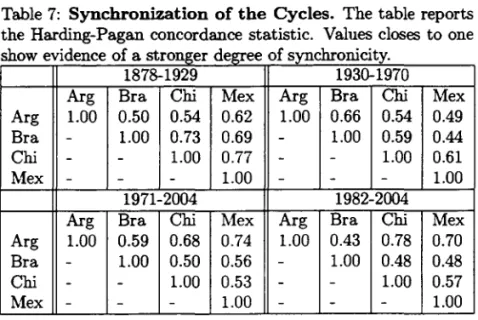
Concordance indices along the lines of Artis et al (1997) and Harding and Pagan
(2002) indicate that business cycles in these economies have been reasonably correlated.
This raises the question of whether there has been a common Latin American business
cycle and, if 80, what drives it? Pooling data from ali four countries, the common
factor methodology we employ permits the identification of a common regional factor.
4
•
•
•
•
•
•
•
•
•
•
•
•
•
•
•
•
•
•
•
•
•
•
•
•
•
•
•
•
•
•
•
•
•
•
•
•
•
•
•
•
•
•
•
•
•
•
•
•
•
•
•
セ@s
•
•
•
•
•
•
•
•
•
•
•
•
•
•
•
•
•
•
•
•
•
•
•
•
•
•
•
•
•
•
•
•
•
•
•
•
•
•
•
•
•
•
•
This provides the basis for a more robust test of the hypothesis that global shocks
(notably shocks to key foreign interest rates such as UK and US Treasury bond rates) have been important in driving capital flows and business cyeles in Latin America
-an issue with salient practical implications that has previously been addressed using
more restrictive empirical approaches and limited data (Calvo et alo 1993;
Fernandez-Arias, 1994; Agénor et al., 2000; Neumeyer and Perri, 2(05). Using a VAR framework
that also allows for the roles of world primary commodity terms of trade and foreign
output shocks and using generalized variance decompositions, we show that shocks to
global interest rates, terms of trade, and foreign output account for between 40 to 70
percent of forecast error variance in the regional common component across the various sub-periods and policy regimes.
The remainder of the paper is divided into four sections as follows. Section 2 lays
out the econometric framework and discusses the main estimation issues. Section 3
provides a brief description of the variables and presents initiaI estimates. Section 4 places our results in an economic context and presents a business cyele chronology for the four countries. Section 5 examines the extent of regional co-movements and the role of common shocks. Section 6 coneludes.
2
Econometric FraIllework
The idea that a cross-section of economic variables share a common factor structure has
a long tradition in economics, dating back at least to the attempt by Burns and Mitchell
(1946) to construct an aggregate measure of economic activity. There are two chief motivations for common factor models. One is that economic theory suggests strong linkages between economic activityacross different sectors due to common productivity, preference, policy shocks but since some of these shocks unobservable, information
about them can only be extracted once one has access to a sufliciently large
cross-section of economic variables that are at least in part driven by these shocks. Hence, a
critical requirement that needs to be met in our analysis is the availability of broad and a
diverse enough set of variables that bear sufliciently elose relation to aggregate business cyele behavior. Natural candidates inelude capital formation, government revenue and
expenditures, sectorial output series, as well as a externaI trade figures and a host of
financiaI variables. The fact that the Latin American economies have historically been
highly dependent on global capital markets and demand from outside trading partners suggests that interest rates and cyclical output in advanced countries also be included in the analysis.
The second motivation for using dynamic factor analysis is related to the presence of measurement erroIS. Activity leveis in many sectors are measured with considerable error. Provided that measurement errors are largely idiosyncratic, cross-sectional in-formation can be used to construct more robust common factors that are not similarly sensitive to the impact of such errors. Here one has to make assumptions on the
expo-sure of such ohservable variables to common shocks in order to identify the underlying
driving factors.
Stock and Watson (1989, 2002) and Forni, Hallin, Lippi and Reichlin (2000) have shown that the application of dynamic common factor models to a suflicient1y rep-resentative set of macroeconomic and sectorial indicator provides superior forecasting
performance for a target variable such as real GDP or indeed any broad index of
eco-nomic activity. This methodology turns out to be particularly useful when some of the
constituent series that add up to a target variable (such as monthly GDP) are
lack-ing, or when such series are suspected to be mismeasured (as commonly deemed to be
the case for certain service activities). An important requirement is that such
mea-surement errors are sufficiently idiosyncratic or that the cross-section of available time series be sufficiently large and/or representative. This methodology is clearly suitable when interest lies in reconstructing (backcasting) historical measures of the cycle.
2.1 Dynamic
Factor Models
In the following we explain how information on the unohserved factors can be extracted.
Let Xt be a vector of de-meaned time series ohservations on N economic variables
observed over the sample t = 1, ... , T. Assllroing that X admits a dynamic factor
representation we can write
(1)
(2)
6
•
•
•
•
•
•
•
•
•
•
•
•
•
•
•
•
•
•
•
•
•
•
•
•
•
•
•
•
•
•
•
•
•
•
•
•
•
•
•
•
•
•
•
•
•
•
•
•
•
•
•
••
•
•
•
5
•
•
6
•
•
•
•
•
•
•
•
•
•
•
•
•
•
•
•
•
•
•
•
•
•
•
•
•
•
•
•
•
•
•
•
•
•
•
•
•
•
where ft
=
(llt,
... ,
fqt)' is a vector ofq
common dynamic factors, A (L) is anNxq
matrixof filters of length s, セ@ is an N x 1 vector of idiosyncratic disturbances, F t =
(r;, ... ,
fLs)
is an r x 1 vector of stacked factors with r = q x (s
+
1). Notice that while q identifies thenumber of common shocks, the dimension of F t
(r)
dependa on the lag structure of thepropagation mechanjsm of those shocks. We refer to (1) as the dynamic representation
and to (2) as the static representation. Similarly, ft is the vector of q dynamic factors
and Ft the vector of r static factors, while the
A
matrices contain the factor loadings.In practice the factors are typically unobserved and extraction of them from the
observables (Xt ) requires making identifying econometric assumptions. It is common
to assume that the errors, セL@ are mutually orthogonal with respect to ft although
they can be correlated across series and through time. In addition the factors are only
identified up to an arbitrary rotation-we explain in the empirical section how we choose a particular rotation using the idea that the factors are only identified indirectly via the factor loadings.
When applied to a broad cross-section of economic variables, this model is ideally suited to extract information on common components of economic activity. The extent
to which information in the q common factors provides a broad-based measure of ・」セ@
nomic activity dependa crucially on the quality and representativeness of the underlying
economic variables, 50 successful implementation of the approach must be preceded by
careful construction of a data base comprising information on sectorial output variables,
govemment activity, external trade, financiaI variables and 50 forth.
2.2 Factor Estimation
The standard estimation method of dynamic factor models involves maximizing the
likelihood function by means of the Kalman filter. This technique has been employed
for low-dimensional systems by Stock and Watson (1991) and for higher dimensional systems (N=60) where the maximization is undertaken using the EM algorithm. When
N is large, non-parametric methods such as static principal components (Stock and
Watson (2002)), weighted static principal components (Boivin and Ng (2003)) and dynamic generalized principal components (Forni, Hallin, Lippi and Reichlin (2000)) are available for consistent estimation of the factors in approximate dynamic factor models.
Under the assumed orthogonality between the dynamic factors and the idiosyncratic
disturbances, we c.an consider a spectral density matrix or covariance matrix of the Xt
decomposition and the common component can be approximated by projecting either
on the first r static principal components of the covariance matrix (Stock and Watson,
2002) or the first q dynamic principal components (Forni, Hallin Lippi and Reichlin,
2000), possibly after scaling the data by the covariance matrix (Boivin and Ng (2003)).
In the following we briefly deserihe these approaches.
Stock and Watson (2002) proposed a principal component estimator of the factors as the solution to the following least squares problem:
subject to the restriction A'A = I. The solution to this problem takes the form
(3)
where v is an r x 1 vector of eigenvectors corresponding to the r largest eigenvalues of
the variance-covariance matrix of the X-variables,
:E
xx . The resulting estimator of thefactors,
FF,
is the fi.rst r static principal components of Xt .Forni et al (2000) exploit dynamic structure in the factors by extracting principal components from the frequency domain. Their approach permits efticient aggregation of
variables that may be out of phase. In this case the common componen.t is estimated by
projecting the X-variables on present, past and future dynamic principal components. The factors and their loadings are the solution to the following non-linear least squares
problem that weights the idiosyncratic errors by their variance covariance matrix,
n
=E[(Xt - AFt ) (Xt -
AFd):
again subject to A' A
= I. Forni et al (2oo3b) consider a two-step weighted principal
components analysis where they estimate n as the difference between the sample
co-8
•
•
•
•
•
•
•
•
•
•
•
•
•
•
•
•
•
•
•
•
•
•
•
•
•
•
•
•
•
•
•
•
•
•
•
•
•
•
•
•
•
•
•
•
•
•
•
•
•
•
•
•
•
•
•
•
•
•
6
•
•
•
.,
•
•
•
•
•
•
•
•
•
•
•
•
•
•
•
•
•
•
•
•
•
•
•
•
•
•
•
•
•
•
•
•
•
•
セ@
variance matrix, Exx, and the dynamic principal components estimator of the spectral
density matrix of the common components.2
The resulting estimators of the loadings and common factors are
セ@
A - vg
FfHLR
-
セxエ@ =v'X
t ,(4)
where vg are the generallzed eigenvectors associated with the largest generalized
eigen-values of the estimated covariance matrices of common and idiosyncratic components
and the resulting estimator of the factors is the vector consisting of the first r
gen-erallzed principal components of Xt . This can be seen a the first r static principal
components of the transformed data
X
t =(fi)
-1/'2 Xt . An advantage of this approachis that it exploits the dynamic structure in the variance covariance matrix of the data, accounting for leading or lagging relationships among variables which can be out of
phase by deriving an estimate of
n
through dynamic principal components methods.3An important requirement when applying these estimators is that all the variables
entering the dynamic common factor specification are stationary. With the exception of
the inflation rate, real interest rates, and the ratios of export to import value which are
stationary by construction, we employ two alternative approaches to ensure stationarity.
One is the standard Hodrick-Prescott filter, with the smoothing factor
(À)
set to 100,as is common practice with annual data (c.f. Backus and Kehoe, 1992). The second
approach to detrending considered here is the symmetric moving average band-pass
filter advanced by
Baxter
and King (1999). Following common practice with annualdata, we set the size of the symmetric moving average parameter K=3 but use a
larger-2Specifically, let Xt denote the standardized values of Xt . The estimated spectrum of Xt, Szz(w),
is computed at 101 equally spaced ordinates using a Bartlett kernel applied to p = Tl/2 sample
autocovariances. The estimated spectrum ofthe dynamic factor components, SJf(w), is computed for each of the 101 frequencies using q dynamic principal components of Szz(w). The estimated value of
n
is computed as n = Ezz - Eff' where Ezz is the sample second moment matrix of x and EIf is the inverse fourier transform of Sff(w).31n their empirical forecasting comparison D'Agostino and Giannone (2004) find that weighted procedures generally produce better forecasting performance. Similarly, Boivin and Ng (2003) find that weighted principal components improve on the forecasts of the standard principal components methods applied to the static factor model. Stock and Watson (2005) report that forecasts based
on factors estimated with static principal components and those estimated with weighted principal components tend to be high1y correlated.
than-usual bandwidth ranging from 2 to 20 years so as to avoid filtering out the longer
(12-20 year)
pre-war cycles first documented by Kuznets(1956)
for the United Statesand found to be present in severa! advanced countries (Solomou,
1987). As
shown below,both detrending methods yield very similar results. Finally, since we are concemed with
a real economic aggregate, all variables are measured in real terms (deflated by the
consumer price index or by the GDP deflator) with the obvious exceptions of inflation,
the ratios of exports to imports, and country spreads (as measured by the difference
between the yield on a sovereign foreign-currency denominated bond and the respective
UK or US yields). We employ the commonly used of defining the real interest rate as
the difference between the nominal interest rate and current inflation. Since all interest
rate series used in the estimation refer to short-term instruments, discrepancies arising
from possible mismatches between current and expected inflation are les.s criticaI than
in the case of long bonds.4
2.3 Backcasting Historical Activity Measures with Dynamic
Factors Model
The common factors derived above,
Frv
orFf
H LR, are of interest in their own rightsince they provide broad-based measures of economic activity. However, often particular
interest lies in ana1yzing a particular time-series such as GDP growth over long periods
of time. This immediately poses two problems. First, data on this variable may only
be available over a more recent sample. Second, even when available, the series may be subject to considerable measurement error.
The common factor approach is ideally suited to handle these problema provided
that the variable of interest lends itself to a similar dynamic factor representation as
assumed above. In particular, let GDP growth be represented by the variable Yt. Under
the assumption that Yt is driven by the common factors ft =
(flt, ... ,
fqt)' derived above,we have
(5)
Our interest lies in. backcasting values to create a new historicaI time-series of output
growth so we estimate the following backcasting equation using contemporaneous factor
4We also checked the robustness of our results to the use of the US 10-year bond yield and found that this did not have any effect on inferences made in the paper.
10
•
•
•
•
•
•
•
•
•
•
•
•
•
•
•
•
•
•
•
•
•
•
•
•
•
•
•
•
•
•
•
•
•
•
•
•
•
•
•
•
•
•
•
•
•
•
•
•
•
•
•
•
•
•
•
•
•
•
•
•
•
.,
•
•
•
•
•
•
•
•
•
•
•
•
•
•
•
•
•
•
•
•
•
•
•
•
•
•
•
•
•
•
•
•
•
•
values:
Yt =
a
+
f3'F
t+
Et·Data of sufficient quality on Yt is only available over a much shorter (recent) sample
than data on the variables used to construct estimates of the factors. However, under
the maintained mode! (5), we can estimate the parameters () =
{a,,B}
over a (recent)sample period for which quality data is available on output growth, y. We can then
backcast output growth over the longer sample for which estimates of the factors are
available. In the following we explain details of how we set up the data and implement
these ideas .
3
Reconstructing Broad Measures of Economic
Ac-tivity in Latin America
A full set of national income account data for Argentina, Brazil, Chile and Mexi.co is onlyavailable from the mid-1930s (Argentina) or starting at some point in the 1940s for
the other three countries.5 Previous researchers have tried to overcome this limitation
by constructing proxy measures of economic activity for the earlier period. The quality
of these constructs is, however, very uneven due to the lack and/or the very poor
quality of output data for broad sectors of the economy. In the case of Argentina and
Brazil, for instance, offi.cial output data in agriculture, manufacturing, construction, and services only become available from 1900 onwards and, even then, with serious gaps particularly in the case of Brazil (c.f. Haddad, 1978). With regard to Chile and
Mexico, sectorial output data stretching back to the 19th century are more readily
available but, again, often spanning a small subset of the universe of firms and of
questionable quality (see the Appendix). Insofar as previous researchers tried to derive an aggregate measure of economic activity from averages of these production data
(resorting to linear interpolation to fill gaps in some discontinuous annual series), the
resulting indices are bound to be highly inaccurate. While two other attempts have
been made to overcome these problems, they have clear drawbacks. One is that of
5Even for Argentina, full-fledged information underpinning national account estimates is not avail-able before 1950 (see Banco Central de Argentina, 1976). In the case of Mexico, a GDP series con-structed solely on the basis of sectoral output information-and not based on expenditure and income data-has been reported by Banco de Mexico since 1921.
backcasting Argentine GDP based on a handful of production and trade variables by means of linear OL8 regressioDS (della Paolera, 1988, p.189)j the other is the use of static common components to backcast 19th century Brazilian GDP on the basis of foreign trade data (Contador and Haddad, 1975).6 Despite this very limited variable
span, the latter series has been (misleadingly) compiled by Maddison (1995, 2003) and
Mitchell (2003) as a re1iable indicator of pre-war Brazilian GDP.
Our paper addresses these data limitatioDS by substantially broadening the number
of variables from which one can derive valuable information on the pare of aggregate
economic activity. We take into account not only production or forei.gn trade variables, but al.so monetary and financiaI indicators that economic theory suggests should be
cor-related with the business cyele. As discussed. in the Appendix, the data was obtained
from an extensive compilation of both primary and secondary data sources. In some
cases this resulted in entirely new series being createdj once combined with their
coun-terparts from the !ater 20th century, these series span the entire QXWセRPPT@ period. 8till,
as one might expect from country specific idi06yncrasies in data collection (especially
before the standardization of national account and balance of payments methodolo-gies), the availability of macroeconomic and financial indicators varies somewhat across countries. For example, for Mexico very few variables were measured prior to 1877, so our business cycle index for that country only starts in 1878. Likewise, it proved impossible to obtain any meaningful series for manufacturing and agriculture output
in Brazil before 1900, although we were successful in :filling the gap regarding domestic
cement consumption (a proxy for coDStruction activity) as well as output in the trans-portation and communication sectors. A similar gap was filled for pre-1900 Argentina
which also benefitted from the use of a new proxy indicator of manufacturing activity
starting in 1875 and recently compiled by della Paolera and Taylor (2003). Overall, we
were able to put together a pane! of between 20 to 25 time series per country which, as shown below, appears to provide an excellent gauge of the respective national business cyeles. The Appendix provides a detailed discussion of measurement issues underlying the various series and the respective data sources.
6 A cruder attempt of reconstructing 19th century Brazilian GDP can be found in Goldsmith (1986),
who derives a GDP growth series based on an unweighted average of government expenditure, revenues, wages, exports and imports.
12
•
•
•
•
•
•
•
•
•
•
•
•
•
•
•
•
•
•
•
•
•
•
•
•
•
•
•
•
•
•
•
•
•
•
•
•
•
•
•
•
•
•
•
•
•
•
•
•
•
•
•
•
t;
5
•
•
5
•
•
•
•
.,
•
•
•
•
•
•
•
•
•
•
•
•
•
•
•
•
•
•
•
•
•
•
•
•
•
•
•
•
•
•
•
•
•
S
3.1 Empirical Results
Factors extracted from a dataset comprising information on a variety of variables are not typically straightforward to interpreto Nevertheless, the estimated eigenvectors do offer important clues in this respect. While factors are only identified up to an arbitrary
rotation, it becomes clear from the individual factor loadings that the first factor bears
a strong positive correlation with the GDP cycle during periods for which actual GDP data is available.
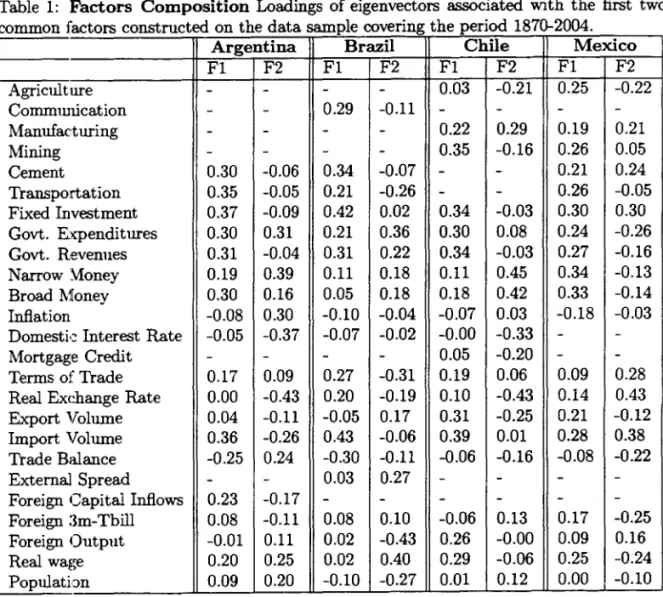
Table 1 shows the estimated factor loadings for the first two factors extracted using
the Stock and Watson procedure and the HP-detrending since·the results using other
methods yield very similar estimates, as shown below. We report only the first two
factors since the addition of further factors only contributes marginally to the total variance of the panel with the exception of one country (Brazil) for which the third factor is important (more on this below). The first factor (labeled FI) can be interpreted as a broad measure of cyclical activity since it loads positively on indicators that are well-known to be procylical such as sectorial output, fixed capital formation, import
quantum and real money, aIl measured in deviations from their respective long-term
trends. The interpretation of the second factor (F2) is less clear-cut. For Argentina, Brazil and Chile, this factor assigns large loadings to money, the domestic interest rate and the real exchange rate (also entered in deviations from trend). Thus, it can
be broadly interpreted as an index of monetary conditions. In the case of Mexico,
the largest loadings are observed on the variables capturing externallinkages such as the term of trade, the real exchange rate or import volume. This is suggestive of an important difference between the economies, possibly indicating that Mexico's linkage
to the US economy is of special relevance - a hypothesis that is corroborated by further
evidence presented below.
Figure 1 plots the two SW factors for each of the countries using the HP detrending
as reported in Table 1. For comparison, we also plot the same factors using band-pass
filter detrending. Since the two approaches yield very similar results, and given that the
HP-detrending does not entailloosing three annual observations on each extremes of the
sample and has been more extensively used in related studies (Backus and Kehoe, 1992;
Kydland and Zarazaga, 1997; Neumeyer and Perri, 2(05), we maintain this detrending
method through the remainder of the paper.
l
•
,
'.
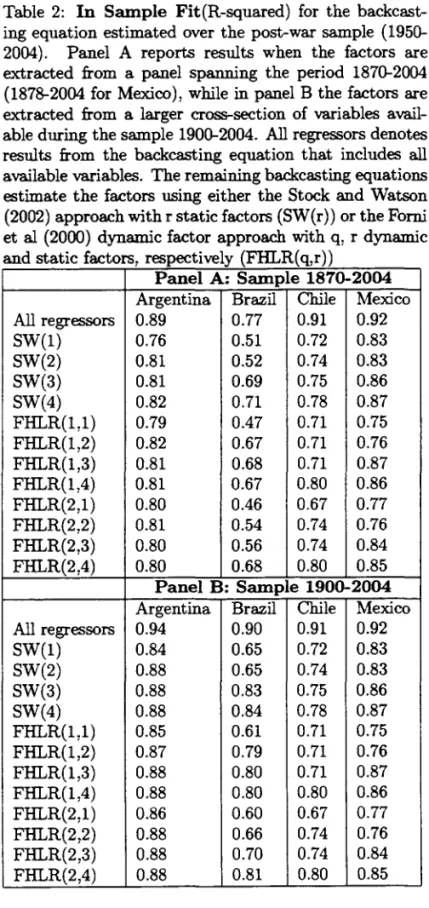
While the factors are of interest in their own right, ultimately our interest lies in reconstructing a measure of cyclical activity in the Latin American economies. To this end, Table 2 reports the R-value of regressions of de-trended actual GDP on the factors across a range of factor model specifications. The results cover the period QYセ@ 2002, when full national account estimates are available for all four countries. As with the bulk of the series entering the alternative factor specifications, actual GDP is also expressed in deviations from an HP trend - a widely used measure of the output gap. Correlations in Table 2 thus gauge the extent to which the various factor models span
the real GDP cycle. To indicate the sensitivity of the results to the adopted econometric methodologies, we present results both for the all regressor approach-which maximizes the
R
2 by projecting cyclical GDP on all variables-and a range of alternative factor approaches such as the Stock and Watson approach using between one and four common factors and the Forni et al (2000) approach estimated with up to two dynamic factors and up to four static factors. As we shall see later, the high in-sample fit of the all-regressor, 'kitchen sink' approach comes at the cost of overfitting the data and producing poor out-of-sample performance.Over the period 1870-2004, the linear projections of GDP growth on the various factors yield a tight fit for Argentina, with
.R
2-values varying from 0.89 for theall-regressor approach to around 0.80 for the two factor approaches Correlations are also generally high for Chile and Mexi.co, with WセXU@ percent of the variance of the real GDP cycle explained by the first two factors. The fit for Brazil is relatively WOISe, as indicated
by
.R
2-values in the PNセPNWP@ range. Only by including the series on agricultural andmanufacturing output (both of which are onlyavailable from 1900 onwards), can one raise the fit of the regressions for Brazil to above 70 percent using the SW and the FHLR approaches, c.f. panel B of Table 2.
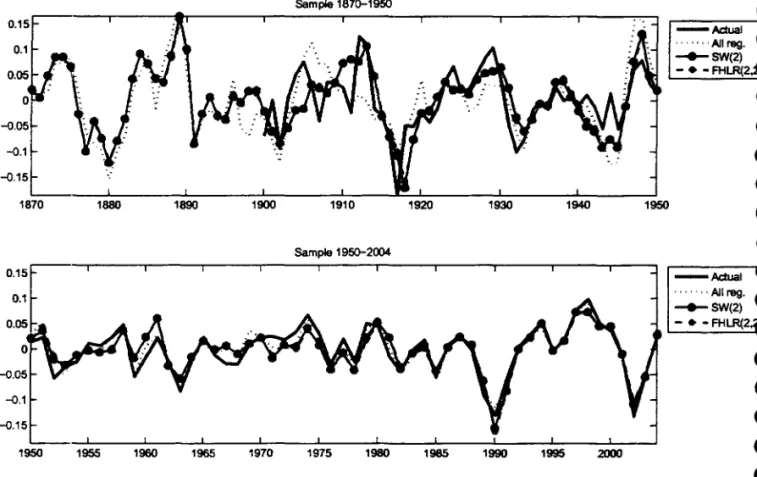
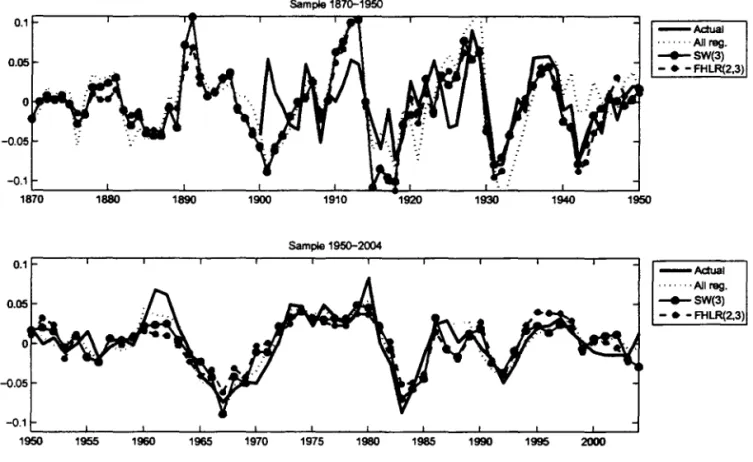
F\rrther evidence that the various approaches tell a simjlar story can be gleaned from Figures 2-5, which show the backcast estimates of cyclical GDP in the four economies.
In each case the upper panel plots the estimates and (where available) actual values of cyclical GDP over the period 1870-1949, while the bottom panel shows the correspond-ing values for the remaincorrespond-ing part of the sample. The close proximity between the fitted and actual values for the post-war period is clear from these plots-visual dilferences onlyemerge during rare and extremely large spikes such as in Brazil in 1961-62 and
14
•
•
•
•
•
•
•
•
•
•
•
•
•
•
•
•
•
•
•
•
•
•
•
•
•
•
•
•
•
•
•
•
•
•
•
•
•
•
•
•
•
•
•
•
•
•
•
s
•
•
•
•
•
•
•
•
s
.,
•
•
•
•
•
•
•
•
•
•
•
•
•
•
•
•
•
•
•
•
•
•
•
•
•
•
•
•
•
•
•
•
•
s
1980.7 Overall, however, it is pIain that: (i) the estimated values dosely track actual
cyclical GDP whenever this is available; (ü) the various factor approaches generate quite
similar estimates of the cyde and
(ili)
factor estimates often differ substantially fromestimates based on the all-regressor least squares approach whicb. in turn is furthest
away from the actual value. This strongly cautions against the use of "kitchen sink"
approach by previous researchers in the reconstruction of earlier GDP data.!l
3.2 Robustness Analysis: Parameter Instability
and
Fador
Specmcation
It is important to investigate whether our estimates are robust to potential instability of the factor loadings and to changes in the factor specification. The common factor projections were built under the assumption that factor loadings remain constant over
time. In the same way that out-of-sample forecasts rely on an implicit assumption
that certain relationships between predictor variables and the target variable remain constant over the forecasting period, backcasting economic activity measures without this assumption is infeasible.
An advantage of our approach is that the use of common factoIS can be expected
to be reasonably robust against the structural instability that plagues low-dimensional forecasting regressions. Stock and Watson (2002) provide both theoretical arguments and empirical evidence tbat principal component factor estimates are consistent even in
the presence of temporal instability in the individual tim&series used to construct the
factoIS provided that this instability averages out in the construction of the common
factoIS. This occurs if the instability is sufficiently idiosyn.cratic to the various series.
To evaluate the robustness of our results for the backcasted GDP values, Figure 6
plots the rojnjroum and maxim.um value across different specifications of the backcasting
7The gaps between the "actual" values and our backcast estimates for Brazil before 1930 should not been seen as misses since what is denoted as actual is the Haddad (1978) estimate which, as noted above, is constructed with incomplete sectoral data and relies extensively on interpolation and use of regression analysis to fill gaps in the actual output series. Given the reasonably tight fit between our index and the oflicial GDP data after 1950, we suspect that such apparent misses reflect the inaccuracies of the Haddad index rather than of our index, which relies on information across a wider spectrum of variables.
8 As mentioned above, this approach has been used by della Paolera (1988) to backcast Argentine
GDP during 1884-1899. It has also been used by Braun et a!. (2000, p.20) to backcast Chilean GDP for much of the 19th century.
equation. In particular we consider:
• Two different estimation samples for the backcasting equation, 1915-2004 and
1950-2004 (GDP data for Chile and Mexico are available only after 1940 so for
these countries the backcasting equation is estimated only over the sample 1950-2004.)
• Sixdifferentfactorspecifications: SW(2), SW(3), FHLR(2,1), FHLR(3,1), FHLR(2,2), FHLR(2,3).
• Different samples for factor estimation, where a new sample occurs if new time
se-ries become available (Argentina: 2004, 1875-2004, 1900-2004;Brazil: 1870-2004, 1900-2004; Chile 1870-2004; Mexico: 1878-2004).
• Two different panels of data, one including the external variables while the other excludes these.
The sensitivity analysis produces 72 specifications for Argentina, 36 for Brazil and 12 for Chile and Mexico. With the exceptions of Brazil in 1890-91, 1986 and 1989, and Chile in 1929-32 and Mexico in 1916, the range is very narrow; and even at those outlier
observations, all estimates point in the same direction. .Ai:. it turns out, all indications
are that little has ebanged over time. This congruence would be unlikely to hold if the
factor loadings were subject to structural breaks or considerable instability.
Overall, the results above make a simple but important point. Even when the
common factors are extracted from a dataset containing limited information on output
growth, they track the real GDP cycle well. This may not be overly surprising since we
selected variables that economic theory suggests should be closely related to cyclical activity. Yet, tbis evidence underscores the robustness of backcasting inferences on the aggregate output cycle using simple combinations of a cross-section of fiscal, financiaI, sectorial and external variables.
3.3 Gains from Using Extended Data Set
Although our results do not appear to be sensitive to the particular choice of factor
estimation metbodology, number of factors or sample period used to estimate the factor
loadings, one might ask what the 'value-added' is of using as wide a set of variables as
16
•
•
•
•
•
•
•
•
•
•
•
•
•
•
•
•
•
•
•
•
•
•
•
•
•
•
•
•
•
•
•
•
•
•
•
•
•
•
•
•
•
•
•
•
•
•
•
•
•
•
•
•
•
•
•
•
•
5
S
•
•
•
•
•
•
•
•
•
•
•
•
•
•
•
•
•
•
•
•
•
•
•
•
•
•
•
•
•
•
•
•
•
•
that adopted here when constructing the common factors. To answer this, we compare
in Figure 7 plots of the first common factor constructed using our extensive data set
vs. that using only sectoral output variables. This comparison shows the value from
including information on financia!, fiscal and trade variables. The differences are not negligible. Common factors based exclusively on sectoral output data are far smoother than those based on the wider set of variables. This shows up in a failure of the more narrowly constructed common factors in fully accounting for the depth of the crises in Argentina in 1918 and 1990, in Brazil and Mexico following World War I and in Chile
following the Great Depression. In addition many of the smaller peaks and troughts
-such as the cycle around 1900 in Argentina - are entirely missed by the common factor
based on sectoral output information.
Notice also that this limitation of the smaller set is not exclusive to Argentina
for which we have only two sectoral variables going back to 1870. Adding industrial output for Argentina (a series that becomes available from 1875) does not overtum this
conclusion. Significant ァ。セ@ also arise for Brazil, Chile, and even Mexi.co which has
a wider sectoral output data converage all the way back to the 1870s. F\rrther, the
discrepancies between the two series are not exclusive to the pr&-war period, and hence do not seem entirely attributable the poorer quality of earlier data; large gaps emerge, for instance, for post-l960 Brazil.
These plots vividly demonstrate the importance to the construction of broad
mea-sures of economic activity of using a wide and varied set of economic variables
repre-senting not just a few sectoral output series. As one might expect, fiscal, financiai and externaI trade variables have a non-negligible role in filling the gap.
4
Thacking
History
We next ask how well the backcasted series square with qualitative historical evidence on
events deemed to be major economic tuming points in these countries. Figure 8 relates
the two. Starting with pre-war Argentina, the index picks up all economic downturns
associated with well-known world events - notably the stock market crashes in Europe
and the US in 1873 and the ensuing global economic depression, the 1890 Barings crisis,
the 1907 financiai panic, the two world war8, and the Great Depression of the 19308.
Likewise, major pa:;t-WWII shocks are also conspicuously pick.ed up as turning points
!
•
,
t
I
,
r
!
!
.
セ@in our index, notably the boom and bust in world commodity prices 8SSOCiated with
the Korean War in the early 1950s, the oi! price shocks of the 1970s, the early 1982-83
debt crisis, as well as the emerging market crises of the 1990s (the 1994-95 "Tequila"
crisis and the Asia and Russia crises of 1997-98). A glance at Figure 8 also indicates that such a juxtaposition of cyclical turning points in country indices with major world
economic events is broaclly corroborated for Brazil, Chile, and Mexico.9
In addition, the portrait of history provided by our index: is consistent with narrative
evidence about the macroeconomic repercussions of key country-specific events. In the
case of Brazil, the index: picks up the mini downturn associated with the 1888 political unrest (end of Slavery and the republican transition) as well as the subsequent boom (the "Encilhamento") stemming from a liberal monetary reform that brought about an unprecedented boom in domestic credit and asset valuations in 1889-90 (see llinner,
2(00). The Brazil index: tracks equally well what is deemed to have been one of Brazil's
most protracted recessions which Cl1]minated in the country's first sovereign default and the debt rescheduling arrangements under the auspices of the Rothchilds in 1898 (see
Fritsch, 1988).10 As for Chile, our index highlights the upturn of 1879-82 associated
with the "War of the Pacific" (against Peru), the downturn around the country's exit
from the gold standard in 1898 (Llona Rodriguez, 20(0), as well as the severity of the
1929-32 depression in Chile due to plummeting terms of trade (Diaz.-Alejandro, 1984). Both in Argentina and Chile as well as (to a lesser ex:tent) Brazil, the index: identifies clear turning points around the military coups of the 1960s and 19708.
Finally, the Mexico index: yields a picture of economic fluctuations that is
remark-ably consistent with that depicted by Mexican historiography starting with the 1879-82
upturn that is typically associated with the onset of the new regime headed by General
Porfirio Diaz (Cardenas, 1997). Likewise, the subsequent recession is clearly depictedj
with the 1885 trough coinciding precisely with the well-documented austerity plan
im-9In contrast with Argentina, Brazil and Chile were little affected by the 1994-95 Mexican crisis partly due to offsetting domEStic developments. In the case of Brazil, a singularly successful stabilization plan in 1994 and renewed political stability set off a domestic demand boom in the following year. In the case of Chile, stronger trade linkages with Asia, low public debt, and a significant improvement in externaI terms of trade limited the disruptive effects of Tequila crisis on the domestic economy (see Singh et aI., 2005).
lOUnlike severa! Latin American countries which defaulted on their externai debts (and some also on their domestic debts) more than once throughout the 19th century, Brazil copiously serviced its sovereign debt obligations until then (Summerhill, 2004).
18
•
•
•
•
•
•
•
•
•
•
•
•
•
•
•
•
•
•
•
•
•
•
•
•
•
•
•
•
•
•
•
•
•
•
•
•
•
•
•
•
•
•
•
•
•
•
•
•
••
•
•
•
•
•
•
•
•
•
•
•
•
•
•
•
•
•
•
•
•
•
•
•
•
•
•
•
•
•
•
•
•
•
•
•
•
•
•
•
•
•
•
•
"
<..
posed by Diaz's finance minister Manuel Dublan that involved a temporary suspension
of payments on domestic public debt; this was followed by an upswing that coincided
with Mexico's renewed access to international capital markets in the wake of the QXXセ@
87 externaI debt settlement and the resumption of strong capital inflows in the late
1880s (c.f. Marichal, 2002). This strong upswing was brought to a ha1.t by a sharp
worldwide fall in silver prices (Mexico's main export item) coupled with a sudden stop
in capital fiows to emerging markets in the early 18908 (c.f. Catão and Solomou, 2(05)
Finally, our business cycle index also provides a new measure of the severity of the
economic downturn associated with the Mexican Revolution of 1911-20 identifying a trough around 1915-16-these were the years when the revolutionary confiict peaked and chaotic monetary conditions triggered a hyperinfiation (Cardenas and Manns, 1988).
4.1 Business
Cycle Dating
Armed with the business cycle indicators for the four countries, we turn to the task
of formally dating the respective turning points. A classic device to this end, which
is also consistent with our definition of the business cycle as output deviations from
a stochastic or deterministic trend, is the Bry and Boscham (1971) algorithmY It
consists of a sequence of procedures starting with the search for extreme values in order to e1iroinate (near-)permanent jumps in the series associated say with outliers, followed by the use of centered moving averages of the series and the search for local maxima
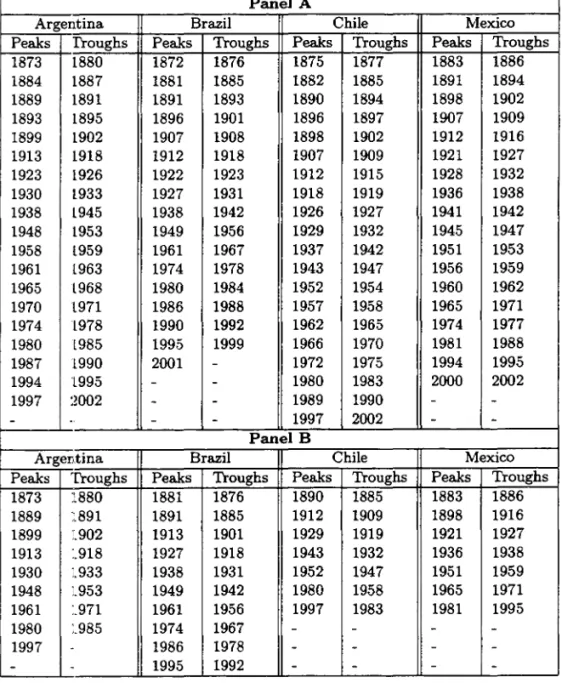
or roiniroa within a chosen window length.12 Panels A and B of Table 3 report results
based on two-year and three-year windows, respectively. As expected., the algorithm
identifies peaks and troughs that are broadly consistent with a visual inspection of
Figures 2-8. When the narrower window is used, the average duration of the cycle is
11 A recent alternative dating procedure which al50 builds on the Bryand Boschan approach has been
advanced by Harding and Pagan (2004). Their procedure has been designed for use with quartely data and growth cydes rather than with measures of the output gap. As discussed in Marcellino (2005), measuring the cyde as deviations from trend as we do is a more suitable procedure in contexts where absolute declines in output are not 50 rare, as in our group of countries over the past century. Conversely, the concept of a growth cycle is more analytically relevant when absolute declines in output are very rare and growth rates are reasonably persistent, as in Western Europe in the early post-war decades. Most of the recent empirical literature on business cycle identification and measurement has focused on the classical cycle defined in terms of deviations from trend (stochastic or deterministic).
12See King and Plosser (1984) and Watson (1994) for further details and application to US data, for
which the algorithm closely replicates the dating by the NBER's panel of experts.
shorter overall, and the more so when one focuses on the post-war era. This finding is consistent with evidence of the shortening business cycle length among advanced
countries
(see,
e.g., Gordon, 1986) Using a longer window, Pane! B indicates thatthe pre-cycle is dominated by the Kuznets or long swings, with similar tuming points
as those identified in the literature on Anglo-saxon economies (Solomou, 1987). This
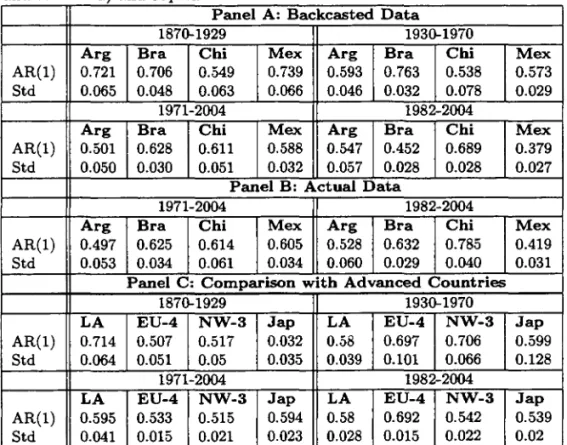
evidence is further reinforced by spectral density function estimates of the individual
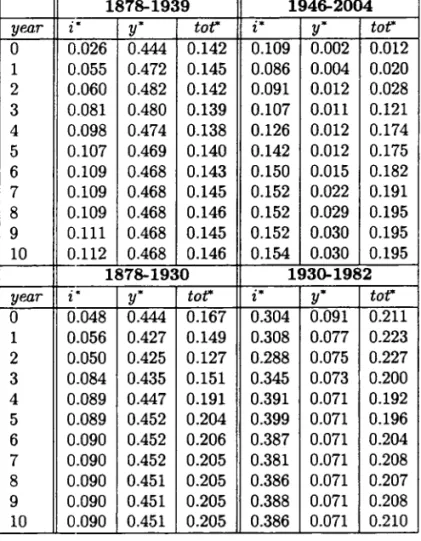
country indices, which point to a domjnant cyclicallength around 14 to 16 years during
the 1870-1930 period (a typical Kuznets-swing length), followed by a 10-12 year cycle
in pa;t-war data (Table 4).
In sum, both the Bry and Bosham algorithm and the spectral density function
estimates point to a reasonably long average cyclical duration in all four countries. The domjnant cyclical pattern was generally longer in the pre-1930 era, but even in the
pa;t-World War II period, cycles in Latin America were substantially more protracted
than in the United States and other advanced countries.13
Against this background, Tables 5 and 6 report a set of descriptive statistics that
he!p characterize other stylized facts about Latin America's business cycles. First, standard deviations corroborate the perception that Latin America has been a more cyclically volatile region than both countries deemed advanced by today's definition as
well as countries such as Australia, Canada and Japan that were considered "emerging
economies" in the pre-war world. This volatility gap between the two groups has
changed over time, however. The four Latin countries were clearly far more volatile in
the early globalization period before the 19308 - characterized as it was by free capital
mobility and very limited quantitative restrictions on trade. Conversely, there is prima
facie evidence tha.t the inward growth policies did succeed in fending these countries oif global instability in the 1930-70 sub-period, when global volatility generally rose, partly due to the recovery from the 1929-32 depression and war shocks, which appear re.flected in the higher standard deviation of the output gap among advanced countries during the period. But as output gap volatility came down in advanced countries in the
pa;t-1960s period (notwithstanding two oil shocks and dramatic changes in economic
policies), cyclical volatility in Latin America remained relatively high; only in the
pa;t-I3To the extent tha.t the combination of large shocks and high cyclical persistence make the task of stabilization policies more difficult, this finding has interesting implications for the interpretation of the history of stabilization policies in Latin America.
20
FUNDAÇÃO GETULIO VARGAS .. ..u.otECA MARIO HENRIQUE SIMONSr..N