AMTD
6, 3859–3882, 2013A chemical analyzer for charged ultrafine
particles
S. G. Gonser and A. Held
Title Page
Abstract Introduction
Conclusions References
Tables Figures
◭ ◮
◭ ◮
Back Close
Full Screen / Esc
Printer-friendly Version Interactive Discussion
Discussion
P
a
per
|
Dis
cussion
P
a
per
|
Discussion
P
a
per
|
Discussio
n
P
a
per
|
Atmos. Meas. Tech. Discuss., 6, 3859–3882, 2013 www.atmos-meas-tech-discuss.net/6/3859/2013/ doi:10.5194/amtd-6-3859-2013
© Author(s) 2013. CC Attribution 3.0 License.
Atmospheric Measurement
Techniques
Open Access
Discussions
Geoscientiic Geoscientiic
Geoscientiic Geoscientiic
This discussion paper is/has been under review for the journal Atmospheric Measurement Techniques (AMT). Please refer to the corresponding final paper in AMT if available.
A chemical analyzer for charged ultrafine
particles
S. G. Gonser and A. Held
Bayreuth Center of Ecology and Environmental Research, University of Bayreuth, 95440 Bayreuth, Germany
Received: 28 March 2013 – Accepted: 6 April 2013 – Published: 18 April 2013
Correspondence to: S. G. Gonser ([email protected])
AMTD
6, 3859–3882, 2013A chemical analyzer for charged ultrafine
particles
S. G. Gonser and A. Held
Title Page
Abstract Introduction
Conclusions References
Tables Figures
◭ ◮
◭ ◮
Back Close
Full Screen / Esc
Printer-friendly Version Interactive Discussion
Discussion
P
a
per
|
Dis
cussion
P
a
per
|
Discussion
P
a
per
|
Discussio
n
P
a
per
|
Abstract
New particle formation is a frequent phenomenon in the atmosphere and of major sig-nificance for the earth’s climate and human health. To date the mechanisms leading to the nucleation of particles as well as to aerosol growth are not completely understood. A lack of appropriate measurement equipment for online analysis of the chemical com-5
position of freshly nucleated particles is one major limitation. We have developed a Chemical Analyzer for Charged Ultrafine Particles (CAChUP) capable of analyzing particles with diameters below 30 nm. A bulk of size separated particles is collected electrostatically on a metal filament, resistively desorbed and consequently analyzed for its molecular composition in a time of flight mass spectrometer. We report of tech-10
nical details as well as characterization experiments performed with the CAChUP. Our instrument was tested in the laboratory for its detection performance as well as for its collection and desorption capabilities. The manual application of known masses of
camphene (C10H16) to the desorption filament resulted in a detection limit between
0.5 and 5 ng, and showed a linear response of the mass spectrometer. Flow tube 15
experiments of 25 nm diameter secondary organic aerosol from ozonolysis of alpha-pinene also showed a linear relation between collection time and the mass spectrom-eter’s signal intensity. The resulting mass spectra from the collection experiments are in good agreement with published work on particles generated by the ozonolysis of alpha-pinene. A sensitivity study shows that the current setup of CAChUP is ready for 20
laboratory measurements and for the observation of new particle formation events in the field.
1 Introduction
Aerosol particles are of eminent relevance for the earth’s radiation balance (Forster et al., 2007) and human health (Delfino et al., 2005; Stieb et al., 2002). It is well 25
AMTD
6, 3859–3882, 2013A chemical analyzer for charged ultrafine
particles
S. G. Gonser and A. Held
Title Page
Abstract Introduction
Conclusions References
Tables Figures
◭ ◮
◭ ◮
Back Close
Full Screen / Esc
Printer-friendly Version Interactive Discussion
Discussion
P
a
per
|
Dis
cussion
P
a
per
|
Discussion
P
a
per
|
Discussio
n
P
a
per
|
precursor molecules. The formation of these so-called secondary aerosol particles can be observed in the planetary boundary layer at a multitude of locations around the world both in natural backgrounds as well as in polluted industrial areas (e.g. Kulmala et al., 2004). Typically, particle nucleation events begin after sunrise and the nucleated particles grow for several hours to a few days by condensation, reaching diameters 5
in the order of 100 nm. Typical aerosol growth and nucleation rates are in the range
of 1–20 nm h−1 and 0.01–10 cm−3s−1, respectively (Kulmala et al., 2004). Once the
initial nuclei are formed the particles will grow due to condensation of certain trace gases. The main contributors to the growth of particles are thought to be sulfuric acid, oxidation products of volatile organic compounds (VOCs), ammonia salts such as am-10
monium sulfate and aminium salts, as has been shown by several studies using direct as well as indirect methods (e.g. Barsanti et al., 2009; Held et al., 2004; Laaksonen et al., 2008; Riipinen et al., 2009; Smith et al., 2010). Even though there is a general idea about the mechanisms governing the growth of freshly nucleated particles a lot of processes remain unrevealed. This is due to the challenging task of performing online 15
chemical analysis of sub-30 nm particles. The small mass of these ultrafine particles is a limiting factor. For example, a particle of 10 nm diameter has a mass of a few
at-tograms (10−18 g). The preferred method to perform such measurements is the mass
spectrometric approach, as the achieved detection limits are low enough to analyze chemical components of ultrafine particles.
20
To date there are two instruments available which are capable of performing on-line measurements of the chemical composition of sub-30 nm aerosol particles in the field: (I) NAMS – the Nano Aerosol Mass Spectrometer (Wang et al., 2006) and (II) TDCIMS – the Thermal Desorption Chemical Ionization Mass Spectrometer (Voisin et al., 2003). NAMS is capable of measuring the quantitative atomic composition of 25
AMTD
6, 3859–3882, 2013A chemical analyzer for charged ultrafine
particles
S. G. Gonser and A. Held
Title Page
Abstract Introduction
Conclusions References
Tables Figures
◭ ◮
◭ ◮
Back Close
Full Screen / Esc
Printer-friendly Version Interactive Discussion
Discussion
P
a
per
|
Dis
cussion
P
a
per
|
Discussion
P
a
per
|
Discussio
n
P
a
per
|
Thus, molecular information about the sampled aerosol is not available. The TDCIMS, in contrast, analyzes the molecular composition of a particle bulk of one size range, down to diameters of 6 nm (Smith et al., 2004). The particles are charged in a unipolar
charger, size selected in a differential mobility analyzer (DMA), collected on a filament
and subsequently evaporated. The resulting gas is chemically ionized and analyzed for 5
its molecular composition in a triple-quadrupole mass spectrometer, an ion trap mass spectrometer (Held et al., 2009), or a high resolution time of flight mass spectrometer (Winkler et al., 2012).
Both instruments are custom-built and at the moment, no instruments with compa-rable capabilities are commercially available. Therefore, we present the design and 10
first measurement results of an additional aerosol mass spectrometer capable of mea-suring the molecular composition of sub-30 nm particles. In principle, our instrument is
similar to the TDCIMS, with a few major differences: firstly, for charging the particles we
optionally use a non-radioactive source, thus facilitating the transport of the instrument to field sites in consideration of the transport restrictions regarding radioactive mate-15
rial. Secondly, we use a compact TOF-MS, minimizing the overall size of our instrument and accepting a lower mass resolution. Thirdly, we use electron ionization instead of chemical ionization resulting in well-known fragmentation of many molecules.
For characterization of the instrument we analyzed particles generated in the
labora-tory using a 10 cm3laminar flow tube. Secondary organic aerosol (SOA) was produced
20
by dark ozonolysis of alpha-pinene resulting in an aerosol size distribution with a mean diameter of 31 nm.
2 Chemical analyzer for charged ultrafine particles
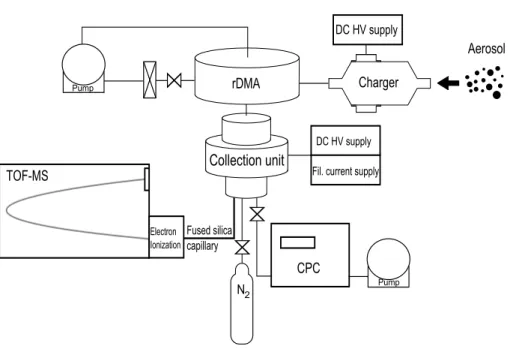
The general setup for aerosol collection and desorption of our Chemical Analyzer for Charged Ultrafine Particles (CAChUP) is similar to the TDCIMS. A size-segregated 25
AMTD
6, 3859–3882, 2013A chemical analyzer for charged ultrafine
particles
S. G. Gonser and A. Held
Title Page
Abstract Introduction
Conclusions References
Tables Figures
◭ ◮
◭ ◮
Back Close
Full Screen / Esc
Printer-friendly Version Interactive Discussion
Discussion
P
a
per
|
Dis
cussion
P
a
per
|
Discussion
P
a
per
|
Discussio
n
P
a
per
|
the charger, ambient aerosol particles are charged either by corona discharge or by
a radioactive neutralizer. The radial differential mobility analyzer (rDMA) selects
parti-cles with a defined mobility diameter, which then are collected on a high voltage biased filament in the collection unit. After the collection period, the sample is evaporated by resistive heating of the filament. The resultant gas phase is transferred via a heated 5
fused silica capillary to the TOF-MS and ionized by electron impact before mass spec-trometric analysis. Following the collection unit, the aerosol flow is measured for its particle concentration with a condensation particle counter (CPC), allowing to
deter-mine the collection efficiency as well as to estimate the collected particle mass. The
individual parts of the instrument are described in more detail below. 10
2.1 Aerosol charging
For size separation in an rDMA and electrostatic precipitation, aerosol particles have
to be electrically charged. Efficient charging of the aerosol is crucial for the overall
per-formance of the mass spectrometer. Due to the small mass of individual nucleation mode particles it is necessary to charge as many particles as possible, in order to 15
collect a sample mass sufficiently large for reliable analysis in the TOF-MS. This
de-pends both on the charging efficiency of the aerosol charger as well as the collection
efficiency of the collection filament. Two charging methods have been used with our
in-strument, i.e. corona discharge based diffusion charging and bipolar diffusion charging
with a radioactive source (Kr-85). 20
A corona discharge ionizes the molecules of the carrier gas (ambient air in our case), and these ions pass their charges to the aerosol particles by collision. Corona dis-charge is generated by applying a high voltage to a conductor with a highly curved surface (e.g. a thin wire or the tip of a needle). The intensity of the corona depends solely on the strength of the resulting electric field in the immediate vicinity of the con-25
AMTD
6, 3859–3882, 2013A chemical analyzer for charged ultrafine
particles
S. G. Gonser and A. Held
Title Page
Abstract Introduction
Conclusions References
Tables Figures
◭ ◮
◭ ◮
Back Close
Full Screen / Esc
Printer-friendly Version Interactive Discussion
Discussion
P
a
per
|
Dis
cussion
P
a
per
|
Discussion
P
a
per
|
Discussio
n
P
a
per
|
(Chen and Davidson, 2002; Han et al., 2008). To avoid the chemical alteration of the aerosol sample through oxidation by ozone, ozone production has to be prevented or kept as low as possible. The design of our charger is based on the development by
Han et al. (2008). In order to produce an efficient corona with a negligible production of
ozone, the charger is equipped with two carbon fiber bundles, with about 100 fibers per 5
bundle and a fiber diameter of about 25 µm, instead of a corona needle. The thin fiber diameter and the large number of fibers comprised in the bundle allows the production
of sufficient ions for charging aerosol particles in environmentally relevant
concentra-tions, while still applying relatively low voltages of 2 kV, thus minimizing the production of ozone. The production of ozone was measured in the laboratory and showed mixing 10
ratios below 1 ppb which is the detection limit of the used ozone monitor (Model 49i, Thermo Scientific, Franklin, MA, USA). A positive DC voltage of 2 kV is applied to the carbon fiber bundles resulting in the production of positive air ions. The aerosol sample is introduced into the charging volume with a flow rate of 1 SLM (standard liter per minute), and the air ions transfer their charges to the particles by collision. The charg-15
ing efficiency depends strongly on aerosol particle concentration, ion concentration and
residence time of the aerosol sample in the charging region. For particle concentrations
of about 104cm−3and below, and a residence time of 4 s, our corona charger showed
an extrinsic charging efficiency of 20 to 30 % for 10 and 20 nm particles, respectively
(cf. Figure 2). The extrinsic charging efficiency is defined as the number of charged
par-20
ticles exiting the charger divided by the total number of particles entering the charger. A known problem for unipolar charging is the occurrence of multiply charged particles. A doubly charged particle exhibits a larger diameter than the singly charged particle of the same electrical mobility. Hence, both sizes will be selected in the rDMA, and the collected aerosol sample will be contaminated by the larger doubly charged parti-25
AMTD
6, 3859–3882, 2013A chemical analyzer for charged ultrafine
particles
S. G. Gonser and A. Held
Title Page
Abstract Introduction
Conclusions References
Tables Figures
◭ ◮
◭ ◮
Back Close
Full Screen / Esc
Printer-friendly Version Interactive Discussion
Discussion
P
a
per
|
Dis
cussion
P
a
per
|
Discussion
P
a
per
|
Discussio
n
P
a
per
|
the charger. Alternatively, a radioactive bipolar diffusion charger (Kr-85) can be used
to minimize multiple charging of aerosol particles. According to Wiedensohler (1988), particles smaller than 30 nm in diameter exhibit less than 0.1 % double charges in the bipolar charge equilibrium state. However, the radioactive charging results in much
lower charging efficiencies than our unipolar design (cf. Fig. 2). For characterization
5
experiments in the laboratory, the radioactive bipolar charger was used with sufficiently
high particle concentrations produced in the flow tube and minimized production of doubly charged particles.
2.2 Aerosol size separation
Size separation of the aerosol particles was performed with a custom built radial diff
er-10
ential mobility analyzer (rDMA). The rDMA design is adapted from Zhang et al. (1995) and Zhang and Flagan (1996) and optimized to separate particles in the size range 1–100 nm. In principle, the layout of an rDMA is similar to a plate capacitor composed of two separated circular electrodes with central outlets. A voltage is applied to one electrode while the other electrode is grounded, resulting in the formation of a uniform 15
electric field. The charged aerosol particles enter the space between the electrodes from an annular gap at the outer edges with the flow directed radially towards the cen-ter, where the sample is extracted at the outlet of the grounded electrode. When an electric field is applied between the electrodes, the charged particles follow distinct trajectories depending on their electrical mobility and the field strength. Thus, the ap-20
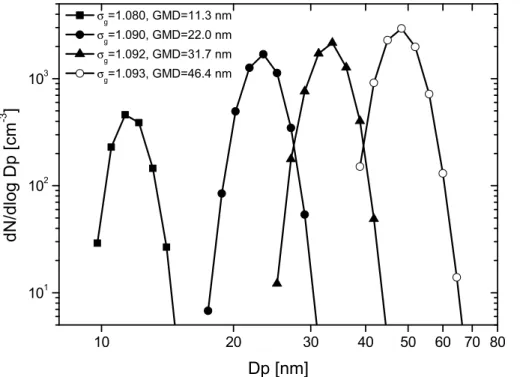
plication of a specific electric field strength will result in the selection of particles with a distinct mobility diameter. The spacing of the two electrodes is 9 mm while the ra-dius between the annular aerosol inlet and the central outlet is 30 mm. Flows in the rDMA were set to a sheath flow of 4 SLM and an aerosol flow of 1 SLM. Figure 3 shows the performance of the rDMA in laboratory experiments, by coupling the rDMA 25
AMTD
6, 3859–3882, 2013A chemical analyzer for charged ultrafine
particles
S. G. Gonser and A. Held
Title Page
Abstract Introduction
Conclusions References
Tables Figures
◭ ◮
◭ ◮
Back Close
Full Screen / Esc
Printer-friendly Version Interactive Discussion
Discussion
P
a
per
|
Dis
cussion
P
a
per
|
Discussion
P
a
per
|
Discussio
n
P
a
per
|
in a size range from 10 to 800 nm. As a result, the custom-built rDMA is capable of separating quasi monodisperse aerosol samples with a geometric standard deviation of about 1.09 in the relevant diameter range from 10 to 50 nm from ambient aerosol samples.
2.3 Aerosol collection and desorption 5
Exiting the rDMA, the size-segregated charged particles are introduced into the collec-tion and desorpcollec-tion unit. Particles are collected on a high voltage (3–5 kV) biased NiCr filament. The circular design (see Fig. 4 for details) can be divided into two distinct re-gions, i.e. (1) the collection region and (2) the desorption region. The collection region is composed of a collection tube (3) containing a movable PEEK (polyetheretherke-10
tone) piston (4) with the collection filament attached to its top (5). The collection tube is enclosed in a cylindrical housing. The sample flow with the charged particles is intro-duced between the collection tube and the housing via an annular gap (6) and extracted above (9). Due to the electric field originating from the collection filament, charged par-ticles are directed towards the filament. For protection of the collected sample from 15
contamination with gaseous constituents of the sample flow, the collection tube is per-manently flushed with molecular nitrogen (7). A second nitrogen flow is introduced through an annular gap above (8), protecting the desorption region from contamina-tion. The sample flow rate is set to 1 SLM while the collection region flushing flow rate (7) is set to 1.3 SLM, assuring that both flows have the same velocity at the upper edge 20
of the collection tube. Both nitrogen flows and the sample flow are extracted through another annular gap (9) located above the collection tube. During collection the filament
is positioned below the upper edge of the collection tube. The collection efficiency for
25 nm particles is greater than 95 % for 5 kV applied to the filament and the mentioned flow rates. After collection, the PEEK piston is moved by means of a linear actuator 25
towards the desorption region (2). The desorption chamber is a conical cavity made
of aluminum with a volume of 0.4 cm3. The angles of the desorption chamber walls
AMTD
6, 3859–3882, 2013A chemical analyzer for charged ultrafine
particles
S. G. Gonser and A. Held
Title Page
Abstract Introduction
Conclusions References
Tables Figures
◭ ◮
◭ ◮
Back Close
Full Screen / Esc
Printer-friendly Version Interactive Discussion
Discussion
P
a
per
|
Dis
cussion
P
a
per
|
Discussion
P
a
per
|
Discussio
n
P
a
per
|
once the PEEK piston is pushed into the desorption position. Resistive heating of the collection filament allows temperature controlled evaporation of the sample. In order to avoid condensational losses of the evaporated particles to the desorption chamber the
walls can be heated to up to 200◦C. Finally, a heated deactivated fused silica capillary
is connected to the upper part of the desorption region (10). 5
2.4 Time-of-flight mass spectrometer
The fused silica capillary with an inner diameter of 25 µm transfers the desorbed gas sample to the TOF-MS. The capillary fulfills the tasks of transferring the sample directly to the ionization region in the TOF-MS as well as ensuring the necessary pressure drop
from atmospheric pressure to the MS operating pressure of less than 1×10⁻⁶mbar.
10
The mass spectrometer is a compact time-of-flight mass spectrometer (CTOF, Tofwerk AG, Thun, Switzerland). The compact, field portable design yields a nominal mass re-solving power of 800 Th and a mass accuracy of better than 100 ppm. Standard 70 eV electron ionization is applied resulting in fragmentation of the analytes. The fragmenta-tion patterns are well known for many molecules, hence allowing a chemical interpre-15
tation of the mass spectra to a certain degree (Allan et al., 2004). Thus, the ionization
method is a trade-offbetween high ionization efficiency and accurate compound
identi-fication. To enhance the potential for molecular identification, this CTOF is ready to be equipped with a soft photo ionization method in future studies. The mass spectrometer has a time resolution of 20 kHz, and typically one second averages are written to hi-20
erarchical data format files (HDF5). Data analysis is performed with the Matlab based toolbox tofTools, developed by H. Junninen (University of Helsinki).
2.5 Experimental characterization
To infer the detection performance of the mass spectrometer, a dilution series of an in-dividual organic compound was measured. For this purpose, 1 µL of camphene-ethanol 25
AMTD
6, 3859–3882, 2013A chemical analyzer for charged ultrafine
particles
S. G. Gonser and A. Held
Title Page
Abstract Introduction
Conclusions References
Tables Figures
◭ ◮
◭ ◮
Back Close
Full Screen / Esc
Printer-friendly Version Interactive Discussion
Discussion
P
a
per
|
Dis
cussion
P
a
per
|
Discussion
P
a
per
|
Discussio
n
P
a
per
|
by means of a 5 µL syringe. After application, the filament was moved to the heated
desorption region (80◦C) to desorb the sample for analysis in the TOF-MS. Being
a monoterpene, camphene (C10H16) represents one of the presumed major compound
groups contributing to the growth of secondary particles. Its suitability for the dilution series is given by its solubility in ethanol and its solid state up to temperatures of about 5
51◦C, hence allowing its application to the filament without a significant loss of
mate-rial prior to the desorption. The sum of the integrated peak areas of the major electron
ionization fragments (m/z 93, 121 and 136) of camphene were used to obtain a robust
signal from the mass spectrometer.
For further test and characterization purposes, laboratory generated secondary or-10
ganic aerosol (SOA) was collected, desorbed and analyzed with CAChUP. SOA was
produced with a laminar flow reactor (Reynolds numberRe=125) for dark ozonolysis
of alpha-pinene similar to Tolocka et al. (2006). The flow reactor consists of a glass tube with a length of 9 cm and a diameter of 1.2 cm. The total volume of the reactor is
10 cm3. The volume flow rate through the flow reactor was set to 1.1 SLM resulting in
15
a residence time of about 0.5 s. Alpha-pinene was introduced into the tube by passing a filtered zero air flow of 0.045 SLM over liquid alpha-pinene in a 100 mL flask. Ozone was generated by exposing a particle free airflow of 0.85 SLM to UV radiation produced by a Pen-Ray lamp. The ozone was introduced together with filtered air at a flow rate of 0.2 SLM. The alpha-pinene flow was introduced separately via a glass tubing in the 20
center axis of the flow tube. The concentration of alpha-pinene in the tube was about
250 ppm, assuming saturation in the alpha-pinene flow at room temperature (25◦C)
and accounting for the dilution with the other two flows. This value can be seen as an upper concentration limit since saturation was most likely not achieved. The ozone mixing ratio was 13 ppm in the absence of alpha-pinene in the reactor measured using 25
AMTD
6, 3859–3882, 2013A chemical analyzer for charged ultrafine
particles
S. G. Gonser and A. Held
Title Page
Abstract Introduction
Conclusions References
Tables Figures
◭ ◮
◭ ◮
Back Close
Full Screen / Esc
Printer-friendly Version Interactive Discussion
Discussion
P
a
per
|
Dis
cussion
P
a
per
|
Discussion
P
a
per
|
Discussio
n
P
a
per
|
by an activated charcoal denuder, installed between the flow tube and our instrument. The flow reactor setup resulted in a narrow particle size distribution with a mean diam-eter of 31 nm and a geometric standard deviation of 1.33.
3 Results and discussion
The instrument’s detection performance for monoterpenes was deduced from a series 5
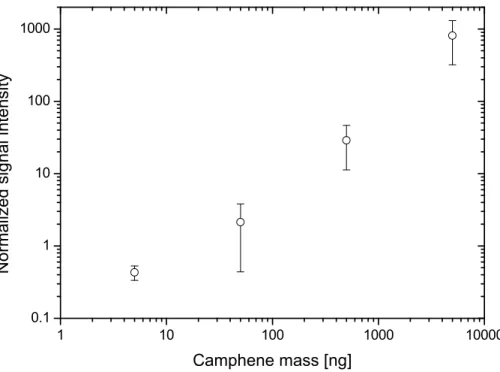
of camphene–ethanol solutions of different concentrations, as described above. From
Fig. 5, a linear relation between the applied mass and the mass spectrometers signal intensity is evident. Shown is the normalized signal intensity of the sum of three
elec-tron ionization fragments of camphene (m/z 93, 121 and 136). Evaporation of a 1 µL
droplet in the desorption chamber resulted in a considerable pressure increase in the 10
mass spectrometer. This effect resulted in a sudden increase of the overall mass
spec-trometer’s signal intensity. Therefore, a normalization of the data was performed by
dividing the unit mass resolution sticks by the peak area of m/z 207, being a typical
contamination signal from silicone and of constant intensity throughout all measure-ments. Also shown in Fig. 5 are the standard deviations of the MS signal intensities. 15
During the experiment pure ethanol as well as camphene masses of 0.5, 5, 50, 500 and 5000 ng were applied to the filament. Both pure ethanol and the solution with 0.5 ng camphene resulted in no clear signal from the TOF-MS. Figure 5 shows that a sample of 5 ng of camphene yields a clear and quantitative signal. Thus, the detection limit for camphene is taken to be between 0.5 and 5 ng with the present setup.
20
In flow reactor experiments, aerosol particles with a diameter of 25 nm were collected for time periods of 30 min, 1 and 2 h, and desorbed from the NiCr filament. During col-lection the filament was permanently flushed with nitrogen, minimizing the colcol-lection of gas-phase compounds. Also, interactions of the collected sample with oxidants like ozone were prevented. Following the collection, the nitrogen flow was increased in 25
AMTD
6, 3859–3882, 2013A chemical analyzer for charged ultrafine
particles
S. G. Gonser and A. Held
Title Page
Abstract Introduction
Conclusions References
Tables Figures
◭ ◮
◭ ◮
Back Close
Full Screen / Esc
Printer-friendly Version Interactive Discussion
Discussion
P
a
per
|
Dis
cussion
P
a
per
|
Discussion
P
a
per
|
Discussio
n
P
a
per
|
position, the desorption chamber was heated up to 150◦C. Only then the NiCr filament
was heated gradually to its final temperature of about 800◦C.
Despite the activated charcoal denuder and the nitrogen purge flows, peaks of gas-phase organics were observed in the mass spectra. To prevent misinterpretation of the signal, a correction for potential gas-phase contamination is necessary. For this pur-5
pose, a blank measurement was performed, sampling the air without a high voltage applied to the collection filament, hence not collecting any particles. This correction is only possible if the adsorption of the gas-phase is similar during collection and blank measurement. This assumption is considered valid if the flow rates, temperatures and the duration of collection and desorption are kept constant for the regular and the blank 10
measurement. To account for temporal variations of the pressure in the mass
spectrom-eter, the mass spectra were normalized. For normalization, the peak atm/z207 was
chosen as the basis, being a signal from silicone and of constant intensity throughout all measurements.
Figure 6 shows mass spectra of three collection cycles with flow tube generated par-15
ticles with a diameter of 25 nm. During all three experiments, the basic conditions in the flow tube, the rDMA and the collection unit were kept constant. Only the collection time was varied between 0.5, 1 and 2 h. For all three measurements, corresponding blank measurements were carried out. The presented mass spectra are consistent with pub-lished studies on laboratory generated particles from ozonolysis of alpha-pinene (e.g. 20
Chhabra et al., 2010; Shilling et al., 2009). For the three different collection periods,
the signal intensities increase with longer collection times while the ratios of the rela-tive peak areas of the major peaks remain constant over the experiments. The major
peaks in Fig. 6 are thought to be fragments of oxidized organics like C2H3O+ form/z
43, CO+2 form/z 44 and C3H3O+/C4H+7 form/z 55 (Chhabra et al., 2010; Shilling et al.,
25
2009). Further prominent peaks are thought to be the non-oxidized ionization
frag-ments C5H+5, C6H+5, C6H+7 and C7H+7 form/z 65, 77, 79, and 91, respectively (based
AMTD
6, 3859–3882, 2013A chemical analyzer for charged ultrafine
particles
S. G. Gonser and A. Held
Title Page
Abstract Introduction
Conclusions References
Tables Figures
◭ ◮
◭ ◮
Back Close
Full Screen / Esc
Printer-friendly Version Interactive Discussion
Discussion
P
a
per
|
Dis
cussion
P
a
per
|
Discussion
P
a
per
|
Discussio
n
P
a
per
|
times, and thus, more collected aerosol mass. Overall, the collection experiments show a good performance of our instrument in flow tube experiments with no restriction in the collection times and the use of a radioactive neutralizer, avoiding multiply charged particles in the sample. In principle, CAChUP is ready for use in smog chamber ex-periments on the formation of SOA, either triggered by dark ozonolysis or photochem-5
ical reactions. Crucial for such experiments is the ability to produce particle formation events with growth rates close to natural rates. If the growth rates are too high particles
of a distinct diameter will not be present for a time period sufficient for collecting the
necessary aerosol mass.
As described above the detection limit of CAChUP for the dilution series of cam-10
phene is between 0.5 and 5 ng. The detection performance of CAChUP during the flow tube experiments can only be determined roughly because the collected particle mass has to be estimated from particle concentration measurements with a CPC, attached downstream of the exhaust of the collection unit. Concentrations measured are to be regarded with care due to particle losses at the collection unit’s exhaust and dilution 15
with the nitrogen flows. The collection efficiency was estimated by calculating the
con-centration ratio between periods with a voltage applied to the collection filament and periods with no voltage applied. For particles with a diameter of 25 nm and 5 kV applied
to the filament, the collection efficiency was better than 95 %. Applying the collection
efficiency together with an assumed particle density of 1.25 g cm−3 (average estimate
20
of the density from Bahreini et al., 2005; Kostenidou et al., 2007) and knowing the par-ticle size and concentration as well as the aerosol volume flow through the collection unit, an estimate of the collected mass was obtained. For the three performed experi-ments, rough estimates of the collected masses were in the range of 7, 34 and 90 ng for the 0.5, 1 and 2 h experiments, respectively. Since collection times below 0.5 h did 25
AMTD
6, 3859–3882, 2013A chemical analyzer for charged ultrafine
particles
S. G. Gonser and A. Held
Title Page
Abstract Introduction
Conclusions References
Tables Figures
◭ ◮
◭ ◮
Back Close
Full Screen / Esc
Printer-friendly Version Interactive Discussion
Discussion
P
a
per
|
Dis
cussion
P
a
per
|
Discussion
P
a
per
|
Discussio
n
P
a
per
|
>20 nm but relatively short collection periods, or particles<20 nm with collection
pe-riods of several hours.
4 Conclusions and outlook
We have developed an aerosol mass spectrometer for the chemical analysis of parti-cles with diameters below 30 nm, extending the diameter range of commercially avail-5
able instruments into the nucleation mode. The instrument collects a charged and sized particle sample on a metal filament. After collection the filament is resistively heated and the resulting gas phase is analyzed for its molecular composition in an electron ion-ization time of flight mass spectrometer. The functionality of the instrument has been validated in laboratory measurements by means of secondary organic particles pro-10
duced from dark ozonolysis of alpha-pinene in a laminar flow tube, and by the direct application of known masses of camphene to the NiCr filament. Considering the re-sults of these experiments, an application of CAChUP in the field seems to be feasible. For example, during nucleation events at the “Waldstein” ecosystem research site in the Fichtelgebirge mountain range, NE Bavaria, Germany, particle concentrations with 15
up to 120 000 cm−3 were detected. During such events the concentration of particles
with a diameter of 20 nm was found to be up to 4000 cm−3. Periods with elevated 20 nm
particle concentrations (>1000 cm−3) prevailed for about 3 h. Considering the charging
efficiency of our unipolar charger, particle losses in the rDMA and the collection unit
as well as the collection efficiency onto the NiCr filament, collected masses for 20 nm
20
particles are expected to be in the order of 1 to 7 ng, thus being within the estimated detection limit.
The performance of CAChUP is promising both for laboratory experiments and also for field measurements. Nevertheless, several improvements will further enhance the performance of the instrument. The unipolar charger is working, yet multiply charged 25
particles have still to be avoided. With the present setup, this requires the use of
AMTD
6, 3859–3882, 2013A chemical analyzer for charged ultrafine
particles
S. G. Gonser and A. Held
Title Page
Abstract Introduction
Conclusions References
Tables Figures
◭ ◮
◭ ◮
Back Close
Full Screen / Esc
Printer-friendly Version Interactive Discussion
Discussion
P
a
per
|
Dis
cussion
P
a
per
|
Discussion
P
a
per
|
Discussio
n
P
a
per
|
be avoided by charging the particles in a bipolar environment, although the charging
efficiency will be small. In the past few years major advances towards bipolar corona
discharge chargers have been accomplished (e.g. Stommel and Riebel, 2004). Further enhancement of the charged particle fraction could be accomplished by parallel use of multiple bipolar chargers coupled to an electrostatic focusing device, focusing one po-5
larity of charged particles to its centre while extracting the excess air at its periphery. By this way the concentration of charged particles could be enhanced significantly while
keeping the same flow rate and collection efficiency in the collection unit. Finally, the
flow regime inside of the collection and desorption unit should be improved. Despite the permanent flushing of the NiCr filament and the desorption region, contaminations 10
during the flow tube experiments could not be avoided completely, making it necessary to perform a blank measurement for every measurement conducted. As laboratory generated secondary organic particles will always be associated with a huge fraction of precursor molecules in the gas phase, the necessity of protecting the device from contaminations is crucial. To tackle this issue the collection unit must be optimized to-15
wards a flow regime with minimal turbulence, hence less penetration of the gas phase onto the NiCr filament and into the desorption region. However, precursor gas phase contaminations are expected to be significantly smaller in the field than in our flow tube experiments.
CAChUP is now ready to be used both in laboratory and field experiments, and the 20
described improvements will be implemented step by step for enhanced performance in future measurement campaigns.
Acknowledgements. This work was supported by the German Research Foundation (DFG grant HE5214/3-1). We acknowledge for construction and technical support Thomas Braun, Klaus Burger, Andrej Einhorn, Stefan Feulner, Michael Groll and Heinz Krejtschi. For help and 25
AMTD
6, 3859–3882, 2013A chemical analyzer for charged ultrafine
particles
S. G. Gonser and A. Held
Title Page
Abstract Introduction
Conclusions References
Tables Figures
◭ ◮
◭ ◮
Back Close
Full Screen / Esc
Printer-friendly Version Interactive Discussion
Discussion
P
a
per
|
Dis
cussion
P
a
per
|
Discussion
P
a
per
|
Discussio
n
P
a
per
|
References
Allan, J. D., Delia, A. E., Coe, H., Bower, K. N., Alfarra, M. R., Jimenez, J. L., Middlebrook, A. M., Drewnick, F., Onasch, T. B., Canagaratna, M. R., Jayne, J. T., and Worsnop, D. R: A gener-alised method for the extraction of chemically resolved mass spectra from Aerodyne aerosol mass spectrometer data, J. Aerosol Sci., 35, 909–922, 2004.
5
Bahreini, R., Keywood, M. D., Ng, N. L., Varutbangkul, V., Gao, S., Flagan, R. C., Seinfeld, J. H., Worsnop, D. R., and Jimenez, J. L.: Measurement of secondary organic aerosol from oxida-tion of cycloalkenes, terpenes, and m-xylene using an Aerodyne aerosol mass spectrometer, Environ. Sci. Technol., 39, 5674–5688, 2005.
Barsanti, K. C., McMurry, P. H., and Smith, J. N.: The potential contribution of organic salts 10
to new particle growth, Atmos. Chem. Phys., 9, 2949–2957, doi:10.5194/acp-9-2949-2009, 2009.
Chen, J. and Davidson, J. H.: Ozone production in the positive DC corona discharge: model and comparison to experiments, Plasma Chem. Plasma P., 22, 495–522, 2002.
Chhabra, P. S., Flagan, R. C., and Seinfeld, J. H.: Elemental analysis of chamber organic 15
aerosol using an aerodyne high-resolution aerosol mass spectrometer, Atmos. Chem. Phys., 10, 4111–4131, doi:10.5194/acp-10-4111-2010, 2010.
Delfino, R. J., Sioutas, C., and Malik, S.: Potential role of ultrafine particles in associations between airborne particle mass and cardiovascular health, Environ. Health Persp., 113, 934– 946, 2005.
20
Forster, P., Ramaswamy, V., Artaxo, P., Berntsen, T., Betts, R., Fahey, D. W., Haywood, J., Lean, J., Lowe, D. C., Myhre, G., Nganga, J., Prinn, R., Raga, G., Schulz, M., and Dor-land, R. V.: Changes in atmospheric constituents and in radiative forcing, in: Climate Change 2007: The Physical Science Basis, Contribution of Working Group I to the Fourth Assess-ment Report of the IntergovernAssess-mental Panel on Climate Change, edited by: Miller, H. L., 25
Cambridge University Press, Cambridge, UK and New York, NY, USA, 129–234, 2007. Han, B., Kim, H.-J., Kim, Y.-J., and Sioutas, C.: Unipolar charging of fine and ultra-fine particles
using carbon fiber ionizers, Aerosol Sci. Tech., 42, 793–800, 2008.
Held, A., Nowak, A., Birmili, W., Wiedensohler, A., Forkel, R., and Klemm, O.: Observations of particle formation and growth in a mountainous forest region in central Europe, J. Geophys. 30
AMTD
6, 3859–3882, 2013A chemical analyzer for charged ultrafine
particles
S. G. Gonser and A. Held
Title Page
Abstract Introduction
Conclusions References
Tables Figures
◭ ◮
◭ ◮
Back Close
Full Screen / Esc
Printer-friendly Version Interactive Discussion
Discussion
P
a
per
|
Dis
cussion
P
a
per
|
Discussion
P
a
per
|
Discussio
n
P
a
per
|
Held, A., Rathbone, G. J., and Smith, J. N.: A thermal desorption chemical ionization ion trap mass spectrometer for the chemical characterization of ultrafine aerosol particles, Aerosol Sci. Tech., 43, 264–272, 2009.
Kostenidou, E., Pathak, R. K., and Pandis, S. N.: An algorithm for the calculation of secondary organic aerosol density combining AMS and SMPS data, Aerosol Sci. Tech., 41, 1002–1010, 5
2007.
Kulmala, M., Vehkam ¨aki, H., Pet ¨aj ¨a, T., Dal Maso, M., Lauri, A., Kerminen, V.-M., Birmili, W., and McMurry, P. H.: Formation and growth rates of ultrafine atmospheric particles: a review of observations, J. Aerosol Sci., 35, 143–176, 2004.
Laaksonen, A., Kulmala, M., O’Dowd, C. D., Joutsensaari, J., Vaattovaara, P., Mikkonen, S., 10
Lehtinen, K. E. J., Sogacheva, L., Dal Maso, M., Aalto, P., Pet ¨aj ¨a, T., Sogachev, A., Yoon, Y. J., Lihavainen, H., Nilsson, D., Facchini, M. C., Cavalli, F., Fuzzi, S., Hoffmann, T., Arnold, F., Hanke, M., Sellegri, K., Umann, B., Junkermann, W., Coe, H., Allan, J. D., Alfarra, M. R., Worsnop, D. R., Riekkola, M.-L., Hy ¨otyl ¨ainen, T., and Viisanen, Y.: The role of VOC oxi-dation products in continental new particle formation, Atmos. Chem. Phys., 8, 2657–2665, 15
doi:10.5194/acp-8-2657-2008, 2008.
Riipinen, I., Manninen, H. E., Yli-Juuti, T., Boy, M., Sipil ¨a, M., Ehn, M., Junninen, H., Pet ¨aj ¨a, T., and Kulmala, M.: Applying the Condensation Particle Counter Battery (CPCB) to study the water-affinity of freshly-formed 2–9 nm particles in boreal forest, Atmos. Chem. Phys., 9, 3317–3330, doi:10.5194/acp-9-3317-2009, 2009.
20
Shilling, J. E., Chen, Q., King, S. M., Rosenoern, T., Kroll, J. H., Worsnop, D. R., DeCarlo, P. F., Aiken, A. C., Sueper, D., Jimenez, J. L., and Martin, S. T.: Loading-dependent elemental composition ofα-pinene SOA particles, Atmos. Chem. Phys., 9, 771–782, doi:10.5194/acp-9-771-2009, 2009.
Smith, J. N., Moore, K. F., McMurry, P. H., and Eisele, F. L.: Atmospheric measurements of 25
sub-20 nm diameter particle chemical composition by thermal desorption chemical ionization mass spectrometry, Aerosol Sci. Tech., 38, 100–110, 2004.
Smith, J. N., Barsanti, K. C., Friedli, H. R., Ehn, M., Kulmala, M., Collins, D. R., Scheck-man, J. H., Williams, B. J., and McMurry, P. H.: Observations of aminium salts in atmospheric nanoparticles and possible climatic implications, P. Natl. Acad. Sci. USA, 107, 6634–6639, 30
AMTD
6, 3859–3882, 2013A chemical analyzer for charged ultrafine
particles
S. G. Gonser and A. Held
Title Page
Abstract Introduction
Conclusions References
Tables Figures
◭ ◮
◭ ◮
Back Close
Full Screen / Esc
Printer-friendly Version Interactive Discussion
Discussion
P
a
per
|
Dis
cussion
P
a
per
|
Discussion
P
a
per
|
Discussio
n
P
a
per
|
Stieb, D. M., Judek, S., and Burnett, R. T.: Meta-analysis of time-series studies of air pollution and mortality: effects of gases and particles and the influence of cause of death, age, and season, JAPCA J. Air Waste Manage., 52, 470–484, 2002.
Stommel, Y. and Riebel, U.: A new corona discharge-based aerosol charger for submicron particles with low initial charge, J. Aerosol Sci., 35, 1051–1069, 2004.
5
Tolocka, M. P., Heaton, K. J., Dreyfus, M. A., Wang, S., Zordan, C. A., Saul, T. D., and John-ston, M. V.: Chemistry of particle inception and growth duringα-pinene ozonolysis, Environ. Sci. Techol., 40, 1843–1848, 2006.
Voisin, D., Smith, J. N., Sakurai, H., McMurry, P. H., and Eisele, F. L.: Thermal desorption chemical ionization mass spectrometer for ultrafine particle chemical composition, Aerosol 10
Sci. Tech., 37, 471–475, 2003.
Wang, S., Zordan, C. A., and Johnston, M. V.: Chemical characterization of individual, airborne sub-10 nm particles and molecules, Anal. Chem., 78, 1750–1754, 2006.
Wiedensohler, A.: Technical note: an approximation of the bipolar charge distribution for parti-cles in the submicron size range, J. Aerosol Sci., 19, 387–389, 1988.
15
Winkler, P. M., Ortega, J., Karl, T., Cappellin, L., Friedli, H. R., Barsanti, K., McMurry, P. H., and Smith, J. N.: Identification of biogenic compounds responsible for size-dependent nanoparti-cle growth, Geophys. Res. Lett., 39, L20815, doi:10.1029/2012GL053253, 2012.
Zhang, S.-H. and Flagan, R. C.: Resolution of the radial differential mobility analyzer for ultrafine particles, J. Aerosol Sci., 27, 1179–1200, 1996.
20
AMTD
6, 3859–3882, 2013A chemical analyzer for charged ultrafine
particles
S. G. Gonser and A. Held
Title Page
Abstract Introduction
Conclusions References
Tables Figures
◭ ◮
◭ ◮
Back Close
Full Screen / Esc
Printer-friendly Version Interactive Discussion
Discussion
P
a
per
|
Dis
cussion
P
a
per
|
Discussion
P
a
per
|
Discussio
n
P
a
per
|
DC HV supply
DC HV supply
N2
CPC TOF-MS
Electron Ionization
Charger rDMA
Collection unit
Pump Fil. current supply
Fused silica capillary
Pump
Aerosol
AMTD
6, 3859–3882, 2013A chemical analyzer for charged ultrafine
particles
S. G. Gonser and A. Held
Title Page
Abstract Introduction
Conclusions References
Tables Figures
◭ ◮
◭ ◮
Back Close
Full Screen / Esc
Printer-friendly Version Interactive Discussion
Discussion
P
a
per
|
Dis
cussion
P
a
per
|
Discussion
P
a
per
|
Discussio
n
P
a
per
|
10 20 30 40 50 60 70
103 104
dN/dlog Dp Carbon fiber
Kr 85 (Wiedensohler, 1988)
Dp [nm]
d
N
/d
lo
g
D
p
[
cm
-3 ]
0 10 20 30 40 50 60
C
h
a
rg
e
d
fr
a
ct
io
n
[%
]
AMTD
6, 3859–3882, 2013A chemical analyzer for charged ultrafine
particles
S. G. Gonser and A. Held
Title Page
Abstract Introduction
Conclusions References
Tables Figures
◭ ◮
◭ ◮
Back Close
Full Screen / Esc
Printer-friendly Version Interactive Discussion
Discussion
P
a
per
|
Dis
cussion
P
a
per
|
Discussion
P
a
per
|
Discussio
n
P
a
per
|
10 20 30 40 50 60 70 80
101
102
103
d
N
/d
lo
g
D
p
[
cm
-3 ]
Dp [nm]
σg=1.080, GMD=11.3 nm σg=1.090, GMD=22.0 nm σg=1.092, GMD=31.7 nm σg=1.093, GMD=46.4 nm
AMTD
6, 3859–3882, 2013A chemical analyzer for charged ultrafine
particles
S. G. Gonser and A. Held
Title Page
Abstract Introduction
Conclusions References
Tables Figures
◭ ◮
◭ ◮
Back Close
Full Screen / Esc
Printer-friendly Version Interactive Discussion
Discussion
P
a
per
|
Dis
cussion
P
a
per
|
Discussion
P
a
per
|
Discussio
n
P
a
per
|
1
2
3
4
5
6
7
8
10
9
AMTD
6, 3859–3882, 2013A chemical analyzer for charged ultrafine
particles
S. G. Gonser and A. Held
Title Page
Abstract Introduction
Conclusions References
Tables Figures
◭ ◮
◭ ◮
Back Close
Full Screen / Esc
Printer-friendly Version Interactive Discussion
Discussion
P
a
per
|
Dis
cussion
P
a
per
|
Discussion
P
a
per
|
Discussio
n
P
a
per
|
1 10 100 1000 10000
0.1 1 10 100 1000
N
o
rm
a
lize
d
s
ig
n
a
l
in
te
n
si
ty
Camphene mass [ng]
AMTD
6, 3859–3882, 2013A chemical analyzer for charged ultrafine
particles
S. G. Gonser and A. Held
Title Page Abstract Introduction Conclusions References Tables Figures ◭ ◮ ◭ ◮ Back Close
Full Screen / Esc
Printer-friendly Version Interactive Discussion Discussion P a per | Dis cussion P a per | Discussion P a per | Discussio n P a per |
0.5 1.0 1.5 2.0
0 20 40 60 80 100 120 0 2 4 40 60 N o rm a liz e d s ig n a l in te n s it y N o rm a liz e d s ig n a l in te n s it y 55 53 65
67 7779 91
43 44 a 0 10 20 120 150 b 55
53 6567 77
79 91
43 44
50 60 70 80 90 100 110
0 20 40 60 400 500 c 55 53
65 67 7779
91 43
44
d
Collection time [h] m/z