EFFECT OF IMPURITIES ON THE CRYSTAL GROWTH FROM
SOLUTIONS – A NEW KINETIC MODEL.
P. M. Martins, F. Rocha*
Departamento de Engenharia Química, Faculdade de Engenharia, Universidade do Porto, Rua Dr. Roberto Frias, 4200-465 Porto, Portugal
*
Tel. +351 225081678-Fax: +351 225081632 – Email: [email protected]
ABSTRACT – A new approach to the phenomena of impurity adsorption during crystal growth is presented. We consider that the adsorption of elements onto the active sites of the crystal surface is a competitive process between the solute and the impurity molecules. Based on that, a general equation relating the face growth rates with the supersaturation and the impurity concentration is derived. The main experimental evidences known from the literature on crystal growth kinetics in the presence of impurities are used to test the proposed model. So far, we conclude that the theoretical statements of the competitive adsorption model are generally in agreement with the experimental facts.
KEYWORDS: crystal growth; impurity effect; competitive adsorption.
1.INTRODUCTION
The occupation by impurities of the preferential places for the incorporation of solute onto the crystal lattice (active sites) is known to have a strong effect on the growth of the crystal. Small quantities of specific impurities can suppress the growth, while others, being crystallographic face-selective, can be used as habit modifiers.
Cabrera and Vermilyea (1958) introduced the pinning mechanism to explain the action of the impurities on the displacement of the faces. They state that, when the impurities are adsorbed at actives sites, the flow of the steps at crystal surface is hindered. The impact of the impurity on the velocity of the step is assumed to be directly connected with the provoked decrease on the radius of curvature (r) relatively to the critical radius of curvature (rc) for the pure system:
r r v vr c − = 1 0 (1)
Calling “l” to the average spacing between neighboring impurities, the velocity of the step will reach the minimum when the radius of curvatures is l/2, 2 1 0 min l r v v c − = (2)
Originally Cabrera and Vermilyea (1958) considered the average advancement velocity v as the geometric mean between v0 and vmin.
More recently, Kubota and Mullin (1995) proposed the use of an arithmetic mean of these velocities to describe v:
2 min 0 v v
v= + (3)
Combining Equation 2 and 3 gives
l r v v = 1− c 0 (4)
The fraction of the active sites covered with impurities can be approximated to the ratio of the average distance between active sites to the average distance between neighboring adsorbed impurities:
l L =
θ (5)
In addition, according to the definition of critical radius of the two-dimensional nucleus given by Burton et al. (1951),
σ γ
kT a
rc = (6)
Therefore, Equation 4 can be written as,
θ σ γ L kT a v v − = 1 0 (7)
From this equation one can expect that the action of a given impurity on the velocity of the steps is a function of:
a) The coverage of active sites (θ), which is described by an adsorption isotherm. Commonly it is adopted a conventional Langmuir isotherm, defined as
1 + = i Kc Kc θ i (8)
although, Temkin isotherms (Sangwal, 1999) and Freundlich isotherms (Sangwal and Mielniczek-Brzoska, 2002) were also studied.
b) The supersaturation-dependent factor α, defined as L kT a σ γ α = (9)
Kubota and Mullin (1995) called to this parameter “impurity effectiveness factor”. Equation 7 can now be rewritten in the form
αθ − = 1 v v 0 (10)
This theory has been confronted with experimental kinetic data in several studies on the influence of supersaturation, impurity type and its concentration on crystal growth kinetics. The behavior of an impurity can be described by the values of α and K, estimated by fitting the equations of the model to v/v0 vs. ci or v/v0
vs. σ data. Alternatively, adsorption isotherms can be determined separately from the kinetic research and then, the values of α corresponding to measured values of v/v0 can
be calculated using Equation 10 (Kubota et al., 2000). Currently, there is a great interest on this particular field of the crystallization but the existing theories are not yet capable to answer all questions (Kubota et al. 2003). The new model presented in this paper is expected to be a contribution for a better understanding of the unclear issues.
2.COMPETITIVE ADSORPTION
MODEL
The following steps can occur when an impurity molecule diffusing from solution, reaches the surface of a growing crystal (Sangwal, 1999):
Step 1: Surface adsorption.
Step 2: Surface diffusion of the adsorbed impurity molecule.
Step 3: Adsorption of the impurity at active sites.
Each of the mentioned steps has an associated thermodynamic energy change, whose relative values determine if and how adsorption occurs. The coverage of the active sites by an impurity,
θl, will be proportional to the correspondent
surface coverage, θs:
s
l βθ
θ = (11)
The value of β here introduced, will take higher values when the second and third steps are thermodynamically favored relatively to the first step. On the contrary, in the case of favorable surface adsorption and low mobility of the adsorbed molecules, it is expected that β will tend to small positive values. Assuming a Langmuir type isotherm, it can be showed for a competitive adsorption that:
σ θ K c K c Ki i s + + = 1 i i σ (12)
The occupation of active sites by impurities implies a proportional decrease of elements of solute integrating the crystal lattice per time unit, i.e. l v v = 1−θ 0 (13)
Using Equations 11, 12 and 13 becomes,
σ β σ K c K c K v v i i i i + + − = 1 1 0 (14)
New ideas about the role of the most important variables on crystallization in the
presence of impurities (impurity concentration, supersaturation, temperature, etc.) are introduced with Equation 14. The main experimental knowledge taken from literature will now be analyzed in the light of the new model, emphasizing the differences and common aspects to existing theories.
3.ANALYSIS OF LITERATURE
DATA AND DISCUSSION
Typical experimental data on crystal growth in the presence of impurities will now be analysed and compared with the theoretical predictions of the competitive adsorption model. It will be focused the influence of supersaturation and impurity concentration on the relative growth rate.
3.1Dependence of v/v
0on σ, at
Constant c
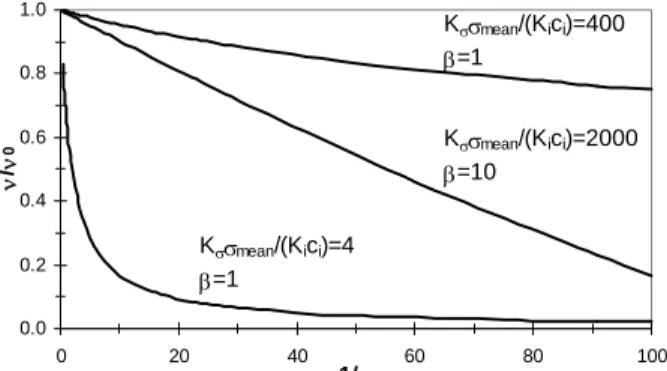
iFigure 1 represents the influence of the reciprocal of the supersaturation on the relative step velocity, according Equation 14.
0.0 0.2 0.4 0.6 0.8 1.0 0 20 40 60 80 10 1/σ ν / ν 0 Kσσmean/(Kici)=400 β=1 Kσσmean/(Kici)=2000 β=10 Kσσmean/(Kici)=4 β=1 0
Figure 1 – Theoretical relationship between the relative step advancement and the reciprocal of the supersaturation for different combinations of the parameters Kσσmean/(Kici) and β; σmean is
the mean value of σ, evaluated for the considered range of supersaturations.
High values of Kσσmean/(Kici), mean a linear
behavior is reported in literature by the works of Kubota et al. (1999) and Kubota (2001). Sometimes, the dispersion of the experimental data or the insufficient number of points does not allow being conclusive about this linearity. In the works of Albon and Dunning (1962) and Kubota et al. (2000) a curvature on the representation of v/v0 vs. σ-1 is admissible.
According to the competitive adsorption model this situation could roughly correspond to the case of Figure 1, when lower values of Kσσmean/(Kici) are used. The models of
Kubota-Mullin and Cabrera-Vermilyea do not admit this variation from linearity – See Equation 7. This happens because, according to the models, the effect of supersaturation is exclusively focused on the critical radius of the two-dimensional nucleus (Equation 6), being the coverage of the active sites on the crystal surface, independent of σ (Equation 8). Although the competition between the phenomena of impurity adsorption and solute adsorption/integration is conceptually admitted (Kubota et al., 1997), the mathematical models ignore it. Such is considered a limitation of these theories (Kubota et al. 2003).
3.2Dependence of v/v
0on c
i, at
Constant σ
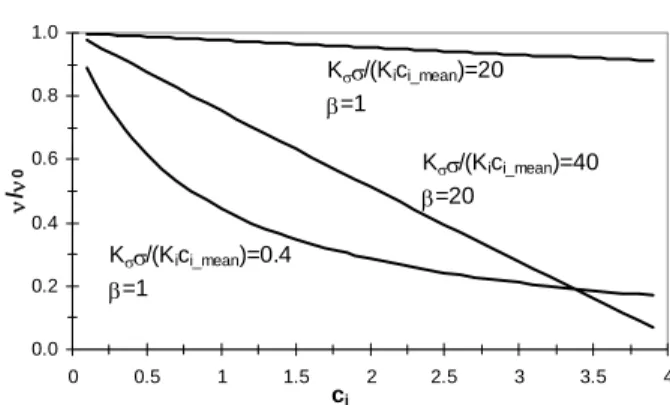
Figure 2 shows the impact of the impurity concentration on the relative step velocity. Again, the plot is based on equation 14. A linear relation of the function v/v0(ci) is
here visible, even for moderate values of Kσσ/(Kici_mean). Indeed, the experimental works
in this field frequently confirm such profile (Mielniczek-Brzoska et al., 2000; Sangwal and Mielniczek-Brzoska, 2002; Kubota et al., 1999; Kubota, 2001). The curve of Figure 2 obtained with a lower value of Kσσ/(Kici_mean) is also
found in the works of Kubota et al. (2000) and Al-Jibbouri and Ulrich (2001). In both studies, the influence of impurities on the growth kinetics of sodium chloride crystals was
investigated. The cases reported in Figure 2 are also expected by the models of Kubota-Mullin and Cabrera-Vermilyea by assuming suitable values for the adsorption isotherms constants and impurity effectiveness factor.
0.0 0.2 0.4 0.6 0.8 1.0 0 0.5 1 1.5 2 2.5 3 3.5 4 ci ν / ν 0 Kσσ/(Kici_mean)=20 β=1 Kσσ/(Kici_mean)=0.4 β=1 Kσσ/(Kici_mean)=40 β=20
Figure 2 – Theoretical relationship between the relative step advancement and impurity concentration for different combinations of the parameters Kσσ/(Kici_mean) and β; ci_mean is the
mean value of ci, evaluated for the considered
range of impurity concentrations.
In Figure 1 and 2, it is implicit the role of the β parameter. Although the langmuirian constants are not kept constant in all curves, one can infer the higher effect of an impurity when it has higher values of β. As it was presented, this is due to the mobility of the adsorbed impurity molecules, which can determine a strong tendency on occupying the active sites of the crystal.
4.CONCLUSIONS
The competitive nature of impurity adsorption during crystallization is consensual among the existing theoretical models. However, the predictions of these theories are not totally in accordance with this assumption, as it is the case of the role of the solute concentration (and supersaturation), whose effects are limited to the size of the critical radius. With the new model proposed, the
dispute between solute and impurity is emphasized in the competitive adsorption isotherm equation. The experimental evidences documented in literature are here confirmed, not only in the case of the influence of impurity concentration on the relative crystal growth rate, but also on the effect of the supersaturation on this rate.
5.NOMENCLATURE
a length the growth unit, m
ci impurity concentration, mg/dm3 (ppm)
k Boltzmann constant, J/K
K Langmuir constant (Equation 8), dm3
/mg Ki impurity Langmuir constant (Equation 12),
dm3/mg
Kσ solute Langmuir constant (Equation 12)
l average spacing between neighboring impurities, m
L average distance between step lines, m v average step velocity in the presence of
impurity, m/s
v0 step velocity for pure solution, m/s
vmin minimum step velocity, m/s
vr velocity of a step with a given radius of
curvature, m/s
r radius of curvature of a growing step, m rc critical radius of the two-dimensional
nucleus, m T temperature, K
α impurity effectiveness factor
β proportionality constant in Equation 11
γ edge free energy, J/m
θ coverage of actives sites by adsorbed impurities (Equation 5)
θl coverage of actives sites by adsorbed
impurities (Equation 10)
θs surface coverage by adsorbed impurities
(Equation 11)
σ relative supersaturation
6.
BIBLIOGRAPHY
ALBON, N.; DUNNING, W. J. Growth of sucrose crystals: Determination of edge energy from the effect of added impurity on rate of step advance. Acta Cryst., v. 15, p. 474-476, 1962.
AL-JIBBOURI, S.; ULRICH, J. The influence of impurities on crystallization kinetics of sodium chloride. Cryst. Res. Technol., v. 36, p. 1365-1375, 2001.
BURTON, W. K.; CABRERA, N.; FRANK, F. C. The growth of crystals and the equilibrium structure of their surfaces. Phil. Trans. Roy. Soc., v. 243, p. 299-358, 1951.
CABRERA, N.; VERMILYEA, D. A. The growth of crystals from solution, in: DOREMUS, R. H.; ROBERTS, B. W.; TURNBULL, D. (Eds.), Growth and perfection of crystals. Wiley, New York, p. 393, 1958.
KUBOTA, N.; YOKOTA, M.; DOKI, N.; GUZMAN, L. A.; SASAKI, S.; MULLIN, J. W. A mathematical model for crystal growth rate hysteresis induced by impurity. Cryst. Growth Des., p 397-402, 2003.
KUBOTA, N. Effect of impurities on the growth kinetics of crystals. Cryst. Res. Technol., v. 36, p. 746-769, 2001.
KUBOTA, N.; KATAGIRI, K.; YOKOTA, M.; SATO, A.; YASHIRO, H; ITAI, K. Impurity effect of iron(III) on the growth of potassium sulfate crystal in aqueous solution. J. Cryst. Growth, v. 196, p. 156-163, 1999.
KUBOTA, N.; MULLIN, J. W. Kinetic model for crystal growth from aqueous solution
in the presence of impurity. J. Cryst. Growth, v. 152, p. 203-208, 1995.
KUBOTA, N.; OTOSAKA, H., DOKI, N.; YOKOTA, M.; SATO, A. Effect of lead (II) impurity on the growth of sodium chloride crystals. J. Cryst. Growth, v. 220, p. 135-139, 2000.
KUBOTA, N.; YOKOTA, M.; MULLIN, J. W. Supersaturation dependence of crystal growth in solutions in the presence of impurity. J. Cryst. Growth, v. 182, p. 86-94, 1997.
MIELNICZEK-BRZOSKA, E.; GIELZAK-KOCWIN, K.; SANGWAL, K.
Effect of Cu(II) ions on the growth of ammonium oxalate monohydrate crystals from aqueous solutions: Growth kinetics, segregation coefficient and characterization of incorporation sites. J. Cryst. Growth, v. 212, p. 532-542., 2000.
SANGWAL, K. Kinetic effects of impurities on the growth of single crystals from solutions. J. Cryst. Growth, v. 203, p. 197-212, 1999.
SANGWAL, K.; MIELNICZEK-BRZOSKA, E. Effect of Cr(III) ions on the growth kinetics of ammonium oxalate monohydrate crystals from aqueous solutions. J. Cryst. Growth, v. 242, p. 421-434, 2002.