Color changes of esthetic orthodontic ligatures
evaluated by orthodontists and patients: a clinical study
Edilene Kawabata1, Vera Lucia Dantas1, Carlos Brito Kato2, David Normando3
Objective: To evaluate in vivo changes in the color of esthetic elastomeric ligatures from different manufacturers. Meth-ods: Four widely used commercial brands of elastomeric ligatures were selected and used in 20 adult patients in a split-mouth design. The ligatures were evaluated by orthodontists and patients in a double-blind manner on the day the ligatures were placed (T0) and 30 days after intraoral exposure (T1) by means of a system of staining scores. Groups were compared by Friedman test with p < 0.05. Results: Orthodontists and patients reported similar staining scores (p > 0.05). Results showed that all brands underwent significant staining when exposed to the intraoral environment. Modular-crystal MorelliTM (Sorocaba, SP, Brazil) showed the highest degree of staining with the median reaching the maximum
value (3); while the other brands (3M UnitekTM, American OrthodonticsTM and GAC DentsplyTM) showed the median
equal to 1 (p < 0.001). A large individual variability in the degree of staining was also found for all brands. Conclusions: All four brands of esthetic ligatures showed significant staining, which appeared to be more pronounced for the MorelliTM
brand. Changes in color of the elastomeric ligatures were perceived similarly by patients and orthodontists. The industry needs to improve the color stability of esthetic ligatures.
Keywords: Esthetic orthodontic ligatures. Esthetic elastomers. Pigmentation Orthodontic treatment.
1 Specialist in Orthodontics, Associação Brasileira de Ortodontia, Belém, Pará,
Brazil.
2 Professor in Orthodontics, Associação Brasileira de Ortodontia, Belém, Pará,
Brazil.
3 Adjunct professor, Universidade Federal do Pará (UFPA), School of Dentistry,
Belém, Pará, Brazil.
Submitted: November 08, 2015 - Revised and accepted: April 19, 2016
DOI: http://dx.doi.org/10.1590/2177-6709.21.5.053-057.oar
How to cite this article: Kawabata E, Dantas VL, Kato CB, Normando D. Color changes of esthetic orthodontic ligatures evaluated by orthodontists and patients: a clinical study. Dental Press J Orthod. 2016 Sept-Oct;21(5):53-7. DOI: http://dx.doi.org/10.1590/2177-6709.21.5.053-057.oar
» The authors report no commercial, proprietary or financial interest in the products or companies described in this article.
Contact address: David Normando
Universidade Federal do Pará, Belém, Brazil. Rua Augusto Corrêa, no 1, CEP: 66.075-110 – E-mail: [email protected]
Objetivo: avaliar, in vivo, as alterações na cor de elastômeros estéticos de diferentes fabricantes. Métodos: quatro marcas comerciais de elastômeros amplamente utilizados foram selecionadas e utilizadas em 20 pacientes adultos, por meio desse estudo com delineamento do tipo boca dividida. As ligaduras foram avaliadas por ortodontistas e pacientes, com método duplo-cego, no dia que as ligaduras foram instaladas (T0) e após 30 dias em exposição ao meio intrabucal (T1), atribuindo escores ao manchamento dessas. Os grupos foram comparados pelo teste de Friedman, com p < 0,05. Resultados: os ortodontistas e pacientes relataram escores semelhantes de manchamento (p > 0,05). Os resultados mostraram que todas as marcas analisadas apresentaram alterações significativas na coloração, quando foram expostas ao ambiente intrabucal. O mo-delo Modular-cristal (Morelli, Sorocaba/SP, Brasil) mostrou o maior grau de manchamento, com a mediana atingindo o valor máximo (3), enquanto nas outras marcas (3M Unitek, American Orthodontics e GAC Dentsply) a mediana foi igual a 1 (p < 0,001). Também se verificou uma grande variabilidade individual no grau de manchamento, para todas as marcas. Con-clusões: Todas as quatro marcas de elastômeros estéticos mostraram manchamento significativo, que pareceu ser mais pro-nunciado para a marca Morelli. As alterações de cor nos elastômeros foram percebidas de forma semelhante pelos pacientes e pelos ortodontistas. Assim, a indústria precisa melhorar a estabilidade de cor dos elastômeros estéticos.
INTRODUCTION
Due to good color stability and improved adhesion, esthetic brackets have become very popu-lar in Orthodontics in recent decades. Moreover, the demand of adult patients for orthodontic treatment performed with esthetic orthodontic brackets has in-creased substantially. Furthermore, as regards elasto-meric ligatures used to tie the bracket/wire combina-tion, clinical orthodontists are concerned and would like to make sure the ligatures’ characteristics remain unchanged. Color changes caused by staining result-ing from food result-ingestion or contact with intraoral fluids are particularly undesirable. These changes are due to swelling and discoloration when elastomers are exposed to the intraoral environment, and it is caused by buccal fluids and bacteria that fill up the spaces in the rubber matrix.1,2,3 In order to minimize the influence of some types of food affecting the color of elastomeric ligatures, metallic pigments have been added during the manufacturing process; however, they reduce the level of force released, impairing their elastomeric properties.1
Many in vitro studies have evaluated the efects of the intraoral environment on the elastomeric prop-erties of elastomers, such as force decay, friction and dimensional changes.1-7 However, only a few in vivo studies have analyzed the behavior of orthodontic ma-terial ater exposure to the intraoral environment,8-11 particularly the changes in esthetics of the elastomeric ligatures used.
In vitro studies have shown that esthetic elastomers
become stained ater being immersed in liquids with high susceptibility to pigmentation.12-18 However, these studies were conducted in vitro, which may not relect the numerous factors present in the intraoral environment contributing to color change, such as the oral lora, temperature variation, the mechanical efect of brushing and solid and semi-solid food that cause pigmentation. Thus, clinical studies can yield a more realistic analysis of actual color changes taking place in orthodontic material ater clinical use.19
Besides the need for clinical evaluation, patients’ real perception of color changes undergone by elas-tomers is not yet known. Thus, this study aimed to investigate clinical changes in the color of esthetic elastomeric ligatures by means of direct visual analysis performed by both orthodontists and patients.
MATERIAL AND METHODS
This study was approved by the Ethics Commit-tee of the Institute of Health Sciences, under proto-col #15958513.7.0000.0018.
Four commercial brands of esthetic ligatures were selected based on a survey conducted on a so-cial network of orthodontists. The following ques-tion was posted: “Which esthetic orthodontic liga-ture do you use in your practice?”
Relying on the collaboration of 94 orthodontists after ten days, the search resulted in the following
brands: Obscure (3M UnitekTM, Monrovia, CA,
USA) with 22 indications (30.13%); followed by American OrthodonticsTM, pearl color (Sheboygan, Wisconsin, USA) with 21 indications (28.76%); Dentsply GACTM, clear (New York, NY, USA) with 20 (27.39%) and Modular-crystal MorelliTM (Soro-caba, SP, Brazil) with ten indications (13.69%).
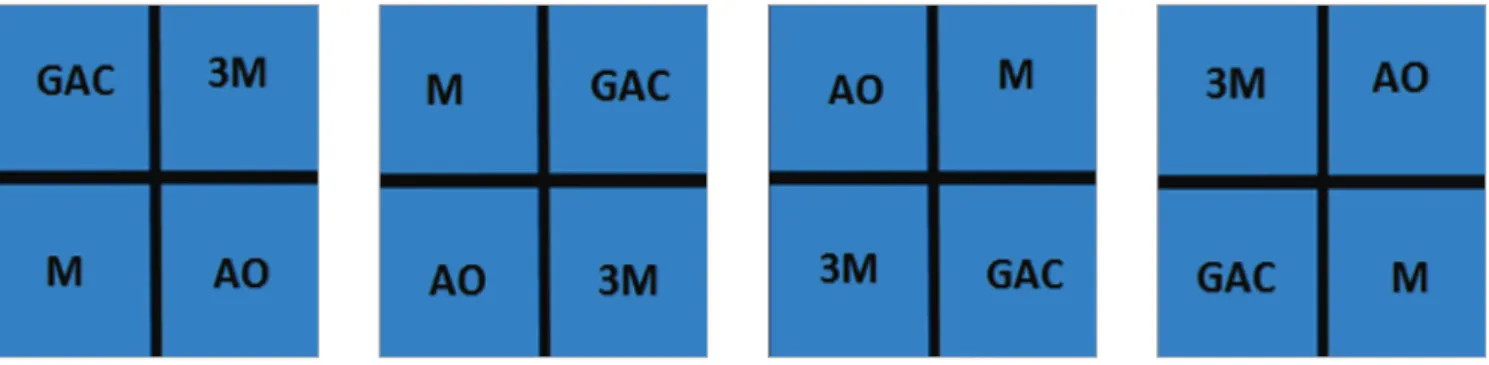
A split-mouth, double-blind, prospective study was designed. A convenience sample included 20 adult volunteer patients (14 females and 6 males), aged be-tween 20 and 57 years old (mean age of 38.5 years). All patients were treated with esthetic ceramic orth-odontic appliances from six different orthorth-odontic practices. In each patient, the four brands were ran-domly distributed by hemiarch and remained in the oral environment for 30 days (Fig 1). Randomization was performed by means of BioEstat 5.3 software (Mamirauá Institute, Belém, Pará, Brazil).
The scoring process was performed while pa-tients were using the ligatures. The ligatures were scored on the same day they were placed (T0), and after 30 days of exposure in the intraoral en-vironment (T1). Evaluation was carried out visu-ally and under cold light, both by patients using a mirror (n = 20) and orthodontists (n = 6), by the same examiner in T0 and T1, under the same light conditions. No patient received any guidance re-garding food restrictions in their diet. Analysis in-volved the use of scores according to the degree of staining,19 in which: 0 = nonpigmented ligatures; 1 = slightly pigmented; 2 = moderately pigmented; and 3 = heavily pigmented.
RESULTS
Evaluation performed by orthodontists and patients was not statistically diferent. The median score for the four as-received elastomer was zero (p > 0.05). Patients and orthodontists evaluated similarly the staining of all brands at T0 (Table 1, Fig 2).
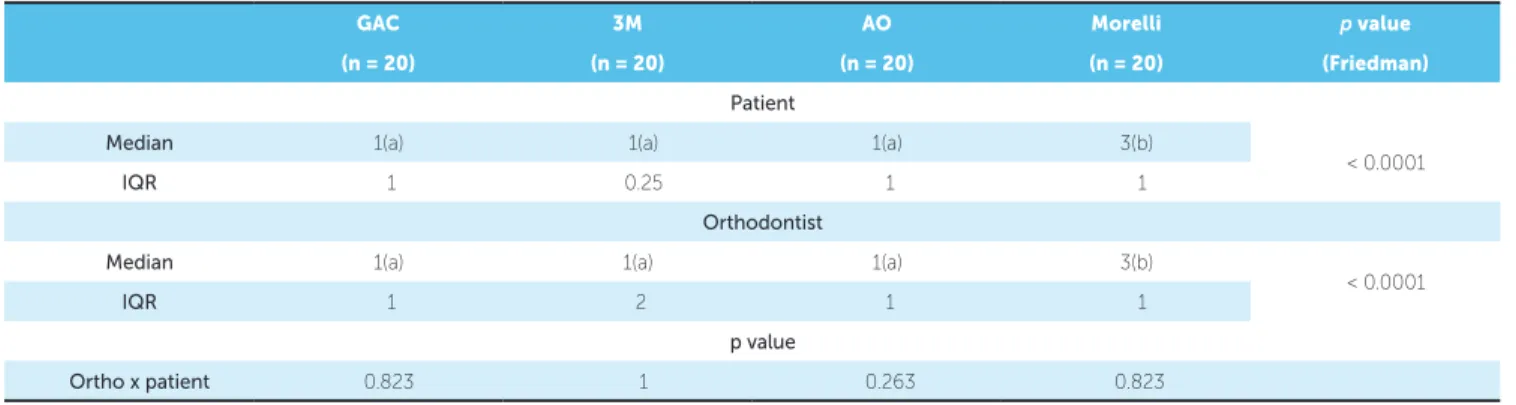
After a 30-day period of intraoral exposure (T1), the four brands of elastomeric ligatures showed sig-nificant staining (Table 2). Differences were statisti-cally significant in all groups (p < 0.001). The median observed at T1 was equal to 1.0 (slightly pigmented) for the three brands manufactured in the United
States (GACTM, 3MTM and American
Orthodon-ticsTM), while the Brazilian brand (MorelliTM) had a score of 3.0 (heavily pigmented) assigned. The
American products manufactured by GACTM, 3M
UnitekTM and American OrthodonticsTM exhibited no significant differences when compared to one an-other (Table 2, Fig 2). However, a large variation in the degree of staining was observed in all brands. In patients’ evaluation, GACTM and 3MTM showed the greatest variation in staining, with scores ranging
from 0 to 3, while American OrthodonticsTM had scores between 0 and 2 assigned. The Brazilian liga-tures (MorelliTM) received scores ranging from 1 to 3 (Fig 2). This variation observed by orthodontists was similarly reported by patients (Fig 2).
Figure 1 - Random distribution by quadrant: M = MorelliTM, GAC = GACTM, AO = American OrthodonticsTM, 3M = 3M UnitekTM.
Figure 2 - Box-plot of medians and IQR of the scores assigned to the four brands according to orthodontists’ and patients’ assessment (T1-T0).
GAC 3M AO Morelli
p value
(n = 20) (n = 20) (n = 20) (n = 20)
Patients
Median 0 0 0 0
0.96
IQR 0.25 1 0 0
Orthodontist
Median 0 0 0 0
0.14
IQR 0.25 1 1 0
Table 1 - Median, interquartile range (IQR) and p-value of four commercial brands evaluated at T0 by patients and orthodontists.
Scor
e
GAC 3M AO Morelli
3.0
2.5
2.0
1.5
1.0
0.5
0.0
Orthodontist
Orthodontist
Pa
tient
Pa
tient
Pa
tient
Pa
t.
Orthodontist
DISCUSSION
Patients’ concerns about facial esthetics and prop-erly aligned teeth have been combined with increased life expectancy and quality of life to boost the demand for orthodontic treatment in adult patients; and with it, the demand for esthetic orthodontic appliances. Despite great improvement in the quality and stability of bracket color, esthetic appliances are faced with the challenge of changes that occur in the color of esthetic orthodontic ligatures when exposed to the intraoral environment. Thus, patients’ complaints are frequent, given that the whole bracket/ligature combination becomes less esthet-ic, as elastomers undergo undesirable staining.
Analyses of color changes in orthodontic ligatures are usually performed in vitro,12-18 which does not relect reality. In this study design, clear elastomers are dipped into high-pigmentation luids and analyzed ater a given period of time. Unlike the clinical design used in the
Table 2 - Median, interquartile range (IQR) and p-value of four commercial brands evaluated at T1-T0 by patients and orthodontists.
Different letters indicate p < 0.05.
GAC 3M AO Morelli p value
(n = 20) (n = 20) (n = 20) (n = 20) (Friedman)
Patient
Median 1(a) 1(a) 1(a) 3(b)
< 0.0001
IQR 1 0.25 1 1
Orthodontist
Median 1(a) 1(a) 1(a) 3(b)
< 0.0001
IQR 1 2 1 1
p value
Ortho x patient 0.823 1 0.263 0.823
Figure 3 - Change in color of the ligatures before (A) and after exposure to the intraoral environment for 30 days (B): note that whereas the ligatures manufac-tured by GACTM, 3MTM and American OrthodonticsTM show a pattern of less staining and are similar to each other, the ligature manufactured by MorelliTM exhibits
a more pronounced pigmentation.
present study, laboratory studies are not afected by oral luids, oral microlora, diet and oral hygiene.
The in vivo model used in this study showed no
sig-niicant diference between orthodontists and patients for all brands at the time the ligatures were placed (T0). The median was the same for all brands, i.e., all values were equal to zero; thus, the metal pigments added during the manufacturing process of some of the esthetic orth-odontic ligatures had no signiicant impact on the assess-ment of patients and orthodontists alike. Thirty days ater exposure to the intraoral environment, all ligatures exhib-ited some degree of staining, but no signiicant diferences were found between GACTM, 3M UnitekTM and Ameri-can OrthodonticsTM. MorelliTM ligatures obtained a me-dian of 3, showing greater susceptibility to pigmentation. Moreover, it was observed that the pigmentation of elastomers made by the same manufacturer var-ied from patient to patient, which may have been re-lated to diet and oral hygiene among the diferent
B A
GAC
GAC
3M
3M
AO AO
experimental subjects. These results contradict the low pigmentation variability found in in vitro studies and further conirm the fact that individual factors can in-luence pigmentation intensity.
This clinical study difers from a previous ex vivo investigation19 whereby analysis of elastomer pigmen-tation was carried outside the intraoral environment. The ligatures were removed, photographed and then analyzed, which could lead to interference in the results, depending on the calibration when capturing the im-ages. In vivo analyses of staining in esthetic orthodontic ligatures could provide more accurate results, since diferent brands are examined through a direct visual analysis in the intraoral cavity by orthodontists and es-pecially by patients themselves. However, even when evaluating American OrthodonticsTM and MorelliTM ligatures, results do not seem to difer.
Dental material science has focused on the prop-erties of as-received material rather than on changes produced ater intraoral exposure.20 The results of this
study warrant the need for greater investment in re-search and technology to improve color stability of es-thetic orthodontic ligatures. For now, a viable clinical option would be esthetic self-ligating brackets, which forestall the use of elastomeric ligatures. However, de-spite the elimination of undesirable staining in ligatures, metal clips, typically used in these attachments, con-tribute to substantial loss in appliance esthetics. Another option for the clinician, which happens to be more af-fordable than esthetic brackets, is the use of esthetic steel ligatures to tie the wire/bracket combination. The main drawback inherent to this method, however, is an in-crease in chair time compared to self-ligating brackets.21
CONCLUSIONS
Ater examining four brands of esthetic elastomeric ligatures, all of them showed signiicant staining, which appeared to be more pronounced in MorelliTM liga-tures.1 Changes in color of elastomeric ligatures were perceived similarly by patients and orthodontists.
1. Wong A K. Orthodontic elastic materials. Angle Orthod. 1976 Apr; 46(2):196-205.
2. Ferriter JP, Meyers CE Jr, Lorton L. The efect of hydrogen ion concentration on the force-degradation rate of orthodontic polyurethane chain elastics. Am J Orthod Dentofacial Orthop. 1990 Nov;98(5):404-10.
3. von Fraunhofer JA, Cofelt MT, Orbell GM. The efects of artiicial saliva and topical luoride treatments on the degradation of the elastic properties of orthodontic chains. Angle Orthod. 1992 Winter;62(4):265-74.
4. Baccetti T, Franchi L. Friction produced by types of elastomeric ligatures in treatment mechanics with the preadjusted appliance. Angle Orthod. 2006 Mar;76(2):211-6.
5. Taloumis LJ, Smith TM, Hondrum SO, Lorton L. Force decay and deformation of orthodontic elastomeric ligatures. Am J Orthod Dentofacial Orthop. 1997 Jan;111(1):1-11.
6. De Genova DC, McInnes-Ledoux P, Weinberg R, Shaye R. Force degradation of orthodontic elastomeric chains--a product comparison study. Am J Orthod. 1985 May;87(5):377-84.
7. Baty DL, Volz JE, von Fraunhofer JA. Force delivery properties of colored elastomeric modules. Am J Orthod Dentofacial Orthop. 1994 July;106(1):40-6.
8. Eliades T, Bourauel C. Intraoral aging of orthodontic materials: the picture we miss and its clinical relevance. Am J Orthod Dentofacial Orthop. 2005 Apr;127(4):403-12.
9. Marques IS, Araújo AM, Gurgel JA, Normando D. Debris, roughness and friction of stainless steel archwires following clinical use. Angle Orthod. 2010 May;80(3):521-7.
10. Araújo RC, Bichara LM, Araujo AM, Normando D. Debris and friction of self-ligating and conventional orthodontic brackets after clinical use. Angle Orthod. 2015 July;85(4):673-7.
REFERENCES
11. Normando D, Araújo AM, Marques I da S, Barroso Tavares Dias CG, Miguel JA. Archwire cleaning after intraoral ageing: the efects on debris, roughness, and friction. Eur J Orthod. 2013 Apr;35(2):223-9.
12. Ardeshna AP, Vaidyanathan TK. Colour changes of orthodontic elastomeric module materials exposed to in vitro dietary media. J Orthod. 2009 Sept;36(3):177-85.
13. Kim SH, Lee YK. Measurement of discolouration of orthodontic elastomeric modules with a digital camera. Eur J Orthod. 2009 Oct;31(5):556-62. 14. Lew KK. Staining of clear elastomeric modules from certain foods. J Clin
Orthod. 1990 Aug;24(8):472-4.
15. Cavalcante JS, Barbosa MC, Sobral MC. Evaluation of the susceptibility to pigmentation of orthodontic esthetic elastomeric ligatures. Dental Press J Orthod. 2013 Mar 15;18(2):20.e1-8.
16. Soldati DC, Silva RC, Oliveira AS, Kaizer MR, Moraes RR. Color stability of ive orthodontic clear elastic ligatures. Orthodontics (Chic.). 2013;14(1):e60-5. 17. Fernandes AB, Ribeiro AA, Araujo MV, Ruellas AC. Inluence of exogenous
pigmentation on the optical properties of orthodontic elastic ligatures. J Appl Oral Sci. 2012 July-Aug;20(4):462-6.
18. Fernandes AB, Ruellas AC, Araújo MV, Sant’Anna EF, Elias CN. Assessment of exogenous pigmentation in colourless elastic ligatures. J Orthod. 2014 Jun;41(2):147-51.
19. Silva AM, Mattos GV, Kato CM, Normando D. In vivo color changes of esthetic orthodontic ligatures. Dental Press J Orthod. 2012;17(5):76-8.
20. Eliades T, Bourauel C. Intraoral aging of orthodontic materials: the picture we miss and its clinical relevance. Am J Orthod Dentofacial Orthop. 2005 Apr;127(4):403-12.