How to cite this interview: Viecilli RF. An interview with Rodrigo F. Viecilli. Dental Press J Orthod. 2016 Sept-Oct;21(5):26-38. DOI: http://dx.doi.org/10.1590/2177-6709.21.5.026-038.int
Submitted: February 07, 2016 - Revised and accepted: February 22, 2016
Early in the 2000, digital communication brought me a new friend. We haven’t studied together or been presented by any common friends. Along lines and lines of conversation, I met a young orthodontist from Canoas/RS, who even without having studied in one of the traditional Mechanics schools in Brazil, knew it deeply. Over time, I learned his story; he had studied Engi-neering and, motivated by his parents, graduated in Dentistry and took specialization in Orthodontics. The thirst for knowledge led him to, by his own, contact Dr Charles Burstone, who, by the time, got impressed and invited him to take Masters in Ortho-dontics and PhD in the USA, being one of the first Brazilian orthodontists with this title from an American university. Besides being awarded with the doctor of philosophy degree, by the Indiana University, he was also the first Brazilian to receive one of the most important award from the American Association of Orthodontics, in 2009. For his paper “Orthodontic mechanotransduction and the role of the P2X7 receptor”, he received the Milo Hellman Award, granted to the best research of the year in the USA. Since then, he has been lecturing almost every year in the American Association of Orthodontics Annual Session, presenting 6 lectures in 7 years of congresses. He was professor of Orthodontics in the New York University and, recently, was hired by Loma Linda University, where he teaches full time and is responsible for the Biomechanics lab. He is diplomate by the American Board of Orthodontics, and in his free time he cooks and reads about philosophy. It is a great honor for me to have this opportunity to coordinate the interview with one of the great personalities of the Brazilian Orthodontics in the USA: My friend, Dr Rodrigo Viecilli.
No começo dos anos 2000, a comunicação digital me trouxe um novo amigo. Não tínhamos estudado junto ou sido apresentados por amigos em comum. Ao longo de linhas e mais linhas de conversa, conheci um jovem ortodontista de Canoas/RS que, mesmo sem ter estudado em uma das escolas tradicionais de mecânica do Brasil, a conhecia profundamente. Ao poucos, fiquei sabendo de sua história; que ele havia cursado Engenharia e que, estimulado pelos pais, fez Odontologia e cursou a especialização em Ortodontia. A sede de conhecimento fez com que ele, de maneira independente, começasse a se comunicar com o Dr. Charles Burstone, o qual, ao longo do tempo, se impressionou e o convidou para fazer o mestrado em Ortodontia e o doutorado direto, nos EUA — sendo um dos primeiros ortodontistas brasileiros com esse título por uma universidade americana. Além de ser agraciado com o doctor of philosophy degree, pela Indiana University, ele também foi o primeiro brasileiro a receber um dos prêmios mais importantes da Associação Americana de Ortodontia, em 2009. Pelo seu trabalho “Orthodontic mechanotransduction and the role of the P2X7 receptor”, ele recebeu o Milo Hellman Award, prêmio concedido ao melhor trabalho de pesquisa do ano feito nos EUA. Desde então, ele tem palestrado quase todos os anos no congresso da Associação Americana de Ortodontia, totalizando 6 palestras em 7 anos de congressos. Ele foi professor de Ortodontia na New York University e, mais recentemente, foi contratado pela Loma Linda University, onde leciona em tempo integral e é responsável pelo laboratório de Biomecânica. Ele é diplomado pelo American Board of Orthodontics e tem como hobbies cozinhar e ler sobre filosofia. É com muita honra que tenho a oportunidade de coordenar a entrevista com uma das grandes sumidades da Ortodontia brasileira nos EUA: meu amigo, o Dr. Rodrigo Viecilli.
Renato Parsekian Martins – coordinator of the interview » Former Student of Engineering, Instituto Tecnológico de Aeronáutica (Technological Institute of
Aeronautics).
» Specialist in Orthodontics, Hospital de Aeronáutica de Canoas (RS, Brazil). » Specialist in Orthodontics, Indiana University.
» PhD in Dental Science/Biomechanics, Indiana University.
» Associate Professor, Orthodontics Department, Loma Linda University. » Director of the Craniofacial Biomechanics Laboratory, Loma Linda University. » Diplomate of the American Board of Orthodontics.
» Designer of the SmartArch, along with Prof. Charles Burstone.
» Winner of the 2009 Milo Hellman Award of the American Association of Orthodontists for Best Graduate Research in North America.
» Author of 3 chapters of the book “The Biomechanical Foundation of Clinical Orthodontics”, by Charles J. Burstone.
» Reviewer of the Journal of Dental Research, American Journal of Orthodontics, Angle Orthodontist, Journal of Biomechanics and more than 10 other journals in Dentistry, Physics and Engineering.
DOI: http://dx.doi.org/10.1590/2177-6709.21.5.026-038.int
Rodrigo F. Viecilli
Why did you choose being professor of Ortho-dontics in a great American university? What moved you in this decision?
(Marcio Almeida and Renato Martins)
While I was studying Engineering, in the mid-90s, my father, Prof. Orlando Viecilli, was special-izing in Orthodontics. Frequently, I was questioned about problems in Orthodontics presumed to be from Physics and how to best move the teeth. I found interesting this difficulty in communication — a dif-ference in language for asking and answering ques-tions. I realized that this difference was due to the tradition in Orthodontics language: A certain level of disconnection between physical sciences and the way clinical Orthodontics was traditionally taught. I remember how the word “torque” was used, re-ferring to the inclination of the bracket or to the torsion on the wire. And I wondered how could a person know if the force system released was just a moment, when in fact it is not. The language we use for communicating is extremely important, because the thought depends intrinsically of the language we use to reason.
I understood, then, that I could somehow contrib-ute to Orthodontics, to help solving this discrepancy. And that, along with other factors, made me change the course of my studies. The greatest challenge was to go through four years of training in which Dentist-ry traditional teaching is, oftentimes, based on mem-orization, protocols and techniques, very different from Engineering study.
At the college in which I studied Dentistry, I had the privilege of being stimulated to be creative, while student, by the professor Oppermann (Department of Periodontics of the Federal University of Rio Grande do Sul), who obtained his doctorate abroad and talk-ed about Periodontics in a very logical way, connect-ed with basic sciences. He explainconnect-ed the molecular mechanisms and cellular interaction in the peri-odontal ligament during infection, in order to ex-plain what would exactly occur clinically. He based clinical practice with scientific findings, which he would mention during class. He was the only one at college who addressed the specialty like this in the end of the 90s. Ironically, he was the first periodon-tist who, while I was a student, gave some consider-ation to the applicconsider-ation of advanced mathematics in
Dentistry (regarding an idea that I had, at that time, for a periodontal index, which ended up being too complicated to become practical).
At the same time, I studied traditional Ortho-dontics with my father, Dr. Orlando Viecilli, and with Dr. Armando Hiraoka, during college, and I observed that there was a lot to be clarified in Bio-mechanics. After I learned the basic of Orthodontics and the treatment according to Tweed and Ricketts techniques, I realized there were a lot of instructions on “how to”, but few explanations on the reasoning to do them — and, when these existed, they made no physical or mathematical sense for me, or they had not enough proofs or data to support or refute the instructions, which was extremely confusing.
While I read books of several authors, trying to find explanations, I noticed that most of them were based in opinions, not in experimental findings. In the ac-ademic environment of the Brazilian Orthodontics, I noticed some traditionalism, which did not favor creative thinking, and the only way out of this trap was the library. I decided to organize in chronological order the papers I found, so I could understand how Biomechanics evolved in Orthodontics. Back then, it was not this easy to find papers online like it is now.
Only when I read the papers of Professor Charles Burstone and his colleagues that I found adequate physics explanations for the mechanical problems. In 2001, I translated one of his books, for my own study, and I found some problems in the mechani-cal design of the “T” loops and how the tests were conducted. At the same time, Professor Mauricio Sakima was publishing papers describing segmented appliances, with logical biomechanical systems, and we invited him to visit Rio Grande do Sul state (Bra-zil) and give a lecture. Around 2001, I sent Burstone an email with several questions, and, after starting a discussion, he suggested me to publish the book in Portuguese. The numerous discussions derived from these questions, this translation and my general in-terest in Biomechanics resulted in the first paper I wrote, being a student of specialization in Orthodon-tics in Brazil, published at the American Journal of Or-thodontics1. Prof. Burstone was the mentor of my
go to Indianapolis for a PhD with one of his former students, focused on the interface between bone bi-ology (Indiana University, with W.E. Roberts, highest authority in Orthodontics in bone biology) and Me-chanical Engineering (T. Katona and J. Chen, engi-neers of the Purdue University, which graduated many NASA astronaut engineers). According to Prof. Bur-stone, at that time, that was the only university specii-cally researching the biological response to mechanical stimulus, with the rigor of Engineering — the way I was looking for. Prof. Burstone and I kept friends and have worked together many times, since then.
When I finished my PhD, it was natural to follow my line of research, and I was invited to initiate the academic career as a professor. Prof. Burstone used to say that the good side of the force (Scientific Biome-chanics) needed another “Jedi” to fight against the dark side (the gurus and prophets of orthodontic tech-niques). Idealistically, I see my career, of scientist and orthodontist, as a continuation of that vision. After that, I did not have much contact with the orthodon-tic environment in Brazil, and my scientific presenta-tions have been focused on USA and other countries. But I’m glad that there are clinicians in Brazil being trained alike. Brazilian Orthodontics owes much of it to UNESP-Araraquara, to Professors Tatsuko and Mauricio Sakima, Luiz Gandini and Renato Martins. They propagated this way of thinking.
Reading and knowing your papers, I realized your close relationship with Dr. Charles Bur-stone, as your mentor for the scientific study of Biomechanics. In your opinion, how was Orthodontics influenced by him, the great-est researcher of Biomechanics in the world? Why do we need to understand Biomechanics in order to treat our patients? And what course
Biomechanics will follow in the near future?
(Marcio Almeida)
In my opinion, there are only a few really bril-liant and visionary minds in the history of Ortho-dontics, from the scientific point of view. Choosing two of them to mention, I need to say Calvin Case and Charles Burstone. As I said before, I always had historical interest in understanding how the think-ing has changed through time in Orthodontics. Early in the twentieth century, contrary to all the others,
Calvin Case used to defend extractions, in selected cases, in order to obtain a harmonious profile; and controlled tooth movement, with custom applianc-es, to achieve these objectives. In his book, he de-scribed his first scientific efforts to understand how to control a force system and move the teeth with a primitive concept of center of resistance. Case de-fended specific treatment objectives based on esthet-ics. On the other hand, Angle, who became far more famous, designed and taught how to use the appli-ances pre-manufactured by S.S. White; he classified the malocclusions to promote the treatment proto-cols with his appliances; and was against extractions, with the argument of resemblance between men and divinity. These discussions are available for reading in the old publication Dental Cosmos and, in my opin-ion, it should be read by every orthodontist — for they still happen nowadays, only in different suits. Oftentimes, I joke saying that I’d rather be part of the Case’s Society than the Angle’s one. Calvin Case was much ahead of his time, but, unfortunately, he was rejected by the orthodontic community. He couldn’t take this rejection and ended up committing suicide. Angle and the Orthodontics with Edgewise applianc-es had the marketing support of a great orthodontic company, unlike Case’s ideas.
The scientific basis of Orthodontics is to compre-hend how to move a tooth in a predictable way, not how to place or manufacture appliances. Literature already agrees that dentoalveolar changes are the big-gest ones we achieve in treatment, and that we mold bones and teeth when we intend to take them from position A to B. Teeth with more bone support guide the movement of teeth with less bone support and need to be treated with a consistent force system from A to B, before placing a continuous archwire to serve as a basis for the shape of the arch. In order to obtain the best movement from A to B, we need to know the force system and its effect on the periodontal lig-ament and bone remodeling. To optimize the system, we need to know materials and biological response to them. This is Scientific Biomechanics. Shouldn’t we have a professor with high level of knowledge on Bio-mechanics in all post-graduation programs? Shouldn’t an Orthodontics program be defined by this, instead of by which treatment “philosophy” it follows?
Craniofacial growing and the diagnosing tools we better emphasize and study during our training are at stake, but Lysle Johnston and Sheldon Baumrind have already shown that we never know, exactly, how much a patient will grow. What is the point of a high refinement in diagnostic concepts and treatment plan-ning if there is no understanding and traiplan-ning on how to properly move teeth from A to B? I could be am-bitious and say that, if there is any growth control and treatment objectives we so much like achieving, these will only be achieved with Scientific Biomechanics. Also, knowing Biomechanics allows understanding which are the realistic treatment objectives, regardless of the appliance we use, because all the appliances can be “reduced” to a force system and anchorage that you already know or used before.
It is always good to emphasize that the orthodontic technique or the bracket type to be used is not Scien-tiic Biomechanics. I would like to imagine that the future clinical Orthodontics will completely quit us-ing this language and inaccurate techniques, and will stop highlighting the latest bracket, treatment proto-col or appliance. I see a tendency in this direction. In American scientiic meetings, for example, generally, orthodontists sponsored by companies with conlict of interest are limited to speak in the commercial area. This needs to be changed in Latin America and other
places of the world. More science, less commercialism. I get sad when I see people misusing the word Biome-chanics. For example, I have been in lectures of sever-al professors with the title “Biomechanics of self-ligating brackets”. I have already seen good biomechanical anal-ysis, but sometimes people give a basically commercial lecture about self-ligating brackets and show a number of selected cases and clinical studies with positive re-sults, to convince the audience to use such bracket. I think there is nothing wrong in promoting a product, but it would be good to convince people because it is superior, irstly from the basic sciences point of view and, then, with clinical studies conirming this with a systematic analysis. Only a few do this.
The greatest challenge of Scientific Biomechanics in Orthodontics is that many choose Dentistry to get rid of Mathematics and Physics and, during training, also from critical thinking. I think it is important to be interested in Philosophy of Science and Language, to understand what really affects our opinion and how to properly support an argument or convince my stu-dents not to choose shortcuts to better practice Or-thodontics. Every group of post-graduation students I have, even before I start teaching them Biomechan-ics, goes through 8 hours of examples and counter-examples of what is a scientific and pseudoscientific thinking in Orthodontics, and about how to detect a argumentative fallacy. I think this logical and philo-sophical perspective is necessary to open our minds to science and creativity in research and treatment.
In a paper of yours, published at AJODO in 2013, you present a new concept of axes of
re-sistance2. How can this new concept clinically
affect the design of mechanics where it is nec-essary a movement of intrusion of the anteri-or block anteri-or molars distalization by translation? (Marcio Almeida)
center of resistance, but no one had ever the courage to say that! First, in a rigorous paper I wrote to AJODO3, when I was a PhD student, I was already convinced of that, but I just subtly mentioned, because I still had not gathered enough data to prove such a thing.
Dr. Burstone and I discussed about it and he agreed with me when he saw the data. Then, we elaborated a way to change the concept, based on the obtained data. Based on those discussions, I wrote a chapter, in the last book published by Prof. Burstone, explain-ing the evolution of the center of resistance concept and why, in fact, it doesn’t exist. The original con-cept is focused on teeth with ideally symmetrical root shapes — for example, a paraboloid of revolution. When the root is perfectly symmetric, the reference for translation is the same in all directions. It doesn’t occur with real teeth or group of teeth, because the ligament strain patterns are different in each direc-tion. The objective of this paper was to formalize a scientific definition of a physically rigorous referential for tooth movement. As scientist and orthodontist, I was embarrassed about the scientific basis of tooth movement not having a more significant Mathemat-ics basis, and decided to dedicate some time to fix this. Since then, formal orthodontic Biomechanics study groups4 already accepted the fact and confirmed the center of resistance being a myth.
The clinical relevance of this inding is that I estimate that may be a variation of up to 1-2 mm in the transla-tion referential, depending on the force directransla-tion. The more asymmetric, the bigger variation. It seems little, but 2 mm may be the diference between a controlled inclination and a translation! I don’t have speciic in-formation about the scenarios you have asked, but my recommendation for any treatment with Scientiic Biomechanics is: Always use clinical feedback, observe how the teeth moved and compare; photograph. If the tooth did not move as planned, make critical adjust-ments on the force system. Ask yourself: Why it did not work? Answer it in details, with diagrams, and try to understand what is happening. Do not rely purely in ideal M:F ratios, because bone anatomy and vari-ations in brackets geometry, along with deformation potential of the appliance — by structural stress relief and deformation of the appliance by the patient (may-be the most common cause) — may cause deviations from the correct trajectory.
In a recent paper of yours, published at AJO-DO, are represented the effects of two types of
skeletal anchorage mechanics5. These
mechan-ics have been advocated by Dr. Chris Chang for the distalization of the entire lower dentition, on the treatment of skeletal Class III, and cor-rection of Class II, instead of using miniplates. What is your opinion regarding the use of this type of anchorage you have been studying by means of finite elements? Do you think about it as the future of skeletal anchorage
(mini-im-plants)? (Marcio Almeida)
The analysis to predict tooth movement that I have been doing for Professors Roberts and Chang are based on the hypothesis that the initial pattern of tooth movement, due to periodontal ligament strain, remains basically the same with time. This is reason-able in inclination movements because the cellular response of the periodontal ligament follows pret-ty much the compression pattern determined by the main stress set in the beginning, and it changes only a little ater the remodeling of the alveolar process. I showed this in another study of mine6. This concept was experimentally demonstrated in animals for the irst time in this paper which, basically, shows that, from the cellular point of view, a tooth moves accord-ing to the pattern of forces and moments, and the con-sequent efect on periodontal ligament. We presume it is true, for humans, when we place an appliance based on the M:F ratio established for the tooth movement. But do you believe that this was never histologically proved until this paper was published? Similarly, re-sorption response follows a similar pattern, but it is exacerbated by the ligament necrosis. Establishing a scientiic basis for the orthodontic treatment is to give scientiic credibility to our specialty.
it with Prof. Chang’s implant cases, which are very interesting. This clinical reports show that we can predict the movement in a reasonable way using bio-mechanical principles.
What precautions would you recommend when using statically indeterminate systems in
Or-thodontics? (Sergei Caldas)
In the previous answer I made some comments that can be applied to the errors in general force systems. I think that indeterminate systems are, usually, more complicate to adjust, because they need a measuring instrument, as a transducer, which by itself is in er-ror — due to the absence of periodontal ligament in the measuring process. When clinically adjusting an indeterminate system, such as a loop or a transpalatal arch, only a few orthodontists have enough knowledge to identify, qualitatively and accurately, what is hap-pening. So, my recommendation when using statically indeterminate systems is: Before clinically using them, study hard and try to comprehend the qualitative con-sequences of making bends or activations. Indetermi-nate systems ofer greater diiculty because it is neces-sary to accept some uncertainty on the magnitude of forces and moments. My irst recommendation for my students is to use the system they know better, from the mechanical point of view. For example, in some cases of symmetrical anchorage, it is possible to make a sliding mechanics to work so well in closing spac-es than a “T” loop correctly activated. But in other cases, in which the arch does not slide so well, due to inclination discrepancies between teeth, a “T” loop and a frictionless mechanics may be the best option. I am against the use of a speciic method for all cases: There is always a simpler and more eicient treatment, according to the scientiic circumstances of the case. In my opinion, there is no honor in using complicat-ed systems in all the cases. Maybe there is greater in-tellectual importance in being wise to choose the best system for the case you have in hands at the moment.
The use of cantilevers for verticalization of molars is a biomechanical resource commonly used by orthodontists. However, many authors claim that increasing the lever arm, using the same vertical activation, would increase the moment produced for the molar
verticaliza-tion. Do you agree with this? And which is, ef-fectively, the moment responsible for promot-ing the molar movement (moment of the force or moment of the binary within the slot)? (Sergei Caldas)
There are many questions at stake here, and I think that the problem originating this controversy between authors is in understanding the concepts of: Moment, load/deflection ratio, balance (first law of Newton) and equivalence of force system, allied to the problem of inaccurate language in Orthodontics, to which I have referred before. In this case, the prob-lem of language is the word “activation”; it is a con-fusing word. The more accurate words to use would be maximum deflection of the cantilever and force released by the cantilever.
The origin of the language problems is that, oten-times, in Scientiic Biomechanics didactics, classes are focused on the appliances. Ater teaching Biomechanics in the last 10 years and trying to ind the balance be-tween rigor and best didactics, I believe the best way is organizing classes by the principles and concepts from Physics and Mathematics. Each concept can be clariied with examples of treatment objectives, force systems and, only then, appliances. Teaching this was, however, requires a long program and logical sequence, and this is not possible in short programs where orthodontists search, for example, for a new “appliance” for molar up-righting. So, to answer your question, I would like to clarify the following aphorisms:
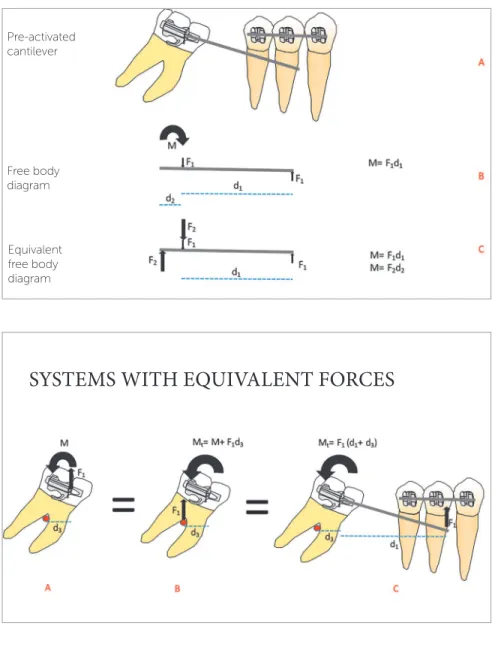
1. In Statistics, the first law of Newton implies that an object at rest or in constant speed has the sum of forces and moments equals to zero. Observe that, to verify a balanced force system, normally we would separate the cantilever in question (as represented by Fig 1A), in what we know as “free body diagram” (Figs 1B and 1C) and we would design the force system acting on the wire, as indicated below. Observe that the moment of torque M, represented by the curved arrow, in fact is the pair of forces F2, illustrated in Figure 1C. This is what happens “in reali-ty”. The representation of the moment with a curved arrow is purely didactic.
the force system on the molar using the concept of equivalence of force system. Since the forces on the tube generate moments on the molar, the force system in the resulting center of resistance needs to relect this (Figs 2A and 2B).
3. The efect of the total force system on the tube is the same of the equivalent force system on the center of resistance of the molar. The molar is bal-anced by the irst law of Newton, by means of in-teraction with the dentoalveolar complex.
4. The moment applied to the molar for its verti-calization depends on the force measured at the anterior application point, and on the distance to the resistance axis of the tooth orthogonal-ly to the line of action of the force. This is the
“fast” way to verify the moment on the molar, if we imagine that tooth and appliance are basically the same “rigid object” and that we are interested only in what happens with the tooth (Fig 2 C). 5. The increase in length of the lever arm (distance)
increases the moment on the molar, if the force measured is kept constant.
6. In a cantilever of linear material, such as steel or beta-titanium, the load/deflection rate is inversely proportional to the cube of the dis-tance — that is, by bending the lever arm, there is a reduction of 8x if the deflection is constant; that is, doubling the distance, we would need to increase the deflection 8x to obtain the same force and double the moment on the molar.
Figure 1 - Free body diagram showing the forces on the cantilever wire.
Figure 2 - Systems with equivalent forces on the molar, considering it: Isolated, in the tube (A) or in the center of resistance (B); or considering the molar and the cantilever as the same body (C). In the last case, it is not necessary — and normally would be incorrect — to design a curved arrow of the moment on the molar, which was inserted here with a didactic purpose.
SYSTEMS WITH EQUIVALENT FORCES
7. The lack of knowledge of any of the concepts aforementioned, along with the misuse of the word activation (confusing force and deforma-tion), is what causes the problems you mentioned. Ideally, a person who does not understand the basic principles of Statics, taught in high school, should not teach Biomechanics and we should not have this kind of controversy in our profession. On the other hand, from the positive point of view, when someone publicly teach-es something wrong, frequently due to the lack of a for-mal Physics basis, there is at least the chance to discuss it. In the end, I like to believe that the search for knowledge of fundamental basic sciences always happens.
Last year, Orthodontics lost one of its great-est scholars of Scientific Biomechanics, Prof. Charles Burstone. Having lived directly with him, and being one of the greatest researchers of his work, how do you see the legacy he left in our specialty? And, also, what do you consid-er being fundamental and that evconsid-ery clinician should know of his work, to practice an
Ortho-dontics of excellence? (Sergei Caldas)
The difference between Burstone and oth-er great names in Orthodontics is that he did not teach a technique, he was not a guru or a clinician. He was a scientist. Every method or system he an-alyzed in Orthodontics was evaluated from the sci-entific point of view, not from the empirical point of view or from “what works in my clinic” or “in my hands”. Comparing the legacy of Prof. Burstone
with any other left by an orthodontist who claimed a technique based only in his clinical reputation is not fair. I think that every scientist of Biomechanics should make it clear. Many around him, even stu-dents, wanted to name his mechanics “segmented arch technique”, something that I think is a huge mistake. For example, when a “T” loop is recom-mended, instead of any other loop, it is because the entire Biomechanics science defends that this is the best simplified design of a loop to obtain the mini-mal load/deflection rate and M:F ratio.
In my opinion, the legacy of Prof. Burstone is simply the institution of the science in orthodontic mechanics. One great reason for me to keep teaching and researching is that I feel honored in preserving this legacy. My relationship and long weekly conver-sations with Prof. Burstone, and the great friendship and mutual respect we had in our discussions are a great motivation. I feel extremely privileged for hav-ing had the opportunity of questionhav-ing and learnhav-ing pretty much everything he had to teach, and I am re-sponsible, as a scientist, for keeping his legacy.
The word Scientific Biomechanics is still little known by Brazilian orthodontists. What does this word really mean, and how its use can help clinicians in a more rational approach of their
treatment plans? (Sergei Caldas)
Biomechanics is based on observation of facts and experiments, and it keeps an open mind for the changes in guidelines, depending on what is observed. It is not
Figure 3 - Simple cantilever system showing the forces and moments in the posterior and an-terior elements (pseudodiagram of free body). The load/deflection rate is inversely proportion-al to the cube of the distance of the tube to the hook (lever arm).
System with one cantilever
about “helping” the clinician, but about learning the correct way of doing things, with a scientiic basis. Bur-stone once told me that there was never such a thing as “Burstone’s segmented arch technique”. The appliances always changed according to the materials and studies on M/F and on how to adequately move the teeth. People started referring to these procedures as a technique be-cause other procedures had also been called techniques. It is not fair to compare pure science with technique. The way the procedures have evolved in Scientiic Bio-mechanics is documented in literature, with scientiic reasoning and proofs since the 50s! What “technique” can do the same?
Traditional orthodontic techniques are based on protocols and prescriptions acceptance because they are supported by an assumed expert or by the marketing of a bracket or appliance, and not in scientiic expla-nations. For this reason, frequently the argumentation justifying techniques is based on logical fallacies and a bias of selected quotations of clinical studies. Learning to identify fallacies is important so that you won’t get carried by commercialism, especially in Brazil. Know-ing the Scientiic Biomechanics possibilities for a case releases the orthodontist from techniques, and forces him to diagnose and plan a more speciic treatment, at least as a mental VTO. The use of Scientiic Biome-chanics allows, as a matter of fact, to scientiically reach the objectives of this VTO.
How does the study and knowledge of Biome-chanics in Orthodontics affect the diagnosing and mechanics planning of clinical cases? And how, from the scientific point of view, is Biome-chanics related to contemporary techniques in
Orthodontics? Orlando Tanaka
I think that almost every orthodontic technique has something that, coincidentally, can be used and im-proved from the scientiic point of view. For example, the technique of closing spaces with sliding mechanics can be very easy and efective, for cases without great anchorage challenges, if the clinician is concerned on using the most possible rigid archwire and verifying if the wire slides easily in the anteroposterior direc-tion. It is clear and common sense from the mechani-cal point of view, but in my experience it is not com-mon to ind a person trying this before setting up for space closure. When the wire is not rigid and a curve is
formed on the arch, many orthodontists still insist on increasing the force and trying to close spaces, when the friction created by the normal forces at the brackets to maintain teeth vertical is immense. Biomechanical principles are universal and apply to the optimization of simpler “techniques” in Orthodontics. The scien-tiic biomechanic sees a procedure as a series of physi-cal variables, and not as a technique.
Another tip to decrease friction is that, when I teach my students to use sliding mechanics I ask them: To remove any appliance interfering in the shape of the arch in the final stages of aligning, such as trans-palatal or lingual arches; to use the most possible rig-id archwire (tempered chrome-cobalt steel), and pull and replace the wire at the brackets, to feel the fric-tion level. If this is not possible, a 200cN force won’t have much effect. If the archwire does not slide, it can be beneficial to align with a larger sized archwire to eliminate the normal forces derived from moments in all directions and, then, go back to a smaller sized archwire, trying again the sliding.
Knowing Biomechanics and basic sciences opens the mind for creativity and optimization of techni-cal principles which, a priori and by definition, didn’t have space for it. This shouldn’t be nothing new. Any serious science works this way.
What are the available tools to improve the knowledge in orthodontic Biomechanics? Are computational simulations essential for this? (Orlando Tanaka)
I think the tools are not the best way to improve research in orthodontic Biomechanics, but the edu-cation and knowledge of the fundamental variables of Mathematical sciences ruling Biomechanics and its effects on treatment.
For example, let us say that a study compares the efects of extraoral and cervical traction appliances for correction of Class II. The authors do not give relevant details on how the appliances were assembled, more speciically which was the action line of the force in relation to teeth resistance references (if the molars are loose from the archwire). There is no explanation and the only diference is that an appliance was used in some of the cases, and another in the other cases.
force system, not the appliance itself? This is a seri-ous language problem we need to ix in our profession. In Materials and Methods, we need to give every de-tail about the force system. Studies based only on “ap-pliances” are, otentimes, almost useless, because the conclusions are limited to a variation of coniguration in patients, which is unique to the study itself. There is another problem in study designs: Using a laser in-stead of a chainsaw to cut a tree. I revise probably the most part of the papers on inite elements published at AJODO. Oten, the problem is modeled by placing an entire statically determined appliance, when only the force system applied would be enough, and there is no need to use inite element analysis to solve the prob-lem. This makes me sad. The inite elements meth-od serves to ind answers to problems that we can not predict with traditional ways. Science evolves through testing and rejecting hypotheses. The inite elements method helps to reject hypotheses that can not be re-jected without the basic application of static principles, or without the modeling of a periodontal ligament in real experiments; or when appliances are too complex to be tested in mass. The choice of a tool is based on what is necessary to test a hypothesis in a simple way.
At the AAO Congress in San Francisco/CA, 2015, you presented the SmartArch. What are the main biomechanic advantages of SmartArch compared to more traditional NiTi orthodontic archwhires? What is the relevance of Dr. Bur-stone in developing the SmartArch project? (Armando Saga and Orlando Tanaka)
SmartArch is an aligning archwire with CuNiTi stiffness requirements calibrated for each interbrack-ets distance, for cases with or without premolars ex-traction. It was conceptualized in discussions I had with Dr Burstone about how to design the best pos-sible aligning archwire. However, I am the only re-sponsible for the calculation and development meth-ods, which is intellectually protected.
Basically, SmartArch was developed to be the only aligning archwire in irst and second order, for a case where a continuous archwire can be inserted. It is a round 0.016-in or 0.018-in CuNiTi wire. In each interbrackets distance, the wire is treated with laser in order to have a diferent stifness. The stifness modiication is made by the selected vaporization of nickel atoms, with laser.
The stiffness in each interbrackets distance was calculated so that each tooth has an optimized force to be moved. At last, SmartArch is the first wire in Orthodontics considering both the root support and interbrackets distance, and has experimental and fi-nite elements data proving that all the teeth will be submitted to forces with ideal proportions to move them. We also considered the friction, and choosing the wire and recommending the use of metal liga-tures or self-ligating brackets is based on these data. Our data show that the use of elastic ligatures is not the most efficient method for alignment in severe or-thodontic cases. Self-ligating brackets or with a metal ligature slightly loose have basically the same effect. It occurs because, when a tooth is aligned, the ex-cess of wire needs to slide to posterior. If there is too much friction, the alignment will not be efficient.
What are your recommendations to improve the graduation of orthodontists?
(Orlando Tanaka)
I think the training in Scientific Biomechanics should represent 50% of theoretical classes in Ortho-dontics programs.
What is the reliability of the numerical simula-tion methods, when applied to the study of
or-thodontic Biomechanics? (Armando Saga)
If the problem is properly modeled, the error for a mesh typically acceptable proposed by a software will be around 10% for a problem of wires or beams simu-lation, for example. This can be improved with mesh refinement and taken to less than 2%. The error can be higher if the materials are not properly modeled, of course. By properly, I mean that there must be ex-perimental results supporting the property of the ma-terials. Complex non linear materials, such as super-elastic wires, have mathematical models based on ap-proximations which also incur in error. These errors are small and can not be a reason to simply discard the results. Ultimately, the total error depends on each problem being modeled, but it needs to be accepted because, in general, the finite elements method is su-perior in aspects that the experiments are not.
bio-logical tissues. What is your opinion on this? (Orlando Tanaka and Armando Saga)
Von Mises criteria basically consists in calculating the so called “total or equivalent stress” of distortion of a material undergoing load. It is based on the theory that the energy of total distortion can be compared to the material elastic capacity, to predict if a ductile material will fail (permanently deform). It can be useful in struc-tural analysis — such bridges, buildings, etc — and en-gineers normally use it. For this reason, in many cases, papers use von Mises in orthodontics due to a problem in communication of purposes between the orthodon-tist who asked the analysis and the engineer. In some cases, both don’t know exactly how/what to analyze. For the periodontal ligament, there is a gradual answer derived from the main stress. It doesn’t make any sense to use von Mises, and I can tell you this because I com-pared myself the histological results with von Mises and main stresses patterns. The von Mises stress does not indicate biological response in Orthodontics. If I want to verify the potential of bone fracture, this might have some utility. But not for modeling of tissues in general, for analysis of tooth movement. I have already explained this many times when revising papers, and each time I ind less this error, because the authors are starting to understand this.
There is still an aggressive marketing, from some orthodontic companies, regarding the supposed advantages of self-ligating brackets in shortening the orthodontic treatment time. How do you explain the existing differences
between in vitro researches results, showing
less friction of these brackets, and the results of in vivo researches, showing the absence of
difference between these and the conventional
brackets? (Renato Martins)
Let us forget for a minute that clinical studies ex-ist. There is nothing mystical about a self-ligating bracket. It is just a metallic door which, if passive, has effect similar to a passive metallic ligature, because in both cases there are no normal forces generating friction between the wire and the bracket, or the wire and the ligature. If the metallic door is active, it has an effect similar to a metallic ligature with a low stress. A metallic ligature with stress adds normal forces, which will add friction. An elastic ligature may have
the same stress, but will cause more friction because it has a higher friction coefficient. A self-ligating brack-et may be easier to manipulate than a mbrack-etallic liga-ture. A ceramic self-ligating bracket is more esthetic. This is everything you need to know about self-ligat-ing brackets for takself-ligat-ing scientific and logical decisions about them.
Due to what I wrote above, I think there might be, physically, an advantage in time of treatment, if com-pared to the orthodontist who aligns and closes spaces using elastic ligatures. Clinical studies help to analyze its benefits and, in general, they show it is controver-sial and, possibly, marginal. This benefit can be sim-ulated by the use of metallic ligatures slightly loose. In my general analysis of the problem, I think it is at least questionable if this marginal benefit justifies the exaggerated cost of such brackets. The orthodontic companies take a lot more advantage than the patient and the orthodontist. An orthodontist treating the patient with conventional brackets but with superior knowledge of Biomechanics will certainly treat a case faster than an orthodontist who ignores Scientific Biomechanics and uses self-ligating brackets.
The marketing of some orthodontists saying that by using these brackets the treatment will be superi-or is even msuperi-ore problematic from the ethical point of view. Normally, if the patients are interested and al-ready heard about the subject, I shortly explain what I wrote above. I never lost a patient for not using metallic self-ligating brackets. Following the logic of my expla-nation, I use lingual or ceramic self-ligating brackets in adults due to the obvious esthetical beneit and shorter time in chair (in case of the lingual appliance).
It seems that, generally, in the USA, the ortho-dontists like treating some types of Class II with upper extractions, while in Brazil it is tried to treat these same cases with molars retraction. How do you see these two treatments and why do you think there is this difference between
Brazil and USA? (Renato Martins)
Obviously, when we close extraction spaces there are two groups of teeth moving in the same direction. Let us say that the speed of closing spaces is 1 mm/month (0.5 mm/month in posteriors, and 0.5 mm/month in anteriors) to close a 6 mm space and correct an Class II. It means 6 months to correct a Class II. For correct-ing a Class II by distalization, we must open the same space with half of the speed (x/2), since only one tooth is moving. It means 6 months to correct a 3 mm molar Class II. Then, to retract the anterior teeth, again with half of the speed (x/2), another 6 months. This means it takes a year to correct a Class II by distalization and 6 months by extraction. I am not against distalization, but the fact is that extraction is a far more eicient way of correction. Observe that I did not even mention the anchorage challenges, complications with appliances or mini-implants failures, additional appliances costs, etc. If you explain all this to a patient, which treatment method do you think he would choose, if the proile result is the same?! Maybe some patient who is more radical against extraction, or that have some chance of losing teeth in the future due to multiple restorations, may ind some advantage in a treatment via distaliza-toin. But these are few.
There is a huge fear of orthodontists in caus-ing root resorptions while treatcaus-ing a case. What is the relation between the type and intensity of forces and non-physiological external root resorption? Is there a way of the orthodontist
trying to avoid it? (Renato Martins)
There are patients who will sufer resorption re-gardless of the orthodontic treatment, but these cases are rare and, when it happen, the resorption normal-ly stops ater removing the stimulus. Unfortunatenormal-ly, there is no scientiic basis for what is considered an ide-al stress on the periodontide-al ligament in human teeth. My research is, so far, the only one showing the stress limit to necrosis and exacerbation of root resorption on the periodontal ligament in rats and mice. I have certainty and experimental basis to say that there is a limit of stress to necrosis and, if we keep crossing this limit during treatment, the root will be resorbed. This is clear on my papers and documented by the relation between the stress on the ligament and cellular re-sponse. But, then, why are we doing a relatively good job as orthodontists in avoiding resorptions?
In general, we know some things. We know that, if we use a NiTi 0,014-in superelastic archwire to align a lower crowding in a healthy patient, there will not be significant resorption. We know how much force we need to distalize and close spaces. We devel-oped some clinical perception of what is acceptable force in some cases. The damages can occur when we lose this perception of our “comfort zone”. This is nothing like a scientific concept, but I think it is im-portant to mention it, lacking a better one, to show how primitive is the scientific state. Concepts about blood pressure and things like that, to propose ideal forces in Orthodontics, were never proved.
Renato Parsekian Martins
» MSc, PhD and post-doc in Orthodontics, UNESP – Araraquara.
» Sandwich doctorate, Baylor College of Dentistry, Dallas, TX/EUA.
» Assistant Professor of the Post-graduation program in Dental Sciences, Orthodontics, UNESP –
Araraquara.
» Associate Editor of the journal Revista Clínica de Ortodontia Dental Press.
Marcio Almeida
» MSc in Orthodontics, Bauru School of Dentistry, FOB-USP.
» PhD in Orthodontics, Bauru School of Dentistry, FOB-USP.
» Post-doc in Orthodontics, Bauru School of Dentistry, FOB-USP.
» Head Professor of Masters Program in
Orthodontics, North Paraná University (UNOPAR), Campus of Londrina/PR.
» Mini-residency in Orthodontics, University of Connecticut/USA.
» Author of the book “Ortodontia Clínica e Biomecânica” (Clinical Orthodontics and Biomechanics).
Armando Yukio Saga
» Professor, Residency in Orthodontics, School of Health and Life Sciences, PUC-PR.
» Diplomate by the Brazilian Board of Orthodontics and Facial Orthopedics.
» Fellow of the World Federation of Orthodontists (WFO).
Orlando Tanaka
» Professor, DDS and Certificate in Orthodontics, School of Health and Life Sciences, PUC-PR.
» Pos-doctoral fellowship at Center for Advanced Dental Education, Saint Louis University (St. Louis, MO/USA). » Diplomate by the Brazilian Board of Orthodontics and
Facial Orthopedics.
» Fellow of the American Association of Orthodontists (AAO).
» Fellow of the World Federation of Orthodontists (WFO).
Sergei Caldas Rabelo
» Adjunct Professor of the discipline of Infant Clinic/ Orthodontics, UFRN.
» Professor of the Specialization Course in Orthodontics, ABO/RN.
» Master and PhD in Orthodontics, UNESP – Araraquara.
REFERENCES
1. Viecilli RF. Self-corrective T-loop design for diferential space closure. Am J Orthod Dentofacial Orthop. 2006 Jan;129(1):48-53.
2. Viecilli RF, Budiman A, Burstone CJ. Axes of resistance for tooth movement: does the center of resistance exist in 3-dimensional space? Am J Orthod Dentofacial Orthop. 2013 Feb;143(2):163-72.
3. Viecilli RF, Katona TR, Chen J, Hartsield JK Jr, Roberts WE. Three-dimensional mechanical environment of orthodontic tooth movement and root resorption. Am J Orthod Dentofacial Orthop. 2008 Jun;133(6):791.e11-26.
4. Dathe H, Nägerl H, Kubein-Meesenburg D. A caveat concerning center of resistance. J Dent Biomech. 2013 Aug 5;4:1758736013499770.
5. Roberts WE, Viecilli RF, Chang C, Katona TR, Paydar NH. Biology of
biomechanics: Finite element analysis of a statically determinate system to rotate the occlusal plane for correction of a skeletal Class III open-bite malocclusion. Am J Orthod Dentofacial Orthop. 2015 Dec;148(6):943-55.