ABSTRACT: Hydrogen peroxide is a non toxic, low cost, green monopropellant with a signiicant potential for applications in satellite microthrusters. It presents a density-speciic impulse similar to hydrazine. A new bulk mixed oxide catalyst for decomposition of hydrogen peroxide has been developed and tested in a 2 N thruster with modular parts, allowing the use of catalytic beds with different diameters and lengths. A method of experiment design with a star coniguration was implemented to optimize the catalytic bed geometry, in order to yield complete peroxide decomposition, reduce thruster size and volume and provide maximum thrust.
KEYWORDS: Satellite propulsion, Hydrogen peroxide, Mixed oxide catalyst, Catalytic bed optimization.
Development and Optimization of a
Catalytic Thruster for Hydrogen
Peroxide Decomposition
Fernanda Francisca Maia1, Leonardo Henrique Gouvea1, Luis Gustavo Ferroni Pereira1,
Ricardo Vieira1, Fernando de Souza Costa1
INTRODUCTION
Nowadays, most satellites in Earth orbit utilize hydrazine catalytic decomposition within their propulsion systems. Hydrazine (N2H4) is an expensive and highly toxic (carcinogenic) monopropellant. In the last decade, due to growing concerns about the environment, there has been a signiicant interest for storable and nontoxic liquid propellants. Hydrogen peroxide (H2O2) is one of the most important candidates for application as a non-toxic, low cost, green-propellant in satellite propulsion systems (Wernimont, 2009).
he traditional catalyst used for H2O2 decomposition is made of superposed silver gauzes which form the catalytic bed. he use of solutions with high concentration of H2O2 leads to the increase of the adiabatic decomposition temperature of the monopropellant (632°C for 85%; 755°C for 90%; 953°C for 98% in mass), making not viable the application of pure silver or silver coated catalysts in long duration operations. he melting point of silver (962°C) is very close to the decomposition temperature of H2O2 and, besides, the formation of silver oxide does not allow the extended use of this type of catalyst (Kappenstein et al., 2002). However, it is notorious that the H2O2 purity level, meaning the amount of stabilizers present in the monopropellant, has high inluence in the eiciency of the catalytic system.
The reaction of H2O2 decomposition for propulsion applications is very fast, where the induction velocity is very dependent on the active sites exposed to the reaction. Since this
1.Instituto Nacional de Pesquisas Espaciais – São José dos Campos/SP – Brazil
Author for correspondence: Fernando de Souza Costa | Laboratório Associado de Combustão e Propulsão – INPE | Rodovia Presidente Dutra, Km 40 | CEP 12.630-000 Cachoeira Paulista/SP – Brazil | Email: [email protected]
reaction is extremely exothermic, a few miliseconds ater the contact of the monopropellant with the catalyst, the catalytic bed reaches a temperature high enough to make the reaction almost entirely of thermal nature instead of catalytic.
A large number of transition metal oxides are catalytically active for H2O2 decomposition (Goldstein, 1974). Nevertheless, a catalyst frequently considered for H2O2 decomposition, is MnO2. However if there is oxidation of this oxide, it will change to Mn2O3, that presents a low catalytic activity. On the other hand, higher temperatures lead to the formation of Mn3O4, which is as active as MnO2 (Hasan et al., 1999).
Rusek (1996) proposed manganese oxides, supported on alumina and silica, to replace the traditional silver catalysts. he results obtained suggest that the catalytic properties of manganese oxides are inluenced by the type of support, hence the interest in new, supported catalyst, containing high concentration of surface active species, which can be stable under reaction conditions, typical of space propulsive applications.
Mixed oxides, containing cations of transition metals, are frequently used as bulk catalysts in diferent reactions. hese oxides are generally prepared by thermal decomposition of diferent precursors, such as hydroxides, carbonates, nitrates and oxalates (Vaccari, 1998).
Taking into account these considerations and the results of preliminary tests, bulk catalysts were developed. Extrudates of cobalt/manganese based mixed oxides were prepared for H2O2 decomposition, employed in satellite microthrusters. he materials were tested in a modular 2 N microthruster, specially designed and built with catalytic beds of variable sizes (diameter and length), for catalytic decomposition of stabilized H2O2, concentrated to 90% in mass.
A method of experiment design, using a star coniguration, was employed to optimize the catalytic bed dimensions, aiming to obtain complete decomposition of propellant, the reduction of thruster volume and mass, and to yield maximum thrust. he modeling of the process was made by the response surface method, adjusting quadratic models to the experimental results, obtained from a factorial planning. Through this modeling, the response sensitivity to the variables can be estimated, besides determining the levels where the response is optimal. he interest factors studied were diameter and length of the catalytic bed, and the response of interest was the thrust generated by the system.
EXPERIMENTAL METHODOLOGY
HYDROgEn pEROxiDE COnCEnTRATiOn
Stabilized 50% H2O2, supplied by Solvay Chemicals, was concentrated to 90%, in mass, by a counter low of hot dry air. A deionization treatment may be done before concentration, in order to remove the stabilizers present in the peroxide. Stabilizers can reduce catalytic stability, however, in this work, stabilized peroxide has been used to evaluate the new catalyst.
CATAlYST pREpARATiOn
Extruded material was prepared from a bulk catalyst, based on manganese and cobalt oxides, capable to spontaneously decompose cold H2O2. The catalyst was prepared by co-precipitation of solutions of cobalt, manganese and aluminum nitrates (Sigma-Aldrich) in a Na2CO3 solution at room temperature, keeping a constant pH of 10, by addition of a NaOH solution. A mole ratio of 4:1:1 (Co:Mn:Al) was used. he product of this reaction was iltered, washed, dried and macerated. he powder was then peptized with HNO3 solution and inally extruded, followed by stove drying and calcinations at 900°C temperature. he inal product presented a cylindrical form with approximate dimensions of 2 mm diameter and 3 mm length.
MiCROTHRuSTER
Figure 1. Photography of disassembled thruster parts.
Chamber D10
Chamber D15
Chamber D22
Post-chamber and Adapter
D08L30 D15L23 D20L25
Post-chamber
D15L30
D10L35 D22L30
D10L25
Post-chamber
Post-chamber
Post-chamber
Post-chamber
D15L37
Post-chamber and Adapter
Post-chamber and Adapter
D20L35
Post-chamber TESTS
Before tests, the mass l ow rate of propellant, as a function of dif erential pressure in the feeding line, was determined to estimate the peroxidetank pressure required to provide the desired mass
RESULTS AND DISCUSSION
The mixed oxides bulk catalysts prepared in this work had high mechanical strength and low specii c area (~6 m2/g)
due to the high temperatures in which they were calcined. Nevertheless, they showed no signii cant mass loss during tests in the microthruster.
h e plan of experiments followed the methodology described by Barros-Neto et al. (1995). Table 1 presents the plan of experiments with a star coni guration built from the factorial planning 23 (2 factors and 3 study levels), added to three
replicates at the central point, totalling 11 tests.
A quadratic model was obtained using a factorial design, describing the inl uences of catalytic bed length (L) and catalytic bed diameter (D) on thrust (F):
F = 2.22 + 0.084L + 0.247D - 0.344L2 + 0.0925LD - 0.573D2
Pressure transducers Thermocouples
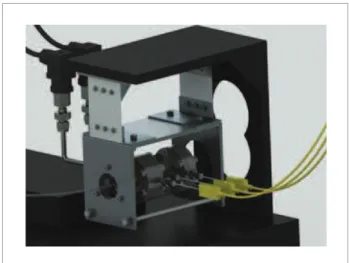
F igure 3. Cut view of thruster with thermocouples and pressure transducers.
Table 1. Plan of experiments.
Test Var 1 Var 2 L (mm) D (mm) F (n)
1 –1.00 –1.00 25 10 1.03
2 1.00 –1.00 35 10 1.06
3 –1.00 1.00 25 20 1.21
4 1.00 1.00 35 20 1.61
5 0.00 0.00 30 15 2.33
6 0.00 0.00 30 15 2.14
7 0.00 0.00 30 15 2.24
8 –1.41 0.00 23 15 1.52
9 1.41 0.00 37 15 1.69
10 0.00 –1.41 30 8 0.71
11 0.00 1.41 30 22 1.59
L = catalytic bed length; D = catalytic bed diameter; F= thrust.
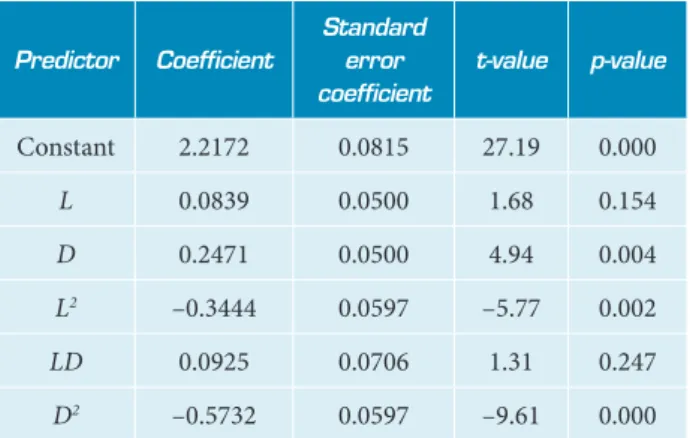
From this model, the inl uences of the variables in the test conditions were represented by level lines of the response surface, as depicted in Fig. 4. h e responses are indicated on z-axis (thrust), with a color bar, as function of the independent variables indicated in the x (diameter) and y (length) axes. Table 2 shows the regression analysis to i t the response function to experimental data.
As seen on Table 2, L and LD present lower coei cients than D, indicating that bed diameter presents a more signii cant inl uence than bed length in this experiment. h e analysis of variance, depicted on Table 3, demonstrates that the model is signii cant,
Diameter (mm) Length (mm)
Thr
u
st (N)
2.5
2
1.5
1
0.5
0
2
1.5
1
0.5
0 22
20 18
16 14
12 10
8 23 25 27 29
31 33 35 37
Figure 4. Contour graphic for the variable response studied: thrust F (N).
as evidenced from the p-value (0.001) obtained. h e model showed a high determination coei cient, which explains 96% of the variability in the response.
According to the contour graphic (Fig. 4), monopropellant microthrusters using the new bulk mixed oxide catalyst for rocket grade stabilized H2O2 decomposition yield optimum thrust when the catalytic bed has length from 29 to 33 mm and diameter from 15 to 17 mm. h rust, specii c impulse and characteristic velocity curves obtained within these optimized dimensions (D = 15 mm and L = 30 mm), with chamber pressure
Pc ~ 5.3 bar, are shown, respectively, in Figs. 5, 6 and 7. h e propellant mass l ow rate ( ) was determined from injection pressure (∆P) considering the following polynomial equation, obtained from a regression of 16 experimental data (up to 9 bar) using water injection, prior to i re tests in the thrust balance:
(1)
h e thruster specii c impulse (Isp) was then determined by:
(2) Table 2. Regression analysis using a 23 full factorial central composite design.
Predictor Coeffi cient
Standard error coeffi cient
t-value p-value
Constant 2.2172 0.0815 27.19 0.000
L 0.0839 0.0500 1.68 0.154
D 0.2471 0.0500 4.94 0.004
L2 –0.3444 0.0597 –5.77 0.002
LD 0.0925 0.0706 1.31 0.247
D2 –0.5732 0.0597 –9.61 0.000 Time (s)
Thr
us
t (N)
2 .5
2 .0
1 .5
1 .0
0 .5
0 .0
2 0 1 5
1 0 5
0
Figure 5. Thrust (N) obtained with CoMnAl based catalyst:
D = 15 mm and L = 30 mm (P
c ~ 5.3 bar).
Time (s)
Is
p (s)
120
100
80
60
40
20
20 12
8 4
0 0
16 Isp = 97 s
Figure 6. Specii c impulse obtained with CoMnAl based catalyst: D = 15 mm and L = 30 mm (P
c ~ 5.3 bar).
Time (s)
c* (m/s)
1000
800
600
400
200
20 12
8 4
0 0
16
c* = 822.3 m/s
Figure 7. Characteristic velocity obtained with CoMnAl based catalyst: D =15 mm and L = 30 mm (P
c ~ 5.3 bar). Table 3. Analysis of variance.
Source Degrees of
freedom SS MS F P
Regression 5 2.6110 0.5222 26.17 0.001
Error 5 0.0997 0.0199
Total 10 2.7107
Table 4. Comparison of c* efi ciencies.
c* efi ciency (%) Catalyst
58 P l a t i num supported in alumina
80 Silver screen
87 Present work
Time (s)
Thr
us
t (N)
2.5
2.0
1.5
1.0
0.5
0.0
20 15 10 5
0 25 30 35 40
Figure 8. Thrust curve obtained during continuous 30-s test with CoMnAl based catalyst (P
c ~ 5 bar).
Time (s)
Thr
us
t (N)
2.5
2.0
1.5
1.0
0.5
0.0
60 40 20
0 80 100 120
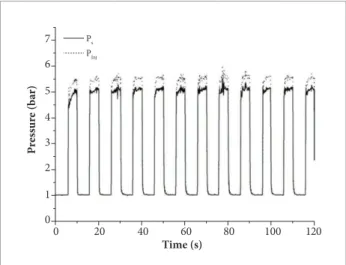
Figure 9. Thrust curve during pulsed test, 5s on/5s off, with CoMnAl based catalyst (P
c ~ 5 bar).
Time (s)
P
ress
ur
e (b
a
r)
6
5
4
2
1
0
60 40 20
0 80 100 120
3
7 Ps
PInj
Figure 10. Pressure curves obtained during a pulse test, 5s on/5s off, with CoMnAl based catalyst.
where F is the measured thrust and go = 9.8065 m/s2 is the
standard gravity acceleration (Sutton and Biblarz, 2000). An average experimental specific impulse of 97 s was obtained (Fig. 6). This value is close to 106 s, the value calculated with the NASA CEA code (1996). Therefore, the experimental result is satisfactory, since various losses occur in the process.
h e experimental characteristic velocity was obtained by:
(3)
where Pc is the measured chamber pressure and At = 3.6 mm2
is the nozzle throat area.
Since the characteristic velocity is a function only of temperature and gas properties in the combustion chamber, one can use this parameter to examine the chamber independently of the nozzle. The theoretical value obtained was 940 m/s and the experimental average value was 822.3 m/s (Fig. 7), corresponding to a characteristic velocity ei ciency of 87%, which indicates incomplete catalytic decomposition. However, this can be considered a high c* ei ciency for hydrogen peroxide decomposition, when compared to results of Pasini et al. (2007) as depicted on Table 4.
CONCLUSIONS
B ulk catalysts based on mixed oxides, containing Co, Mn
and Al, were prepared and showed capable of promoting various cold starts in the decomposition reaction of H2O2 in a 2 N microthruster. he catalyst showed high catalytic activity, despite its low speciic surface. he catalytic bed sizes, for rocket grade H2O2 decomposition using the new CoMnAl based catalyst, were optimized to obtain maximum thrust in a modular microthruster. A design of experiments methodology allowed the determination of the optimum dimensions of the catalytic bed: length from 29 to 33 mm and diameter from 15 to 17 mm. For an optimized catalytic
bed, the measured speciic impulse was 97s, and the characteristic velocity eiciency was about 87%. Additional tests will be performed to evaluate thruster performance in a broader operational range.
ACKNOWLEDGMENTS
The authors acknowledge the Fundação de Amparo à Pesquisa do Estado de São Paulo, the Agência Espacial Brasileira and the Conselho Nacional d e Desenvolvimento Cientíico e
Tecnológico for supporting this research.
REFERENCES
Barros-Neto, B., Scarminio, I.S. and Bruns, R.E, 1995, Planejamento e Otimização de Experimentos, UNICAMP, Campinas, SP, Brazil (in Portuguese).
Goldstein, J.R. and Tseung, A.C.C., 1974, “The kinetics of hydrogen peroxide decomposition catalyzed by cobalt-iron oxides”. Journal of Catalysis, Vol. 32, No. 3, pp. 452-465.
Hasan, M.A., Zaki., M.I., Pasupulety, L. and Kumari, K., 1999, “Promotion of the hydrogen peroxide decomposition activity of manganese oxide catalysts”. Applied Catalysis A, Vol. 181, No. 1, pp. 171-179.
Kappenstein, C., Pirault-Roy, L., Guérin, M., Wahdan, T., Ali, A.A., Al-Sagheer, F.A. and Zaki., M.I., 2002, “Monopropellant decomposition catalysts: thermal decomposition and reduction of permanganates
as models for the preparation of supported MnOx catalysts”. Applied
Catalysis A, Vol. 234, No. 1, pp. 145-153.
McBride, B.J. and Gordon, S., 1996, “Computer program for calculation of complex chemical equilibrium compositions and applications, II-Users manual and program description”, NASA-RP-1311.
Pasini, A., Torre, L., Romeo, L., Cervone, A., d’Agostino, L., Musker, A.J. and Saccoccia, G., 2007, “Experimental characterization of a 5 N hydrogen peroxide monopropellant thruster prototype”,
AIAA 2007-5465, 43rd AIAA/ASME/SAE/ASEE Joint Propulsion
Conference & Exhibit, Cincinnati, OH, USA.
Rusek, J.J., 1996, “New decomposition catalysts and characterization techniques for rocket grade hydrogen peroxide”. Journal of Propulsion and Power, Vol. 12, No. 3, pp. 574-579.
Sutton, G.P. and Biblarz, O., 2000, Rocket Propulsion Elements, 7a ed., John Wiley & Sons.
Vaccari, A., 1998, “Preparation and catalytic properties of cationic and anionic clays”. Catalysis Today, Vol. 41, No. 1-3, pp. 53-71.