Brazilian Journal of Physics, vol. 34, no. 1A, March, 2004 247
Percolation of Monte Carlo Clusters
W.G. Wanzeller
1, A. Cucchieri
2, T. Mendes
2, and G. Krein
11Instituto de F´ısica Te´orica, Universidade Estadual Paulista, Rua Pamplona 145, 01405-900, S ˜ao Paulo, SP, Brasil 2Instituto de F´ısica de S˜ao Carlos, Universidade de S˜ao Paulo, P.O. Box 369, 13560-970, S˜ao Carlos, SP, Brasil
Received on 15 August, 2003.
Percolation theory is of interest in problems of phase transitions in condensed matter physics, and in biology and chemistry. More recently, concepts of percolation theory have been invoked in studies of color deconfinement at high temperatures in Quantum Chromodynamics. In the present paper we briefly review the basic concept of percolation theory, exemplify its application to the Ising model, and present the arguments for a possible relevance of percolation theory to the problem of color deconfinement.
1
Percolation
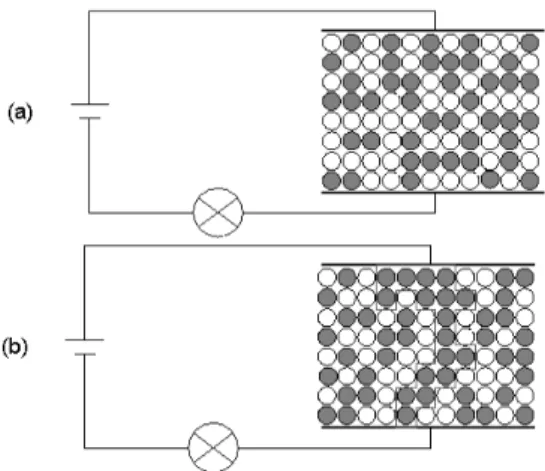
In order to explain the concept of percolation, let us con-sider Fig. 1. The figure represents pictorially an electrical circuit composed of a set of conducting spheres, represented by (•) and a set of insulating spheres, represented by (◦). An electrical current will flow from the top plate to the bot-tom plate and the bulb (⊗) will light once enough conduct-ing spheres are present in the circuit. That is, there will be a “percolating” electrical current through the system when a conducting sphere from the top is continuously connected to a conducting sphere on the bottom. It is intuitively clear that percolation will happen once a minimum of conduct-ing spheres is present in the system, i.e. there is a critical value for the concentration of conducting spheres for which a “percolating cluster” will be formed.
Figure 1. Pictorial representation of percolation. When a continu-ous chain from the top to the bottom is formed as in (b), there will
be a percolating current and the light bulb (⊗) will turn on.
The existence of a critical value for percolation and the consequent formation of a percolation cluster can be illus-trated as follows. Let us consider a square lattice of volume
L×L. For each lattice site, we attribute a probabilitypthat
the site will be occupied, and a probability1−pthat it is empty. A “cluster” is defined as groups of neighboring oc-cupied sites. Suppose now that one fixes a value ofpand at each site of the lattice we draw a random number r. If
r≤p, then one considers that the site is occupied, ifr > p, the site is considered empty. Groups of neighboring occu-pied sites are collected to form a cluster. At the end, one checks if there is at least one cluster that has percolated, that is, if an occupied site from the top of the lattice belonging to some cluster is continuously connected to an occupied site at the bottom of the lattice. Then, the process is repeated many times. Each complete visit to all sites of the lattice is called a “sweep”. Next, we define a percolation probability as
hPi= 1
N
N
X
j=1
Cj, (1)
whereCj ≡ 1(0)if a percolating cluster has (has not)
oc-curred during the sweepj, andNis the number of sweeps. In Fig. 2 we plothPifor different values ofpforL = 100,250,400,600 and 1000, using free boundary condi-tions. One sees that there exists a transition region around a certain value ofpwhere the percolation probability changes from a small value to a value that becomes close to one for large lattices. It is clear that as the lattice becomes larger and larger, the transition region becomes sharper and sharper, with a well defined transition pointpc. In the limit of an
in-finite lattice, for the present case of a two-dimensional cubic lattice the value ofpcis found to be [1]
pc= 0.592746. (2)
Clearly the numerical simulations, for large lattices, givepc
very close to this value. To be more precise, using the prin-ciple of finite-size-scaling, our simulations give [2]
248 W.G. Wanzelleret al.
0.5854 0.5878 0.5902 0.5926 0.595 0.5974 0.5998 p 0 0.1 0.2 0.3 0.4 0.5 0.6 0.7 0.8 0.9 1 <P> 10.000 iteracoes
L = 100 L = 400 L = 600 L = 800 L = 250 L = 1000
Figure 2.hPifor different lattices sizes.
2
Percolation theory in the Ising
Model
The magnetic phase transition that occurs in the Ising model (for dimensions larger than 1) can be related to a percola-tion phenomenon. The relapercola-tion was established in two ma-jor steps. The first step was given in 1972 by Fortuin and Kasteleyn [3], who showed that it is possible to rewrite the partition function of the Ising model as a sum over config-urations of spin clusters, instead of the usual sum over spin configurations, as follows
Z= X
{S=±1}
X
{n}
nij=1
Y
<i,j>
pijδSiSj
nij=0
Y
<i,j>
(1−pij)
, (4) where
pij = 1−exp(−2Jβ), (5)
is the probability that a bond between spins at neighboring sitesiandj occurs, andnij = 1(0)indicates that there is
(there is not) a bond between spins atiandj. Note that a bond may be placed only between spins of the same value. In Eq. (5)β= 1/kT, wherekis the Boltzmann constant and
J is the spin-spin strength, defined in the Ising Hamiltonian as
H =−JX
hiji
SiSj, (6)
where hiji means nearest neighbors andSi = ±1/2 are
spins at sitei. A spin cluster can therefore be naturally de-fined as the collection of spins that are continuously bound. Note that now the probability of a spin to belong to a clus-ter depends on the temperature (and the strength J) as in Eq. (5). The next step was given in 1980 by Coniglio and Klein [4] when they showed, using renormalization group techniques that the magnetic critical temperatureTc of the
Ising model determines the critical value for the occur-rence of a percolating cluster, withpcgiven by the formula
pc = 1−exp(−2J/kTc). The Fortuin-Kasteleyn clusters
were later used (in 1987) by Swendsen and Wang [5] as a very efficient way of performing global spin updates in Monte Carlo simulations of spin models.
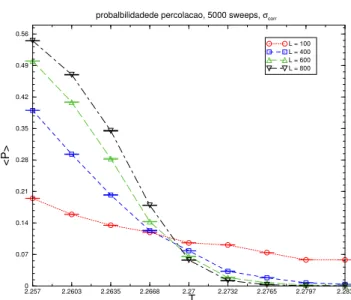
In Fig. 3 we show results of our Monte Carlo simulation for the percolation probabilityhPi, defined in Eq. (1). In the figure we show results for lattice sizesL = 100,400,600 and800. A detailed description of the Swendsen-Wang al-gorithm used, the reasons for using it, comparisons with other Monte Carlo algorithms, and the error analysis per-formed can be found in Ref. [2]. The exact critical temper-ature of the two-dimensional Ising model is (for J = 1)
Tc = 2.269185. Clearly, our simulations show that the
percolation temperature, determined with the use of Eq. (5) shows a good agreement with the exact value. Specifically, we obtained
Tc= 2.2691±0.0001. (7)
2.257 2.2603 2.2635 2.2668 2.27 2.2732 2.2765 2.2797 2.283
T 0 0.07 0.14 0.21 0.28 0.35 0.42 0.49 0.56 <P>
probalbilidadede percolacao, 5000 sweeps, σcorr
L = 100 L = 400 L = 600 L = 800
Figure 3.hPiforL= 100,400,600,and800using the
Swensen-Wang cluster algorithm.
3
Percolation Theory and
Deconfine-ment in QCD
As said above, percolation theory is of interest in several areas of natural science. Our motivation in this theory is driven basically by its possible relevance to the problem of color deconfinement in Quantum Chromodynamics (QCD). The connection between the two phenomena can be argued as follows [6, 8].
Let us consider the formulation of a pureSU(N)gauge theory on an Euclidean lattice withNσpoints in each spatial
direction andNτpoints in the time direction. The partition
function at finite temperature can be written as
Z(Nσ, Nτ;g
2 ) =
Z Y
links
Brazilian Journal of Physics, vol. 34, no. 1A, March, 2004 249
where the integration is over link variablesUµ,
Uµ = exp [−igaAµ(~x, t)], (9)
withathe lattice spacing andµthe space-time direction, and
S[U]is the Wilson action given by
S[U] = 2N
g2
X
P
·
1− 1
NRe Tr(UP)
¸
. (10)
HereP
Pmeans that the sum is done over all plaquettesUP,
where a plaquette is the basic circuit of fourU’s [7]. At finite temperatures, the gauge field configurations are periodic in the “time” interval[0, β]. This periodicity leads to a global symmetry that is important for the phase struc-ture of the theory at finite temperastruc-ture. Because of such a symmetry, gauge transformations in the time direction only need to be periodic up to an elementz of the centerZ(N) ofSU(N). The action remains invariant if the gauge trans-formationGinSU(N)satisfies the condition
G(~x,0) =z G(~x, β), (11) for all spatial pointsx. Now, since an element ofZ(N)is given by
zn =e 2πin
N , n= 0,1,· · ·N−1, (12)
it is easy to show that the quantity, known as the Polyakov loop,
Lx=
1
NTr
Nτ
Y
t=1
U4(~x, t), (13)
changes as
Lx→zLx, (14)
under a gauge transformation as in Eq. (11). An average over the lattice and field configurations,L¯ = hLxi, which
indicates the state of the system, does not change this result. One can show that the free energyF of a very heavy quark immersed in the QCD vacuum is related toL¯as
¯
L∼e−βF. (15)
In the confined phase, one expectsF = ∞, and therefore ¯
L= 0, and the transformation given in Eq. (14) leavesL¯ in-variant. The transition from a confined to a deconfined pure gaugeSU(N)field theory can therefore be characterized by the breaking of the global centerZ(N)symmetry, since in the deconfined phaseL¯ 6= 0breaks the invariance of the the-ory. Studies of lattice gauge theories show that such a phase transition indeed takes place.
Now, it is natural to speculate whether the deconfine-ment phase transition ofSU(N)gauge theories can be stud-ied in analogy to the phase transitions in the much simpler
Z(N)spin systems. In particular, it has been confirmed by lattice gauge simulations that the critical exponents of
SU(2)gauge theory andZ(2)spin system fall in the same universality class. From the discussion in Section II, it is
very natural to conjecture that color deconfinement could be a percolation phenomenon.
Recently, Satz and Fortunato [6, 8] have undertaken per-colation studies forSU(2)gauge theories. This was made possible by the use of the Green-Karsch [9] effective theory which allows to write the partition function of the theory, in the strong coupling limit and neglecting spacelike plaque-ttes, as
Z ∼
Z
ΠxdLx
p
1−L2
xexp(β
′X
ij
LiLj), (16)
whereLiis the value of the Polyakov loop at sitei, the sum
is over nearest neighbors, and
β′= 4
µβ
4
¶Nτ
. (17)
From this, one can define a bond probably (between sites withLi,Ljof the same sign) as
pij = 1−exp{−2β′LiLj}. (18)
4
Conclusions and Future
Perspec-tives
Our aim in this communication was to present the argu-ments in favor of a percolation description of the decon-finement transition in QCD. We started with a brief review the basic concept of percolation theory through a simple ex-ample of site percolation. Then, we proceeded by show-ing as the magnetic phase transition that occurs in the two-dimensional Ising model can be understood as a percolation phenomenon. In the last section, we presented the connec-tion betweenSU(2)gauge theory and effective spin system, as argued by Satz and Fortunato [6, 8].
Using percolation theory, we have measured the criti-cal temperature and the criticriti-cal exponent for the percola-tion process and have compared with the corresponding crit-ical magnetic observables, in conformity with Coniglio and Klein previsions [4]. The conclusion is that the percolation process and the magnetic phase transition of the 2d-Ising model are in the same universality class. Some of the results shown here are not new, but all numerical codes employed in the simulations and error estimates are original.
We are currently extending our percolation studies to the continuousO(4)spin model with magnetic field. Another direction we are pursuing is the evaluation of dinamic criti-cal exponents [10].
Acknowledgments
250 W.G. Wanzelleret al.
References
[1] D. Stauffer and A. Aharony,Introduction to Percolation
The-ory(Taylor & Francis, 1992).
[2] W.G. Wanzeller, Estudo de Percolac¸˜ao de Clusters de
Monte Carlo para o Modelo de Ising Bi-dimen-sional, Master-Dissertation, Instituto de F´ısica Te´orica, IFT/UNESP D.002/03 (2003) (unpublished).
[3] C. M Fortuin and P.W. Kasteleyn, Physica57, 536 (1972).
[4] A. Coniglio and W. Klein, J. Phys. A13, 2775 (1980).
[5] R. Swendsen and J-S. Wang, Phys. Rev. Lett.58, 1 (1987).
[6] H. Satz, Comp. Phys. Commun. 147, 46 (2002); Fortsch.
Phys.50, 541 (2002);Nucl. Phys. A681, 3 (2001).
[7] H.J. Rothe,Lattice Gauge Theories: An Introduction(World
Scientific, 1998).
[8] S. Fortunato,Percolation and Deconfinement in SU(2) Gauge
Theory. PhD Thesis, Physics Faculty, University of Bielefeld.
[9] F. Green and F. Karsch, Nucl. Phys. B238, 297 (1984).