1166 Arq Bras Endocrinol Metab 2007;51/7
ABSTRACT
Parathyroid scintigraphies have been used to detect pathological parathy-roid glands either before as well as after the parathyparathy-roid resection surgery in patients with hyperparathyroidism. One of the most utilized techniques to perform the studies is the double-phase images with Tc-99m sestamibi, which has been shown to be very accurate in the localization of enlarged parathyroid glands. Similar to Tc-99m sestamibi, Tc-99m tetrofosmin is a radiopharmaceutical initially developed to perform myocardial perfusion study that has been used to perform parathyroid scintigraphies. Although most of the papers suggest that the overall sensitivities of both radiophar-maceuticals are similar, there are some papers questioning the accuracy of Tc-99m tetrofosmin to detect abnormal parathyroid glands. In the present article, we report a case with discordant results by both methods. (Arq Bras Endocrinol Metab 2007;51/7:1166-1168)
Keywords:Scintigraphy; Parathyroid; MIBI; Sestamibi; Tetrofosmin
RESUMO
Resultados Discordantes em Cintilografias das Paratireóides Realizadas com Tetrofosmin-99mTc e com Sestamibi-99mTc
A cintilografia das paratireóides tem sido utilizada para detectar glândulas paratireóides patológicas tanto antes quanto após (em caso de insucesso) a cirurgia de ressecção em pacientes com hiperparatireoidismo. Uma das técnicas mais utilizadas para realizar este exame é a de duas fases utilizando como radiofármaco o sestamibi-99mTc, a qual tem se mostrado acurada na localização de glândulas paratireóides aumentadas. Similarmente ao sestamibi-99mTc, o tetrofosmin-99mTc é um radiofármaco que foi inicialmente desenvolvido para a realização de cintilografia de perfusão do miocárdio e que tem sido utilizado para a realização de cintilografia das paratireóides. Apesar de muitos artigos sugerirem que as sensibilidades dos dois radiofármacos são idênticas, alguns poucos trabalhos questionam a acurácia do tetrofosmin-99mTc para a localização de glândulas paratireóides anômalas. No presente artigo, relatamos um caso em que foi observado resultado discordante pelos dois métodos. (Arq Bras Endocrinol Metab 2007;51/7:1166-1168)
Descritores:Cintilografia de paratireóides; Paratireóide; MIBI; Sestamibi; Tetrofosmin
P
ARATHYROID SCINTIGRAPHY IS USUALLY performed in patients with recurrent hyperparathyroidism after the resection of the parathyroid glands or as a pre-operative “roadmap” to shorten the duration of surgery and the length of the incision (1-3). There are different techniques to per-form parathyroid scintigraphies. One of the most utilized is the double-phase image with Tc-99m sestamibi (sestamibi). This technique has beenapresentação de caso
Discordant Results in Tc-99m Tetrofosmin and Tc-99m
Sestamibi Parathyroid Scintigraphies
PAULOSCHIAVOMDUARTE
FERNANDAC. DOMINGUES
MICHELESANTICOSTA
CYNTHIABRANDÃO
MARCOA.C. DEOLIVEIRA
JOSÉG.H. VIEIRA
Fleury — Centro de Medicina Diagnóstica, São Paulo, SP.
Discordant Results in Parathyroid Scintigraphies Duarte et al.
1167 Arq Bras Endocrinol Metab 2007;51/7
shown to be very accurate in the localization of parathy-roid adenomas. Similar to sestamibi, the Tc-99m tetro-fosmin (tetrotetro-fosmin) is a radiopharmaceutical initially developed to perform myocardial perfusion study that has been used to perform parathyroid scintigraphies. There are papers comparing the double-phase parathy-roid scintigraphy with sestamibi with that performed with tetrofosmin. These papers suggest that there is a difference in the washout of the radiopharmaceutical from the thyroid tissue, with a delay washout with tetro-fosmin, but the overall sensitivities of the methods are reported to be similar (4-10). However, there are some papers questioning the accuracy of tetrofosmin to detect abnormal parathyroid glands (11,12). In our short experience with tetrofosmin, we observed potential lim-itations of this radiopharmaceutical agent as a marker for enlarged parathyroid gland.
CASE REPORT
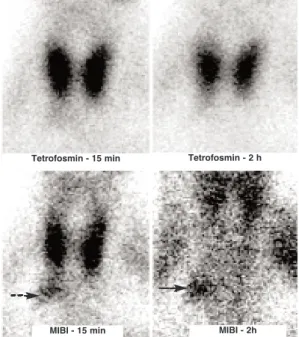
A 65-year-old woman with high serum calcium (11.7 mg/dL — normal range from 8.4 to 10.2 mg/dL) and PTH (250 pg/mL — normal range from 10 to 65 pg/mL) concentrations showed a negative double-phase parathyroid scintigraphy with tetrofosmin (fig-ure 1). Since we have little experience with
double-phase parathyroid scintigraphy with tetrofosmin (as opposed to sestamibi), and as there was a high proba-bility of a positive parathyroid scintigraphy result with sestamibi with such high levels of calcium and PTH (13,14), another parathyroid scintigraphy with ses-tamibi was performed one week later. The second study demonstrated a region of slight sestamibi uptake (arrow) inferior to the right thyroid lobe (figure 1). The SPECT images (figure 2) of the parathyroid scintigraphy with sestamibi confirmed a focal uptake inferior and posterior to the right thyroid lobe (arrows). A parathyroid adenoma in this location was surgically removed one month later. After the surgery, calcium and PTH plasmatic concentrations fell to 8.5 mg/dL and 49 pg/mL, respectively.
DISCUSSION
Tetrofosmin is a radiopharmaceutical similar to ses-tamibi that has been extensively used to perform myocardial perfusion studies. Once sestamibi has been also used to perform parathyroid scintigraphy studies, some researchers have analyzed the usefulness of tetro-fosmin in this last application. Although most of the articles show that the overall sensitivities of the meth-ods are similar (4-10), there are some papers ques-tioning the accuracy of tetrofosmin to detect abnormal parathyroid glands (11,12). In the case herein
report-Figure 1.The parathyroid scintigraphy performed with Tc-99m tetrofosmin (upper row) and Tc-Tc-99m sestamibi (lower row) are presented. There is a region with Tc-99m sestamibi (MIBI) uptake (arrow) inferior to the right thyroid lobe. There is no similar uptake on the scintigraphy performed with Tc-99m tetrofosmin.
Figure 2. The SPECT images from the parathyroid scintigraphy with Tc-99m sestamibi confirmed a focal uptake localized inferior and posterior to the right thyroid lobe (arrows).
Tetrofosmin - 15 min
MIBI - 15 min MIBI - 2h
Tetrofosmin - 2 h
TRANSVERSAL
CORONAL
SAGITTAL
36
23 24 25 26
47 48 49 50
Discordant Results in Parathyroid Scintigraphies Duarte et al.
1168 Arq Bras Endocrinol Metab 2007;51/7
ed the results of both methods were discordant with a false-negative finding on tetrofosmin. The reason for these discordant results could be the differences in the washout kinetics of them. Arbab et al. (15,16) found in both myocardial and tumor cells that only a part of the accumulated tetrofosmin entered the mitochon-dria, whereas most of the sestamibi accumulation was related to mitochondrial uptake. This difference in mitochondrial accumulation could be the cause of the discordance in the results of these two radiopharma-ceuticals, when used to perform parathyroid scintigra-phy.
CONCLUSION
Although tetrofosmin and sestamibi are similar radio-pharmaceuticals, there are discordant findings on parathyroid scintigraphy studies. In the case here reported, sestamibi was superior to tetrofosmin.
REFERENCES
1. Carty SE, Worsey J, Virji MA, Brown ML, Watson CG. Concise parathyroidectomy: the impact of preoperative SPECT 99mTc sestamibi scanning and intraoperative quick parathormone assay. Surgery 1997;122:1107-14.
2. Casas AT, Burke GJ, Mansberger AR Jr., Wei JP. Impact of technetium-99m-sestamibi localization on operative time and success of operations for primary hyperparathyroidism. Am Surg 1994;60:12-6.
3. Irvin GL III, Prudhomme DL, Deriso GT, Sfakianakis G, Chan-darlapaty SK. A new approach to parathyroidectomy. Ann Surg 1994;219:574-9.
4. Aigner RM, Fueger GF, Nicoletti R. Parathyroid scintigraphy: comparison of technetium-99m methoxyisobutylisonitrile and technetium-99m tetrofosmin studies. Eur J Nucl Med 1996;23:693-6.
5. Fjeld JG, Erichsen K, Pfeffer PF, Clausen OP, Rootwelt K. Technetium-99m-tetrofosmin for parathyroid scintigraphy: a comparison with sestamibi. J Nucl Med 1997;38:831-4. 6. Gallowitsch HJ, Mikosch P, Kresnik E, Gomez I, Lind P.
Tech-netium 99m tetrofosmin parathyroid imaging. Results with double-phase study and SPECT in primary and secondary hyperparathyroidism. Invest Radiol 1997;32:459-65.
7. Ishibashi M, Nishida H, Hiromatsu Y, Kojima K, Tabuchi E, Hayabuchi N. Comparison of technetium-99m-MIBI, tech-netium-99m-tetrofosmin, ultrasound and MRI for localization of abnormal parathyroid glands. J Nucl Med 1998;39:320-4. 8. Mansi L, Rambaldi PF, Marino G, Pecori B, Del Vecchio E. Kinetics of Tc-99m sestamibi and Tc-99m tetrofosmin in a case of parathyroid adenoma. Clin Nucl Med 1996;21:700-3. 9. Vallejos V, Martin-Comin J, Gonzalez MT, Rafecas R, Munoz
A, Fernandez A, et al. The usefulness of Tc-99m tetrofosmin scintigraphy in the diagnosis and localization of hyperfunc-tioning parathyroid glands. Clin Nucl Med 1999;24:959-64. 10. Wakamatsu H, Noguchi S, Yamashita H, Yamashita H, Tamura S, Jinnouchi S, et al. Technetium-99m tetrofosmin for parathy-roid scintigraphy: a direct comparison with (99m)Tc-MIBI, (201)Tl, MRI, and US. Eur J Nucl Med 2001;28:1817-27. 11. Giordano A, Meduri G, Marozzi P, Rubini G, Burroni L,
Cap-pagli M. Differences between sestamibi and 99mTc-tetrofosmin uptake in thyroid and salivary glands: compari-son with 99mTc-pertechnetate in 86 subjects. Nucl Med Commun 2003;24:321-6.
12. Harrell RM, Mackman DM, Bimston DN. Nonequivalent results of tetrofosmin and sestamibi imaging of parathyroid tumors. Endocr Pract 2006;12:179-82.
13. Duarte PS, Decker HH, Aldighieri FC, Brandão C, Alonso G, Vieira JG. The relation between serum levels of calcium and PTH and the positivity of parathyroid scintigraphy with ses-tamibi — analysis of 194 patients. Arq Bras Endocrinol Metab 2005;49:930-7.
14. Sousa CA, Duarte PS, Pereira JC. Fuzzy logic and logistic regression in the decision making for parathyroid scintigra-phy study. Rev Saúde Pública 2006;40:898-906.
15. Arbab AS, Koizumi K, Toyama K, Araki T. Uptake of tech-netium-99m-tetrofosmin, technetium-99m-MIBI and thallium-201 in tumor cell lines. J Nucl Med 1996;37:1551-6. 16. Arbab AS, Koizumi K, Toyama K, Arai T, Araki T.
Technetium-99m-tetrofosmin, technetium-99m-MIBI and thallium-201 uptake in rat myocardial cells. J Nucl Med 1998;39:266-71.
Endereço para correspondência:
Paulo Schiavom Duarte
Fleury — Centro de Medicina Diagnóstica Seção de Medicina Nuclear
Rua Cincinato Braga 282 01333-910 São Paulo, SP Fax: (11) 5014-6788