Low-dose dobutamine myocardial perfusion scintigraphy
in the identification of viable myocardium*
Cintilografia de perfusão miocárdica sob baixa dose de dobutamina na identificação do miocárdio viável
Renata Freire de Moraes1, José Cláudio Meneghetti2, Adelanir Antonio Barroso3
OBJECTIVE: To evaluate the increase in specificity of dual isotope myocardial perfusion gated SPECT (99m Tc-sestamibi/thallium-201), a highly sensitive method to detect viable myocardium, with addition of data on con-tractile reserve simultaneously acquired by low-dose dobutamine gated SPECT, similarly to echocardiography. MATERIALS AND METHODS: A total of 260 myocardial segments were assessed in 13 patients with myocar-dial infarction referred for investigation of myocarmyocar-dial viability before undergoing revascularization. Cellular integrity and contractile reserve were evaluated by dual isotope perfusion myocardial gated SPECT with thallium rest and redistribution images and post-stress 99m
Tc-sestamibi gated-SPECT images under basal conditions and with low-dose dobutamine. The improvement in the contractile performance detected by post-revasculari-zation 99m
Tc-sestamibi gated SPECT was the parameter considered for determining myocardial viability. For the purpose of results analysis, the functional parameters of the myocardial segments were quantified at the different phases of the study and stratified according to their viability for a later post-revascularization func-tional comparison. RESULTS: In the statistical analysis, systolic wall thickening demonstrated to be a relevant parameter in the evaluation of myocardial contractile reserve by this method, with a tendency of improve-ment in the specificity (84%), demonstrating higher values than those observed in the literature. CONCLU-SION: This method tends to present an effective contribution in the assessment of myocardial viability.
Keywords: Left ventricular dysfunction; Dobutamine; Scintigraphy.
OBJETIVO: Verificar se a cintilografia de perfusão miocárdica duoisotópica(99mTc-sestamibi/tálio-201), mé-todo de alta sensibilidade para identificação do músculo viável, tem sua especificidade aumentada com a inclusão de informações sobre reserva contrátil miocárdica obtidas simultaneamente através de gated SPECT
na vigência de baixas doses de dobutamina de forma semelhante ao ecocardiograma. MATERIAIS E MÉTO-DOS: Estudaram-se 260 segmentos miocárdicos de 13 pacientes com infarto do miocárdio, encaminhados para pesquisa de viabilidade antes do procedimento de revascularização. Avaliaram-se a integridade celular e a reserva contrátil pela cintilografia de perfusão miocárdica duoisotópica com imagens de repouso e redis-tribuição do tálio-201 e de estresse (99m
Tc-sestamibi gated SPECT), em condições basais e na vigência de baixas doses de dobutamina. A melhora do desempenho contrátil em controle cintilográfico pós-revascula-rização (99m
Tc-sestamibi gated SPECT) confirmava a presença de viabilidade. Para análise dos resultados quantificaram-se os parâmetros funcionais dos segmentos miocárdicos nas diferentes etapas do estudo, estratificando-os quanto à viabilidade para posterior comparação funcional pós-revascularização. RESULTA-DOS: No tratamento estatístico a análise do espessamento sistólico se destacou como parâmetro de avalia-ção da reserva contrátil miocárdica pelo método, mostrando tendência a incremento na especificidade (84%), demonstrando valores superiores aos da literatura. CONCLUSÃO: O método tende a apresentar contribui-ções efetivas na busca do miocárdio viável.
Unitermos: Disfunção ventricular esquerda; Dobutamina; Cintilografia.
Abstract
Resumo
* Study developed in the Department of Radiology at Hospital das Clínicas da Faculdade de Medicina da Universidade de São Paulo (HC-FMUSP), São Paulo, SP, and in the Unit of Nuclear Medicine at Hospital Socor/Nuclear Medcenter, Belo Horizonte, MG, Brazil.
1. PhD, Nuclear Physician at Division of Nuclear Medicine, Department of Molecular Imaging and Diagnosis of Instituto Hermes Pardini, Belo Horizonte, MG, Brazil.
2. Doctor Professor, Director for the Unit of Nuclear Medicine and Molecular Imaging of Instituto do Coração (InCor) – Hospi-tal das Clínicas da Faculdade de Medicina da Universidade de São Paulo (HC-FMUSP), São Paulo, SP, Brazil.
3. Master, Nuclear Physician, Director for Nuclear Medcen-ter, Belo Horizonte, MG, Brazil.
in mortality rates as a consequence of the effective treatment of acute coronary syn-dromes. Two thirds of the patients with heart failure present coronary artery disease as the main etiology(1). The long-term prog-nosis for heart failure is quite unfavorable, being accountable for 20% of all hospital-izations of individuals above 65 years of age, with an annual mortality rate close to 45%(2). Ischemic ventricular dysfunction Moraes RF, Meneghetti JC, Barroso AA. Low-dose dobutamine myocardial perfusion scintigraphy in the identification of viable myocardium. Radiol Bras. 2010;43(5):281–287.
Mailing address: Dra. Renata Freire de Moraes. Instituto Her-mes Pardini, Divisão de Medicina Nuclear. Rua dos Aimorés, 66, Funcionários. Belo Horizonte, MG, Brazil, 30140-070. E-mail: [email protected]
Received January 10, 2010. Accepted after revision August 11, 2010.
INTRODUCTION
may result from the presence of scar or hi-bernation, stunning and ischemic precon-ditioning as adaptive responses of the myocytes to the decrease in blood flow, reducing their metabolism in order to re-main alive(2,3). The progression of ischemic cardiomyopathy can be modified with the recovery of myocardial contractility, once the coronary blood flow is reestablished(4). The identification of viable myocardium has become essential in the medical pro-pedeutic, as in the presence of living tissue, post-revascularization contractility recov-ery may be obtained, with improvement in the patient’s quality of life and decrease in mortality(4–8).
In a meta-analysis, Allmann et al.(9) have observed a significant association between revascularization and improvement in the survival of patients with coronariopathy and ventricular dysfunction, but with myo-cardial viability at imaging studies and that, the more deteriorated the left ventricular function, the better was the result. The an-nual mortality rate among patients with myocardial viability who were surgically treated was as low as 3.2% as compared with a rate of 16% for those submitted to pharmacological treatment. More than 40% of revascularized patients presented improvement in the left ventricle ejection fraction. A greater postoperative mortality was observed in the absence of myocardial viability, reflecting the high risk of the pro-cedure in the absence of clinical benefit.
Thallium-201 scintigraphy and stress echocardiography are the most utilized imaging methods for investigating of myo-cardial viability, considering the smaller availability of methods such as positron emission tomography and magnetic reso-nance imaging(10). Thallium-201, a potas-sium analog, identifies the cellular integ-rity, and echocardiography evaluates the contractile reserve through the inotropic stimulus of dobutamine(11). Both methods evaluate different parameters of myocar-dial viability, with differences in accuracy: thallium-201 presents a high sensitivity, while echocardiography presents a high specificity(12,13).
Gated SPECT images allow the evalu-ation of the myocardial contractility, mak-ing the investigation of the contractile re-serve possible, with the simultaneous
evaluation of cellular integrity, which po-tentially would increment the specificity of scintigraphy in the investigation of viable myocardium(14).
The objective of the present study was to evaluate the increase in specificity of dual isotope myocardial perfusion gated SPECT (99mTc-sestamibi/thallium-201), a
highly sensitive method to detect viable myocardium, with addition of data on con-tractile reserve simultaneously acquired by low-dose dobutamine gated SPECT.
MATERIALS AND METHODS
Cellular integrity and contractile reserve of 260 myocardial segments were evaluated by means of scintigraphic techniques in 13 previously infracted patients with ischemic cardiomyopathy referred to the Unit of Nuclear Medicine for investigation of myo-cardial viability. The patients were subse-quently revascularized and underwent scin-tigraphic follow-up for evaluation of post-revascularization contractile performance. The present study was approved by the Committee for Ethics in Research of the authors’ institutions, and the patients signed a term of free and informed consent for participating in the research protocol.
The mean patients’ age was 58.9 years; 12 patients were men (92.3%) and one, woman (7.6%). The mean time elapsed from myocardial infarction ranged between 3 and 15 months and all the patients pre-sented segmental contractile dysfunction at echocardiography. In this group, 7 patients (54%) had been previously revascularized, 11 (84.6%) reported angina, all of them (100%) presented hypertension, 9 (69.2%) dyslipidemia, and 5 (38.4%), diabetes. Seven patients (53.8%) reported regular use of beta blockers, seven (53.8%) used vasodilators and six (46.1%), calcium channel blockers.
Dual isotope perfusion myocardial scin-tigraphy was performed with stress images (99mTc-sestamibi), rest and redistribution
(thallium-201 chloride) for myocardial vi-ability investigation.
Stress images (99mTc-sestamibi) were
acquired in synchronization with electro-cardiography (gated SPECT), allowing the evaluation of contractile function through the analysis of parietal motility and systolic
thickening (contractility), ejection fraction and cardiac volumes. A second acquisition (low-dose dobutamine gated SPECT) was added for evaluation of the myocardial contractile reserve.
The improvement of the contractile dys-function at the post-revascularization scin-tigraphic study (99mTc-sestamibi gated
SPECT) was considered as parameter of myocardial viability.
Images acquisition protocol
A two-day protocol with rest/redistribu-tion and stress phases in different days was utilized for images acquisition with the pa-tients lying in the supine position, with the arms elevated above the head, in a VariCam®
scintillation chamber (Elscint; Haifa, Is-rael) with detectors at 90° to each other, coupled with an eNtegra® workstation
(General Electric Medical Systems; Mil-waukee, WI, USA). A high-resolution col-limator was utilized on a circular 180° or-bit, initiating in a 45°oblique right anterior incidence with angular step of 6°, 64 × 64 matrix, zoom of 1.28 and 10% window at the photopeak and 140 keV for 99m
Tc-sestamibi acquisitions and 72 and 163 keV for thallium-201 images. Attenuation cor-rection was not performed.
Rest and redistribution images were ac-quired after 4 hour-fasting, with an intra-venous dose of 130 MBq of thallium-201 chloride (IPEN-CNEN), with rest images being acquired after 20 minutes in 30 steps of 35 seconds, and redistribution images four to six hours after, in 30 steps of 45 seconds.
For the physical or pharmacological stress images acquisition, the ingestion of a light meal was allowed up to two hours previously to the examination, and the pa-tients were encouraged to interrupt the use of beta blockers, calcium channel blockers and vasodilators for a period of 48 hours. Physical stress was achieved with maxi-mum isotonic exercise on a treadmill uti-lizing the Bruce’s protocol with continuous hemodynamic and electrocardiographic monitoring. The 99mTc-sestamibi dose of
Pharmacological stress (dipyridamole) required previous suspension of xanthines, caffeine and derivatives. An intravenous dipyridamole dose (0.56 mg/kg) was ad-ministered over five minutes under con-tinuous hemodynamic and electrocardio-graphic monitoring. The radiopharmaceu-tical drug was injected two minutes after completion of the coronary vasodilator in-fusion and the images were acquired 90 minutes afterwards.
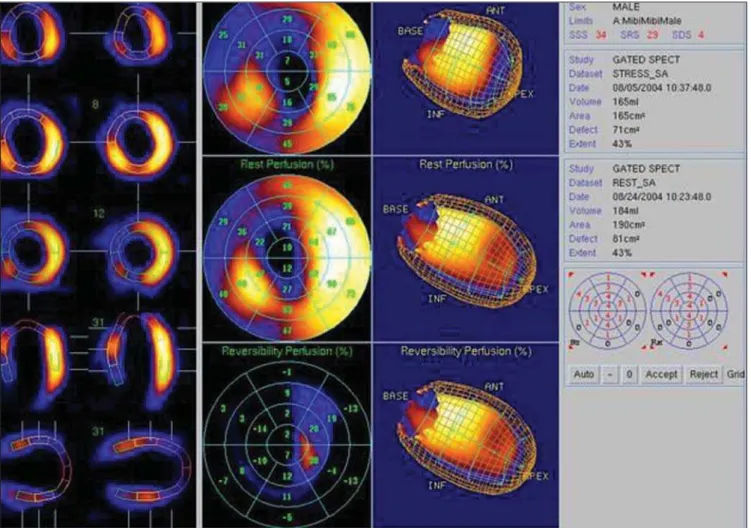
Two sets of CT images (gated SPECT) were acquired under stress and basal con-ditions and with low-dose dobutamine, with the cardiac cycle divided into eight pictures and images acquired in 30 steps of 30 seconds (Figure 1). Once the first acqui-sition was completed, continuous infusion of dobutamine (5 µg/kg/min) was started through peripheral vein by means of an infusion pump for five minutes, increasing to 10 to 15 µg/kg/min, coinciding with the beginning of images acquisition to its completion (15 minutes on average).
Images processing
The images were processed by filtered retroprojection (Butterworth filter) at a cut-off frequency of 0.25 and order 5 for thal-lium-201 chloride and cut-off frequency of 0.5 and order 5 for 99mTc-sestamibi.
For the analysis of results, the Cedars-Sinai Quantitative SPECT QGS/QPS ap-plication (Berman, Germano) (Elgems GE) was utilized, with the division of the heart into 20 segments and automatic quantifi-cation of the perfusion, parietal contractil-ity and motilcontractil-ity at different moments of the study (Figures 2 and 3). The method allows an increase in the number of relevant pa-rameters that may be objectively measured and with reproducibility(15).
Follow-up
From the third month following myo-cardial revascularization, 99mTc-sestamibi
gated SPECT was performed with images acquisition 45 minutes after intravenous
99mTc-sestamibi injection under basal
con-ditions.
Results analysis
In order to evaluate perfusional viabil-ity, the statistically significant difference between the scores of the myocardial
seg-Figure 2. Myocardial segmentation model. Myocardial segments: distal anterior (1), medial (7), basal (13); distal anteroseptal (2), medial (8), basal (14); distal inferoseptal (3), medial (9), basal (15); distal inferior (4), medial (10), basal (16); inferolateral (5), medial (11), basal (17); anterolateral (6), medial (12), basal (18); distal antero-apical (19), distal infero-apical (20).
ments at the stress and rest and rest and redistribution images was analyzed.
The difference between scores regard-ing systolic thickenregard-ing and parietal motil-ity under basal conditions and inotropic stimulus was evaluated to determine the myocardial contractile reserve.
For analysis of post-revascularization improvement in contractility, differences between scores of contractility under basal and post-revascularization conditions were compared.
Values for final diastolic and systolic volumes and left ventricle ejection fraction (LVEF) were analyzed under basal, inotro-pic and post-revascularization conditions. In the evaluation of the method speci-ficity, the presence of contractile reserve in the segments with contractile dysfunction, myocardial viability at thallium-201, and improvement of contractility in the post-revascularization follow-up were taken into consideration.
Statistical analysis
Descriptive analysis of the studied vari-ables was performed.
Frequency distribution tables were con-structed for categorical variables, and for the continuous variables, central trend measurement and scatterplots were calcu-lated.
The marginal homogeneity test was uti-lized for comparison of perfusion, contrac-tility and parietal mocontrac-tility patterns of the myocardial segments in different situa-tions.
The McNemar’s test was utilized to evaluate the relationship between post-revascularization improvement and con-tractile reserve.
Given the asymmetrical character of the distribution, the non-parametric paired Wilcoxon test was utilized to compare the
measurements of final diastolic and sys-tolic volumes and ejection fraction.
A level of significance corresponding to 5% was considered in the analyses in the present study. The SPSS 12.0 and Statxact 6.0 softwares were utilized.
RESULTS
No symptom related to the intravenous dobutamine infusion was reported by the patients during the proposed scintigraphic study.
Seven (53.8%) patients underwent phar-macological stress while six (46.2%) un-derwent isotonic exercise.
Angioplasty with implant placement was performed in nine (69.2%) patients, and myocardial revascularization surgery was performed in four patients (30.7%).
The post-revascularization follow-up was performed in a mean period of 8.8 months after the procedures.
Functional parameters in basal conditions and under inotropic stimulus
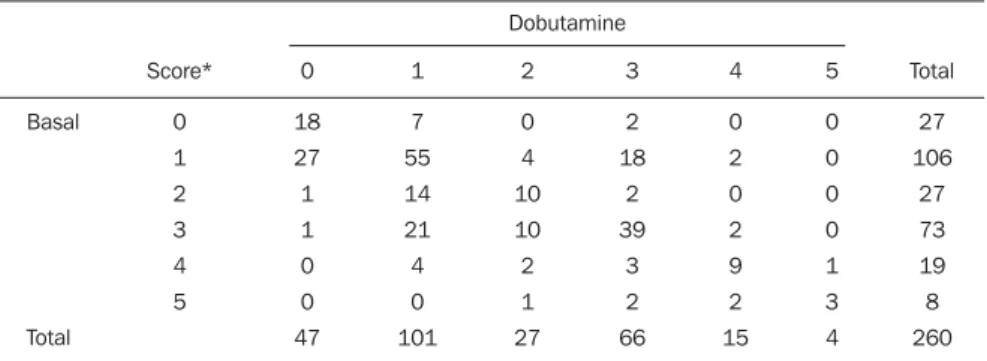
Tables 1 and 2 demonstrate statistically significant differences between the two moments (p-value < 0.001), with better
contractility and parietal motility with low-dose dobutamine in relation to the basal study.
On average, the final diastolic and sys-tolic volumes were smaller with the use of dobutamine (143.7 and 87.8) and greater in the basal study (151 and 100.6). The mean LVEF was smaller under basal condition (35%) than under dobutamine stimulus (41%).
Functional parameters under basal conditions and in the
post-revascularization follow-up
Tables 3 and 4 demonstrate compari-sons between contractility and parietal motility in the segments under basal con-dition and post-revascularization. Statisti-cally significant differences were observed between the two moments (Table 3, p-value
< 0.001; Table 4, p-value = 0.003), with
greater post-revascularization contractility and parietal motility as compared with basal motility.
On average, the final diastolic and sys-tolic volumes were smaller after revascu-larization (136.6 and 85), as compared with the basal study (151 and 100.6). The mean LVEF was smaller under basal condition (35%) and greater after revascularization (41%).
Analysis of contractile performance in the post-revascularization
scintigraphic follow-up of myocardial segments with contractile dysfunction but viable at thallium-201
Fifty-eight (22.4%) myocardial seg-ments with contractile dysfunction pre-sented stress-induced ischemia and 63 (24.3%) presented persistent hypoper-fusion but viable at thallium-201. Overall, 98 myocardial segments (37.8%) were vi-able, i.e., presented stress-induced is-chemia, viability at thallium-201 or both si-multaneously.
As basal and post-revascularization contractility of the 98 segments are com-pared, statistically significant differences are observed between the two moments (p
-value = 0.008), with improvement in the contractility after revascularization.
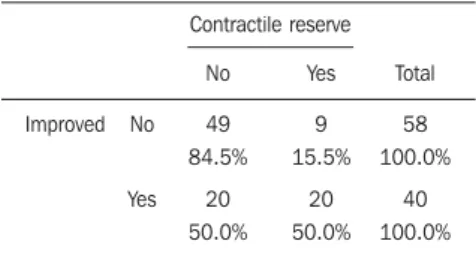
Table 5 shows that 58 segments pre-sented no post-revascularization improve-ment and that contractile reserve was not observed in most of them (84.5%). The McNemar’s test demonstrated a borderline
p-value (0.061), demonstrating a tendency
towards a statistically significant result. As basal and post-revascularization pa-rietal motility of the 98 viable segments at thallium-201 are compared, no statistically significant difference can be confirmed between the two moments (p-value > 0.05).
Additionally, the authors observed that 59 segments demonstrated no
improve-Table 2 Comparison of basal versus low-dose dobutamine motility.
Basal Score* 0 1 2 3 4 5 Dobutamine Total 0 18 27 1 1 0 0 47 1 7 55 14 21 4 0 101 2 0 4 10 10 2 1 27 3 2 18 2 39 3 2 66 4 0 2 0 2 9 2 15 5 0 0 0 0 1 3 4 Total 27 106 27 73 19 8 260
Marginal homogeneity (p-value < 0.001).
* Score: 0, normal; 1, subtle hypomotility; 2, moderate hypomotility; 3, severe hypomotility; 4, akinesia; 5, dys-kinesia.
Table 1 Comparison of basal versus low-dose dobutamine contractility.
Basal Score* 0 1 2 3 Dobutamine 0 3 14 1 2 1 4 107 33 6 2 0 14 36 11 3 0 7 9 13 Total 7 142 79 32
Marginal homogeneity (p-value < 0.001).
* Score: 0, normal; 1, subtle hypocontractility; 2, moderate hypocontractility; 3, severe hypocontractility.
Table 3 Comparison of basal versus post-revascularization contractility.
Basal Score* 0 1 2 3 Post-revascularization 0 6 43 7 4 1 1 71 31 12 2 0 19 28 11 3 0 9 12 4 Total 7 142 79 32
Marginal homogeneity (p-value < 0.001).
* Score: 0, normal; 1, subtle hypocontractility; 2, moderate hypocontractility; 3, severe hypocontractility.
Table 4 Comparison of basal versus post-revascularization motility.
Basal Score* 0 1 2 3 4 5 Post-revascularization Total 0 13 30 3 7 2 0 55 1 9 36 13 26 7 2 93 2 0 17 4 8 1 0 30 3 4 18 6 28 3 3 62 4 1 5 1 2 5 2 16 5 0 0 0 2 1 1 4 Total 27 106 27 73 19 8 260
Marginal homogeneity (p-value < 0.003).
ment in motility after revascularization. Among these segments, the majority (78%) did not present contractile reserve. How-ever, according to the p-value demonstrated
by the McNemar’s test (> 0.05), such result is not statistically significant.
DISCUSSION
The protocol described in the present study is simple and easy to perform.
The patients presented good tolerance to the proposed scintigraphic procedure, and did not present symptoms during the intra-venous dobutamine infusion. According to Kasama et al.(16), who have performed gated SPECT with low-dose dobutamine in 26 patients with dilated myocardiopathy, dobutamine in low doses presents a pow-erful chronotropic effect and minimum arrhythmogenic or vascular effect.
The size of the sample was considered as a limiting factor in the present study.
The investigation of viable myocardium by means of perfusion and myocardial me-tabolism studies by nuclear medicine is in agreement with initial reports on myocar-dial viability. The radioisotope techniques require few viable cells to demonstrate cellular integrity, but these cells may be insufficient for post-revascularization con-tractile recovery. It seems that the presence of a minimum amount of viable myocar-dium is required for the detection of con-tractile reserve(17).
In an attempt to improve the specificity of thallium-201, a widely utilized method, some authors have reported experiments with low-dose dobutamine gated SPECT, similarly to stress echocardiography, to al-low the analysis of perfusion and myocar-dial contractile reserve during a single
ex-amination. Different authors have also demonstrated that this technique is quite reproducible in relation to stress echocar-diography and magnetic resonance imag-ing(18,19). Yoshinaga et al.(20), in a study with 23 patients comparing 99mTc-sestamibi
gated SPECT under low-dose dobutamine and with echocardiography and positron-emission tomography, demonstrated a good correlation of the results of contractile re-serve between the two methods. Leoncini et al.(21), in a study with 63 patients with 99mTc-sestamibi gated SPECT under
low-dose dobutamine have observed 79% sen-sitivity and 78% specificity in the predic-tion of the post-revascularizapredic-tion increase in LVEF under inotropic stimulus. Simões et al.(22) have demonstrated the increase in methods accuracy from 0.69 to 0.84 with data regarding contractile reserve obtained by means of thallium-201 gated-SPECT under low-dose dobutamine. Duncan et al.(23) have studied 16 patients with 99m
Tc-sestamibi gated SPECT and confirmed the effectiveness of the method in the predic-tion of post-revascularizapredic-tion increase in ejection fraction, similarly to results re-ported by Leoncini et al.(21).
For the 13 patients evaluated in the present study, myocardial viability at thal-lium-201 was considered in the presence of perfusional reversibility between the per-fusion phases, regardless the uptake de-gree. Kitsiou et al.(24) have demonstrated that reversible thallium defects are more accurate in the prediction of post-revascu-larization contractile recovery than irrevers-ible thallium defects with uptake > 50%, frequently corresponding to subendocar-dial fibrosis that cannot improve contrac-tility after revascularization. The presence of myocardial ischemia is required for the contractile performance recovery after revascularization, i.e., that is, the artery accountable by the blood supply in the ter-ritory must be stenotic, or otherwise, in the presence of cellular structural damage the post-revascularization contractile recovery will not occur(25). Candell-Riera et al.(26) have performed an investigation on con-tractile reserve by means of low-dose dobutamine gated SPECT in patients with coronariopathy and reported that a negative contractile reserve was observed particu-larly in viable myocardial segments which
did not recover contractility after revascu-larization and were supplied by a patent coronary artery.
Positive contractile reserve was consid-ered in the presence of improvement in the contractility of the investigated myocardial segments, independently of the increase in LVEF with inotropic stimulus. The increase in LVEF varied among the patients accord-ing to the viability parameters. The greater the myocardial viability at the perfusion evaluation, the greater was the increase in LVEF increase low-dose dobutamine. In order for the LVEF to increase after revas-cularization, a mass of at least 25% of vi-able tissue is necessary(27).
In the evaluation of functional param-eters, an increased final diastolic and sys-tolic volumes and decreased mean LVEF value was observed under basal conditions, demonstrating the presence of significant ischemic cardiomyopathy among the pa-tients. With dobutamine stimulus, the car-diac volumes decreased and the LVEF val-ues presented statistically significant in-crease, like under basal conditions and af-ter revascularization as the same param-eters are considered. According to Schinkel et al.(28), the main objectives of myocardial revascularization are the improvement in LVEF (global systolic function), decrease in diastolic and systolic volumes (reverse remodeling), besides the improvement in segmental contractility and consequential improvement of heart failure symptoms, improvement in the quality of life and de-crease in the mortality (sudden death).
For the purposes of assessing the con-tractile reserve, the improvement of pari-etal motility and systolic thickening in the myocardial segments with contractile dys-function but viable at thallium-201, were isolatedly evaluated.
The separate analysis of the systolic thickening, as a functional parameter of contractile reserve, demonstrated results with borderline statistical significance, demonstrating a tendency towards high specificity in the investigation on contrac-tile reserve with values close to those ob-served in the literature for stress echocar-diography(11). The analysis of systolic thick-ening was statistically more significant than that of parietal motility, in agreement with data reported in the literature.
Imag-Table 5 Relationship between segments with or without post-revascularization contractility improve-ment (systolic thickening) that had or did not have contractile reserve (n = 98).
Contractile reserve
Improved
Total
58 100.0%
40
100.0% No
Yes No
49 84.5%
20
50.0% Yes
9 15.5%
20
50.0%
ing methods utilized the evaluation of myocardial walls thickening such as echo-cardiography, computed tomography, mag-netic resonance imaging and gated SPECT, allow the analysis of systolic thickening that is considered as a more sensitive indi-cator than parietal motility(29).
CONCLUSION
Dual isotope myocardial perfusion scin-tigraphy (gated SPECT), with addition of data on contractile reserve simultaneously acquired by low-dose dobutamine gated SPECT tends to present an effective con-tribution in the assessment of myocardial viability.
Acknowledgments
To Prof. Dr. Alfonso Barbato, Dr. Cris-tina Harumi Yamashiba, and the staff of Nuclear Medcenter.
REFERENCES
1. Gheorghiade M, Bonow RO. Chronic heart fail-ure in the United States: a manifestation of coro-nary artery disease. Circulation. 1998;97:282–9.
2. Mesquita CT, Félix RCM. Viabilidade miocár-dica: uma visão crítica. Programa de Educação Continuada da Sociedade Brasileira de Cardiolo-gia. Aterosclerose. 2004;2:27–32.
3. Canty JM, Fallavollita JA. Hibernating myocar-dium. J Nucl Cardiol. 2005;12:104–19.
4. Dellegrottaglie S, Perrone-Filardi P, Pace L, et al. Prediction of long-term effects of revasculari-zation on regional and global left ventricular func-tion by dobutamine echocardiography and rest Tl-201 imaging alone and in combination in patients with chronic coronary artery disease. J Nucl Cardiol. 2002;9:174–82.
5. Soares Junior J. Diagnóstico da viabilidade do miocárdio. In: Thom AF, Smanio PEP. Medicina nuclear em cardiologia – da metodologia à clí-nica. São Paulo, SP: Atheneu; 2007. p. 199–212. 6. Di Carli MF, Asgarzadie F, Schelbert HR, et al. Quantitative relation between myocardial viabil-ity and improvement in heart failure symptoms after revascularization in patients with ischemic cardomiopathy. Circulation. 1995;92:3436–44.
7. Marwick TH, Zuchowski C, Lauer MS, et al. Functional status and quality of life in patients with heart failure undergoing coronary bypass surgery after assessment of myocardial viability. J Am Coll Cardiol. 1999;33:750–8.
8. Beller GA. Noninvasive assessment of myocar-dial viability. N Engl J Med. 2000;343:1488–90.
9. Allman KC, Shaw LJ, Hachamovitch R, et al. Myocardial viability testing and impact of revas-cularization on prognosis in patients with coro-nary artery disease and left ventricular dysfunc-tion: a meta-analysis. J Am Coll Cardiol. 2002;39: 1151–8.
10. Nelson C, McCrohon J, Khafagi F, et al. Impact of scar thickness on the assessment of viability using dobutamine echocardiography and thallium single-photon emission computed tomography: a comparison with contrast-enhanced magnetic resonance imaging. J Am Coll Cardiol. 2004;43: 1248–56.
11. Yao SS, Chaudhry FA. Assessment of myocardial viability with dobutamine stress echocardiog-raphy in patients with ischemic left ventricular disfunction. Echocardiography. 2005;22:71–83.
12. Bax JJ, Maddahi J, Poldermans D, et al. Sequen-tial (201)Tl imaging and dobutamine echocardi-ography to enhance accuracy of predicting im-proved left ventricular ejection fraction after revascularization. J Nucl Med. 2002;43:795–802. 13. Bax JJ, Maddahi J, Poldermans D, et al Preopera-tive comparison of different noninvasive strate-gies for predicting improvement in left ventricu-lar function after coronary artery bypass grafting. Am J Cardiol. 2003;92:1–4.
14. Candell-Riera J, Romero-Farina G, Milá M, et al. Low-dose dobutamine gated-SPECT analysis of left ventricular segmental wall thickening in is-chemic cardiomiopathy. Rev Esp Cardiol. 2008; 61:1061–9.
15. Germano G, Berman DS. Clinical gated cardiac SPECT. Armonk, NY: Futura Publishing; 1999.
16. Kasama S, Toyama T, Kumakura H, et al. Myo-cardial contractile reserve determined by dobuta-mine stress Tc-99m tetrofosmin quantitative gated SPECT predicts late spontaneous improve-ment in cardiac function in patients with recent-onset dilated cardiomyopathy. J Nucl Cardiol. 2003;10:607–14.
17. Baumgartner H, Porenta G, Lau YK, et al. Assess-ment of myocardial viability by dobutamine echocardiography, positron emission tomography and thallium-201 SPECT: correlation with histo-pathology in explanted hearts. J Am Coll Cardiol. 1998;32:1701–8.
18. Strach K, Meyer C, Schild H, et al. Cardiac stress
MR imaging with dobutamine. Eur Radiol. 2006;16:2728–38.
19. Heilmaier C, Bruder O, Meier F, et al. Dobuta-mine stress cardiovascular magnetic resonance imaging in patients after invasive coronary revascularization with stent placement. Acta Radiol. 2009;50:1134–41.
20. Yoshinaga K, Morita K, Yamada S, et al. Low-dose dobutamine electrocardiograph-gated myocardial SPECT for identifying viable myocardium: com-parison with dobutamine stress echocardiography and PET. J Nucl Med. 2001;42:838–44.
21. Leoncini M, Sciagrà R, Maioli M, et al. Useful-ness of dobutamine Tc-99m sestamibi-gated single-photon emission computed tomography for prediction of left ventricular ejection fraction outcome after coronary revascularization for is-chemic cardiomyopathy. Am J Cardiol. 2002;89: 817–21.
22. Simões MV, Almeida-Filho OC, Pintya AO, et al. Prediction of left ventricular wall motion recov-ery after acute myocardial infarction by Tl-201 gated SPECT: incremental value of integrated contractile reserve assessment. J Nucl Cardiol. 2002;9:294–303.
23. Duncan BH, Ahberg AW, Marini D, et al. Re-gional left ventricular response to low-dose dobu-tamine infusion during ECG-gated Tc-99m-ses-tamibi SPECT image acquisition accurately pre-dicts global left ventricular function after revas-cularization in patients with coronary artery dis-ease and left ventricular dysfunction. J Am Coll Cardiol. 2000;35:446A.
24. Kitsiou AN, Srinivasan G, Quyyumi AA, et al. Stress-induced reversible and mild-to-moderate irreversible thallium defects: are they equally accurate for predicting recovery of regional left ventricular function after revascularization? Cir-culation. 1998;98:501–8.
25. Travin MI, Bergman SR. Assessment of myocar-dial viability. Semin Nucl Med. 2005;35:2–16. 26. Candell-Riera J, Romero-Farina G, Milá M, et al.
Negative contractile reserve with low-dose dobu-tamine in patients with ischemic cardiomyopathy investigated by gated myocardial perfusion SPECT. Rev Esp Cardiol. 2010;63:181–9.
27. Vitola JV, Delbeke D. Nuclear cardiology & cor-relative imaging. A teaching file. New York, NY: Springer; 2004.