M
ASTER IN
A
CTUARIAL
S
CIENCE
M
ASTERS
F
INAL
W
ORK
I
NTERNSHIP
R
EPORT
E
VALUATION OF
T
ECHNICAL
P
ROVISIONS AND
S
OLVENCY
C
APITAL
R
EQUIREMENT FOR
L
IFE
I
NSURANCE
R
ICARDO
U
NGARO
M
ASTER IN
A
CTUARIAL
S
CIENCE
M
ASTERS
F
INAL
W
ORK
I
NTERNSHIP
R
EPORT
E
VALUATION OF
T
ECHNICAL
P
ROVISIONS AND
S
OLVENCY
C
APITAL
R
EQUIREMENT FOR
L
IFE
I
NSURANCE
R
ICARDO
U
NGARO
S
UPERVISORS:
H
UGOM
IGUELM
OREIRAB
ORGINHOS
OFIAG
ANDIAGAF
REDERICOAbstract
In the pursuit of assuring the financial soundness of an insurance undertaking, a
fundamental step is to make sure that the Technical Provisions and Solvency
Capital Requirement calculated by the undertaking correspond properly to the
obligations and risks it is subjected to.
The new European solvency regime, Solvency II, brought new challenges and
implied a deep analysis to the values hold by the undertakings.
This report follows an internship at the Portuguese Insurance and Pension Funds
Supervisory Authority whose main objective was to create a tool capable of
calculating the amount of Technical Provisions and Solvency Capital Requirement
related to the most representative types of Life insurance products. The chosen
types are annuity contracts, whole life and term insurance and finally endowment
policies. The necessary background studies for each one were made. Noteworthy is
the study made for endowment contracts including profit-sharing clauses. Given its
inherent relationship with the undertaking’s investments and thus with the
financial market, economic scenarios were simulated to reproduce the possible
behaviour of such investments. A hybrid Heston-Gaussian two-factor model was
Resumo
Na prossecução do objetivo de garantir a solidez financeira de uma empresa de
seguros, é um passo fundamental assegurar que as Provisões Técnicas e o
Requisito de Capital de Solvência calculados pela seguradora correspondem
adequadamente às suas obrigações e riscos a que se encontra exposta.
O novo regime Europeu de solvência, Solvência II, trouxe novos desafios e implicou
uma análise profunda aos valores detidos pelas seguradoras.
Este relatório decorre de um estágio na Autoridade de Supervisão de Seguros e
Fundos de Pensões cujo objetivo principal foi a criação de uma ferramenta capaz
de calcular o valor das Provisões Técnicas e do Requisito de Capital de Solvência
correspondente aos produtos do ramo Vida mais relevantes. Os tipos de produtos
escolhidos foram as anuidades, os seguros de vida inteira e temporários e ainda os
capitais diferidos. Os estudos de base necessários para cada um dos referidos tipos
foram feitos. Um caso relevante é o estudo efetuado para os produtos com
participação de resultados. Dada a sua inerente relação com os investimentos da
seguradora e portanto com o mercado financeiro, foram simulados cenários
financeiros na tentativa de reproduzir o possível comportamento dos referidos
investimentos. Um modelo híbrido Heston-Gaussian dois fatores foi utilizado para
Acknowledgements
By the end of this project I feel the necessity to express my sincere gratitude to my supervisor Sofia Frederico for her incessant support and commitment during my internship. I also want to thank my supervisor Professor Hugo Borginho, for the opportunity of integrating ASF, and Professor Lourdes Centeno for playing an important role in making the internship possible. Further I want to mention Professor Onofre Simões that inspired me to choose the field of study.
Contents
1-Introduction ... 1
2-Solvency II framework ... 3
3-Implementation of the calculation tool ... 6
3.1-Annuities ... 8
3.1.1-Dynamic mortality tables ... 9
3.2-Whole life and term insurance ... 11
3.2.1-Classical whole-life and term insurance ... 12
3.2.2-Annual renewable term insurance ... 12
3.3-Endowment ... 13
4-Economic Scenario Generator ... 16
4.1-Heston model ... 16
4.2-Gaussian two-factor model ... 17
4.3-Correlation between interest rate and equity... 19
4.4-Monte Carlo simulation ... 20
5-Results ... 22
5.1-Model Calibration... 22
5.1.1-Heston model ... 22
5.1.2-G2++ model ... 23
5.2-Portfolio simulation ... 24
5.3-Application of the calculation tool ... 25
5.3.1-Annuities ... 26
5.3.2-Whole life and term insurance... 27
5.3.2.1-Classical whole life and term insurance ... 27
5.3.2.2-Annual renewable term insurance ... 28
5.3.3-Endowment ... 29
6-Conclusion ... 31
A-Appendix ... 33
A.1- Dynamic mortality tables estimated parameters ... 33
A.1.1- Estimated parameters of the Poisson-Lee-Carter model ... 33
A.1.2- Forecasted values of the Poisson-Lee-Carter model ... 34
A.1.3- Cox proportional hazards ... 34
A.3- Financial models calibration results ... 36
A.4- Octave code... 37
A.4.1- Price determining algorithm for an European call option under the Heston model... 37
A.4.2- Optimization algorithm for the calibration of the Heston model ... 39
A.4.3- Price determining algorithm for a payer Swaption under the G2++ model ... 40
A.4.4- Optimization algorithm for the calibration of the G2++ model ... 42
A.4.5- Algorithm for the simulation of the portfolio’s evolution ... 43
List of Figures
Figure 1: Portuguese Life Insurance Market (2015) ... 6
Figure 2: Rolling correlations between the first difference of EURIBOR 3M and log Eurostoxx 50... 20
Figure 3: Adjustment errors for the G2++ model ... 31
Figure 4: Simulated evolution of a portfolio investing 25% in stocks and 75% in bonds ... 26
Figure 5: SCR Life composition for annuity contracts ... 28
Figure 6: SCR Life composition for whole life and term contracts ... 29
Figure 7: SCR Life composition for annual renewable term contracts ... 30
List of Tables
Table 1: HE model parameters ... 23
Table 2: G2++ model parameters ... 25
Table 3: Percentiles for the simulated return rates of the portfolio ... 26
Table 4: Results for annuity contracts ... 27
Table 5: Results for whole life and term contracts ... 28
Table 6: Results for annual renewable term contracts ... 29
Table 7: Results for endowment contracts ... 30
Table 8: Estimated Possoin-Lee-Carter parameters for male and female populations based on 1970-2012 data ... 34
Table 9: forecasts of the Poisson-Lee-Carter model for male and female populations .... 35
Table 10: Estimated parameters for the relational model based on Cox proportional hazards based on 1970-2012 data ... 35
Table 11: Implied volatilities of options over Eurostoxx 50 index (29-12-2015) ... 36
Table 12: Prices of options over Eurostoxx 50 index calculated by the Black-Scholes formula ... 36
Table 13: Swaptions Normal implied volatility (30-12-2015)... 36
Table 14: Swaptions prices calculated by the Normal model ... 37
Table 15: Relative differences between model and theoretical prices of options over Eurostoxx 50 index ... 37
Acronyms and Abbreviations
ASF
BE
DRS
EIOPA
FFT
MSE
QE
RM
RMSE
SCR
TP
VBA
Autoridade de Supervisão de Seguros e Fundos de Pensões
Best Estimate
Departamento de Análise de Riscos e Solvência
European Insurance and Occupational Pensions Authority
Fast Fourier Transform
Mean Square Error
Quadratic Exponential
Risk Margin
Root Mean Square Error
Solvency Capital Requirement
Technical Provisions
1
1-Introduction
This work was developed during an internship at the Risk Analysis and Solvency
Department (DRS) of the Portuguese Insurance and Pension Funds Supervisory
Authority (ASF).
DRS, whose responsibilities include monitoring of the solvency and financial
solidity of the insurance and pension funds market, on a macroprudential
perspective, always working in alignment with the European Insurance and
Occupational Pensions Authority (EIOPA), plays a prominent role in what concerns
the implementation of the new European solvency regime, Solvency II.
Of great relevance under any regime is assuring that both technical provisions and
capital requirements are being adequately calculated and covered by the insurance
undertakings, this is the motivation behind this work. I was requested to develop a
tool that would be capable of calculating the amount of Technical Provisions (TP)
as well as Solvency Capital Requirement (SCR) for the main types of Life insurance
products. This tool would also allow users to perform sensitivity analysis by
testing different assumptions and evaluating its impact on TP and SCR.
The main program that comprises the deterministic calculations for each type of
product considered in this work was built in Microsoft Excel using Visual Basic for Applications (VBA) to allow for more flexibility with regard to the inputs that can be introduced by the users. As outputs, the program not only computes the main
results in terms of TP and SCR, but also makes cash flows projections, allowing
users to analyse the liabilities profile and make the necessary comparisons.
As referred above, assumptions, such as mortality tables, financial variables and
others, are needed as inputs for this program. The estimations for some of these
assumptions were based on previous projects, namely Pateiro (2013), applied with
the purpose of updating dynamic mortality tables for the Portuguese pension
funds’ population to the most recent available data using the software R. These
tables are taken as reference for the annuitants’ population. For participating
1-Introduction
2
create economic scenarios that would enable the projection of the investment
returns for a portfolio composed of bonds and stocks. This was achieved through
the use of GNU Octave.
In chapter 2, a brief introduction to the main specifications of Solvency II in what
concerns the valuation of TP and SCR, with focus on Life insurance business, is
given. Following this, in chapter 3 a description of the types of Life insurance
products that were considered and the main assumptions and calculations made
by the program is presented. This being done, in chapter 4 the chosen method to
generate economic scenarios is explained, the need to create such tool to simulate
the behaviour of financial variables is justified later in this report. In chapter 5 the
application of the previously described techniques is presented along with its
3
2-Solvency II framework
Now a brief introduction to the relevant Solvency II concepts will be made. It can
be found, as a main principle of this regime, the fact that assets and liabilities
should be valued based on economic principles. From this we reach the definition
of TP, the current amount the undertakings would have to pay if they were to
transfer their insurance obligations to another undertaking. This being stated,
valuation should rely as much as possible on market information. When the
valuation of TP as a whole is not applicable (i.e. when the future cash-flows
associated with insurance obligations cannot be reliably replicated using financial
instruments), insurance undertakings should separately calculate a Best Estimate
(BE) and a Risk Margin (RM). The calculations for TP should take account for the
time value of the money, considering for that effect the relevant risk-free interest
rate term structure.
BE, defined as the average of all possible outcomes weighted by the respective
probabilities, should be calculated using a market consistent approach and
applying the appropriate actuarial and statistical methods, including stochastic,
deterministic and analytical techniques.
As explained in Baldvisnsdóttir & Palmborg (2011) an appropriate management of
financial guarantees by the insurance undertakings has earned extra importance
with the fall in the return rates obtained by the undertakings. This problem is still
affecting undertakings today in the context of the low interest rate environment.
Keeping this in mind, the use of simulation methods for contracts where
cash-flows depend of investment returns, such as participating contracts that give rise
to discretionary benefits usually leads to more robust results.
Under this approach, economic scenario generators play a key role in modelling
the behaviour of financial variables, namely interest rate and equity indexes. For a
market consistent valuation, scenarios are generally projected under a risk neutral
2-Solvency II framework
4
With regard to the valuation of BE, also noteworthy is the concept of contract
boundaries, that defines which cash flows should be included in this calculation. As
a general rule, all obligations relating to the existing contracts should be included
in it. However, after some defined points in time, as referred in article 18 of the
Commission Delegated Regulation (EU) 2015/35, of 10 of October 2014, premiums
do not belong to the contract, excluding obligations related to the referred
premiums. Those points in time correspond to the dates when the undertaking has
the possibility of exercising unilateral rights that would allow it not to assume
future risks. This is based in the concept that if the undertaking can avoid incoming
cash-flows, outgoing cash-flows will also not occur, preventing the undertaking’s exposure to any related risks.
Now for the second part of TP, RM has the aim to ensure that TP represents the
amount another undertaking would be expected to require to accept and meet the
existing insurance obligations. It is defined as the cost of providing eligible own
funds that would match the necessary SCR. This is achieved through the
Cost-of-Capital approach.
SCR is the amount of capital necessary to ensure that the undertaking can
withstand a relevant volume of unexpected losses. It is calculated under a 99,5%
confidence level and a 1 year time horizon. This calculation can be done using the
standard formula or internal models developed by the undertaking itself, which
require the approval of the supervisor.
The standard formula comprises individual risk modules which are aggregated
using correlation matrices. The calculation of the SCR should also reflect, when
applicable, the adjustment for the loss absorbing capacity of TP. This adjustment
takes into account the potential compensation of unexpected losses by a
concurrent reduction in TP. The referred adjustment accounts for the risk
mitigating effect of future discretionary benefits, benefits subject to a potential
reduction by the undertaking as a mean to cover unexpected losses.
Given the scope of this work the main focus falls on the life underwriting risk
module (SCR Life). According to the Commission Delegated Regulation (EU)
2015/35, of 10 of October 2014, in the standard formula the shocks for each of the
2-Solvency II framework
5
Mortality risk- it will be the loss in own funds, as for all the categories, resulting from a permanent increase of 15% in mortality rates, used for the
calculations of BE.
Longevity risk- it is calculated for a decrease of 20% in mortality rates.
Disability/morbidity risk- it is calculated based on a combination of events, an increase of 35% of the disability/morbidity rates for the
following 12 months, an increase of 25% of the rates after those 12 months,
accompanied by a permanent decrease of 20% of the recovery rates from
disability/morbidity status.
Life-expense risk- the calculations are based on a scenario of a 10% increase in the amount of the considered expenses combined with a 1%
increase on the accounted inflation rates.
Revision risk- applying only for annuities where the benefits can increase as a result of a change in the legal environment or in the health status of the
insured person, this SCR is computed considering a permanent 3% increase
in those benefits.
Lapse risk- lapse risk is divided into three scenarios, SCR Lapse is the largest of the three. The first and second are opposite scenarios, a
permanent increase or decrease of 50% in the options exercise rates for the
relevant options. The third scenario is the mass lapse risk, with exception of
some situations not considered in this work, is calculated with a
discontinuance of 40% of the insured people.
Life-catastrophe risk- for this final component SCR is reached through a scenario where an increase of 0,15 percentage points in the considered6
3-Implementation of the calculation tool
In this chapter a description of the calculation methods and associated hypothesis
will be presented. As written above, a tool was developed in Excel to evaluate the
TP and SCR. Easily comprehendible is the fact that, in the perfect scenario, all
calculations should be done policy per policy or at least by homogeneous risk
groups. This statement is backed up by the Solvency II general valuation principles.
However, when combining the complexity and diversity of the Life insurance
contracts that can be found in the market with the scope and granularity of
information that is available to supervisors, one is forced to assume some
simplifying hypothesis, such as aggregating the contracts into more standardized
types of insurance or using average inputs. Logically, this limitation has to be taken
into account in the interpretation of the results.
Three broad groups were considered in this work: annuity contracts, whole life
and term insurance (in this category a separate approach was taken for annual
renewable term contracts) and endowment insurance (participating and
non-participating). Away from this works’ scope are the unit-linked contracts.
The following figure provides an overview of the weight of each of these categories
in the Portuguese Life insurance market.
3-Implementation of the calculation tool
7
In what concerns the Life insurance market, non-linked insurance represented, in
2015, 75% of the total life insurance premiums. This compares to a share of close
to 80% in 2014, showing an increase of the weight of unit-linked contracts during
2015.
Within the category of term insurance, annual renewable term contracts
corresponded to 88% of premiums. The profitability of this line of business has
remained stable over the years due to a continuous increase in pricing that
compensated the decline in the number of insured persons and capital sums.
Regarding financial insurance, the uncertainty in financial markets has been
causing a significant volatility in the financial profitability of the assets underlying
these contracts. In recent years, life insurance undertakings have been offering
lower guaranteed rates in new products as response to the current low interest
rate environment. But due to the limited representativeness of these products in
the overall portfolio of existing contracts, the global average guaranteed rate has
not decrease significantly. Therefore, it is predictable that this sector will continue
to face difficulties in the next years.
BE is calculated as the expected present value of all future cash-flows and, for each
risk, SCR as the difference between an hypothetical BE applying each specific SCR’s shock to the relevant assumptions and the real BE. Provided that Life insurance is
being analysed, the main focus is on the calculation of SCR Life. Keeping this in
mind, only RM based on SCR Life is calculated. From the formula of the RM one can
conclude that the calculation of future SCRs is necessary. The value for such capital
requirements for future moments is obtained assuming that all variables behave
according to the assumptions made for the calculation of the BE until the point in
time when the SCR is being calculated considering the relevant shocks from that
moment on.
Due to the importance of the discount effect on the value of the BE, the capital
requirement for the interest rate risk, considering the up and down scenarios in
the standard formula, is also calculated. Although interest rate risk affects both
assets and liabilities, only the effect on the liabilities side is considered, as on the
3-Implementation of the calculation tool
8
This internship had the goal to create a tool, as flexible as possible, that could be
used in practice to analyse the impact of different assumptions and with that gain
some additional insight on how outputs such as TP or the risk profile would vary
under different scenarios. Bearing that in mind, all the values that one could think
of as inputs instead of fixed constants were indeed left as open variables. Some
obvious examples of these inputs are discount rates, mortality tables, age of the
insured person, benefits, premiums, expenses, term of the contract, SCRs’ shocks, among others.
Although each group of contracts has its own specifications, some general
assumptions were made.
Unit of time – in this work the unit of time considered is always the year.
Expenses –expenses were assumed to be a cash-out-flow at the beginning of the year, at the same time premiums are received (when applicable).
With the way the program is constructed, an average expense per insured
person is considered as an input.
Disability/Morbidity – the wide variety of complementary coverages offered in the market combined with the available information makes it
complicated to model this type of benefits. So it was decided to exclude this
segment. However, one can comprehend its relevance for some of the types
of contracts considered, as these benefits are often part of whole life, term
and participating insurance. Consequently, the disability/morbidity
sub-module of the standard formula is also not applicable.
Revision risk – this risk is not applicable for the products that are being considered.
3.1-Annuities
The existence of several variants of annuities makes it challenging to analyse every
possible contract. Taking that into consideration, some simplifying assumptions
were made. A fixed individual annuity is considered, though the possibility of
3-Implementation of the calculation tool
9
future premiums are considered, which implies the assumption that the contract is
fully paid by the annuitant. The previous assumption eliminates the concern with
the way the annuity was sold, i.e. lump-sum or regular payments, which is a
reasonable assumption as there are no premium payments for annuities already in
force. For the sake of flexibility, the user is given the option to choose between
lifelong and temporary annuity and also between immediate and deferred.
In what concerns SCR Life, the longevity risk pointedly stands out. The reason for
this is the fact that the longer the life of beneficiaries the larger the number of
payments made by the insurer and so if the mortality is lower than the one
predicted by the mortality table it can cause long-term financing problems. Apart
from this risk, only expense risk is relevant, provided that the remaining
components are either not considered or not applicable to these products.
As referred above, the user is given the choice of which mortality table to use.
However, when dealing with annuities, an additional option is given, dynamic
mortality tables. The reason behind this possibility only being available for this
type of contract is the importance of reflecting future evolutions in mortality on
the calculation of the best estimate for these products.
3.1.1-Dynamic mortality tables
In accordance with what was written in the introduction, in Pateiro (2013)
dynamic mortality tables for the Portuguese pension funds’ population were built. As can be read in the paper, the use of these tables allows the calculation of TP
considering a future trend on mortality. It is stated in Pateiro (2013) that the best
way to achieve longevity increments in the tables is to use models that would
extrapolate mortality tendencies. The previous sentence implies that substantial
historical data is required to apply such models, this is why at first general
population is analysed and afterwards a relational model is applied to obtain the
results for the pension funds’ population. The fact that these tables are built for the
pension funds’ population is not deterrent of using them to the studied annuities
due to the similarity between the mortality profile of the annuitant of the studied
3-Implementation of the calculation tool
10
The work’s main model was Poisson-Lee-Carter. However, given the shortage of data for ages above 90, a different approach was required. The choice fell on the
Denuit and Goderniaux method (Denuit & Goderniaux 2005).
Stating the base hypothesis to be the assumption that all forces of mortality are
constant between time and age intervals, in accordance with the primary model,
: force of mortality of an individual aged x at year t.
(1) for and .
From here one can arrive to the conclusion that forces of mortality of individual
aged x year t can be obtained by the ratio of the number of deaths of individuals
aged x at year t and the number of individuals aged x exposed at year t.
The main model, Poisson-Lee-Carter (Brouhns et al. 2002a) results of the original
Lee-Carter Model (Lee & Carter 1992),
(2)
for and , where is the random part of the model ).
Parameter estimation from observed mortality is done with singular value
decomposition method, thus obtaining a minimum squares solution.
Once the parameters are obtained, ARIMA models can be used to project the time
trend .
The innovation of the used model was introduced in Brouhns et al. (2002),
claiming that the number of deaths can be accurately represented by a Poisson
random variable. The authors replace the random term by a random
variation derived from the inclusion of a Poisson regression,
(3) .
Now the parameters are estimated by maximizing the logarithm of the likelihood
function.
As stated in Pateiro (2013), an alternative method had to be chosen to extrapolate
death probabilities of ages above 90. This method needed to be adequate taking
into consideration the characteristics of this age group that exhibits a deceleration
in the growth of death probabilities. Now a brief description of the chosen method
3-Implementation of the calculation tool
11
The Denuit and Goderniaux method (Denuit & Goderniaux 2005) is based on a log
quadratic regression,
(4)
this model will demand that the user decides a value for the limit of the human age,
both in Pateiro (2013) and in this work the decision was to consider 125 as the
maximum value.
Finally the relational method, to adjust the results to the pension funds’ population, two different models were used, Brass relational model (Brass 1974)
and a relational model based on Cox proportional hazards model (Cox 1972).
The first type of models relates the two populations using a function ,
(5) .
This relationship is assumed to hold in time and for all ages.
Again the decision of which function to use was the same in Pateiro (2013) and in
this work, the choice fell on the logarithmic function.
Using the alternative, Cox proportional hazards, a base assumption will be that the
force of mortality of the study group is proportional to the one of the reference
population,
(6)
as it can be observed, the proportionality factor, is independent of age.
Therefore, the relationship will hold for all ages and in time.
3.2-Whole life and term insurance
This type of contract is purely life protection insurance, with a lump-sum being
paid in case of death of the insured person. When considering term insurance,
logically, the payment is only made if the death occurs during the term. Given the
structure of these products, the relevant SCR’s components are different. Mortality risk is now important, which implies the addition of the life catastrophe risk. It was
decided to separate the group and to analyse annual renewable term contracts in a
different worksheet. These contracts have a higher relevance in the current market
(in 2015 they represented around 88% of the total premiums for term insurance)
3-Implementation of the calculation tool
12
3.2.1-Classical whole-life and term insurance
For this group of contract the user can first choose whether it is a whole-life or
term insurance, in which case the remaining years until maturity is needed as
input. Similarly to what was done for the annuity contracts, the hypothesis that all
premiums are already paid was established. Thus, there is no need to calculate
premiums.
3.2.2-Annual renewable term insurance
As the denomination implies these are annual independent contracts, which in the
Portuguese market are commonly associated with mortgages. This justifies the
choice to leave an input that defines the variation of the insured capital over time.
For these products, BE may be negative, due to the way the products are
constructed.
Premiums- there is a need to calculate the premiums for these contracts. They are computed in such a way that the insured capital, amount to be
paid in case of death, is included as an input and the program returns the
pure premium. To this pure premium, calculated as the present value of the
mortality benefit, a load is applied, resulting in the commercial premium,
which is assumed to be paid as a lump sum in the beginning of each year.
The option of using mortality assumptions and discount rates to calculate
the premiums different from the ones applied to calculate BE is included.
Lapse- in this case it is also relevant to consider the possibility that the policyholder ceases to pay the premiums, implying that the contract will not
be renewed. If, in particular, the premiums beyond the next renewal date is
included in the calculation of the BE, there is exposure to lapse risk.
Whether these future premiums and the associated obligations can be
considered in practice by insurance undertakings, it will depend on the
3-Implementation of the calculation tool
13
3.3-Endowment
This type of contract, also commonly named deferred capital, consists, as easily
interpreted by the second denomination, on the payment of a lump-sum at
maturity, corresponding to the accumulated invested capital, if the beneficiary is
alive. However, there is a lot more than what meets the eye, there are multiple
variations of these products that complicates its analysis. A particular case of these
products are the retirement saving schemes, which have some specific
characteristics such as longer maturity and withdrawal conditions defined by law.
These products are closer to a financial investment, they are many times preferred
because they are perceived as safer than other kinds of investments, namely direct
equity investments. One very common variant of this type of product is the
participating or with-profits insurance, where part of the interest rate used to
accumulate the capital every year depends on the results of the company. In this
work, for simplification purposes, the profit sharing mechanism considered
depends only on financial results. Although these are mainly contracts of a
financial nature, endowment insurance frequently offers life protection too, as well
as a withdrawal option.
For the calculation of the SCR, the capital requirements for all the risks that are
within the scope of this work are computed, although mortality and longevity risks
are not simultaneously applicable.
Premiums- left as inputs there are two variables that will define how much the policyholder will invest, which can also be considered as the previously
accumulated amount, the initial capital, and the annual premiums. The
number of premiums is left open for input.
Guaranteed rate- the minimum rate at which the capital will be accumulated each year is also left as an input and it can vary with time.
Profit-sharing- as introduced above, profit-sharing will depend on the financial results of the insurance company. A participating rate is left as an
input for each year, corresponding to the percentage of the results that will
be distributed to policyholders. The extra return rate, in addition to the
3-Implementation of the calculation tool
14
difference between the profit rate of the company’s investments and the guaranteed rate.
(7)
Where is the profit sharing rate for year t, is the participating rate, is
the return rate of the company’s investments underlying these contracts and the guaranteed rate. The resulting rate will then be multiplied by the
accumulated capital, it is assumed in this work that these computations are
made at the end of each contract year. Logically, if is negative the value
of the profit-sharing in that year will be 0.
To calculate BE and SCR for moment 0, the program uses simulations to find
but given the complexity of SCR projections, necessary to obtain the RM,
values for BE and SCR for future moments are calculated under a central
scenario, according to which investments’ return would follow the relevant risk free interest rate term structure.
As the profit-sharing mechanism only depends on financial results, the SCR
Life shocks will not have an impact on the amount that is distributed to
policyholders. This is also based on the hypothesis that the participation
rate is the minimum percentage that is contractually defined and
therefore cannot be reduced following a shock scenario.
In what concerns the interest rate risk, changes to the relevant risk free
interest rate term structure would have an impact on future investments’ return. However, as this in an additional sensitivity analysis, only the net
calculation is performed, taking into account the impact of the scenarios in
the future profit sharing.
Options and financial guarantees evaluation- the time value of options and financial guarantees is calculated. The method behind it was inspired
by what is done in the industry and by the CFO Forum Market Consistent
Embedded Value Principles, according to which the time value is the
difference between the BE calculated using stochastic scenarios and the BE
calculated based on the central scenario.
Death Benefits- a very usual feature of this type of contract is the inclusion of a death clause, according to which, in case of death during the contract, a
3-Implementation of the calculation tool
15
found on what is done in the market. It is assumed that the lump-sum paid
in case of death is the accumulated capital itself. It is accumulated until the
end of the year of death as it was assumed that the benefit is paid at the end
of the referred year. An also important assumption is that this benefit is
calculated right before profit-sharing amount is added to the account. The
provision for this situation is calculated adding for each contract year the
present value of the total death benefits paid in that year. Logically, this
total is reached calculating the total number of deaths in each year. To find
that number one has not only to consider the mortality rates but also
withdrawal rates, to be explained shortly.
Withdrawal benefits- being investment type insurance, these products include the possibility of withdrawing the capital before reaching the term
of the contract, although insurance companies commonly apply a penalty. In
this work, this penalty was only applied to the return of the year of
withdrawal. Again, the hypothesis that the payment is made at the end of
the year, right before profit-sharing is calculated, is followed. From that it
can be concluded that the penalty will only affect the guaranteed return.
With a similar process to the one followed to obtain total deaths in each
year, total annual withdrawals are found and used to reach the best
estimate for the withdrawal benefits provision.
As inputs for this specific part annual withdrawal rates and the annual
16
4-Economic Scenario Generator
As previously explained, the use of an economic scenario generator is a key
element for the valuation of participating contracts. From here it was decided to
use an economic scenario generator to simulate the behaviour of bonds and stocks.
The main inspiration for this work was Barker (2015), where hybrid models are
used to perform such simulations. In concrete, a Heston Gaussian two-factor
interest rate model is analysed. In this approach the two models are calibrated
separately and several simulation schemes are attempted, one of them is the
Quadratic Exponential (QE) scheme. The main innovation in this approach is
considering the correlation between the interest rate and the stock processes.
4.1-Heston model
The choice fell on this model as it is one of the most common stochastic volatility
models and it was decided to follow the stochastic volatility approach. In addition,
the referred model also allows us to price European options using semi-analytical
formulas. Under a risk neutral probability measure this model can be represented
by the following system of equations,
(8)
2
.1 2 1 dt ρ t W d t W d t W d t v ξ dt t v θ κ t v d t W d t S t v dt t S r t S d HE
From
S
t :t0
and
v
t :t0
is found, respectively, the representation of theevolution of the price and volatility of a given stock or index,
W1,W2
is abi-dimensional Brownian motion with an instant correlationρHE. The parameter r
represents the risk free interest rate, with the volatility of the asset price being
given by v
t . From the equations one can see that v
t follows a mean reverting4-Economic Scenario Generator
17
volatility clustering. The volatility of volatility or the strength of the volatility smile
is given by ξ.
Bearing in mind the concerns with the speed and accuracy of the computations, the
pricing of financial options is done based on the Fast Fourier Transform (FFT).
Using the characteristic function of the model this technique obtains an analytic
expression for the option price inverting the Fourier transform. The formula for
the price of an European call with maturity T and strike price K as well as the
explanation and description of its components can be found in Frederico (2010),
(9) C
k k e
e e
fT
xT d kx rT T
T
where xT log
ST , K ekand fT
x is the density function of x under a risk neutral probability measure.To calibrate the Heston model one can use several objective functions. In Barker
(2015) it can be found the justification to use a quadratic norm. Bearing that in
mind it was decided to minimize the Mean Square Error (MSE) in accordance to
what was done in Frederico (2010). The model is calibrated to call options of the
Eurostoxx 50 Index at the 29th of December of 2015. An aspect to take into
consideration is to find instruments with a relevant maturity date. As this work is
related to Life insurance, longer maturities are more critical.
4.2-Gaussian two-factor model
Being an arbitrage free model, it is designed to exactly match the relevant interest
rate term structure, which is one of the main conditions for a market consistent
valuation.
This model also has the advantage of presenting analytical formulas to price bonds
and interest rate derivatives, making it an attractive option to price swaptions. It is
a two-factor model, which allows the modelling of the slope of the interest rate
term structure as it can capture more information from the swap volatility. Under
a risk neutral probability measure the short rate’s dynamics can be represented by
4-Economic Scenario Generator
18
The processes
x
t :t0
and
y
t :t0
satisfy the equations(11)
0 0 , 0 0 , y x y t ηdW dt t by t dy x t σdW dt t ax t dxwhere
Wx,Wy
is a bi-dimensional Brownian motion with instant correlation ρG2,
y
2 . x t dW t ρ dtdW G The parameters
r
0,
a, b,σ,η are positive constants. The finalparameter
t is the term which fits the term structure, meaning
0
r
0.
Provided that the G2++ model does not have an exact solution to price swaptions
an alternative approximated formula is used in Frederico (2010), assuming that
under the model the swap rate follows a Normal distribution. The formula for a
payer swaption is the following,
(12)
N N N N N N N T T ,T T T T T T ,T T ,T T T T N payer σ S K σ σ K S Φ K S N P , , , , , 0 0 0 0 0 0 0 0 0 0 0 ) 0 (
where the formulas for all the components can be found in Frederico (2010),
) ( ] , [0 t
S
n T
T is the forward swap rate over time tfor a payer interest rate swap with
maturity in T0 and payments in T1 ...Tn(T0 T1), K is the strike price, Φand are respectively the cumulative distribution function and the probability
distribution function of a standard normal variable and
N T T
σ0, is the square root of
the average integrated variance of the swap rates
N ,T T
S
0 in the interval
0,T0 .In accordance to the procedure for the Heston model the objective is to minimize
the differences between the market prices of a derivative and the ones produces by
the model. The model was calibrated to swaption prices calculated by the normal
model, the pricing formula for a payer swaption with strike K at time 0 was found
in a research report from Milliman1,
(13)
ˆ
ˆ ˆ
(0, )1 1 1 1 0 , i n i N N
payer T d Φ d d P T
P , (14) 0 ] , [ (0)
ˆ 0 1 T K S d N T T n , 1
4-Economic Scenario Generator
19
(15)
) , (
) , ( ) , ( ) (
1 0 ]
, [0
i n i
n T
T
T t P
T t P T t P t S
n
.
Where P(t,T)is the value of a zero-coupon bond with nominal 1, maturity at time
T and the parameterNis the normal volatility, obtained from the market
observed implied volatility matrices.
The previously stated choice is justified by the low interest rates environment that
emerged after the 2008 financial crisis extending itself for almost 10 years so far, it
is driven by both cuts to the base rates and the use of Quantitative Easing by
central banks. Rates have approached, in some cases even crossed, the zero line,
this is a major obstruction to the use of the usual Black volatilities. Black’s formula,
assuming that the rates follow a lognormal distribution, becomes infinitely
sensitive to price changes as rates approach zero, calculations are impossible for
negative strikes or forward rates.
4.3-Correlation between interest rate and equity
As explained in Barker (2015) a Monte Carlo approach is needed to combine the
two previous models. Since this is being done the correlation between interest and
equity models ρr,S has to be considered, it’s found from historical estimation. A 2
year rolling window of the 10 years correlation between the returns from
Eurostoxx 50 and a proxy for the short term interest rate, EURIBOR 3M was
chosen.
4-Economic Scenario Generator
20
4.4-Monte Carlo simulation
Considering now the hybrid Heston Gaussian two-factor model, the stock price is a
function of both the interest rate and the volatility, from that one needs to find a
separate discretization scheme for the interest rate and volatility before
considering the asset process. In addition to the stock the behaviour of bonds
needs also to be simulated.
First, the interest rate model, from the Cholesky decomposition applied to the
correlation matrix in accordance with Barker (2015), a formula to simulate the
paths of
x
and yis obtained,(16)
y
2 2 x 2 2 2 x 2 2 1 1 2 1 2 Z Z e b e t y dt t y Z e a e t x dt t x G G bdt bdt adt adt
From here one can reach the simulated prices for zero-coupon bonds, priced under
the following formula, in accordance to Barker (2015),
(17)
t y b e t x a e t V T V t,T V exp t P T P t,T P t T b t T a M M 1 1 0, 0, 2 1 0, 0, (18)
e
e
duab ση ρ du e b η du e a σ T t V T t u T b u T a G T t u T b T t u T a
1 1 2 1 1 , 2 2 2 2 2 2 2where PM
0,t denotes the market zero discount factor maturing at time t.For the volatility process a moment matching approximation is done in order to
approximate v(tdt)by a Gaussian variable, a QE scheme was followed,
4-Economic Scenario Generator
21
where 2
1 b m a
, dt
e t v
m( ( )) , b2 zz z z1, 2
2
2 s m
z ,
2 2 2 2 ) 1 ( 2 ) 1 ( )
( dt dt
dt e e e t v
s
.
An alternative function is also proposed for small values of v(t)because the
moment matching will not work in this situation,
(20) 1 ) 1 1 ln( 0 0 ) ( 1 u ifp u p p u if dt t v where 1 1 2 2 2 2 m s m s p , m p 1
and uis a uniform random number.
Finally, the asset prices are simulated combining both processes, formulas for the
simulation can be found in Barker (2015).
(21) . 1 1 ( 1 ) ( ) ( ) ( ) ( ln ) ( ln 2 2 2 2 2 1 0 S xy xy xS yS xS vS y xy xy xS yS x xS dt t t Z K Z K Z K dt t V K t v K K dt du u r t S dt t S
Where the values above are also defined in Barker (2015), and
22
5-Results
This is a more practical chapter where the application of the theory will be made,
considering the reference date the end of 2015. We will first present the model
calibration whose results will enable the simulation of the representative
investments of the undertakings in what concerns profit-sharing contracts.
5.1-Model Calibration
5.1.1-Heston model
To obtain the model parameters, the model needs to be calibrated to market
information. In this case, the implied volatilities associated to options over the
Eurostoxx 50 index are used. Given that we are comparing prices, a theoretical one
is obtained from the implied volatilities. In conformity to what was done in
Frederico (2010) these prices are determined by the Black-Scholes formula.
In contemplation of performing a wide analysis without making the calculation too
much time consuming, 7 different strikes, representing between 90% and 110% of
the stock price at the valuation date, were chosen. Concerning maturity, given the
small liquidity of options with high maturities and given our concern with those
longer maturities, implied volatilities were extrapolated for maturities until 9
years by the following formula that can be found in Baldvisnsdóttir & Palmborg
(2011),
(23) 2 1 (1e )(IV02 IV2) at
IV
IVt at
where all the parameters, IV02,IV2 and a are obtained using Excel’s Solver to
minimize the Root Mean Square Errors (RMSE) between the values obtained by the
5-Results
23
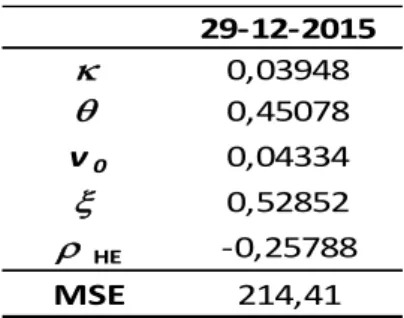
As stated in the previous chapter the calibration was done by minimizing the MSE.
In order to ensure that the optimization procedure would not return a local
minimum, one applied a global minimum search procedure, Simulated Annealing,
which is implemented in Octave through the function “samin”. The results were the following,
Table 1: HE model parameters
5.1.2-G2++ model
The calibration of the G2++ model was based on the relevant risk free interest rate
term structure and on swaptions implied volatility, recalculating as explained
before, a theoretical price based on Normal volatilities, collected from
at-the-money swaptions.
Again, the logical goal is to minimize the differences between the model prices and
the prices obtained from the implied volatility, the objective function is the
following,
(24)
N
i i
i i
price l theoretica
price l theoretica price
model min
1
2
,
with N as the total number of observations.
A similar procedure to the one used for the Heston model was followed to calibrate
this model. The table below expresses the result of the calibration. The swaptions
with shorter, until 4 years, expiries and tenors were disregarded as its inclusion
affected the calibration for longer expiries and tenors. As this work is focused in
Life Insurance, longer maturities emerge as more relevant.
29-12-2015
0,03948
0,45078
v0 0,04334
0,52852
HE -0,25788
5-Results
24
Table 2: G2++ model parameters
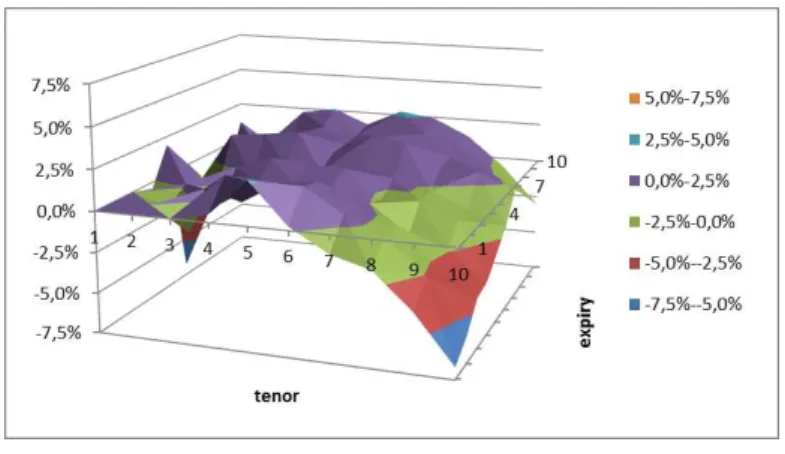
This being done, and to evaluate the quality of the adjustment the relative
differences between the two prices were calculated, the results are presented in
the figure below.
Figure 3: Adjustment errors for the G2++ model
5.2-Portfolio simulation
Regarding the simulation it was decided to consider a portfolio with 75% of the
investment in bonds with non-relevant credit risk and 25% in stocks. This
conservative approach was defined considering the typical undertaking’s investments.
The evolution of the portfolio’s value is assumed to have the following behavior, in
accordance with Andreatta & Corradin (2003),
(25) F
t pA
t 1p
Gt ,0 p1,where pis the proportion of the investment in the stock component, whose value
is represented by A
t . G
t has a similar meaning but for the bond index.30-12-2015
a 0,499019
b 0,056903
0,028109
0,013509
5-Results
25
It is considered that the bond index value at any point in time is the accumulated
results considering a negotiation strategy of zero coupon bonds with duration D
strategy with a fixed transaction horizon .
Hereafter the percentiles of the simulated evolution of the portfolio of assets are
presented. The parameters obtained for each model as well as δ0,25 and D 5
were used as inputs.
Figure 4: Simulated evolution of a portfolio investing 25% in stocks and 75% in bonds
Table 3: Percentiles for the simulated return rates of the portfolio
5.3-Application of the calculation tool
For each of the types of contract considered, a case study was developed to
exemplify the application of the calculation tool. Whenever possible, average
market values were taken into account as inputs (e.g. average age of insured
persons, average benefit per insured person). For other inputs, additional
assumptions were made. For each case, an initial population of 1000 individuals
was specified. With regard to the projection of expenses, due to data limitation
Percentiles
1 2 3 4 5 6 7 8 9 10
10% -4,715% -2,936% -2,599% -1,739% -1,513% -0,854% -0,642% -0,067% 0,254% 0,867%
20% -2,510% -1,338% -1,336% -0,966% -0,502% -0,252% -0,142% 0,312% 0,240% 0,545%
30% -1,403% -0,780% -0,659% -0,231% -0,227% 0,274% 0,242% 0,694% 0,992% 0,795%
40% -0,641% -0,499% -0,320% 0,124% 0,227% 0,504% 0,792% 0,936% 1,197% 1,293%
50% -0,041% -0,211% 0,012% 0,172% 0,537% 0,841% 1,096% 1,152% 1,465% 1,613%
60% 0,518% 0,029% 0,234% 0,419% 0,678% 1,048% 1,404% 1,404% 1,695% 1,750%
70% 1,095% 0,301% 0,415% 0,667% 0,943% 1,251% 1,583% 1,710% 1,945% 2,042%
80% 1,824% 0,567% 0,674% 0,940% 1,272% 1,423% 1,868% 2,025% 2,350% 2,707%
5-Results
26
issues, an amount of 10 euros per insured person was introduced as input. This
estimation, based on market average, was obtained by allocating the total
administrative expenses per main type of product and then per insured person. It
is also worth to remind that the SCR Interest rate indicated in the following tables
only reflects the variation of the BE.
5.3.1-Annuities
For this type of contract, two sub-cases of a lifelong immediate annuity were
analysed, in order to compare the results between the use of static and dynamic
mortality tables. For the static table the choice fell on TV 88/90, as it is quite used
for longevity products in the Portuguese market. On the other hand, the male
dynamic table 2012 was applied.
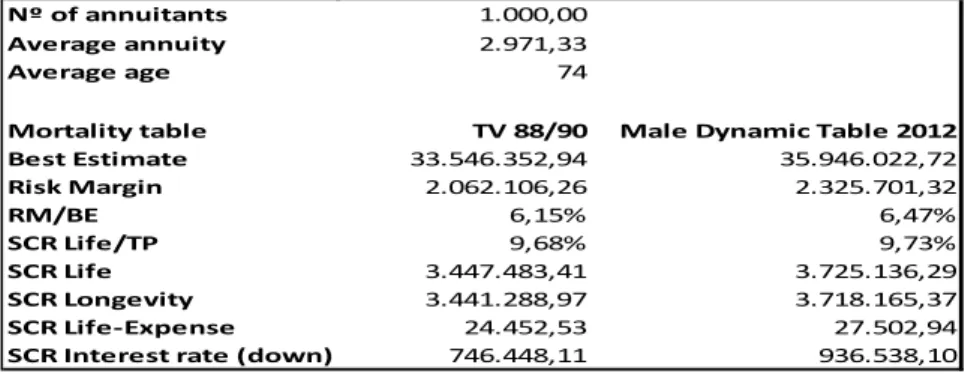
Table 4: Results for annuity contracts
From the table above one can conclude, for instance, that the use of the dynamic
table leads to an increase of 7,15% in the BE and a higher SCR as well as RM.
In what concerns the composition of SCR Life, for this type of contract longevity
risk represents almost the total of the SCR Life. The fact that longevity risk is so
relevant for these products reinforces the importance of using the most
appropriate mortality tables.
Nº of annuitants 1.000,00
Average annuity 2.971,33
Average age 74
Mortality table TV 88/90 Male Dynamic Table 2012
Best Estimate 33.546.352,94 35.946.022,72
Risk Margin 2.062.106,26 2.325.701,32
RM/BE 6,15% 6,47%
SCR Life/TP 9,68% 9,73%
SCR Life 3.447.483,41 3.725.136,29
SCR Longevity 3.441.288,97 3.718.165,37
SCR Life-Expense 24.452,53 27.502,94
5-Results
27
Figure 5: SCR Life composition for annuity contracts
5.3.2-Whole life and term insurance
5.3.2.1-Classical whole life and term insurance
For this case study it was decided to compare the results for a whole life contract
and a term contract with a remaining maturity of 11 years, maintaining all the
other assumptions equal.
Table 5: Results for whole life and term contracts
From this analysis some noteworthy observations emerge related to the length of
the contract and the risk profile reflected in the SCR Life. In fact, as shown in the
figure below, for shorter term contracts the SCR Life tends to be more diversified
and the Life catastrophe risk represents a higher proportion of the total SCR Life. It
is also worth to highlight the large dimension of the SCR Interest Rate for the
whole life contract when compared to the SCR Life.
Insured people 1.000,00
Average death benefit 14.432,69
Average age 46
Mortality table 50% GKM 95
Term Whole life 11
Best Estimate 6.210.977,68 487.241,29
Risk Margin 549.197,71 31.508,14
RM/BE 8,84% 6,47%
SCR Life/TP 5,10% 13,71%
SCR Life 344.600,08 71.127,19
SCR Mortality 298.224,94 55.406,42
SCR Life-Expense 106.297,16 17.387,41
SCR Life-Catastrophe 12.399,93 20.998,23
5-Results
28
Figure 6: SCR Life composition for whole life and term contracts
5.3.2.2-Annual renewable term insurance
Table 6: Results for annual renewable term contracts
For this type of contracts a relevant analysis is the impact of the application of
contract boundaries, by comparing the results between the projection until the
next date of renewal (assumed to be one year) and the projection for a longer
period of time. As it could be expected, for these contracts a negative BE emerges.
This value results from the fact that higher mortality values are being used for
premia calculations than for BE calculations. In addition, a charge is applied to the
resulting pure premium. Both the previous assumptions are common in the
insurance market.
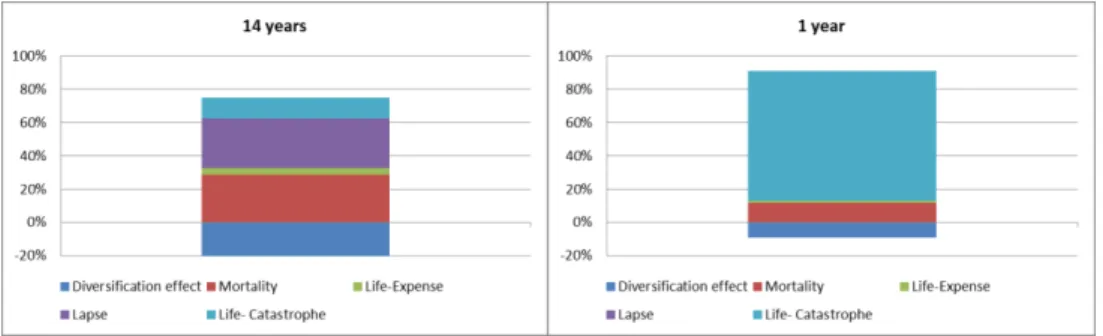
For a 14 year projection, the SCR Life composition is quite diverse. One of the main
risk components for these contracts is the Lapse risk, which plays no role in the
Insured people 1.000,00Average age 46
Average death benefit 31.464,14Premia mortality 70% GKM 95
Mortality table 50% GKM 95Pure premium charge 10%
Term 14 1
Best Estimate -299.069,80 -15.138,50
Risk Margin 82.744,78 2.990,52
RM/BE -27,67% -19,75%
SCR Life/TP -87,34% -409,65%
SCR Life 188.948,55 49.763,68
SCR Mortality 109.852,59 6.982,92
SCR Life-Expense 15.097,49 1.000,00
SCR Lapse (mass) 113.572,52
-SCR Life-Catastrophe 47.696,95 47.270,42
-5-Results
29
one year contract. In this latter case, the Life-Catastrophe risk arises as the most
important risk due to the short term of the contract.
Figure 7: SCR Life composition for annual renewable term contracts
5.3.3-Endowment
Table 7: Results for endowment contracts
Comparing the results for the two sub-cases (i.e. with and without profit sharing),
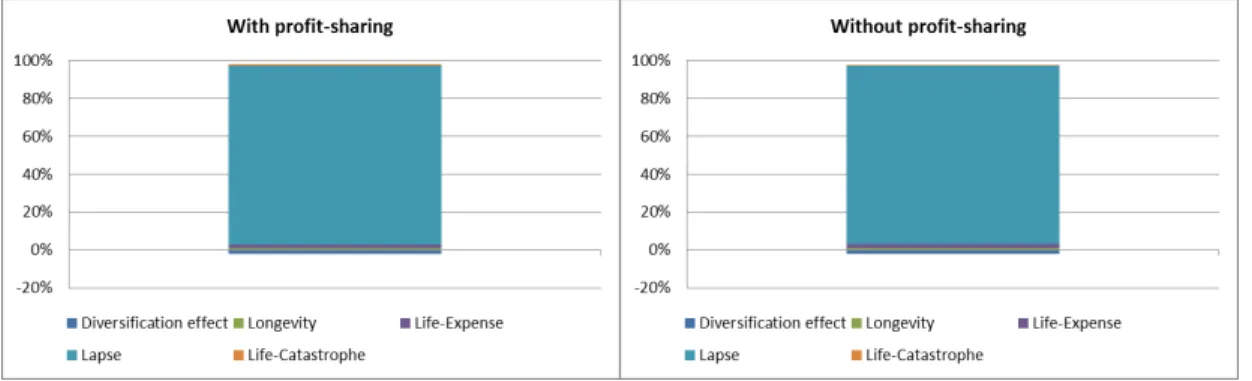
one can conclude from both the table above and the figure below that, for the
assumptions made, no relevant structural differences emerge from the addition of
a profit-sharing clause. Indeed, for the entire projection horizon, the guaranteed
rate assumption is higher than the annual returns implicit in the relevant risk free
interest rate term structure (i.e. in the central scenario no profit-sharing will
occur) and also higher than the average simulated return rates for each year. It
Insured people 1.000,00 Average age 54
Average initial capital 13.049,03Average term 8
Average premium 662Mortality table 50% GKM 95
Average guaranteed rate 2,74%
Profit-sharing % 85% 0%
Best Estimate 15.383.461,97 15.065.199,57
Risk Margin 62.023,97 62.023,97
RM/BE 0,40% 0,41%
SCR Life/TP 2,89% 2,35%
Profit-sharing component 318.262,40
-Cost of options and guarantees 318.262,40
-COG/BE 2,07%
-SCR Life 446.088,76 355.745,25
SCR Longevity 5.261,20 3.914,10
SCR Life-Expense 7.947,79 7.947,79
SCR Lapse (decrease) 439.967,69 350.077,22
SCR Life-Catastrophe 2.899,24 2.420,30
5-Results
30
means that, on average, the portfolio’s return would not even be sufficient to cover the guaranteed rates.
In both sub-cases Lapse risk represents the SCR Life almost entirely. The fact that
the value for such component results from a decrease in the withdrawal rates may
indicate that these are not profitable contracts. In fact, as referred above, the
guaranteed rate assumption is on average higher than the return rates, indicating
that the previous conclusion is not unreasonable.