Applicability of respiratory variations in stroke
volume and its surrogates for dynamic luid
responsiveness prediction in critically ill patients:
a systematic review of the prevalence of required
conditions
INTRODUCTION
Fluid resuscitation is one of the most important interventions in patients with acute circulatory failure. Volume expansion is expected to be of hemodynamic beneit if the increase in the cardiac preload is accompanied by an increase in the stroke volume to a similar extent (preload responsiveness).(1,2) his improvement in the cardiac output is expected to ameliorate perfusion deicits if administered in a timely manner.(3) However, positive luid balance is increasingly associated with morbidity and mortality in critical illness.(4-6) herefore, luid administration should be titrated by accurate parameters, such as dynamic indices of luid responsiveness (e.g., stroke volume variation).(7,8) Leandro Utino Taniguchi1,2, Fernando Godinho
Zampieri1,3, Antonio Paulo Nassar Jr.1,4
1. Discipline of Emergency Medicine, Faculdade de Medicina, Universidade de São Paulo - São Paulo (SP), Brazil.
2. Research and Education Institute, Hospital Sírio-Libanês - São Paulo (SP), Brazil.
3. Intensive Care Unit, Hospital Alemão Oswaldo Cruz - São Paulo (SP), Brazil.
4. Adult Intensive Care Unit, A.C. Camargo Cancer Center - São Paulo (SP), Brazil.
Objective: he present systematic
review searched for published data on the prevalence of required conditions for proper assessment in critically ill patients.
Methods: he Medline, Scopus and
Web of Science databases were searched to identify studies that evaluated the prevalence of validated conditions for the luid responsiveness assessment using respiratory variations in the stroke volume or another surrogate in adult critically ill patients. he primary outcome was the suitability of the luid responsiveness evaluation. he secondary objectives were the type and prevalence of pre-requisites evaluated to deine the suitability.
Results: Five studies were included (14,804 patients). High clinical and
Conflicts of interest: None. Submitted on August 1, 2016 Accepted on August 17, 2016
Corresponding author:
Leandro Utino Taniguchi Discipline of Emergency Medicine,
Faculdade de Medicina, Universidade de São Paulo Rua Dr. Enéas de Carvalho Aguiar, 255, 5º, Room 6040
Zip code: 05403-000 - São Paulo (SP), Brazil E-mail: [email protected]
Disclaimer: Dr Taniguchi, Section Editor for Revista Brasileira de Terapia Intensiva, was not involved in the evaluation or decision to publish this article.
Responsible editor: Glauco Adrieno Westphal
Aplicabilidade das variações respiratórias do volume sistólico
e seus substitutos para predição da responsividade dinâmica a
luidos em pacientes críticos: uma revisão sistemática sobre a
prevalência das condições requeridas
ABSTRACT
Keywords: Critical care; Monitoring, physiologic; Hemodynamics; Fluid therapy
statistical heterogeneity was observed (I2 = 98.6%), which prevented us from
pooling the results into a meaningful summary conclusion. he most frequent limitation identiied is the absence of invasive mechanical ventilation with a tidal volume ≥ 8mL/kg. he inal suitability for the luid responsiveness assessment was low (in four studies, it varied between 1.9 to 8.3%, in one study, it was 42.4%).
Conclusion: Applicability of
the dynamic indices of preload responsiveness requiring heart-lung interactions might be limited in daily practice.
One major constraint of most of these dynamic parameters is the requirement for invasive mechanical ventilation with the controlled mode and adequate tidal volume (Vt).(9) Other requirements are sinus rhythm, the presence of an arterial line and appropriate monitoring devices.(8) hese limitations could undermine the bedside applicability of these parameters. In fact, some studies suggest that this might be the case.(10,11) he objective of this systematic review was to estimate the prevalence of required conditions for proper use of the stroke volume variation (SVV) or other similar surrogates (e.g., pulse pressure variation [PPV]) of luid responsiveness in critically ill patients.
METHODS
Literature search
Studies were identiied through a standardized search of Medline (via PubMed), Scopus and Web of Science databases. A sensitive search strategy was used, which combined the following keywords: “luid responsiveness” or “preload responsiveness” or “volume responsiveness” and “prevalence” or “incidence” or “applicability” or “suitability”. he references in the included studies and personal iles were also searched. he search strategy was restricted to studies that aimed to assess the luid responsiveness in adult subjects and published prior to December 1, 2015. here was no language restriction. he titles and abstracts were assessed for eligibility, and full-text copies of all articles deemed potentially relevant were retrieved. A standardized eligibility assessment was independently performed by two reviewers. Disagreements were resolved by consensus.
he PRISMA statement was used for guidance,(12) and
the systematic review was registered in the PROSPERO database (CRD42016032769).
Study selection
Studies that fulilled the following criteria were included: aimed to assess the prevalence of validated conditions for luid responsiveness assessment using the SVV or another surrogate in a population of critical care or surgical adult patients; described the proportion of patients with the following fundamental conditions to assess the luid responsiveness: invasive mechanical ventilation, absence of breathing eforts, sinus rhythm, “adequate Vt” (as deined by each study) and threshold used to deine its adequacy.
Data extraction
A data extraction sheet was developed. Two authors independently extracted the following data from the included studies: year of publication, country, study type (cross-sectional or cohort) and total number of assessed patients. Out of the total number of patients, the proportion of patients on invasive mechanical ventilation, without breathing eforts and with sinus rhythm was recorded. Additionally, if available, we collected data on the number of patients with an arterial line, vasopressors, cutof for positive end expiratory pressure (PEEP) and for Vt that were considered unsuitable to assess luid responsiveness (and the number of patients ventilated with lower levels from that cutof), heart rate to respiratory rate ratio (HR/RR) > 3.6(13) and total respiratory system compliance (CTRS) > 30mL/cmH2O.(14)
he risk of bias in the individual trials was not assessed because we only planned on including prevalence studies and commonly evaluated variables in the quality assessment, such as selection of cases, controls or cohorts, ascertainment of exposures and follow-up of the patients were not assessed in these prevalence studies.
Outcome measurement
he primary outcome was the prevalence of suitability for assessing the luid responsiveness, deined as the number of patients who were invasively, mechanically ventilated with a Vt higher than the identiied threshold, who lacked breathing eforts and had a regular sinus rhythm.
A formal meta-analysis was planned, but it was not performed because of the heterogeneity among the studies (I2 = 98.6%).(15)
RESULTS
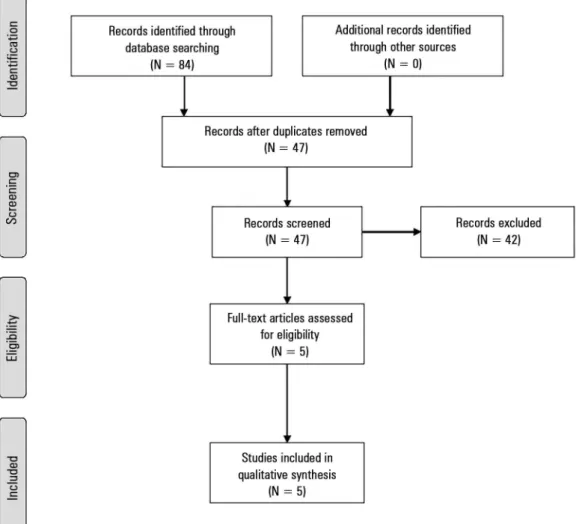
Figure 1 - Study flowchart.
Table 1 - Characteristics of the included studies
Study Country Type of study Setting Number of centers
Mahjoub et al.(10) France Cross-sectional ICU 26
Mendes et al.(11) Brazil Prospective ICU 2
Maguire et al.(16) USA Retrospective Surgical room 1
Benes et al.(17) Czech Republic Retrospective ICU 1
Fischer et al.(18) France Cross-sectional ICU 36
ICU - intensive care unit.
he characteristics of the assessed patients in included studies are given in table 2. A total of 14,804 patients were evaluated. Overall, except for one study, more than half of patients were mechanically ventilated. However, only one study reported that the majority of patients lacked a breathing efort. We also observed that the use of arterial lines varied among the studies (15.7 to 81%) as did the administration of vasopressors. heir use varied from only 192 of 4,792 patients (4%), which had the required
conditions for assessing luid responsiveness in the study by Maguire et al.(16) to 59% of critically ill patients in the study by Benes et al.(17) All other studies of critical care patients had a lower use of vasopressors (13.5 to 28.5%).
Two studies reported a PEEP value cutof for assessing the luid responsiveness. Maguire et al. (16) deined it as
5cmH2O, and 56.4% of all mechanically ventilated
patients had a PEEP equal to or lower than that. Benes et al.(17) deined the PEEP cutof as 10cmH
Table 2 - Prevalence of conditions affecting the assessment of fluid responsiveness in the included studies
Study Number of patients
Mechanical ventilation
Controlled mechanical ventilation
Tidal volume ≥
8mL/kg Sinus rhythm Arterial line
Suitability for assessment of fluid-responsiveness
Mahjoub et al.(10) 311 158 (50.8) 44 (14.1) 12 (3.8) 274 (88.1) 170 (54.7) 12 (3.8)
Mendes et al.(11) 424 106 (25.0) 33 (7.8) 12 (2.8) 404 (95.2) 69 (16.3) 12 (2.8)
Maguire et al.(16) 12,308 7,754 (63.0) NA 5,046 (41.0) NA 1,936 (15.7) 4,792 (38.9)†
1,019 (8.3)‡
Benes et al.(17) 1,296 1,073 (82.8) 983 (75.8) 585 (45.1) 1,191 (91.9) 1,050 (81.0) 549 (42.4)
Fischer et al.(18) 465 282 (60.6) 127 (27.3) 25 (5.4) 408 (87.7) 324 (69.7) 9 (1.9)
NA - not available. † data for respiratory variations in the plethysmographic waveform amplitude. ‡ data for the pulse pressure variation. Data presented as the number of patients (percentage
of the total number of patients).
of mechanically ventilated patients had a PEEP level equal to or lower than that. All identiied studies used a threshold of 8mL/kg as the cutof of validity for the SVV or surrogate.
Mahjoub et al.(10) also gathered data on other
physiological criteria for assessing the luid responsiveness and found that 10 (3.2%) patients had an HR/RR > 3.6, and 8 (2.6%) patients had a CTRS > 30mL/cmH2O. Fischer et al.(18) found that 177 (38.1%) patients an HR/RR > 3.6 and 108 (23.2%) patients had a CTRS > 30mL/cmH2O. Additionally, they considered a tricuspid annular peak systolic velocity > 0.15ms-1 as suitable for the preload responsiveness assessment and only six (2%) patients fulilled these criteria as well the other required conditions for this assessment (mechanical ventilation, regular rhythm, no spontaneous breathing, Vt > 8mL/kg, HR/RR > 3.6 and CTRS > 30mL/cmH2O).
Overall, the prevalence of the required conditions, i.e., invasive mechanical ventilation, absence of breathing eforts, Vt higher than the identiied threshold (8mL/ kg of body weight in all studies) and sinus rhythm, was very low in three ICU studies (1.9 to 3.8%). In contrast, two studies found a higher proportion (38.9 and 42.4%) of patients presenting with the required conditions for assessing the luid responsiveness. One of these studies only included surgical patients(16) and the other included a selected population of critical care patients, as mentioned above (Table 2).(17) Of note, the study by Maguire et al.(16) assessed the proportion of patients fulilling criteria for both respiratory variations in the plethysmographic waveform amplitude (38.9% from the total population) and PPV (8.3% from the total population).
DISCUSSION
Since “dynamic” parameters (such as SVV and PPV) have been advocated to have greater accuracy in predicting the luid responsiveness,(1,19,20) their bedside applicability in the real world context has become a relevant question
due to their known constrains. In this systematic review, we could observe the following: (1) there is a paucity of studies about the prevalence of requisites for correct application of respiratory-dependent dynamic parameters; (2) the available literature has a marked heterogeneity; and (3) at most, these parameters could be applied to 42% of the patients in the ICU, which is usually to less than 10%.
After the Michard et al. publication on the utility of PPV in the early 2000s,(21) substantial enthusiasm was observed about dynamic indices to predict luid responsiveness. However, many limitations for the use of respiratory variations in stroke volume or surrogates have been identiied. he most relevant one is the absolute requirement for the absence of spontaneous respiratory eforts (i.e., invasive mechanical ventilation in the controlled mode).(22,23) We observed high variability in the prevalence of invasive mechanical ventilation (from 25 to 82.8%), which is probably due to the case-mix among studies. Of note, the study from Benes et al., which demonstrated the highest proportion of mechanically ventilated patients, only evaluated a highly selected severe subgroup, as previously discussed.(17) Even the study by Mendes et al.,(11) which had the lowest prevalence of invasive mechanical ventilation (25%), presented values that were similar to a large multicenter cohort study of mechanical ventilation.(24) More recently, the LUNG-SAFE study evaluated 459 ICU in 50 diferent countries and observed 46.5% of critically ill patients underwent invasive mechanical ventilation.(25)
literature, which demonstrated that even small periods in susceptible patients of non-protective ventilation could induce harm.(27-29) Other constraints are the absence of a cardiac arrhythmia and presence of an arterial line, whose insertion practice is also highly variable between units, with median usage rates in American ICUs as low as 22.4% in medical units and 51.7% in patients with vasopressors.(30) herefore, the prevalence of required conditions for the correct application of respiratory dependent indices of luid responsiveness is very low; commonly, it was less than 10% in the included studies (Table 2). If other confounders are also evaluated (such as HR/RR > 3.6,(13) low respiratory compliance,(14) intra-abdominal hypertension,(31) and pulmonary hypertension(32)), much lower values are expected, limiting the bedside applicability of these hemodynamic evaluations.
One may argue that a formal meta-analysis to summarize the results should have been attempted. However, given the high statistical heterogeneity detected, any attempt to pool the results could be misleading. A relevant clinical heterogeneity between selected studies could be observed with the case-mix of medical and surgical patients, local setting (ICU or surgical room), diferent deinitions of suitability for inal application of dynamic parameters, and length of stay at the time of evaluation. his should be acknowledged when interpreting the inal percentage of patients with valid conditions for SVV or PPV, ranging from 1.9% to 42.4%. he Cochrane Group suggests that if signiicant heterogeneity is detected, one possibility is to not pool the data.(15) Unfortunately, due to the limited number of studies, meta-regression, which is another option, might also be misleading.
Others may also argue that in the early phases of luid resuscitation, when volume administration has the largest microcirculatory efects,(3) the presence of required conditions would probably be more frequent in the most critically ill. In fact, the only study identiied in our systematic review to speciically address this early phase is also the one with the highest prevalence (the study from Benes et al.(17) in table 2). However, even in septic patients, for whom timely administration of luids is considered one of the most life-saving interventions,(2) three recent large randomized controlled trials regarding protocolized early hemodynamic care observed that approximately 20% of included patients had invasive mechanical ventilation in the irst 6 hours.(33-35) As a result, even in this important early phase, only a minority would be correctly evaluated using dynamic parameters. Some alternatives have been published for application in patients with spontaneous breathing activity regardless of the cardiac rhythm. he
passive leg raise is a preload-modifying maneuver that has been demonstrated to be an excellent predictor of luid responsiveness (pooled area under the receiver-operating characteristics curve of 0.95 in a recent meta-analysis).(36)
One inal remark is the observation in some recent literature that it might be accurate to apply PPV even in acute respiratory distress syndrome patients who are ventilated with low Vt.(37,38) In such a population, higher PPV values might be predictive of luid responsiveness, which is probably due to lower intrathoracic pressure variation induced by low Vt mechanical ventilation. herefore, even with “protective ventilation”, PPV (and probably SVV) could be justiied with the application of higher thresholds. Nevertheless, some drawbacks should also be highlighted. Biais et al. applied the “gray zone” approach to a large cohort of mechanically ventilated patients and observed that in 62% of them, values between 4 and 17% could not predict luid responsiveness.(39) Even if one applies this rationale to weigh the beneit/risk ratio of giving/withholding luid infusion (i.e., decide to infuse luids in patients with high values of PPV to correct underperfusion even if they are receiving protective ventilation), luid administration has a time-dependent efect on the microcirculation.(3) herefore, in the early phases of luid management, application of PPV to titrate luid infusion (such as in the operative room) may improve outcomes,(40) but it could later lead to luid accumulation without perfusion improvement.(3)
Our study has some strengths and limitations. First, we performed an extensive and systematic literature search for possible articles. Unfortunately, only ive studies could be included and, due to the heterogeneity, a formal pooled analysis could not be performed. Second, the population studied in the included articles was treated at the surgical room and ICU, which increases the generalizability as well as the heterogeneity. Finally, to the best of our knowledge, this is the irst systematic review on the prevalence of respiratory-dependent dynamic indices of luid responsiveness. Nevertheless, even this important theme was studied in just a few articles, which highlights a relevant lack of knowledge of this issue in diferent settings.
CONCLUSION
Author contributions
LU Taniguchi, FG Zampieri and AP Nassar Jr. conceived the study concept and helped draft the manuscript. LU Taniguchi and AP Nassar Jr. performed
the search queries, reviewed the articles and extracted the data. FG Zampieri performed the statistical analyses. All authors drafted the manuscript and critically revised it. All authors read and approved the inal manuscript.
Objetivo: Avaliar os dados publicados em relação à
prevalência das condições requeridas para avaliação apropriada em pacientes críticos.
Métodos: Foram realizadas buscas nas bases de dados
MEDLINE, Scopus e Web of Science para identiicar estudos que discutiam a prevalência de condições validadas para avaliação da responsividade a luidos com uso de variações respiratórias do volume sistólico ou algum outro substituto em pacientes críticos adultos. O desfecho primário foi a prevalência de adequação para avaliação da responsividade. O objetivo secundário foi o tipo e a prevalência de pré-requisitos avaliados para deinir a adequação.
Resultados: Incluíram-se cinco estudos (14.804 pacientes). Observaram-se elevadas heterogeneidades do ponto de vista clínico e estatístico (I2 = 98,6%), o que impediu o agrupamento
dos resultados em uma conclusão sumarizada signiicativa. A limitação mais frequentemente identiicada foi a ausência de ventilação mecânica invasiva com volume corrente ≥ 8mL/kg. A adequação inal para avaliação da responsividade a luidos foi baixa (em quatro estudos, variou entre 1,9 e 8,3% e, em um estudo, foi de 42,4%).
Conclusão: A aplicabilidade na prática diária de índices dinâmicos de responsividade da pré-carga que demandam interações cardiopulmonares pode ser limitada.
RESUMO
Descritores: Cuidados críticos; Monitorização isiológica; Hemodinâmica; Hidratação
REFERENCES
1. Monnet X, Teboul JL. Assessment of volume responsiveness during mechanical ventilation: recent advances. Crit Care. 2013;17(2):217. 2. Vincent JL, De Backer D. Circulatory shock. N Engl J Med.
2013;369(18):1726-34.
3. Ospina-Tascon G, Neves AP, Occhipinti G, Donadello K, Büchele G, Simion D, et al. Effects of fluids on microvascular perfusion in patients with severe sepsis. Intensive Care Med. 2010;36(6):949-55.
4. Bouchard J, Soroko SB, Chertow GM, Himmelfarb J, Ikizler TA, Paganini EP, Mehta RL; Program to Improve Care in Acute Renal Disease (PICARD) Study Group. Fluid accumulation, survival and recovery of kidney function in critically ill patients with acute kidney injury. Kidney Int. 2009;76(4):422-7. 5. Azevedo LC, Park M, Salluh JI, Rea-Neto A, Souza-Dantas VC, Varaschin P,
Oliveira MC, Tierno PF, dal-Pizzol F, Silva UV, Knibel M, Nassar AP Jr, Alves RA, Ferreira JC, Teixeira C, Rezende V, Martinez A, Luciano PM, Schettino G, Soares M; ERICC (Epidemiology of Respiratory Insufficiency in Critical Care) investigators. Clinical outcomes of patients requiring ventilatory support in Brazilian intensive care units: a multicenter, prospective, cohort study. Crit Care. 2013;17(2):R63.
6. Besen BA, Gobatto AL, Melro LM, Maciel AT, Park M. Fluid and electrolyte overload in critically ill patients: An overview. World J Crit Care Med. 2015;4(2):116-29.
7. Mohsenin V. Assessment of preload and fluid responsiveness in intensive care unit. How good are we? J Crit Care. 2015;30(3):567-73.
8. Renner J, Scholz J, Bein B. Monitoring fluid therapy. Best Pract Res Clin Anaesthesiol. 2009;23(2):159-71.
9. De Backer D, Heenen S, Piagnerelli M, Koch M, Vincent J. Pulse pressure variations to predict fluid responsiveness: influence of tidal volume. Intensive Care Med. 2005;31(4):517-23.
10. Mahjoub Y, Lejeune V, Muller L, Perbet S, Zieleskiewicz L, Bart F, et al. Evaluation of pulse pressure variation validity criteria in critically ill patients: a prospective observational multicentre point-prevalence study. Br J Anaesth. 2014;112(4):681-5.
11. Mendes PV, Rodrigues BN, Miranda LC, Zampieri FG, Queiroz EL, Schettino G, et al. Prevalence of ventilatory conditions for dynamic fluid responsiveness prediction in 2 tertiary intensive care units. J Intensive Care Med. 2016;31(4):258-62.
12. Liberati A, Altman DG, Tetzlaff J, Mulrow C, Gøtzsche PC, Ioannidis JP, et al. The PRISMA statement for reporting systematic reviews and meta-analyses of studies that evaluate healthcare interventions: explanation and elaboration. BMJ. 2009;339:b2700.
13. De Backer D, Taccone FS, Holsten R, Ibrahimi F, Vincent JL. Influence of respiratory rate on stroke volume variation in mechanically ventilated patients. Anesthesiology. 2009;110(5):1092-7.
14. Monnet X, Bleibtreu A, Ferré A, Dres M, Gharbi R, Richard C, et al. Passive leg-raising and end-expiratory occlusion tests perform better than pulse pressure variation in patients with low respiratory system compliance. Crit Care Med. 2012;40(1):152-7.
15. Ryan R; Cochrane Consumers and Communication Review Group. Heterogeneity and subgroup analyses in Cochrane Consumers and Communication Review Group reviews: planning the analysis at protocol stage [Internet]. 2014 [Available at: http://cccrg.cochrane.org/sites/cccrg. cochrane.org/files/uploads/Heterogeneity%26subgroup_analyses.pdf]. 16. Maguire S, Rinehart J, Vakharia S, Cannesson M. Technical communication:
respiratory variation in pulse pressure and plethysmographic waveforms: intraoperative applicability in a North American academic center. Anesth Analg. 2011;112(1):94-6.
18. Fischer MO, Mahjoub Y, Boisselier C, Tavernier B, Dupont H, Leone M, Lefrant JY, Gérard JL, Hanouz JL, Fellahi JL; Atlanrea groups. Arterial pulse pressure variation suitability in critical care: A French national survey. Anaesth Crit Care Pain Med. 2015;34(1):23-8.
19. Michard F, Teboul JL. Predicting fluid responsiveness in ICU patients: a critical analysis of the evidence. Chest. 2002;121(6):2000-8. Review. 20. Yang X, Du B. Does pulse pressure variation predict fluid responsiveness
in critically ill patients? A systematic review and meta-analysis. Crit Care. 2014;18(6):650.
21. Michard F, Boussat S, Chemla D, Anguel N, Mercat A, Lecarpentier Y, et al. Relation between respiratory changes in arterial pulse pressure and fluid responsiveness in septic patients with acute circulatory failure. Am J Respir Crit Care Med. 2000;162(1):134-8.
22. Heenen S, De Backer D, Vincent JL. How can the response to volume expansion in patients with spontaneous respiratory movements be predicted? Crit Care. 2006;10(4):R102.
23. Soubrier S, Saulnier F, Hubert H, Delour P, Lenci H, Ominus T, et al. Can dynamic indicators help the prediction of fluid responsiveness in spontaneously breathing critically ill patients? Intensive Care Med. 2007;33(7):1117-24.
24. Esteban A, Ferguson ND, Meade MO, Frutos-Vivar F, Apezteguia C, Brochard L, Raymondos K, Nin N, Hurtado J, Tomicic V, González M, Elizalde J, Nightingale P, Abroug F, Pelosi P, Arabi Y, Moreno R, Jibaja M, D’Empaire G, Sandi F, Matamis D, Montañez AM, Anzueto A; VENTILA Group. Evolution of mechanical ventilation in response to clinical research. Am J Respir Crit Care Med. 2008;177(2):170-7.
25. Bellani G, Laffey JG, Pham T, Fan E, Brochard L, Esteban A, Gattinoni L, van Haren F, Larsson A, McAuley DF, Ranieri M, Rubenfeld G, Thompson BT, Wrigge H, Slutsky AS, Pesenti A; LUNG SAFE Investigators; ESICM Trials Group. Epidemiology, patterns of care, and mortality for patients with acute respiratory distress syndrome in intensive care units in 50 countries. JAMA. 2016;315(8):788-800.
26. Muller L, Louart G, Bousquet PJ, Candela D, Zoric L, de La Coussaye JE, et al. The influence of the airway driving pressure on pulsed pressure variation as a predictor of fluid responsiveness. Intensive Care Med. 2010;36(3):496-503.
27. Ventilation with lower tidal volumes as compared with traditional tidal volumes for acute lung injury and the acute respiratory distress syndrome. The Acute Respiratory Distress Syndrome Network. N Eng J Med. 2000;342(18):1301-8.
28. Gajic O, Frutos-Vivar F, Esteban A, Hubmayr RD, Anzueto A. Ventilator settings as a risk factor for acute respiratory distress syndrome in mechanically ventilated patients. Intensive Care Med. 2005;31(7):922-6.
29. Futier E, Constantin JM, Paugam-Burtz C, Pascal J, Eurin M, Neuschwander A, Marret E, Beaussier M, Gutton C, Lefrant JY, Allaouchiche B, Verzilli D, Leone M, De Jong A, Bazin JE, Pereira B, Jaber S; IMPROVE Study Group. A trial of intraoperative low-tidal-volume ventilation in abdominal surgery. N Engl J Med. 2013;369(5):428-37.
30. Gershengorn HB, Garland A, Kramer A, Scales DC, Rubenfeld G, Wunsch H. Variation of arterial and central venous catheter use in United States intensive care units. Anesthesiology. 2014;120(3):650-64.
31. Jacques D, Bendjelid K, Duperret S, Colling J, Piriou V, Viale JP. Pulse pressure variation and stroke volume variation during increased intra-abdominal pressure: an experimental study. Crit Care. 2011;15(1):R33. 32. Wyler von Ballmoos M, Takala J, Roeck M, Porta F, Tueller D, Ganter CC,
et al. Pulse-pressure variation and hemodynamic response in patients with elevated pulmonary artery pressure: a clinical study. Crit Care. 2010;14(3):R111.
33. ProCESS Investigators, Yealy DM, Kellum JA, Huang DT, Barnato AE, Weissfeld LA, et al. A randomized trial of protocol-based care for early septic shock. N Engl J Med. 2014;370(18):1683-93.
34. ARISE Investigators; ANZICS Clinical Trials Group, Peake SL, Delaney A, Bailey M, Bellomo R, et al. Goal-directed resuscitation for patients with early septic shock. N Engl J Med. 2014;371(16):1496-506.
35. Mouncey PR, Osborn TM, Power GS, Harrison DA, Sadique MZ, Grieve RD, Jahan R, Harvey SE, Bell D, Bion JF, Coats TJ, Singer M, Young JD, Rowan KM; ProMISe Trial Investigators. Trial of early, goal-directed resuscitation for septic shock. N Engl J Med. 2015;372(14):1301-11.
36. Cavallaro F, Sandroni C, Marano C, La Torre G, Mannocci A, De Waure C, et al. Diagnostic accuracy of passive leg raising for prediction of fluid responsiveness in adults: systematic review and meta-analysis of clinical studies. Intensive Care Med. 2010;36(9):1475-83.
37. Huang CC, Fu JY, Hu HC, Kao KC, Chen NH, Hsieh MJ, et al. Prediction of fluid responsiveness in acute respiratory distress syndrome patients ventilated with low tidal volume and high positive end-expiratory pressure. Crit Care Med. 2008;36(10):2810-6.
38. Freitas FG, Bafi AT, Nascente AP, Assunção M, Mazza B, Azevedo LC, et al. Predictive value of pulse pressure variation for fluid responsiveness in septic patients using lung-protective ventilation strategies. Br J Anaesth. 2013;110(3):402-8.
39. Biais M, Ehrmann S, Mari A, Conte B, Mahjoub Y, Desebbe O, Pottecher J, Lakhal K, Benzekri-Lefevre D, Molinari N, Boulain T, Lefrant JY, Muller L; AzuRea Group. Clinical relevance of pulse pressure variations for predicting fluid responsiveness in mechanically ventilated intensive care unit patients: the grey zone approach. Crit Care. 2014;18(6):587. 40. Benes J, Giglio M, Brienza N, Michard F. The effects of goal-directed fluid