Reducing pressure ulcers in patients with
prolonged acute mechanical ventilation:
a quasi-experimental study
INTRODUCTION
Critical care patients are exposed to multiple problems related to the quality and safety of care.(1) A frequent issue that these patients experience is the development of pressure ulcers (PUs), which are usually related to global and local hypoperfusion as well as exposure to excessive pressure, shearing forces,
Cecilia Inés Loudet1,2, María Cecilia Marchena1, María Roxana Maradeo3, Silvia Laura Fernández1, María Victoria Romero1, Graciela Esther Valenzuela1, Isabel Eustaquia Herrera1, Martha Teresa Ramírez1, Silvia Rojas Palomino1, Mariana Virginia Teberobsky3, Leandro Ismael Tumino1, Ana Laura González1, Rosa Reina1, Elisa Estenssoro1
1. Intensive Care Unit, Hospital Interzonal General de Agudos “General San Martín” - La Plata, Buenos Aires, Argentina.
2. Cátedra de Farmacología Aplicada, sección Terapia Intensiva, Facultad de Ciencias Médicas, Universidad Nacional de La Plata - La Plata, Buenos Aires, Argentina.
3. Dermatology Service, Hospital Interzonal General de Agudos “General San Martín” - La Plata, Buenos Aires, Argentina.
Objective: To determine the
efectiveness of a quality management program in reducing the incidence and severity of pressure ulcers in critical care patients.
Methods: his was a
quasi-experimental, before-and-after study that was conducted in a medical-surgical intensive care unit. Consecutive patients who had received mechanical ventilation for ≥ 96 hours were included. A “Process Improvement” team designed a multifaceted interventional process that consisted of an educational session, a pressure ulcer checklist, a smartphone application for lesion monitoring and decision-making, and a “family prevention bundle”.
Results: Fifty-ive patients were included in Pre-I group, and 69 were included in the Post-I group, and the incidence of pressure ulcers in these groups was 41 (75%) and 37 (54%), respectively. he median time for pressure ulcers to develop was 4.5 [4 - 5] days in the Pre-I group and 9 [6 - 20] days in the Post-I group after admission for each period. he
Conflicts of interest: None
Submitted on July 24, 2016 Accepted on December 17, 2016
Corresponding author:
Cecilia Inés Loudet
Intensive Care Unit, Hospital Interzonal General de Agudos “General San Martín
117 1467 La Plata 1900 Buenos Aires, Argentina E-mail: [email protected]
Responsible editor: Flávia Ribeiro Machado
Diminuição das úlceras por pressão em pacientes com ventilação
mecânica aguda prolongada: um estudo quasi-experimental
ABSTRACT
Keywords: Pressure ulcer/prevention & control; Respiration, artiicial; Length of stay; Mobile applications/standards; Smartphone; Telemedicine/methods; Intensive care units
incidence of advanced-grade pressure ulcers was 27 (49%) in the Pre-I group and 7 (10%) in the Post-I group, and inally, the presence of pressure ulcers at discharge was 38 (69%) and 18 (26%), respectively (p < 0.05 for all comparisons). Family participation totaled 9% in the Pre-I group and increased to 57% in the Post-I group (p < 0.05). A logistic regression model was used to analyze the predictors of advanced-grade pressure ulcers. he duration of mechanical ventilation and the presence of organ failure were positively associated with the development of pressure ulcers, while the multifaceted intervention program acted as a protective factor.
Conclusion: A quality program
based on both a smartphone application and family participation can reduce the incidence and severity of pressure ulcers in patients on prolonged acute mechanical ventilation.
mortality and decreased quality of life. herefore, the incidence and severity of PUs have become indicators of the quality of care and safety of patients in the intensive care unit (ICU).(4)
Prevalence and incidence studies indicate that PUs are common. Among diferent reports, prevalence rates range from 0.38% to 53.2%, and incidence can vary from 1.9% to 71.6% across Europe, Japan, China, the Middle
East, the USA, Australia and Canada.(5,6) he estimated
incidence of PUs in acute care settings varies widely as well, from 3.3 to 53.4%.(7)
Few published studies have analyzed the incidence of PUs in Latin America, apart from Brazil, where there is a high incidence of PUs that have been reported in some regions. For example, one ICU in Brazil recorded an incidence of 53%; however, Brazil reports wide variability, with incidence varying from 5.8 to 55%.(8)
A recently published study conducted in our ICU between 2010 and 2012 aimed to describe the evolution of selected physical and psychological symptoms after discharge in ICU survivors who had received more than 48 hours of mechanical ventilation (MV) and detected serious issues regarding the incidence of PUs. At one month post-discharge, 75% of patients presented with PUs in addition to other physical consequences.(9)
To address this complication as part of a quality-of-care program, we designed a multifaceted intervention that focused on patients with prolonged acute MV (MV ≥ 96 hours).(10) Our aim was to determine the efectiveness of this program in reducing the incidence and severity of PUs in this critical care population.
METHODS
his was a quasi-experimental, before-and-after study that was conducted in a 14-bed medical-surgical ICU within a university-ailiated hospital. ICU patients who were adults (≥ 15 years old), who were consecutively enrolled and who required MV ≥ 96 hours were included in this study.(10) Patients who had do-not-resuscitate orders and pre-existent PUs were not included in this study. he Ethical Review Board of the Hospital San Martín de La Plata approved this protocol (number: 001513; date: 01/01/13). Written, informed consent was obtained from relatives before the patients were included in the study.
his study consisted of a pre-intervention period of 7 months (Pre-I, June-December 2013) and a post-intervention period of 9 months (Post-I,
intervention. During the Pre-I period, standard care was provided, which consisted of patient repositioning during every nursing shift (repositioning occurred only when the patients were hemodynamically stable, had normal intracranial pressure and had a closed abdomen) and use of hydrocolloid moisture-retentive wound dressings, heel loats and air mattresses. hereafter, a 3-month “wash-in” phase ensued to allow time for full implementation of the protocol wherein standard PU care was maintained.
When developing the intervention, we irst focused on the reality that there was only one dermatologist who specialized in soft tissue lesions and who was available for the entire hospital. Consequently, a “process improvement” task-force was formed to maximize the expertise of the specialist in an extremely limited time frame. he team was composed of 16 ICU nurses, 1 dermatologist, and 3 critical care specialists. Two physicians and 2 nurses were appointed as team leaders, had direct contact with the dermatologist and designed a multifaceted educational intervention.
Next, the ICU medical and nursing personnel were instructed by the dermatologist on lesion classiication, wound cleansing methodology, and treatment indication as well as discussion of the diferent therapeutic options (i.e., the type of wound care product and the need for consultation with a surgical specialist) during four educational sessions. hereafter, a daily head-to-toe inspection of the skin was performed, and upon completion of the inspection, a paper form for PU monitoring and treatment that was designed by the team was completed at the patient’s bedside each time a change occurred or at least once during every 48-hour period (Figure 1).
Afterward, the use of the Whatsapp® smartphone
Figure 1 - Form designed for monitoring and managing pressure ulcers.
considerations of using photographs for educational and therapeutic purposes, and great care was taken to ensure that no identifying patient features were included in the photographs.
Finally, the last component added to the intervention was the involvement of the patient’s family. After the family received training from the staf, family members who volunteered to participate in the “family prevention bundle” agreed to perform pre-speciied, limited activities for a minimum of two hours per day, twice a day, seven days a week. he bundle included daily monitoring of skin for the detection of new skin lesions and for the evolution of older lesions, daily application of lotions and vitamin A creams for hydration or silicone sprays for bony prominences, and assisting in rotating the patient together with the nursing staf. Most families took advantage of the open visitation policy, were present throughout the day and enthusiastically conducted their bundle duties.
In each period, we recorded the epidemiological variables, the reasons for admission, the severity-of-illness score on admission using Acute Physiology and Chronic Health Evaluation - APACHE-II and Sequential Organ
Failure Assessment on admission - SOFA24 scores, the
duration of mechanical ventilation and the length of the ICU stay as well as the in-hospital mortality, and the nurse:patient ratio.(11,12) he outcome measures were
calculated as indicators for the prevention and treatment of PUs. he risk of developing PUs was evaluated using the Braden Scale. he scale ranges from 6 to 23 points: grade 0, without risk (19 to 23 points); grade 1, mild risk (15 to 18 points); grade 2, moderate risk (13 to 14 points); grade 3, high risk (10 to 12 points); and grade 4, severe risk (6 to 9 points).(13) his scale was selected because it is one of the most widely used scales in the critical care arena. Other outcome measurements that were calculated included the rate of patients using pressure-prevention mattresses, the incidence and location of PUs as well as the number of days it took to develop them, the number of PUs per patient, the incidence of advanced-grade PUs (3 or 4),(14) the rate of patients with PUs at the time of ICU discharge, and the rate of family participation.
Statistical analysis
he data are presented as percentages, mean ± standard deviation (SD), or median and interquartile ranges (IQR 25 - 75%). Comparisons were made between the Pre-I and Post-I groups. Continuous variables were compared
using t-tests or the Mann-Whitney U test, according to
their distribution, and categorical variables were compared using the chi-square test.
with advanced-grade PUs in the univariate analysis (p < 0.20) were included in the multivariate analysis. he model was calibrated using the Hosmer-Lemeshow test; discrimination, using the receiver operating characteristic (ROC) curve. For all comparisons, a p-value of ≤ 0.05 was considered statistically signiicant. All analyses were performed with STATA 11.1 software. he SQUIRE 2.0 guideline was used for quality improvement reporting.(15) he sample size was calculated after taking a baseline PU
incidence of 75% into consideration.(9) Anticipating a
Post-I reduction in PUs of at least 45%, a two-sided α of 0.05 and a power of 80%, the number of patients required per period was ≥ 48. After adding 20% for possible losses, the inal total N required was ≥ 116.
RESULTS
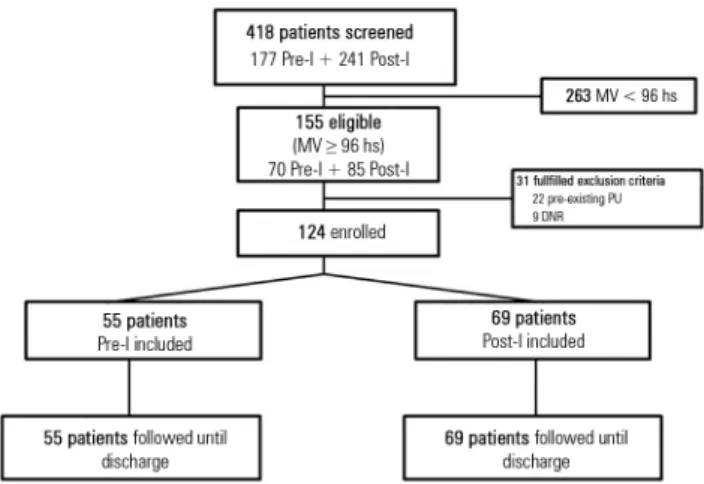
Of 418 patients who were admitted to the ICU during the study period, 263 were not included because the time that they spent on MV was < 96 hours. Of 155 eligible patients (70 in the Pre-I group; 85 in the Post-I group), an additional 31 patients were excluded (22 had pre-existing PUs, and 9 had do-not-resuscitate orders). Consequently, 124 patients met the inclusion criteria of MV ≥ 96 hours and an absence of previous lesions; 55 patients were enrolled in the Pre-I period, and 69 patients were enrolled in the Post-I period (Figure 2). Relevant patient characteristics for both periods are shown in table 1. Briely, this population was young and acutely ill; the mean patient age was higher in the Post-I period. Medical diagnoses and severe organ failure predominated, and both multiple trauma and acute brain injury were frequent causes of admission. hese patients exhibited a prolonged duration of mechanical ventilation and length of ICU stay, and the mortality was high. he nurse:patient ratio remained unchanged throughout the study in both periods.
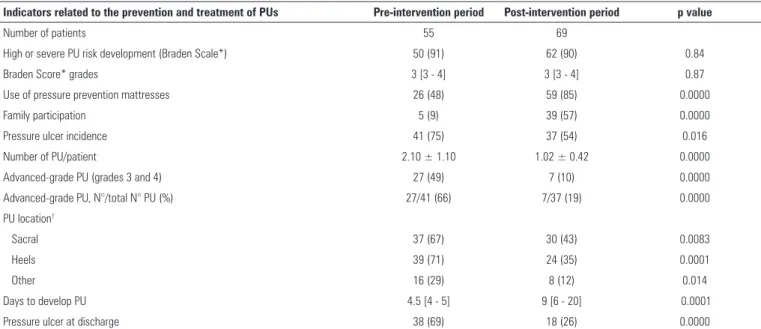
Performance indicators for the prevention and treatment of PUs in both periods are detailed in table 2. he risk of developing PUs according to the Braden Scale was similar in both periods. However, in the Post-I period, the use of pressure-prevention mattresses increased from 26 (48%) to 59 (85%) (p = 0.0000), and the rate of family participation improved from 5 (9%) to 39 (57%) (p = 0.0000). he global pressure ulcer incidence decreased in the Post-I period from 41 (75%) to 37 (54%) (p = 0.016). here was a notable decrease in advanced-grade PUs from 27 (49%) to 7 (10%) (p = 0.0000). he sacral, heel and other PU locations were also signiicantly
Figure 2 - Flow-chart of the study. MV - mechanical ventilation; PU - pressure ulcers; DNR - do-not-resuscitate orders.
Table 1 - Characteristics of patients in pre- and post-intervention periods
Variables Pre-intervention period
Post-intervention
period p value
Number of patients 55 69
Age (years) 47 ± 18 39 ± 17 0.01
APACHE II score 18 ± 7 18 ± 6 0.77
SOFA24 score 7 [4 - 9] 8 [6 - 10] 0.06
Medical admission 31 (56) 33 (48) 0.35
Multiple trauma 6 (10) 14 (20) 0.13
Traumatic brain injury 8 (15) 13 (19) 0.51
Shock on admission 26 (48) 42 (63) 0.11
Dialysis 9 (17) 6 (8) 0.16
MV duration (days) 18 [9 - 46] 14 [8 - 34] 0.55 ICU LOS (days) 23 [8 - 47] 19.5 [11 - 36] 0.98
ICU mortality 23 (42) 24 (35) 0.42
Nurse:patient ratio 1: 2.5 1: 2.4 0.86
APACHE - Acute Physiology and Chronic Health Evaluation; SOFA24 - Sequential Organ Failure Assessment on admission; LOS - length of stay; MV - mechanical ventilation; ICU - intensive care unit. The data are presented as N (%), mean ± standard deviation or median [p25 - 75].
reduced in the Post-I period. In addition, the onset of new lesions was delayed from a median of 4.5 [4 - 5] to 9 [6 - 20] days (p = 0.0001), and lesions that were present at ICU discharge decreased from 38 (69%) to 18 (26%) (p = 0.0000).
he logistic regression model indicated that the MV
duration and SOFA24 score were positively associated
Table 2 - Indicators for the prevention and treatment of pressure ulcers
Indicators related to the prevention and treatment of PUs Pre-intervention period Post-intervention period p value
Number of patients 55 69
High or severe PU risk development (Braden Scale*) 50 (91) 62 (90) 0.84
Braden Score* grades 3 [3 - 4] 3 [3 - 4] 0.87
Use of pressure prevention mattresses 26 (48) 59 (85) 0.0000
Family participation 5 (9) 39 (57) 0.0000
Pressure ulcer incidence 41 (75) 37 (54) 0.016
Number of PU/patient 2.10 ± 1.10 1.02 ± 0.42 0.0000
Advanced-grade PU (grades 3 and 4) 27 (49) 7 (10) 0.0000
Advanced-grade PU, N°/total N° PU (%) 27/41 (66) 7/37 (19) 0.0000
PU location†
Sacral 37 (67) 30 (43) 0.0083
Heels 39 (71) 24 (35) 0.0001
Other 16 (29) 8 (12) 0.014
Days to develop PU 4.5 [4 - 5] 9 [6 - 20] 0.0001
Pressure ulcer at discharge 38 (69) 18 (26) 0.0000
PU - pressure ulcer. * Pressure ulcer risk development: 1: mild; 2: moderate; 3: high; 4: severe. † Patients can have pressure ulcers in more than one location. The data are presented as N
(%), mean ± standard deviation or median [p25-75].
Table 3 - Multivariate logistic regression model for advanced-grade pressure ulcers
Advanced-grade PU Odds
ratio SE p value
95% Confidence interval
MV duration* (d) 1.04 0.015 0.006 1.012 - 1.070
SOFA24* 1.43 0.166 0.002 1.140 - 1.798
Multifaceted intervention 0.04 0.031 0.000 0.009 - 0.186
PU - pressure ulcers; SE - standard error; MV - mechanical ventilation; SOFA24 - Sequential Organ Failure Assessment at admission; * The odds ratio increased with respect to the units of mechanical ventilation or SOFA24 score.
DISCUSSION
his study demonstrated that a multifaceted educational intervention that consisted of the implementation of a multidisciplinary team for the management of PUs, a smartphone application as a telemedicine tool for lesion oversight, and the participation of families in patient care decreased the incidence and
severity of lesions. Furthermore, we found that SOFA24
score and mechanical ventilation duration - both markers of acute, severe disease - were independent risk factors for the occurrence of advanced-grade pressure ulcers. Notably, the multifaceted educational intervention acted as the only protective predictor. Additionally, the onset of lesions was signiicantly delayed in the Post-I period, and the percentage of patients discharged without lesions was higher.
he risk of developing PUs in our ICU is high. Taking into consideration the entire population screened during the study period, the total incidence of PUs for all ICU patients was 23% in the Pre-I period and 15% in the
Post-I period (data not presented). Considering only patients with MV ≥ 96 hours, the incidence of PUs was even higher (75% in the Pre-I period and 54% in the Post-I period); these patients were at the highest risk given their high grades (3 and 4) on the Braden Scale, prolonged MV duration, and immobilization due to shock, as well as the high incidence of multiple trauma and traumatic brain injury. Considering this scenario, no matter how comprehensive the protocol is that we design, PUs will still develop in some patients. herefore, our multifaceted approach had the ultimate goal of reducing not only the global incidence of PUs, but also the number of advanced-grade lesions; we succeeded in this latter goal, with the incidence decreasing from 49% to 10%.
Another issue that complicated the high incidence of PUs is that the possibility of discharge to tertiary care institutions in Argentina - as well as Latin America in general - is limited; therefore, patients may remain in the ICU for months. Furthermore, the nurse:patient ratio in our ICU is clearly insuicient (1:2.4 - 2.5), with values similar to those in Latin America, (1:1.8 [1.0 - 2.6]), which are some of the lowest in the world.(16) Insuicient clinical care staf is a well-known predictor of adverse outcomes.(17)
For evaluating and improving quality-of-care, the “monitoring system” approach focuses on the performance and periodic evaluation of selected indicators, while the PDSA (Plan, Do, Study, Act) cycle irst identiies a problem, analyses it, and inally, proposes improvements(18)
strategy, and inally, establishing monitoring guidelines. It is generally accepted that multicomponent interventions might be more efective than any individual approach for the prevention of PUs (e.g., the use of devices for pressure relief, such as advanced static mattresses or static overlays).(6,21,22) In a recent ICU study in the US, a multifaceted prevention program reduced the incidence
of PUs from 10% to 3%.(7) Many other studies that have
attempted to decrease the development of PUs only used singular interventions. For example, the turn team proposed in a study by Still et al. reduced lesions by turning patients every two hours.(23) In the Behrendt et al. study, PUs were reduced by continuous bedside pressure mapping.(24)
Some elements of our approach have been used in limited degrees by other researchers. For example, in the de Araujo et al. study, the authors used digital photography over three months to classify lesions; however, of the 42 patients who participated in the study, only 47 grade 1
and 2 lesions were identiied.(25) Our study catalogued
more than 1,500 photographs over a 16-month period and recorded all four grades of PUs. We maintained the standard practices for care of PUs as indicated above but also incorporated other elements, such as the smartphone application and the family prevention bundle. To our knowledge, this is the irst study to incorporate this combination of diferent approaches.
Incorporating WhatsApp® enabled the team to
maximize the limited time of the specialist by focusing on the most severe lesions. Photographs of the lesions were simultaneously sent to all staf members, which allowed for timely monitoring and instantaneous comparison with the prior state of the lesion. he sheer number of photographs that were evaluated during the study dramatically increased the less-trained staf’s exposure to the evaluation and treatment of PUs since not all personnel had the same knowledge on the prevention and treatment of this complication. his discrepancy in knowledge has also been noted in other studies.(26)
Family participation is a controversial issue for critical care staf. Most studies have explored the intention of family members to involve themselves in patient care, but few have reported active participation in speciic tasks without overstepping boundaries with the staf, as we have successfully illustrated in the present study.(27-29) It has been well documented that the presence of family aids in patient recovery.(30,31) In two previous studies, family members expressed that massages were one of the main elements of healthcare they could most readily provide
then added speciic, yet limited, tasks that family members could provide while reducing the burden on the limited nursing staf. his engagement was possible due to the open visitation policy, which allowed family members to be present for extended periods.(34)
he indings of a recent American College of Critical Care Medicine Task Force on Models of Critical Care also supported many of our conclusions: (1) an intensivist-led, high-performing, multidisciplinary team dedicated to the ICU is an integral part of efective care delivery; (2) process improvement is the cornerstone of achieving high-quality ICU outcomes; and (3) standardized protocols including care bundles and protocols to facilitate measurable processes and outcomes should be used and further developed in the ICU setting.(35)
A limitation of this study was that it was conducted in only one public center, which compromises its external validity; however, the simplicity of the intervention allows for eventual generalization. Age was also a limitation in that this was a relatively young population (47 versus 39); therefore, we cannot completely rule out age as a predictor. However, in our model, age was not independently associated with more advanced-grade PUs. Another limitation was that we only evaluated family participation and not family satisfaction. As none of the family members refused to participate or quit, our impression was that their feeling of usefulness increased their involvement in their loved one’s recovery. Finally, we cannot discard that awareness of good clinical practices by nurses could have contributed to better clinical outcomes, as they knew they were being observed (Hawthorne efect), regardless of any intervention. However, this is a collateral beneit that has been frequently described in before-after quality studies.
previously mentioned US study that highlights the overall cost-savings for the hospital through the implementation of this kind of intervention.(7)
CONCLUSION
It was feasible to signiicantly reduce the incidence and the severity of pressure ulcers in a high-risk population through the implementation of a multifaceted educational intervention that included the voluntary participation of a patient’s family members. A no-cost smartphone application was utilized to reach this goal in combination with free educational components for personnel.
ACKNOWLEDGMENTS
We are indebted to the members of the nursing team for their collaboration, and we especially thank the patient’s families who agreed to participate in this study with great enthusiasm and commitment.
Author contributions
Conception: Cecilia Inés Loudet. Study design: Cecilia Inés Loudet, María Cecilia Marchena, María Roxana Maradeo, Silvia Laura Fernández, and María Victoria Romero. Data acquisition: Cecilia Inés Loudet, María Cecilia Marchena, María Roxana Maradeo, Silvia Laura Fernández, María Victoria Romero, Graciela Esther Valenzuela, Isabel Eustaquia Herrera, Martha Teresa Ramírez, Silvia Rojas Palomino, Leandro Ismael Tumino, Rosa Reina, and Ana Laura González. Dermatology expert: María Roxana Maradeo. On-call dermatology expert: Mariana Virginia Teberobsky. Analysis or interpretation of data: Cecilia Inés Loudet, María Cecilia Marchena, and Elisa Estenssoro. Drafting of the manuscript: Cecilia Inés Loudet and Elisa Estenssoro. Revising the manuscript for important intellectual content: María Cecilia Marchena and Elisa Estenssoro. Final approval: All authors.
Objetivo: Determinar a eicácia de um programa de gestão da qualidade para reduzir a incidência e a gravidade de úlceras por pressão em pacientes de terapia intensiva.
Métodos: Estudo com metodologia quasi-experimental, antes-e-depois, conduzido em uma unidade de terapia inten-siva clínica e cirúrgica. Incluíram-se os pacientes consecutivos que receberam ventilação mecânica por um período igual ou superior a 96 horas. Uma equipe de Melhoria de Processos de-lineou um processo de intervenção multifacetado, que consistiu de uma sessão educacional, uma lista de veriicação de úlcera de pressão, um aplicativo para smartphone para monitoramento de lesões e um conjunto de normas de tomada de decisão, além de prevenção familiar.
Resultados: O Grupo Pré-I incluiu 25 pacientes, e o Grupo Pós-I foi constituído por 69 pacientes. A incidência de úlce-ra de pressão nestes grupos foi de 41 (75%) e 37 (54%), res-pectivamente. O tempo mediano para o desenvolvimento das úlceras por pressão foi de 4,5 (4-5) dias no Grupo Pré-I e 9 (6-20) dias no Grupo Pós-I após a admissão para cada um dos
períodos. A incidência de úlceras por pressão de grau avançado foi de 27 (49%) no Grupo Pré-I e 7 (10%) no Grupo Pós-I. A presença de úlceras por pressão na alta foi de 38 (69%) e 18 (26%), respectivamente, para os Grupos Pré-I e Pós-I (p < 0,05 para todas as comparações). A participação da família tota-lizou 9% no Grupo Pré-I e aumentou para 57% no Grupo Pós-I (p < 0,05). Utilizou-se um modelo de regressão logística para analisar os preditores de úlcera de pressão com grau avançado. A duração da ventilação mecânica e a presença de falência de órgão associaram-se positivamente com o desenvolvimento de úlceras por pressão, enquanto o programa multifacetado de intervenção atuou como fator de proteção.
Conclusão: Um programa de qualidade, com base em um aplicativo para smartphone e na participação da família, pode reduzir a incidência e a gravidade de úlceras por pressão em pa-cientes com ventilação mecânica aguda prolongada.
RESUMO
C, et al. Developing and pilot testing quality indicators in the intensive care unit. J Crit Care. 2003;18(3):145-55.
2. Moore ZE, Cowman S. Risk assessment tools for the prevention of pressure ulcers. Cochrane Database Syst Rev. 2014;(2):CD006471. 3. Manzano F, Pérez-Pérez AM, Martínez-Ruiz S, Garrido-Colmenero C, Roldan
D, Jiménez-Quintana MM, et al. Hospital-acquired pressure ulcers and risk of hospital mortality in intensive care patients on mechanical ventilation. J Eval Clin Pract. 2014;20(4):362-8.
4. Cooper KL. Evidence-based prevention of pressure ulcers in the intensive care unit. Crit Care Nurse. 2013;33(6):57-66.
5. McInnes E, Jammali-Blasi A, Bell-Syer SE, Dumville JC, Middleton V, Cullum N. Support surfaces for pressure ulcer prevention. Cochrane Database Syst Rev. 2015;(9):CD001735.
6. Moore ZE, Webster J, Samuriwo R. Wound-care teams for preventing and treating pressure ulcers. Cochrane Database Syst Rev. 2015;(9):CD011011. 7. Swafford K, Culpepper R, Dunn C. Use of a comprehensive program to
reduce the incidence of hospital-acquired pressure ulcers in an intensive care unit. Am J Crit Care. 2016;25(2):152-5.
8. Oliveira Costa AC, Sabino Pinho CP, Almeida dos Santos AD, Santos do Nascimento AC. [Pressure ulcer: Incidence and demographic, clinical and nutrition factors associated in intensive care unit patients]. Nutr Hosp. 2015;32(5):2242-52.
9. Das Neves AV, Vasquez DN, Loudet CI, Intile D, Sáenz MG, Marchena C, et al. Symptom burden and health-related quality of life among intensive care unit survivors in Argentina: A prospective cohort study. J Crit Care. 2015;30(5):1049-54.
10. Zilberberg MD, Luippold RS, Sulsky S, Shorr AF. Prolonged acute mechanical ventilation, hospital resource utilization, and mortality in the United States. Crit Care Med. 2008;36(3):724-30.
11. Knaus WA, Draper EA, Wagner DP, Zimmerman JE. APACHE II: a severity of disease classification system. Crit Care Med. 1985;13(10):818-29. 12. Vincent JL, Moreno R, Takala J, Willatts S, De Mendonca A, Bruining H, et
al. The SOFA (Sepsis-Related Organ Failure Assessment) score to describe organ dysfunction/failure. On behalf of the Working Group on Sepsis-Related Problems of the European Society of Intensive Care Medicine. Intensive Care Med. 1996;22(7):707-10.
13. Bergstrom N, Demuth PJ, Braden BJ. A clinical trial of the Braden Scale for Predicting Pressure Sore Risk. Nurs Clin North Am. 1987;22(2):417-28. 14. European Pressure Ulcer Advisory Panel. [Internet]. [cited 2016 Jul 10].
Available from http://www.puclas.ugent.be/puclas/
15. Ogrinc G, Davies L, Goodman D, Batalden P, Davidoff F, Stevens D. Squire 2.0 (Standards for Quality Improvement Reporting Excellence): revised publication guidelines from a detailed consensus process. BMJ Qual Saf. 2016;25(12):986-92.
16. Sakr Y, Moreira CL, Rhodes A, Ferguson ND, Kleinpell R, Pickkers P, Kuiper MA, Lipman J, Vincent JL; Extended Prevalence of Infection in Intensive Care Study Investigators. The impact of hospital and ICU organizational factors on outcome in critically ill patients: Results from the Extended Prevalence of Infection in Intensive Care Study. Crit Care Med. 2015;43(3):519-26. 17. Penoyer DA. Nurse staffing and patient outcomes in critical care: a concise
review. Crit Care Med. 2010;38(7):1521-8; quiz 1529.
18. Sociedad Española de Medicina Intensiva, Crítica y Unidades Coronarias (SEMICYUC). Quality indicators in critically ill patients. Update 2011. [Internet]. [cited 2016 Jul 10]. Available from http://www.semicyuc.org/ sites/default/files/quality_indicators_update_2011.pdf
20. Taylor MJ, McNicholas C, Nicolay C, Darzi A, Bell D, Reed JE. Systematic review of the application of the plan-do-study-act method to improve quality in healthcare. BMJ Qual Saf. 2014;23(4):290-8.
21. Sullivan N, Schoelles KM. Preventing in-facility pressure ulcers as a patient safety strategy: a systematic review. Ann Intern Med. 2013;158(5 Pt 2):410-6.
22. Qaseem A, Mir TP, Starkey M, Denberg TD; Clinical Guidelines Committee of the American College of Physicians. Risk assessment and prevention of pressure ulcers: a clinical practice guideline from the American College Of Physicians. Ann Intern Med. 2015;162(5):359-69.
23. Still MD, Cross LC, Dunlap M, Rencher R, Larkins ER, Carpenter DL, et al. The turn team: a novel strategy for reducing pressure ulcers in the surgical intensive care unit. J Am Coll Surg. 2013;216(3):373-9.
24. Behrendt R, Ghaznavi AM, Mahan M, Craft S, Siddiqui A. Continuous bedside pressure mapping and rates of hospital-associated pressure ulcers in a medical intensive care unit. Am J Crit Care. 2014;23(2):127-33. 25. Araujo TM, de Araujo MF, Caetano JA. [Using the Braden scale and
photographs to assess pressure ulcer risk]. Rev Esc Enferm USP. 2012;46(4):858-64. Portuguese.
26. Cox J, Roche S, Gandhi N. Critical care physicians: attitudes, beliefs, and knowledge about pressure ulcers. Adv Skin Wound Care. 2013;26(4):168-76.
27. Garrouste-Orgeas M, Philippart F, Timsit JF, Diaw F, Willems V, Tabah A, et al. Perceptions of a 24-hour visiting policy in the intensive care unit. Crit Care Med. 2008;36(1):30-5.
28. Biancofiore G, Bindi LM, Barsotti E, Menichini S, Baldini S. Open intensive care units: a regional survey about the beliefs and attitudes of healthcare professionals. Minerva Anestesiol. 2010;76(2):93-9.
29. da Silva Ramos FJ, Fumis RR, Azevedo LC, Schettino G. Perceptions of an open visitation policy by intensive care unit workers. Ann Intensive Care. 2013;3(1):34.
30. Kleinpell RM. Visiting hours in the intensive care unit: more evidence that open visitation is beneficial. Crit Care Med. 2008;36(1):334-5.
31. Giannini A, Garrouste-Orgeas M, Latour JM. What’s new in ICU visiting policies: can we continue to keep the doors closed? Intensive Care Med. 2014;40(5):730-3.
32. McAdam JL, Arai S, Puntillo KA. Unrecognized contributions of families in the intensive care unit. Intensive Care Med. 2008;34(6):1097-101. 33. Garrouste-Orgeas M, Willems V, Timsit JF, Diaw F, Brochon S, Vesin A,
et al. Opinions of families, staff, and patients about family participation in care in intensive care units. J Crit Care. 2010;25(4):634-40.
34. Azoulay E, Pochard F, Chevret S, Arich C, Brivet F, Brun F, Charles PE, Desmettre T, Dubois D, Galliot R, Garrouste-Orgeas M, Goldgran-Toledano D, Herbecq P, Joly LM, Jourdain M, Kaidomar M, Lepape A, Letellier N, Marie O, Page B, Parrot A, Rodie-Talbere PA, Sermet A, Tenaillon A, Thuong M, Tulasne P, Le Gall JR, Schlemmer B; French Famirea Group. Family participation in care to the critically ill: opinions of families and staff. Intensive Care Med. 2003;29(9):1498-504.