Chronic obstructive pulmonary disease
exacerbation in the intensive care unit: clinical,
functional and quality of life at discharge and 3
months of follow up
INTRODUCTION
Chronic obstructive pulmonary disease (COPD) is one of the most common chronic health care problems.(1,2) According to the Global Initiative for Chronic
Obstructive Lung Disease (GOLD), COPD is considered a preventable and treatable disease, which is often underdiagnosed in Latin America.(1)
he natural course of COPD is characterized by exacerbations, which are considered acute worsening of the respiratory condition, from the stable state and beyond normal day-to-day variations, and these exacerbations require additional treatment. In severe exacerbations, COPD patients require hospitalization or an emergency visit. Both respiratory failure with ventilatory support and intensive care unit (ICU) admission are frequent.(1-10)
Renata Cristina Teixeira Pinto Viana1,2, Mariangela Pimentel Pincelli3,4, Emílio Pizzichini3, André Pacheco Silva5, Joice Manes6, Tatiana Dias Marconi7, Leila John Marques Steidle3
1. Internal Medicine, Universidade do Vale do Itajaí - Itajaí (SC), Brazil.
2. Intensive and Palliative Care, Universidade Federal de Santa Catarina - Florianópolis (SC), Brazil.
3. Department of Internal Medicine/Pneumology, Hospital Universitário, Universidade Federal de Santa Catarina - Florianópolis (SC), Brazil. 4. Intensive Care, Hospital Nereu Ramos - Florianópolis (SC), Brazil.
5. Instituto de Cardiologia de Santa Catarina - Florianópolis (SC), Brazil.
6. Internal Medicine, Hospital Universitário, Universidade Federal de Santa Catarina - Florianópolis (SC), Brazil.
7. Hematology, Centro de Pesquisas Oncológicas - Florianópolis (SC), Brazil.
Objective: he purpose of this study was to evaluate the clinical/functional aspects and quality of life of chronic obstructive pulmonary disease patients who were discharged after an intensive care unit admission for acute respiratory failure.
Methods: his prospective study
included chronic obstructive pulmonary disease patients who were admitted to two intensive care units between December of 2010 and August of 2011 and evaluated over three visits after discharge. hirty patients were included, and 20 patients completed the three-month follow up.
Results: here was a signiicant
improvement in the following: forced expiratory low in one second (L) (1.1/1.4/1.4; p = 0.019), six-minute walk test (m) (- /232.8 /272.6; p = 0.04), BODE score (7.5/5.0/3.8; p = 0.001), cognition measured by the Mini Mental
Conflicts of interest: None.
Submitted on September 27, 2016 Accepted on January 3, 2017
Corresponding author: Leila John Marques Steidle
Divisão de Pneunologia do Hospital Universitário da Universidade Federal de Santa Catarina Rua Profa. Maria Flora Pausewang, s/n - Trindade Zip code: 88036-800 - Florianópolis (SC), Brazil E-mail: [email protected]
Responsible editor: Felipe Dal Pizzol
Exacerbação da doença pulmonar obstrutiva crônica na unidade
de terapia intensiva: avaliação clínica, funcional e da qualidade
de vida na alta e após 3 meses de seguimento
ABSTRACT
Keywords: Chronic obstructive
pulmonary disease; Pulmonary function tests; Cognition; Quality of life; Treatment outcome
State Examination (21/23.5/23.5; p = 0.008) and quality of life measured by the total Saint George Respiratory Questionnaire score (63.3/56.8/51, p = 0.02). he mean diference in the total score was 12.3 (between visits 1 and three). Important clinical diferences were observed for the symptom score (18.8), activities score (5.2) and impact score (14.3). he majority of participants (80%) reported they would be willing to undergo a new intensive care unit admission.
Conclusion: Despite the disease
severity, there was a signiicant clinical, functional and quality of life improvement at the end of the third month. Most patients would be willing to undergo a new intensive care unit admission.
here are many studies on mortality in severe COPD
exacerbations,(3-15) and some studies have analyzed the
health status and quality of life of patients with COPD during the stable disease phases. However, there are few studies on the impact of severe exacerbations on the quality of life in this population.(5,8,16,17)
Studies that evaluate the impact of an ICU stay in a more comprehensive, detailed form for COPD patients, especially immediately after discharge and in long term follow-up, are necessary.
he present study aims to evaluate patients with COPD during the irst three months after they have been discharged from hospitalization for acute respiratory failure (ARF) in two ICUs with consideration for the clinical, functional (pulmonary function/motor function/ cognitive function) and quality of life aspects.
METHODS
A prospective cohort study was conducted between December 2010 and August 2011, involving all COPD patients who were admitted for ARF and discharged from two ICUs in Florianopolis, Santa Catarina, Brazil: 1) Hospital Universitário - Universidade Federal de Santa Catarina (HU-UFSC) and 2) Hospital Nereu Ramos
(HNR).
he inclusion criteria were patients over 18 years old; clinical diagnosis of ARF and admitted to the ICU; airlow obstruction of the airways, deined as a ratio of forced expiratory low in one second (FEV1) to the forced vital capacity (FVC) of less than 0.7; and a history of tobacco smoking. he exclusion criteria were a previous diagnosis of asthma; COPD patients who were hospitalized for reasons other than ARF; and lack of fulillment of the GOLDcriteria.(1)
he protocol was approved by the Universidade Federal
de Santa Catarina Ethics Committee number 1161/10. All participants or relatives gave written, informed consent before entering the study.
During the irst week after ICU discharge, the following demographic and ICU admission data were collected: modiied Medical Research Council dyspnea
scale (mMRC),(18) smoking status, comorbidities, home
oxygen therapy before admission, COPD treatment before hospitalization, previous ICU admissions, length of ICU stay, Acute Physiology and Chronic Health Evaluation
II (APACHE II) score,(19) and ventilatory support. hree
visits were performed as follows: (1) irst week after ICU discharge (in patients who were still in the hospital,
one month after discharge, and (3) three months after discharge.
he demographic data, smoking history, comorbidities, dyspnea score (mMRC), previous COPD treatment features, previous ICU admissions, APACHE II score and ventilatory support history were collected at ICU admission. he following parameters were evaluated in
three visits: FVC, FEV1, FEV1/FVC (spirometric data
collected when the maneuver could be performed),(20)
body mass index (BMI), six-minute walk test distance
(6MWT),(21) mMRC dyspnea score, BODE index
score,(22) mini mental (Mini Mental State Examination -
MMSE)(23) and Saint George Respiratory Questionnaire
(SGRQ) scores.(24,25) Additionally, patients were asked
about advanced directives and possible ICU readmission, if necessary.
Statistical analysis
Statistical analysis was performed using the Statistical Package for Social Science (SPSS) version 17. Descriptive analysis was performed using the frequencies for categorical variables and mean and standard deviation for normal continuous variables. he comparison between the parametric continuous variables was performed using
the t test and ANOVA with Bonferroni correction and
between the categorical variables using chi-square and Fischer’s tests. Statistical signiicance (p) was set as less than or equal to 0.05.
RESULTS
Overall, in the HU-UFSC ICU, 439 patients were
admitted to the ICU during the study period; 24 were COPD patients who were hospitalized due to ARF. Eight of these patients died during the ICU stay, and 16 were discharged. Sixteen patients attended the irst visit; however, two of them were excluded for not having a
FEV1/FVC < 0.7. Fourteen patients attended a second
visit, but two died before the last visit, and one missed the inal follow-up appointment. Eleven patients in this unit completed the last visit (Figure 1).
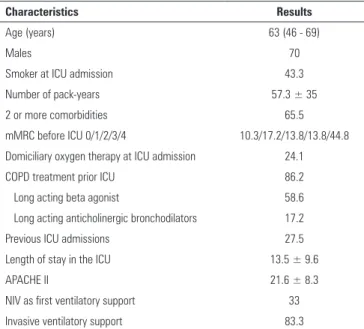
stay was 13.5 + 9.6 days. Non-invasive ventilation (NIV) was used in 33% of patients as the irst ventilatory support; in 83.3%, invasive support was applied. he demographic data are presented in table 1.
Figure 1 - Recruitment and follow up of patients from two intensive care units. ICU - Intensive Care Unit; HU - Hospital Universitário; HNR - Hospital Nereu Ramos; COPD - chronic obstructive pulmonary disease; ARF - acute respiratory failure; V1 - visit during the first week after discharge from the intensive care unit; V2 - visit one month following discharge from the intensive care unit; V3 - visit three months after discharge from the intensive care unit.
After ICU discharge, 30 patients were included in the study. Twenty patients completed the three visits and were included in the analysis (Figure 1).
Considering all 30 patients included in the study, the mean age was 63 ± 8.8 years old, and most patients (70%) were male. Almost half (43.3%) of the patients continued to smoke until their ICU admission, and they had an important smoking history (mean 35 ± 57 packs/year). he mean APACHE II was 21.6 ± 9.6, and the mean ICU
Table 1 - Characteristics of 30 chronic obstructive pulmonary disease patients discharged from intensive care units
Characteristics Results
Age (years) 63 (46 - 69)
Males 70
Smoker at ICU admission 43.3
Number of pack-years 57.3 ± 35
2 or more comorbidities 65.5
mMRC before ICU 0/1/2/3/4 10.3/17.2/13.8/13.8/44.8 Domiciliary oxygen therapy at ICU admission 24.1
COPD treatment prior ICU 86.2
Long acting beta agonist 58.6
Long acting anticholinergic bronchodilators 17.2
Previous ICU admissions 27.5
Length of stay in the ICU 13.5 ± 9.6
APACHE II 21.6 ± 8.3
NIV as first ventilatory support 33
Invasive ventilatory support 83.3
ICU - intensive care unit; MMRC - Modified Medical Research Council; COPD - chronic obstructive pulmonary disease; APACHE II - Acute Physiology and Chronic Health Evaluation II; NIV - non-invasive ventilation. The results are expressed as the median (25% - 75%), mean ± standard deviation or percentage.
Regarding the referred comorbidities, systemic arterial hypertension (SAH) was present in 58.6%, congestive heart failure (CHF) in 34.5%, diabetes in 27.6% and depression in 34.5% of the cases.
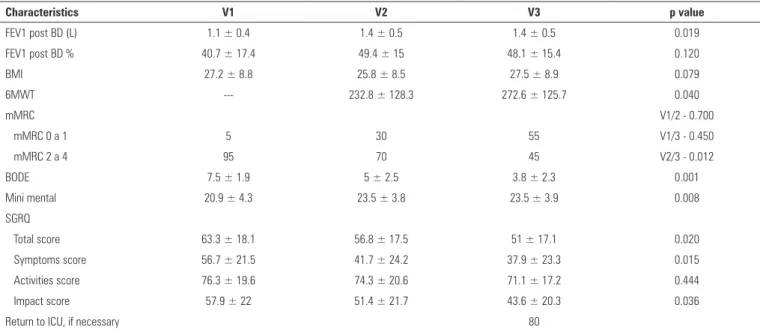
As shown in table 2, the follow-up at three months after ICU discharge showed a signiicant improvement in the quality of life, as perceived by patients, according the total SGRQ score (63.3 versus 56.8 versus 51, p = 0.02) and most domain scores of this questionnaire (Figure 2). he magnitude of the improvement in the quality of life was also veriied through the mean diferences scores, and the domain variation values, considering the interval between the irst and third visits. he minimal important clinical diference was 4 units.(26) he mean diference in
the total score was 12.3. Important clinical diferences were observed for the symptoms score (18.8), activities score (5.2) and impact score (14.3) (Table 3).
A signiicant improvement in the FEV1 (L) (1.1 versus
Table 2 - Analysis of clinical, functional and quality of life characteristics of 20 patients who completed all three visits after discharge from the intensive care unit
Characteristics V1 V2 V3 p value
FEV1 post BD (L) 1.1 ± 0.4 1.4 ± 0.5 1.4 ± 0.5 0.019
FEV1 post BD % 40.7 ± 17.4 49.4 ± 15 48.1 ± 15.4 0.120
BMI 27.2 ± 8.8 25.8 ± 8.5 27.5 ± 8.9 0.079
6MWT --- 232.8 ± 128.3 272.6 ± 125.7 0.040
mMRC V1/2 - 0.700
mMRC 0 a 1 5 30 55 V1/3 - 0.450
mMRC 2 a 4 95 70 45 V2/3 - 0.012
BODE 7.5 ± 1.9 5 ± 2.5 3.8 ± 2.3 0.001
Mini mental 20.9 ± 4.3 23.5 ± 3.8 23.5 ± 3.9 0.008
SGRQ
Total score 63.3 ± 18.1 56.8 ± 17.5 51 ± 17.1 0.020
Symptoms score 56.7 ± 21.5 41.7 ± 24.2 37.9 ± 23.3 0.015
Activities score 76.3 ± 19.6 74.3 ± 20.6 71.1 ± 17.2 0.444
Impact score 57.9 ± 22 51.4 ± 21.7 43.6 ± 20.3 0.036
Return to ICU, if necessary 80
V1 - visit during the first week after discharge from the intensive care unit; V2 - visit one month following discharge from the intensive care unit; V3 - visit three months after discharge from the intensive care unit; ICU - intensive care unit; p - significance level; FEV1 post BD (L) - forced expiratory volume in 1st second post bronchodilator (in liters); FEV
1 post BD % - percentage of forced
volume in 1st second post bronchodilator; BMI - body mass index; 6MWT - six-minute walk test; MMRC - modified Medical Research Council; BODE - Body-Mass Index, Airflow Obstruction,
Dyspnea and Exercise Capacity; SGRQ - Saint George Respiratory Questionnaire. The results are expressed as the mean ± standard deviation or percentage.
Table 3 - Mean differences in the Saint George Respiratory Questionnaire scores between V1 and V3
Characteristics ≠ V1 - V3
Saint George Respiratory Questionnaire
Total score 12.3
Symptom score 18.8
Activities score 5.2
Impact score 14.3
V1 - during the first week after intensive care unit discharge; V3 - three months after intensive care unit discharge.
Figure 2 - Saint George Respiratory Questionnaire scores in the chronic obstructive pulmonary disease patients during the first week (V1), one month (V2) and three months (V3) after intensive care unit discharge.
was also a signiicant improvement in the performance on the 6MWT (m) between the second and third visits
(232.8 versus 272.6, p = 0.040). However, the 6MWT
cannot be completed in most patients in the irst visit because of their poor clinical conditions. he mMRC dyspnea scale showed signiicant improvement in the interval between the second and third visits (p = 0.012). he cognitive parameters inferred by examining the Mini Mental showed signiicant improvement between V1 and V2, and they remained stable between the V2 and the V3 (21 versus 23.5 versus 23.5, p = 0.008) (Table 2).
he survival rates during the ICU stay, one month after discharge, and three months after discharge were 63%, 59% and 56%, respectively. During the follow-up, six patients (6/30) died (20%). After three months,
patients were asked about their willingness to undergo a new admission in intensive care, if necessary. Even while aware of the possibility of negative outcomes, the great majority (80%) said they would agree to another ICU admission (Table 2).
DISCUSSION
he main inding of the present cohort study was the observation of a signiicant quality of life improvement detected by the SGRQ within three months after ICU discharge. In accordance with this result, there was also
a signiicant improvement in the FEV1, 6MWT distance,
frequency of ongoing smokers at ICU admission. Some patients were already undergoing domiciliary oxygen therapy and had previous ICU admissions, showing the severity of disease in this COPD population.
Follow-up studies of ICU patients admitted for general causes are insuicient.(13,27,28) here are few papers
on COPD patients with severe exacerbations who require
ICU hospitalization(9,14) or that include COPD patients
after ICU discharge.(3,5,8,10) Studies evaluating patients with
chronic respiratory disease after ICU hospitalization are very important because they add information about the possible beneits of ICU admissions in these chronically ill patients. herefore, this is an original and relevant study for clinical practice because it allows for a multifaceted view of this population.
he severity of these patient’s conditions is likely related to the social reality of our country where most of such patients have never undergone spirometry(2) and are
undertreated. In Brazil, patients with COPD are often underdiagnosed, have no access to respiratory physicians
and do not receive adequate treatment.(2) he results
showed that patients who survived had the potential for improvement in a relatively short period of time. he cause of this improvement may be related to the better management of these COPD patients in a respiratory reference unit.
he data quality was ensured by the selection of patients. To be included in this study, it was necessary to have a clinical diagnosis of COPD prior to or during hospitalization, a history of smoking, and ARF as the cause of ICU admission. In addition, individuals who subsequently had no spirometric criteria for COPD according to GOLD were excluded. he use of objective
measures, such as FEV1 and 6MWT, and the choice of
instruments that widely recognized and validated for use, such as the SGRQ, gives credibility to the results. Careful questionnaire application, in an identical manner, without external interference and by the same trained investigators group, also supports the results.
As reported in a broad population-based study conducted in Sao Paulo,(2) most patients lacked previous
pulmonary functional assessment. Only 33% of patients had previously undergone spirometry. As a result, the objective assessment of the disease severity and the adequacy of treatment before ICU admission was not appropriate. COPD was conirmed with later spirometry in all 20 patients who were included in this report.
Additionally, there was a signiicant improvement in the
FEV1, with an average gain of 290mL in the irst month
of follow-up, which remained until the end of the three months. After each exacerbation, there is a signiicant decrease in lung function recorded by the FEV1, and there is a subsequent recovery; however, patients usually do not achieve levels comparable to their baseline.(1,7,8) Although
patients have shown signiicant gains in lung function, it is unknown where these individuals are in the trajectory of functional restoration after exacerbation because there is a lack of spirometric data prior to admission.
According to some studies, the mortality of exacerbated COPD patients during the ICU stay is variable.(3,4,5,7) In
the present study, the ICU mortality agreed with the APACHE II-predicted mortality (21.6 ± 8.3, 38.9%). Pincelli et al. showed that the mortality rates during the ICU stay and after 28 days of discharge were 20.8% and
33.3%, respectively.(3) Ucgun et al. reported a 33.1%
mortality rate in the hospital.(29) In the current study,
the mortality rates during the ICU stay, one month after discharge and three months after discharge were 37%, 41% and 44%, respectively.
he relationship between the SGRQ score and mortality has been conirmed, regardless of the severity of bronchial obstruction provided by the FEV1.(11,30) A
recent systematic review evaluated nine studies on the quality of life after invasive ventilation in COPD and demonstrated that the quality of life deteriorated after invasive ventilation, but the quality of life was similar to patients who are undergoing long-term oxygen therapy or pulmonary rehabilitation programs.(31,32) Rivera-Fernández
et al. observed the quality of life of COPD patients after receiving mechanical ventilation at two moments, at discharge and six years later. hese authors demonstrated a decrease in the quality of life six years after ICU discharge,(33)
which may be due to disease progression during this long post-hospitalization time interval instead of from the impact of the ICU stay. Berkius et al. observed that the health-related quality of life of COPD patients after ICU treatment is lower than in the general population, but 24 months after discharge, the quality of life for these patients was similar to that of COPD patients who were not treated in the ICU.(34) Chiarchiaro et al. showed a decline
in the well-being trajectories suddenly after admission
to the ICU with recovery in the next 6 months.(35) On
quality of life the same as, or better than, before ICU
admission;(5) however, the CAOS study included COPD
and asthmatic patients. According to Machado et al., patients admitted in the ICU of HU-UFSC for general causes reported a quality of life that was equal to, or better than, after discharge when compared to the quality of life prior to admission. Additionally, there was signiicant
improvement 90 and 180 days after discharge.(36) In
accordance with the CAOS study and Machado et al., the present study showed signiicant improvements in the quality of life. he observed increase in the quality of life for COPD exacerbated patients, detected by the SGRQ in a relatively short period of time, must be highlighted in this study, especially considering the symptom domain.
Although not possible for most patients to complete the 6MWT during the irst week after discharge from the ICU, there was signiicant improvement in performance between the second and third visits. A gain of 54m in the 6MWT after intervention was correlated with clinical improvement.(24) Wise et al. showed a clinically signiicant
diference of 50 to 80m in the 6MWT.(25) In any case, for
these patients who have a very low functional capacity, such as the capacity to walk 100m in the 6MWT, a gain of 50m is a signiicant improvement. herefore, the best interpretation should be achieved with the diference from the percentage of the basal distance to the distance obtained after intervention, which is considered functional improvement when the gain is more than ten percent of the basal distance value.
Another important inding of this study was a signiicant improvement in the integrative BODE index during the three-month follow-up period. he increase in the BODE index is related to the increase in hospital admissions and
increased number of hospitalization days.(37) Hospital
admissions for COPD exacerbation are associated with
a higher BODE index.(38) Sanjaume et al. demonstrated
that the BODE assessed at discharge predicts mortality in patients who require multiple admissions for COPD
exacerbations.(15) hus far, no study has evaluated the
BODE index as a prognostic marker after ICU admission. Similarly, the cognitive parameters, assessed by the MMSE, showed improvement in the irst month after discharge from the ICU and remained stable until the third month of follow-up. Using the MMSE, Ambrosino et al. showed that six months after ICU discharge, the cognition of patients who had already been hospitalized in
the ICU for an exacerbation is similar to that in patients
who have never previously received intensive care.(39)
However, according to Torgersen et al., cognitive deicits can be found in 64% of individuals immediately after the ICU stay, but cognition improves rapidly in the irst three months after discharge,(40) as observed in this study.
In the CAOS study, the great majority of COPD and asthma patients who survived the ICU were willing to be readmitted to the ICU, if necessary. Similarly, 80% of patients in the current study also agreed that they might need to return to the ICU. his inding probably indicates that these patients did not experience the ICU stay as a traumatic experience, which may relect progress in sedation and analgesia and humanization of intensive care. his observation could also have been inluenced by the patient perception of improvement in this post-ICU period.
he limitations of this study are the small sample size and relatively short follow-up duration. Nonetheless, we cannot forget that these individuals have extreme diiculty moving themselves. hey require family support for outpatient visits and signiicant physical exertion. Reassessment of these patients in a year or two should be performed to obtain comparative information.
CONCLUSION
In conclusion, despite the progressive nature of chronic obstructive pulmonary disease and condition severity required for intensive care unit hospitalization, the present study suggests that some patients could have improvement in their clinical, functional and quality of life conditions, even in a brief time interval. Perhaps, the main factor associated with signiicant clinical improvement after discharge should have been specialist-oriented follow-up, respecting the guidelines to optimize the disease treatment. hese indings inspire relection on the decisions for intensive care unit admission in this population.
ACKNOWLEDGMENTS
We would like to thank all patients and their families, who were very attentive throughout the research process. We would like to thank all professionals who helped with the implementation of this project and would especially like to thank to the intensive care unit doctors at the
Objetivo: Avaliar aspectos clínicos e funcionais, assim como qualidade de vida de pacientes com doença pulmonar obstrutiva crônica após receberem alta da unidade de terapia intensiva à qual foram admitidos por insuiciência respiratória aguda.
Métodos: Estudo prospectivo que incluiu pacientes com do-ença pulmonar obstrutiva crônica admitidos a duas unidades de terapia intensiva entre dezembro de 2010 e agosto de 2011, e que foram avaliados em três visitas após a alta da unidade de terapia intensiva. Incluíram-se 31 pacientes e, destes, 20 pacientes com-pletaram o seguimento de 3 meses.
Resultados: Ocorreu melhora signiicante dos
seguin-tes aspectos: volume expiratório forçado em 1 segundo (L) (1,1/1,4/1,4; p = 0,019), Teste de Caminhada de 6 Minutos (m) (- /232,8/272,6; p = 0,04), escore BODE (7,5/5,0/3,8; p = 0,001), cognição avaliada com uso da escala Mini Mental
State Examination (21/23,5/23,5; p = 0,008) e qualidade de vida avaliada pelo Saint George Respiratory Questionnaire
(63,3/56,8/51; p = 0,02). A diferença média no escore total foi de 12,3 (entre as visitas um e três). Observaram-se diferenças clínicas importantes em relação ao escore de sintomas (18,8), escore de atividades (5,2) e escore de impacto (14,3). A maior parte dos participantes (80%) relatou que aceitaria uma nova admissão à unidade de terapia intensiva.
Conclusão: Apesar da gravidade da doença, ao inal do ter-ceiro mês ocorreu uma signiicativa melhora clínica, funcional e de qualidade de vida. A maior parte dos pacientes aceitaria sub-meter-se a uma nova internação na unidade de terapia intensiva.
RESUMO
Descritores: Doença pulmonar obstrutiva crônica; Testes de função respiratória; Cognição; Qualidade de vida; Resultado do tratamento
REFERENCES
1. Global Strategy for Diagnosis, Management, and Prevention of Chronic Obstructive Pulmonary Disease [Internet]. [updated 2017 August 4] Available from: http://www.goldcopd.org/
2. Nascimento OA, Camelier A, Rosa FW, Menezes AM, Pérez-Padilla R, Jardim JR; Latin American Project for the Investigation of Obstructive Lung Disease (PLATINO) Group. Chronic obstructive pulmonary disease is underdiagnosed and undertreated in São Paulo (Brazil): results of the PLATINO study. Braz J Med Biol Res. 2007;40(7):887-95.
3. Pincelli MP, Grumann AC, Fernandes C, Cavalheiro AG, Haussen DA, Maia IS. Characteristics of COPD patients admitted to the ICU of a referral hospital for respiratory diseases in Brazil. J Bras Pneumol. 2011;37(2):217-22. 4. Ai-Ping C, Lee KH, Lim TK. In-hospital and 5-year mortality of patients
treated in the ICU for acute exacerbation of COPD: a retrospective study. Chest. 2005;128(2):518-24.
5. Wildman MJ, Sanderson C, Groves J, Reeves BC, Ayres J, Harrison DA, et al. Predicting mortality for patients with exacerbations of COPD and Asthma in the COPD and Asthma Outcome Study (CAOS). QJM. 2009;102(6):389-99.
6. Miró Andreu G, Félez Flor M, Solsona Durán JF. [Medical decisions in patients with chronic obstructive pulmonary disease]. Med Clin (Barc). 2001;116(14):536-8. Spanish.
7. Steer J, Gibson GJ, Bourke SC. Predicting outcomes following hospitalization for acute exacerbations of COPD. QJM. 2010;103(11):817-29.
8. Teixeira C, Cabral CR, Hass JS, Oliveira RP, Vargas MA, Freitas AP, et al. Exacerbação aguda da DPOC: mortalidade e estado funcional dois anos após a alta da UTI. J Bras Pneumol. 2011;37(3):334-40.
9. Afessa B, Morales IJ, Scanlon PD, Peters SG. Prognostic factors, clinical course, and hospital outcome of patients with chronic obstructive pulmonary disease admitted to an intensive care unit for acute respiratory failure. Crit Care Med. 2002;30(7):1610-5.
10. Seneff MG, Wagner DP, Wagner RP, Zimmerman JE, Knaus WA. Hospital and 1-year survival of patients admitted to intensive care units with acute exacerbation of chronic obstructive pulmonary disease. JAMA. 1995;274(23):1852-7.
11. Almagro P, Calbo E, Ochoa de Echagüen A, Barreiro B, Quintana S, Heredia JL, et al. Mortality after hospitalization for COPD. Chest. 2002;121(5):1441-8.
12. Wildman MJ, Sanderson CF, Groves J, Reeves BC, Ayres JG, Harrison D, et al. Survival and quality of life for patients with COPD or asthma admitted to intensive care in a UK multicentre cohort: the COPD and Asthma Outcome Study (CAOS). Thorax. 2009;64(2):128-32.
13. Eddleston JM, White P, Guthrie E. Survival, morbidity, and quality of life after discharge from intensive care. Crit Care Med. 2000;28(7):2293-9. 14. Añón JM, de Lorenzo AG. Prognosis of patients with COPD admitted to the
ICU. Thorax. 2009;64(10):916; author reply 916-7.
15. Sanjaume M, Almagro P, Rodríguez-Carballeira M, Barreiro B, Heredia JL, Garau J. [Post-hospital mortality in patients re-admitted due to COPD. Utility of BODE index]. Rev Clin Esp. 2009;209(8):364-70. Spanish. 16. Wildman MJ, O’Dea J, Kostopoulou O, Tindall M, Walia S, Khan Z. Variation
in intubation decisions for patients with chronic obstructive pulmonary disease in one critical care network. QJM. 2003;96(8):583-91.
17. Menn P, Weber N, Holle R. Health-related quality of life in patients with severe COPD hospitalized for exacerbations - comparing EQ-5D, SF-12 and SGRQ. Health Qual Life Outcomes. 2010;8:39.
18. Kovelis D, Segretti NO, Probst VS, Lareau SC, Brunetto AF, Pitta F. Validação do Modified Pulmonary Functional Status and Dyspnea Questionnaire e da escala do Medical Research Council para o uso em pacientes com doença pulmonar obstrutiva crônica no Brasil. J Bras Pneumol. 2008;34(12):1008-18. 19. Knaus WA, Draper EA, Wagner DP, Zimmerman JE. APACHE II: a severity
of disease classification system. Crit Care Med. 1985;13(10):818-29. 20. Miller MR, Hankinson J, Brusasco V, Burgos F, Casaburi R, Coates A,
Crapo R, Enright P, van der Grinten CP, Gustafsson P, Jensen R, Johnson DC, MacIntyre N, McKay R, Navajas D, Pedersen OF, Pellegrino R, Viegi G, Wanger J; ATS/ERS Task Force. Standardisation of spirometry. Eur Respir J. 2005;26(2):319-38.
21. ATS Committee on Proficiency Standards for Clinical Pulmonary Function Laboratories. ATS statement: guidelines for the six-minute walk test. Am J Respir Crit Care Med. 2002;166(1):111-7.
22. Celli BR, Cote CG, Marin JM, Casanova C, Montes de Oca M, Mendez RA, et al. The body-mass index, airflow obstruction, dyspnea, and exercise capacity index in chronic obstructive pulmonary disease. N Engl J Med. 2004;350(10):1005-12.
24. Barr JT, Schumacher GE, Freeman S, LeMoine M, Bakst AW, Jones PW. American translation, modification, and validation of the St. George´s Respiratory Questionnaire. Clin Ther. 2000;22(9):1121-45.
25. Wise RA, Brown CD. Minimal clinically important differences in the six-minute walk test and the incremental shuttle walking test. COPD. 2005;2(1):125-9.
26. Schünemann HJ, Griffith L, Jaeschke R, Goldstein R, Stubbing D, Guyatt GH. Evaluation of the minimal important difference for the feeling thermometer and the St. George`s Respiratory Questionnaire in patients with chronic airflow obstruction. J Clin Epidemiol. 2003;56(12):1170-6. 27. Stricker KH, Sailer S, Uehlinger DE, Rothen HU, Zuercher Zenklusen RM,
Frick S. Quality of life 9 years after an intensive care unit stay: a long-term outcome study. J Crit Care. 2011;26(4):379-87.
28. Dowdy DW, Eid MP, Sedrakyan A, Mendez-Tellez PA, Pronovost PJ, Herridge MS, et al. Quality of life in adult survivors of critical illness: a systematic review of the literature. Intensive Care Med. 2005;31(5):611-20. Erratum in Intensive Care Med. 2005;31(7):1007.
29. Ucgun I, Metintas M, Moral H, Alatas F, Yildirim H, Erginel S. Predictors of hospital outcome and intubation in COPD patients admitted to the respiratory ICU for acute hypercapnic respiratory failure. Respir Med. 2006;100(1):66-74.
30. Oga T, Nishimura K, Tsukino M, Sato S, Hajiro T. Analysis of the factors related to mortality in chronic obstructive pulmonary disease: role of exercise capacity and health status. Am J Respir Crit Care Med. 2003;167(4):544-9.
31. Beer T. What is the health-related quality of life of patients with chronic obstructive pulmonary disease after invasive ventilation? JICS 2008;9(3):232-7.
32. Euteneuer S, Windisch W, Suchi S, Köhler D, Jones PW, Schönhofer B. Health-related quality of life in patients with chronic respiratory failure after long-term mechanical ventilation. Respir Med. 2006;100(3):477-86. 33. Rivera-Fernández R, Navarrete-Navarro P, Fernández-Mondejar E,
Rodriguez-Elvira M, Guerrero-López F, Vázquez-Mata G; Project for the Epidemiological Analysis of Critical Care Patients (PAEEC) Group. Six-year mortality and quality of life in critically ill patients with chronic obstructive pulmonary disease. Crit Care Med. 2006;34(9):2317-24.
34. Berkius J, Engerström L, Orwelius L, Nordlund P, Sjöberg F, Fredrikson M, et al. A prospective longitudinal multicentre study of health related quality of life in ICU survivors with COPD. Crit Care. 2013;17(5):R211.
35. Chiarchiaro J, Olsen MK, Steinhauser KE, Tulsky JA. Admission to the intensive care unit and well-being in patients with advanced chronic illness. Am J Crit Care. 2013;22(3):223-31.
36. Machado FO, Moritz RD, Margarida CS, Basso G. Avaliação da qualidade e satisfação de vida dos pacientes antes da internação na Unidade de Terapia Intensiva e após a alta hospitalar. Rev Bras Ter Intensiva. 2007;19(1):60-6. 37. Bu XN, Yang T, Thompson MA, Hutchinson AF, Irving LB. Changes in the
BODE index, exacerbation duration and hospitalization in a cohort of COPD patients. Singapore Med J. 2011;52(12):894-900.
38. Alcázar B, Gaecía-Polo C, Herrejón A, Ruiz LA, de Miguel J, Ros JA, et al. Factors associated with hospital admission for exacerbation of chronic obstructive pulmonary disease. Arch Bronconeumol. 2012;48(3):70-6. 39. Ambrosino N, Bruletti G, Scala V, Porta R, Vitacca M. Cognitive and
perceived health status in patient with chronic obstructive pulmonary disease surviving acute on chronic respiratory failure: a controlled study. Intensive Care Med. 2002;28(2):170-7.