Abstract
Mining projects for mineral resource mining contain in certain cases speciic technical and technological solutions, these being the result of the mine’s characteristic spatial position and the geometry of the ore deposit, existing mining works, struc-tures, and terrain relief etc. For the purpose of completion of the mining project, it is necessary to carry out a series of mining and surveying tasks during the pre-project and project stage of mining, as well as during the construction of mining facilities and excavation of mineral resources. Speciic features of the project concerning excavation of the remaining reserves of bauxite in the deposit of "Podbracan", and in this way the forthcoming mining and surveying works, are displayed by the integration of the un-derground mining project into the existing mine chambers, infrastructure structures on the terrain surface and into the open pit. Large number of mining and surveying works will follow the completion of this project, but in the meantime, this paper shows the a priory accuracy assessment of the spatial position of the point, it being the exit point to the existing bench of the open pit at the elevation +420m.
keywords: underground mining, bauxite mine, mine surveying, a priori accu-racy assessment.
Aleksandar Milutinovic
Associate professor University of Belgrade Faculty of Mining and Geology Mining Department
Belgrade - Serbia
Aleksandar Ganic
Full professor University of Belgrade Faculty of Mining and Geology Mining Department Belgrade – Serbia
Thamer Rayes Diyab
Dr.Lecturer
University of Babylon College of Engineering Faculty of Environment Engineering Babylon - Iraq
Rade Tokalic
Associate professor University of Belgrade Faculty of Mining and Geology Mining Department Belgrade – Serbia [email protected]
Meri Ganic
Assistant professor University of Belgrade Faculty of Mining and Geology Geology Department Belgrade – Serbia [email protected]
Mine surveying works for
the purpose of excavating the
remaining reserves of bauxite
in the deposit of "Podbracan"
Mining
Mineração
http://dx.doi.org/10.1590/0370-44672014680100
1. Introduction
The bauxite deposit "Podbracan" is located on northwestern slopes of the Javor and Susica mountains in the territory of the municipality Milici – Bosnia and Herzegovina (The Republic of Srpska).
The ore reserves of the bauxite deposit of "Podbracan" were excavated till 2010 by using the open pit method of mining at the central and northern part of the deposit up to the +410m. Above this level, in the
mo-ment. In view of these facts, it was decided to excavate the remaining reserves by us-ing an underground method of minus-ing. For the purpose of this, the Main Mining Design was elaborated (Faculty of Mining
and Geology, 2008), whose technical and technological solutions were conditioned by the spatial position and geometry of the open pit including appertaining structures, underground mine chambers
constructed in the seventies within the underground production system at that time, as well as by spatial position and geometry of the bauxite deposit (Qiang et. alli. 2005) (Figure 1).
Figure 1
(1) Spatial position of mining and geological structures at the location "Podbracan" existing and
(2) newly designed mine chambers, (3) open pit ,
(4) terrain , (5)bauxite ore body
2. Geology of the "podbracan" bauxite deposit
Bauxite deposit "Podbracan" has a surface of approximately 523,000m2
and is classiied as the irst group of red bauxite deposits by its structure-morphological type and economic importance. The ore body was created during the continental phase of devel-opment between the upper Triassic and older upper Cretaceous period, most likely during the lower Cretaceous. Due to the typical illing of paleo relief cavities, the ore body thickness varies from several centimetres up to 37m, discordantly lying over the loor. The thickest is the central deposit area baux-ite. The ore body is irregularly layered, sinking toward the SSE by 20°. These are mostly oolitic-pisolitic bauxites of dark red colour, where the basic baux-ite mass dominates over oolbaux-ites and pisolites. The oolites and pisolites are mainly evenly distributed within the
basic mass, making on average 30% of the overall bauxite mass. The highest areas of the ore body are made of the light red, multi-coloured, predomi-nantly kaolinitic bauxites with higher SiO2 and Al2O3 content in comparison to the Fe2O3 content. The pre-deposited bauxite, mixed with the red clays is also located in this area.
The ore body lies over Trias-sic light-grey crystalline and massive underlying limestones with numerous Karst occurrences (sinkholes, chasms, blind valleys). These limestones are occurring along the rim of the deposit.
The overlying beds are made of the upper Cretaceous and Neogene deposits. The upper Cretaceous sedi-ments were discovered furthest to the southeast of the deposit, spreading to the east outside of the deposit. They are represented by marlstones, marly
lime-stones and sandlime-stones with thickness up to 70m. These sediments are moved over the Neogene deposits along the low-angle reverse fault. The longevity of the movement and the dip angle of the reverse faults are not determined, since it is predominantly located outside of the explored deposit.
The Neogene sediments are vastly spread both horizontally and vertically (approximately 300m in thickness) and discordantly lies over the older beds. They are consisted of sandy and grav-elly clays, clayly and ironaceus quartz sands and semi-consolidated sand-stones, laterally and vertically shifting on the bauxite-limestone base. The increased iron content in most of the Neogene sediments is originated partly from the deposed bauxitic material, and partly from the deposed Triassic ironaceus sandstones.
3. Characteristics of the existing structures
The open pit is of a deep type with 10m high levels, with 8m-10m wide bed-ding planes, the angle of inclination of slopes 55°-65° and a general end slope of 33°. Bauxite is being excavated up to the looring so that the stope slope is milder in the northwestern part and
there are roads for the bauxite transport located. The stope is open from level +410m to the terrain surface, while to the southeast, the stope is formed up to the level +710m, which means that the total depth of mine is 300m. In the nineteen seventies, the concept for
4. Selection of opening and development solutions
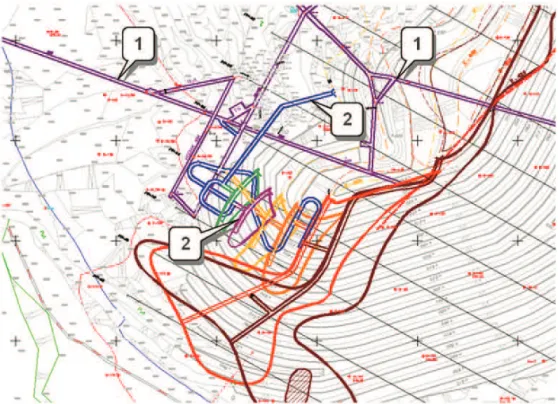
The opening, development and excavation concept is conditioned by the natural conditions of the deposit and by
its technical and technological conditions. Figure 2 shows the mine layout with the existing and newly designed mine
cham-bers for the purpose of the design docu-mentation of the Main Mining Design for Underground Mining.
Figure 2 (1) Mine layout with the existing and (2) newly designed mine chambers
During the opening stage at lev-els +470m and +460m, haulage drift TH-470 and TH-460 are constructed for
the purpose of determining the loor part of the bauxite ore. The basic layout of the development is to construct haulage drift
(TH) from haul downcast for E-470 level to the level E-420 up to the ore body level (Figure 3).
Figure 3 Newly designed mine chambers; the opening, development and excavation concept
After the haulage drift reaches the ore body, bench drift EH is constructed along the loor part of ore body to the exit into the open pit, and to the oppo-site side till the deposit excavation limit.
Bench drifts have multiple purposes: preparation for the construction of exca-vation drifts and for the ore excaexca-vation, supplying fresh air, and as emergency exit from the pit. The adopted altitude
difference between excavation levels is 10m, the same as the height of the benches at open pit, for the purpose of using the benches of the mine for com-munication (Figure 4).
4.1. Mining method
T he applied mining method, named the sublevel caving excavation method in crosswise direction, was chosen based on the relevant mining-geological parameters, mining condi-tions and other technical-technological factors inluencing the mining. Basically, the ore body is made of separate min-ing ields divided by height to levels with the height difference of 10m. By this method, mining starts at the end of bench drift (EH) and generally pro-gresses toward the opening location of the level, i.e. the haulage drift (TH). Excavation dimensions of the bench drift (EH) are 3.5m×3.5m. The stope is
made of the over pit part with overall height at 6.5m and the pillar next to the excavation drift, 4.0m wide. The mining of bauxite is performed backwards, in retreat towards the level gallery, by rock drilling of mining holes in the shape of semi-fan and blasting ("semi-fan"). Angle of blasting surface is 60°, while the internal distance between the semi-fans is 1.8m, which is the least resistance line at the same time. The transport and hauling of the ore is realized by the diesel-powered loading-hauling and dump (LHD) equipment and pit truck. The loading and transport of the blasted ore from the stope to the appropriate
loading place to the pit truck is real-ized by the LHD machine. The ore is transported by the pit truck through the main haulage adit (GIP) to the surface, and afterwards with the same truck to the ore dump location.
A special feature of this project requires an analytical and systematic approach when deining the existing spatial position and geometry, and setting out structures designed at and under the terrain surface (Kessler et alli. 2008). The tasks set shall be completed by mining and surveying works, whose extent, type and special positioning must observe the progress of the project.
5. Mine surveying works
Mining and surveying works are present at the pre-extraction and extrac-tion stage of the underground deposit mining project.
Pre-extraction activity in view of mine surveying includes:
- Analysis of the existing geometric
base on the terrain surface, stabilization of new geodetic points and determination of their spatial coordinates;
- Connection of geometric grid on the terrain surface with mine traverses and determination of spatial coordinates of points in the pit;
- Detailed scanning of the open pit levels (Figure 5), which are interactive with the designed bench drifts for the purposes of geomechanical analysis of the stability;
- Detailed scanning of the existing mine chambers.
Figure 5
Parts of open pit benches in interaction with bench drifts
The extraction activity in view of mine surveying includes: a priori
accu-racy assessment of geometry elements for setting out the mine chambers designed
and the setting and scanning of the as-built condition.
6. A priori accuracy assessment for setting out the mine chambers projected
Within the extraction activities, and immediately before setting out the mine chambers projected, it is necessary to carry out the a priori accuracy assessment of the geometric elements to be used for setting out. In this stage, the a priori accuracy assessment is the most important task in view of mine surveying, because this analysis deines the setting out method, the type of surveying instruments and their class, as well as the accuracy itself and the number of repetitions in per-forming the setting out of the geometric
elements for the project.
As aforementioned, this project pro-vides for a unilateral construction of mine chambers, from the main haulage adit to the existing benches of the open pit. At the irst stage of the project, the lowest bench, planned to be exited to, is located at the level +420m. This is the longest complex of the designed underground chambers, whose spatial length is dk=743.52m, and total horizontal length is d=739.73m. The total of 54 points is designed in those chambers; those points are to represent the
future mine continuing series of levels, and they need to be set out while carrying out mining works. Mine traverse is to include 54 traverse legs, or levelling distances with average length of 13.70m. Only two distances are longer than 50m (the longest one is 95.38m long), and even 36 distances are shorter than 10m (the shortest one is only 1.70m long). Those facts have caused to carry out, within the project to set out the designed mine chambers, the a priory accuracy assessment within the horizontal and vertical planes.
6.1. A priori accuracy assessment for setting out of the designed mine chambers within the horizontal plane
method to set out characteristic points by means of horizontal angles and lengths. The characteristic points of the designed mine chambers represent, at the same time, the traverse points of the future mine traverse. This means that each
characteristic (traverse) point is to be set out from the previous, already set out, traverse point. The future mine traverse through mine chambers designed shall be from the point GIP in front of the main haul adit up to the point E420-10
representing the exit of the bench drift onto the bench at level +420m. The co-ordinates of the traverse points set out on the traverse are to be calculated by using the known equations (Boershch-Komponiets et alli. 1989):
Whereby: N
i, Ei - coordinates of the
last traverse point set out;
N
i-1, Ei-1 - coordinates of the
previ-ously set out traverse point;
∆Ni i-1, ∆E
i
i-1- coordinates of the
differ-ence between the traverse points;
d i
i-1 - horizontal length between
traverse points (element to be set out);
vi
i-1- grid bearing between
tra-verse points;
βi-1 - direction angle (element to be set out).
The coordinates of the start-ing con nectstart-ing point GI P of the designed mine traverse are deter-mined by using the static GPS meth-od and they are: EG I P=5917.60m i
NGIP=1648.12m. The tolerance of the GIP point within the horizontal plane is
The coordinates of the starting orientation point OR of the designed mine traverse are also determined by using static GPS method and they are: EOR=6215.61m i NOR=1914.61m, w it h t he s t a nd a rd tolera nc e of
.
The bearing and the horizontal length between starting orientation and starting connecting point are:
(1)
(2)
(3)
(4)
On the basis of those values, the standard tolerance of the initial grid
bearing between starting orientation and starting connecting point was calculated
(Stoiljkovic et al. 2013):
Whereby: ff hhhh hhhh
The designed coordinates for the point E420-10 of the exit of bench drift onto the bench at level +420m are:
EE 42 0 -10= 602 2 .70 m a nd NE 42 0 -10=
1581.30m.
The designed width of the bench
drift is 3.40m. According to the Rule-book on the Method for Executing of Mine Surveying (The Government of the Republic of Serbia, 1997), the permissible transversal error of the last point E420-10 is 1/4 of the chamber width, i.e. in this case ∆ = 0.85m.
The maximum allowable stan-dard deviation for setting out the last point E420-10 within the horizontal plane, for the probability of 95% is to be calculated by using the following equation:
The standard deviation of the set-ting out of the last point E420-10 within the horizontal plane is affected by the given dimensions:
- Standard deviation of the po-sition of starting point in traverse
- Standard deviation of the start-ing grid bearstart-ing ( σ v= ± 8ʺ); as well as the errors occurring during measuring, i.e. during setting out of traverse points
in form of errors in setting out direction angles and error in setting out lengths of traverse legs.
The environment enables the use of total station when setting out the designed mine chambers, i.e. of the mine traverse. When carrying out the a priori accuracy assessment, the standard deviation for setting out direction angles σβ = ± 20ʺ and stan-dard deviation for setting out length
σd = ± 0.01m were adopted.
Based on the standard deviations for given dimensions and adopted standard deviations of dimensions to be set out, and in accordance with (1), by implementing the General Law on the Propagation of Errors (Chandra, 2005), the variance-covariance matrix for standard deviations of coordinate differences was established:
2 2
,
, 2 2
,
0
0
N N E
T d
N E
N E E
N
N
N
E
d
d
d
K
A K A
E
E
N
E
d
ν
σ
σ
σ
ν
σ
σ
σ
ν
ν
ν
Δ Δ Δ
Δ Δ
Δ Δ Δ
∂Δ
∂Δ
∂Δ
∂Δ
⎡
⎤
⎡
⎤
⎢
∂
∂
⎥
⎡
⎤
⎢
∂
∂
⎥ ⎡
⎤
= ⋅ ⋅
=
⎢
∂Δ
∂Δ
⎥
⋅
⎢
⎥
⋅
⎢
∂Δ
∂Δ
⎥ ⎢
=
⎥
⎢
⎥
⎣
⎦
⎢
⎥
⎣
⎦
⎢
∂
∂
⎥
⎢
∂
∂
⎥
⎣
⎦
⎣
⎦
Whereby: A - the coeficient matrix (Jacobian matrix) that represents matrix
of partial derivatives when compared with the variables;
Where partial derivations are:
(5)
(6)
(7)
(8)
In the covariance measurement ma-trix K, members outside the main diagonal
are zeros, because the measurements are independent from each other. Standard
deviation of the traverse leg inclination is to be calculated according to the equation:
Whereby:
- standard deviation of the grid bearing of previous traverse leg;
- standard deviation for setting out the corresponding direction angle within the traverse.
Standard deviation of the traverse point position is calculated according to the equation: 1 2 i i ν
σ
− − 1 i βσ
−(
1 1) (
1 1)
2 2 2 2 2 2
, i i
i i
i
i E N i E i
N E
N N E
σ
σ
σ
σ
−σ
σ
−σ
− − Δ Δ
=
+
=
+
+
+
Whereby: i Nσ
- standard deviation of tra-verse point in the direction of x-axis;i
E
σ
- standard deviation of tra-verse point in the direction of y-axis;1
i
N
σ
− - standard deviation of theprevious traverse point in the direction of x-axis;
1
i
E
σ
− - standard deviation of the previous traverse point in the direction of y-axis;1
,
1i i
i i
N E
σ
σ
− −
Δ Δ - standard deviation
of coordinate differences calculated ac-cording to the equation (4).
Based on the above equation, calcu-lated the standard deviation of the position of the last point in the traverse E420-17, which is σN E, = ±0.100m
.
6.2. A priori accuracy assessment for setting out of the designed mine chambers within the vertical plane
Setting out the mine chambers designed within the vertical plane is to be carried out by using trigonometric leveling of reference points by means of vertical angle (zenith distance). The reference points representing traverse
points are to represent, at the same time, leveling points (benchmarks) of the future mine traverse, as well. This means that, similar to the case of set-ting out within the horizontal plane, setting out of each point within the
vertical plane ist to be set out by us-ing the previous already set out point. The levels of the mine traverse points set out are to be calculated by using the known equations (Schofield & Breach, 2007):
1
1 1 1
1
tan
i
i i
i i i i i
i
d
H
H
H
H
i l
z
−− − −
−
=
+ Δ
=
+
+ −
Whereby:
H
i - the level of the last point set out;
H
i-1 - the level of the previously set
out point;
∆Hi
i-1 - the altitude difference
be-tween points;
d i
i-1- the horizontal length between
points (element to be set out);
zi
i-1 - zenith distance between points
(element to be set out);
i - height of the instrument; l - altitude of the signal.
The GIP point level of the mine tra-verse designed was determined by static GPS method and it is HGIP=460.36m with standard deviation .
The E420-10 level of the point projected at the bench drift exit at level +420m is HE420-10=420.07m.
The design speciies to construct the adit from the GIP point upwards at the length of 151.63m, with inclination of 6.4% up to the point 2, which should be at the level H2=470.00m. Through the haul downcast, transport drifts and bench drift, descend mine chambers up to the designed point E420-10 at the level 420.07m, which represents average drop of 8.5%.
It is normal that allowable tolerances within the vertical plane, while carrying out crosscut, i.e. when setting out points within undergroud traverses, are 2.5 times smaller in comparison with permissible lateral tolerances. Therefore, maximum allowable standard deviation for setting out of the last point E420-10 within the vertical plane, for the probability of 95%
in this case, is .
Setting out of the designed mine chambers within the vertical plane shall also be carried out by using total station and it is to be carried out at the same time as setting out within the horizontal plane. While making the a priori accuracy assessment, the standard deviation for setting out zenith distances σz =± 15" was adopted, as well as standard deviations for measuring the instrument height and the altitude of signal of σi = σl = ± 0.01m.
In accordance with (8), and by implementing the General Law on Propagation of Variances (Wolf & Ghilani, 1997), standard deviations for elevation differences are to be calculated as follows:
2 2
2 2
2 2 2 2
l i
z d
H
H
H
H
H
d
z
i
l
σ
Δσ
σ
σ
σ
∂Δ
∂Δ
∂Δ
∂Δ
⎛
⎞
⎛
⎞
⎛
⎞
⎛
⎞
=
⎜
⎟
⋅
+
⎜
⎟
⋅
+
⎜
⎟
⋅
+
⎜
⎟
⋅
∂
∂
∂
∂
⎝
⎠
⎝
⎠
⎝
⎠
⎝
⎠
1 1
2 2
i
i i i
H H H
σ
σ
−σ
−
Δ
=
+
(9)
2
cot ;
;
1;
1
sin
H
H
d
H
H
z
d
z
z
i
l
∂Δ
=
∂Δ
= −
∂Δ
= +
∂Δ
= −
∂
∂
∂
∂
Standard deviation for the level of the point set out is to be calculated by using the following equation:
Whereby:
1
i
H
σ
− - standard deviation of the level of the point previously set out;1
i i
H
σ
−
Δ - standard deviation of
elevation differences calculated by using
the equation (10).
Calculate the standard deviation of el-evation points E420-10 is σ H = 0.107m.
7. Conclusion
Standard deviations of given param-eters and a priori adopted standard devia-tions for setting out of direction angles and horizontal lengths cause the standard deviation for the position of the last point E420-10 within the horizontal plane to be
σN, E = ±0.10m, which is 4 times smaller than the maximum allowable tolerance. Therefore, this value, which is obtained by using the a priori accuracy assessment method, does not need to be broken down to longitudinal and lateral components.
The additional analysis of standard deviation for the position of the last point E420-10 in terms of adopted tolerances for parameters to be set out, indicate:
- that standard deviation for setting out direction angles of σβ = ±20" causes standard deviation for the position of the
last point of ;
- that standard deviation for setting out lengths of σd = ±0.01m causes standard deviation for the position of the last point
of .
These values show that the adopted standard deviations of parameters to be set out not only satisfy the accuracy prerequisites laid down, but they also satisfy the prerequisite of equal impact of setting out angles and lengths onto the standard deviation for the position of the last point E420-10.
The deviation of the last point E420-10 within the vertical plane, obtained by the a priori accuracy as-sessment, is
240 10
0.107m,
E
H
σ
−=
which is approximately 1/3 smaller than the maximum allowable tolerance. The impact of setting out the zenith distance onto the standard deviation for the position of the last point E420-10 within the vertical plane is negligible. The analysis has shown that, if standard deviation of zenith distances would be 30"instead of the adopted 15", the stan-dard deviation of the last point would be 0.108m (it would remain the same). The largest impact onto the standard
deviation of the last point's position within the vertical plane is the result of measuring the instrument height and the altitude of signal. If standard deviations of these measured altitudes would be 0.02m, the standard deviation of the last point would also be almost 2 times larger than the value obtained by the analysis (0.209m).
All of this indicates that the comple-tion of this project in terms of mine surveying may be carried out by using total station of common accuracy, that setting out of direction angles and zenith distances may be carried out with only one position of scope (it is required that the total station be previously tested and rectiied), and that while carrying out of those operations, one must not strictly look at the alignment of instrument and signal, due to the fact that the lengths of sides are short, but one must also look at the quality of measurement of the instru-ment height and altitude of signal.
8. Acknowledgement
This paper was realized as a part of the projects TR33029 and TR33044 inanced by the Ministry of Education,
Science and Technological Development of the Republic of Serbia within the framework of Programme of research in
the ield of technological development for the period 2011-2014.
10. References
BOERSHCH-KOMPONIETS V. et al. Mine surveying. Moscow: Mir Publisher, 1989.
CHANDRA, A. M. Surveying - problem solving with theory and objective type
questions. New Delhi: New Age International (P) Ltd., Publishers, 2005.
FACULTY OF MINING AND GEOLOGY. The main mining project for under-ground mining of bauxite reserves remainingin the deposit "Podbracan". Belgrade: 2008. [In Serbian]
THE GOVERNMENT OF THE REPUBLIC OF SERBIA. Rulebook on the method for executing of mine surveying. OficialGazette of the Republic of Serbia, n. 40, p. 841-845, 1997. [In Serbian]
KESSLER, H. et alii. Unlocking the potential of digital 3D geological subsurface models for geotechnical engineers. In: EUROPEAN ECONFERENCE OF THE INTERNATIONAL ASSOCIATION FOR ENGINEERING GEOLOGY, 2008.
Received: 23 March 2014 - Accepted: 15 May 2015.
Madrid: Asociación Española de Geología Aplicada a la Ingeniería, 2008. (http://nora.nerc.ac.uk/3817/1/EUROENGEO_2008_Kessler_et_al.pdf)
QIANG, W. et. alii. An effective method for 3D geological modeling with multi-sour-ce data integration. Computers & Geosciences, n. 31, p. 35-43, 2005.
SCHOFIELD, W., BREACH M. Engineering surveying. UK: Elsevier, 2007.
STOILJKOVIC, V. et alii. Apriori accuracy evaluation for the crosscut in a horizontal plane between the VI horizon and the P2 SD adit of the "Blagodat". Underground
Mining Engineering, n. 23, p. 33-44, 2013.
WOLF, P. R., GHILANI, C. D. Adjustment computations - statistics and least squares