ACPD
11, 7811–7849, 2011Improvement of ozone forecast over
Beijing
J. Zhu et al.
Title Page
Abstract Introduction
Conclusions References
Tables Figures
◭ ◮
◭ ◮
Back Close
Full Screen / Esc
Printer-friendly Version Interactive Discussion
Discussion
P
a
per
|
Dis
cussion
P
a
per
|
Discussion
P
a
per
|
Discussio
n
P
a
per
|
Atmos. Chem. Phys. Discuss., 11, 7811–7849, 2011 www.atmos-chem-phys-discuss.net/11/7811/2011/ doi:10.5194/acpd-11-7811-2011
© Author(s) 2011. CC Attribution 3.0 License.
Atmospheric Chemistry and Physics Discussions
This discussion paper is/has been under review for the journal Atmospheric Chemistry and Physics (ACP). Please refer to the corresponding final paper in ACP if available.
Improvement of ozone forecast over
Beijing based on ensemble Kalman filter
with simultaneous adjustment of initial
conditions and emissions
X. Tang, J. Zhu, Z. F. Wang, and A. Gbaguidi
LAPC and ICCES, Institute of Atmospheric Physics, Chinese Academy of Sciences, Beijing, China
Received: 18 February 2011 – Accepted: 1 March 2011 – Published: 8 March 2011 Correspondence to: J. Zhu ([email protected])
ACPD
11, 7811–7849, 2011Improvement of ozone forecast over
Beijing
J. Zhu et al.
Title Page
Abstract Introduction
Conclusions References
Tables Figures
◭ ◮
◭ ◮
Back Close
Full Screen / Esc
Printer-friendly Version Interactive Discussion
Discussion
P
a
per
|
Dis
cussion
P
a
per
|
Discussion
P
a
per
|
Discussio
n
P
a
per
|
Abstract
We performed ozone data assimilation by simultaneously adjusting the ozone initial conditions, precursor initial conditions and emissions based on the Ensemble Kalman Filter (EnKF) and assessed its impacts on ozone modeling and forecasting in Beijing and nearby regions. A high-resolution regional air quality model and a newly
estab-5
lished regional monitoring network covering Beijing and its surrounding areas were employed. At each assimilation cycle, the forecast error covariance was sampled from a set of forecast ensembles that were generated by perturbing ozone precursor initial conditions, emissions, photolysis rates and deposition velocity. A model-error module and a local analysis scheme have been introduced to reduce the impact of filter
di-10
vergence and spurious correlation that accompanied with EnKF. The results showed significant improvement of 1-hour ozone forecast in Beijing and its surrounding areas through separately adjusting ozone initial conditions, precursor initial conditions and emissions with ozone observations. However, adjustment of precursor initial condi-tions and emissions had minor effect on the 1-hour ozone forecast in suburban area.
15
The best ozone forecast skill was obtained through jointly adjusting ozone initial con-ditions, NOx and VOC initial conditions and emissions. The root mean square errors of 1-hour ozone forecast at urban sites and suburban sites decreased by 54% and 59% respectively compared with those in free run. Furthermore, the specific impacts of observations from urban and suburban sites on ozone data assimilation were
eval-20
uated by implementing sensitivity experiments. Both urban and suburban sites were found to be very important for the improvement of regional ozone forecast. The im-portance of observational data at urban sites was particularly highlighted through its role in constraining the uncertainty of precursor initial conditions and emission rates. Further improvement of regional ozone forecast might therefore be expected with more
25
ACPD
11, 7811–7849, 2011Improvement of ozone forecast over
Beijing
J. Zhu et al.
Title Page
Abstract Introduction
Conclusions References
Tables Figures
◭ ◮
◭ ◮
Back Close
Full Screen / Esc
Printer-friendly Version Interactive Discussion
Discussion
P
a
per
|
Dis
cussion
P
a
per
|
Discussion
P
a
per
|
Discussio
n
P
a
per
|
1 Introduction
As one of the typical city clusters in China, Beijing and its surrounding areas are facing serious challenge of regional air pollution. Among all the regional air pollution prob-lems, high surface ozone is one of the most serious probprob-lems, which is also one of the key issues in the CAREBeijing campaign. It is not only an important pollutants but also
5
closely related to the formation of other important pollutants such PM2.5 and PM10. The daily maximum ozone concentration of urban Beijing in summer has increased from 80 µg m−3 in 1982 to 250 µg m−3 in 2003 (Shao et al., 2006), much higher than
whole China’s air quality class-II standard (160 µg m−3 for hourly ozone). Ozone is
powerful respiratory irritant; it can reduce the body’s resistance to infection. Exposure
10
to high levels of ozone may lead to large reduction in lung function, inflammation of the lung tinning and more frequent and severe respiratory diseases. Therefore, pro-viding ozone forecast in Beijing is undoubtedly as important as PM10 prediction, not only for an effective control strategy, but also for public. On the other hand, forecast-ing and early warnforecast-ing of ozone pollution is needed durforecast-ing Beijforecast-ing Olympic Games in
15
order to ensure a health environment for athletes and attendees. However, large uncer-tainty still exists in the current numerical ozone forecasting and modeling in Beijing and neighboring regions. Around 30 ppbv of root mean square error was reported for ozone forecast in Beijing during the 2008 Olympic Summer Games with the Nested Air Quality Prediction Model System (Tang et al., 2010a). This study attempts to reduce the
un-20
certainty of ozone forecast at Beijing and its surrounding areas by assimilating ozone observational data into a regional air quality modeling system. The newly established regional air quality observation network covering Beijing, Tianjin and Hebei Province now provides valuable information on spatial and temporal variations of ozone.
Data assimilation is a data analysis technique which integrates observational
in-25
ACPD
11, 7811–7849, 2011Improvement of ozone forecast over
Beijing
J. Zhu et al.
Title Page
Abstract Introduction
Conclusions References
Tables Figures
◭ ◮
◭ ◮
Back Close
Full Screen / Esc
Printer-friendly Version Interactive Discussion
Discussion
P
a
per
|
Dis
cussion
P
a
per
|
Discussion
P
a
per
|
Discussio
n
P
a
per
|
et al., 2006; Elbern et al., 2007; van Loon et al., 2000; Hanea et al., 2004; Constanti-nescu et al., 2007). However, data assimilation for ozone forecast over Beijing region was weakly documented.
The difficulties in ozone forecast of Beijing and its surrounding areas to a large extent lie in the complex processes of surface fluxes, flow, turbulent transport and chemical
5
reactions that control ozone concentrations. Previously, many studies have identified some important factors including photolysis frequencies (Li et al., 2011), regional trans-port (Streets et al., 2007; Wu et al., 2011) and ozone initial conditions (Tang et al., 2010b). On the other hand, rapid and complex perturbations of air pollutant emission rates occur in these areas, with significant uncertainties of NOx and VOC emissions,
10
which are two of the most important ozone precursors. For instance, the number of motor vehicles in Beijing rocketed from about 3.5 million in 2008 to around 5 million in 2010. At the same time, however, several emission reduction measures such as traffic restriction are conducted. These changes can hardly be described only with the existing emission inventory updated once for 2–3 years, inducing large uncertainty into
15
ozone modeling. Therefore, an efficient way to control the errors in ozone forecast is needed to reduce the errors in ozone initial conditions, precursor initial conditions and emissions, at least from a regional perspective. For this purpose, we employed the ensemble Kalman filter (EnKF) method associated with the regional observational network. In order to obtain the most effective assimilation on ozone forecast, we
expe-20
rienced several strategies including separated and simultaneous adjustments of ozone and precursor initial conditions and emissions with a compared analysis of the impacts of urban and suburban sites on the data assimilation performance.
Section 2 describes the methodology adopted in this study, results and discussions are presented in Sect. 3, and conclusions are given in Sect. 4.
ACPD
11, 7811–7849, 2011Improvement of ozone forecast over
Beijing
J. Zhu et al.
Title Page
Abstract Introduction
Conclusions References
Tables Figures
◭ ◮
◭ ◮
Back Close
Full Screen / Esc
Printer-friendly Version Interactive Discussion
Discussion
P
a
per
|
Dis
cussion
P
a
per
|
Discussion
P
a
per
|
Discussio
n
P
a
per
|
2 Methodology
2.1 Data assimilation with EnKF
EnKF, introduced by Evensen (1994), is an approximate version or extension of Kalman filter. It employs Monte Carlo approach to represent the uncertainty of variable with a large stochastic ensemble. In this way, the uncertainty can evolve nonlinearly with
5
ensemble forecast, and flow-dependent background error covariance can be obtained from the forecast ensemble results. Thus, the measurements can be integrated into model in a physical consistent way. Compared with the four-dimensional variation, another advanced data assimilation approach, it does not require an adjoint model and is easy to implement. A detailed introduction of the EnKF theory and its applications
10
for atmospheric and ocean researches are provided by Evensen (2009).
An EnKF data assimilation system has been developed for dust storm forecast over China and brings significant improvement of forecast skill (Lin et al., 2008a, b; Zhu et al., 2009). The dust storm forecast is mainly dependent on emission and trans-port without considering chemical reaction. In this study, the EnKF data assimilation
15
system is used for the ozone forecast which includes not only processes of emissions and transport but also the complex chemical reactions. The system is employed for constraining input uncertainties of ozone modeling including ozone initial conditions, precursor (NOx, VOC) initial conditions and emissions. The implementation of EnKF and its detailed setup are as following.
20
Initial perturbation of control variables
The forecast process of state variable in a chemical transport model can be simply represented by:
ACPD
11, 7811–7849, 2011Improvement of ozone forecast over
Beijing
J. Zhu et al.
Title Page
Abstract Introduction
Conclusions References
Tables Figures
◭ ◮
◭ ◮
Back Close
Full Screen / Esc
Printer-friendly Version Interactive Discussion
Discussion
P
a
per
|
Dis
cussion
P
a
per
|
Discussion
P
a
per
|
Discussio
n
P
a
per
|
wherext+1represents the forecast state variable at the time stept+1, andM denotes the model operator. pi=1,n represents the model inputs of precursor initial conditions and emission rates. The uncertainty in the first guess value ofxtandpi=1,ncan evolve with model integration and are induced into the forecast results. A key process of EnKF is using a group of stochastic ensemble samples to represent the uncertainty of control
5
variables (ozone initial conditions, precursor (NOx, VOC) initial conditions and emission rates)
Vt=
xt+ε1, xt+ε2, ..., xt+εN pi+γ1,pi+γ2,...,pi+γN ...
=
Xt Pt
(2)
Xt represents the ensemble of ozone. Pt denotes the ensemble of precursor initial values and emission rates.N is the ensemble size set as 50, which have been proved
10
to be credible by previous publications (Carmichael et al., 2008; Constantinescu et al., 2007). εandγ represent random initial perturbation samples which are added to first guess value of control variables at initial time.
Ideally, initial perturbations should reflect the characterization of initial errors of first guess value (Evensen, 2003). Different from the great impact of initial perturbation
15
on meteorological and ocean data assimilation, initial perturbation of state variables in chemical transport model has a relatively small influence on performance of EnKF. Promised results of ozone data assimilation with EnKF have been obtained by Wu et al. (2008) in which initial perturbation is not applied. In the present study, the strat-egy which has been proven credible by Evensen (1994) is employed to generate initial
20
perturbation fields for its simplicity in implementation. The spatial correlation scale of initial perturbation fields are set as 54 km in horizontal and 3 model grids in vertical after several sensitivity tests. The perturbations are assumed to be within 50% of the first guess values for initial conditions of O3, NOx and VOC. Perturbation ranges of NOx and VOC emission rates are set as 60% and 80% of based emission rates
ac-25
ACPD
11, 7811–7849, 2011Improvement of ozone forecast over
Beijing
J. Zhu et al.
Title Page
Abstract Introduction
Conclusions References
Tables Figures
◭ ◮
◭ ◮
Back Close
Full Screen / Esc
Printer-friendly Version Interactive Discussion
Discussion
P
a
per
|
Dis
cussion
P
a
per
|
Discussion
P
a
per
|
Discussio
n
P
a
per
|
between control variables are hard to obtain directly, they are assumed to be indepen-dent with each other for initial perturbation. These correlations between state variables and emissions can be reconstructed with model integration. It should be noteworthy that the correlations between the two emissions cannot be reconstructed with model integration. It may lead to underestimation of the correlation between them and affect
5
background error covariance. This issue is beyond the scope of this paper and further investigations are needed.
Forecast and update of control variables
The second step of EnKF is using the initial samples of control variables as inputs to implement several simulations with the original model operator. The prediction of
10
control variables with ensemble simulation can be represented by Vtf+1=MVt. The background error covariance is calculated by:
Bft
+1=
(Vtf+1−V¯tf+1)(Vtf+1−V¯tf+1)T
N−1 (3)
where ¯Vtf+1 is the ensemble mean of Vtf+1. The observed values of state variables are also assumed to be uncertain, and an ensemble of observation values Yt+1=
15
[yt+1+τ1, yt+1+τ2, ..., yt+1+τN] is obtained by adding random perturbations τto the observed valuesyt+1.The observation error covariance is calculated by:
Rt+1=(Yt+1−Y¯t+1)(Yt+1−Y¯t+1)
T
N−1 (4)
The observation errors, including both representative error and measurement error, are assumed to be uncorrelated in time and space. The perturbations for observation
20
ACPD
11, 7811–7849, 2011Improvement of ozone forecast over
Beijing
J. Zhu et al.
Title Page
Abstract Introduction
Conclusions References
Tables Figures
◭ ◮
◭ ◮
Back Close
Full Screen / Esc
Printer-friendly Version Interactive Discussion
Discussion
P
a
per
|
Dis
cussion
P
a
per
|
Discussion
P
a
per
|
Discussio
n
P
a
per
|
Based on the error statistics of simulation and observation, the simulated values of control variables in three-dimensional space and surface observations are combined to update the estimation of control variables:
Vta
+1=V f
t+1+K(Yt+1−HVtf+1) (5)
K= B
f t+1H
T
(HBft+1HT+R t+1)
(6)
5
H is the projection operator to interpolate the simulated values in three-dimensional model space into these in observational space. K is the Kalman gain which is cal-culated based on the background and observation error covariance. It projects the departure between simulation and observation in observational space (Yt+1−HVtf+1) to increment of control variables in model space. The ozone observations of different sites
10
are integrated into model in a sequential way. At every update step only observation of one site is assimilated, and then the updated field of control variables is used as the background for assimilating observation of next site. The sequential way is suggested to be better than the way with observations of all sites assimilated at the same time (Houtekamer and Mitchell, 2001).
15
Assimilation with localization and model error
A major problem in EnKF is the spurious correlation between the ensembles of two independent variables. It is caused by using finite ensemble size and can result in spurious update of control variables and underestimation of analysis error covariance. A local analysis scheme is employed in this study to reduce the impact of spurious
20
ACPD
11, 7811–7849, 2011Improvement of ozone forecast over
Beijing
J. Zhu et al.
Title Page
Abstract Introduction
Conclusions References
Tables Figures
◭ ◮
◭ ◮
Back Close
Full Screen / Esc
Printer-friendly Version Interactive Discussion
Discussion
P
a
per
|
Dis
cussion
P
a
per
|
Discussion
P
a
per
|
Discussio
n
P
a
per
|
efficiently remove the influence of spurious correlation, while not degrading the effect of observation. The optimal localization scale can vary with ensemble size, dynamic system and life cycle of chemical species. In this study, 54 km of localization scale is set for updating ozone initial conditions and 45 km for updating precursor initial conditions and emissions after several sensitivity tests.
5
Another problem in EnKF is filter divergence which are shown by underestimation of the weight of observation and even disregarding of observation during update of control variable. A simple method to prevent filter divergence is inflating background error covariance before or after updating control variable (Constantinescu et al., 2007). The main drawback of inflation method is lack of physical or chemical constraint. Therefore,
10
it can lead to spurious linear increase of background error covariance at the area far away from observation sites. The dynamic and chemical balance of model may be destroyed by the inflation. In this study, however, we employ another approach to reduce the impact of filter divergence without destroying the model balance.
In fact, besides the spurious correlation induced by finite ensemble size and its
re-15
sulting underestimation of analysis error covariance, another important reason for filter divergence is the neglect of model errors. For chemical transport model, the errors from surface parameters such as emissions and deposition are quit important for es-timating background error covariance. Tang et al. (2010b) have identified the major uncertainty sources of regional ozone forecast in Beijing and its surround areas which
20
includes precursor emissions, photolysis rate and dry deposition velocity. Therefore, we integrate these important errors into the forecast ensembles of EnKF through per-turbing these factors. With reference to the uncertainty analysis of Tang et al. (2010b), the perturbation ranges are set as 60%, 80%, 30% and 25% of their first guess values for NOx and VOC emission rates, photolysis rate of NO2 and dry deposition velocity
25
respectively. The evolvement of these errors in time is simulated by a first order linear Markov model:
ACPD
11, 7811–7849, 2011Improvement of ozone forecast over
Beijing
J. Zhu et al.
Title Page
Abstract Introduction
Conclusions References
Tables Figures
◭ ◮
◭ ◮
Back Close
Full Screen / Esc
Printer-friendly Version Interactive Discussion
Discussion
P
a
per
|
Dis
cussion
P
a
per
|
Discussion
P
a
per
|
Discussio
n
P
a
per
|
whereqt represents the error at the time step t. wt is random white noise added at each time step. α is the decorrelation length of errors in time, set as 24 h. Similar model can be found in the study of Evensen (2003).
2.2 Regional air quality model
The chemical transport model used with EnKF is the Nested Air Quality Prediction
5
Modeling System (NAQPMS). NAQPMS has been applied to simulating chemical pro-cess and transport of ozone (Li et al., 2009; Tang et al., 2010c), modeling propro-cess of aerosol and acid rain (Li et al., 2011; Wang et al., 2002) and providing operational air quality forecast in mega cities such as Beijing and Shanghai (Wang et al., 2006b). As a multi-scale air quality model NAQPMS can provide forecast of both primary and
10
secondary pollutant from regional to urban scale. It includes modules of emissions, diffusion, advection/convection, deposition and gas/aqueous chemistry. The process of gas phase chemistry is modeled with the Carbon-Bond Mechanism Z (CBM-Z) pro-posed by Zaveri and Peters (1999). A revised version of RADM aqueous-phase chem-istry (Wang et al., 2002) is served to simulate the aqueous-phase chemchem-istry. The dry
15
deposition modeling follows the scheme of Wesely (1989). The hourly meteorologi-cal driver of chemimeteorologi-cal transport model is provided by the Fifth-Generation NCAR/Penn State Mesoscale Model (MM5) (Grell, 1994) and the initial and boundary conditions of MM5 is obtained from NCAR/NCEP 1◦
×1◦ reanalysis data. The outputs of a global
transport model CHASER (Sudo et al., 2002) at three hour intervals are used to
pro-20
vide the initial and boundary conditions of chemical transport model. Vertically, twenty layers with terrain following coordinates are configured with the height of the top-layer 15 km and that of the first layer near the surface 50 m. A more detailed description of this model can be found in previous publications (Li et al., 2007; Wang et al., 2006a).
The simulation in this study is configured with three nested model domains
(dis-25
ACPD
11, 7811–7849, 2011Improvement of ozone forecast over
Beijing
J. Zhu et al.
Title Page
Abstract Introduction
Conclusions References
Tables Figures
◭ ◮
◭ ◮
Back Close
Full Screen / Esc
Printer-friendly Version Interactive Discussion
Discussion
P
a
per
|
Dis
cussion
P
a
per
|
Discussion
P
a
per
|
Discussio
n
P
a
per
|
is served as the regional emission inventory for all model domains. Then the power emissions of Beijing and its surrounding provinces (Tianjin, Hebei, Shanxi, Inner Mon-golia and Shandong) in INTEX-B emission are replaced by the power plant emission dataset with exact longitude and latitude of point sources (Hao et al., 2007). The other emissions of Beijing in INTEX-B emission are also updated with the industrial boiler,
5
domestic, industrial process emissions, and with the mobile emissions derived from Mobile 6 in SMOKE according to the traffic flow from the annual report of Beijing Traffic Development Research Center in 2006. Furthermore, the emission reductions con-ducted in Beijing and its surrounding areas for the 29th Olympic Games is forced into the above emission inventory according to the “29th Olympic Games Beijing air quality
10
protection measures”, which is developed jointly by the governments of Beijing, Tianjin, Hebei, Shanxi, Inner Mongolia and Shandong. Previous publications provide more de-tails for the emission control measures during the Beijing 2008 Olympic Games (Wang et al., 2009). Finally, the emission inventory prepared above is transformed to three-dimensional gridded emissions through the Sparse Matrix Operator Kernel Emissions
15
(SMOKE) model (Houyoux et al., 2000).
3 Regional air quality observation network
The regional air quality observational network employed in this study covers Beijing, Tianjin and Hebei province and was established in 2008 as part of the 29th Olympic Games Beijing air quality prediction. The main purpose of this network is to assess
20
the regional air quality and the impact of regional pollutant transport on air quality of Beijing. This network is an integrated multi-dimensional monitoring network with tower, laser and surface monitoring devices etc. Hourly observed atmospheric pollu-tant concentration, including O3, NOx, SO2, CO, PM2.5, are provided by this network in real-time way during 1 July 2008 to 20 September 2008. It has been used to
ana-25
ACPD
11, 7811–7849, 2011Improvement of ozone forecast over
Beijing
J. Zhu et al.
Title Page
Abstract Introduction
Conclusions References
Tables Figures
◭ ◮
◭ ◮
Back Close
Full Screen / Esc
Printer-friendly Version Interactive Discussion
Discussion
P
a
per
|
Dis
cussion
P
a
per
|
Discussion
P
a
per
|
Discussio
n
P
a
per
|
to evaluate model performance (Zou et al., 2010) and to improve forecast skill of an ozone ensemble forecast system (Tang et al., 2010a). This study is the first attempt to use this regional air quality network for data assimilation. Figure 1b displays the distribution of the seventeen monitoring stations in this network. There are six urban sites at the surrounding cities of Beijing (Baoding, Cangzhou, Qinghuangdao,
Shiji-5
azhuang, Tangshan, Tianjin), five urban sites at Beijing (Changping, Beida, Beiyi, IAP, Yangfang,) and six suburban sites close to Beijing (Langfang, Xianghe, Xinglong, Yan-jiao, Yufa, Yongledian). The urban sites are located at the central urban area with high emission rates, while the suburban sites are located away from the central urban area with a relatively low emission rate.
10
3.1 Experiment design
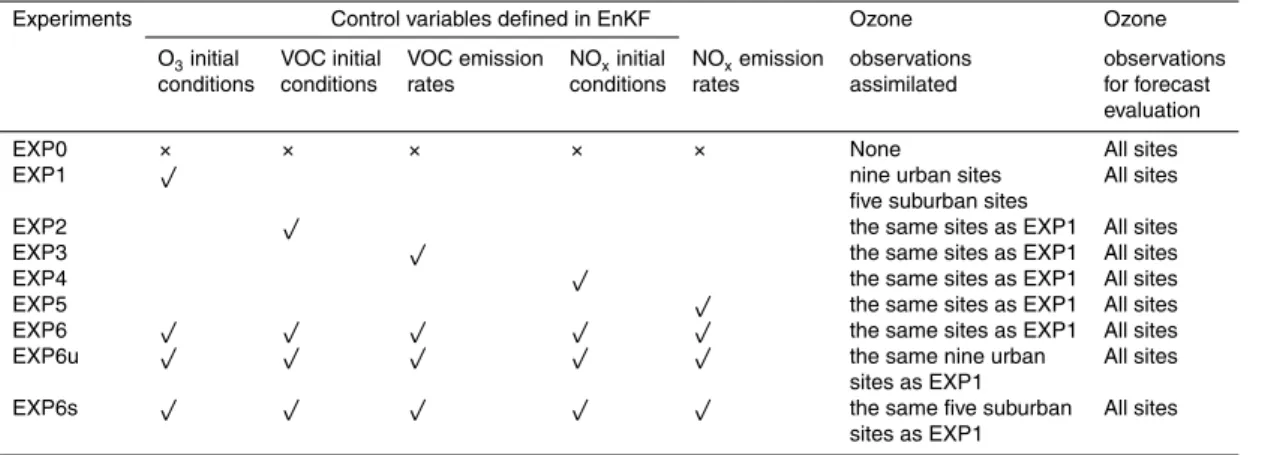
The experiments designed are shown in Table 1. Firstly, a free run of model (EXP0) is conducted without data assimilation. It is taken as a reference for evaluating the per-formances of the data assimilation experiments. EXP1 is designed to investigate the effects of optimizing ozone initial value on ozone forecast with the current regional air
15
quality network. EXP2 and EXP4 are designed to test the cross-species data assimi-lation strategy in which NOx and VOC initial conditions are adjusted respectively with assimilating ozone observations. EXP3 and EXP5 are conducted to provide insight into the benefits and shortcomings with adjusting the precursor emission rates when ozone observations are used only. A simultaneous adjustment of both ozone initial
20
conditions and precursor (NOx and VOC) initial conditions and emission with ozone observations is also implemented in EXP6. In order to evaluate the roles of observa-tions from urban sites and suburban sites in ozone data assimilation, two sensitivity experiments are carried out with only observations of urban sites assimilated in EXP6u and those of suburban sites assimilated in EXP6s. In order to independently evaluate
25
ACPD
11, 7811–7849, 2011Improvement of ozone forecast over
Beijing
J. Zhu et al.
Title Page
Abstract Introduction
Conclusions References
Tables Figures
◭ ◮
◭ ◮
Back Close
Full Screen / Esc
Printer-friendly Version Interactive Discussion
Discussion
P
a
per
|
Dis
cussion
P
a
per
|
Discussion
P
a
per
|
Discussio
n
P
a
per
|
In all the experiments, we firstly conducted two-week spin-up simulation without perturbation to reduce influences of initial conditions. Then initial perturbations were added to the initial conditions of control variables at 19:00 on 12 August 2008 (LT), while ensemble simulations started at the same time. In order to ensure the balance of model state after perturbation and obtain flow-dependent background error covariance
5
for EnKF, five hour spin-up ensemble simulations are conducted. At 00:00 on 13 Au-gust 2008 (LT) the observed data of surface ozone start to be assimilated hour by hour. The assimilation ended at 23:00 on 13 August 2008 (LT). In addition, evaluation focuses on the performance of 1-hour ozone forecast after assimilating observational data. Although the 1-hour short term ozone forecast may not as valuable as much
10
longer forecast such as 24-hour or 48-hour forecast in application, it can provide quick responses of ozone forecast after assimilating observation and identify advantages and disadvantages of different assimilation strategies.
4 Results and discussion
4.1 Adjustment of ozone initial conditions
15
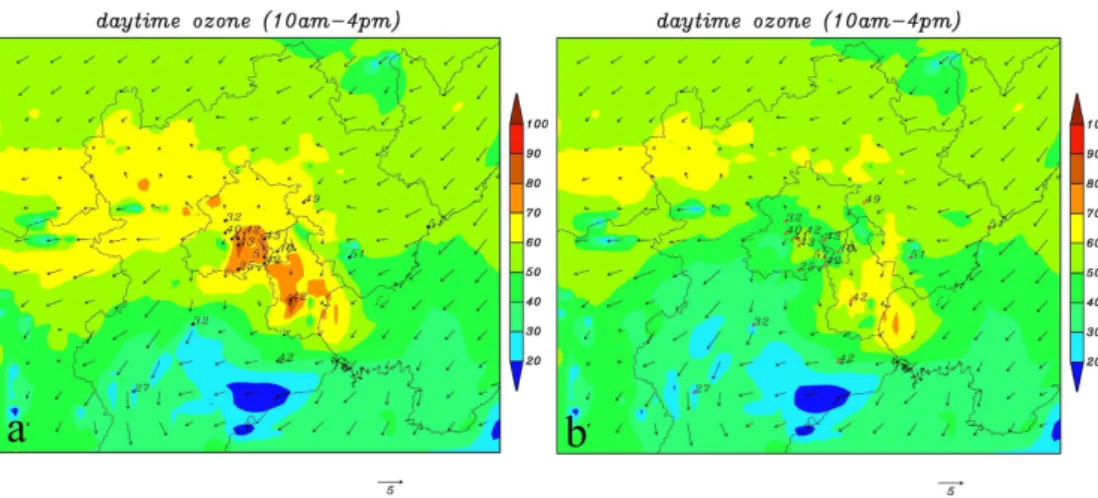
We first look at the results from EXP1, in which only the ozone initial conditions are adjusted by assimilating ozone observations. Figure 2a and b present a comparison of observed daytime ozone values of the monitoring stations against simulated daytime ozone concentrations in free run (EXP0) and EXP1 respectively. In the free run, high ozone concentrations can be observed at Tianjin and Beijing with the maximum values
20
over 80 ppbv, as well as the downwind areas of Beijing with the maximum values over 60 ppbv. It is obvious that ozone concentrations are overestimated by model in the ur-ban areas of Beijing, Tianjin and the suburur-ban areas between them but underestimated in the urban areas of Tangshan. After optimizing ozone initial conditions in EXP1, the overestimation is weakened to a large extent for the 1-hour ozone forecast, especially
25
ACPD
11, 7811–7849, 2011Improvement of ozone forecast over
Beijing
J. Zhu et al.
Title Page
Abstract Introduction
Conclusions References
Tables Figures
◭ ◮
◭ ◮
Back Close
Full Screen / Esc
Printer-friendly Version Interactive Discussion
Discussion
P
a
per
|
Dis
cussion
P
a
per
|
Discussion
P
a
per
|
Discussio
n
P
a
per
|
be noted that the simulated ozone concentrations are also much lower than those of free run at the downwind areas of Beijing where no monitoring station available. This modification at downwind areas probably originates from the optimization of ozone ini-tial conditions at upwind areas such as Beijing. It indicates that adjusting ozone iniini-tial conditions with EnKF not only optimize ozone simulation in the areas with abundant
5
observations, but also provides potentials of improving those in the areas with no ob-servations and obtaining better estimation of regional ozone transport.
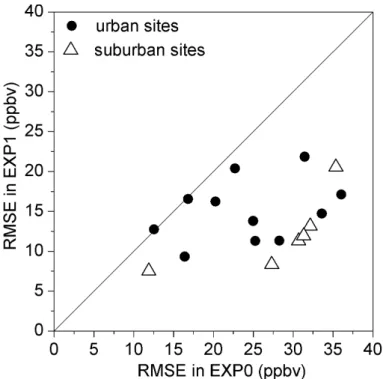
As shown in Fig. 3, a comparison is made between the root mean square error (RMSE) of 1-hour ozone forecast at individual sites in free run and those in EXP1. Sig-nificant improvement of ozone forecast skill can be claimed after adjustment of ozone
10
initial conditions. The RMSE averaged over urban sites is reduced by 38% and that over suburban sites reduced by 57%. The sharp decrease of RMSE at suburban sites indicates that the uncertainty of ozone initial value plays a very important role for short term ozone forecast in suburban area. A relatively smaller decrease of RMSE at urban sites than that at suburban sites is probably caused by the quite complex uncertainty
15
sources for ozone forecast in the urban areas. In order to further understand the diff er-ent effects of adjusting ozone initial conditions on ozone forecast at urban and suburban sites, the hourly ozone concentrations from observations, model free run, analysis and 1-hour forecast in EXP1 at two urban sites and two suburban sites are displayed in Fig. 4.
20
Obvious overestimation of ozone concentration is observed at the two suburban sites (Yanjiao and Yufa) in the free run. After the strong adjustment through assimilating the local observation data at these sites, the overestimation is removed with the analyzed ozone concentrations very close to the observed values. On the other hand, the fore-cast ozone in EXP1 is consistent with the observation except for the forefore-cast during the
25
ACPD
11, 7811–7849, 2011Improvement of ozone forecast over
Beijing
J. Zhu et al.
Title Page
Abstract Introduction
Conclusions References
Tables Figures
◭ ◮
◭ ◮
Back Close
Full Screen / Esc
Printer-friendly Version Interactive Discussion
Discussion
P
a
per
|
Dis
cussion
P
a
per
|
Discussion
P
a
per
|
Discussio
n
P
a
per
|
constraint from ozone observation on its initial conditions. Generally, the surface ozone concentrations in suburban area have a relatively long life cycle and can be influenced by regional transport and vertical flux of ozone significantly. However, high-precision analyzed ozone values in three-dimensional space are not easy to be obtained within one or two hours, because there are only a few observation stations available.
5
Different from the previous two suburban sites, gradual improvement of ozone fore-cast is hardly observed at the two urban sites (Tianjin and Tangshan). An overestima-tion of daytime ozone at Tianjin staoverestima-tion and an underestimaoverestima-tion of daytime ozone at Tangshan station exist for the free run. The analysis can adjust the background ozone to the observed values quite well except for certain hours during nighttime (e.g., the
10
first 4 h at Tangshan). However, the 1-hour forecast rapidly relaxes toward the free run especially at Tangshan station. Two things can account for the ceasing impact of ozone initial value optimization. Firstly, ozone at urban areas has a relatively short life cycle due to the rapid chemical production and destruction, which can lead to small spatial correlation scales of background field and the corresponding small influence ranges
15
of observations. On the other hand, the errors of the freshly emitted precursors can quickly affect the short term ozone forecast at urban areas and lead to the deficiency of ozone forecast even with good ozone initial conditions. Another noteworthy phe-nomenon is the deficiency of EnKF in adjusting ozone initial conditions at urban sites during nighttime. It is probably due to the almost zero values of the simulated ozone
20
concentration during nighttime, which can lead to a very small background error covari-ance and disregards of observation during the analysis. Further studies are needed to find out solutions for this problem.
4.2 Adjustment of precursor initial conditions
One of the goals of this study was to obtain some insights into cross-species data
25
ACPD
11, 7811–7849, 2011Improvement of ozone forecast over
Beijing
J. Zhu et al.
Title Page
Abstract Introduction
Conclusions References
Tables Figures
◭ ◮
◭ ◮
Back Close
Full Screen / Esc
Printer-friendly Version Interactive Discussion
Discussion
P
a
per
|
Dis
cussion
P
a
per
|
Discussion
P
a
per
|
Discussio
n
P
a
per
|
facilitate developing an effective cross-species data assimilation strategy. In EXP2 and EXP4, VOC initial conditions and NOxinitial conditions are adjusted, respectively, with assimilating ozone observations.
Figure 5a and b display the departure of daytime VOC in EXP2 and daytime NO in EXP4 from those in free run respectively. Significant discrepancy of VOC and NO
5
initial concentrations can be observed in Beijing, Tianjin and Tangshan areas, where densely distributed observations are available and strong relationship between ozone and its precursor exists. It indicates that assimilating ozone observation can effectively change VOC and NO initial field. In EXP2, daytime VOC concentrations decrease in the urban areas of Beijing and Tianjin with the maximum reduction over 50 ppbv, while
10
those in Tangshan increase. Different from the behavior of VOC, the adjustment of NOx initial conditions with ozone observations leads to a reverse effect on NO concentra-tions. Increment of daytime NO concentrations in Beijing and Tianjin urban areas and reduction in Tangshan urban area are observed.
The quite different changes of VOC and NO initial conditions when ozone
obser-15
vations are assimilated are largely dependent on the complex nonlinear relationship between ozone and its precursors. The daytime ozone level in urban areas is mostly “VOC-limited” in Beijing and Tianjin areas, with ozone concentration positively related to VOC concentrations and negatively related to NO concentrations. Therefore, both reducing of VOC concentration and increasing of NO concentration are useful for
weak-20
ening the overestimation of ozone in these areas. On the other hand, increment of VOC initial conditions or decrease of NO initial conditions would be beneficial to less the un-derestimation of daytime ozone in Tangshan urban area.
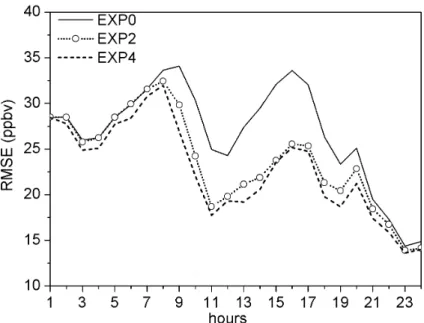
Figure 6 displays a comparison of the hourly RMSE of ozone forecast when the initial conditions of VOC and NOx are adjusted separately with assimilating ozone
observa-25
ACPD
11, 7811–7849, 2011Improvement of ozone forecast over
Beijing
J. Zhu et al.
Title Page
Abstract Introduction
Conclusions References
Tables Figures
◭ ◮
◭ ◮
Back Close
Full Screen / Esc
Printer-friendly Version Interactive Discussion
Discussion
P
a
per
|
Dis
cussion
P
a
per
|
Discussion
P
a
per
|
Discussio
n
P
a
per
|
forecast. Greater impacts of adjusting precursor initial conditions on ozone forecast occur during daytime than night time. This difference is probably related to the rapid photochemical reactions between ozone and its precursors, which only occur during daytime and make the daytime ozone level more dependent on the precursor concen-trations than the nighttime ozone. On the other hand, the slightly better performance
5
of adjusting NOxinitial conditions than adjusting VOC initial conditions during nighttime is probably due to the relatively important role of titration reaction between ozone and NO in nighttime ozone chemistry.
4.3 Adjustment of precursor emission rates
Although the relationships between ozone and its precursor emissions are nonlinear,
10
it is still possible to describe it approximately in a linear way in the model. For ex-ample, Tang et al. (2010b) employed Monte Carlo method to identify the relationship between ozone concentrations and its precursor emissions in urban Beijing with linear regression equations. Such relationship can be used to adjust the precursor emission with observed ozone. In this study, the same random perturbation method is employed
15
to establish the correlation between the gridded emission rate and ozone concentra-tions. EXP3 and EXP5 are conducted to investigate the benefits and shortcomings with adjusting the precursor emission rates when only ozone observations are used. The emission rate at each grid is taken as an independent variable. A simple local-ization scheme is applied to emission rate estimation: the correction of emission rates
20
in one grid only rests on the ozone observations within 54 km distance from this grid. The adjusted emissions obtained at the analysis step are then used for the subsequent simulation. Furthermore, the correction factor is restricted to be in the range between 0.2 and 5 in order to avoid excessive furious correction and its resulting instability in model simulation.
25
ACPD
11, 7811–7849, 2011Improvement of ozone forecast over
Beijing
J. Zhu et al.
Title Page
Abstract Introduction
Conclusions References
Tables Figures
◭ ◮
◭ ◮
Back Close
Full Screen / Esc
Printer-friendly Version Interactive Discussion
Discussion
P
a
per
|
Dis
cussion
P
a
per
|
Discussion
P
a
per
|
Discussio
n
P
a
per
|
at the urban areas of Beijing, Tianjin and Tangshan, similar to the impact on VOC initial conditions. In the urban areas of Beijing and Tianjin, assimilating ozone observations leads to a large reduction of VOC emission rates during daytime with the maximum reduction over 50% of reference emission rates. This adjustment would be useful to compensate for the overestimation of ozone concentration in such areas. In urban
5
areas of Tangshan, the VOC emission rates increase after the adjustment, which in turn reduces the underestimation of ozone concentrations in the model. This result indicates that assimilating ozone observations can effectively adjust VOC emission rates in urban areas with high emission rates and improve ozone forecast accordingly. In Fig. 7b, on the other hand, a reverse effect on NOx emission rates is observed
10
from adjusting NOx emissions only in EXP5. This reverse effect is quite similar to that shown in the experiments for adjusting precursor initial conditions. It is noteworthy that such a revision for a single factor could not be interpreted as the optimization of the emission source as pointed out by precious studies (Hanea et al., 2004), because this revision is mainly to compensate partly for the differences between observation
15
and simulation and reduce the root mean square error of simulation. The difference between observation and simulation in fact originates from many uncertainty sources besides emission rates. Further investigation on assessing the contribution of emission error to this difference is needed for emission inversion.
In Fig. 8a, a comparison is made between the RMSE of 1-hour ozone forecast at
in-20
dividual sites in EXP3 and those in free run. Similar comparison is also made in Fig. 8b for the experiment with NOxemission adjustment. Obviously, significant improvement of ozone forecast skill at urban sites can be claimed from adjusting either VOC or NOx emissions. The site-averaged RMSE is reduced by 19% and 38% respectively. How-ever, almost no impact is found on ozone forecast skill at suburban sites. Local VOC
25
ACPD
11, 7811–7849, 2011Improvement of ozone forecast over
Beijing
J. Zhu et al.
Title Page
Abstract Introduction
Conclusions References
Tables Figures
◭ ◮
◭ ◮
Back Close
Full Screen / Esc
Printer-friendly Version Interactive Discussion
Discussion
P
a
per
|
Dis
cussion
P
a
per
|
Discussion
P
a
per
|
Discussio
n
P
a
per
|
rates, precursor emissions play an important role in ozone chemistry and their uncer-tainties are also the key uncertainty source in ozone forecast. This results indicates that adjustment of precursor emissions would be a useful way to improve ozone forecast at urban sites. It also identifies the possibility to use ozone observations for precursor emission inversion. Of course, the complex nonlinear relationship between ozone and
5
its precursor emissions is a great challenge for such attempt.
4.4 Simultaneous adjustment of ozone initial conditions and precursor initial conditions and emissions
The purpose of combined, simultaneous adjustment of ozone initial value, precursor initial conditions and emission rates in EXP6 is to evaluate the ability of EnKF in
ad-10
justing multi uncertainty sources with ozone observations. Figure 9 presents a com-parison between the hourly RMSE of ozone forecast in EXP6 with the simultaneous adjustment strategy and those in previous experiments. It can be seen that the si-multaneous adjustment outperforms the other experiments with the smallest RMSE. The daily-averaged RMSE of ozone forecast in EXP6 is 56% lower than that in free
15
run. It indicates that the regional ozone forecast can be further improved with ozone initial conditions, precursor initial conditions and emissions adjusted simultaneously by EnKF. The simultaneous adjustment would be a valuable method to improve regional ozone forecast when only ozone observations are available. A similar result is obtained by Elbern et al. (2007), in which four-dimensional variational data assimilation method
20
is employed to assimilate about 39 000 ozone observations a day in European and a chemical transport model with a coarse horizontal resolution of 54 km is used. On the other hand, however, there is still 11.4 ppbv of daily-averaged RMSE for 1-hour ozone forecast in EXP6. The residual errors may originate from other uncertainty sources such as vertical diffusion and dry deposition. The potentials for further improving
re-25
ACPD
11, 7811–7849, 2011Improvement of ozone forecast over
Beijing
J. Zhu et al.
Title Page
Abstract Introduction
Conclusions References
Tables Figures
◭ ◮
◭ ◮
Back Close
Full Screen / Esc
Printer-friendly Version Interactive Discussion
Discussion
P
a
per
|
Dis
cussion
P
a
per
|
Discussion
P
a
per
|
Discussio
n
P
a
per
|
In Fig. 9, the second-best forecast skill is obtained by optimizing ozone initial value. The significant improvement of forecast skill can be observed during both daytime and nighttime. The daily averaged RMSE of ozone forecast is 47% lower than that of free run, which highlights the importance of optimizing ozone initial conditions to improving short-term regional ozone forecast. On the other hand, the adjustments of two
precur-5
sor initial conditions and emissions also show good performances in improving ozone forecast. However, the impacts of such adjustments are mainly reflected in improving daytime ozone forecast skill especial for adjusting VOC initial conditions and emissions. An explanation for this is the quite different characters of daytime ozone chemistry and nighttime chemistry mentioned in Sect. 3.2.
10
In order to evaluate the effects of the simultaneous adjustment on ozone forecast in different areas, a comparison of RMSE of 1-hour ozone forecast at individual sites in EXP6 against those in free run are made in Fig. 10. The forecast skills at both urban and suburban sites are significantly improved with the simultaneous adjustment. The RMSE of ozone forecast at urban and suburban sites are reduced by 54% and 59%
15
respectively. Compared with EXP1 (experiment with optimizing ozone initial conditions only), further improvement of ozone forecast is clearly visible at urban sites after ad-justing ozone initial value, precursor initial conditions and emission rates jointly, while it is hardly observed at suburban sites. This result is consistent with the finding from ad-justing precursor initial conditions or emissions separately. It highlights the importance
20
of adjusting precursor initial conditions and emission rates for improvement of ozone forecast at urban areas.
4.5 Sensitivity of data assimilation to ozone observations at urban and suburban sites
The regional air pollution monitoring network used in this study includes eleven urban
25
ACPD
11, 7811–7849, 2011Improvement of ozone forecast over
Beijing
J. Zhu et al.
Title Page
Abstract Introduction
Conclusions References
Tables Figures
◭ ◮
◭ ◮
Back Close
Full Screen / Esc
Printer-friendly Version Interactive Discussion
Discussion
P
a
per
|
Dis
cussion
P
a
per
|
Discussion
P
a
per
|
Discussio
n
P
a
per
|
on performance of data assimilation. To investigate this issue, we perform two data assimilation sensitivity experiments with only observations of urban sites assimilated in EXP6u and only those of suburban sites assimilated in EXP6s. The simultaneous adjustment data assimilation strategies are employed in the two experiments.
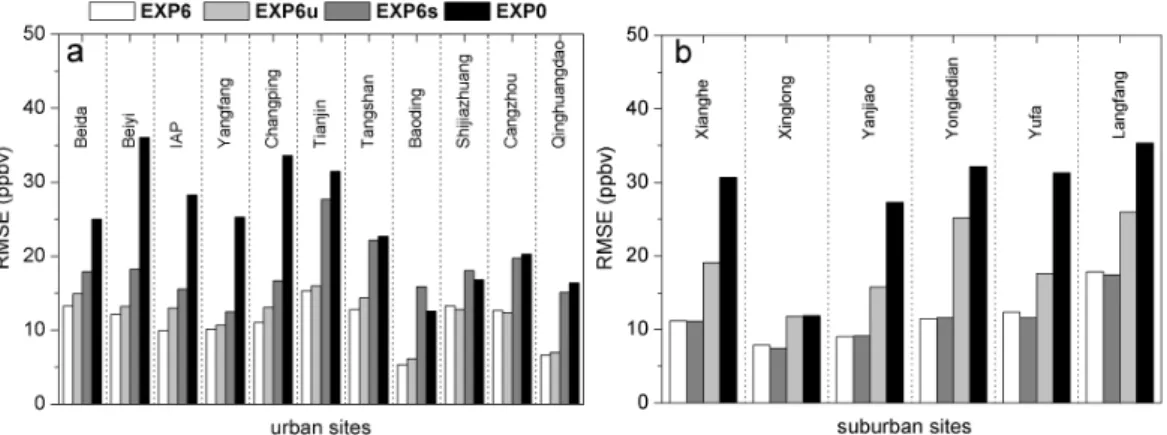
Figure 11a presents a comparison of RMSE of 1-hour ozone forecast at the urban
5
sites in EXP0(free run), EXP6(assimilating ozone observations at all sites except for those at the three independent sites), EXP6u(assimilating ozone observations at urban sites only) and EXP6s(assimilating ozone observations at suburban sites). The RMSE of ozone forecast at urban sites in all the three data assimilation experiments are lower than that in free run. Compared with EXP6, removing observations of suburban sites
10
mainly affects the ozone forecast in Beijing and Tianjin. Slight increases of RMSE of ozone forecast at these sites can be observed. On the other hand, removing obser-vations of urban sites induces significant increases of RMSE of ozone forecast at all urban sites. This result indicates that ozone observations of both urban sites and sub-urban sites are useful for improvement of ozone forecast at sub-urban sites. A greater role
15
of observations at urban sites than those at suburban sites in improving ozone forecast of urban areas is shown.
A comparison of RMSE of ozone forecast at the suburban sites in the above four experiments is presented in Fig. 11b. Similar to the findings at the urban sites, the RMSE of ozone forecast at suburban sites in all the three data assimilation
experi-20
ments are lower than that in free run. An interesting finding is that RMSE of ozone forecast adjusted by ozone observations of all the sites decreases by almost the same large margin as that adjusted by ozone observations of suburban sites only. Both on the other hand are smaller than the RMSE adjusted by ozone observations of urban sites only. This result exhibits the importance of the ozone observations at suburban
25
ACPD
11, 7811–7849, 2011Improvement of ozone forecast over
Beijing
J. Zhu et al.
Title Page
Abstract Introduction
Conclusions References
Tables Figures
◭ ◮
◭ ◮
Back Close
Full Screen / Esc
Printer-friendly Version Interactive Discussion
Discussion
P
a
per
|
Dis
cussion
P
a
per
|
Discussion
P
a
per
|
Discussio
n
P
a
per
|
ozone concentrations of its surrounding areas, which can be optimized quite well by assimilating observations of suburban sites only.
We also compared the surface field of ozone initial conditions, precursor initial con-ditions and emission rates in the above two sensitivity experiments against those in free run. We found that all the three factors in urban areas can be effectively adjusted
5
through assimilating ozone observations of urban sites only. Assimilation with only sub-urban sites can effectively adjust ozone initial value but hardly adjust precursor initial conditions or emission rates. This result highlights the importance of urban sites for constraining the uncertainty of precursor initial conditions and emission rates.
From the previous sensitivity experiments, we can conclude that both urban sites
10
and rural sites are important for improvement of regional ozone forecast. Further im-provement of regional ozone forecast can be expected when more regional air pollution monitoring stations are established, including in suburban areas where relatively few stations are available.
5 Conclusions
15
In this study, ozone observational data from a newly established regional air quality monitoring network were assimilated into a high-resolution regional air quality model to improve the ozone forecast in Beijing and its surrounding areas. By using the EnKF method, we developed an assimilation strategy that can simultaneously adjust ozone initial conditions, precursor initial conditions and emissions for the modeling system.
20
The results suggest that EnKF as a powerful tool for adjusting both state variables and emissions can bring significant improvement of regional ozone forecast. By compar-ing results from different data assimilation settings we investigated the separate roles of the improved ozone initial conditions, precursor initial conditions and emissions in ozone forecasting. Improving ozone initial conditions at the areas with abundant
ob-25
ACPD
11, 7811–7849, 2011Improvement of ozone forecast over
Beijing
J. Zhu et al.
Title Page
Abstract Introduction
Conclusions References
Tables Figures
◭ ◮
◭ ◮
Back Close
Full Screen / Esc
Printer-friendly Version Interactive Discussion
Discussion
P
a
per
|
Dis
cussion
P
a
per
|
Discussion
P
a
per
|
Discussio
n
P
a
per
|
the daytime ozone forecast skill at urban area although it has little effect on the ozone forecast at suburban area. It implies that precursor initial conditions and emissions are good control variables of data assimilation to improve daytime ozone forecast of urban area. Furthermore, simultaneous adjustment of ozone initial conditions and precur-sor initial conditions and emissions shows the best performance in improving regional
5
ozone forecast, indicating the possibility to obtain further improvement of ozone fore-cast through modifying more uncertainty factors with ozone observations.
Another important finding is that ozone observations from both urban sites and sub-urban sites in the regional air quality monitoring network are very important for improv-ing the regional ozone forecast, but they could have different behaviors in adjusting
10
different control variables. This study highlights the importance of ozone observations at urban sites for constraining the uncertainty of precursor initial conditions and emis-sion rates. Ozone observations at suburban sites are found to be quite useful for optimizing ozone initial conditions of suburban areas, which imply that they can serve as important information for improving estimation of regional ozone transport. Further
15
improvement of regional ozone forecast can be expected when more monitoring sites are established especially at the areas with current relatively few stations.
This study provides several useful findings on how to improve the region ozone forecast at Beijing and its surrounding areas through employing the data assimilation method of EnKF. However, there are still limitations that should be stated. First of all,
20
the uncertainty in ozone forecast comes partly from precursor initial conditions and emission rates, which is adjusted by ozone observations in this study, but the impact of the adjustment on the forecast of the two precursors VOC and NOx has not been evaluated. Ideally a good data assimilation method should be able to optimize the mod-eling of the targeted variable while without degrading the modmod-eling of other variables.
25
ACPD
11, 7811–7849, 2011Improvement of ozone forecast over
Beijing
J. Zhu et al.
Title Page
Abstract Introduction
Conclusions References
Tables Figures
◭ ◮
◭ ◮
Back Close
Full Screen / Esc
Printer-friendly Version Interactive Discussion
Discussion
P
a
per
|
Dis
cussion
P
a
per
|
Discussion
P
a
per
|
Discussio
n
P
a
per
|
residual errors may originate from other uncertainty sources such as vertical diffusion and dry deposition. Further effort is needed to investigate their impacts on regional ozone forecast. Last but not least, this study focuses on the performance of different assimilation strategies on improving 1-hour ozone forecast. Longer forecast such as 24-hour or 48-hour forecast may provide opportunities to evaluate different assimilation
5
strategies from a different time scale and enrich our understanding of their applications. Acknowledgements. The authors would like to thank the observation group of SCAS-CERN, Institute of Atmospheric Sciences of Chinese Academy of Sciences and the observation group of College of Environmental Sciences and Engineering, Peking University for providing the observational data used for data assimilation experiments in this study. This study is funded
10
by the 863 Key Projects (20060106A3004) and the Beijing Municipal Science and Technology Commission (D09040903670904).
References
Carmichael, G. R., Sandu, A., Chai, T. F., Daescu, D. N., Constantinescu, E. M., and Tang, Y. H.: Predicting air quality: improvements through advanced methods to integrate models and
15
measurements, J. Computational. Physics., 227(7), 3540–3571, 2008.
Chai, T. F., Carmichael, G. R., Sandu, A., Tang, Y. H., and Daescu, D. N.: Chemical data assimilation of Transport and Chemical Evolution over the Pacific (TRACE-P) aircraft mea-surements, J. Geophys. Res., 111, D02301, doi:10.1029/2005JD005883, 2006.
Constantinescu, E. M., Sandu, A., Chai, T. F., and Carmichael, G. R.: Assessment of
ensemble-20
based chemical data assimilation in an idealized setting, Atmos. Environ., 41(1), 18–36, 2007.
Elbern, H., Strunk, A., Schmidt, H., and Talagrand, O.: Emission rate and chemical state estimation by 4-dimensional variational inversion, Atmos. Chem. Phys., 7, 3749–3769, doi:10.5194/acp-7-3749-2007, 2007.
25
ACPD
11, 7811–7849, 2011Improvement of ozone forecast over
Beijing
J. Zhu et al.
Title Page
Abstract Introduction
Conclusions References
Tables Figures
◭ ◮
◭ ◮
Back Close
Full Screen / Esc
Printer-friendly Version Interactive Discussion
Discussion
P
a
per
|
Dis
cussion
P
a
per
|
Discussion
P
a
per
|
Discussio
n
P
a
per
|
Evensen, G.: The ensemble Kalman Filter: theoretical formulation and practical implementa-tion, Ocean Dynam., 53, 343–367, 2003.
Evensen, G.: The Ensemble Kalman Filter for combined state and parameter estimation, IEEE Contr. Syst. Mag., 29(3), 83–104, 2009.
Grell, G. A., Dudhia, J., and Stauffer, D. R.: A description of the fifth-generation Penn
5
State/NCAR mesoscale model (MM5), NCAR Technical Note, NCAR/TN-398+STR, 117 pp., 1994.
Hanea, R. G., Velders, G. J. M., and Heemink, A.: Data assimilation of ground-level ozone in Europe with a Kalman filter and chemistry transport model, J. Geophys. Res., 109, D10302, doi:10.1029/2003JD004283, 2004.
10
Hao, J. M., Wang, L. T., Shen, M. J., Li, L., and Hu, J. N.: Air quality impacts of power plant emissions in Beijing, Environ. Pollut., 147(2), 401–408, 2007.
Houtekamer, P. L. and Mitchell, H. L.: A sequential ensemble Kalman filter for atmospheric data assimilation, Mon. Weather Rev., 129(1), 123–137, 2001.
Houyoux, M. R., Vukovich, J. M., Coats, C. J., Wheeler, N. J. M., and Kasibhatla, P. S.:
Emis-15
sion inventory development and processing for the Seasonal Model for Regional Air Quality (SMRAQ) project, J. Geophys. Res., 105(D7), 9079–9090, 2000.
Li, J., Wang, Z. F., Akimoto, H., Gao, C., Pochanart, P., and Wang, X. Q.: Modeling study of ozone seasonal cycle in lower troposphere over east Asia, J. Geophys. Res., 112(D22), D22S25, doi:10.1029/2006JD008209, 2007.
20
Li, J., Wang, Z. F., Akimoto, H., Tang, J., and Uno, I.: Modeling of the impacts of China’s anthropogenic pollutants on the surface ozone summer maximum on the northern Tibetan Plateau, Geophys. Res. Lett., 36, L24802, doi:10.1029/2009GL041123, 2009.
Li, J., Wang, Z., Wang, X., Yamaji, K., Takigawa, M., Kanaya, Y., Pochanart, P., Liu, Y., Irie, H., Hu, B., Tanimoto, H., and Akimoto, H.: Impacts of aerosols on summertime tropospheric
25
photolysis frequencies and photochemistry over Central Eastern China, Atmos. Environ., in press, doi:10.1016/j.atmosenv.2011.01.016, 2011.
Lin, C., Wang, Z., and Zhu, J.: An Ensemble Kalman Filter for severe dust storm data as-similation over China, Atmos. Chem. Phys., 8, 2975–2983, doi:10.5194/acp-8-2975-2008, 2008a.
30
Lin, C., Zhu, J., and Wang, Z.: Model bias correction for dust storm forecast using ensemble Kalman filter, J. Geophys. Res., 113, D14306, doi:10.1029/2007JD009498, 2008b.
ACPD
11, 7811–7849, 2011Improvement of ozone forecast over
Beijing
J. Zhu et al.
Title Page
Abstract Introduction
Conclusions References
Tables Figures
◭ ◮
◭ ◮
Back Close
Full Screen / Esc
Printer-friendly Version Interactive Discussion
Discussion
P
a
per
|
Dis
cussion
P
a
per
|
Discussion
P
a
per
|
Discussio
n
P
a
per
|
pollution, Front. Ecol. Environ., 4, 353–361, 2006.
Streets, D. G., Fu, J .H. S., Jang, C. J., Hao, J. M., He, K. B., Tang, X. Y., Zhang, Y. H., Wang, Z. F., Li, Z. P., Zhang, Q., Wang, L. T., Wang, B. Y., and Yu, C.: Air quality during the 2008 Beijing Olympic Games, Atmos. Environ., 41(3), 480–492, 2007.
Sudo, K. M., Takahashi, J., Kurokawa, and Akimoto, H.: CHASER: A global
chemi-5
cal model of the troposphere 1.Model description, J. Geophys. Res., 107(D17), 4339, doi:10.1029/2001JD001113, 2002.
Tang, X., Wang, Z. F., Zhu, J., Wu, Q. Z., and Gbaguidi, A.: Ensemble-based surface ozone forecast over Beijing, Climate and Environmental Research, 15(5), 677–684, 2010a (in Chi-nese).
10
Tang, X., Wang, Z. F., Zhu, J., Wu, Q. Z., and Gbaguidi, A.: Preliminary application of Monte Carlo uncertainty analysis in ozone simulation, Climate and Environmental Research, 15(5), 541–550, 2010b (in Chinese) .
Tang, X., Wang, Z. F., Zhu, J., Gbaguidi, A., Wu, Q. Z., Li, J., and Zhu, T.: Sensitivity of ozone to precursor emissions in urban Beijing with a Monte Carlo scheme, Atmos. Environ., 44,
15
3833–3842, 2010c.
van Loon, M., Builtjes, P. J. H., and Segers, A. J.: Data assimilation of ozone in the atmospheric transport chemistry model LOTOS, Environ. Model. Softw., 15, 603–609, 2000.
Wang, Z., Akimoto, H., and Uno, I.: Neutralization of soil aerosol and its impact on the dis-tribution of acid rain over East Asia: Observations and model results, J. Geophys. Res.,
20
107(D19), 4389, doi:10.1029/2001JD001040, 2002.
Wang, Z., Li, J., Wang, X., Pochanart, P., and Akimoto, H.: Modeling of regional high ozone episode observed at two mountain sites (Mt. Tai and Huang) in East China, J. Atmos. Chem., 55(3), 253–272, doi:10.1007/s10874-006-9038-6, 2006a.
Wang, Z. F., Xie, F. Y., Wang, X. Q., An, J. L., and Zhu, J.: Development and application of
25
Nested Air Quality Prediction Modeling System, Chinese J. Atmos. Sci., 30, 778–790, 2006b (in Chinese).
Wang, Y., Hao, J., McElroy, M. B., Munger, J. W., Ma, H., Chen, D., and Nielsen, C. P.: Ozone air quality during the 2008 Beijing Olympics: effectiveness of emission restrictions, Atmos. Chem. Phys., 9, 5237–5251, doi:10.5194/acp-9-5237-2009, 2009.
30
Wesely, M. L.: Parameterization of surface resistances to gaseous dry deposition in regional-scale numerical models, Atmos. Environ., 23, 1293–1304, 1989.
ACPD
11, 7811–7849, 2011Improvement of ozone forecast over
Beijing
J. Zhu et al.
Title Page
Abstract Introduction
Conclusions References
Tables Figures
◭ ◮
◭ ◮
Back Close
Full Screen / Esc
Printer-friendly Version Interactive Discussion
Discussion
P
a
per
|
Dis
cussion
P
a
per
|
Discussion
P
a
per
|
Discussio
n
P
a
per
|
assimilation algorithms for ozone forecasts, J. Geophys. Res., 113(D20), D20310, doi:10.1029/2008JD009991, 2008.
Wu, Q. Z., Wang, Z. F., Gbaguidi, A., Gao, C., Li, L. N., and Wang, W.: A numerical study of the contribution to the air pollutant in Beijing during CAREBeijing-2006, Atmos. Chem. Phys. Discuss., 11, 5271–5312, doi:10.5194/acpd-11-5271-2011, 2011.
5
Xin, J. Y., Wang, Y. S., Tang, G. Q., Wang, L. L., Sun, Y., Wang, Y. H., Hu, B., Song, T., Ji, D. S., Wang, W. F., Li, L., and Liu, G. R.: Variability and reduction of atmospheric pollutants in Beijing and its surrounding area during the Beijing 2008 Olympic Games, Chinese Sci. Bull., 55(18), 1937–1944, 2010 (in Chinese).
Zaveri, R. A. and Peters, L. K.: A new lumped structure photochemical mechanism for
large-10
scale applications, J. Geophys. Res., 104(D23), 30387–30415, 1999.
Zhang, Q., Streets, D. G., Carmichael, G. R., He, K. B., Huo, H., Kannari, A., Klimont, Z., Park, I. S., Reddy, S., Fu, J. S., Chen, D., Duan, L., Lei, Y., Wang, L. T., and Yao, Z. L.: Asian emissions in 2006 for the NASA INTEX-B mission, Atmos. Chem. Phys., 9, 5131–5153, doi:10.5194/acp-9-5131-2009, 2009.
15
Zhu., J., Lin, C., and Wang, Z.: Dust storm ensemble forecast experiments in East Asia, Adv. in Atmos. Sci., 26(6), 1053–1070, 2009.
Zou, Y. F., Wu, Q., Wang, Z. F., and Zhu, J.: Update of industrial pollution source in Hebei and its effects on regional air quality modeling during 2008 Beijing Olympics Games, Climate and Environmental Research, 15(5), 624–635, 2010( in Chinese).