340 Brazilian Journal of Physics, vol. 36, no. 2A, June, 2006
Memory Effects in Backscattering of Two-Dimensional
Electrons in Corrugated Systems
N. M. Sotomayor ∗, J. F. da Rocha Neto∗, and G. M. Gusev † ∗ Universidade Federal do Tocantins, Campus Universit ´ario de Arraias and †Instituto de F´ısica da Universidade de S˜ao Paulo, Caixa Postal 66318, Brazil
Received on 4 April, 2005.
It is reported a theoretical and numerical study of non-markovian memory effects in backscattering of bal-listic electrons constrained to move in a corrugated surface topography. Two approaches to model the electron trajectories are used, better approximation is obtained with the Hamilton-Dirac method for constrained system.
Keywords: Backscattering of two-dimensional electrons; Numerical study; Memory effects
I. INTRODUCTION
The classical low-field magnetoresistance (MR) in metals and semiconductors has been recently revised, since it was recognized that the conventional Boltzmann-Drude approach fails to describe the electron dynamics in disordered systems [1–3]. According to the Boltzmann-Drude model, magne-toresistance must yield no change, in the presence of short range electrostatic potential, which is in disagreement with the facts observed in experiments [4–6]. In a recent work, we report measurements of large linear negative magnetoresis-tance (LNMR) in a GaAs/AlxGa1−xAs two-dimensional elec-tron system (2D) with non-planar topography, caused by ran-dom distribution of corrugations, generated by a combination of pre-patterning and regrowth processes [7]. The observed LNMR, that is an anomalous behavior, reached up to 20 % of the zero field resistivity(ρxx(B=0)), however, in a very small region around B=0, the resistivity showed a non-anomalous behavior. Recent theoretical developments for the conductiv-ity of a classical two-dimensional Lorentz gas [8, 9] allowed us to attribute this MR to non-Markovian memory effects orig-inated by specific return processes in backscattering of elec-trons by corrugations and defects. However, a certain differ-ence related to the order of magnitude of the full variation of ∆ρxx/ρxx(0) = [ρxx(B)−ρxx(0)]/ρxx(0)appeared between the theoretical model and our experimental results. This phenom-enon that may be closely related to a specific “corridor effect” for scattering with corrugations and antidots, that should pre-set greater cross sections for electrons, motivate us to explore further the classical electron dynamics of 2D electrons con-strained to random-shape topographies in order to analyze the influence of memory effects that appear in different scattering processes in these systems.
II. CONSTRAINED DYNAMICS
For a proper description of the low field magnetoresistance in our samples it is necessary to simulate numerically the dy-namics of two-dimensional electrons constrained to move in a randomly-shaped non-planar topography in the presence of a uniform perpendicular magnetic field. A first approach to describe the classical electron dynamics in corrugated
semi-conductor systems was made in reference [10], where the case of random magnetic field was treated departing from the La-grangian of the system. In the present work we use two dif-ferent approaches to the study the electron dynamics in con-strained electron systems to non-planar topographies. As a first model to describe the magnetoresistance of 2D electrons constrained to random topographies, we assume that the elec-tron motion, influenced by the perpendicular uniform mag-netic field, in the non-planar topography formed by the ran-dom distribution of corrugations and defects, can be compared with the simulation of a two-dimensional Lorentz gas com-posed of electrons and hard scatterers, under the influence of a perpendicular uniform magnetic field. The array of non-overlapping scatterers is characterized by a sum of gaussian potentials with a random distribution. As we are interested in the classical nature of transport in this system, we used linear response theory [11], for the calculation of magnetoresistance ρxxthrough a different numerical approach. We started with the Hamiltonian for the classical electron dynamics of a 2D electron gas under the influence of uniform magnetic field, di-rected perpendicularly to the plane of the gas (Lorentz gas),
H= 1
2m∗(−→p −e − →
A)2+Uw(x,y) +U
2D(x,y), (1)
where the potential vector is written as: −→A = (−By/2,Bx/2,0). Uw(x,y) =U0(xn+ym) is a sum of
hard potential walls, along x e y directions, to account for periodic conditions, U0 is the amplitude and, n and m are
positive integers. The random antidot potential of the antidots U2D, is simulated by the expression:
UAD(x,y) = M
∑
i=1 U0exp
·
−¡x−x0
Γx
¢γ ¸
∗exp ·
−¡y−y0
Γy
¢γ ¸
(2)
where M is the number of antidots, U0is the maximum
N. M. Sotomayor et al. 341
the 2D electron gas is given by: σi j=Nse
2
EF
Z ∞
0 υi
(t)υj(t=0)®
Γe−
t
τdt (3)
where Nsis the electron concentration, EFis the Fermi energy, <vi(t)vj(0)>Γ is the velocity-velocity correlation function double averaged over phase spaceΓ, the indices i and j stand for the x and y direction, respectively. The presence of addi-tional scattering is included through the electron mean scatter-ing timeτ, where the probability of an electron not suffering a collision within the time interval [0,t] is given by e−t/τ. From
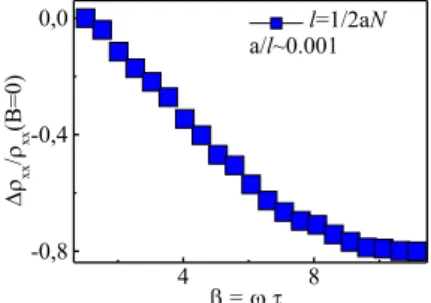
the numerical computation of the conductivity tensors we are able to determine the longitudinalρxx and transverseρxy re-sistivities. Ensembles of electron trajectories, depart inside a square region of side al, where al is the antidot lattice pe-riod, chosen to be equal to unity. This region contains 500 scatterers, with gaussian potentials, placed according to a uni-form distribution. The ratio a/l (where a is the radius of the scatterer at the Fermi energy) was chosen to be 0.001, and the mean free path l= (N2a)−1 was 6.3a
l. N is the two-dimensional concentration of scatterers. For the integration process we generate two hundred trajectories for each partic-ular configuration of scatterers, after this a new configuration is established and the process is repeated up to ten times. The 2D electrons move in a medium composed of an array of non-overlapping and randomly distributed, hard-scatterers. We integrate, numerically, the motion equations for this Lorentz gas and from this we obtained the relative magnetoresistance (MR), which is shown in Fig. 1.
FIG. 1. Relative magnetoresistance for a two-dimensional Lorentz gas obtained by numerical integration.
God agreement with the LNMR experimental results was found. However, a certain difference between this theoreti-cal model and our experimental results is related to the or-der of magnitude of the full variation of the relative magne-toresistance. While in our experiment the LNMR reaches up to 30% of its zero value our numerical results show an al-most 80% decrease, that is a better approximation than the re-sults obtained in reference [9]. A more exact approach to de-scribe the electron dynamics of a single electron constrained to move in corrugated surfaces is obtained through the appli-cation of the Hamilton-Dirac method for systems including second class constraints [12]. According to this model, the extended Hamiltonian of the system is given by
He(~p,~r) =Hc−ΦaC−ab1{Φb,Hc} (4)
where~r= (x,y,z),~p= (px,py,pz)are the position and mo-mentum vectors respectively. The indexes a and b assume the values 1,2. Φ1=φ=z−cosβ(x) =0 andΦ2=m1~P.~∇Φ1=
0 are second class constraints with ~P=~p−e~A being A= B
2(−y,x,0)the potential vector. The matrix C −1
ab is the inverse matrix obtained out of the Poisson brackets{Φa,Φb}. The canonical Hamiltonian Hcappearing in 4 is give by
Hc(~p,~r) = 1
2m(~p−e~A)
2−λφ (5)
whereλis a Lagrange multiplier given by λ= 1
m(~∇Φ1)2 µ
~
P.~∇(~P.~∇Φ1) +
1 2
~∇Φ1.~∇~P2 ¶
(6)
The motion equations of the particle are obtained in terms of the Dirac brackets [12] and are given by:
˙ ~r= 1
m µ
~
P− 1
(~∇Φ1)2
~∇Φ1(~P.~∇Φ1)¶ (7)
and ˙ ~p= 1
m µ−1
2 ~∇~P
2−mλ~∇Φ 1+
1 2(~∇Φ1)2
~∇(~P.~∇Φ1)2 ¶
. (8)
The numerical integration of this coupled differential equa-tions gives us the trajectories of the electron scattering in constrained non-planar topographies as the one given byφ= z−cosβ(x) =0. Fig. 2 shows a scheme of this surface together with some electron trajectories calculated for different values of the magnetic field. Scattering by periodic and random ar-rays of antidot can be added, as well as a random shaped sur-faces that can be modeled by the addition of gaussian poten-tials with negative-positive amplitudes and random distribu-tion. Calculation of magnetoresistance for these systems is under development and will not be presented here.
342 Brazilian Journal of Physics, vol. 36, no. 2A, June, 2006
III. CONCLUSION
In summary, we have modeled the low field electron dy-namics of two dimensional electrons constrained to move in non-planar topographies composed of random corrugations and defects, contrary to the prediction of the Boltzmann-Drude approach, the MR of one of this disordered system shows a dominant large linear negative decrease. A more ex-act approach, for the electron dynamics in constrained sys-tems is developed though the Hamilton-Dirac equation.
Acknowledgments
This work was supported by CNPq Brazilian Funding Agency and is acknowledged. We would like to thanks, also, to the LCCA of the University of S˜ao Paulo by the computa-tional facilities which made possible part of this work.
[1] A. V. Bobylev, Frank A. Maaø, Alex Hansen, and E. H. Hauge, Journal of Statistical Physics. 87, 1205 (1997).
[2] A. D. Mirlin, J. Wilke, F. Evers, D. G. Polyakov, and P. W ¨olfle, Phys. Rev. Lett. 83, 2801 (1999).
[3] D. G. Polyakov, F. Evers, A. D. Mirlin, and P. W ¨olfle, Phys. Rev. B 64, 205306-1 (2001).
[4] G. M. Gusev, P. Basmaji, Z. D. Kvon, L. V. Litvin, Yu. V. Nas-taushev, and A. I. Toropov, Surface Science 305, 443 (1994). [5] G. M. Gusev, A. A. Quivy, J. R. Leite, A. A. Bykov, N. T.
Moshegov, V. M. Kudryashev, A. I. Toropov, and Yu. V. Nas-taushev, Semicond. Sci. Technol. 14, 1114 (1999).
[6] A. A. Bykov, G. M. Gusev, J. R. Leite, A. K. Bakarov, A. V. Goran, V. M. Kudryashev, and A. I. Toropov, Phys. Rev. B 65, 035302 (2001).
[7] N. M. Sotomayor, G. M. Gusev, J. R. Leite, A. A. Bykov, A. K. Kalagin, V. M. Kudryashev, and A. I. Toropov, Phys. Rev. B 70,
235326-1 (2004).
[8] A. Dmitriev, M. Dyakonov, and R. Jullien, Phys. Rev. Lett. 89, 266804 (2002).
[9] Vadim V. Cheianov, A. P. Dmitriev, and V. Yu. Kachorovskii, Phys. Rev. B 68, 201304-1 (2003).
[10] M. Trinidade Dos Santos, G. M. Gusev, J. R. Leite, A, A, Bykov, N. T. Moshegov, V. M. Kudryashev, A. I. Toropov, and Yu. V. Nastaushev, Superlattices and Microstructures 25, 167 (1999).
[11] R. Kubo, M. Toda and N. Hashitsime, Statistical Physics II, Springer-Verlag, Berlin (1985).