908 Brazilian Journal of Physics, vol. 36, no. 3B, September, 2006
Box Model for Hysteresis Loops of Arrays of Ni Nanowires
D. Laroze1,2,3,, P. Vargas1, D. Altbir4, and M. V´azquez3
1Departamento de F´ısica, Universidad T´ecnica Federico Santa Mar´ıa, Casilla 110-V, Chile 2Instituto de F´ısica, Pontificia Universidad Cat´olica de Valpara´ıso, Casilla 4059, Chile 3Instituto de Ciencia de Materiales de Madrid, CSIC, Campus Cantoblanco E–28049, Spain
4Departamento de F´ısica, Universidad de Santiago de Chile, Av. Ecuador 3493, Chile
Received on 8 December, 2005
In the present work, by means of a phenomenological model, we simulate the hysteresis loop of an hexagonal array of Ni nanowires. Our model is based on the assumption that the hysteresis loop of a single wire is a rectangular box with a particular value of the coercive field, and the effect of the array is to generate a distribution of the coercive fields. Our results are in good agreement with experimental data.
Keywords: Nanowires; Hysteresis; Phenomenological model
I. INTRODUCTION
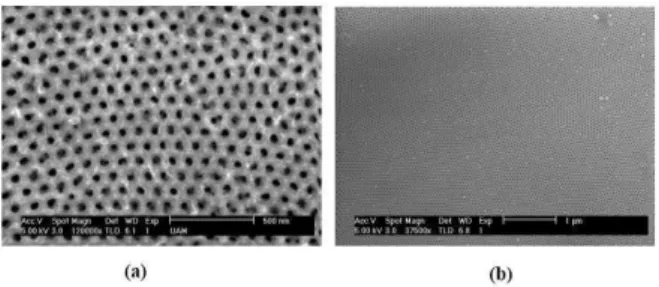
During the last decade, arrays of nanowires have been ex-tensively studied. Particular properties arising from the in-trinsic nature of the nanowires together with the magnetic or-dering of the array give rise to outstanding properties of fun-damental and technological interest in areas such as semicon-ductors, magneto-optics, biomedical and magnetic storage [1– 2]. Different procedures can be used to fabricate nanowires ar-rays [3–4]. In general, the first step is a careful production of nanoporous alumina membranes, with the highest quality and well controlled geometrical characteristics. Nanoporous alu-mina membranes with hexagonal ordering have been prepared by a two-step anodisation process; after that the nanoporous are filled with Ni by electro deposition. Fig. 1 illustrates a nonporous and Ni nanowires array pattern.
FIG. 1: a) Surface image obtained by means of FMF (Magnetic Force Microscope) of an array of nanopores. b)The same nanoporus array filled with Ni.
From the theoretical point of view, many different studies of the hysteresis loop of nanowires arrays have been presented in the literature. We can mention some works based on meth-ods using the Anhysteretic curve [5], statistical approaches via Monte Carlo simulations [6] or micro-magnetic calculations [7]. However, analytical calculations have not been developed yet.
The aim of this paper is to simulate the hysteresis loop us-ing a simple phenomenological model basede on the assump-tion that the hysteresis loop of each wire has the form of a rectangular box with a particular coercive field. The effect
of the array can be described by the inclusion of a distribu-tion of the coercive fields. This method has three important strenghtens; first the two assumptions are based on experi-mental evidence; second, it takes into account the intrinsic non-irreversible character of the hysteresis, and finally it gives an analytical description of the loop. The paper is organized as follows. In Sec. II, the model is presented and the hysteresis loop of a Ni nanowire array is obtained. Finally, conclusions are presented in Sec. III.
II. MODEL AND RESULTS
Not much about the magnetization processes occurring in an array of closely packed magnetic nanowires are known. This happens because even single nanowires may have inter-nal complex magnetic structures, closure domain structures at the edges, etc [8]. The problem becomes even more com-plicated when the long-range magnetostatic coupling between nanowires is considered. Therefore the modelling of these systems is often subject to strong simplifications. For ex-ample, magnetostatic interactions between wires are some-times investigated by assuming that each nanowire can be re-garded as a single monodomain which is described as a big dipole [6,9]. Though many of the models based on simpli-fying assumptions yield often good agreement with experi-mental observation, their validity is sometimes discussed. For nanowires with diameters of less than 60 nm it is reasonable to expect that a single nanowire can behave like a monodomain. In this work we investigate the properties of such an array. Therefore, for modelling the hysteresis loop we do not con-sider the internal domain structure [7] of the magnetization along the wire. Then, a single wire has only two possible mag-netic states with its magmag-netic moment pointing up or down. Within this model we assume that the loop of each single nanowire has a rectangular form with a particular value of the anisotropy field. We consider the following simple mathemat-ical function to describe each part of the loop of a single wire
D. Laroze et al. 909
magnetic moment of a single wire, so the total loop is given by
Mone(H+Ha)∪Mone(H−Ha), (2) withHathe coercive field. Equation (2) represents a square hysteresis loop, which is typical of bi-stable systems and hard magnetic materials.
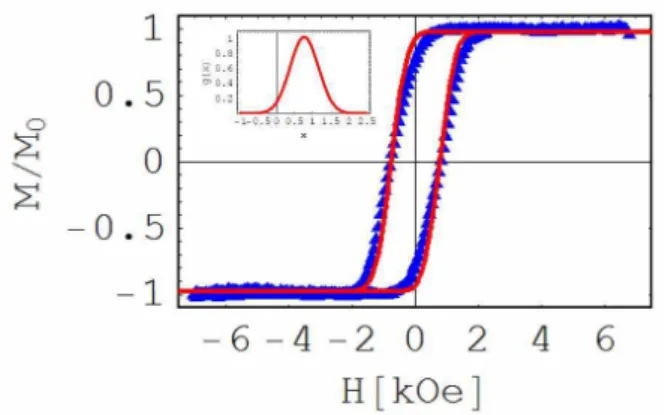
FIG. 2: Solid line: Hysteresis cycle obtained using the rectangular box model for a single nanowire with a distribution of coercive fields. Triangles: experimental data. The inset shows the distribution of anisotropy field obtained by fitting the model with the experimental result.
Our model also considers that the anisotropy field varies from one wire to other so the array shows a distribution of anisotropy fields, giving rise to a distribution of coercive fields. We assume that the coercive field of the array follows a normal distribution, defined by
g(x) =√1 2π σexp
³
−(x−µ)2.2σ2´, (3)
whereσandµare constants. Then the collective effect at each part of the loop can be express in the form
M∓Tot(H) =N−1 Z
Mone(H±ξ)g(ξ)dξ, (4)
where the super index + or - depicts the upper or lower branch of the cycle andNcorresponds to a normalization constant. In addition, equation (4) can be express in a close form
aM∓Tot(H,ξ,σ) = √
2π σEr f³(x±µ).³√2σ´´, (5)
whereEr f(•)is the error function. Fig. 2 illustrates the hys-teresis loop generate by equation (5). The best fit of the ex-perimental data illustrated also in Figure 2 is obtained with σ=0.6886 andµ=−0.37382.
We observe that our results are in good agreement with the experimental data. In addition we remark that the best distri-bution function of the coercive field has a negative shift. The reason for the appearance of this component is the in-plane anisotropy originated in the dipolar interaction between the wires. Then our model also considers the effect of magneto-static interactions between the array.
III. CONCLUSION
We have presented an analytical and simple model to de-scribe the hysteresis loop of magnetic nanowire arrays. Our model considers each wire as a big magnetic moment with two possible states which changes under the influence of an external magnetic field parallel to it. The effect of the array arises in the distribution of the coercive field considered. This simple model describes quantitatively well the shape of the magnetization curve for nanowire arrays of less than 60 nm. diameter.
Acknowledgement
This work was supported by CONICYT Program Fellow-ship, FONDECYT-CHILE grant number 1040354, Millen-nium project P02-054-F.
[1] C. Lapointe, A. Hultgren, D. M. Silevitch, E. J. Felton, D. H. Reich, and R. L. Leheny, Science,303, 652 (2004).
[2] Y. Wu, J. Xiang, C. Yang, W. Lu, and C. M. Lieber, Nature430, 61 (2004).
[3] H. Masuda, K. Fukuda, Science,268, 1466 (1995).
[4] R.M. Metzger, V. V. Konovalov, M. Sun, T. Xu , G. Zangari, B. Xu, M. Benakli, and W. D. Doyle, IEEE Trans. Magn., 36, 30 (2000).
[5] P. Allia, F. Ghigo, M. Knobel, P. Tiberto, and F. Vinai, J. Mag. Mag. Mat.,158, 319 (1996).
[6] M. Vazquez, K. Nielsch, P Vargas, J. Velazquez, D. Navas, K. Pirota, M. Hernandez-Velez, E. Vogel, J. Cartes, R.B. Wehrspohn, and U. Gosele, Physica B,343, 395 (2004). [7] R. Hertel, J. Magn. Magn. Mater249, 251 (2002).
[8] L. Belliard, J. Miltat, A. Thiaville, S. Dubois, J. L. Duvail, and L. Piraux, J. Magn. Magn. Mater190, 1 (1998).