1Programa de Pós-graduação em Geologia e Geoquímica, Instituto de Geociências, Universidade Federal do Pará – UFPA, Belém (PA), Brasil. E-mail:
2Laboratório de Geologia Isotópica, Universidade Federal do Pará – UFPA, Belém (PA), Brasil. E-mail: [email protected]
3Serviço Geológico do Brasil, Companhia de Pesquisa de Recursos Minerais – CPRM, Superintendência Regional de Belém – SUREG-Belém, Belém (PA), Brasil.
E-mail:[email protected] *Corresponding author
Manuscript ID: 20160059. Received in: 05/01/2016. Approved in: 10/26/2016. ABSTRACT: he Tapajós Domain, located in the southern portion of the Amazonian Craton, is a tectonic domain of the Tapajós-Parima Province, a Paleoproterozoic orogenic belt adjacent to a reworked Ar-chean crust, the Central Amazonian Province. his domain has been interpreted as the product of an assemblage of successive magmatic arcs followed by post-orogenic A-type magmatism formed ca. 1880 Ma-old granites of the Maloquinha Intrusive Suite. he study presented here was carried out in four granitic bodies of this suite (Igarapé Tabuleiro, Dalpaiz, Mamoal and Serra Alta) from the eastern part of the Tapajós Domain, as well as an I-type granite (Igarapé Salustiano) related to the Parauari Intrusive Suite. he A-type granites are syenogranites and monzogranites, and alkali feldspar granites and quartz syenites occur subordinately. hese rocks are ferroan, alkalic-calcic to alkalic and dom-inantly peraluminous, with negative anomalies of Ba, Sr, P and Ti and high rare earth elements (REE) contents with pronounced negative Eu anomaly. his set of features is typical of A-type granites. he Igarapé Salustiano granite encompasses monzogranites and quartz monzonites, which are magnesian, calcic to calc-alkalic, high-K and mainly meta-luminous, with high Ba and Sr contents and depleted pattern in high ield strength elements (HFSE) and heavy rare earth elements (HREE), characteristic of I-type granites. he source of magma of these A-type granites is similar to post-collisional granites, while the I-type granite keeps syn-collisional signature. Most of the studied granites have ε
Nd (-3.85 to -0.76) and Nd TDM model ages (2.22 to 2.46 Ga) compatible with the Paleoproterozoic crust of the Tapajós Domain. We conclude that the Archean crust source (ε
Nd of -5.01 and Nd TDM of 2.6 Ga) was local for these A-type granites.
KEYWORDS: Maloquinha Intrusive Suite; Parauari Intrusive Suite; Granites; Orosirian; Amazonian Craton.
RESUMO: O Domínio Tapajós, localizado na porção sul do Cráton Amazônico, é um domínio tectônico da Província Tapajós–Parima, um cinturão orogênico Paleoproterozoico, adjacente a uma crosta arque-ana retrabalhada, a Província Amazônia Central. Esse domínio foi interpretado como resultado da acreção de sucessivos arcos magmáticos, seguidos por um magmatismo pós-orogênico do tipo A, representado por granitos de ca. 1880 Ma da Suíte Intrusiva Maloquinha. Este es-tudo foi realizado em quatro granitos dessa suíte (Igarapé Tabuleiro, Dalpaiz, Mamoal e Serra Alta) da porção leste do Domínio Tapajós, assim como um granito tipo I (Igarapé Salustiano), relacionado à Suíte Intrusiva Parauari. Os granitos tipo A são sienogranitos e monzograni-tos, e subordinadamente feldspato alcalino granitos e quartzo sienitos. Essas rochas são ferrosas, alcalicálcica a alcalinas e dominantemente peraluminosas, com anomalias negativas de Ba, Sr, P e Ti, e alto con-teúdo de elementos terras raras (ETR) com pronunciada anomalia ne-gativa de Eu. Esse conjunto de características é típico de granitos tipo A. O Granito Igarapé Salustiano apresenta monzogranitos e quartzo monzonitos magnesianos, cálcicos a calcioalcalinos, alto K e dominan-temente metaluminosos, com alto conteúdo de Ba e Sr, e empobrecidos em high ield strength elements (HFSE) e ETR pesados, característicos de granitos do tipo I. A fonte do magma dos granitos tipo A é similar a de granitos pós-colisionais, enquanto os granitos tipo I mantêm assina-tura sincolisional. A maioria dos granitos estudados tem ε
Nd (-3,85 a -0,76) e idades modelo Nd TDM (2,22 a 2,46 Ga) compatíveis com a crosta paleoproterozoica do Domínio Tapajós. Conclui-se que fonte crustal arqueana (ε
Nd de -5,01 e Nd TDM de 2,6 Ga) é local para os granitos tipo A.
PALAVRAS-CHAVE: Suíte Intrusiva Maloquinha; Suíte Intrusiva Parauari; Granitos; Orosiriano; Cráton Amazônico.
Petrography, geochemistry and Sm-Nd
isotopes of the granites from eastern
of the Tapajós Domain, Pará state
Petrograia, geoquímica e isótopos Sm-Nd de granitos
do leste do Domínio Tapajós, estado do Pará
Flávio Robson Dias Semblano¹*, Moacir José Buenano Macambira², Marcelo Lacerda Vasquez³
INTRODUCTION
As well as other terrains of the Amazonian Craton, the Tapajós Domain hosts meaningful Paleoproterozoic granitoids related to formation of the Tapajós-Parima province (Fig. 1) (Santos et al. 2000; 2004). In this context the Maloquinha Intrusive Suite (MIS) is included. It is a signiicant suite that was initially proposed by Santos et al. (1975) as Maloquinha granites to group several subcircular granitic plutons, widely distributed in the Tapajós Domain. In subsequent work, sev-eral similar plutons have been mapped, and Andrade et al. (1978) proposed the name Maloquinha Intrusive Suite for these granitic plutons. hese granites are characterized by an alkaline ainity (A-type), typical of intracontinental or post-collisional environments. MIS appears to postdate the Tropas Orogeny (Santos et al. 2004), which originated the Parauari Intrusive Suite (PIS) rocks.
However, many granitic plutons of alkaline ailiation that outcrop in the Tapajós Domain were arbitrarily grouped as MIS, often for a lack of more detailed studies. he Pepita granite, for example, which outcrops on Tapajós River as a batholith of ellipsoidal shape, was included in the MIS. Based on the occurrence of sodic amphibole and pyroxene, Brito (2000) proposed to distinguish it from MIS granites, calling it the Pepita granite. Subsequently, Santos et al. (2004) presented the age of 1872±4 Ma (U-Pb sensitive high-res-olution ion microprobe — SHRIMP — in zircon), for the emplacement of the Pepita granite, conirming what was sug-gested by Brito (2000). Another example is the Porquinho granite, a batholith located in the interluve of Branco and Aruri rivers (southwestern of Pará state), which was also cor-related with MIS (Pessoa et al. 1977; Almeida et al. 1977). However, the determination of a subalcaline to alkaline signature, combined with 1786±14 Ma crystallization age (Santos et al. 2004), obtained by U-Pb SHRIMP in zircon, led the authors to correlate it with Teles Pires Intrusive Suite magmatism, from Juruena Domain, in Mato Grosso state.
Despite development of additional geological knowl-edge in the last few years (e.g. Lamarão et al. 2002; 2005; Vasquez et al. 2002; Santos et al. 2001; 2004), the Tapajós Domain still lacks geological, geochemical and isotopic studies of greater detail and accuracy. Studies of this nature have advanced more slowly in the Amazonian Craton than in the rest of the country. his results from the diicul-ties imposed by the region, mainly logistic ones, due to the presence of dense forest and lack of access that require huge eforts in carrying out geological surveys. his paper intends to determine the geochemical signature and inves-tigate the sources of magmas of the felsic igneous rocks of the eastern portion of the Tapajós Domain, in the SB.21-Z-A-II (São Domingos) and SB.21-Z-SB.21-Z-A-III (Jardim do Ouro)
1:100,000 sheets, based upon petrographic, isotopic (Sm-Nd whole rock) and lithochemical studies.
REGIONAL GEOLOGICAL CONTEXT
Located in the northern portion of South America, the Amazonian Craton (Almeida et al. 1981) is one of the main tectonic units of the South American Platform.Several models have been proposed for a tectonic subdivision of the Amazonian Craton (Cordani et al. 1979; Teixeira et al. 1989; Tassinari 1996). Among the most discussed proposals, the ones of Santos et al. (2000) and Tassinari and Macambira (1999; 2004) stand out. he main disagreements between the two of them concern the limits and time intervals of tectonic provinces, though both agree that the evolution of the craton is the result of successive episodes of crustal accretion during the Paleo and Mesoproterozoic, around an ancient core stabilized in Neoarchean.
he region of interest here is in a critical transition between Tapajós and Iriri-Xingu domains, respectively southern por-tions of Tapajós-Parima and Central Amazonian provinces (Fig. 1). Yet, the boundary between these domains described by Santos et al. (2000) and Tassinari and Macambira (1999; 2004) require reevaluation in light of the work presented here, as well as other recent eforts in this region (Vasquez
et al. 2008a; Semblano et al. 2016). hus, this work adopted the tectonic subdivision model presented by Vasquez et al.
(2008a) (Fig. 1), which was initiated by Santos et al. (2000) (reviewed in Santos 2003) with the warning that the Tapajós/ Iriri-Xingu limit was eastward, in the Iriri-Xingu Domain. According to this author, the Amazonian Craton is split in seven tectonic or geochronological provinces: Carajás (3000-2500 Ma), Transamazonas (2260-1990 Ma), Tapajós-Parima (2030-1860 Ma), Central Amazonian (1900-1860 Ma), Rondônia-Juruena (1850-1540 Ma), Rio Negro (1820-1520 Ma) and Sunsás (1450-1000 Ma).
According to Santos et al. (2001; 2004), the formation of the Tapajós-Parima Province is marked by the develop-ment of two distinct orogenies that incorporated four mag-matic arcs followed by post-orogenic alkaline magmatism.
he irst magmatic arc (Cuiú-Cuiú complex) was gener-ated between 2.03 and 2.00 Ga and was likely an island arc whose remnants are mainly metatonalites and metabasalts. he second arc (calc-alkaline), called the Creporizão arc,
Figure 1. Provinces and tectonic domains of state of Pará (Vasquez et al. 2008a, modiied from Santos 2003).
58ºW 56ºW 54ºW 52ºW
Study area
Rio Maria Domain (RMD) (3000-2800 Ma) Carajás Domain (CJD) (2800-2500 Ma) Carajás Province
Santana do Araguaia Domain (SAD) Bacajá Domain (BJD)
Amapá Bloc (APB) Carecuru Domain (CAD)
Transamazonian Province (2260-1990 Ma) Tapajós Domain (TJD)
Tapajós-Parima Province (2030-1860 Ma)
Iriri-Xingu Domain (IXD)
Erepecuru-Trombetas Domain (ETD) Central Amazonian Province (1900-1860 Ma)
Juruena Domain (1790-1760 Ma) Rondônia-Juruena Province
Amazonian Craton
Araguaia belt Gurupi belt
Tectonic provinces and domains
GRB – Grajaú basin AMB – Amazonas basin ATB – lto Tapajós basin Phanerozoic basins and covers 8ºS
6ºS
46ºW 48ºW
50ºW
2ºN
0º
2ºS
4ºS
was generated between 1980 and 1950 Ma, and exhibits evidence for previous incorporation of continental crust, composed of monzogranites and andesites. hese irst two arcs form the Mundurucus orogeny. After a hiatus of about 50 million years, a new orogen developed initially by the formation of and the collision to another primitive islands arc. his arc was added to the continent between 1900 and 1890 Ma (Tropas arc) and is composed of tonalite, basalts, and andesites. his arc collision was followed by another collision with a continental arc called Parauari, character-ized by monzogranites and felsic volcanic rocks (1883-1879 Ma). he post-orogenic magmatism (Maloquinha Intrusive Suite and Iriri Group volcanic rocks) took place around 1870 million years ago, shortly after the development of Parauari arc. Alternatively, there was a collision of only one arc (Cuiú-Cuiú/Anauá arc), followed by post-collisional and extensional magmatic events with associated underplating (Vasquez et al. 2002).
he MIS comprises alkali granites generated in post-col-lisional environments and are spatially associated with vol-canic rocks of the Iriri Group. his suite consists of alkali feldspar granite, syenogranite and leucocratic monzogranite plutons with a pertitic orthoclase predominance and rare microcline. hey outcrop as stocks and elliptical to circular batholiths along NW-SE regional lineament. Chemically, these rocks are metaluminous to peraluminous and sub-alkaline to sub-alkaline with high SiO2 content (70.3-76.6%, Lamarão et al. 2002), enriched in alkalis, high FeOt/MgO and K2O/Na2O ratios and low in CaO, Al2O3, Ba, Sr and Ti contents. heir petrographic, chemical and rare earth ele-ments (REE) pattern are similar to those described for A-type granites by Eby (1992). Additionally, it seems as the calc-al-kaline volcanic rocks of the Iriri Group were not emplaced during the Maloquinha alkaline magmatic event, though, which led Juliani et al. (2005) to consider that the volcanic rocks of Iriri Group are part of the late- to post-collisional set of Parauari calc-alkaline magmatic event. hese alkaline volcanic rocks can be correlated with the Moraes Almeida (Lamarão et al. 2002) and Santa Rosa formations (Juliani and Fernandes 2010). he MIS granitoids correspond to a post-orogenic generation of the Parauari Intrusive Suite (Santos et al. 2004). It comprises unfoliated and isotropic plutons split in two petrographic facies: granodioritic, pre-dominantly composed of leucocratic monzogranites and granodiorites; and granitic, composed of monzogranites, syenogranites and subordinate porphyritic units (Vasquez
et al. 2008b), both of which intrude the Cuiú-Cuiú and Creporizão granitoids.
Like the MIS in the Tapajós Domain, Paleoproterozoic (ca. 1.88 Ga) A-type anorogenic magmatism is recorded in several other parts of the Amazonian Craton. In Rio Maria
Domain (Carajás Province), there is also a meaningful record of this magmatism. he oxidized A-type granites of Rio Maria Domain were grouped with the Jamon Suite, and moder-ately reduced A-type granites were clustered in Serra dos Carajás Suite (Dall’Agnol et al. 1999a). he Jamon Suite is composed of Jamon, Musa, Redenção and Banach granitic plutons. Serra dos Carajás Suite granites are represented by Serra dos Carajás, Cigano, Seringa and São João plutons, showing petrographic and geochemical features similar to the Jamon Suite, contrasting with it chiely by the Serra dos Carajás’s slightly reduced nature. In the Carajás Province, the Velho Guilherme, Antônio Vicente, Mocambo and Rio Xingu massif granites belong to the Velho Guilherme Intrusive Suite. In Iriri-Xingu Domain (Central Amazonian Province) there is also an important record of plutonic and volcanic rocks of A-type alkaline ainity. he plutonic rocks belong to the Rio Dourado Intrusive Suite, which is related to the MIS, plus a set of granitic plutons (Ananás, Bom Destino, Triunfo and São Pedro do Iriri), mapped by Vasquez et al.
(2008b), and characterized as undiferentiated A-type granites. he volcanic record in this domain is mainly represented by the Santa Rosa Formation, which has a geochemical ainity with the Velho Guilherme Intrusive Suite (Fernandes et al. 2011). Northward of the craton, in the Guyana Shield, this magmatism emplaced the Mapuera Intrusive Suite, which consists of dozens of granitic batholiths and stocks (Madeira, Alalaú, Simão, Rastro, Bom Futuro, São Gabriel, Murauaú granites, etc.), widespread in the Uatumã-Anauá Domain. However, Costi et al. (2000) included Madeira, Água Boa and Europa plutons (previously incorporated into Mapuera Intrusive Suite), located in the Pitinga region, northern of State of Amazonas), in a new unit called Madeira Suite, due to the discovery of slightly younger ages (ca. 1.82 Ga) than those identiied in Mapuera Intrusive Suite. In this region, the volcanic rocks related to Mapuera Intrusive Suite occur predominantly in the western portion of Erepecuru-Trombetas Domain, extending westward in Uatumã-Anauá Domain and represented by the Iricoumé Group.
Crystallization ages of 1882±4 and 1880±9 Ma were obtained by zircon Pb-evaporation method for MIS gran-ites (Vasquez et al. 1999; Lamarão et al. 2002). Additionally, Santos et al. (2001) showed zircon U-Pb SHRIMPages for the granites of this suite with values between 1877±12 and 1872±4 Ma and identiied populations of neoarchean to oro-sirian inherited zircons. Lamarão et al. (2005) identiied a signature of Nd isotopes for the MIS granites in the eastern portion of the Tapajós Domain, suggesting paleoprotero-zoic sources (TDM 2.28 to 2.23 Ga and ε
Nd(t) -0.72 to -2.45).
However, the isotopic signature of some granites belonging to this suite indicates the participation of archean crust in its formation (TDM 2.53 to 2.60 Ga and ε
Table 1. Geochronological and isotopic data for paleoproterozoic A-type granites and related volcanic rocks, and
PIS rocks from Tapajós and Iriri-Xingu domains, Amazonian Craton.
Geologic unit Suite Rock type Age (Ma) Method Ref.
ε
Nd(t) TDM (Ga) Ref.
Iriri-Xingu Domain (Central Amazonian Province)
Rio Dourado RDIS Syenogranite 1884±4 U-Pb zr 10
Rio Dourado RDIS Granite 1876±39 U-Pb zr 11 -10.7 to -3.10 2.84 to 2.61 11
Santa Rosa Formation - Ash tuf 1884±2 Pb-Pb zr 12
-11.39 to -5.80 3.12 to 2.56 12
Santa Rosa Formation - Rhyolite 1879±2 Pb-Pb zr 12
A-type Undiferentiated
Granite - quartz syenite 1889±2 Pb-Pb zr 13 -8.76 2.87 13
Tapajós Domain (Tapajós-Parima Province)
Iriri Group MIS Rhyolite 1888±2 Pb-Pb zr 2
Maloquinha granite MIS Bt-hb granite 1882±4 Pb-Pb zr 4
Iriri Group MIS Rhyodacite 1888±2 Pb-Pb zr 4
Iriri Group MIS Rhyolite 1888±7 Pb-Pb zr 3
Maloquinha granite MIS Monzogranite 1877±12 U-Pb zr 7
-6.67 to -2.84 2.60 to 2.53 5
Maloquinha granite MIS Monzogranite 1874±7 U-Pb zr 7
Maloquinha granite MIS Monzogranite 1872±4 U-Pb zr 7
Maloquinha granite MIS Alaskite 1899±25 U-Pb zr 7
Iriri Group MIS - 1870±8 U-Pb zr 7 -1.37 2.45 5
Maloquinha granite MIS Bt monzogranite 1880±9 Pb-Pb zr 8 -2.45 to -0.72 2.28 to 2.23 9
Moraes Almeida Formation MIS Rhyolite 1890±6 Pb-Pb zr 8
-3.05 to -1.98 2.44 to 2.29 9
Moraes Almeida Formation MIS Trachyte 1881±4 Pb-Pb zr 8
Moraes Almeida Formation MIS Ignimbrite 1875±4 Pb-Pb zr 8
Mamoal granite MIS - - - - -5.01 to -0.89 2.60 to 2.20 14
Dalpaiz granite MIS - - - - -2.07 to -0.76 2.41 to 2.22 14
Serra Alta granite MIS - - - - -3.85 to -3.85 2.46 14
Parauari granite PIS Syenogranite 1883±4 U-Pb zr 7
Parauari granite PIS - 1883±8 Pb-Pb zr 1
Parauari granite PIS Granite 1883±2 Pb-Pb zr 6
Parauari granite PIS Monzogranite 1879±11 U-Pb zr 5
Jardim do Ouro granite PIS Hb-bt monzogranite 1880±3 Pb-Pb zr 8 -1.82 2.32 9
Younger São Jorge granite PIS Hb-bt monzogranite 1891±3 Pb-Pb zr 8 -5.21 and -3.42 2.43 and 2.32 9
References: 1) Brito et al. (1999), 2) Dall’Agnol et al. (1999b), 3) Moura et al. (1999), 4) Vasquez et al. (1999), 5) Santos et al. (2000), 6) Klein & Vasquez (2000), 7) Santos et al. (2001), 8) Lamarão et al. (2002), 9) Lamarão et al. (2005), 10) Barros et al. (2006), 11) Barros et al. (2011), 12) Fernandes et al. (2011), 13) Semblano et al. (2016), 14) this work.
RDIS: Rio Dourado Intrusive Suite; MIS: Maloquinha Intrusive Suite; PIS: Parauari Intrusive Suite; Bt: biotite; Hb: hornblende; zr: zircon.
Santos et al. 2000) (Tab. 1), which is compatible with the presence of neoarchean inherited zircon crystals, as identi-ied by Santos et al. (2001) in rocks of this same unit. Many
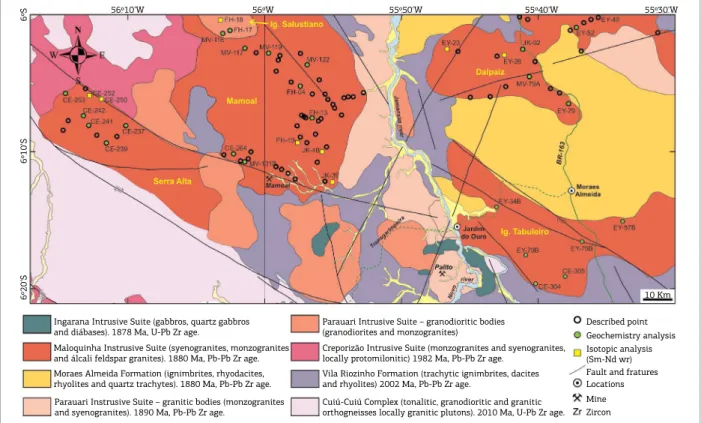
Figure 2. Geological map of the study area with rocks samples of the study granites (modiied from Vasquez et al. 2014a; 2014b).
Zircon Ingarana Intrusive Suite (gabbros, quartz gabbros
and diábases). 1878 Ma, U-Pb Zr age.
Maloquinha Instrusive Suite (syenogranites, monzogranites and álcali feldspar granites). 1880 Ma, Pb-Pb Zr age. Moraes Almeida Formation (ignimbrites, rhyodacites, rhyolites and quartz trachytes). 1880 Ma, Pb-Pb Zr age.
Parauari Instrusive Suite – granitic bodies (monzogranites and syenogranites). 1890 Ma, Pb-Pb Zr age.
Parauari Intrusive Suite – granodioritic bodies (granodiorites and monzogranites)
Creporizão Intrusive Suite (monzogranites and syenogranites, locally protomilonitic) 1982 Ma, Pb-Pb Zr age.
Vila Riozinho Formation (trachytic ignimbrites, dacites and rhyolites) 2002 Ma, Pb-Pb Zr age.
Cuiú-Cuiú Complex (tonalitic, granodioritic and granitic orthogneisses locally granitic plutons). 2010 Ma, U-Pb Zr age.
Described point 10 Km
Geochemistry analysis Isotopic analysis (Sm-Nd wr) Fault and fratures Locations Mine
6ºS 56º10'W
6º
10'S
56ºW 55º50'W 55º40'W 55º30'W
6º
20'S
Klein and Vasquez 2000), including Younger São Jorge and Jardim do Ouro granites, dated by Lamarão et al. (2002). he Nd isotopic signature obtained in these two plutons (TDM of 2.43 to 2.32 Ga and ε
Nd(t) -5.21 to -1.82) (Tab. 1)
suggests interaction of juvenile source with an older crustal one (Lamarão et al. 2005). Rare Sm-Nd TDM neoarchean ages are recorded in the Tapajós Domain rocks, which has mainly paleoproterozoic sources. Eastward, they dominate igneous rocks with typical crustal Archean sources, which characterize the Iriri-Xingu Domain (Fig. 1).
STUDY AREA
he study area we focus on here is located in eastern portion of the Tapajós Domain, southern of the Tapajós-Parima Province. Geographically, it is located in Itaituba city, southwestern of the state of Pará. he eastern portion of the area is cut by Novo and Jamanxim rivers and BR-163, which are important connection routes from headquarters Itaituba city (north) to Moraes Almeida district, where the study area is located. his area is included in the SB.21-Z-A-II (São Domingos) and SB.21-SB.21-Z-A-III (Jardim do Ouro) 1:100,000 sheets, between 55º30’W and 56º17’W longitudes, and 6ºS and 6º21’S latitudes (Fig. 2). Figure 2
also shows the sampled points for geochemical and isoto-pic (Sm-Nd whole rock) study on the ive plutons stud-ied here: Dalpaiz, Mamoal, Igarapé Tabuleiro, Serra Alta e Igarapé Salustiano, established by Vasquez et al. (2014a; 2014b) with gamma spectrometry and magnetometry air-borne geophysical support.
PETROGRAPHY
Petrographic studies were performed in four of the ive plutons covered: Mamoal, Dalpaiz, Serra Alta and Igarapé Salustiano granites (Fig. 2). he petrography of the Igarapé Tabuleiro granite was presented by Lamarão (2001), who named it as Maloquinha granite. he rocks of Mamoal, Dalpaiz and Serra Alta plutons, belonging to the MIS, have reddish pink to pinkish gray color, whereas the Igarapé Salustiano granite (PIS) is greyish. All units are dominantly hololeucocratic.
Figure 3. Q-A-P and Q-(A+P)-M diagrams (Streckeisen 1976) showing the mineralogical modal composition of Mamoal, Dalpaiz, Serra Alta and Igarapé Salustiano plutons. Lines 1, 2 and 3, respectively, represent the trends of tonalitic-trondhjemitic calc-alkaline, granodioritic calc-alkaline and shoshonitic series. The grey ield represents the granitoids formed by crustal melting (Lameyre and Bowden 1982).
Mamoal Granite
Biotite-amphibole monzogranite (BAMzG) Biotite-amphibole syenogranite (BASG) Biotite alkali feldspar granite (BAFG) Dalpaiz Granite
Biotite-amphibole monzogranie (BAMzG) Biotite syenogranite (BSG)
Serra Alta
Amphibole syenogranite (ASG) Biotite quartz syenite (BQzS) Alkali feldspar granite (AFG) Igarapé Salustiano
A+P 10 20 M 3
2 1
P Q
Q
A
Syenogranite
AFG Monzogranite
Qz syenite Qz monzonite plotted on the Streckeisen (1976) QAP diagram (Fig. 3),
which allowed the classiication of the rock sets according to the International Union of Geological Sciences (IUGS) proposed nomenclature. Table 2 summarizes the modal content of essential, maic and varietal minerals, and the occurrence of accessory and secondary minerals in each one of the described facies from studied plutons.
Mamoal granite
he Mamoal granite was split into three petrographic facies: biotite-amphibole monzogranite (BAMzG), bio-tite-amphibole syenogranite (BASG), and biotite-alkali feldspar granite (BAFG). hese rocks have hypidiomor-phic inequigranular texture and are medium- to coarse-grained. Locally, we observed porphyritic textures with a ine-grained matrix (Fig. 4A) and myrmekitic inter-growths, as well as intergranular albites. Plagioclase occurs as prismatic and subhedral crystals with irregular contacts and subordinately straight, especially between quartz and biotite. Its dominant composition is oligoclase (An12-30), but some samples of BAMzG facies have andesitic com-position (An30-34). he plagioclase comprises less than 1% modal content of some BAFG facies samples. he alkali
feldspar (orthoclase) occurs predominantly as subhedral to anhedral prismatic and perthitic crystals, particularly in BAFG facies, and exhibits well developed pertites (Fig. 4B). Inclusions of plagioclase and quartz were observed in some crystals. Furthermore, they form irregular contacts among them and are predominantly irregular and locally straight with quartz. he varietal minerals are biotite (0.5-5%) and amphibole (<3%). Allanite is an accessory mineral that has been identiied in BAMzG facies and displays subhedral to euhedral crystals, strongly zoned, metamictizated, and they are mostly associated to opaque minerals and amphi-bole (Fig. 4C). he secondary minerals are representeded by clay minerals, sericite, epidote, chlorite, muscovite, biotite and opaques.
Dalpaiz granite
Occasionally, it displays embayment features, whose edges are intergrown with alkali feldspar (Fig. 4D). It also occurs the forming granophyric intergrowth (radial fringe type) in alkali feldspar crystals (Fig. 4E). Plagioclase (oligoclase type, An12-28) occurs as subhedral and subordinate euhe-dral prismatic crystals. hey show normal compositional zoning with calcic core (pointed out by alteration). Some
of their crystals show penetrative contact within alkali feldspar. Alkali feldspar crystals, orthoclase type, are tab-ular, predominantly prismatic and sometimes occur with interstitial aspect or perthitic intergrowth. They form irregular contacts among themselves and other miner-als, locally straight with quartz. he varietal minerals are biotite (<7%) and amphibole (<2%), and the secondary
Table 2. Mineralogical contents of Mamoal, Dalpaiz, Igarapé Tabuleiro, Serra Alta and Igarapé Salustiano plutons.
Pluton Facies Essential minerals (modal %) Maic minerals (modal %) Varietal minerals (modal %) Accessory minerals Secondary minerals Plagioclase Mamoal BAMzG Qz (24–46) Pl (20–42) K-fsp (32–43)
0.1–7 Bt (<2.5)
Hb (<2) Ttn, Aln, Opq, Ap, Zr
Ser, Ep, Chl, Opq, Cm Oligoclase/ Andesine BASG Qz (24–47) Pl (5–22) K-fsp (37–62)
0.5–6 Bt (0.5–5)
Hb (<2) Ap, Zr, Opq, Ttn
Ser, Ep, Chl,
Ms, Bt, Cm Oligoclase
BAFG
Qz (39–28) Pl (<8) K-fsp (58–71)
<1 Bt (<2) Ap, Zr, Opq Ser, Ms, Ep,
Cm (Albite) Oligoclase Dalpaiz BAMzG Qz (28–38) Pl (25–33) K-fsp (27–37)
2–11 Bt (4–7)
Hb (<5) Ttn, Opq, Ap, Zr
Ser, Ms, Chl,
Bt, Opq, Cm Oligoclase
BSG
Qz (31–36) Pl (16–21) K-fsp (41–52)
1–2 Bt (~2) Ap, Aln, Opq, Zr, Ep Ser, Chl, Opq,
Cm Oligoclase Igarapé Tabuleiroa BLMzG/SG Qz (24–47) Pl (8–24) K-fsp (35–56)
1–4 Bt (<3.5) Ap, Aln, Opq, Zr
Ser, Chl, Ms, Opq, Ttn, Fl, Cb Oligoclase/ Albite ABQM Qz (19) Pl (39) K-fsp (42)
~6 Bt (2.2)
Hb (1.1) Ap, Zr, Opq
Ser, Chl, Ep,
Ttn, Fl, Cm
-BQS
Qz (17) Pl (18) K-fsp (65)
~4 Bt (2.4) Ap, Zr, Opq Ser, Chl, Ttn,
Fl, Cm
-Serra Alta
ASG
Qz (23–42) Pl (10–17) K-fsp (47–66)
2.5–6 Bt (<1.8)
Hb (1–2) Opq, Ep, Zr, Ap, Aln
Ser, Ep, Opq, Cb, Cm Oligoclase/ Andesine BQzS Qz (18–19) Pl (9–11) K-fsp (69–72)
5–7 Bt (2–4)
Hb (<2) Ep, Ap, Zr
Ep, Ser, Ms,
Opq, Cm Oligoclase
AFG
Qz (21–24) Pl (5–6) K-fsp (71–73)
2–5 Bt (1–1.5)
Hb (<2.5) Ap, Ep, Ms Ser, Opq, Cm
Albite/ Oligoclase Igarapé Salustiano BAMzG Qz (16–31) Pl (41–44) K-fsp (29–42)
6–7 Bt (5–6)
Hb (<1) Ttn, Opq, Ap, Zr Ser, Chl, Cm
Oligoclase/ Andesine
Petrographic facies: BAMzG) biotite-amphibole monzogranite; BASG) biotite-amphibole syenogranite; BAFG) biotite alkali feldspar granite; BSG) biotite syenogranite; BLMzG/SG) biotite leucomonzogranite to leucosienogranite; ABQM) amphibole-biotite quartz monzonite; BQS) biotite quartz sienite; ASG) amphibole syenogranite; BQzS) biotite quartz syenite; AFG) alkali feldspar granite.
Minerals: Aln) allanite; Ap) apatite; Bt) biotite; Cb) carbonate; Chl) chlorite; Cm) clay minerals; Ep) epidote; Fl) luorite; K-fsp) alcali feldspar; Hb) hornblende; Ms) muscovite; Opq) opaque; Pl) plagioclase; Qz) quartz; Ser) sericite; Ttn) titanite; Zr) zircon.
minerals are described as sericite, clay minerals, chlorite, biotite, muscovite and opaques.
Serra Alta granite
he Serra Alta granite encompasses three petrographic facies: amphibole syenogranite (ASG), biotite quartz syenite (BQzS) and alkaline feldspar granite (AFG). hese rocks have hypidiomorphic inequigranular texture and medium- to coarse-grained in the ASG and AFG facies, and ine- to medium-grained in the BQzS facies. he ASG facies also includes rocks with a porphyritic texture with a ine-grained quartz-feldspathic matrix. In the AFG facies, quartz intergrown into alkali feldspar is common, forming a granophyric texture.
Plagioclase appears as subhedral prismatic crystals, showing normal zoning. heir anorthite contents usually have An18 to An32 (oligoclase to andesine), but in the AFG facies there are also rocks with albitic plagioclase. heir contacts are regular with other crystals and interpenetrating especially with quartz and biotite. Locally, they occur included in alkali feldspar. Alkali feldspar displays anhedral to subhedral strongly per-thitic tabular crystals, especially in the AFG facies. It occurs mostly as orthoclase, and it is possible to identify microcline in the BQzG facies. In the ASG facies, allanite crystals are associated with epidote (Fig. 4F) and opaque minerals replac-ing amphibole (Fig. 4G). he remainreplac-ing secondary minerals are clay minerals, sericite, epidote, carbonate and muscovite.
A
D
G H
E F
B C
Figure 4. Textural aspects photomicrographs of the studied rocks. (A) porphyritic texture in BAMzG facies rock of the Mamoal granite; (B) well developed pertitas in BFAG facies of the Mamoal granite; (C) allanite crystal associated with opaque minerals and amphibole, which presents break-up to biotite in BAMzG facies of the Mamoal granite; (D) bight in quartz crystals with their edges intergrown in alkali feldspar of the BAMzG facies of the Dalpaiz granite; (E) alkali feldspar crystal showing radial fringe type granoiric intergrowth with quartz in BSG facies of the Dalpaiz granite; (F) allanite crystals associated to epidote in ASG facies of the Serra Alta granite; (G) opaque mineral replacing amphibole crystals in ASG facies of the Serra Alta granite; (H) representative isotropic textural aspect of the Igarapé Salustiano granite. Images are under cross-polarized light.
Aln: allanite; Bt: biotite; Hb: hornblende; Opq: opaque; Or: orthoclase; Pl: plagioclase; Qz: quartz.
1 mm 1 mm 0,2 mm
1 mm
0,5 mm 1 mm
Iguarapé Salustiano granite
his pluton has hypidiomorphic to idiomorphic inequi-granular texture, and is medium- to coarse-grained. Large plagioclase and alkali feldspar crystals (6 to 9 mm) are dis-persed throughout the rock. he plagioclase is prismatic, subhedral to euhedral, and its composition ranges from oligoclase to andesine (An25-34). It shows dominant regu-lar contact with other crystals and is weakly zoned. Alkali feldspar is prismatic to tabular and subhedral. Its contacts are irregular, especially among itselves and with quartz. In some crystals it can be seen the double albite-pericline twin, diagnostic of microcline. More developed alkali feld-spar crystals have inclusions of plagioclase and opaque min-erals. Varietal minerals are biotite (5-6%) and amphibole (<1%), whereas the secondary are sericite, clay minerals and chlorite. Any apparent textural feature of anisotropy was not identiied in these rocks (Fig. 4H).
GEOCHEMISTRY
Analytical procedures
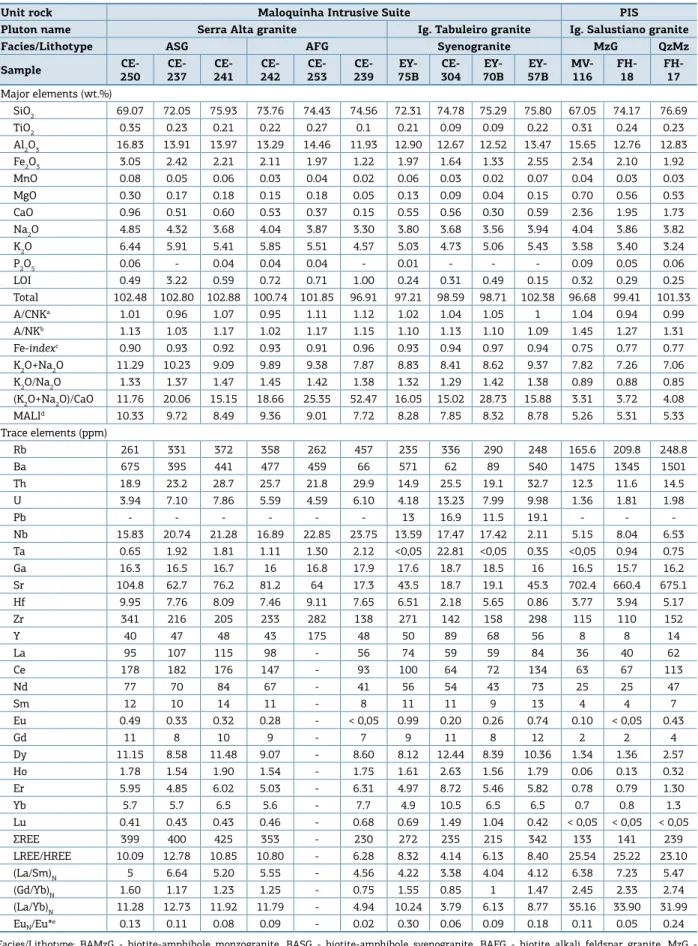
Chemical analyses of 29studied rock samples (Tab. 3) were performed at SGS Geosol Laboratory and provided to this work by Companhia de Pesquisa de Recursos Minerais (CPRM) – Brazilian Geological Survey (Superintendência Regional de Belém – SUREG-BE). Major and minor ele-ments were analyzed (SiO2, Al2O3, Fe2O3, MgO, CaO, Na2O, K2O, TiO2 and P2O5) by Inductively Coupled Plasma Atomic Emission Spectroscopy (ICP-ES), trace (Rb, Sr, Ba, Ga, Hf, Y, Zr, Nb, Ta, U and h), including REE (La, Ce, Nd, Sm, Eu, Gd, Dy, Ho, Er, Yb and Lu), by Inductively Coupled Plasma Mass Spectrometry (ICP-MS). Geochemical classiication of the studied plutons followed the procedures drafted by Ragland (1989) and Rolisson (1993) using difer-ent diagrams (Shand 1951; Whalen et al. 1987; Eby 1992; Pearce 1996; Frost et al. 2001), aiming to geochemically characterize the involved processes in magmatic evolution, granitic typology, environment and geotectonic signature of the studied rocks.
Results
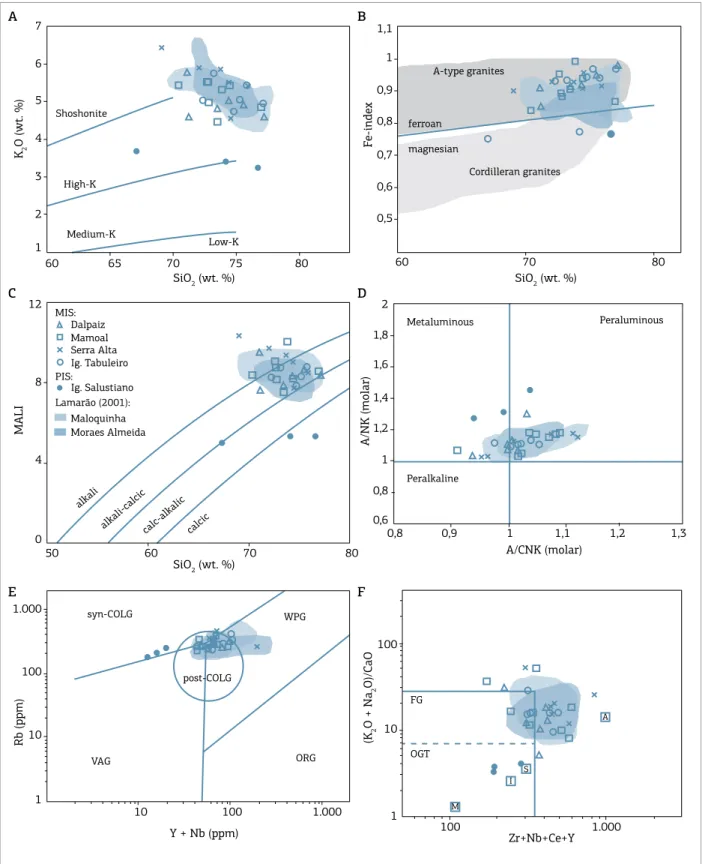
he Dalpaiz, Mamoal, Igarapé Tabuleiro and Serra Alta plutons belonging to the MIS have a high content of SiO2 (69.1-77.1%), and the Igarapé Salustiano granite, belonging to PIS, has uniform composition in two of the three analyzed samples with SiO2 between 74.2 and 76.7% and a sample (MV-116) with lower value (67.1%). he MIS alkalis content (Na2O+K2O = 7.8-11.3%) is greater than PIS (Na2O+K2O = 7.1-7.8%). In K2O vs. SiO2 diagram (Fig. 5A) MIS samples fell into high-K and shoshonite ields, and the PIS samples
plotted as high- to medium-K, indicating that the PIS has Na2O content higher than K2O compared to its high alkalis content. Fe-index vs. SiO2 (Fig. 5B) and Modiied Alkali-Lime Index (MALI) vs. SiO2 (Fig. 5C) from Frost et al. (2001) also pointed out the contrast between MIS and Igarapé Salustiano pluton from PIS. he MIS shows high Fe-index values (0.82-0.99) plotting in A-type granite ield as ferroan, and the PIS samples (Fe-index = 0.75-0.77) are magnesian plotting mostly in the cordilleran granites ield. he MIS has MALI (Na2O+K2O-CaO) values considerably higher than PIS, and in the MALI vs. SiO2 diagram MIS falls in the alkalic and alkalic-calcic ields, whereas PIS in the calc-alkalic and cal-cic ields. A/NK vs. A/CNK diagram (Fig. 5D) shows that both MIS and PIS are peraluminous to metaluminous, with A/CNK ratios ranging from 0.91 to 1.12 for the MIS, and 0.94 to 1.04 for PIS rocks. However, PIS samples have A/NK ratios slightly bigger than MIS, but both with A/NK>1.0.
In Rb vs. (Y + Nb) diagram (Fig. 5E), both MIS and PIS samples exhibit high Rb contents, however the MIS rocks plot in within-plate or post-collisional granitoids ield (Pearce 1996), and the PIS in the syn-collisional granitoids ield. In (K2O+Na2O)/CaO vs. (Zr + Nb + Ce + Y) diagram from Whallen et al. (1987) (Fig. 5F) it is observed that the MIS samples fall dominantly in the A-type granites ield, with some samples extending to the fractionated I-type granites ield, whereas PIS samples falls in the not fractionated I- and S-type granites ield. MIS has medium to high values of Zr + Nb + Ce + Y (223-840 ppm) in relation to PIS (190-285 ppm).
In spidergram (Fig. 6), MIS shows enrichment in the Rb, h, U and K elements, and depletion of Ba, Nb, Sr, P and Ti, whereas the PIS is enriched in Rb, Ba, h and K with a slight negative anomaly of U and depleted in Nb, P and Ti. Variations in the Rb, Ba, Sr and Ti contents are mainly attributed to diferences in the rock-forming minerals con-tents. he high Rb contents and low Sr and Ba from MIS, as well as high Rb and Ba contents, and low Ti from PIS were caused by fractional crystallization of alkali feldspar, plagioclase and biotite. Both units showed quite consistent and reproducible patterns with each other.
Table 3. Major (wt.%) and trace (ppm) elements data for Maloquinha Intrusive Suite (MIS) and Parauari Intrusive Suite (PIS) granitoids.
Unit rock Maloquinha Intrusive Suite
Pluton name Dalpiz granite Mamoal granite
Facies/Lithotype BAMzG BAMzG BASG BAFG
Sample
EY-26 EY-
23
MV-79
JK-02 EY-
52
EY- 79
FH-13
MV-119
MV-122
JK-39
MV-131B
CE-264
FH- 04
MV-117 Major elements (wt.%)
SiO2 71.12 71.20 73.50 74.39 75.57 77.21 70.42 72.84 77.00 72.66 72.78 73.51 73.88 74.47 TiO2 0.23 0.28 0.14 0.19 0.19 0.07 0.37 0.21 0.26 0.17 0.37 0.23 0.09 0.16
Al2O3 16.04 16.77 12.63 12.45 13.17 12.39 13.51 13.96 14.57 12.69 15.21 12.13 14.01 13.27
Fe2O3 3.08 3.32 1.92 2.41 2.52 1.64 2.72 1.85 1.81 1.62 3.04 1.93 1.38 1.70 MnO 0.10 0.12 0.06 0.06 0.04 0.02 0.06 0.05 0.06 0.05 0.11 0.05 - 0.02 MgO 0.28 0.53 0.16 0.19 0.12 0.03 0.47 0.22 0.25 0.07 0.33 0.18 0.01 0.10 CaO 1.02 1.84 0.70 0.69 0.50 0.28 1.19 0.78 0.58 0.18 0.98 0.43 0.08 0.53 Na2O 4.77 4.84 3.75 4.00 4.22 4.08 4.12 3.96 4.30 3.71 4.21 3.47 4.79 3.30 K2O 5.77 4.57 4.82 5.03 4.94 4.59 5.44 4.98 4.85 5.53 5.52 4.47 5.32 5.43 P2O5 - 0.05 - 0.03 - - 0.10 0.03 0.07 0.02 0.07 0.03 0.01 0.02
LOI 0.11 0.17 0.24 0.38 0.19 0.11 0.44 0.22 0.39 0.42 0.34 0.66 0.23 0.18 Total 102.5 103.69 97.93 99.82 101.47 100.43 98.84 99.10 104.14 97.12 102.96 97.09 99.81 99.18 A/CNKa 1.01 1.03 1.00 0.94 1.00 1.02 0.91 1.05 1.09 1.02 1.04 1.07 1.02 1.08
A/NKb 1.14 1.30 1.11 1.04 1.07 1.06 1.07 1.17 1.18 1.05 1.18 1.15 1.03 1.17
Fe-indexc 0.91 0.85 0.92 0.92 0.95 0.98 0.84 0.88 0.87 0.95 0.89 0.91 0.99 0.94
K2O+Na2O 10.54 9.41 8.57 9.03 9.16 8.67 9.56 8.94 9.15 9.24 9.73 7.94 10.11 8.73 K2O/Na2O 1.21 0.94 1.29 1.26 1.17 1.13 1.32 1.26 1.13 1.49 1.31 1.29 1.11 1.65
(K2O+Na2O)/CaO 10.33 5.11 12.24 13.09 18.32 30.96 8.03 11.46 15.78 51.33 9.93 18.47 126.38 16.47
MALId 9.52 7.57 7.87 8.34 8.66 8.39 8.37 8.16 8.57 9.06 8.75 7.51 10.03 8.20
Trace elements (ppm)
Rb 272 237 318 255 279 301 331 287 343 289 261 264 382 225
Ba 427 585 257 414 367 48 907 414 409 240 600 373 13 221
Th 22.6 18.2 23.1 24.5 22.7 36.8 19.5 27.9 31.8 22.0 20.7 26.8 32.5 30.5 U 6.60 5.65 8.33 5.07 6.95 15.48 3.83 6.87 6.93 4.63 4.21 6.34 5.52 3.95
Pb 11.9 7.5 18.1 13.6 12.9 16.0 - - - 12.9 - - -
-Nb 4.49 5.03 2.23 15.09 2.27 1.80 29.82 20.62 26.01 24.42 16.92 21.01 52.15 9.10 Ta 0.56 0.54 0.12 0.38 0.36 0.38 3.50 2.38 1.67 2.01 0.82 1.35 2.34 0.61 Ga 15.5 15.8 19.2 23.2 17.6 16.3 22.1 15.5 17.9 23.1 16.2 17.6 27.9 14.8 Sr 63.1 163.9 42.9 52.3 37.5 11.0 166.6 87.7 112.2 29.9 83.6 55.4 0.5 65.2 Hf 1.41 1.60 0.39 4.70 0.77 0.46 9.81 5.88 6.14 8.68 10.72 10.10 6.23 4.21
Zr 247 209 137 191 233 140 347 136 160 205 287 233 131 96
Y 44 54 97 68 66 63 37 52 20 43 33 75 19 35
La 55 73 62 74 88 - - 69 107 74 86 210 - 80
Ce 81 101 73 145 109 - - 116 133 86 180 269 - 106
Nd 50 64 58 69 78 - - 48 45 57 67 135 - 68
Sm 9 12 12 14 16 - - 10 6 10 12 21 - 12
Eu 0.37 0.67 0.49 0.61 0.60 - - 0.31 0.67 0.50 0.51 1.09 - 0.61
Gd 8 11 14 11 15 - - 9 5 7 8 20 - 8
Dy 7.36 9.24 15.13 11.19 12.75 - - 10.52 3.42 6.41 8.50 17.86 - 8.24 Ho 1.32 1.78 3.19 2.19 2.37 - - 2.07 0.51 1.13 1.40 2.90 - 1.26 Er 4.82 6.28 10.86 6.58 7.02 - - 7.29 1.88 3.79 5.11 8.53 - 4.34
Yb 5.6 6.4 11.2 7.1 7.1 - - 7.0 2.3 4.3 4.8 7.8 - 4.1
Lu 0.31 0.32 2.09 0.84 0.45 - - 0.58 < 0.05 0.68 0.35 0.67 - 0.18
ΣREE 223 285 262 342 336 - - 281 304 251 372 694 - 293
LREE/HREE 7.15 7.27 3.73 7.87 6.49 - - 6.76 22.90 10.10 12.17 11.11 - 10.09 (La/Sm)N 3.68 3.96 3.33 3.27 3.60 - - 4.28 11.86 4.56 4.69 6.35 - 4.25 (Gd/Yb)N 1.19 1.34 1.04 1.29 1.76 - - 1.06 1.61 1.29 1.41 2.08 - 1.65
(La/Yb)N 6.62 7.68 3.73 7.05 8.41 - - 6.68 31.49 11.59 12.05 18.24 - 13.11
EuN/Eu*e 0.13 0.18 0.12 0.15 0.12 - - 0.10 0.40 0.18 0.16 0.16 - 0.19
Unit rock Maloquinha Intrusive Suite PIS
Pluton name Serra Alta granite Ig. Tabuleiro granite Ig. Salustiano granite
Facies/Lithotype ASG AFG Syenogranite MzG QzMz
Sample
CE-250 CE-237
CE-241
CE-242
CE-253
CE-239
EY-75B
CE-304
EY-70B
EY-57B
MV-116
FH- 18
FH- 17 Major elements (wt.%)
SiO2 69.07 72.05 75.93 73.76 74.43 74.56 72.31 74.78 75.29 75.80 67.05 74.17 76.69
TiO2 0.35 0.23 0.21 0.22 0.27 0.1 0.21 0.09 0.09 0.22 0.31 0.24 0.23
Al2O3 16.83 13.91 13.97 13.29 14.46 11.93 12.90 12.67 12.52 13.47 15.65 12.76 12.83
Fe2O3 3.05 2.42 2.21 2.11 1.97 1.22 1.97 1.64 1.33 2.55 2.34 2.10 1.92
MnO 0.08 0.05 0.06 0.03 0.04 0.02 0.06 0.03 0.02 0.07 0.04 0.03 0.03 MgO 0.30 0.17 0.18 0.15 0.18 0.05 0.13 0.09 0.04 0.15 0.70 0.56 0.53 CaO 0.96 0.51 0.60 0.53 0.37 0.15 0.55 0.56 0.30 0.59 2.36 1.95 1.73 Na2O 4.85 4.32 3.68 4.04 3.87 3.30 3.80 3.68 3.56 3.94 4.04 3.86 3.82 K2O 6.44 5.91 5.41 5.85 5.51 4.57 5.03 4.73 5.06 5.43 3.58 3.40 3.24
P2O5 0.06 - 0.04 0.04 0.04 - 0.01 - - - 0.09 0.05 0.06
LOI 0.49 3.22 0.59 0.72 0.71 1.00 0.24 0.31 0.49 0.15 0.32 0.29 0.25 Total 102.48 102.80 102.88 100.74 101.85 96.91 97.21 98.59 98.71 102.38 96.68 99.41 101.33 A/CNKa 1.01 0.96 1.07 0.95 1.11 1.12 1.02 1.04 1.05 1 1.04 0.94 0.99
A/NKb 1.13 1.03 1.17 1.02 1.17 1.15 1.10 1.13 1.10 1.09 1.45 1.27 1.31
Fe-indexc 0.90 0.93 0.92 0.93 0.91 0.96 0.93 0.94 0.97 0.94 0.75 0.77 0.77
K2O+Na2O 11.29 10.23 9.09 9.89 9.38 7.87 8.83 8.41 8.62 9.37 7.82 7.26 7.06 K2O/Na2O 1.33 1.37 1.47 1.45 1.42 1.38 1.32 1.29 1.42 1.38 0.89 0.88 0.85 (K2O+Na2O)/CaO 11.76 20.06 15.15 18.66 25.35 52.47 16.05 15.02 28.73 15.88 3.31 3.72 4.08 MALId 10.33 9.72 8.49 9.36 9.01 7.72 8.28 7.85 8.32 8.78 5.26 5.31 5.33
Trace elements (ppm)
Rb 261 331 372 358 262 457 235 336 290 248 165.6 209.8 248.8
Ba 675 395 441 477 459 66 571 62 89 540 1475 1345 1501
Th 18.9 23.2 28.7 25.7 21.8 29.9 14.9 25.5 19.1 32.7 12.3 11.6 14.5 U 3.94 7.10 7.86 5.59 4.59 6.10 4.18 13.23 7.99 9.98 1.36 1.81 1.98
Pb - - - 13 16.9 11.5 19.1 - -
-Nb 15.83 20.74 21.28 16.89 22.85 23.75 13.59 17.47 17.42 2.11 5.15 8.04 6.53 Ta 0.65 1.92 1.81 1.11 1.30 2.12 <0,05 22.81 <0,05 0.35 <0,05 0.94 0.75 Ga 16.3 16.5 16.7 16 16.8 17.9 17.6 18.7 18.5 16 16.5 15.7 16.2 Sr 104.8 62.7 76.2 81.2 64 17.3 43.5 18.7 19.1 45.3 702.4 660.4 675.1 Hf 9.95 7.76 8.09 7.46 9.11 7.65 6.51 2.18 5.65 0.86 3.77 3.94 5.17
Zr 341 216 205 233 282 138 271 142 158 298 115 110 152
Y 40 47 48 43 175 48 50 89 68 56 8 8 14
La 95 107 115 98 - 56 74 59 59 84 36 40 62
Ce 178 182 176 147 - 93 100 64 72 134 63 67 113
Nd 77 70 84 67 - 41 56 54 43 73 25 25 47
Sm 12 10 14 11 - 8 11 11 9 13 4 4 7
Eu 0.49 0.33 0.32 0.28 - < 0,05 0.99 0.20 0.26 0.74 0.10 < 0,05 0.43
Gd 11 8 10 9 - 7 9 11 8 12 2 2 4
Dy 11.15 8.58 11.48 9.07 - 8.60 8.12 12.44 8.39 10.36 1.34 1.36 2.57 Ho 1.78 1.54 1.90 1.54 - 1.75 1.61 2.63 1.56 1.79 0.06 0.13 0.32 Er 5.95 4.85 6.02 5.03 - 6.31 4.97 8.72 5.46 5.82 0.78 0.79 1.30
Yb 5.7 5.7 6.5 5.6 - 7.7 4.9 10.5 6.5 6.5 0.7 0.8 1.3
Lu 0.41 0.43 0.43 0.46 - 0.68 0.69 1.49 1.04 0.42 < 0,05 < 0,05 < 0,05
ΣREE 399 400 425 353 - 230 272 235 215 342 133 141 239
LREE/HREE 10.09 12.78 10.85 10.80 - 6.28 8.32 4.14 6.13 8.40 25.54 25.22 23.10 (La/Sm)N 5 6.64 5.20 5.55 - 4.56 4.22 3.38 4.04 4.12 6.38 7.23 5.47
(Gd/Yb)N 1.60 1.17 1.23 1.25 - 0.75 1.55 0.85 1 1.47 2.45 2.33 2.74
(La/Yb)N 11.28 12.73 11.92 11.79 - 4.94 10.24 3.79 6.13 8.77 35.16 33.90 31.99 EuN/Eu*e 0.13 0.11 0.08 0.09 - 0.02 0.30 0.06 0.09 0.18 0.11 0.05 0.24
Facies/Lithotype: BAMzG - biotite-amphibole monzogranite, BASG - biotite-amphibole syenogranite, BAFG - biotite alkali feldspar granite, MzG - monzogranite, QzMz - quartz monzonite.
aA/CNK= molecular Al
2O3/(CaO+Na2O+K2O),
b A/NK= molecular Al
2O3/( Na2O+K2O),
c Fe-index = FeO
t/(FeOt+MgO),
d MALI = (Na
2O+K2O-CaO), eEu
N/Eu*= EuN/
Figure 5. Geochemical diagrams for study rocks from the MIS and PIS, including ields related to MIS from Lamarão
et al. (2002): (A) K
2O vs. SiO2; (B) Fe-index [FeOt/(FeOt+MgO)] vs. SiO2 from Frost et al. (2001) (FeOt calculated as
FeO); (C) MALI (Na2O+K2O-CaO) vs. SiO
2; (D) A/NK (Al2O3/Na2O+K2O) vs. A/CNK (Al2O3/CaO+Na2O+K2O) molar from
Shand (1951); (E) Rb vs. Y + Nb, ields from Pearce (1996): Syn-COLG – syn-collsional granites, WPG –
within-plate granites, post-COLG – post-collisional granites, VAG – volcanic arc granites, ORG – ocean ridge granites;
(F) (K2O+Na2O)/CaO vs. (Zr + Nb + Ce + Y) diagram, average composition of A-type (A), M-type (M), S-type (S), I-type
(I) granites and the ields for fractionated felsic granites (FG) and unfractionated M-, I- and S-type granites (OGT)
according to Whallen et al. (1987).
Shoshonite
High-K
Medium-K
Low-K
SiO2 (wt. %) SiO2 (wt. %)
SiO2 (wt. %)
F
e-index
K2
O (wt. %)
A-type granites
ferroan
magnesian
Cordilleran granites
MIS: 7
6
5
4
3
2
65 60
8
4
0
1.000
100
10
1
50 60
10
70
100
80
100 1.000
1.000
70 75 80 60 70 80
1
12
1,1
1
0,9
0,8
0,7
0,6
0,5
1,3 1,2
1,1 1
0,9 0,8
2
1,8
1,6
1,4
1,2
1
0,8
100
10
1 0,6 Dalpaiz
Mamoal Serra Alta Ig. Tabuleiro PIS:
Ig. Salustiano Lamarão (2001):
Maloquinha Moraes Almeida
alkali
alkali-calciccalc-alkalic calcic
A/NK (molar)
A/CNK (molar)
Metaluminous Peraluminous
Peralkaline
MALI
Rb (ppm)
Y + Nb (ppm) Zr+Nb+Ce+Y
(K2
O + Na
2
O)/CaO
syn-COLG WPG
VAG ORG
post-COLG
FG
OGT
M
I S
A
A
C
E
B
D
of the REE [(La/Yb)N] between 32 and 35.2. he MIS and PIS LREE/HREE ratios are 3.6 to 12.6 and 23 to 25.3 respectively. Both units show sharp Eu negative anomaly, MIS (EuN/Eu*) = 0.02-0.4 and PIS (EuN/Eu*) = 0.1-0.2.
Sm
-N
d
WHOLE ROCK
Analytical procedures
Selected samples for Sm-Nd analyses were powdered with aid of a Shatter Box type rings mill and agate mortar and pestle. For each sample, approximately 100 mg was used in this procedure. he chemical digestion of the samples and
the chemical extraction of the Sm and Nd elements fol-lowed the procedures described by Oliveira et al. (2008). In the irst step, sample dissolution was carried out in con-centrated HNO3** (bi-distilled) and HF**. he second step was conducted using HCl** 6N and 2N with heated for evaporation. he sample solid residue was dissolved again (in HCl** 2N) to be introduced into the ion-exchange columns. REE extraction was in Telon columns illed with BioRad Dowex 50W-X8 cationic resin by a sequence of HCl** 2N
and HNO3** 3N. Sm and Nd elements were separated
from the other REE by ion exchange chromatography in Telon columns illed with Dowex AG1-X4 anionic resin by a sequence of HCl** 0.2N and HCl** 0.3N.
Figure 6. Normalized spidergram to primordial mantle (Wood 1979) for the MIS rocks: (A) Dalpaiz granite; (B) Igarapé Tabuleiro granite; (C) Mamoal granite; (D) Serra Alta granite, PIS; (E) Igarapé Salustiano granite; (F) MIS related
units: Maloquinha granite and Moraes Almeida Formation from Lamarão et al. (2002).
Rock/Primordial mantle
Rock/Primordial mantle
Rock/Primordial mantle
Rock/Primordial mantle
Rock/Primordial mantle
Rock/Primordial mantle
Serra Alta La
U K NbCe Nd Sm
Th
RbBa Sr P Hf Zr Ti Yb Y
La
U K NbCe Nd Sm
Th
RbBa Sr P Hf Zr Ti Yb Y
La
U K NbCe Nd Sm
Th
RbBa Sr P Hf Zr Ti Yb Y
La
U K NbCe Nd Sm
Th
RbBa Sr P Hf Zr Ti Yb Y
La
U K NbCe Nd Sm
Th
RbBa Sr P Hf Zr Ti Yb Y Rb Ba K La Nb Ce Sr Nd P ZrSm Ti Yb Y
1,000
100
10
1
0,1 1,000
100
10
1
0,1
1,000
100
10
1
0,1
1,000
100
10
1
0,1
1,000
100
10
1
0,1
1,000
100
10
1
0,1
Dalpaiz Igarapé Tabuleiro
Mamoal
Igarapé Salustiano Maloquinha and
Moraes Almeida
Maloquinha Moraes Almeida
A
C
E
B
D
Isotopic analyses were performed in ICP-MS Neptune model from Thermo Finnigan, equipped with 9 Faraday cups, an electron multiplier and five ion-counters multi ion channel (MIC) type of Isotope Geology Laboratory of the Federal University of Pará (Pará-Iso). The Nd ele-ment mass fractionation was normalized to 146Nd/144Nd =
0,7219 ratio. During analyses, 143Nd/144Nd average ratios
of 0.5118339 and 0.5126335 were obtained respec-tively for La Jolla and Basalt, Columbia River (BCR-01) standards. Nd (28.58 ppm) and Sm (6.56 ppm) concentrations for La Jolla standard were also obtained. Total measured blanks were <0.6 ng for Nd and <0.2 ng for Sm.
Results
Altogether, eight samples for Sm-Nd whole rock analyses were selected. Seven MIS and one PIS samples were analyzed, two biotite monzogranite samples (EY-23 and EY-26) from Dalpaiz granite, three syenogranite samples (FH-10, JK-39 and JK-40) from Mamoal granite, a syenogranite (CE-250) and a biotite quartz syenite samples (CE-252) from Serra Alta granite, and a biotite monzogranite (FH-18) from Igarapé Salustiano granite. he isotopic results are shown in Table 4. To calculate the ε
Nd(t) parameter, it was used the
crystalliza-tion ages obtained in zircon Pb-evaporacrystalliza-tion by Lamarão et al. (2002) for Maloquinha and Younger São Jorge granites, refer-ring respectively to MIS and Igarapé Salustiano granite samples.
Figure 7. Normalized REE diagram to chondrite (Eversen et al. 1978) for the MIS samples: Dalpaiz granite (A),
Igarapé Tabuleiro granite (B), Mamoal granite (C), Serra Alta granite (D), and PIS: Igarapé Salustiano granite (E),
and the MIS related units: Maloquinha granite and Moraes Almeida Formation (F) from Lamarão et al. (2002).
Dalpaiz 1,000
100
10
1
La Ce Nd Sm Eu Gd Dy Ho Er Yb Lu
Rock/Chondrite
1,000
100
10
1
Rock/Chondrite
1,000
100
10
1
Rock/Chondrite
1,000
100
10
1
Rock/Chondrite
1,000
100
10
1
Rock/Chondrite
Rock/Chondrite
[REE]=223-342 ppm (La/Yb)n=8,4-3,7 Eu/Eu*=0,1-0,2
Mamoal
[REE]=251-694 ppm (La/Yb)n=6,7-18,2 Eu/Eu*=0,1-0,4
Serra Alta Igarapé Tabuleiro
[REE]=230-425 ppm (La/Yb)n=4,9-12,7 Eu/Eu*=0,02-0,1
Igarapé Salustiano
[REE]=133-239 ppm (La/Yb)n=32-35,2 Eu/Eu*=0,1-0,2
Maloquinha and Moraes Almeida
Maloquinha Moraes Almeida
[REE]=200-342 ppm (La/Yb)n=2,7-10,2 Eu/Eu*=0,1-0,3
0,1
1,000
100
10
1
0,1
La Ce Nd Sm Eu Gd Dy Ho Er Yb Lu
La Ce Nd Sm Eu Gd Dy Ho Er Yb Lu La Ce Nd Sm Eu Gd Dy Ho Er Yb Lu
La Ce Nd Sm Eu Gd Dy Ho Er Yb Lu La Ce Nd Sm Eu Gd Dy Ho Er Yb Lu
A
C
E
B
D
The Sm and Nd contents of the MIS samples were between 4 and 28 ppm for Sm, and 20 and 158 for Nd, and Serra Alta granite shows concentrations much higher than other examined plutons in this suite. PIS sample content is 1 ppm for Sm and 10 ppm for Nd. Except sample FH-18, all presented 147Sm/144Nd ratios within the 0.090-0.125 range.
However, the sample FH-18 shows 0.081 147Sm/144Nd ratios
(very close to cited range), besides its TDM age (2.26 Ga) and ε
Nd (-2.26) parameter do not difer much from obtained
values by Lamarão et al. (2005) for Younger São Jorge gran-ite, here considered correlated to Igarapé Salustiano pluton. he f(Sm/Nd) values were between -0.59 and -0.37, suggesting that there was not meaningful Sm/Nd fractionation during the formation of the analyzed set samples.
MIS samples present negative ε
Nd(t) values, between -5.01
and -0.76, and a wide ield of TDM ages, dominantly paleo-proterozoic (2.46 to 2.20 Ga) and an archean one (2.60 Ga, sample JK-39). he results are indicative that MIS and PIS rocks were formed probably by interactionof paleop-roterozoic magmas (juveniles) and resulting melting from crustal reworking of an Archean component. he mixing of a bulk of magma derived from mantle (paleoprotero-zoic) and a bulk derived from crust (Archean) ascribes to TDM ages only an estimate of crustal residence time (Arndt & Goldstein 1987).
Fig. 8 shows the Nd (ε
Nd) isotopic evolution diagram
during geological time (T), according to the 147Sm/144Nd ratio.
In this diagram, the studied samples in this work are plot-ted and compared to ields showing the obtained values by Lamarão et al. (2005) for Maloquinha granite plus Moraes Almeida volcanic rocks and Younger São Jorge granite. his diagram also includes the mantle (CHUR) and the depleted mantle (DM) evolution curves proposed respectively by DePaolo & Wasserburger (1976) and DePaolo (1981).
DISCUSSION
Magmatic series and granitoid typology
Granitoid typology is a widely applied approach since the 1980’s (e.g., Pitcher 1983; Whalen et al. 1987; Chappell & White 1992; Eby, 1992; Barbarin 1999). he deining charac-teristics of the I-, S- and M-type granites are mainly controlled by their magma source characteristics, whereas A-type granite can be afected by its unique emplacement environment and chemical characteristics. Loiselle & Wones (1979) introduced the A-type granite terminology to designate anorogenic granite of alkaline nature and supposedly anhydrous. Geochemically, they have elevated values of SiO2 (>70 %), FeOt/MgO, K2O/ Na2O, Ga/Al, Zr, Nb, Y, Ta and REE (except Eu), and low of CaO, Al2O3, MgO, Ba, Sr and Ti (Whalen et al. 1987; Eby 1992). MIS samples are transitional between I-type fraction-ated granites and A-type granites (Fig. 5F). However, its high
Table 4. Sm-Nd whole rock isotopic data for the studied plutonic rocks.
Sample Lat. Long. Sm
(ppm) Nd (ppm)
147Sm/ 144Nd
143Nd/ 144Nd
2σ
(10-6) f(Sm/Nd) εNd(0)
Zircon age (Ma) εNd(t)
TDM (Ga)
Dalpaiz granite (MIS)
EY-23 -6.04199 -55.77737 8.28 47.05 0.106391 0.511482 5 -0.4591 -22.55 1880¹ -0.76 2.22
EY-26 -6.04923 -55.70790 7.35 35.84 0.123905 0.511632 12 -0.3701 -19.62 1880¹ -2.07 2.41
Mamoal granite (MIS)
FH-10 -6.15499 -55.95954 3.84 19.56 0.118696 0.511574 10 -0.3966 -20.76 1880¹ -1.94 2.37
JK-39 -6.20465 -55.91682 6.98 36.68 0.115106 0.511373 10 -0.4148 -24.68 1880¹ -5.01 2.6
JK-40 -6.16689 -55.92991 5.99 38.28 0.094646 0.511330 6 -0.5188 -25.52 1880¹ -0.89 2.2
Serra Alta granite (MIS)
CE-250 -6.10300 -56.19628 13.56 75.98 0.107935 0.511346 9 -0.4513 -25.2 1880¹ -3.8 2.46
CE-252 -6.08756 -56.21936 28.20 158.25 0.107748 0.511341 5 -0.4522 -25.3 1880¹ -3.85 2.46
Igarapé Salustiano granite (PIS)
FH-18 -6.00688 -56.05358 1.37 10.21 0.081017 0.511084 9 -0.5881 -30.31 1891² -2.26 2.26
TDM and ε
Nd(t) were calculated relative to CHUR and depleted mantle (DM) with presente-day values of
143Nd/144Nd = 0.512638 and 147Sm/144Nd = 0.1967,
Fe-index (>0.80), post-collisional granitic ainity, alkalic-cal-cic to alkalic character and high REE content with negative Eu anomalies, besides the marked correlation observed in the spidergrams (Fig. 6) of these rocks with Maloquinha granite and Moraes Almeida Formation (Lamarão et al. 2002), led us to classify them as A-type granites and group these rocks with the Maloquinha Intrusive Suite. Igarapé Salustiano granite samples plotted in the I- and S-type granites ield of Whallen et al. (1987) diagram (Fig. 5F), but its metalumi-nous to peralumimetalumi-nous ainity and syn-collisional character suggest I-type granite ainity.
Since Loiselle & Wones (1979), several models have been proposed to explain A-type granites petrogenesis (Collins
et al. 1982; Anderson 1983; Whalen et al. 1987; Eby, 1992; Barbarin 1996; Patiño Douce 1997). In this work, A-type granitic classiication proposed by Eby (1992), which uses the subdivision of A1 granitoids group, characterized by elemental ratios similar to those observed in oceanic island basalts (OIB), and A2 granitoids group, characterized by ratios ranging from those observed in continental crust to island arc basalts. he A1 group represents mantle diferen-tiates from the same type of source that produces OIB, but formed during continental rifting or within-plate magma-tism, and may also be formed as result of hot spot or mantle plume. he A2 group represents melts arising by underplat-ing or collision of continent-continent/ocean-continent in continental crust. hey are generated in post-collisional or post-orogenic environments with signiicant lithospheric anatexis contribution. MIS rocks plotted in the A2 gran-ites ield (Fig. 9). he deductions revealed from Eby dia-grams could be conirmed both by other geochemical and isotopic parameters. he MIS shows negative Ba, Sr and Eu
anomalies, with the latter two the strongest (Figs. 6 and 7). Such anomalies, when taken together, are not produced by fractional crystallization, but by stability of plagioclase in the source region, furthering the increase of K2O/Na2O ratio by retention of Na2O, and it also decreases the CaO content (Patiño Douce 1997). Another geochemical charac-teristic that point in the same direction is the alkalic-calcic to alkalic nature and ainity of these rocks with post-colli-sional and within-plate granites (Fig. 5E). Such signatures may indicate a calc-alkaline to alkaline transition series, in an orogenic to post-orogenic tectonic environment (Bonin 1990; Barbarin 1999) or increase in arc maturity (Brown
et al. 1984). he ε
Nd(t) isotopic parameters are negatives for
MIS rocks (-0.76 to -2.26), showing that these rocks were generated by anatexis of older crust (crustal reworking). It also enhances their ainity with Eby A2-type granites.
Igarapé Salustiano granite shows calc-alkaline signature of syn-collisional I-type granites and meta to peraluminous nature. It is medium to high-K and its Fe-index is <0.80, which display a close relationship to the Younger São Jorge granite (Lamarão et al. 2002), and inserted it in the PIS.
Source of magmas and implications
for geotectonic subdivision
Investigation of the source rocks in the boundaries between the Amazonian Craton geochronological provinces is critical to understand their evolution. hus, Sm-Nd data has been
Figure 9. Nb-Y-Ce and Nb-Y-Ga*3 discriminant diagrams for A1- and A2-type granitoids (Eby 1992) for the MIS rocks. Symbols as Fig. 5.
Nb
A1
A2
Ce
Ga*3 Y
Y
A2
Figure 8. ε
Nd vs. time (T) showing Nd isotopic
composition of the studied plutonic rocks. CHUR is undiferentiated Earth (DePaolo & Wasserburger 1976) and DM depleted mantle (DePaolo 1981).
5
CHUR DM
0
-5
-10
-15
-20
0.8 1.0 1.2 1.4 1.6 1.8 2.0 2.2 2.4 2.6 2.8 T (Ga)
Intervals of ε
Nd
εNd
MIS: Dalpaiz Mamoal Serra Alta PIS:
Ig. Salustiano Lamarão et al. (2005):
used to obtain information about the sources of these rocks and to outline boundaries among these provinces. he Central Amazonian Province represented by archean crustal source rock contrasts with the Tapajós-Parima Province, represented by juvenile paleoproterozoic source rocks or with the low participation of older crust. his contrast was established by Tassinari (1996), who called this province Ventuari-Tapajós. Santos (2003) and Tassinari & Macambira (2004) adopted the same criteria for subdivision of Central Amazonian and Tapajós-Parima (Santos 2003) or Ventuari-Tapajós (Tassinari and Macambira 2004) provinces.
In the southern portion of the Amazonian Craton, the boundary between these two provinces is poorly deined. Santos (2003), Tassinari & Macambira (2004), and Vasquez et al.
(2008a) disagreed on the boundary between them. his diver-gence owes to the absence of tectonic structures that could help to outline this boundary. Such structures have not been iden-tiied yet in a satisfactory way for a tectonic subdivision, and geological structures observed on the edges of the two provinces are very similar, making it diicult to outline the line between them. In addition, the orosirian magmatism of intracontinental character is a hallmark of both Tapajós and Iriri-Xingu domains. Petrographically, this magmatism is essentially marked by unde-formed granitoids and loods of volcanic and volcanoclastic acid rocks. he latter is the majority in the Iriri-Xingu Domain and is represented predominantly by Iriri Group.
In this work, it was shown that Archean source rocks (2.60 Ga) occur within Tapajós Domain, likewise presented by Santos et al. (2000) – 2.53 and 2.60 Ga TDM ages – in rocks related to MIS. Semblano et al. (2016) presented paleo-proterozoic sources (TDM = 2.43 Ga) to the rocks belonging to I-type Undiferentiated granitoids (Vasquez et al. 2008b) in Iriri-Xingu Domain. hese ages, found both in Tapajós and Iriri-Xingu domains, expose the lack of detailed stud-ies (particularly in the transition ield between them) and irmer criteria for the geochronological subdivision of the Amazonian Craton.
In fact, the rocks belonging to Iriri-Xingu Domain have source ages that are mostly Archean, and the rocks of Tapajós Domain are mostly paleoproterozoic. However, the ε
Nd parameter identiied in rocks of these domains shows that
the contribution of Archean crust in the Iriri-Xingu rocks was more signiicant than in Tapajós rocks. Orosirian magmatism acted indiscriminately in both domains, released magmas from the mantle which passed by unproportional interac-tion with Archean magmas of anatetic origin. his episode was responsible for the irregular geochronological pattern observed in the rocks of the edges of these domains. Arndt & Goldstein (1987) showed that in order to date a crustal formation event by Sm-Nd ages satisfactorily, all of the sam-ple material must have come from the mantle during a single
event. he obtained negative ε
Nd(t) values showed that the
studied rocks cannot have been produced by maic magma derived directly from the mantle. When material derived from the mantle mix at diferent stages, Sm-Nd ages reveal only the average time between diferent episodes of mantle melting. hus, when Sm-Nd model ages do not agree with any particular orogenic event associated with the magma-tism, it should be understood as forming during the mean age of diferent source mixtures. Moreover, it must be con-sidered that this interaction occurs in a heterogeneous way in diferent proportions within lithosphere. And this hetero-geneity precludes the drawing of a clear boundary between provinces with diferent Sm-Nd model ages, thus making it diicult to separate Tapajós Domain from Iriri-Xingu Domain. One must also consider the zircon crystallization ages, showing that tectonic-magmatic events responsible by formation of these rocks acted simultaneously in both areas.
CONCLUSIONS
According to the data presented herein, it is possible to include Mamoal, Dalpaiz and Serra Alta plutons in the MIS, even without their crystallization age determination. Firstly, this grouping stems from a compatible geochemi-cal signature with A-type granites, as well as comparative study (petrographic and geochemical) with Maloquinha granite and Moraes Almeida Formation from Lamarão et al. (2002). he rocks belonging to these three plutons have Ba, Sr and Eu negative anomalies, with a similar pattern to the rocks formed by partial melting. Furthermore, other geo-chemical characteristics show alkalic-calcic to alkalic nature and ainity with post-collisional and within-plate granites. heir negative ε
Nd(t) isotopic parameter also reinforces this
interpretation, that the rocks were generated by crustal ana-texis. All these features point out to a scenario of arc matu-rity or even transition of orogenic for post-orogenic tectonic environment (Bonin 1990; Barbarin 1999).
hese plutons are chronologically correlated with oro-sirian anorogenic magmatism (~1.88 Ga), well documented in several provinces of the Amazonian Craton. In Carajás Province, it is represented by Jamon and Serra dos Carajás suites, in the Iriri-Xingu Domain by Rio Dourado Intrusive Suite, and northward of craton, in Erepecuru-Trombetas and Uatumã-Anauá domains, by Mapuera Intrusive Suite and to MIS, in the Tapajós Domain. hus, it is concluded that this anorogenic magmatism not only afected the new terranes that were added to the craton, but also older ones stabilized in the Archean as Carajás Province (Dall’Agnol