Article
Sequential Injection Analysis Determination of Sulphate in
Wastewaters by Ultraviolet-Spectrophotometry
Rui A. S. Lapa*, José L. F. C. Lima and Ivone V. O. S. Pinto
CEQUP/Departamento de Química-Física, Faculdade de Farmácia da Universidade do Porto, R. Aníbal Cunha, 164, 4050 Porto, Portugal
Foi desenvolvido um sistema de análise por injeção sequencial, baseado na formação do cátion FeSO4+ e detecção espectrofotométrica a 355 nm, para a determinação de sulfato em águas residuais. Os principais interferentes foram avaliados. O sistema proposto é totalmente automático e permite o monitoramento de sulfato em amostras. O desvio padrão relativo (RSD) obtido foi inferior a 2,4%. O sistema apresentou uma resposta linear entre 10 e 1000 mg L-1. A velocidade de amostragem obtida foi de 72 amostras por h.
A sequential injection analysis system based on the formation of the cation FeSO4+ and the spectrophotometric measuring of the absorbance at 355 nm has been developed for the determination of sulphate in wastewaters. The main interferents were also evaluated. The proposed system is fully automatized and is able to monitor sulphate in samples. The relative standard deviation (RSD) obtained was smaller than 2.4%. The linearity of response was obtained between 10 and 1000 mg L-1. The sampling rate was 72 samples per hour.
Keywords: flow system, spectrophotometric analysis, sequential injection analysis, sulphate
*e-mail: [email protected]
Introduction
Sulphate is one of the major components of natural wa-ters and its determination in water is especially important because of its relevance to the problems of air pollution and acid rain. Also, the widespread industrial use of sulphuric acid makes the determination of sulphate impor-tant for environmental protection.
In many countries legislation has been passed that es-tablishes a maximum permissible sulphate concentration1. Several approaches have already been described for the determination of sulphate. The existing manual methods, for example the standard gravimetric method2 and the titri-metric methods3,4, including potentiometric methods with ion-selective electrodes, which usually involve precipita-tion titraprecipita-tions with lead(II) soluprecipita-tion and a lead-selective electrode4-7, are all cumbersome, tedious and time-con-suming, inconvenient for application to environmental stud-ies in which usually large numbers of samples are involved, as well, the methodologies based on chromatography8-9 where the usable life of an expensive chromatographic col-umn is severally shortened. Methodologies based on flow
injection analysis (FIA) have been published for sulphate determination with turbidimetric10,11, spectrofluorimetric12, atomic absorption13 or spectrophotometric14 detection.
Simplicity of the design, robustness, reliability, long-sta-bility and low frequency of maintenance of process analysers are required for its application in environmental process con-trol. A technique, sequential injection analysis (SIA) compris-ing only a scompris-ingle propulsor system, scompris-ingle valve and a scompris-ingle channel was introduced to overcome the problems related to the conventional flow systems, such as, manual reconfiguration of the flow channel, high reagent consumption due to con-tinuous flow operation, frequent maintenance of peristaltic pumps and frequent recalibration of the system. This is ac-ceptable in laboratory applications, but are obstructive when considering environment process control. Some of the advan-tages of SIA technique are simpler manifolds, flexibility, ver-satility, less maintenance and stable flow rates.
In a SIA system, by use of a selection valve, wash solution, sample zone, and reagent zone(s) are sequentially injected into a channel. Therefore a stack of well defined zones is obtained which is then injected through a reactor into a detector. The flow reversal as result of the injection step cre-ates a composite zone in which sample and reagent zone merge together due to combined axial and radial dispersion15-18.
This paper describes a SIA system with ultraviolet de-tection of cation FeSO4+ for the determination of sulphate in wastewaters. The main interferents, namely chloride, fluoride and organic compounds were evaluated. The work-ing characteristics of this system were shown to be rapid, sensitive and accurate, and easily adapted to on-line pro-cess measurements.
Experimental
Reagents and solutions
Solutions were prepared using high purity water, with conductivity smaller than 0.1 µS cm-1. Analytical grade reagents were used throughout.
A sulphate stock solution (1 g L-1) was prepared from potassium sulphate (1.81 g, previously dried at 450ºC) in water. Working sulphate standards were daily prepared by appropriate dilution of stock solution with water.
The complexing solution (0.02 mol L-1 Fe(III), 0.02 mol L-1 Al(III) and 0.1 mol L-1 Hg(II) in 0.34 mol L-1 perchloric acid) was prepared by dissolving 21.8 g of HgO in 37 mL of 60% perchloric acid, adding 8.1 g of Fe(NO3)3.9H2O and 7.5 g of Al(NO3)3.9H2O, and diluting to 1 L with water.
A 0.34 mol L-1 perchloric acid solution was used as carrier. The wastewater samples were collected at wood indus-try and corresponds to the influents and effluents of the wastewater treatment plant.
Equipment
The sequential injection system used was composed of individual components. A CRISON microBU 2031 (Crison instruments, Alella, Spain) with a 5 mL syringe was used as propulsor system. The liquids were propelled or aspirated at a constant flow-rate between 0.1-3 mL min-1.
A multiposition selection valve VICI (Valco Instru-ments Co. Inc.) with 8 inlets and 1 central outlet was used as injection system.
The manifold was built from PTFE tubing (0.8 mm i.d.) with Gilson connectors.
A spectrophotometer UV/VIS JENWAY 6105, equipped with an 18 mL flow-through cell of 1cm path length was used for absorbance measurements at 355 nm. The detec-tor output was recorder on a Kipp & Zonen recorder and signal evaluation was made by peak-height measurement. A microcomputer was used as control unit. All software was written in QuickBasic. The communication between mi-crocomputer and burette was made by standard serial RS232C protocol, whereas digital TTL signals, using an Advantech model 818 interface card was used for the connection with the valve. The same interface card was used for data acquisition.
Conventional procedure
The quality of the results obtained by the SIA system was assessed by comparison with those obtained by the reference method. Therefore, the procedures suggested by the “Standard Methods for the Examination of Water and Wastewater”19 were applied.
Results and Discussion
The simple manifold used for the sulphate determina-tion by SIA is depicted in Figure 1. The respective work-ing parameters have been studied.
Once the optimal conditions of operation were established, the analytical features of the system were determined and the quality of the results assessed.
Rg
Mc
B
D
W
R Rc
S C V
Hc
Figure 1. SIA manifold used in the determination of sulphate in wastewaters of wood industry. S- sample; C- carrier; Rg- complexing agent; B- automatic burette; D- detector; V- valve; R- recorder; Mc-microcomputer; Rc- reaction coil (100 cm); Hc- holding coil.
System optimization
In order to optimise the SIA manifold, the influence of the hydrodynamic and chemical parameters on the magni-tude of the peak height, reproducibility and accuracy of the results were studied. Experimental parameters were optimised by an univariate approach.
The formation of the cation FeSO4+ is significantly affected by pH. If the solution is too acid, sulphate is pro-tonated and, if is too alkaline, the cation FeOH2+ species formed will exhibit an absorption curve similar to that of cation FeSO4+20. In this work the complexing solution used had the same proportion of Fe(III) to perchloric acid. Chloride and fluoride were evaluated as interferents. Mercury(II) was used in the complexing agent to mask any chloride present in the natural waters thus preventing the for-mation of the cation FeCl2+, which has an absorbance maxi-mum at 340 nm; aluminium(III) was used to mask fluoride.
Lengths of pathways to the detector between 75 and 200 cm were tried. The best analytical responses were obtained with a 100 cm pathway and when 100 mL of sample were used. Varying the flow rate, selected for the measurement step, in the range 0.1-3 mL min-1 no significant changes of the analytical response were observed. Due to the rapid reaction between sample and complexing agent, flow rate of 3 mL min-1 was used, this being a compromise between the sampling rate and the height of the peak.
Furthermore, it was observed that the increase of the peak height and sensitivity of the measurements was better achieved by intercalating the sample in equal volumes of complexing agent.
In Figure 2, analytical signals obtained for the differ-ent standards of sulphate, with concdiffer-entrations between 10 and 1000 mg L-1, are presented.
Calibration data obtained for the determination of sulphate in the range 10-1000 mg L-1 showed a linear relationship between concentration and analytical sig-nal with correlation coefficient of 0.9995 (Figure 3). The statistical limit of detection (3s) was 5 mg L-1. Af-ter replicate injections of each standard solution the precision found was typically better than 2.4% (this value correspond to the standard 200 mg L-1). The sam-pling rate was about 72 samples h-1. Measurements of 100 mg L-1 sulphate were not affected by the presence of 200 mg L-1 chloride and 5 mg L-1 fluoride. Above these concentrations interference starts.
Figure 2. Calibration record obtained for the different sulphate standards. A-1000 mg L-1; B-800 mg L-1; C-500 mg L-1; D-200 mg L-1; E-50 mg L-1; F-10 mg L-1.
y = 0,0072x + 3,888 R2 = 0,9995
0 2 4 6 8 10 12
0 200 400 600 800 1000 1200
Sulphate concentration (mg L-1)
Peak height (cm)
Figure 3. Analytical curve obtained for the different sulphate standards.
Application to sample analysis
The quality of the results attained by the automatic system developed for the determination of sulphate in wastewaters was evaluated by comparing the results with those given by the reference method. Direct application of the method developed for sulphate determination showed errors in this comparison. The reason for the divergence is assumed to be the presence of organic compounds absorb-ing ultraviolet light, in the wastewaters.
Ultraviolet irradiation of the samples to decompose organic species was studied and it was observed that it was not an effective method for elimination of the organic com-pounds. More satisfactory results were obtained by sample analysis with subtraction of the background absorbances. To measure these absorbances, samples were aspirated but, instead of the usual complexing agent, a solution of the same composition except for Fe(III) ion was used. In order to achieve the same ionic strength, an equimolar amount of the aluminium salt was added.
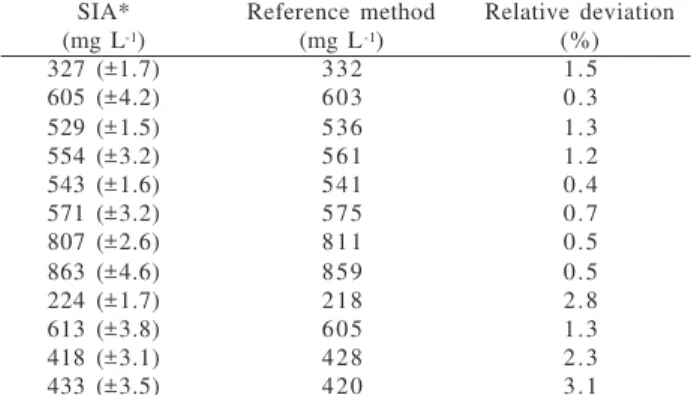
Table 1 presents the results obtained using the two different methodologies, for 12 wastewater samples. The maximum relative deviation between the results attained by the developed system and by the conventional proce-dure for the same samples was less than 3.1%.
Table 1. Results obtained for 12 wastewater samples, in the determination of sulphate
SIA* Reference method Relative deviation
(mg L-1) (mg L-1) (%)
327 (±1.7) 332 1.5
605 (±4.2) 603 0.3
529 (±1.5) 536 1.3
554 (±3.2) 561 1.2
543 (±1.6) 541 0.4
571 (±3.2) 575 0.7
807 (±2.6) 811 0.5
863 (±4.6) 859 0.5
224 (±1.7) 218 2.8
613 (±3.8) 605 1.3
418 (±3.1) 428 2.3
433 (±3.5) 420 3.1
* mean and relative standard deviation (%) of each sample.
Conclusions
A sequential injection analysis system, with an ultra-violet-spectrophotometric detector, was developed to evaluate the sulphate concentration in wastewaters.
Some aspects are clearly advantageous, like the use of small volumes of reagents and sample, this being important in continuous analysis as it means less main-tenance and less waste disposal. Additionally, all com-ponents and solutions were clustered around the selec-tion valve, thus facilitating the future minimisaselec-tion of the system and its complete automatization by use of computer-controlled operations running for extended periods. The greatest attribute of the system is probably the fact that the same manifold configuration can ac-commodate a variety of chemistries, without requiring physical reconfiguration.
Nevertheless, there are two drawbacks that must be men-tioned. First, since the aspiration of the wash and sequenc-ing of the zones in reaction coil takes some time, the sam-pling frequency of this system is presently lower than that of conventional FIA systems, in which the filling of the injection valve is a matter of a few seconds. Secondly, this system requires special software, as the sequencing and injection are entirely computer driven. This, however, is not an obstacle to using this technique. Its attributes are valuable for environmental process control and overcome its drawbacks in a practical and readily accessible form in wastewater analysis.
The application of the developed system in sulphate determination has been found to be an inexpensive and
rapid technique that yields results in good agreement with those provided by a reference method, with accuracy, rela-tive deviations smaller than 2.4% and enable the measure-ment of sulphate levels over the range commonly encoun-tered in wastewaters.
In the sulphate determination with ultraviolet detection the most significant interference arises from organic com-pounds which absorb in the ultraviolet region. However, satisfactory results can be obtained with the subtractive pro-cedure in which each sample is aspirated twice and reagent solutions with and without Fe(III) ions are used.
The implementation of the developed system in labora-tories where sulphate determination is currently carried out is accessible, as the materials are simple, economic, and the system is easily maintained and operated as an operator only needs to enter the parameters required for controling the methodology by the system to run automatically.
Acknowledgements
The authors thank the financial support through the EC-AMOCO-FAIR-CT96-1198 project. One of us (I.V.O.S. Pinto) thanks PRAXIS XXI program for the PhD grant (BD/9539/96).
References
1.Boletín Oficial del Estado, Spain, 20 September 1990, R. D. 1138/90, p.27493.
2. American Society for Testing and Materials, Book of ASTM Standards. Part 23, Water: Atmospheric Analysis, ASTM. Philadelphia, 1973, pp.425-431. 3. Schroeder, W.C. Ind. Eng. Chem. 1933, 5, 403. 4. Ross, J.W; Frant, M. S. Anal. Chem. 1969, 41, 967. 5. Hulanicki, A.; Lewandowski, R.; Lewenstam, A.
Analyst1976, 101, 939.
6. Scheide, E. P.; Durst, R. A. Anal. Lett. 1977, 10, 55. 7. Trojanowicz M., Hulanicki A. Chem. Anal. (Warsaw)
1977, 22, 615.
8. Story, J. N. J. Chromatogr. Sci. 1983, 21, 272. 9. Singh, R. P.; Pambid, E. R.; Abbas, N. M. Anal. Chem.
1991, 63, 1897.
10. Santelli, R. E.; Salgado Lopes, P. R.; Leme Santelli, R. C.; Rebello Wagener, A. L. Anal. Chim. Acta1995, 300, 149. 11. Zhi, A. L.; Rios, A.; Valcarcel, M. Quim. Anal. 1994,
13, 121.
12. Chimpalee, N.; Chimpalee, D.; Suparuknari, S.; Boonyanitchayakul, B.; Thorburn Burns, D. Anal. Chim. Acta1994, 298, 401.
13. Gallego, M.; Valcarcel, M. Mickrochim. Acta1991,
14. Kojlo, A.; Michalowski, J.; Trojanowicz, M. Anal. Chim. Acta1990, 228, 287.
15. Ruzicka, J.; Gubeli, T. Anal. Chem. 1991, 63, 1680. 16. Ruzicka, J. Anal. Chim. Acta1992, 261, 3.
17. Christian, G. D.; Ruzicka, J. Anal. Chim. Acta1992,
261, 11.
18. Ruzicka, J. Analyst1994, 119, 1925.
19.Standard Methods for the Examination of Water and Wastewater (American Public Health Association, Washington, D.C.). 16th edn., 1985, Part 510. 20. Whitecker, R. A.; Davidson, N. J. Am. Chem. Soc.
1953, 75, 308.